
A Practical Guide to 2 Way Communication Systems
When you hear "2 way communication system," what comes to mind? For most people, it’s probably a walkie-talkie or a phone call. And they're not wrong. At its core, a 2 way system is simply a setup that lets information flow back and forth between people in real time. It’s a conversation, not a lecture.
This isn’t a one-way street like a radio broadcast or sending an email into the void. It’s built for instant, interactive dialogue.
Understanding the Core of Two-Way Communication
At its heart, a 2 way communication system is all about creating a live conversation. This might sound simple, but that ability to send and receive information simultaneously is a game-changer in high-stakes environments where even a few seconds of delay can have serious consequences.
Think about a construction site. A manager can instantly warn a crane operator about a shifting load, preventing a dangerous and expensive accident. Or picture event staff at a massive concert coordinating a medical response in seconds, getting help where it's needed without causing a widespread panic. These real-time interactions are where these systems prove their worth.
Why Instant Group Talk Matters
This isn't new tech. In fact, its roots go all the way back to the dawn of wireless. Guglielmo Marconi’s first transatlantic wireless transmission back in 1901 proved long-distance radio was possible, laying the foundation for the devices we all rely on today. If you're curious, you can explore the history of two-way wireless to see just how far we've come.
Today, the biggest benefit is coordinated action. When every member of a team can hear and be heard by the entire group, everyone is operating from the same playbook. It creates a shared awareness that dramatically improves both efficiency and safety.
The real magic of a 2 way communication system is its power to eliminate information lag. When a message goes out, everyone gets it at once. This ensures synchronized operations and allows for immediate, informed decision-making.
Saving Money Through Better Coordination
A reliable group communication system isn't just an operational tool—it's a financial one. Take a logistics company managing a fleet of delivery trucks. A dispatcher with a proper system can reroute a driver in real-time to avoid a traffic jam, saving fuel, cutting down on labor hours, and preventing penalties for late deliveries. These direct operational savings add up quickly.
Actionable Insight: A practical example is a plumbing service. Instead of a technician finishing a job and driving back to the office for their next assignment, a dispatcher can use a 2 way system to instantly send them to an emergency call just two blocks away. This small change reduces fuel consumption, vehicle wear and tear, and allows the company to fit one or two extra billable jobs into the day, directly boosting revenue.
So, what are the options out there? Understanding the different technologies is the first step toward picking a system that fits your operational needs and your budget.
Quick Overview of 2 Way Communication Technologies
To give you a quick lay of the land, here’s a look at the most common technologies powering two-way communication. Each has its own sweet spot.
| Technology | Primary Use Case | Key Characteristic |
|---|---|---|
| Analog Radios | Local, on-site teams (construction, small events) | Simple, cost-effective, but limited in range and features. |
| Digital Radios | Public safety, large industrial sites | Clearer audio, enhanced security, and data capabilities. |
| PTT over Cellular | Nationwide fleets, mobile workforces | Uses existing cellular networks for vast, instant coverage. |
| Mesh Networks | Remote areas with no cell service (disaster relief) | Devices connect directly to each other to create a network. |
This table should help you start thinking about which technology might make sense for your team. From old-school analog radios to sophisticated mesh networks, there's a solution for nearly every scenario.
Comparing the Core Communication Technologies
Choosing the right two-way communication system is a lot like picking the right engine for a vehicle. What works for a local delivery van isn't going to cut it for a long-haul truck. You have to understand the core technologies that power these systems—traditional radios and modern cellular networks—to make a smart, cost-effective choice.
Each one has its own set of trade-offs in cost, clarity, and coverage. Making the wrong call can mean blowing your budget on features you don't need or, worse, underinvesting in a system that fails right when you need it most.
The Classic Showdown: Analog vs. Digital Radios
The most traditional form of two-way communication comes from Land Mobile Radios (LMR). These break down into two main camps: analog and digital.
Think of the difference like an old standard-definition CRT television versus a modern 4K smart TV.
- Analog Radios: Like that old CRT TV, analog radios are simple and get the job done. They transmit your voice as a continuous radio wave. They're cheap upfront, which is why they're still a popular choice for small, localized teams like a single construction site or event security.
- Digital Radios: Digital radios are the 4K TV—a massive leap in quality and features. They convert your voice into digital data (ones and zeros) before sending it out. This clever process filters out a ton of background noise, giving you crystal-clear audio right up to the very edge of your coverage area.
The journey from one-way to two-way systems has a pretty rich history, especially in public safety. Back in the 1930s, early police radio systems were bulky, two-way monsters that often cost more than the patrol cars they were bolted into. It's a world away from the compact digital units we have today. You can discover more about the history of push-to-talk to really appreciate how far the technology has come.
The Game Changer: Push-to-Talk Over Cellular
While digital radios were a huge step up in quality, Push-to-Talk over Cellular (PoC) completely changed the game. It threw out the biggest cost and limitation of traditional radio: building your own private infrastructure.
PoC systems just run on the cellular and Wi-Fi networks that already exist. This gives you the instant, walkie-talkie style communication your team is used to, but with nationwide—or even global—coverage. No radio towers to build, no repeaters to maintain, and no expensive FCC licenses to acquire.
This is the single most significant money-saving insight for organizations with mobile teams. By using a PoC system, you can slash capital expenditures by tens or even hundreds of thousands of dollars by completely avoiding the need to build and maintain private radio network infrastructure.
Instead of buying racks of dedicated radio hardware, teams can just use apps on the smartphones they already carry. This immediately saves thousands on device costs and makes life simpler, since you aren't managing two separate devices for every person. Modern platforms also offer a deep set of dispatching and communication features that go way beyond what a traditional radio ever could.
A Head-to-Head Technology Breakdown
To really nail this down, let's compare these three core technologies across the factors that actually matter to your budget and daily operations. This table should give you a clear picture of where your money is best spent based on your specific needs.
Technology Cost and Feature Comparison
| Feature | Analog LMR | Digital LMR | PTT over Cellular (PoC) |
|---|---|---|---|
| Upfront Cost | Low (basic hardware) | High (advanced hardware, repeaters) | Very Low (uses existing smartphones) |
| Recurring Cost | Low (minimal maintenance) | Moderate (licensing, maintenance) | Low (monthly per-user subscription) |
| Range | Limited (1-5 miles, requires repeaters) | Limited (1-5 miles, requires repeaters) | Global (wherever cell/Wi-Fi exists) |
| Audio Quality | Degrades with distance | Clear until out of range | Consistently clear over network |
| Security | None (easily scanned) | High (digital encryption available) | High (network and app-level encryption) |
| Scalability | Difficult and expensive | Difficult and expensive | Easy (add users with a click) |
| Best For | Small, single-site teams | Public safety, large industrial sites | Mobile workforces, logistics, field services |
In the end, it really comes down to your operational footprint. If your team works within a single building, a simple analog or digital system might be all you need. But for any organization with a mobile workforce, a 2 way communication system built on PoC technology offers superior range, scalability, and a significantly lower total cost of ownership.
Understanding Your System's Key Components
A modern 2 way communication system can seem pretty complicated on the surface, but it really just boils down to three core parts working together. Once you get a handle on each piece, you start to see where you can boost performance and, more importantly, save a significant amount of money.
Think of it like building a house: you’ve got the rooms (your devices), the wiring and plumbing that connect everything (the network), and the main fuse box controlling it all (the dispatch console). Each part has a distinct job to do to make sure your messages get from point A to point B, instantly and reliably.
Let's break down these essential building blocks.
The Three Pillars of Communication
Every single system, no matter how simple or advanced, is built on a foundation of endpoint devices, network infrastructure, and a central command console. Getting these three elements right is the key to a successful deployment.
-
Endpoint Devices: These are the actual tools in your team's hands. They are the primary way your people send and receive information, and this category covers everything from rugged handheld radios on a construction site to smartphone apps used by a mobile sales force.
-
Network Infrastructure: This is the invisible highway that carries all your communications. It could be physical hardware you own, like radio repeaters and towers, or it can be virtual, piggybacking on existing cellular networks and cloud servers. The infrastructure is what dictates your system's range and reliability.
-
Dispatch Console: This is your command center. It’s the software or hardware hub where a dispatcher can monitor, manage, and coordinate all communications happening across the network. It provides that crucial bird's-eye view of your entire operation.
Where Your Team Connects: The Endpoint Devices
Endpoint devices are the most visible part of your system. A security team at a stadium, for instance, might stick with traditional digital radios because they're durable and have that simple push-to-talk function everyone knows. On the flip side, a logistics company can equip its drivers with a Push-to-Talk over Cellular (PoC) app on their existing smartphones, instantly turning a personal device into a powerful communication tool.
Actionable Insight to Save Money: Right here is your first major opportunity for cost savings. Instead of shelling out for hundreds of dedicated radios at $500 to $2,000 each, you could use a PoC app on company-issued smartphones. That simple switch can save you thousands, or even tens of thousands, of dollars in upfront hardware costs alone.
This graphic breaks down the fundamental technologies that power these devices.
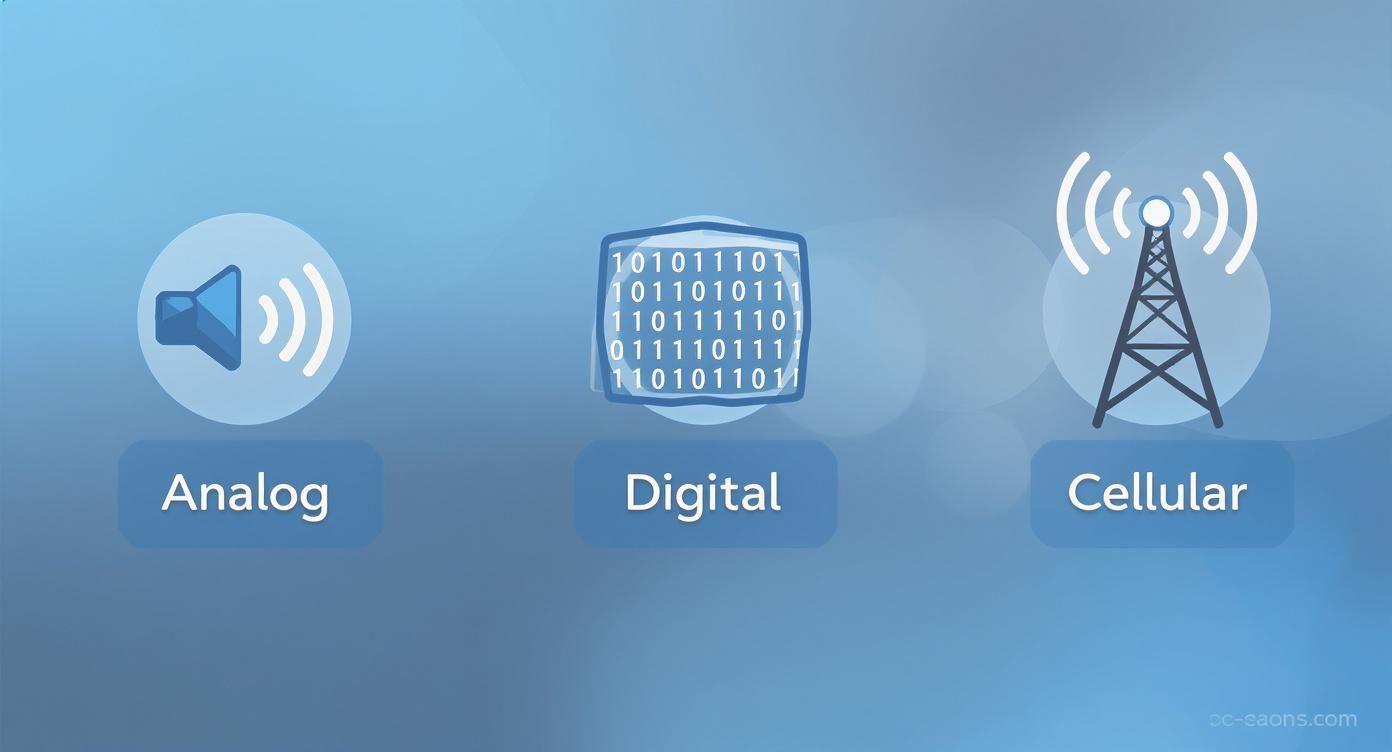
You can clearly see the evolution here, from simple analog waves to complex data packets. It really highlights how modern cellular systems offer the most versatility.
The Network That Carries the Message
Your network infrastructure is the backbone of your entire operation. For a construction crew working in a remote valley with spotty cell service, a strategically placed radio repeater is an absolute necessity. Think of it as a signal booster perched on top of a hill; it catches weak signals from the valley floor and blasts them back out with more power, extending coverage for miles.
But let's be honest, building and maintaining that kind of private infrastructure is incredibly expensive. That’s why modern systems are increasingly relying on existing cellular networks and cloud-based servers.
Actionable Money-Saving Insight: By shifting to a cloud-based infrastructure, you eliminate the need for costly on-site servers, dedicated IT staff for maintenance, and expensive service contracts. This move can reduce your total cost of ownership by 30-50% over the lifespan of the system.
Your Command Center: The Dispatch Console
Finally, the dispatch console is what brings it all together. Traditionally, this was a massive, expensive piece of hardware sitting in a dedicated room. These days, powerful, software-based dispatch solutions can run on any standard computer.
Platforms like Resgrid offer a cloud-based dispatch solution that rolls messaging, personnel tracking, and unit management into a single interface. This doesn't just save money by getting rid of proprietary hardware; it also streamlines the dispatcher's workflow, cutting down on the potential for human error and improving overall operational efficiency. For example, a dispatcher can see all units on a map and instantly create a talk group with the three closest units to an incident, instead of having to call each one individually.
How Teams Use These Systems in the Real World
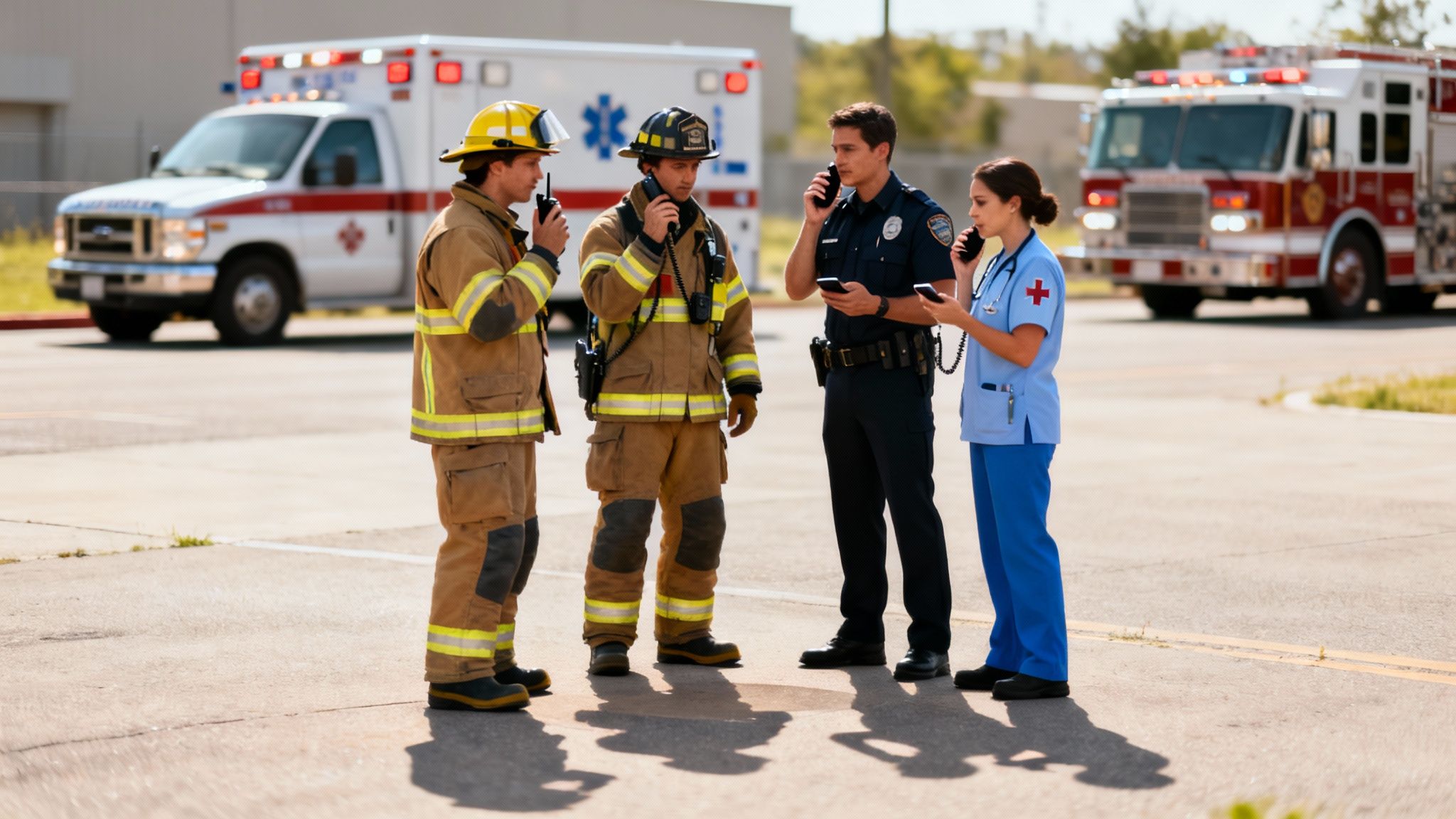
It’s one thing to understand the tech and components behind a 2 way communication system, but it's another to see it in action. These systems are the invisible threads that weave teams together during high-stakes, chaotic events, transforming what could be a mess of confusion into coordinated, decisive action.
From emergency scenes to massive public gatherings, instant communication for every team member isn't a luxury—it's the very foundation of a successful operation. Let’s jump into a couple of real-world scenarios to see how this technology saves time, resources, and, most importantly, lives.
Multi-Agency Emergency Response
Picture this: a large fire erupts in a downtown commercial building. Within minutes, units from the local fire department, police, and emergency medical services (EMS) are all rushing to the scene. Without a way to talk to each other, this situation becomes a logistical nightmare, fast.
This is exactly where an interoperable communication system proves its worth. By using dedicated, multi-agency channels, the incident commander can direct all the moving parts from a single point of command.
- Firefighters inside the building can report changing fire conditions and call for specific equipment.
- Police officers securing the perimeter can communicate traffic control updates and manage public safety.
- Paramedics can relay the number of patients and the severity of their injuries, giving the nearest hospital a critical heads-up.
A central dispatch console, powered up with GPS tracking, lets the dispatcher see every unit's location in real-time. If another vehicle is needed, they can send the absolute closest one, shaving precious seconds off the response time. And in moments where radio silence is key, dispatch can push text alerts with critical updates, ensuring the message gets through without adding to the noise on scene. This level of coordination cuts down on costly mistakes and dramatically improves outcomes.
Actionable Insight: The core financial benefit of a well-coordinated response is risk mitigation. Every minute saved reduces property damage, minimizes operational liability, and prevents costly errors. Over time, these efficiencies save organizations a fortune.
Managing a Large Music Festival
Now, let's switch gears to a different kind of controlled chaos: a weekend-long music festival with 50,000 people packed in. The security, medical, and operations teams are spread thin across hundreds of acres, dealing with everything from crowd control to heat exhaustion.
Here, a Push-to-Talk over Cellular (PoC) system is a game-changer. Using smartphone apps, staff can talk instantly across the entire venue, blowing past the range limitations of traditional radios.
The event command center becomes the nerve center. If a medical tent reports they're low on supplies, a quick message on the logistics channel gets a restock rolling immediately. When a security guard spots a problem in the crowd, they can instantly alert their whole team and drop a pin on a shared map, allowing for a swift, low-key response.
Platforms like Resgrid take this even further, adding advanced personnel tracking and automated dispatching. For instance, if a medical call comes in, the system can automatically ping and dispatch the nearest available medic, all without a dispatcher having to manually scan schedules or locations. You can check out how these platforms work by exploring Resgrid’s apps and seeing the features for yourself. To get a broader sense of how teams are using these systems, take a look at these powerful remote team communication tools.
Whether it's a five-alarm fire or a sold-out festival, the principle is the same. A reliable 2 way communication system turns a collection of individuals into a single, cohesive team. This synchronized effort doesn't just boost efficiency and safety; it also delivers real savings by making sure resources are put exactly where and when they are needed most.
Putting Your New Communication System into Action
Rolling out a new 2-way communication system is about a lot more than just buying some new hardware. You're building the communications backbone for your entire operation, and for that to be successful, you need a clear, practical roadmap. A solid, step-by-step plan is what ensures you pick the right gear, don't blow the budget, and get your team on board from day one.
If you plan it right, you'll dodge costly mistakes and set your team up for a huge leap in efficiency and safety. Let's walk through the essential checklist to make this deployment smooth and successful.
Start with a Thorough Needs Assessment
Before you even think about looking at a single piece of equipment, you have to nail down what your team actually needs. This initial planning phase is the single most critical part of the whole process. It's what keeps costs in check and guarantees the system you end up with actually solves your problems. Don't skip this—a proper assessment keeps you from overspending on features you'll never touch.
Start by asking the big questions to build out your requirements:
- How many users need to be on the system? Get an exact count of everyone who needs to communicate, from crews in the field to the people at the dispatch console.
- What's your actual coverage area? Are you operating inside a single building, across a sprawling campus, or over an entire state? This one question will be a huge factor in deciding between technologies like radio repeaters and cellular networks.
- What are the absolute must-have features? Do you need GPS tracking for units? What about text messaging or dedicated emergency alert buttons? Make a list of your non-negotiables.
Actionable Money-Saving Insight: A classic mistake is buying a system with way too much capacity. By taking the time to accurately count your users and map your real-world coverage area, you can avoid paying for infrastructure or user licenses that just sit there collecting dust. For example, if only 50 of your 100 employees need to be on the system daily, only license 50 users.
Technology Selection and Integration Planning
Once you have your needs clearly defined, you can start digging into the technology that fits. This is also the perfect time to figure out how this new system is going to play with the other software your team already uses every day. Real efficiency happens when you create a single, seamless operational picture for your dispatchers.
A perfect example is integrating your communication system with a Computer-Aided Dispatch (CAD) platform. Instead of a dispatcher staring at one screen for incident data and then turning to a separate radio console to talk to units, integration merges the two. This creates a "single pane of glass" where they can see an incident on a map and talk to the closest unit with a single click.
Actionable Money-Saving Insight: Integrating your dispatch and communication systems can reduce dispatcher error rates by as much as 25%. When all the information is in one spot, the chance of miscommunication or sending the wrong unit drops like a rock, saving precious time and resources on every call.
This kind of integrated approach doesn't just streamline workflows; it makes sure information flows effortlessly from the command center to the field and back again.
Phased Deployment and Smart Budgeting
Bringing a new 2-way communication system online doesn't have to be a massive, one-time cash burn. A phased deployment is a smart, budget-friendly strategy that lets you manage costs while causing minimal disruption to your daily operations. This approach works especially well for larger teams or organizations moving off an older, legacy system.
Here’s how you can save some serious money during the rollout:
- Start with a Pilot Group: Before you go all-in, deploy the new system to a single, smaller team. This lets you find and fix any kinks on a small scale, long before you launch it to everyone.
- Leverage Existing Infrastructure: If you end up going with a Push-to-Talk over Cellular (PoC) solution, you can use your existing Wi-Fi networks and even company-issued smartphones. That move alone can drastically slash your initial hardware and infrastructure spend.
- Prioritize Scalable Solutions: Pick a system that can grow with you. A cloud-based platform, for instance, lets you add new users with a simple subscription change, saving you from a costly "rip and replace" overhaul down the road when your team expands.
Finally, user training is completely non-negotiable. The most advanced system in the world is useless if your people don't know how to use it right. Run hands-on training sessions that walk through real-world scenarios to make sure everyone is confident and competent with their new tools.
Ensuring System Reliability and Security
A 2 way communication system is only as good as its uptime. If it doesn't work when you need it or if sensitive chatter gets out, it's failed its core mission. In high-stakes fields like public safety or corporate security, reliability isn’t just a nice-to-have—it’s the entire reason the system exists. Keeping those lines of communication open and secure isn't about scrambling to fix things; it's about building proactive habits.
It starts with the simple things, like routine battery maintenance for all your handheld devices. A quick weekly check can stop a radio from dying in the middle of an incident. That small bit of effort can prevent a massive communication breakdown.
Building a Resilient Communication Network
Real reliability means you've already planned for failure. What’s your game plan if the primary system goes down? This is where redundancy moves from a concept to a critical necessity.
A smart, cost-effective move is to use a Push-to-Talk over Cellular (PoC) system as a backup to your traditional radio network. If a repeater fails or you hit a dead spot, your team can just flip over to their smartphones and stay in the loop. This keeps the operation moving without you having to shell out for duplicate radio hardware.
Actionable Money-Saving Insight: The biggest money-saving tip I can give you is this: preventative maintenance. A small, consistent investment in checking gear like batteries, antennas, and connections can add years to the life of your expensive hardware. It saves you from catastrophic system failures and the ridiculously high cost of emergency replacements.
Locking Down Your Transmissions
We live in an age where information is currency, and leaving your communications unencrypted is like leaving the vault door wide open. Anyone with a cheap radio scanner can tune into analog signals, exposing tactical plans, private customer data, or sensitive security details.
This is exactly why digital encryption is no longer optional.
- AES-256 Encryption: This is the gold standard for a reason. It scrambles your signal so thoroughly that it becomes virtually impossible for outsiders to eavesdrop.
- Preventing Interference: Encryption also acts as a shield against bad actors trying to jam your channels or, even worse, impersonate one of your team members.
- Protecting Privacy: For any industry handling sensitive information—think healthcare or private security—encrypted communication is often a baseline compliance requirement.
Putting strong security in place isn't just about the tech; it's about protecting your people and your mission. If you want a deeper look at how a modern platform approaches this, check out the Resgrid security model—it outlines some really robust practices for keeping information safe.
A Quick Troubleshooting Guide
Even the best-laid plans can hit a snag. When things go wrong, here are a few common problems and their fixes:
- Coverage Dead Spots: If you're consistently losing signal in certain areas, map them out. For radio systems, you might need to look at installing a repeater. For PoC systems, a cellular booster or even just a solid Wi-Fi access point can often fill the gap.
- Poor Audio Quality: Before you do anything else, check the antenna on the device. Is it screwed on tight? If the issue is more about background noise, this is where digital radios really shine. Their built-in noise-cancellation is a much better long-term fix.
A Few Common Questions
Diving into two-way communication systems can bring up a lot of questions, especially around the budget and the rules. Getting straight, practical answers is the key to picking a solution that actually helps your team, instead of creating logistical headaches or surprise costs down the road. Let's tackle some of the most common things we hear.
What’s a 2-Way Communication System Going to Cost Me?
Honestly, the costs can be all over the map depending on the tech you choose. A classic digital radio system, for instance, can be a serious capital expense. You're often looking at tens of thousands of dollars just for the hardware, repeaters, and licensing fees.
A much more wallet-friendly path is a Push-to-Talk over Cellular (PoC) system. Since it just runs on the devices your team already has, the upfront cost is next to nothing. You can get a team up and running for as little as $10-$30 per user, per month. That makes it an incredibly scalable and affordable option for most organizations.
Do I Need a License to Run a 2-Way Radio System?
It really depends on the system. For most of the business and public safety radios out there that use dedicated frequencies, you'll almost always need to get and maintain an FCC license. That's another layer of cost and paperwork to deal with.
Actionable Money-Saving Insight: Push-to-Talk over Cellular (PoC) systems are the big exception here, and they represent a huge opportunity to save. Because they operate on existing networks like AT&T or Verizon, they do not require a separate FCC license. That saves you both money and a whole lot of hassle.
Can I Just Use My Smartphone as a 2-Way Communication Device?
Absolutely. That's the whole idea behind modern Push-to-Talk over Cellular (PoC) apps. They're built to turn any regular smartphone into a powerful walkie-talkie with a global reach, as long as you have a cell or Wi-Fi signal.
This is a major cost-saving strategy for countless organizations. By using the devices your team already owns, you completely sidestep the expense of buying, managing, and maintaining a separate fleet of dedicated radio hardware.
Ready to see how a modern, flexible communication platform can transform your operations without breaking the bank? Resgrid provides a complete dispatch, tracking, and communication solution that runs on the devices your team already uses. Start your free trial today and discover a smarter way to stay connected.