
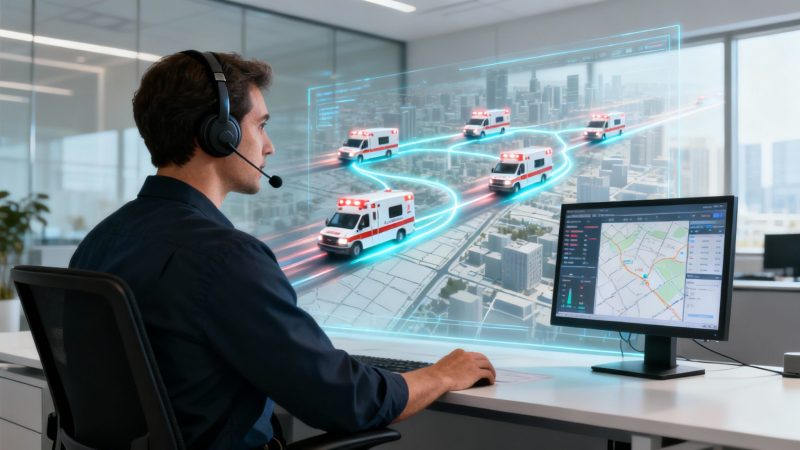
A Guide to Ambulance Dispatching Software
At its core, ambulance dispatching software is the digital command center for emergency medical services. It’s what turns a chaotic 911 call into a calm, coordinated, and life-saving response. Instead of guesswork, the software uses technology to automate unit selection, optimize routes, and keep everyone in sync, making sure the right help gets to the scene as fast as humanly possible.
The Digital Backbone of Emergency Response
Think about how dispatch used to work—and in some places, still does. It was like trying to navigate a sprawling city at night with nothing but a wrinkled paper map. A dispatcher would take a call, rifle through a logbook of available units, and rely on crackly radio chatter and memory to send the "closest" ambulance. It worked, but it was slow and prone to human error—tiny delays that add up when seconds are the difference between life and death.
Ambulance dispatching software completely flips that script. It’s like giving that same dispatcher a high-tech air traffic control system for their ground units. When a call hits the system, it instantly analyzes the incident's location, type, and severity against a real-time map of all available resources.
Practical Example: Imagine a multi-car pileup on a busy highway. A manual dispatcher might spend five minutes on the radio just confirming which units are available and closest. The software does this in less than a second, identifying the three nearest ambulances, a heavy rescue truck, and a supervisor, then recommending them all for dispatch with a single click.
Actionable Insight: Use the software’s data logging to run a “response time analysis” for different neighborhoods. If you find a new subdivision consistently has longer response times, you have concrete data to justify a budget request for staging an ambulance in that area during peak hours, which can save fuel and improve outcomes.
This shift from manual to automated isn’t just a nice-to-have; it’s become a necessity. The numbers tell the story: the global market for this software hit around USD 1.2 billion in 2023 and is on track to nearly double to USD 2.5 billion by 2032. You can dig into the full market research to see the industry-wide trend for yourself. It’s clear that modern EMS agencies are betting on this technology to save lives and manage their resources without breaking the bank.
From Manual Chaos to Automated Clarity
The real job of this software is to cut through the fog of an emergency. It replaces ambiguity with certainty by creating a single, live view of the entire operation. This empowers dispatchers to make smarter, faster decisions when the pressure is on. The difference between the old way and the new way is night and day.
To really see the impact, let's compare the old, manual methods with what modern software brings to the table. The shift doesn't just improve response times; it has a direct effect on the agency's bottom line.
| Challenge | Manual Dispatch Method | Software-Based Solution | Direct Cost Savings |
|---|---|---|---|
| Unit Selection | Relies on dispatcher memory and radio check-ins. | Automatically identifies the closest, most appropriate unit. | Reduces fuel consumption by eliminating unnecessary mileage. |
| Route Planning | Crews use standard maps, unaware of traffic jams. | Provides real-time GPS routing that avoids delays. | Lowers vehicle wear-and-tear and minimizes fuel waste. |
| Status Updates | Requires constant radio calls to track unit status. | Units update their status (e.g., en route, on scene) with one click. | Frees up radio channels for critical communications. |
| Resource Allocation | Guesswork on which type of unit to send (BLS vs. ALS). | Recommends the correct unit based on call protocols. | Avoids sending over-qualified, more expensive units to minor calls. |
The move to a software-based system takes the guesswork out of the equation, replacing it with data-driven decisions that save precious time and money.
The most significant advantage is turning raw data into actionable intelligence. By optimizing routes and improving unit allocation, an agency can see immediate and substantial cost savings on two of its biggest expenses—fuel and vehicle maintenance.
Ultimately, this software isn't just another tool. It's a fundamental upgrade to an agency's entire operational model, making it an indispensable investment for any modern emergency medical service.
Core Features That Drive Operational Efficiency
Let's get one thing straight: modern ambulance dispatching software is so much more than a fancy digital map. It's a powerhouse of interconnected tools built to turn the chaos of a high-stress emergency into a controlled, efficient response. Each feature chips away at guesswork, slashes delays, and feeds your team the intel they need to make life-saving calls in seconds.
At the very center of it all is Computer-Aided Dispatch (CAD). Think of it as the brain of the operation, processing every scrap of incoming data. This isn't just a nice-to-have; it's the core engine. The global market for CAD tech hit USD 2.26 billion in 2024, and the software itself carved out a massive 63.5% of that pie. That shows you just how fundamental this technology has become.
But what does all this tech actually do? Let's break down the essential pieces and see how they work in the real world. This map gives you a high-level look at the flow, from the initial call to a coordinated and swift response.
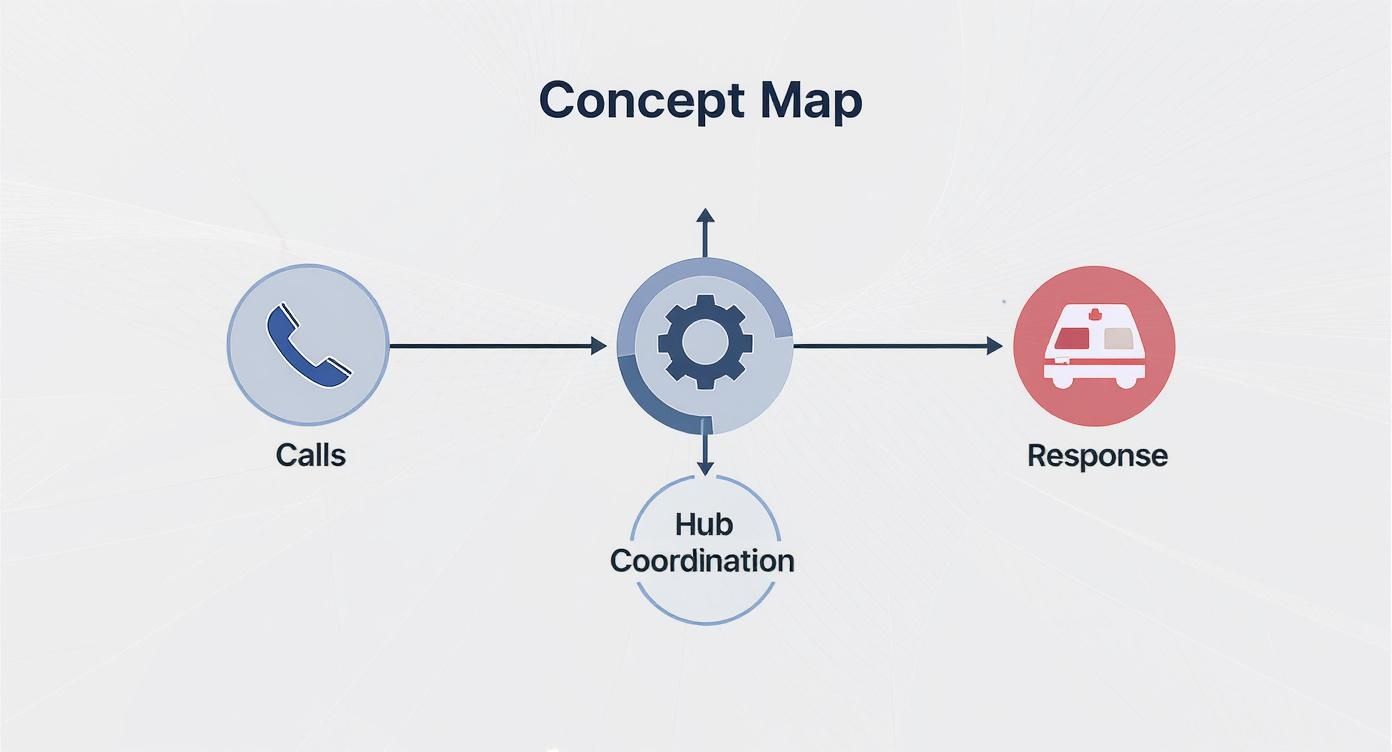
As you can see, the software acts as the central hub, keeping every moving part of the response locked in and synchronized.
Computer-Aided Dispatch and Real-Time Tracking
Every incident kicks off in the CAD system. A call comes in, and the software instantly logs the location, incident type, and other critical details. It then immediately checks this against the live status and location of every single unit in your fleet.
This process gets a turbo-boost from real-time GPS tracking, which you'll often hear called Automatic Vehicle Location (AVL). Forget static radio check-ins. Dispatchers get a live, bird's-eye view of everything. It's this one-two punch of CAD logic and live location data that makes modern dispatching so incredibly effective.
- Practical Example: A call for a potential stroke comes from a downtown high-rise. The CAD flags the closest Advanced Life Support (ALS) unit just three miles away—but it's bogged down in traffic. At the same time, it sees another ALS unit four miles out with a clear run. The system recommends the second unit, shaving five critical minutes off the response time.
- Actionable Insight: Use your AVL data to review driving habits. If you notice certain crews are frequently idling for extended periods or taking inefficient routes, you can address it directly. Reducing idle time across your fleet by just 30 minutes per shift can save thousands of dollars in fuel costs annually.
The real power isn't just knowing where your units are. It's using that data to make the smartest possible decision, every single time. This turns a purely reactive process into a proactive, strategic operation.
Integrated Messaging and Secure Communications
During an emergency, communication has to be crystal clear and absolutely reliable. Modern dispatch software brings all your communication channels into one secure platform. This gets rid of the patchwork of different apps, text messages, and radio chatter that can easily breed confusion.
Dispatchers, crews in the field, and supervisors can all send secure messages, share files, and get critical updates right inside the same system that's tracking the incident. This creates a complete, time-stamped log of every communication tied to a specific call—an invaluable tool for after-action reviews and quality control.
- Practical Example: A paramedic on-scene needs a consult with a medical director about a tricky patient condition. Instead of tying up a radio channel, they can send a secure message with the patient's vitals right through the dispatch app and get a quick, documented response.
- Actionable Insight: By switching to an all-in-one platform with messaging built-in, you can ditch expensive third-party communication subscriptions. For an agency with 50 personnel, this could easily save $2,000-$3,000 per year while also improving security and creating a verifiable audit trail for every call.
Automated Scheduling and Personnel Management
Trying to manage schedules for a 24/7 operation is a massive administrative headache. The best dispatch software comes with powerful tools for scheduling and personnel management, automating what used to be a painfully manual job.
These features let you build schedules, handle time-off requests, track certifications, and make sure you're never caught short-staffed. When that last-minute sick call hits, the system can automatically find and notify qualified, available people to pick up the shift.
- Practical Example: An EMT calls out sick for their overnight shift. Instead of a supervisor burning an hour on the phone, they just send a blast notification through the software to all qualified part-timers. The first person to accept the shift is automatically slotted into the schedule. Done.
- Actionable Insight: Set up your scheduling module to automatically enforce rules that minimize overtime. For instance, program it to offer open shifts to part-time or per-diem staff first before offering them to full-time staff who would accrue overtime. This simple rule can slash one of your largest and most unpredictable labor expenses. A platform like Resgrid offers a whole suite of dispatch and management features that bundle these critical functions together.
The Financial and Operational Benefits for EMS Agencies
Sure, the technical features of ambulance dispatching software are impressive, but the real story is what it does for your bottom line. For any EMS agency, this kind of technology isn't just an operational tweak—it's a powerful financial lever that drives real cost savings while pushing patient care to a higher standard. Every second saved and every resource optimized translates directly into a healthier budget and a safer community.
The most obvious impact is on response times. Shaving even 30 seconds off a response can mean the difference between life and death, especially in cases like cardiac arrest or stroke. This doesn't just save lives; it also cuts down on the long-term healthcare costs that come with delayed treatment and lengthy recoveries.

Slashing Operational Expenses with Smart Allocation
One of the biggest money-savers is simply sending the right truck to the right call. It sounds basic, but it's a huge source of waste. Not every call needs a full-blown advanced life support (ALS) response, and modern software lets dispatchers see that instantly.
Practical Example: A call comes in for a minor fall at a local park. Without smart software, you might just send the closest unit—which happens to be your fully-staffed ALS ambulance with a highly-trained paramedic. But the software, using predefined call protocols, flags it as a non-critical event and suggests a nearby Basic Life Support (BLS) unit instead.
That one simple, automated decision saves you money on multiple fronts:
- Personnel Costs: Your higher-paid paramedic is now free for a genuine emergency.
- Supply Costs: You didn't burn through expensive ALS supplies that weren't even necessary.
- Fuel and Maintenance: You spared the wear and tear on your more expensive ALS vehicle.
By making sure the right tool goes to the right job, an agency stops wasting its most valuable assets. When you repeat that strategic decision hundreds of times a month, the savings really start to stack up over the year.
Improving Crew Retention and Accelerating Billing
The savings don't stop with trucks and supplies. Ambulance dispatching software also tackles two other major financial headaches: staff turnover and slow billing. Anyone who's ever built a schedule by hand knows it's a major source of stress for everyone involved.
Automated scheduling tools create fair, balanced rotas, manage time-off requests smoothly, and distribute shifts without the constant back-and-forth. That leads to happier crews, less burnout, and better retention—a huge financial win when you consider how much it costs to recruit and train new paramedics and EMTs.
Actionable Insight: Use the software’s integrated patient data to speed up your billing cycle. Because the call time, patient demographics, and incident details are captured electronically from the start, you can submit cleaner insurance claims faster. This can shorten your average accounts receivable from 60 days to under 30, dramatically improving your agency's cash flow.
On top of that, streamlined data capture speeds up the entire billing cycle. When dispatch records are automatically tied to electronic patient care reports (ePCRs), all the info needed for reimbursement is captured correctly from the get-go. This slashes billing errors, gets claims out the door faster, and improves cash flow. Plain and simple, you get paid faster for the work you do.
Case Study: A Clear Return on Investment
Let's look at a real-world example. A mid-sized municipal EMS agency was getting hammered by rising fuel prices and unpredictable overtime. After bringing in a modern ambulance dispatching software platform, they started using its GPS-based routing and automated scheduling.
The results after just one year were pretty remarkable:
- Fuel Costs: By always dispatching the closest unit and giving crews the most efficient routes, they cut their annual fuel consumption by 15%.
- Overtime Pay: The scheduling system helped them fill open shifts without scrambling, slashing overtime hours by 20%.
This just goes to show that this software is way more than a dispatch tool. It’s a full-blown management system that gives you the data and automation you need to run a tighter, more financially sound operation.
Integrating Dispatch Systems with Healthcare Technology
Modern EMS doesn’t operate on an island. It’s the critical first link in a long chain of patient care. An ambulance dispatching software platform that operates in a silo is like a relay racer who refuses to pass the baton—it just breaks the entire process. For that reason, seamless integration with other healthcare systems isn't a luxury anymore; it’s an absolute necessity.
Think of it as a flawless handoff. The moment a call is dispatched, the clock starts ticking. The information gathered by the dispatcher—patient details, symptoms, location—is the baton. This data has to be passed cleanly to the ambulance crew's Electronic Patient Care Reporting (ePCR) system and, just as importantly, to the receiving hospital's Emergency Department.
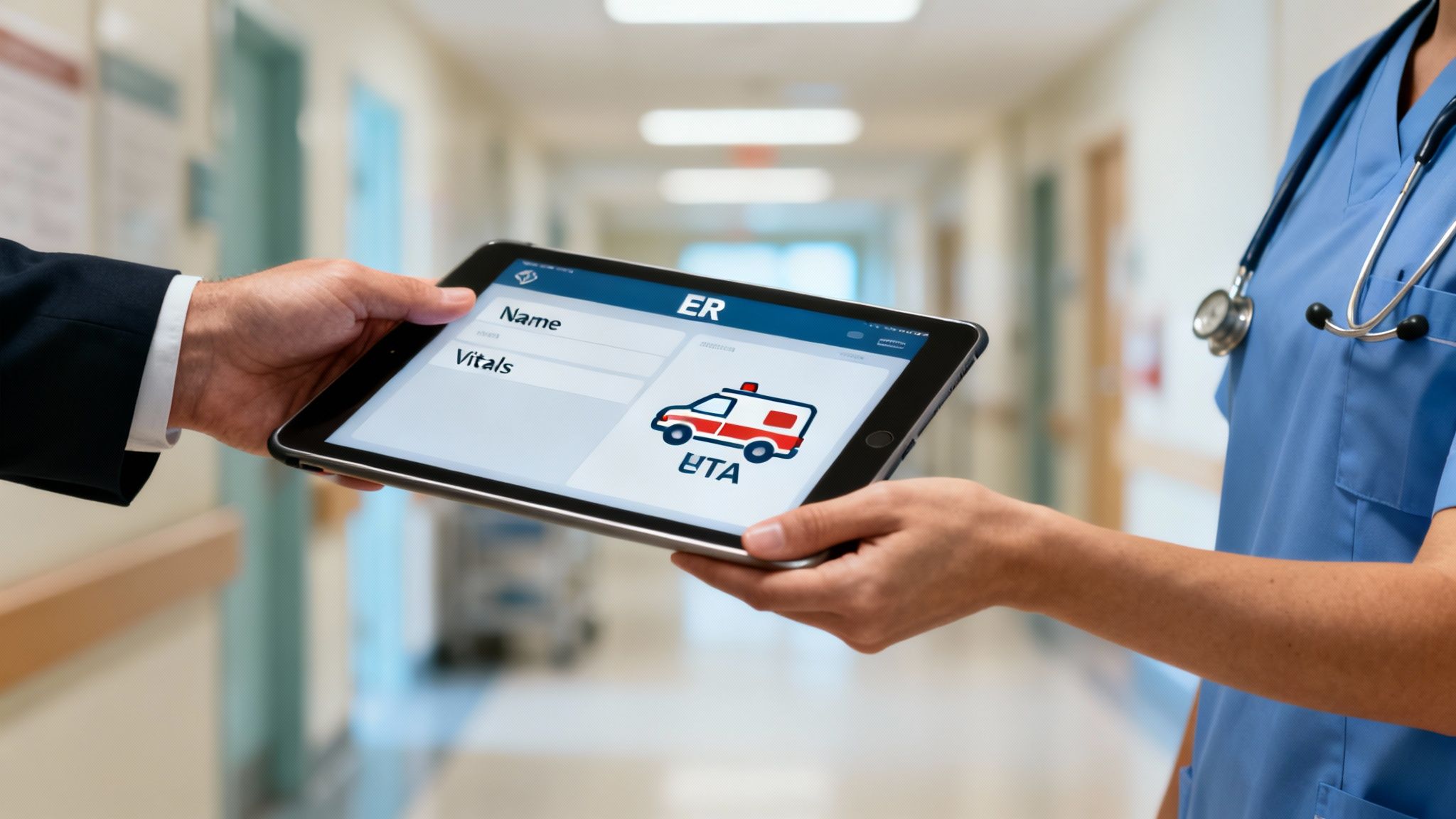
This seamless flow of information is what experts call interoperability. It’s the glue that ensures everyone involved in a patient's care is working from the same script, from the initial 911 call all the way to the hospital bed.
The Power of NEMSIS and Data Standards
For this data handoff to actually work, everyone needs to speak the same digital language. This is where industry standards like the National EMS Information System (NEMSIS) become so vital. A dispatch system that is NEMSIS-compliant guarantees that the data it generates can be easily understood and accepted by other healthcare platforms.
When you're looking at software, confirming its support for these standards is a non-negotiable. It's the only way to be sure your system won't become an isolated data island, unable to communicate with the hospitals and billing systems that depend on its information.
The real goal of integration is to create a single, unbroken thread of patient data. When your dispatch software, ePCR, and the hospital’s systems are all talking to each other, you eliminate errors, speed up care, and get better outcomes. Simple as that.
How Integration Directly Saves Money
The financial perks of a well-integrated system are immediate and surprisingly big. By creating a smooth, automated flow of information, you plug leaks in your budget that you might not even realize are there.
- Eliminating Redundant Data Entry: Without integration, paramedics and hospital staff waste countless hours manually re-entering patient info that was already captured by dispatch. This administrative drag is a direct hit to your labor budget.
- Preventing Costly Billing Errors: When dispatch data flows right into the ePCR and then to billing, the risk of typos and inaccuracies plummets. A single transposed digit in an insurance number can delay a claim for weeks, wrecking your cash flow.
- Optimizing Hospital Preparedness: Giving an ER a heads-up about an incoming patient lets them get ready. For a stroke patient, this means the neurology team can be waiting at the door. That kind of efficiency reduces patient length-of-stay, a key metric for hospitals and the entire healthcare system.
The broader ambulance services market, which is built on technologies like ambulance dispatching software, is exploding. Its global market size is projected to jump from an estimated USD 51.37 billion in 2025 to over USD 120.24 billion by 2034, all driven by innovations that demand this kind of deep integration. You can dig into the trends shaping the ambulance services market to see where the industry is heading.
A Practical Money-Saving Example
Let's get practical. Imagine a non-integrated system causes a billing claim to be rejected because of a data entry error made during the chaotic handoff at the hospital. An administrator might spend two hours digging through dispatch logs and patient reports to find the correct info and resubmit the claim. At an administrative wage of $25/hour, that single error just cost your agency $50.
Now, multiply that by hundreds of calls every month. An integrated system that stops these errors before they happen can easily save thousands of dollars a year in recovered admin time alone. That's a clear and measurable return on investment. On top of that, ensuring the secure transfer of this sensitive health information is paramount for staying HIPAA compliant and building trust with your community.
How to Choose the Right Ambulance Dispatch Software
Picking the right ambulance dispatch software is one of the biggest calls an agency can make. This isn’t just about buying a new piece of tech; it's about choosing the operational backbone that will dictate response times, crew morale, and your budget for years to come. A smart, methodical approach is the only way to make sure you invest in a system that actually solves your problems.
Actionable Insight: The single best money-saving move you can make is to run a detailed needs analysis before you even look at a single product demo. Too many agencies jump straight into vendor calls without a clear picture of their own pain points. That's a fast track to getting upsold on flashy features that sound amazing but don't address your real-world headaches, adding thousands to your annual subscription for tools you'll never use.
A practical first step? Form a selection committee. And this is critical: make sure it includes your frontline staff—the dispatchers and field crews who will live in this software every single day.
Practical Example: Ask your dispatchers simple, direct questions like, "What are the three biggest time-wasters in our current process?" If they say, "Constantly having to radio crews for their status," then "one-click mobile status updates" becomes a non-negotiable "must-have" feature. This simple exercise will keep you from overspending on the nice-to-haves.
Key Evaluation Criteria
Once you have a solid grasp of your needs, you can start looking at solutions. Your focus should be on criteria that determine a system's long-term value and effectiveness in a high-stakes world.
- Scalability: Can the system grow with you? A platform that works for five ambulances might completely buckle under the pressure of twenty. You need to ask vendors how their software handles surges in call volume and an expanding fleet.
- User-Friendliness: Is the interface clean and intuitive for a dispatcher under extreme pressure? During a major incident, a confusing or clunky system is a direct liability. The best platforms are built for speed and clarity, period.
- Customer Support: What happens when something breaks at 3 AM? Reliable, 24/7 support is absolutely non-negotiable. Look for vendors who offer direct access to knowledgeable support staff, not just a generic help desk that creates another ticket.
The goal is to find a system that not only has the right features but also aligns with your operational reality. A solution that’s too complex or expensive will create more problems than it solves. Insist on a live demo with your core dispatch team and let them run through real-world scenarios.
On-Premise vs Cloud-Based Solutions
Another critical decision is the fork in the road between a traditional on-premise system you host yourself and a modern, cloud-based Software as a Service (SaaS) model. Each one has massively different implications for your total cost of ownership.
Actionable Insight: For most agencies today, a SaaS model offers a lower overall cost and far greater flexibility. You completely avoid the massive upfront capital expense of server hardware (often $10,000+) and the ongoing salary for IT staff to maintain it. This is a direct path to savings, especially for smaller or budget-conscious organizations.
The best platforms, including powerful open-source options, often come with a whole suite of integrated tools. To see what a modern, unified system includes, you can explore the various dispatch and management apps available.
A Practical Checklist for Software Evaluation
To keep your evaluation process structured and honest, use a checklist to compare vendors fairly. This little bit of organization ensures you're asking the right questions and truly understand the cost implications behind each choice.
Here's a simple table to guide those conversations.
Software Evaluation Checklist
| Evaluation Criteria | Key Questions to Ask | Cost Implication |
|---|---|---|
| Needs Assessment | Does this feature solve a specific problem identified by our frontline staff? | Prevents overspending on unnecessary features. |
| Integration | Can it seamlessly connect with our existing ePCR and billing software? | Eliminates manual data entry, saving labor costs and reducing errors. |
| Deployment Model | Is this a cloud-based (SaaS) or on-premise system? | Cloud solutions typically have lower upfront costs and predictable monthly fees. |
| Security Protocols | Is the platform HIPAA compliant and what are its data security measures? | Avoids costly fines and protects agency liability. |
| Budget Impact | Does the vendor offer open-source options or scalable pricing for smaller agencies? | Provides a modernization path for organizations with tight budgets, avoiding high licensing fees. |
By following this kind of framework, you can cut through the sales pitches and make a decision based on data, not demos. The right ambulance dispatching software won't just improve your response capabilities—it will deliver a clear return on investment by optimizing your resources and cutting down on operational waste.
Your Top Questions About Ambulance Dispatch Software, Answered
Making the jump to new technology always stirs up some questions, and that's especially true for something as core to your operations as dispatch software. I get it. Leaders, dispatchers, and medics all want to know what the real-world impact will be before they sign on the dotted line. Let's tackle some of the most common questions I hear with straight, practical answers.
How Does This Software Actually Make Us Faster?
It’s not magic; it’s just a smarter way of working. Good dispatch software attacks delays from a couple of different angles at once.
First, the Computer-Aided Dispatch (CAD) side of things instantly digests the call location and incident type to pinpoint the best possible unit for the job. This completely cuts out the manual guesswork and radio chatter that used to burn through precious seconds. While that's happening, integrated GPS is feeding the crew the fastest route to the scene, actively dodging traffic jams, road closures, or any other real-time headaches. It's the combination of automated unit selection and smart routing that shaves critical minutes off your response times—and we all know what that means for patient outcomes.
- Practical Example: A call for anaphylaxis comes in from a suburb during rush hour. Your CAD sees two available ALS units. Unit A is a mile closer on the map, but the software sees they're on the wrong side of a massive traffic jam. It immediately recommends Unit B, which has a slightly longer route but zero traffic, getting them on scene four minutes faster.
- Actionable Insight: Let the software's analytics run for a few months and look for "slow zones"—areas where crews constantly hit delays. This gives you hard data to justify staging a unit in that area during peak hours. You'll cut response times and save a surprising amount of fuel by not having to make long, cross-town runs.
Can We Really Trust the Cloud with Patient Data?
Yes, and honestly, it's often more secure than what most agencies can manage on their own. Reputable cloud providers live and breathe HIPAA-compliant security. They’re using multiple layers of protection, from end-to-end data encryption to physically secured data centers with biometric access. They even pay third-party firms to constantly try and break in, just to find any potential weakness.
Think about it: this level of security is a full-time job for a team of specialists. Handing that responsibility over to a trusted provider is usually a safer and more cost-effective move than trying to maintain your own servers in a back closet.
Key Takeaway: Before you sign anything, ask the vendor for their SOC 2 compliance report. Also, ask them to walk you through their disaster recovery plan. This is your proof that patient data is protected by real-world, industry-leading security, which goes a long way in reducing your agency's own liability.
- Practical Example: An agency hosts its own server in the station. A summer thunderstorm knocks out power and causes a roof leak, frying the server and taking all their dispatch data with it. The cloud-based agency across town sails through the same storm with zero downtime because their data is safely mirrored in secure facilities hundreds of miles apart.
- Actionable Insight: Going with a cloud solution means you don't have to shell out thousands for server hardware, cooling, and maintenance. You also get to skip the IT payroll costs for someone to manage it all. This can save an agency a massive chunk of change upfront, turning a huge capital expense into a predictable monthly operating cost.
What's the Biggest Mistake Agencies Make During Implementation?
This one is easy: failing to bring your frontline people—the dispatchers and the crews in the field—into the decision-making process from day one. I've seen it happen too many times. Management gets wowed by a slick sales demo, buys a system based on a checklist, and then wonders why nobody wants to use it.
If the software is clunky, slow, or missing a feature that dispatchers rely on every single shift, they'll find a workaround. Usually, that means going back to the old, inefficient way of doing things. You have to form a selection committee with people from every role that will actually touch the software. Their buy-in isn't just nice to have; it's essential for getting your money's worth.
- Practical Example: A department's command staff buys a new dispatch system with amazing reporting features but a nightmarish user interface. Under pressure, dispatchers find it too slow and confusing, so they just go back to pen and paper for their unit tracking. The expensive new software becomes a six-figure paperweight.
- Actionable Insight: During the demo phase, put your most seasoned dispatcher in the driver's seat. Have them run through a complex, multi-unit MCI drill. If they can't navigate it quickly and intuitively, the software is a liability that will slow things down and kill efficiency. Avoiding this mistake saves you from a massive, wasted investment.
Can a Small Volunteer Squad Actually Afford This?
Absolutely. The landscape has changed a lot. You no longer need a massive upfront investment to get powerful tools. Modern, cloud-based solutions are often sold as a subscription, so you only pay for what you actually use. This model puts them well within reach for smaller agencies.
Even better, there are some fantastic open-source options out there. They give you the core dispatching, tracking, and messaging functions you need for free or at a very low cost. They might require a little more technical love to get going, but they make modern dispatch tech a reality for any organization, even all-volunteer corps running on a shoestring budget.
- Practical Example: A small, rural volunteer ambulance service adopts an open-source platform and only pays a small monthly fee for cloud hosting. Suddenly, they have real-time GPS tracking and instant messaging—capabilities they always assumed were thousands of dollars out of their reach.
- Actionable Insight: Start with a free or low-cost open-source solution to get your core operations modernized. This allows you to prove the concept and demonstrate the value to your board or municipality without a large financial commitment. Once you have data showing improved response times and efficiency, it’s much easier to get budget approval for a more advanced, paid platform later.
Ready to see how a modern, flexible dispatch solution can transform your operations? Resgrid provides a comprehensive platform designed for the real-world needs of first responders. Explore our features and get started today.