
A Guide to Your Ambulance Dispatch System
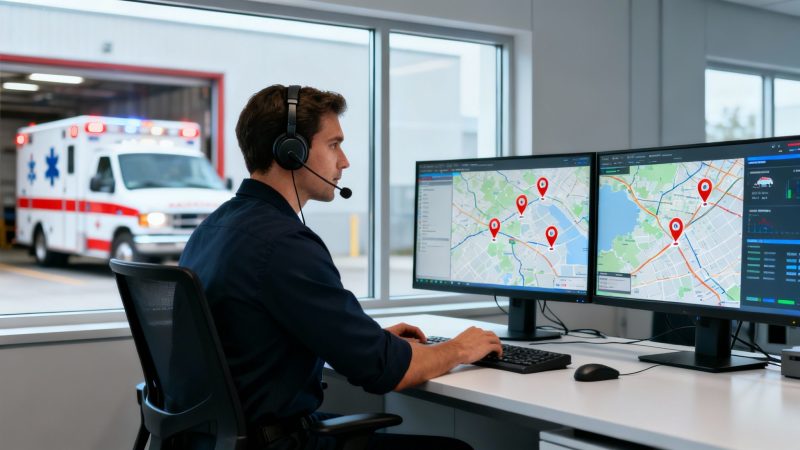
An ambulance dispatch system is the central nervous system for any emergency medical service. Its whole reason for being is to get the right people and equipment to the right place as fast as humanly possible, using a suite of advanced software and communication tools. This technology is the invisible hand guiding every phase of a response, from the second a 911 call hits the floor to the moment a patient is safely at the hospital.
Understanding Your Ambulance Dispatch System

It’s helpful to think of a dispatch system as an air traffic control tower for the streets. Just like a controller guides planes to keep them from colliding and ensures they land on time, a dispatch system manages the complex dance of ambulances, paramedics, and other first responders. It gives dispatchers a bird's-eye view, turning potential chaos into a finely tuned, life-saving operation.
Without this kind of technology, dispatchers are stuck in the dark ages, relying on fragmented radio chatter, messy logbooks, and a whole lot of guesswork. It’s slow, incredibly prone to human error, and just plain inefficient. A modern system throws those manual routines out the window, replacing them with smart automation that ensures every single decision is grounded in real-time data.
The Core Mission and Its Impact
When you boil it all down, the goal is simple: shave precious seconds and minutes off response times. Those seconds are everything; they directly correlate with better patient outcomes. When a call comes in for a cardiac arrest, the system doesn't just look for any ambulance. It instantly pinpoints the closest and most appropriate unit and maps out the fastest possible route, steering the crew around traffic jams and road closures.
This is where you see the real, practical benefits. By automating the monotonous tasks, a solid dispatch system frees up human dispatchers to focus on the things they're truly needed for: managing complex scenes, giving pre-arrival instructions over the phone, and making those critical judgment calls that no computer can.
A recent initiative at Sweden's SOS Alarm really drove this point home. By automating the dispatch for the most critical medical emergencies, a process that used to take a dispatcher 20-30 seconds of manual work now happens in less than two seconds.
This isn't just a win for efficiency. That massive leap in speed translates directly into saved lives and a less frantic, more controlled environment for the dispatchers themselves.
From Operational Headaches to Financial Health
Getting an advanced ambulance dispatch system in place doesn't just fix nagging operational problems; it delivers a real, tangible financial return. Forget about crews having to radio in their status or dispatchers manually trying to keep track of vehicle locations—the system handles all of that automatically. This new level of awareness lets you allocate your resources much more intelligently, which has a huge knock-on effect on your budget.
For instance, real-time vehicle tracking ensures you always send the nearest unit. That small change, repeated hundreds of times a day, adds up to a drastic reduction in fuel costs and vehicle wear and tear. The table below breaks down how specific functions tackle common issues and lead to clear cost savings.
Core Functions and Cost-Saving Benefits
Here’s a look at how key system features solve everyday operational challenges and directly benefit an organization's bottom line.
| Core Function | Problem Solved | How It Saves Money |
|---|---|---|
| Computer-Aided Dispatch (CAD) | Slow, manual call intake and resource assignment. | Reduces dispatcher workload, allowing for higher call volume without increasing staff. |
| Automated Vehicle Location (AVL) | Dispatching a distant unit instead of a closer one. | Decreases fuel usage and vehicle maintenance costs by ensuring the closest unit is always sent. |
| GIS and Digital Mapping | Routing ambulances into traffic jams or road closures. | Minimizes unnecessary mileage and fuel waste, while also improving response times. |
| Automated Reporting | Time-consuming manual data entry for compliance reports. | Slashes administrative hours, freeing up personnel for more critical, value-added tasks. |
Ultimately, a good system pays for itself by turning operational efficiency into direct financial savings, allowing you to reinvest resources where they matter most: on the front lines.
The Technology Driving Modern Dispatch
A modern ambulance dispatch system isn't just a radio and a map anymore. It’s a complex ecosystem where different technologies talk to each other, turning the chaos of an emergency into a coordinated, life-saving response. When you look under the hood, you see how a high-performance system doesn't just manage calls—it anticipates needs, optimizes resources, and genuinely drives better patient outcomes.
Each piece of this technological puzzle has a specific job, but the real magic happens when they seamlessly share information. That synergy is what elevates a simple dispatch into an intelligent, data-driven operation.
Computer-Aided Dispatch: The Digital Brain
At the heart of any modern dispatch center is the Computer-Aided Dispatch (CAD) system. You can think of it as the digital brain of the entire operation. When a 911 call comes in, the CAD is where the dispatcher creates the incident, logs critical details like the patient's condition and location, and starts assigning resources.
But a modern CAD does a lot more than just take notes. It acts as a central hub, constantly crunching data from other components to give dispatchers smart recommendations. This is a huge deal for reducing cognitive load during incredibly high-stress situations.
GIS Mapping: The Strategic View
Geographic Information Systems (GIS) provide the visual context for every single call. Forget the static map on the wall; GIS offers a dynamic, data-rich view of the service area. This isn't just about seeing streets; it's about seeing crucial details that can make or break a response time.
- Practical Example: A call comes in for an accident on a major highway. The GIS map instantly flags a section of that road as closed for construction a mile ahead.
- Actionable Insight: The system automatically plots a new route that bypasses the closure, sending the ambulance down a side street. This small, automated decision saves precious minutes, cuts down on fuel by avoiding a dead-end, and prevents the crew from getting stuck.
By layering data like traffic flow, road closures, and even one-way streets, GIS makes sure that every route is the most efficient one possible at that very moment.
Automatic Vehicle Location: Real-Time Awareness
Automatic Vehicle Location (AVL), powered by GPS, answers the single most critical question in dispatch: "Where are my units right now?" This tech provides real-time location data for every ambulance in the fleet, showing their position directly on the GIS map inside the CAD system.
This constant stream of location data is the fuel for intelligent dispatching. It gets rid of all the guesswork and the manual radio check-ins that bogged down older systems.
A truly integrated ambulance dispatch system uses AVL data to automate unit selection. When a new incident pops up, the CAD instantly analyzes the AVL feeds and recommends the closest, most appropriate unit—often without any human intervention. This synergy minimizes the risk of human error and can slash unit assignment time from 30 seconds to less than two.
This automation directly leads to lower training costs, since new dispatchers can get up to speed faster. It also helps with staff retention by cutting down on the stress of manually tracking every single unit. Taking a look at the full range of Resgrid's capabilities shows how these features come together to build a smarter, more responsive system.
Mobile Data Terminals: The In-Cab Connection
Mobile Data Terminals (MDTs) or mobile apps on tablets are the in-cab link between the dispatch center and the crews on the street. These devices put the power of the CAD right in the ambulance, giving paramedics vital information at a glance.
Crews can get call details, see navigation maps, update their status (like en route, on scene, or transporting), and communicate securely with dispatch without clogging up the radio channels. This two-way data flow keeps everyone perfectly in sync. The growth of these technologies is a key reason the global ambulance services market is expected to grow by USD 13.75 billion between 2018 and 2028. This shift toward digital tools that improve communication and resource management is a major trend in the industry.
The Dispatch Workflow in Action
To really get a feel for how these systems work, it helps to walk through a single emergency call. Let's follow the entire journey, from the first report to the moment a patient gets to the hospital, and see how the tech supports the human element at every critical point.
Picture this: a call comes in about a person who collapsed at a busy downtown intersection, right in the middle of rush hour. The clock is already ticking. The dispatcher keys the address and initial details into the CAD system. Instantly, the GIS component locks in the location, flagging it on a live map and pointing out potential headaches—like a parade route causing street closures nearby.
Automated Unit Selection and Dispatch
The system doesn't just sit there waiting for the dispatcher to scroll through a list of available ambulances. It's already querying the AVL data, pinpointing the closest and best-equipped unit for the job—in this case, an Advanced Life Support (ALS) rig. The CAD serves this unit up as the top recommendation, complete with the fastest route that cleverly bypasses the parade traffic.
With one click, the dispatcher sends the alert. That whole process—from answering the call to sending the perfect unit with the best route—takes just seconds. You simply can't match that speed or accuracy doing things the old way.
This diagram shows how information flows from one component to the next, starting with GIS location data feeding the CAD, which then uses AVL to pick a unit and pushes all the details to the crew's MDT.
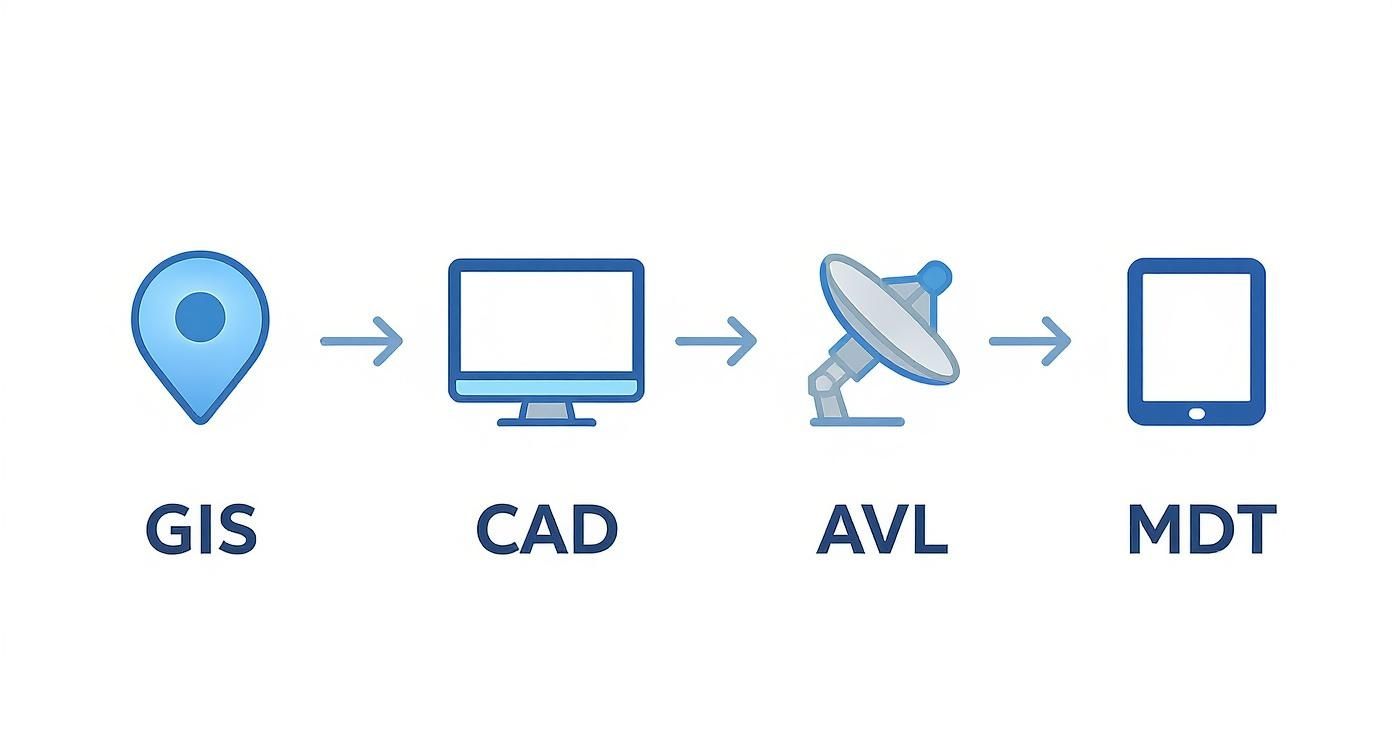
It’s a great visual of how each piece of tech builds on the last, creating a seamless, data-driven response from start to finish.
Real-Time Updates and On-Scene Data
While they're heading to the scene, the paramedic crew gets all the incident details on their Mobile Data Terminal (MDT). They can see the patient's reported condition, watch the map update in real-time, and talk back to dispatch without tying up the radio by just tapping to update their status from "en route" to "on scene." This keeps the airwaves clear for truly urgent communications.
Once they arrive, the real work starts. The crew uses their MDT to log patient vitals, record treatments, and document everything they're seeing. This data is fed directly back into the CAD as part of the official incident record, making sure the timeline is accurate and complete for any reporting or review down the road.
A seamless workflow eliminates vehicle and crew idle time. By optimizing every step from dispatch to patient hand-off, an agency can dramatically increase its unit availability, allowing it to handle a higher call volume with the same number of resources—a direct cost-saving benefit.
Seamless Patient Hand-Off to the Hospital
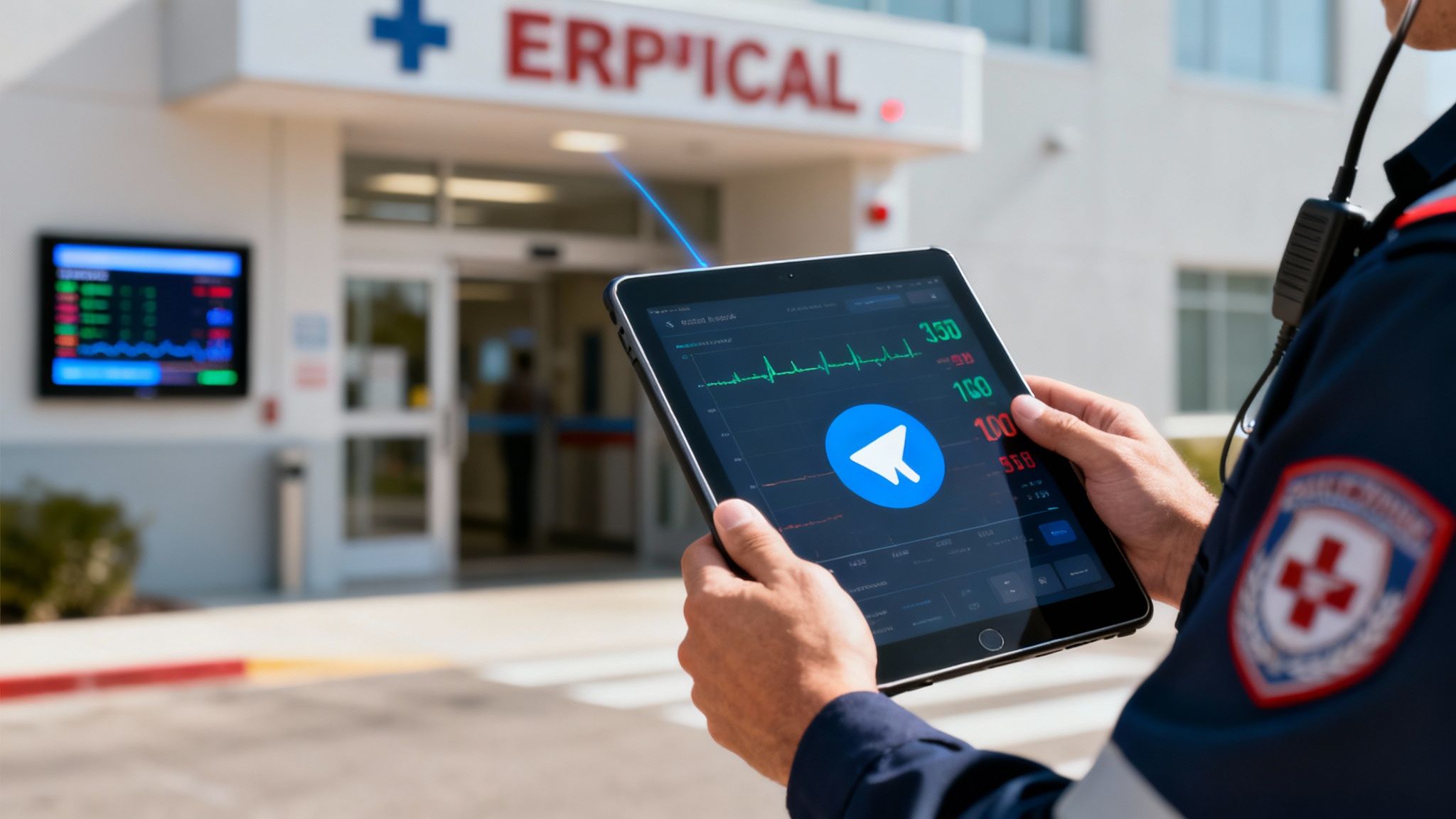
This is where the system really shows its value. As the ambulance is transporting the patient, the paramedic uses the MDT to send a pre-arrival alert straight to the destination hospital's emergency department. We're not just talking about a quick radio call; this is a digital transfer of the patient's vitals, EKG readings, and a suspected diagnosis. You can check out the kinds of dispatch mobile apps that make this field-to-hospital communication happen.
This heads-up gives the ER staff time to get specialized equipment ready and assemble the right medical team before the ambulance even pulls up. For time-sensitive emergencies like a stroke or heart attack, that extra prep time can make all the difference in a patient's outcome.
If you want to dig deeper into how modern tech makes this all possible, it’s worth looking into the general principles of process automation, which really get to the heart of why these interconnected digital workflows are so powerful. The entire story—from the initial 911 call to the ER team standing ready—shows that an ambulance dispatch system isn't just one tool. It's a complete ecosystem built to save time, money, and most importantly, lives.
Integrating Your Dispatch System for Peak Performance
A standalone ambulance dispatch system gets the job done, but its real power emerges when it’s connected to the other software you rely on every day. Think of it like a musician in an orchestra. A solo performance can be impressive, but the real magic happens when every instrument plays together in harmony. Integration turns your dispatch platform from a siloed tool into a true information hub.
When your systems can talk to each other automatically, the digital walls between departments and partner agencies come tumbling down. Information flows to where it needs to be, right when it's needed most. This drives quicker decisions on the ground, measurably improves patient care, and creates some serious operational efficiencies. The goal is to build an ecosystem where data works for you, not the other way around.
Connecting to Electronic Health Records
One of the most powerful connections you can make is with the Electronic Health Record (EHR) platforms used by hospitals. This bridge between pre-hospital care and the emergency department is a game-changer, creating a smooth, continuous flow of patient information.
Picture this: a paramedic crew is treating a patient for a suspected stroke. From their tablet in the ambulance, they can send initial EKG readings, vitals, and notes directly to the destination hospital's EHR system while they're still rolling. This isn't just a heads-up; it's the very beginning of the patient's official hospital record.
Getting that data in advance gives the ER team a massive head start. Doctors can review the incoming information, assemble a specialized stroke team, and have the right equipment ready to go before the ambulance even pulls into the bay. In emergencies where every minute counts, this can make all the difference in a patient's outcome.
Sharing Data with Mutual Aid Partners
Major incidents don't care about town lines or county borders. A serious event often demands a coordinated response from multiple agencies, and that's where integrating with mutual aid Computer-Aided Dispatch (CAD) systems is absolutely essential. Without it, you’re stuck trying to coordinate on crowded radio channels or phone lines—a slow, clunky process ripe for mistakes.
But when CAD systems are linked, a dispatcher can see the real-time status and location of a neighboring agency’s units right on their own map. If a multi-car pileup happens near the county line and all your units are tied up, that dispatcher can request the closest available ambulance from the next county over with a single click.
The Money-Saving Insight: Smart integrations automate data flow, which kills redundant manual data entry. This simple change slashes administrative errors and dramatically cuts the labor costs tied to managing disconnected systems, freeing up your people for more important work.
This seamless resource sharing guarantees the fastest possible response, no matter whose "jurisdiction" the call falls in. It also provides a unified view of the entire operation during large-scale events, improving both responder safety and command-and-control.
Multi-Channel Communication Tools
Solid communication isn't just about CAD-to-CAD. A modern ambulance dispatch system has to plug into a whole suite of communication tools to make sure messages always get through. This means connecting to traditional radio systems, pagers, SMS text messaging, and push notifications via mobile apps.
For example, when a call goes out, the system can simultaneously broadcast it over the primary radio channel, push a notification with full incident details to the crew's mobile app, and fire off an SMS text as a bulletproof backup. This layered approach ensures critical information is received, even if a unit is in an area with spotty radio coverage. It cuts the risk of missed calls and boosts response reliability without adding a single extra task for your dispatchers.
Comparing Integration Approaches
When it comes to connecting your dispatch system with other platforms, you generally have two paths: building a custom solution from the ground up or using a pre-built, off-the-shelf connector. Each has its place, and the right choice depends on your specific needs, budget, and technical resources.
| Factor | Custom API Integration | Off-the-Shelf Connector |
|---|---|---|
| Flexibility | Highly customizable to exact workflows and unique data needs. | Limited to the features and workflows defined by the developer. |
| Cost | Higher upfront development and ongoing maintenance costs. | Lower initial cost, typically a subscription or one-time fee. |
| Implementation Speed | Slower; requires significant development, testing, and deployment time. | Faster to deploy; often just requires configuration. |
| Technical Expertise | Requires specialized developers with API and software engineering skills. | Can often be implemented by IT staff with minimal coding knowledge. |
| Support | Support and maintenance are your team's responsibility. | Supported by the vendor, including updates and bug fixes. |
Choosing a custom API integration gives you ultimate control and a perfect fit for your processes, but it comes at a higher price in both time and money. Off-the-shelf connectors, on the other hand, offer a quicker, more affordable way to get your systems talking, though you may have to adapt your workflow to the connector's capabilities. Platforms like Resgrid often provide a mix, offering robust APIs for custom work while also building out a library of common connectors to give you the best of both worlds.
Calculating the Return on Your Investment
Justifying a big technology purchase like a new ambulance dispatch system takes more than a gut feeling. Decision-makers, especially those holding the purse strings, need to see a clear, data-driven business case. They want a tangible Return on Investment (ROI) that goes beyond just saying "we'll have better response times." The good news is, the financial benefits are usually hiding in plain sight, right there in your daily operations.
The key is to focus on measurable savings that directly hit your bottom line. These aren't abstract ideas; they're hard numbers you can track. By calculating these concrete savings, you can build a powerful argument for upgrading your tech and show its long-term financial value.
Pinpointing Tangible Cost Savings
The most direct way an ambulance dispatch system saves money is by getting your resources to the right place, more efficiently. This immediately cuts down on operational waste. Three key areas usually provide the clearest financial returns and are the easiest to actually measure.
Start with these core metrics:
- Reduced Fuel Consumption: With advanced GIS mapping and real-time AVL data, you're always sending the closest unit and routing them around traffic jams or road closures. This systematically shaves off unnecessary mileage across your entire fleet, day in and day out.
- Lower Maintenance Costs: Fewer miles on the road doesn't just save on gas; it means less wear and tear on your vehicles. That translates to fewer oil changes, less frequent tire replacements, and longer stretches between major mechanical repairs. You're extending the life of your most expensive assets.
- Minimized Staff Overtime: Efficiency is the enemy of overtime. A smart, automated system reduces the load on your dispatchers and streamlines the whole call-taking process. Your team can handle a higher call volume without needing to stay late, which directly cuts down on payroll.
A Practical ROI Calculation
Let's put this into perspective with a simple, real-world example. Imagine you're running a mid-sized EMS agency with a fleet of 15 ambulances.
Scenario: Your agency's fleet travels a combined 750,000 miles per year, with an annual fuel budget of $400,000. By implementing an ambulance dispatch system with optimized routing, you achieve a pretty conservative 5% reduction in total mileage.
Here’s how the savings break down:
- Annual Fuel Savings: 5% of $400,000 = $20,000
- Reduced Mileage: 5% of 750,000 miles = 37,500 fewer miles
- Maintenance Savings: Figuring an average of $0.50/mile in maintenance costs, this adds up to another $18,750 saved.
In this scenario, your total annual savings from just fuel and maintenance alone would be $38,750. That figure by itself can often justify the investment, especially when you look at flexible subscription models. You can explore different ambulance dispatch system pricing options to see just how quickly these savings can offset the cost.
Beyond the Hard Numbers
While the tangible savings build the core of your business case, don't forget about the qualitative benefits. These "soft" returns contribute a ton to your agency's long-term health and financial stability, even if they're a bit harder to stick a dollar amount on.
Pair your hard numbers with these powerful points:
- Improved Crew Morale and Retention: An efficient system reduces stress on both dispatchers and field crews. That leads to higher job satisfaction and lower staff turnover—a huge cost saver when you think about recruitment and training.
- Better Patient Outcomes: Faster, more accurate responses lead to better medical outcomes. This can, in turn, reduce agency liability and any associated legal costs.
- Enhanced Community Trust: A reliable and effective EMS system builds public confidence. That trust is invaluable when it comes time to secure future funding and community support.
The growing demand for emergency services makes this kind of efficiency more critical than ever. The global ambulance services market is projected to expand from USD 51.37 billion in 2025 to USD 120.24 billion by 2034, driven largely by technological advancements. You can learn more about how technology is shaping the ambulance services market on Precedence Research. This growth just underscores how important it is to invest in modern systems to keep pace.
Implementation and Management Best Practices
Getting a new ambulance dispatch system up and running is about more than just flipping a switch. It takes a smart plan and consistent attention to get it right. A solid implementation strategy makes the transition smoother for everyone, gets your team on board quickly, and starts showing a return on your investment from day one. Without it, even the best tech can fall flat.
The whole process has to start with strong leadership and open communication. You need buy-in from every single level—from the chiefs down to the dispatchers and field crews who will be using the system every day. This creates a real sense of shared ownership and helps get past that natural resistance to change that always comes with new technology.
Phased Rollouts and Comprehensive Training
Instead of a high-risk, big-bang launch, think about rolling it out in phases. Start with a small pilot group of your more tech-savvy users. Let them test the system in the real world, find the kinks, and become champions for the new platform. This approach keeps disruptions to a minimum and gives you a chance to fine-tune your process before going live everywhere.
Training is obviously another huge piece of the puzzle. But just relying on vendor-led sessions can get expensive fast and leave you dependent on them long-term.
Actionable Insight: Set up a 'train-the-trainer' program. Pick a few of your own people and empower them to become in-house experts. This builds a sustainable way to train your team, drastically cuts your long-term costs on vendor support, and makes sure new hires get onboarded efficiently.
This strategy doesn't just save money; it ensures training comes from someone who actually understands your agency’s specific workflows and day-to-day challenges.
Data Policies and Performance Audits
Once you're live, smart management is what unlocks the system's true potential. First up, you need clear data governance policies. These are the rules that ensure all the information going into the ambulance dispatch system is consistent, accurate, and secure. Without good data, your reporting and analytics are useless.
Regular performance audits are just as important. Use the system's own analytics to keep a close watch on key metrics like response times, unit availability, and call volume patterns. This data is a goldmine of insights into how your operation is really running.
Practical Example: Let's say you analyze response times by zone and discover a consistent delay in a fast-growing suburb. That data gives you the hard evidence you need to justify repositioning an ambulance there during peak hours. This one change can improve patient outcomes and reduce fuel costs by cutting down travel time for far-off units. The availability of vehicles is central to dispatch efficiency, a fact underscored by the projected growth of the emergency ambulance vehicle market from USD 52.33 billion in 2025 to USD 95.05 billion by 2032. You can read more about the emergency ambulance vehicle market on Coherent Market Insights. This kind of proactive, data-driven management turns your dispatch system from a simple tool into a genuine strategic asset.
Got Questions? We've Got Answers
When you're looking at a new ambulance dispatch system, a few key questions always pop up. It's completely normal to wonder about the price tag, if you can really trust a cloud system, and what it’s actually going to take to switch over. Let's get into the real talk on these common concerns.
So, What's a New Ambulance Dispatch System Going to Cost?
Honestly, the price can be all over the map. A small volunteer squad might find a free or very low-cost option that's a perfect fit. On the other hand, a big city service could easily spend hundreds of thousands on a massive CAD platform loaded with every integration under the sun.
The big levers on price are almost always the number of people using the system, how many vehicles you need to track, and how deeply it needs to connect with your other software.
Actionable Insight: Want to know the best way to keep costs in check? Figure out exactly what you need before you even start looking at vendors. Make a list of "must-have" vs. "nice-to-have" features. This solid needs assessment keeps you from paying for flashy add-ons your crew will never touch.
Can We Really Trust a Cloud-Based Dispatch System?
Absolutely. Modern cloud systems are rock-solid, often even more reliable and secure than the old-school server sitting in a closet down the hall. Big cloud providers have uptime guarantees and security teams that most agencies couldn't afford to run on their own.
Here's a money-saving angle you might not have considered: with the cloud, you're not buying, maintaining, and eventually replacing thousands of dollars in server hardware. That also means you don't need a dedicated IT person just to keep the lights on. Of course, for any EMS agency, you have to go with a vendor that is HIPAA compliant. Patient data is non-negotiable.
What’s the Toughest Part About Switching to a New System?
The biggest headache is a two-part problem: getting your old data into the new system, and getting your people to actually use the new system. Moving years of call history is a technical puzzle, for sure. But getting the team on board is just as critical if you want the project to be a success.
The secret? Bring your dispatchers and field crews into the decision-making process early. Their buy-in is worth its weight in gold.
- Practical Example: A fire department knew they needed to upgrade. They created a small pilot team of dispatchers and medics to test-drive their top two software choices for a month. That team's feedback directly led to the final decision.
- Actionable Insight: By letting the end-users have a real say, the department picked a system that meshed with how they actually worked. This made adoption way faster and slashed the costs of post-launch training and user frustration.
Ready to see how a modern, flexible dispatch system can transform your operations without the hefty price tag? Resgrid offers a comprehensive, customizable platform designed for first responders. Explore our features and transparent pricing to get started today.