
Top 8 Interview Questions for 911 Dispatchers in 2025: A Hiring Manager’s Guide
Hiring a 911 dispatcher is one of the most critical decisions a public safety agency can make. An exceptional dispatcher is a calm, decisive, multitasking professional who serves as the first point of contact in a crisis. A poor hire, however, can increase response times, introduce significant liability, and quickly erode public trust. The key to differentiating top-tier candidates from the rest lies in asking the right questions, ones that move beyond surface-level qualifications to reveal their true crisis-management capabilities and emotional resilience under pressure.
This guide provides a comprehensive list of the most impactful interview questions for 911 dispatchers, complete with sample answers, red flags to watch for, and actionable insights for hiring managers. Here, you will learn how to identify candidates who possess not only the necessary technical skills but also the unwavering judgment and composure to excel in this demanding role. When crafting your own questions to find elite candidates, consider incorporating effective behavioral interview questions to assess their past performance and critical soft skills.
By refining your interview process with these targeted questions, you can significantly reduce training attrition and costly operational errors. This strategic approach directly saves your agency thousands in hiring, onboarding, and retraining expenses, ensuring you build a team that is truly prepared for the front lines of emergency response.
1. Tell me about a time you had to manage multiple emergency calls simultaneously
This behavioral question is a cornerstone of any effective interview process for 911 dispatchers. It cuts directly to the core competency of the role: the ability to multitask under extreme pressure while maintaining absolute accuracy. The goal is to move beyond a simple "yes, I can multitask" and see concrete evidence of how a candidate prioritizes, communicates, and makes critical decisions when chaos erupts. A dispatcher’s ability to triage incoming calls and allocate resources effectively is paramount to public safety.
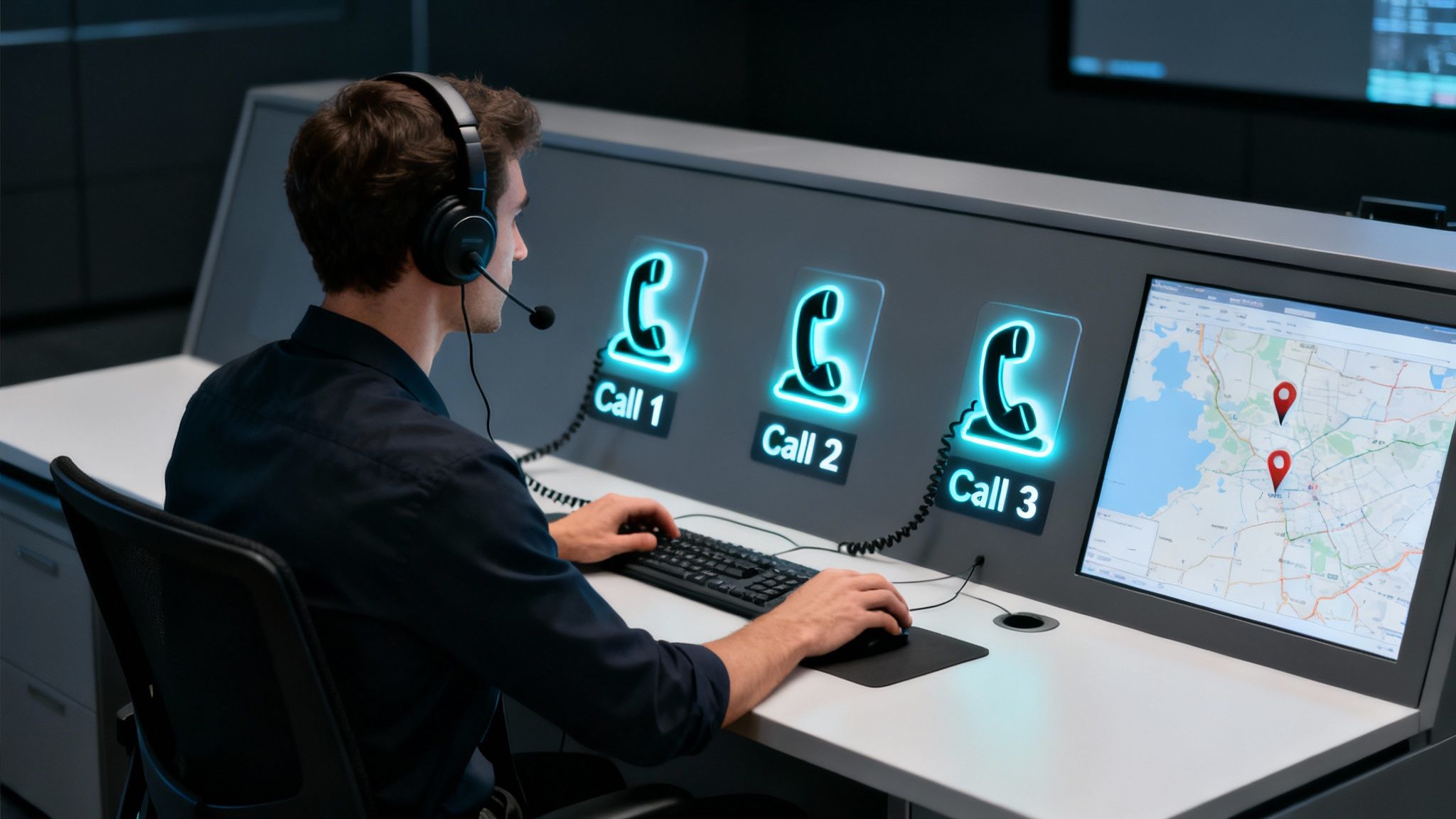
This question evaluates a candidate's workflow management and their familiarity with dispatch technology. For example, a strong answer might detail how they used a Computer-Aided Dispatch (CAD) system alongside radio communications to coordinate multiple units. Their response reveals their capacity to remain calm and methodical, ensuring no critical detail is missed even when handling several incidents at once.
What to Look For in a Response
Interviewers should listen for a structured, logical explanation. A candidate who can clearly articulate their thought process during a high-stress event is likely to be a reliable and effective team member.
- Prioritization Skills: Did the candidate assess the severity of each call and act accordingly? A practical example would be explaining how they handled a major pile-up on the highway while a medical alert was also coming in.
- System Proficiency: Do they mention specific tools, like CAD or radio channels? A candidate mentioning experience with sophisticated platforms demonstrates advanced readiness. For instance, familiarity with the powerful tools in Resgrid's dispatch and management apps indicates a high level of technical competence.
- Communication Clarity: How did they communicate with callers, field units, and other dispatchers to keep everyone informed?
- Emotional Regulation: Does their tone and language reflect a calm, controlled demeanor, even when describing a stressful situation?
Interviewer’s Note: A superior candidate won't just list their actions; they will explain the why behind them. For example, "I prioritized the reported cardiac arrest over the non-injury traffic collision because of the immediate threat to life, while simultaneously logging the collision details for the next available unit." This demonstrates critical thinking, not just task completion. A candidate who can articulate how their efficient multitasking directly led to faster response times and better resource allocation shows a clear understanding of how their role impacts operational costs and outcomes.
2. How would you handle a caller who is panicked, angry, or uncooperative?
This question probes a candidate's emotional intelligence, patience, and ability to maintain control in a volatile situation. It's a critical component of interview questions for 911 dispatchers because it assesses their de-escalation skills. Dispatchers are the first point of contact during a crisis, and their ability to calm a hysterical caller or manage an aggressive one is essential for gathering the accurate, life-saving information needed for an effective emergency response.

This question moves beyond technical proficiency to evaluate a candidate's interpersonal effectiveness under pressure. A strong answer will reveal their capacity for empathy and their tactical communication skills. For example, they might describe using a calm, repetitive tone to soothe a panicked parent reporting a missing child, or using firm, direct questions to cut through the anger of an uncooperative caller. Their response shows if they can separate the caller's emotion from the mission-critical facts.
What to Look For in a Response
Interviewers should look for specific, repeatable techniques, not just vague assurances of being a "calm person." A candidate who can articulate a clear strategy for managing difficult callers is more likely to perform well when faced with a real emergency.
- De-escalation Techniques: Do they mention specific methods like active listening, validating feelings ("I understand this is a frightening situation"), or adjusting their tone and pacing?
- Information Extraction: How do they pivot from managing emotions to gathering facts? Look for phrases like, "I know you're scared, but I need you to tell me exactly where you are." A practical example could be explaining their script for getting an address from someone who is screaming.
- Professional Boundaries: Does the candidate show they can remain empathetic without becoming emotionally entangled, maintaining the professional distance needed to do the job?
- Resilience: Do they convey an understanding that these calls are difficult but manageable, demonstrating the mental fortitude required for the role?
Interviewer’s Note: A top-tier candidate will explain how their de-escalation tactics directly improve operational outcomes. For example, "By calming the caller, I was able to get a precise address and a description of the suspect in under 30 seconds, which allowed me to dispatch units faster and provide them with crucial intelligence. This efficiency prevents wasted time and fuel from units responding to the wrong location, directly impacting operational costs." This demonstrates a clear link between their communication skills and resource management.
3. Describe your experience with Computer-Aided Dispatch (CAD) systems or dispatch management software
This technical question is designed to gauge a candidate's direct, hands-on proficiency with the foundational technology of any modern dispatch center. A dispatcher’s ability to navigate, utilize, and even troubleshoot CAD software is non-negotiable for efficient and accurate emergency response. This inquiry moves beyond theoretical knowledge to confirm practical experience, revealing how quickly a candidate can integrate into a specific technological environment and start contributing effectively.
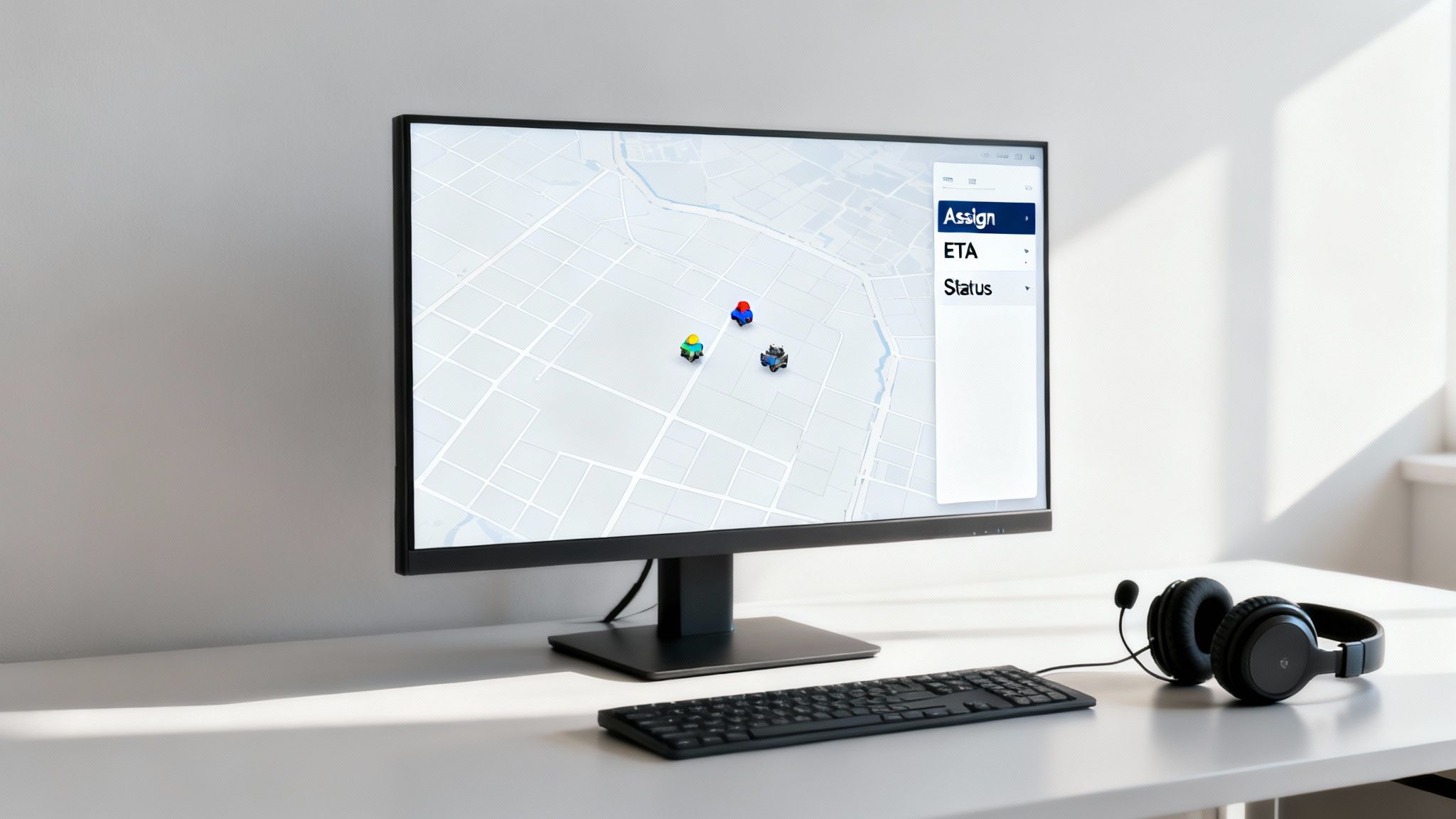
The answer to this question highlights a candidate's comfort level with the digital nervous system of emergency services. It reveals their capacity to manage incident creation, track unit status, use mapping tools for optimal deployment, and communicate critical updates in real-time. Experience with sophisticated platforms indicates a candidate who understands the importance of technology in saving lives and resources.
What to Look For in a Response
Interviewers should seek answers that demonstrate both technical competence and an understanding of how the technology serves the mission. A candidate who can connect their software skills to operational outcomes is a significant asset.
- Specific System Knowledge: Does the candidate name specific CAD systems they have used (e.g., Motorola, CentralSquare, Tyler Technologies)?
- Feature Proficiency: Can they describe using advanced features like AVL (Automatic Vehicle Location), GIS mapping, or integrated messaging to improve response? Experience with the comprehensive features available in modern dispatch platforms shows they are prepared for a high-tech environment.
- Adaptability: How do they talk about learning new software? A practical example could be describing how they taught themselves a new mapping layer to improve location accuracy.
- Problem-Solving: Have they ever encountered a system issue during a critical incident? How did they handle it? This reveals their grace under technical pressure.
Interviewer’s Note: A top-tier candidate will connect their CAD proficiency directly to efficiency and cost savings. For example, "Using the AVL and traffic data features in my previous CAD system, I was able to reroute an ambulance around a major accident, cutting five minutes off its response time to a critical patient and saving fuel." This type of answer shows they don't just use the tools; they leverage them strategically to reduce operational costs and improve outcomes.
4. How do you prioritize calls when demand exceeds capacity?
This question is a critical test of a candidate's judgment, ethical framework, and ability to perform under the most intense circumstances. It moves beyond simple multitasking to assess how a dispatcher makes life-or-death decisions when resources are stretched thin. The interviewer is looking for evidence of a systematic, protocol-driven approach to triage, ensuring the most critical incidents receive immediate attention even during a mass casualty event or a major storm.

The ability to prioritize effectively is not just about following a script; it’s about applying established protocols like the Medical Priority Dispatch System (MPDS) to dynamic, real-world situations. A candidate’s answer reveals their capacity to manage a queue of pending calls, communicate realistic timelines to callers, and make justifiable decisions that can stand up to post-incident scrutiny. This skill is vital for managing operational efficiency and public trust.
What to Look For in a Response
A strong answer will demonstrate both procedural knowledge and emotional intelligence. The candidate should be able to explain their decision-making process logically while also showing empathy for the callers whose needs might be temporarily de-prioritized.
- Protocol Adherence: Does the candidate reference specific, recognized triage systems like MPDS or APCO standards?
- Justification of Decisions: Can they clearly explain why a structure fire with reported entrapment takes precedence over a non-injury vehicle accident?
- Resource Management: Do they mention coordinating mutual aid or leveraging technology for better situational awareness? For instance, a candidate familiar with Resgrid's personnel and unit tracking might explain how they would identify the closest available resource, even from a neighboring agency, to reduce response times.
- Communication Strategy: How would they manage the expectations of a caller with a lower-priority issue? A practical example would be a script: "Sir, I have your call logged and an officer will be dispatched. We are currently handling several life-threatening emergencies, but we will get to you as soon as a unit is free."
- Ethical Considerations: Does the response show an understanding of the immense responsibility and the emotional toll of making these decisions?
Interviewer’s Note: The best candidates will connect their prioritization skills to tangible outcomes. They won't just say, "I'd follow protocol." They'll say, "By using MPDS to identify the chest pain call as an 'ECHO' level determinant, I can dispatch the closest paramedic unit in under 30 seconds, while logging the noise complaint for dispatch once that critical unit is en route." This demonstrates an understanding of how precise triage directly saves lives and optimizes the use of high-value resources, ultimately reducing operational strain and improving the agency's performance metrics.
5. Tell me about a mistake you made as a dispatcher and what you learned from it
This behavioral question is designed to test a candidate's accountability, self-awareness, and capacity for growth. In a high-stakes environment like a 911 dispatch center, mistakes are inevitable, but the ability to own them, analyze them, and implement corrective actions is non-negotiable. This question separates candidates who deflect blame from those who demonstrate maturity and a commitment to continuous improvement, which are vital for maintaining public trust and operational excellence.
This question probes a candidate's problem-solving skills and their dedication to refining protocols. It’s not about finding a flawless candidate; it's about finding one who is resilient and learns from experience. A strong response will illustrate a clear, structured process of reflection and action, showing that the individual is not only trustworthy but also an asset in strengthening the team's overall performance.
What to Look For in a Response
Interviewers should look for a narrative that demonstrates humility and a proactive approach to preventing future errors. The candidate's ability to deconstruct their mistake without making excuses is a powerful indicator of their professional integrity.
- Accountability: Does the candidate take full ownership of the mistake, or do they shift blame to colleagues, systems, or the caller?
- Root Cause Analysis: Can they clearly articulate why the mistake happened? For example, was it a knowledge gap, a communication breakdown, or a lapse in protocol?
- Corrective Actions: What specific, tangible steps did they take to rectify the situation and prevent it from recurring? A practical example could be creating a personal checklist for high-risk calls that they review before each shift.
- Demonstrated Learning: Does the candidate connect the lesson learned to their overall professional development and a deeper understanding of the dispatcher's role and responsibilities?
Interviewer’s Note: A top-tier candidate will frame their mistake as a catalyst for positive change. For instance: "I once misunderstood a caller's location due to background noise and sent a unit to the wrong street, which added three minutes to their response time. I took full responsibility and developed a new personal protocol to always verify street names using phonetic alphabets and confirming cross-streets, a practice my supervisor later adopted for our team's training manual." This shows not just personal learning but also a contribution to systemic improvement, which directly enhances operational efficiency and reduces costly errors.
6. How do you stay current with emergency response protocols, training, and industry changes?
This forward-looking question helps separate a candidate who simply performs a job from a professional dedicated to a career. Emergency communications is a dynamic field, with protocols, technologies, and best practices constantly evolving. This question probes a candidate's commitment to continuous learning, adaptability, and professional growth, revealing whether they are proactive in enhancing their skills or passively wait for mandatory training.
An agency invests significant resources in training and technology, and a candidate who demonstrates initiative in their own development is a more valuable long-term asset. Their answer shows an understanding that staying current is not just a personal benefit but a critical component of public safety. It directly impacts the quality of service provided to the community and the safety of first responders in the field.
What to Look For in a Response
Interviewers should look for specific, tangible examples of professional development activities. A vague answer like "I read things online" is a red flag, whereas a detailed response indicates genuine engagement and passion for the profession.
- Specific Certifications: Do they mention relevant credentials like APCO or NENA certifications, or system-specific training like Medical Priority Dispatch System (MPDS)?
- Industry Involvement: Do they reference participation in professional organizations, attending conferences, or reading industry publications like 911 Magazine?
- Proactive Learning: Do they describe seeking out new information on emerging topics like mental health response protocols, Next Generation 911 (NG911), or T-CPR (Telecommunicator CPR)? A practical example might be, "I subscribe to the NENA newsletter to stay on top of NG911 developments."
- Application of Knowledge: Can they provide an example of how something they learned improved their performance or helped a colleague?
Interviewer’s Note: A top-tier candidate will connect their professional development directly to operational excellence and efficiency. For example, "I recently completed an advanced CAD course that taught me several new shortcuts. By using them, I've been able to reduce my call processing time by an average of 15 seconds, which gets units dispatched faster." This answer shows a direct return on investment, as faster, more accurate dispatches save crucial seconds and optimize resource use. It also indicates a readiness to master complex systems; candidates who are already exploring advanced dispatch features often require less onboarding and can quickly adapt to new software. For detailed guidance on our system's capabilities, our support documentation is an excellent resource for continuous learning.
7. Describe your experience with interpersonal communication and teamwork in a dispatch center environment
This question assesses a candidate's ability to operate within the unique, high-stakes ecosystem of a dispatch center. While technical skill is vital, the capacity to collaborate seamlessly with colleagues, supervisors, and field personnel is equally crucial for operational success and safety. The question probes beyond simple agreeableness, seeking evidence of effective communication strategies, conflict resolution skills, and a commitment to a cohesive team culture. In an environment where every second counts, a breakdown in internal communication can be as catastrophic as a missed call.
This question reveals a candidate's understanding that the dispatch center is a collaborative hub, not a collection of isolated workstations. A strong response will highlight their ability to contribute positively to the team, whether by supporting a colleague during a difficult shift or ensuring precise information transfer to multiple agencies. This cooperative spirit is fundamental to maintaining a high-functioning, resilient team that can withstand the daily pressures of the job.
What to Look For in a Response
Interviewers should look for answers that provide specific, tangible examples of collaboration. A candidate who understands the importance of teamwork will be able to articulate how their actions contributed to a safer, more efficient operational environment.
- Collaborative Mindset: Did they provide examples of coordinating with police, fire, and EMS on multi-agency incidents?
- Conflict Resolution: Can they describe a time they helped resolve a disagreement constructively, either between dispatchers or with field units? A practical example: "A patrol officer was frustrated about a call's priority. I calmly explained the factors behind the classification and assured him of the protocol, which de-escalated the tension."
- Supportive Behavior: Do they mention instances of supporting a struggling team member or contributing to positive morale?
- Communication Adaptability: How did they adjust their communication style for different audiences, such as a frantic caller versus a seasoned police officer?
Interviewer’s Note: A top-tier candidate will connect their teamwork skills directly to operational efficiency and safety. For instance, "During a major structure fire, I proactively coordinated with the neighboring agency's dispatch to pre-plan mutual aid, ensuring their units were staged and ready. This prevented radio congestion and got resources on scene 5 minutes faster." This demonstrates proactive problem-solving and an understanding of how clear internal communication directly impacts life-saving outcomes and optimizes the use of costly emergency resources.
8. How would you handle a situation where you disagreed with a supervisor's decision or dispatch directive?
This question assesses a candidate's professional judgment, respect for the chain of command, and ability to advocate for safety under pressure. In a 911 dispatch center, directives from supervisors are the norm, but blind obedience is not always the safest path. This question reveals if a candidate can balance deference to authority with their professional responsibility to ensure the safety of the public and field responders. It’s a crucial test of their communication skills, integrity, and situational awareness.
This question moves beyond simple compliance to explore a candidate’s critical thinking and problem-solving abilities. A dispatcher who can respectfully and logically question a directive when they have a valid safety concern is an asset, not an obstacle. Their response indicates whether they can use data and facts to support their position, promoting a culture of safety and continuous improvement rather than conflict.
What to Look For in a Response
Interviewers should look for a response that demonstrates a clear, respectful process for addressing disagreements. The candidate should prioritize safety and protocol over personal opinion.
- Respect for Chain of Command: Does the candidate first seek to understand the supervisor’s perspective and rationale before challenging the decision?
- Fact-Based Reasoning: Do they mention using objective data, policy, or direct observations to support their concern, rather than relying on emotion or personal preference? For instance, referencing incident documentation from a platform like Resgrid to present facts shows a commitment to data-driven decision-making.
- Professional Communication: How would they articulate their concern? The language should be collaborative and solution-oriented, not confrontational. A practical example: "Could you clarify the reasoning? My map shows that unit is farther away and sending them would violate our response time policy."
- Understanding of Final Authority: Does the candidate acknowledge that after voicing their concern through proper channels, the supervisor's decision is final, and they are expected to execute it professionally?
Interviewer’s Note: A strong candidate will frame their response around collaborative problem-solving and safety. For example, "I would respectfully ask my supervisor for a moment to clarify the directive, stating, 'My understanding of the situation is X, which makes me concerned about Y. Could you help me understand the additional factors you're considering?'" This approach shows respect, invites dialogue, and keeps the focus on the operational outcome. This proactive, clear communication avoids costly errors and ensures resources are deployed efficiently, which directly impacts operational budgets and public safety.
8-Question 911 Dispatcher Interview Comparison
| Question | Implementation complexity 🔄 | Resource requirements ⚡ | Expected outcomes ⭐📊 | Ideal use cases | Key advantages 💡 |
|---|---|---|---|---|---|
| Tell me about a time you had to manage multiple emergency calls simultaneously | 🔄🔄🔄 High — real-time coordination and multitasking | ⚡⚡⚡ High — multiple units, robust CAD/CMS | ⭐⭐⭐, 📊 Demonstrates prioritization, sustained performance under load | Busy urban dispatch, mass-casualty or multi-incident events | 💡Reveals prioritization strategy, stress tolerance, system proficiency |
| How would you handle a caller who is panicked, angry, or uncooperative? | 🔄🔄 Moderate — requires soft skills + protocol adherence | ⚡⚡ Low–Medium — training, supervision support | ⭐⭐, 📊 Shows de-escalation ability and information capture | Distressed callers, aggressive or emotional interactions | 💡Assesses emotional intelligence, calming techniques, communication clarity |
| Describe your experience with CAD systems or dispatch software | 🔄🔄 Moderate — technical familiarity and adaptation | ⚡⚡ Medium — access to systems, training and practice | ⭐⭐⭐, 📊 Predicts fast onboarding and technical competence | Modern dispatch centers, software migrations, integrated tracking | 💡Identifies technical readiness, reduces training time, highlights platform fit |
| How do you prioritize calls when demand exceeds capacity? | 🔄🔄🔄 High — ethical and operational decision-making | ⚡⚡ Medium — protocols, live unit/status data | ⭐⭐⭐, 📊 Reveals triage reasoning and resource-allocation quality | Resource-constrained shifts, large geographic coverage, surge events | 💡Evaluates protocol knowledge, risk assessment, transparent communication |
| Tell me about a mistake you made as a dispatcher and what you learned from it | 🔄🔄 Moderate — reflective and structured response | ⚡ Low — requires documentation and honesty | ⭐⭐, 📊 Indicates accountability, corrective actions and learning | Hiring for safety-critical roles, culture and QA assessments | 💡Shows ownership, root-cause thinking, process improvement orientation |
| How do you stay current with emergency response protocols, training, and industry changes? | 🔄🔄 Ongoing — continuous professional development | ⚡⚡ Medium — time, courses, memberships, certifications | ⭐⭐⭐, 📊 Predicts adaptability and adoption of best practices | Organizations using evolving tech or protocols (e.g., Resgrid updates) | 💡Measures initiative, certification currency, knowledge sharing |
| Describe your experience with interpersonal communication and teamwork in a dispatch center environment | 🔄🔄 Moderate — team dynamics and conflict resolution | ⚡ Low — relies on collaboration structures and culture | ⭐⭐⭐, 📊 Predicts team cohesion and operational coordination | Multi-agency incidents, high-stress shifts, shift handovers | 💡Assesses collaboration, conflict resolution, mentoring potential |
| How would you handle a situation where you disagreed with a supervisor's decision or dispatch directive? | 🔄🔄🔄 Moderate–High — authority, ethics, and escalation judgment | ⚡ Low — procedural knowledge and documentation | ⭐⭐, 📊 Shows judgment, respectful escalation, and safety advocacy | Safety-critical disputes, ambiguous directives, policy concerns | 💡Evaluates integrity, chain-of-command navigation, evidence-based challenge |
Transforming Interviews into Cost-Saving Onboarding
Choosing the right dispatcher is far more than filling a vacancy; it is a critical investment in your community's safety, your agency's operational integrity, and your long-term financial health. The comprehensive set of interview questions for 911 dispatchers detailed in this guide moves beyond standard, predictable inquiries. They are diagnostic tools designed to reveal a candidate’s true capabilities in multitasking, stress resilience, technical aptitude, and collaborative problem-solving. By integrating these targeted behavioral, situational, and technical questions, you transform your hiring process from a simple screening into a predictive and strategic assessment of future performance.
The insights gleaned from this rigorous approach do more than just identify top talent. They illuminate specific areas where a candidate excels and where they may need further development. This data is invaluable, allowing you to create a customized, cost-effective onboarding plan that addresses precise skill gaps from day one, rather than discovering them months later during a critical incident.
From Interview Insights to Fiscal Responsibility
A well-vetted hire, identified through a strategic interview process, is a direct path to significant cost savings. Consider the financial impact: a carefully selected dispatcher is less likely to require extensive remedial training, adapts more quickly to complex protocols, and integrates seamlessly into your team culture. This reduces the hidden costs associated with a poor hiring decision, which can include overtime for other staff, decreased team morale, and, most importantly, the risk of operational errors that can have severe consequences.
Moreover, a high-quality hire leads to lower turnover. The cost of replacing a single dispatcher, including recruitment, background checks, overtime coverage, and intensive training, can easily exceed tens of thousands of dollars. By using these interview questions to ensure a better fit, you are making a fiscally responsible decision that strengthens your entire emergency response framework.
Key Takeaway: The interview is not just a gateway to hiring; it is the first step in a cost-efficient training and retention strategy. The answers you receive provide a roadmap for personalized onboarding, minimizing wasted resources and maximizing employee potential from the outset.
Actionable Next Steps for Your Agency
To turn these concepts into tangible results, start by implementing a structured interview panel that uses a consistent scoring rubric for each question. This ensures fairness and allows for objective comparisons between candidates.
- Audit Your Current Process: Review your existing interview questions. Are they uncovering the core competencies needed for a modern dispatcher, or are they generic HR queries? Replace vague questions with the specific behavioral and scenario-based examples provided in this article.
- Develop a Scoring Rubric: Create a simple 1-5 scoring system for key competencies like communication, prioritization, technical skill, and composure. This provides quantifiable data to support your hiring decisions.
- Tailor Your Onboarding: Use the interview performance to build a 30-60-90 day onboarding plan. If a candidate struggled with technical questions about CAD systems but excelled in communication, you know exactly where to focus their initial training efforts.
By mastering this strategic approach to hiring, you build a resilient, high-performing dispatch team prepared for any challenge. A strong team starts with a strong interview, and a strong interview is one that is intentional, diagnostic, and directly linked to the real-world demands of the dispatch center. This methodology ensures that every new hire is not just a person in a seat but a valuable, long-term asset to your agency and the community it serves.
Ready to pair your expertly-vetted dispatch team with a modern, flexible dispatch platform? Resgrid, LLC offers a powerful, self-service dispatch, management, and logistics system without the costly contracts and complex setup of traditional solutions. Visit Resgrid, LLC to see how our adaptable platform can empower your high-performing dispatchers and streamline your entire emergency response operation.