

Firefighter accountability systems: Boost Incident Command and Safety
At its core, a firefighter accountability system is the framework—part process, part technology—that we use to track every single responder on an incident scene. The goal is simple but absolutely critical: know who is on scene, where they are, and what they are doing at all times.
This constant, real-time awareness isn't just a nice-to-have; it's the bedrock of fireground safety and effective incident command.
The Critical Need for Accountability in Modern Firefighting
Think of an Incident Commander like an air traffic controller trying to land multiple planes in a bad storm. The accountability system is their radar and comms network, painting a clear picture in an otherwise chaotic environment. It's a living process that kicks off the second a unit is dispatched and doesn't end until every last member has safely cleared the scene.
Without this structure, command staff are essentially flying blind. They can't effectively deploy resources, and more importantly, they can't quickly locate and rescue a downed firefighter. To really get it, you have to understand the overarching concept of accountability as it applies in any high-stakes job. On the fireground, it's a matter of life and death, making sure no one gets left behind. When this process breaks down, the results can be tragic.
Why This System Is Non-Negotiable
The stakes on the job are just too high. A 2021 global study from the International Association of Fire and Rescue Services found that in just 20 reporting countries, 150 firefighters died on duty and 64,673 were injured. Those are sobering numbers. They hammer home the urgent need for rock-solid tracking in high-risk environments where a lack of oversight can turn a dangerous call into a fatal one. You can dig into the full report on global fire statistics for more context.
A good accountability system does way more than check a box for compliance. It delivers real-world benefits that you can see and feel on scene:
- Enhanced Situational Awareness: Gives the Incident Commander a live roster and location for all personnel.
- Rapid Rescue Capability: In a Mayday, knowing a firefighter's last known location and assignment shaves precious minutes off the rescue effort.
- Improved Resource Management: Helps you track crew assignments, manage work/rest cycles, and put a stop to freelancing.
The Financial Case for Accountability
Beyond the primary mission of protecting our people, strong accountability systems also make a lot of financial sense. When you can meticulously track personnel and equipment, you're far less likely to lose expensive gear like thermal imagers or portable radios in the chaos. A single lost radio can cost thousands of dollars to replace.
- Practical Example: During a chaotic multi-agency wildfire operation, a hand crew leaves behind a specialized toolkit and a portable radio. Without an integrated tracking system, the equipment is considered lost.
- Actionable Insight: By using a platform that includes asset tracking, the department can geo-locate the equipment's last known position on a map. This feature saves the $2,500 replacement cost for the lost gear and prevents a budget hit, all by leveraging the same system used for personnel accountability.
Solutions like Resgrid tie dispatch, personnel tracking, and communication together into one affordable system. This kind of integration means you don't need multiple software subscriptions and you cut down on manual data entry, saving both time and money. When you adopt a system like this, you're not just investing in a tool to protect your most valuable asset—your people—but you're also protecting your department's bottom line.
The Evolution from Manual Tags to Smart Systems
For decades, the backbone of fireground accountability was decidedly low-tech. We relied on simple, physical, and rugged manual systems. Think of the classic PASSPORT® system: Velcro tags, ID cards, and a collection board slapped on the side of an engine.
The process was brutally simple. Before you went inside, you handed your personal tag to an accountability officer. They'd stick it on the board, and just like that, there was a physical record of who was in the hot zone. It was a huge leap forward for its time, creating a tangible list of everyone committed to the fight. But its Achilles' heel was human nature—it demanded perfect discipline in the middle of absolute chaos. One forgotten tag or a disorganized board could instantly create a life-threatening blind spot.
The Leap from "Who" to "Where"
The big problem with manual tags is they only tell you who is inside a building. They can't tell you where they are or what their status is. That critical gap is what pushed the fire service toward the modern electronic and software-based systems we see today.
The game really changed with the introduction of tech like Radio-Frequency Identification (RFID) and Global Positioning System (GPS). These systems started to automate the entire check-in process, taking some of the human error out of the equation.
- RFID Systems use scanners at entry points. A firefighter with an RFID-enabled tag walks through a doorway, and their presence is logged automatically. No hand-off required.
- GPS Trackers, often built right into our radios, give us real-time location data for personnel outside, which is a lifesaver on large-scale incidents or wildland fires.
This shift took accountability from a static checklist to a living, breathing map of the fireground. The focus went from just knowing who was on scene to actively tracking their location and status, giving the Incident Commander a much clearer, more actionable picture.
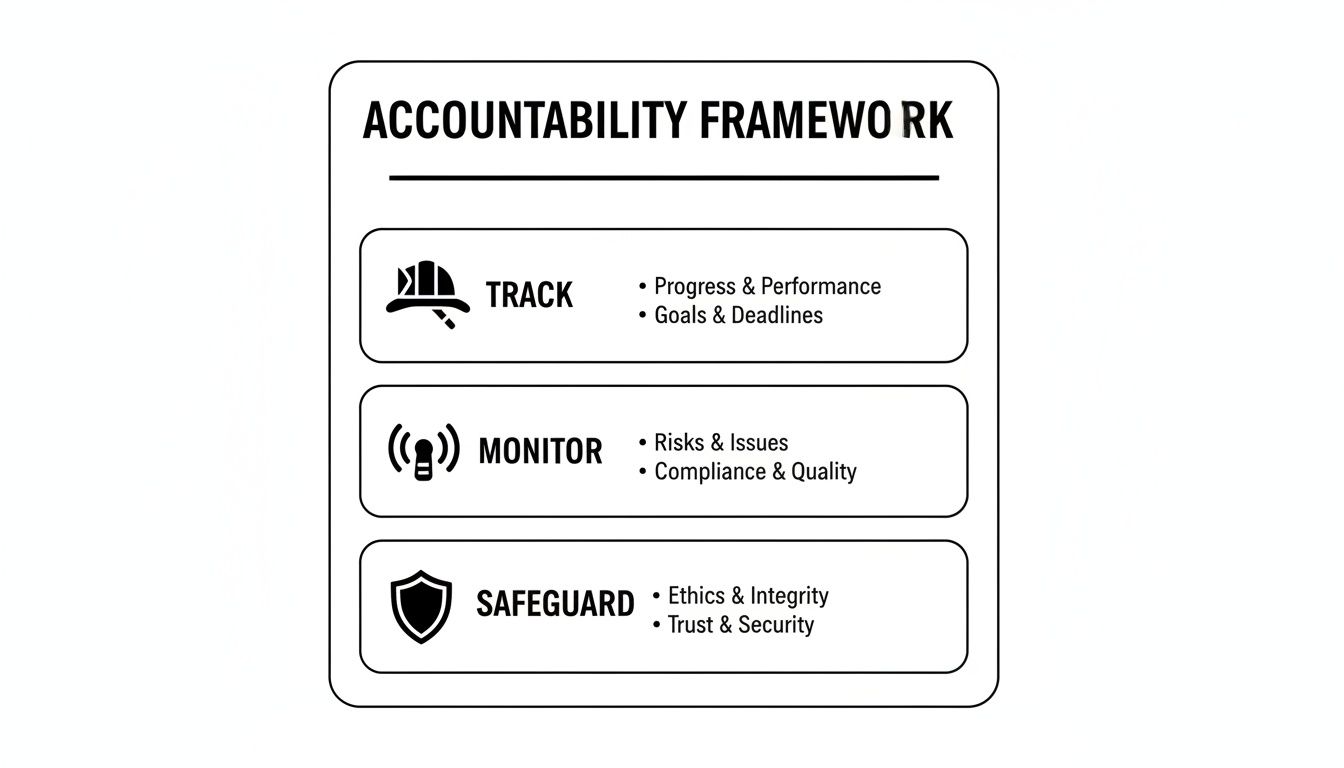
As you can see, a complete system isn't just one piece of hardware. It's a whole framework designed to track, monitor, and ultimately bring every single person home safely.
Comparison of Firefighter Accountability System Types
To really understand this evolution, it helps to see the different system types laid out side-by-side. The table below breaks down the key differences between the old-school manual tags, the first wave of electronic trackers, and today's fully integrated software.
| Feature | Manual Tag Systems (e.g., PASSPORT®) | Electronic Systems (RFID/GPS) | Integrated Software Platforms (e.g., Resgrid) |
|---|---|---|---|
| Real-Time Tracking | None; static entry/exit only | Automated entry/exit, outdoor GPS location | Live personnel mapping, status, timers (PAR/SCBA) |
| Data & Reporting | Manual logs, handwritten notes | Basic entry/exit timestamps | Automated incident reports, historical data |
| Initial Cost | Low | High (scanners, proprietary tags) | Low to moderate (often uses existing hardware) |
| Operational Complexity | High; requires strict manual discipline | Moderate; hardware maintenance | Low; intuitive software on familiar devices |
| Equipment Tracking | Not applicable | Possible with tagged equipment | Integrated asset management features |
| Scalability | Limited to board size | Limited by hardware range | Highly scalable for any incident size |
It's pretty clear how far we've come. What started as a simple board has morphed into a dynamic command tool that gives us unprecedented situational awareness.
A Modern, Accessible Solution
The final piece of this evolution is the move to integrated software platforms. Tools like Resgrid have made advanced accountability accessible to literally any department, no matter the budget. You don't need a massive capital investment in proprietary hardware anymore.
These platforms work as standalone systems on the smartphones your crew already carries or can integrate with the RFID/GPS hardware you might already own.
- Practical Example: A volunteer department with a tight budget wants to upgrade from a manual tag system but can't afford a $20,000 hardware package.
- Actionable Insight: By adopting a software-based system like Resgrid, they can implement real-time tracking using their members’ existing smartphones. This eliminates the upfront capital expense for proprietary tags and scanners, allowing them to deploy a modern system for a low monthly subscription fee. This move saves the department thousands in initial costs while dramatically improving safety and operational efficiency.
This software-first approach is a game-changer. It ensures that every department, paid or volunteer, large or small, can afford the modern accountability systems our people deserve.
The Core Components of an Effective System

Putting together a bulletproof firefighter accountability system isn't about finding one magic gadget. It's about building a layered defense, with several core components all working together. Think of it like a safety net—these building blocks, which are the backbone of standards like NFPA 1500, create redundancies.
If one part of your system gets overwhelmed or fails in the heat of the moment, another layer is there to back it up. That's how we guarantee nobody slips through the cracks.
Everything starts with the individual firefighter. At the most basic level, we have Personnel Accountability Tags (PATs). These are the simplest, most fundamental form of ID on the fireground, usually listing a firefighter's name, unit, and key qualifications.
Think of each tag as a physical token representing a life on the line. When a crew makes entry into a hazard zone, their tags get collected at the entry point. Right away, you have a tangible, physical record of exactly who is committed inside. That simple action kicks off the entire chain of accountability that stretches all the way to the Incident Commander.
From Tags to a Command-Level View
Those individual PATs are only useful if they have a central collection point. That’s where the status board comes in. This can be as low-tech as a magnetic board slapped on the side of the engine or as advanced as a sophisticated digital dashboard. A physical board is great because it’s a fail-safe, visual gut-check of your crew assignments.
But let's be honest, modern incidents move fast, and that’s where digital status boards really shine. Imagine an IC with a tablet who can see every crew assignment, monitor timers for PAR checks, and even get low-air alerts directly from SCBA telemetry—all on a single screen. This turns accountability from a static checklist into a dynamic, real-time command tool.
The goal is to create a system where technology supports and automates the fundamental discipline of accountability. A digital dashboard doesn't replace the need for a PAR check; it makes conducting one faster, more accurate, and less prone to human error during a high-stress event.
Solid systems also rely on command worksheets. Whether on paper or a screen, these documents help the command staff organize the incident, track assignments, and log key benchmarks. They bring structure to a chaotic scene and make sure every tactical objective has a crew assigned to it.
Automating the Personnel Accountability Report (PAR)
One of the most critical functions on any fireground is the Personnel Accountability Report (PAR). It's the roll call confirming that every member of a crew is safe and accounted for. We typically call for a PAR at key moments—after a sudden change in fire conditions, when switching from offense to defense, or immediately following a Mayday.
Trying to conduct a PAR manually over the radio can be a nightmare. It eats up time and clogs a vital communications channel right when you need it most. This is where software gives you a massive operational—and financial—advantage.
- Practical Example: A battalion chief is running a multi-alarm fire with ten crews inside. Instead of tying up the main radio channel for several minutes to call each crew for a verbal PAR, they initiate an automated PAR check through their command software.
- Actionable Insight: Every crew leader gets a notification on their device and confirms their crew's status with a single tap. The command dashboard updates instantly, showing which crews have checked in and flagging any that haven't responded. This can shrink a five-minute radio roll call down to under 30 seconds, freeing up the air for critical fireground communications. The reduction in radio traffic minimizes the need for a second tactical channel, potentially saving on radio equipment and licensing costs.
This automation doesn't just save precious seconds; it cuts down the risk of a missed check-in because of a garbled radio transmission. You can find out more about how platforms like Resgrid automate these tasks and pull multiple firefighter accountability systems into one platform by checking out our features here: https://resgrid.com/features.
By letting technology handle the routine checks, command can focus on strategy and firefighter safety, leading to a safer, more efficient outcome with fewer resources bogged down in administrative tasks.
How to Implement Your Accountability System
Picking and rolling out one of the many firefighter accountability systems out there can feel like a massive undertaking. But if you break it down into a practical checklist, it becomes a whole lot more manageable. The real goal isn't just to buy the latest and greatest tech; it's to select a system that genuinely fits your department's specific needs, budget, and day-to-day operational reality.
The absolute first step is a thorough needs assessment. Don't start by looking at fancy product demos—start by looking at your own first-due. Are you dealing with high-rises, sprawling industrial complexes, or wildland-urban interface zones? Each of those environments brings unique accountability headaches that a simple tag board just can't handle.
This initial analysis is the foundation for every decision you make from here on out. It ensures the system you end up with is an actual solution to your problems, not just another gadget. It's also critical to nail down your budget constraints early and see what grant funding might be available for safety equipment.
Building Your Implementation Checklist
Once you have a solid handle on your hazards and your budget, you can start building a clear implementation plan. For most departments, a phased rollout is the smartest way to go. It’s more successful, more cost-effective, and it lets your crews adapt without getting overwhelmed. Plus, it spreads the financial hit over time.
Here's a practical checklist to guide you through it:
- Assess Your Operational Reality: Pinpoint your most common and high-risk incident types. A department running highway incidents all day has wildly different needs than one protecting a dense urban core with old construction.
- Evaluate Integration Needs: Does this new system need to talk to your existing Computer-Aided Dispatch (CAD) or Records Management System (RMS)? Getting that right saves a ton of time and cuts down on errors.
- Establish a Clear Budget: Figure out the total cost—not just the initial purchase, but also training and any ongoing maintenance or subscription fees. This is where you can find some serious savings if you plan ahead.
- Form a Selection Committee: Pull in people from all ranks, from the newest probationary firefighter to the chief officers. Their different perspectives will make sure the system you pick is actually practical for everyone on the fireground.
- Schedule Vendor Demos: Get vendors to show you their systems in a real-world setting, not just a slick PowerPoint. Get your hands on the components. Test their usability and see how durable they really are.
- Develop a Phased Rollout Plan: Start small with a pilot program on a single engine or in one battalion. This lets you iron out all the kinks before you go department-wide.
- Prioritize Training and Drills: A system is completely useless if no one is proficient with it. Schedule regular, mandatory training and bake the system into every single drill until using it becomes muscle memory.
The Non-Negotiable Role of Training
Let's be clear: technology doesn't create accountability. Discipline and training do. The Gatineau Fire Department, a career force of 250, learned this the hard way. They had a rigorous seven-step accountability chain on paper, but infrequent drills revealed significant flaws in their procedures that nobody saw coming.
This just hammers home a critical truth: even the best system will fail without constant practice. A 2021 Project Mayday survey reinforced this, revealing that a shocking 68% of commanding officers didn't have basic accountability tools like tags or riding lists ready to go when a Mayday was called.
A firefighter accountability system should be drilled on with the same intensity as pulling a hoseline or throwing a ladder. It is a core competency, not an administrative afterthought. Proficiency under pressure is built through repetition, not just policy.
Actionable Insights for Saving Money
Upgrading your system doesn't have to break the bank. For smaller or volunteer departments, taking that phased approach can make advanced technology surprisingly affordable. You could start by implementing a software-based system that runs on the smartphones your crew already carries, then add dedicated hardware like RFID readers later on as the budget allows.
- Practical Example: A department needs to document training hours for grant applications and ISO ratings, a process that takes an administrator several hours per week of manual data entry from paper logs.
- Actionable Insight: By choosing an integrated platform, the department can automatically log participation in training drills through the same app used for incident check-ins. This eliminates manual data entry, saving 4-5 hours of administrative time per week, which translates directly into payroll savings or frees up personnel for more critical tasks. The accurate, automated reports also strengthen grant proposals, potentially bringing in more funding.
To see how these tools can be deployed on devices your team already uses, you can explore the available Resgrid apps.
Integrating Accountability with Modern Incident Command
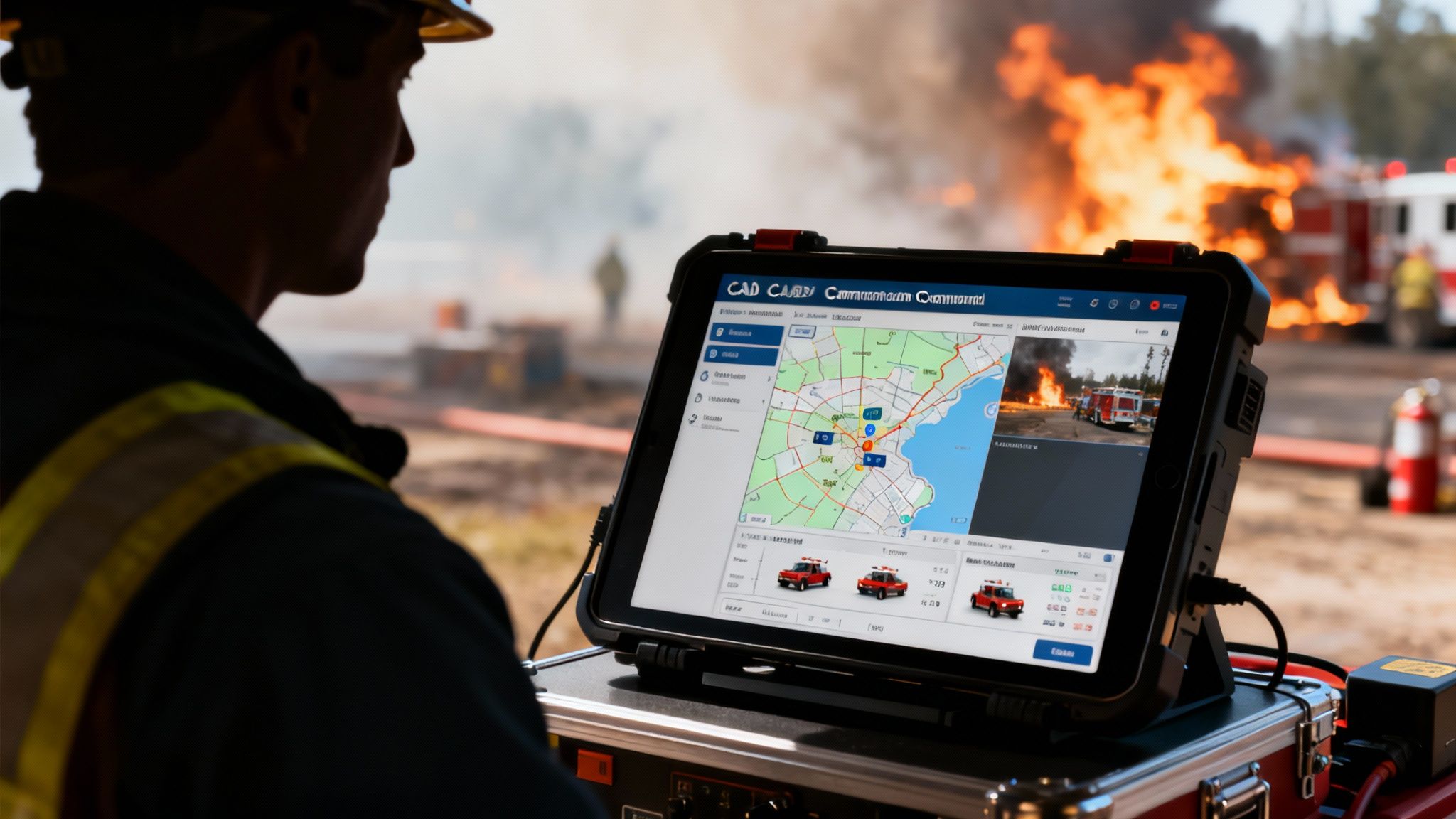
The era of accountability systems that live on an island is over. A tag board or a simple RFID reader that only works at the front door just doesn’t cut it anymore. The future of fireground safety is all about deep integration, where accountability data flows seamlessly from the dispatch center right to the Incident Commander's tablet.
Modern systems have to connect with the entire emergency response ecosystem. This isn't just about making things easier; it's about building a complete, accurate, real-time picture of the incident. When your accountability tool can talk directly to your dispatch platform, the IC has a massive advantage from the second the first unit rolls out the door.
This approach creates a single source of truth. It closes the dangerous information gaps that pop up when command staff are trying to juggle a bunch of disconnected systems. Instead of burning critical seconds manually entering crew rosters, integrated platforms automatically pull that data into the incident, letting the IC focus on strategy and safety.
Aligning with NIMS for a Unified Command Structure
This shift toward interconnected systems is a core principle of the National Incident Management System (NIMS). NIMS was designed to create a common operational framework for everyone, and that includes technology. An effective system ensures that data isn't trapped in one piece of software but can be shared across agencies and jurisdictions for a truly unified response.
Think of it this way: a standalone accountability system is like a single musician playing their own tune. An integrated system is like a whole orchestra playing from the same sheet music—a coordinated and powerful result. This alignment is absolutely critical for large-scale events where mutual aid is a given.
An integrated system provides a common operating picture for every agency on scene. When accountability data flows through a NIMS-compliant platform, a battalion chief from a neighboring department can instantly see crew assignments and locations without needing special training on an unfamiliar, proprietary system.
This kind of interoperability isn't some far-off goal; it's the expectation right now. It means that when multiple agencies show up to a scene, their command tools can communicate, maintaining accountability across the entire incident—not just within their own crews.
The Future of Data Integration: NERIS and Beyond
The upcoming National Emergency Response Information System (NERIS) really drives this point home. With U.S. fire departments logging over 30 million incident reports in 2023, NERIS is set to completely modernize how this massive amount of data is collected and used. By connecting Computer-Aided Dispatch (CAD) and Records Management Systems (RMS) with geospatial data and advanced analytics, it will provide a much richer stream of information for decision-making.
This evolution directly impacts firefighter accountability systems, because better data from the start leads to smarter, safer operations on the ground. To get a better sense of this shift, you can explore more insights about improved incident data.
This is where forward-thinking platforms built for integration shine. Platforms like Resgrid are designed with this future in mind, offering open-source tools that can easily connect with other systems.
- Practical Example: A dispatcher creates an incident in their CAD system. Because their firefighter accountability systems are integrated, the incident details, responding units, and crew rosters automatically get pushed to the IC’s command dashboard.
- Actionable Insight: The IC arrives on scene with immediate situational awareness, including pre-plan data for the structure and a live roster of personnel. This automated data flow eliminates the need for redundant radio traffic and manual data entry, saving an average of 3-5 minutes of setup time at the start of a critical incident. By adopting a unified platform that bundles these features, a department can eliminate separate software subscriptions for dispatch, messaging, and accountability, potentially saving $1,000-$3,000 per year in licensing fees.
This integration gives command a single, reliable source of information for better efficiency and, most importantly, firefighter safety.
Common Questions About Accountability Systems
When you start digging into firefighter accountability systems, a lot of questions pop up. It doesn't matter if you're a chief officer looking at a department-wide overhaul or a company officer just trying to keep your crew safer—getting straight answers is key to making the right call. This section cuts through the noise to answer the most common questions we hear.
We're going to skip the technical jargon and focus on what really matters on the fireground. We’ll tackle the big concerns around cost, compliance, and what it’s actually like to use these systems day in and day out.
What Is the Most Important Part of a Firefighter Accountability System?
The most critical piece isn't the tech—it's the discipline and consistency behind it. A department can have the slickest, most expensive system on the market, but if crews pencil-whip their check-ins or the training is spotty, it’s all for nothing. The real bedrock of accountability is a solid Standard Operating Procedure (SOP) that gets drilled into muscle memory through constant, realistic practice.
Technology is a fantastic force multiplier, no doubt. It automates the tedious stuff, slashes the risk of human error, and gives you real-time data that’s impossible to track with a grease pencil.
The best firefighter accountability systems are always a combination of two things: reliable technology and unwavering human discipline. One cannot effectively function without the other.
So while picking the right software or hardware matters, your investment in training and building good habits is what will ultimately save lives.
How Much Do Firefighter Accountability Systems Cost?
The price tag on these systems can swing wildly. A simple manual tag board might only set you back a few hundred dollars. On the other end, hardware-heavy electronic systems with RFID readers and proprietary tags can easily climb into the tens of thousands. While manual systems look cheap on paper, they come with hidden costs: wasted time, a higher chance for error, and a complete lack of real-time intel.
Thankfully, the move toward software-as-a-service (SaaS) platforms has been a game-changer for budgets.
- Practical Example: A small volunteer department wants to move past their old tag board but doesn't have $15,000 in the capital budget for a hardware-based system.
- Actionable Insight: By choosing a platform like Resgrid, they can use their members' own smartphones for check-ins and status updates. This move completely sidesteps the massive upfront cost and long-term contracts, making modern, real-time accountability affordable and scalable for a low monthly fee that can be covered by operational funds instead of a capital budget request.
This model puts top-tier safety tools within reach for career and volunteer departments alike. If you need a hand with implementation or just have questions getting started, our Resgrid support documentation is packed with useful info.
How Does a System Comply with NFPA Standards?
Staying compliant with national standards is non-negotiable for any fire department. The big ones here are NFPA 1500 (Standard on Fire Department Occupational Safety, Health, and Wellness Program) and NFPA 1561 (Standard on Emergency Services Incident Management System and Command Safety), which lay out the ground rules for accountability.
At their core, these standards demand that a system must be able to:
- Identify every single person operating on the scene.
- Track their location and assignment.
- Handle regular status checks, like a Personnel Accountability Report (PAR).
This is where modern digital systems really shine. They automatically create a clean, time-stamped digital log of everything that happens on the fireground. The personnel tracking and automated PAR checks in a digital platform provide a perfect, auditable record. This log proves exactly who was on scene, what they were doing, and when they answered a PAR check, directly supporting NFPA compliance and making post-incident reviews way more effective for training.
Can Small or Volunteer Departments Afford Modern Systems?
Absolutely. This is one of the biggest myths out there. In the past, the high price of proprietary hardware locked out anyone but the big, well-funded municipal departments. Those days are over.
- Practical Example: A rural volunteer department struggles to track who is responding to a call, leading to delayed or insufficient response.
- Actionable Insight: By using a software system with a mobile app, members can set their status with one tap. This gives the command staff a real-time view of who is en route to the station before the apparatus even leaves. This feature eliminates the need for costly pager systems or text message chains, saving money while ensuring an adequate crew is available for a safer response.
This gives them a robust digital system that’s light-years ahead of a manual tag board, all without the sticker shock. Don't forget about grants, either. Programs like the Assistance to Firefighters Grant (AFG) are often a great source of funding for tools that improve safety, and that includes firefighter accountability systems. This makes them even more attainable for departments that have to watch every penny.
Resgrid provides a comprehensive, open-source platform that integrates dispatch, messaging, and real-time personnel tracking into one unified system. Eliminate costly contracts and implementation fees while equipping your first responders with the tools they need to stay safe and connected. Learn more at https://resgrid.com.