

A Modern Guide to the Telephone Tree System
A telephone tree is one of the simplest, yet most powerful, communication tools out there. At its core, it's a structured calling chain: one person calls a few designated people, who then each call a few more, and so on. The message cascades down the list until everyone has been reached.
It’s an old-school method, for sure. But in a crisis, it’s a reliable way to spread urgent information fast, especially when modern systems like email or text messaging apps fail. That's why it remains a go-to for emergency services and any organization that needs a bulletproof plan to mobilize its people.
What a Telephone Tree Is (and Why It Still Matters)
Picture this: It's 2 AM, and a volunteer fire department gets a call. Instead of one person trying to ring 20 different firefighters, the dispatcher makes a single call to the fire chief. The chief then phones three captains. Each of those captains, in turn, dials their assigned crew of four. In just a few minutes, a message that started with one call has reached the entire team, and they’re all heading to the station.
That’s a telephone tree in action. It’s a person-to-person communication chain built for speed and reliability, ensuring a message gets out without overwhelming any single individual.
The Core Idea Behind the Tree
The "tree" analogy is perfect. The process starts with a single person at the "root" who kicks things off. They contact a small, manageable number of people who act as the first "branches." Each of those people is then responsible for calling their own list, creating even smaller branches. This continues until the message reaches the last "leaves" on the list.
This system isn't new; it has a long, proven history. As telephone networks exploded in the late 19th century, the telephone tree emerged as a critical coordination tool. Global phone subscribers grew from a handful in 1877 to nearly 2 million by 1900, which laid the groundwork for these calling chains to become effective. You can find some fascinating history on early telegraph and telephone networks on Wikipedia.
Why It's Still So Relevant
In an age of instant messaging and mass emails, you might wonder why anyone would bother with a manual calling tree. The answer is simple: it just works, especially when nothing else will.
When a storm knocks out the power grid or cell towers are overloaded, a simple phone call is often the last and most dependable option standing. Plus, a direct conversation confirms the message was actually received and understood. There's no "unread" notification or missed email—just clear, verbal confirmation.
A telephone tree provides an invaluable layer of redundancy in any communication plan. It's the fallback that works when sophisticated systems don't, ensuring critical messages always get through to the right people at the right time.
Saving Money with a Foundational System
One of the biggest draws of a manual telephone tree is how incredibly cost-effective it is. The main investment isn't money; it's the time and planning you put into setting it up.
- No Subscription Fees: Unlike automated notification software, a manual tree doesn't hit you with monthly payments.
- Minimal Tech Needed: All you really need is a list of phone numbers and a solid, well-organized plan. No expensive hardware or complicated IT setup required.
- Low Training Costs: The concept is so intuitive that it requires very little training for everyone involved.
By dedicating just a few hours to building a reliable calling tree, any organization can establish a powerful emergency notification system without spending a dime on technology. This makes it an essential, budget-friendly starting point for small businesses, community volunteer groups, and anyone looking to be better prepared.
How to Build a Reliable Telephone Tree Structure
Putting together a telephone tree that actually works when you need it most is a lot like laying the foundation for a house—it has to be solid. A well-designed tree gets the word out fast and, just as importantly, accurately. Without that strong structure, you're setting yourself up for the kind of chaos that happens when communication completely breaks down.
The whole point is to create a cascade effect. One call turns into a few more calls, which in turn leads to even more, spreading information like wildfire without relying on a single person to do all the heavy lifting.
This whole process kicks off with one person: the 'root' of your tree. This is your single point of activation, usually a team leader, department head, or maybe a dedicated safety officer. Once you know who's making that first call, you can start building out the main branches.
Here's a simple visual to show how the information flows from that single leader down through their teams.
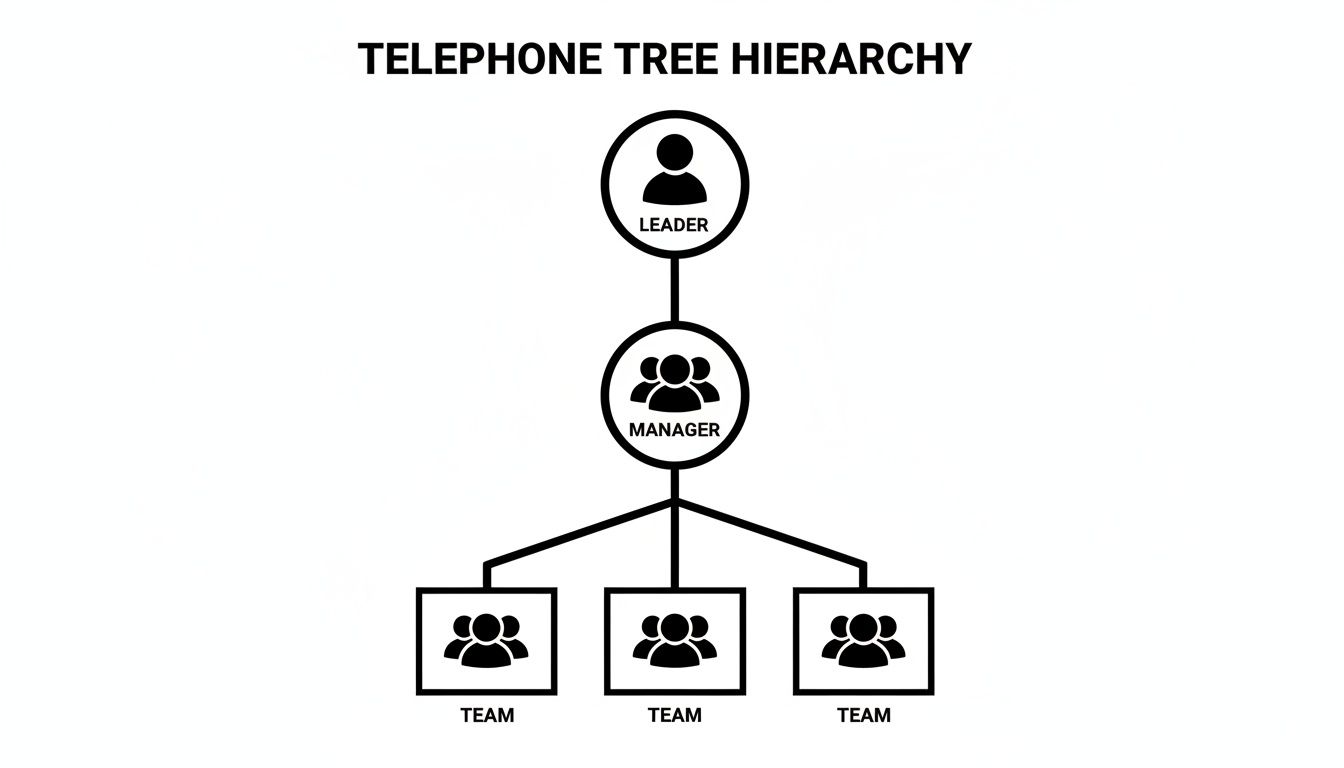
This diagram shows how one leader can kick off a series of calls to their managers, who then get their own teams looped in. It’s a classic, effective way to get broad coverage quickly.
Establish Clear and Balanced Branches
The primary branches are the first wave of people the root caller gets in touch with. A key insight here is to balance the call load. If your root caller has to dial twenty different people, your system is already dead in the water—it’s just too slow. Instead, that initial caller should only be responsible for a small, manageable group.
A good rule of thumb is for each person in the chain to call between two and five others. This keeps the responsibility on any one individual to a minimum and massively speeds up how quickly the message gets out.
Actionable Insight: A small business owner (the root) calls their three department managers. Each of those managers then calls the five people on their team. Just like that, in two quick rounds of calls, 19 people have the message. No single person was overloaded, and critical time wasn't wasted during an incident. The money saved here comes from speed; a faster response to a burst pipe or system outage can prevent thousands of dollars in damages or lost revenue.
Build in Redundancy to Prevent Failure
So, what happens if a key person in the chain doesn't pick up their phone? A telephone tree without a backup plan is a huge liability. The most common weak spot is an unavailable caller, which can bring an entire branch of your communication tree to a screeching halt.
You have to build redundancy into every single step to get around this.
- Assign Backup Callers: Every single person who has to make a call needs a designated backup. If the primary person is unreachable, the caller should know to immediately pivot and contact the backup instead.
- Create a "No Contact" Protocol: Tell your people exactly what to do if they can't get ahold of anyone on their list. The protocol should be simple: if you can't reach your primary or backup contact after two tries, you call back up the chain to let the person who called you know there's a problem.
A truly resilient telephone tree is designed with the expectation of failure. By assigning backups and having clear rules for missed calls, you create a self-healing system that ensures the message keeps moving, even when people are tied up.
This kind of proactive planning is a cheap way to guarantee reliability. The alternative—a stalled communication chain during a real emergency—can lead to expensive operational delays or serious safety failures. While modern platforms can automate this kind of redundancy, building it into a manual system is a smart, budget-friendly move. For organizations looking for more advanced tools, exploring the features available in modern dispatch systems can offer deeper insight into creating truly bulletproof plans.
Crafting Call Scripts That Get Results
A well-oiled telephone tree can get a message moving, but it’s the message itself that actually drives action. Your entire communication plan is only as strong as its script. A vague or confusing message can cause more harm than good, creating hesitation and costly mistakes when every single second counts.
The whole point is to eliminate any and all ambiguity. When an incident kicks off, your team shouldn't be trying to decipher instructions; they need to instantly understand the situation and what their role is. The best way to guarantee that level of clarity is to have pre-approved, battle-tested scripts ready to go.
The Anatomy of an Effective Script
Every solid call script, no matter the situation, boils down to four key parts. This structure makes sure the message lands quickly, is understood completely, and gets the right response. Think of it as a simple checklist for clear communication.
- 1. Identify and State Purpose: Get straight to the point. Say who you are and why you're calling. This cuts through any initial confusion and immediately grabs their attention.
- 2. Summarize the Situation: Give a short, direct summary of what’s happening. Use plain language and ditch the jargon.
- 3. Give Actionable Instructions: This is the most critical part. Tell the person exactly what they need to do next.
- 4. Confirm and Cascade: Have the person confirm they got the message and remind them it's their turn to call the next people on their branch of the telephone tree.
This simple formula is your best defense against the "telephone game" effect, where the message gets twisted and distorted as it passes from person to person. A 2018 study found that after just three retellings, only 25% of a story's original facts are typically left intact. A tight, structured script is how you fight that information decay.
The ultimate money-saving insight of a well-written script is prevention. By removing confusion, you prevent the expensive operational mistakes, safety incidents, and wasted response time that come from unclear directives. Every minute your team spends clarifying a message is a minute not spent solving the problem.
Practical Script Templates for Different Scenarios
The nature of the emergency will obviously shape the specifics of your message. Building a library of pre-written scripts for common situations means you can activate your telephone tree without a moment's delay.
Here are a couple of practical examples to get you started.
Scenario 1: Facility Closure Due to Weather
This kind of script is for non-imminent threats, where the focus is on safety and clear logistics.
- Introduction: "This is [Your Name], the [Your Title] for [Organization]. This is an important operational update."
- Summary: "Due to the severe winter storm warning, we are closing the facility effective immediately to ensure everyone's safety."
- Instructions: "Do not report to work for your shift. We will send another update via this telephone tree by 6 AM tomorrow regarding reopening. Please stay safe and off the roads."
- Confirmation: "Please confirm you have received this message. Now, proceed with calling the contacts on your list."
Scenario 2: Full Team Mobilization Alert
This script is built for speed in an urgent, all-hands-on-deck emergency.
- Introduction: "This is an emergency mobilization alert from [Organization]."
- Summary: "We have a critical incident at [Location] requiring an immediate, full-team response."
- Instructions: "Report to the staging area at [Address] immediately. Acknowledge this call, then proceed to the site."
- Confirmation: "After this call, immediately contact your assigned team members to relay this exact message. Speed is essential."
Testing and Maintaining Your Telephone Tree System
Let's be blunt: an untested plan is just a theory on paper. If you want to turn your telephone tree into a reliable, battle-tested tool, you have to commit to regular drills and upkeep. Think of it as a low-cost insurance policy against failure, making sure your communication chain actually holds up when things get real.
The absolute last time you want to discover a key contact’s number is out of date is during an actual emergency. That's a costly, completely avoidable mistake. By running regular tests and keeping your list fresh, you transform your telephone tree from a hopeful idea into a dependable asset.
Conducting Regular and Effective Drills
The only way to know if your system truly works is to fire it up. Scheduled drills are your chance to simulate a real event and spot the weak points in a low-stakes environment where you can fix them without consequence. The goal isn't just to see if the calls go through; it's to measure how smoothly the entire process runs from start to finish.
Actionable Insight: Treat your drills as training opportunities. You're not just testing the system; you're building muscle memory for your team. This cuts down on panic and hesitation during a real crisis, leading to quicker, more effective responses that can prevent expensive downtime or safety incidents.
To get the most out of each drill, you'll want to track a few key things:
- Total Time to Completion: How long did it take from the first call until the very last person confirmed they got the message? This is your most critical benchmark for speed.
- Message Accuracy: At the end of the drill, check in with a few people at the "leaves" of the tree. Ask them to repeat the message back to you. You need to know if the information got distorted as it was passed down the line.
- Point of Failure Analysis: Did any branch of the tree just stop? Pinpoint exactly where the breakdown happened and figure out why. Was a caller unavailable? Was a number wrong? Did the backup protocol fail?
Creating a System Maintenance Routine
A telephone tree is a living document, not a "set it and forget it" tool. People's contact info changes, they leave the company, and roles get shuffled. A static list quickly becomes a liability. The best way to keep your system accurate is to build a simple, recurring maintenance schedule.
Proactive maintenance is about more than just updating phone numbers; it's about preserving the integrity of your entire emergency plan. A quarterly review might take less than an hour, but it can save your organization from a catastrophic communication breakdown when it counts.
Just set a recurring calendar reminder for a designated admin to run through these checks. A quarterly review is a solid starting point for most organizations. And make no mistake, this old-school method is still a cornerstone of modern emergency planning. Over 70% of U.S. business leaders say that effective communication strategies like call trees significantly boost team productivity, which shows just how relevant they are. The 'tree' structure, where one person starts a cascade of calls, is crucial in disaster recovery when every second is vital.
To keep everything running smoothly, a good checklist is your best friend. Here's a practical one you can use to stay on top of your telephone tree drills.
Your Telephone Tree System Testing Checklist
| Phase | Task | Status (Not Started, In Progress, Complete) |
|---|---|---|
| Planning (1-2 Weeks Before Drill) | Define drill objectives and scope (e.g., test for speed, accuracy). | |
| Schedule the drill date and time, notifying all participants. | ||
| Prepare a clear, concise drill message or scenario. | ||
| Verify the current telephone tree list for any obvious errors. | ||
| Execution (Day of Drill) | The initiator makes the first call to start the tree. | |
| Each participant calls their assigned contacts and logs the time. | ||
| Track any unreachable contacts and note if backups were activated. | ||
| The final person on each branch reports back to the drill coordinator. | ||
| Review (1-3 Days After Drill) | Collect all call logs and document the total completion time. | |
| Survey a sample of participants to check for message accuracy. | ||
| Analyze points of failure and identify root causes. | ||
| Gather feedback from participants on what worked and what didn't. | ||
| Maintenance (Post-Review) | Update contact information that was found to be incorrect. | |
| Adjust the tree structure based on feedback and failure analysis. | ||
| Document lessons learned and communicate changes to the team. | ||
| Schedule the next quarterly drill. |
Once you've run your drill, your maintenance checklist should include these final steps:
- Verify All Contact Information: Send a quick email blast asking everyone to confirm their primary and secondary numbers are still correct.
- Review Roles and Responsibilities: Make sure everyone listed in the tree is still with the organization and in the same role. Update the list to reflect any staff changes.
- Confirm Backups: Double-check that every primary caller has a designated backup who knows what to do.
- Gather Feedback: After each drill, ask for input. Your team on the ground might have great ideas for improving the script or the process.
If you hit any technical snags or need help sorting through the process, our team is always here to help. You can easily find assistance through the Resgrid support page.
Common Telephone Tree Pitfalls and How to Avoid Them
Even the most buttoned-up telephone tree can fall apart under real-world pressure. One bad phone number or a key person who’s unreachable can snap the chain of communication right when you need it most. Knowing where these systems break isn't just about improvement—it's about preventing a total meltdown during a crisis.
The good news is that shoring up these weak points doesn't have to cost a dime. It's all about being proactive. By getting ahead of the common problems, you can build a communication plan that’s far more reliable when things go sideways.
The Most Common Points of Failure
I've seen it time and time again—most telephone trees get derailed by one of three issues. Each one is a weak link that can break during an emergency, leading to some serious delays and confusion.
- Outdated Contact Information: This is the silent killer. A single wrong number can completely isolate an entire branch of your tree, leaving them in the dark.
- The Unavailable Caller: People have lives. They might be driving, in a dead zone, or just have their phone silenced. If a designated caller misses their call, everyone downstream gets nothing.
- Message Distortion (The "Telephone Game"): We all played this as kids, and it’s just as problematic in a real emergency. As a verbal message gets passed along, details get twisted. Research shows that after just three retellings, a message can lose up to 75% of its original details. That's a dangerous level of information loss when every word counts.
The real cost here isn’t just a bungled drill. It’s the chaos that unfolds during a live event. Avoiding these classic mistakes is a direct investment in your team's safety and effectiveness.
Proactive Solutions You Can Implement Today
Thankfully, fixing these weaknesses doesn't take a big budget. It just takes a little discipline. For the low cost of a bit of dedicated time, you can make your telephone tree dramatically more dependable.
Practical Example: A small manufacturing plant schedules a 15-minute "contact audit" on the first Monday of every quarter. An administrator simply sends a company-wide email asking staff to confirm their phone number is correct. This tiny, low-effort check keeps their emergency contact list 99% accurate and slashes the risk of a failed call during an actual plant shutdown. This simple habit saves them from potentially costly delays where every minute of downtime is money lost.
Navigating Crucial Legal and Privacy Considerations
Beyond just making sure it works, you have to think about the legal side of things, especially if you use any automated calling. The two big ones to have on your radar are the Telephone Consumer Protection Act (TCPA) in the U.S. and the General Data protection Regulation (GDPR) in Europe.
At their core, these laws protect people from unwanted calls and texts. For your telephone tree, this means you absolutely must have clear consent from your team to be contacted, particularly on their personal phones for anything that isn’t a life-or-death emergency.
Money-Saving Insight: Be compliant from the start. Fines for breaking rules like the TCPA can be jaw-dropping, running up to $1,500 per violation. One mistake could trigger massive legal fees that would dwarf the cost of any notification system. Getting documented consent isn't just a best practice; it’s a critical financial safeguard. A simple consent form added to your employee onboarding paperwork costs nothing but can save you thousands.
When and How to Automate Your Telephone Tree
A manual telephone tree is a solid, low-cost way to get started, but it has a ceiling. As your organization gets bigger, or as the need for a rapid response becomes absolutely critical, the weak spots in a manual system—human error, slow activation, and trouble scaling up—turn into serious liabilities. Automation is the logical next step, turning your simple calling chain into a powerful, multi-channel alert system.
Knowing when to make the switch is everything. If your team has grown past 20-30 people, if you're spread across multiple locations, or if a delayed response could cost you dearly, it's time to look at automation. Platforms like Resgrid are built to solve the exact problems that plague manual trees, transforming a slow, sequential process into an instant one.

This kind of dashboard puts true mass communication at your fingertips, letting you launch a complex alert with just a few clicks.
Overcoming the Limits of Manual Calling
The biggest win with automation is that it removes the single weakest link in any manual chain: human dependency. An automated system doesn't get a busy signal, forget to call the next person, or accidentally pass along the wrong message. It follows the plan perfectly, every single time.
This change shifts your organization from a one-to-one communication model to a one-to-many broadcast. Instead of a slow cascade of phone calls, a single action can fire off simultaneous alerts across a whole bunch of channels.
The real savings from an automated system isn't in the subscription fee; it's in the time you get back and the errors you prevent. It frees your leaders from the grunt work of making calls so they can focus completely on managing the crisis. That alone drastically cuts the risk of expensive mistakes made under pressure.
How Automation Transforms the Process
Modern alert platforms make upgrading your telephone tree surprisingly simple. The whole process is designed to be intuitive, so you can get a sophisticated system up and running with minimal fuss.
- Import Contacts Seamlessly: Forget manually typing out lists. You can import your entire staff roster from a simple spreadsheet, which saves hours of administrative work and ensures everything is accurate from the start.
- Create Smart Notification Groups: You can slice and dice your audience any way you need—by department, location, role, or specific response team. Need to alert only the night shift or the emergency response team? Just create a dedicated group for them.
- Launch Multi-Channel Alerts: With one click, you can blast a notification via phone call, SMS text, and email all at once. This multi-pronged approach dramatically increases the odds that your message gets seen immediately, since it hits every device a person might be checking.
You just can't get this level of control and speed with a manual tree. For organizations that need serious communication tools, the various Resgrid apps offer a whole suite of solutions that bring dispatch, messaging, and personnel management together into one unified system.
The Financial Case for Automation
Sure, a manual tree is free, but its hidden costs can be massive. Think about the cost of a leader's time—if a manager making $50 an hour spends 30 minutes kicking off a call tree, that's $25 in lost productivity. During an actual crisis, that leader’s time is worth exponentially more.
Practical Example: A regional logistics company used a manual call tree to warn drivers about highway closures. During a sudden snowstorm, the depot manager spent 45 minutes making calls. By the time he reached the last driver, several trucks were already stuck. The result? $10,000 in delayed shipment penalties and overtime costs. An automated system could have notified all 50 drivers in under a minute for a tiny fraction of that cost.
Getting a handle on VoIP technology is also a big help for businesses thinking about automation, as it's the engine behind modern communication. This tech is what allows platforms to deliver crystal-clear voice alerts over the internet at a massive scale, providing a powerful and affordable alternative to old-school phone lines. When you invest in automation, you’re really buying speed, reliability, and peace of mind.
Your Questions Answered: Making a Telephone Tree Work
Getting a telephone tree right involves more than just a list of names and numbers. A lot of organizations stumble on the details, so let's walk through some of the most common questions we hear. These are the practical things you need to know to build a calling chain that's reliable, fast, and doesn't break the bank.
How Many People Should Each Person Call?
When you're building a manual telephone tree, the magic number is somewhere between two and five people per caller. Simple as that.
Actionable Insight: If you ask someone to call more than five people, you've just created a bottleneck. The whole process grinds to a halt while one person is stuck on the phone. By keeping the call load small, the message spreads like wildfire, and nobody gets overwhelmed. Think of it as a simple, no-cost way to speed things up—a balanced tree prevents expensive delays when every second counts.
What Is the Best Way to Handle Unreachable Contacts?
This is where most manual systems fall apart, but the fix is easy: have a clear, pre-defined protocol.
Here's our rule of thumb: If you can't reach your primary contact after two tries, you immediately pivot and call that person's designated backup. If the backup doesn't answer either, you don't just give up. You report the failure back up the chain to the person who called you.
Actionable Insight: This "report up" rule is critical. It stops an entire branch of the tree from going dark just because one or two people didn't answer their phones. It's a free, built-in redundancy that adds a ton of resilience to your system without needing any fancy software. This prevents the costly scenario where a portion of your team is left uninformed during an urgent situation.
Do We Need Consent to Use Personal Phones?
Yes. Absolutely, unequivocally, yes. Getting consent is non-negotiable, especially for anything that isn't a life-or-death emergency.
Using personal phone numbers without explicit permission is a surefire way to land in hot water with regulations like the TCPA. You need to get documented consent from every single team member to contact them on their personal devices for work-related alerts.
Proactively securing consent isn't just a best practice; it's a critical risk-management step. It helps your organization sidestep the massive fines and legal nightmares that come with improper communication, potentially saving you from crippling financial penalties down the line.
Ready to move beyond manual calling chains? Resgrid offers a powerful, automated system that ensures your critical messages are delivered instantly across multiple channels. Stop worrying about missed calls and human error—discover how Resgrid can transform your emergency communications today.