
Public Safety Defined a Guide for Modern Responders
When the sirens fade and the news crews pack up, the work of public safety is far from over. It's an ongoing, often invisible effort. But what is it, really? More than just reacting to a crisis, true public safety is the proactive, coordinated system a community builds to protect its people from harm, stop emergencies before they start, and get back on its feet when they do.
What Public Safety Truly Means Today
The best way to think about public safety isn't as a single service, but as a city's immune system. It’s a dynamic, interconnected network of agencies, technologies, and community partners all working together. Just like a healthy immune system fights off threats before you even know you're sick, a modern public safety strategy is all about prevention first, followed by a swift, organized response when things go wrong.
This shift to a proactive mindset is critical. Instead of just sending units to an emergency call, it means identifying risks, educating the public, and building a more resilient community from the ground up. It’s a recognition that true security isn’t just about those moments of crisis; it's built on countless hours of planning, training, and collaboration that happen behind the scenes. How well this system works has a direct impact on a community's well-being and the trust people have in their leaders.
The Expanding Scope of Public Safety
The job description for "public safety" has gotten a lot bigger. It's no longer just the traditional trio of police, fire, and EMS. To be truly effective today, it has to cover a much wider range of functions that all need to work together without a hitch.
You can see this expansion just by following the money. The global public safety and security market shot up from $616.61 billion in 2024 to $690.05 billion in 2025. That growth is being pushed by new threats and the urgent need for more integrated, collaborative solutions. Experts are projecting the market will hit $1.13 trillion by 2029, which tells you everything you need to know about the global priority on building safer, more resilient communities. If you want to dive deeper into the numbers, you can explore the full public safety market report for more details.
A siloed approach where police, fire, and emergency management operate in isolation is not just inefficient—it's dangerous and expensive. True public safety is achieved when these pillars are connected by a shared operational picture, enabling collaborative, real-time decision-making.
The table below breaks down the four core functions that every modern public safety strategy relies on. They aren't separate jobs; they are deeply interconnected parts of a single mission.
The Four Pillars of Modern Public Safety
| Pillar | Primary Goal | Key Activities |
|---|---|---|
| Prevention | Mitigate risks before incidents occur | Community outreach, code enforcement, intelligence analysis, public health initiatives |
| Response | Provide immediate aid during emergencies | Dispatch, law enforcement, fire suppression, emergency medical services, search and rescue |
| Recovery | Restore community function post-incident | Damage assessment, debris removal, shelter management, mental health support |
| Coordination | Ensure seamless inter-agency collaboration | Joint training exercises, establishing unified command, managing shared resources |
From preventing incidents through community work to coordinating a massive multi-agency response, each pillar supports the others. A failure in one area puts stress on the entire system.
A Unified System Saves More Than Just Time—It Saves Money
Here's a key takeaway for any agency leader: running separate, outdated systems for each public safety function is a huge waste of money. You're paying for multiple software licenses, redundant hardware, and siloed training programs.
One of the most practical, money-saving actions you can take is to move to a unified platform. For example, a volunteer fire department paying for separate dispatch paging, scheduling software, and a mass notification service can often combine these into one system, cutting monthly software bills by over 50%. By consolidating dispatch, communication, and resource management into a single system like Resgrid, agencies can slash subscription costs, reduce IT headaches, and make operations run smoother. You end up saving taxpayer dollars while making the job safer for your responders.
Understanding the Public Safety Ecosystem
Public safety isn't one department or a single mission; it’s a living, breathing ecosystem of specialized teams working in concert. Think of it like a hospital’s trauma center. You don't just have a single doctor handling a major accident. You have triage nurses, ER physicians, surgeons, and anesthesiologists—all with distinct jobs, but all laser-focused on the same goal: saving a life. Public safety is built on that same principle, with different agencies stepping in to handle specific parts of an incident.
This whole system is built on a foundation of distinct yet interconnected disciplines. Each agency brings a unique set of skills to the table, and the real measure of success is how well they can communicate and coordinate under extreme pressure. When those connections are strong, the response is fast and effective. When they're not, chaos takes over.
The Core Components of Emergency Response
For almost any major incident, you’ll see the same key players show up: law enforcement, fire and rescue, emergency medical services (EMS), and emergency management. Each has a clear mandate, and knowing what each one does helps clarify what “public safety” really means in practice.
- Law Enforcement: Cops are almost always the first to arrive. Their job is to secure the scene, manage traffic, investigate what happened, and basically create a safe perimeter so everyone else can do their jobs without interference.
- Fire and Rescue: These are the folks who run toward the immediate physical danger. Firefighters are tasked with fire suppression, containing hazardous materials, and technical rescues like cutting someone out of a crumpled car.
- Emergency Medical Services (EMS): Paramedics and EMTs are all about patient care. They perform triage to figure out who needs help most urgently, deliver life-saving treatment right there on the scene, and get patients to the hospital.
- Emergency Management: This is the team coordinating the entire big-picture response. They’re the ones managing resources, getting information out to the public, setting up shelters, and planning for the community's long-term recovery. They make sure every agency is working from the same playbook.
This concept map does a great job of showing how these different roles fit together around the central goal of safety, moving from prevention all the way through to response and recovery.
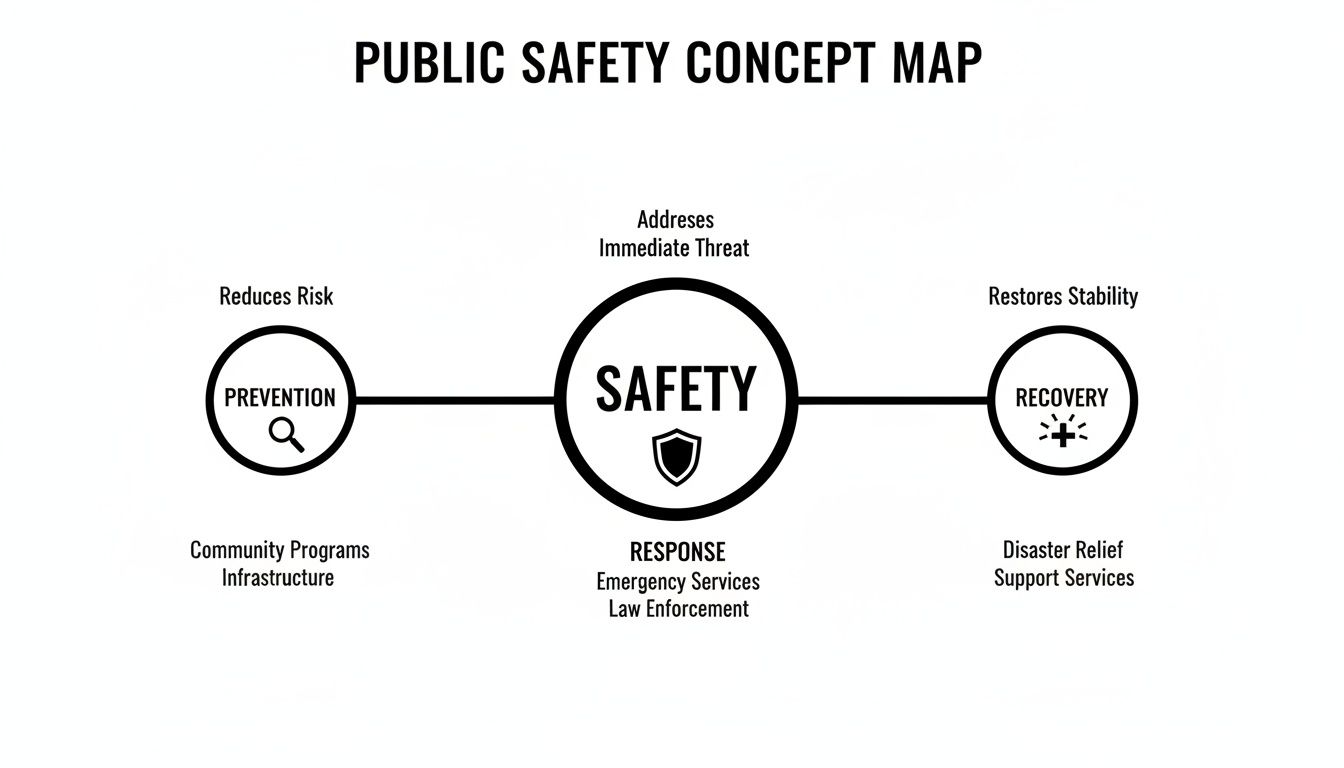
As you can see, a solid public safety strategy has to cover the entire lifecycle of an incident, not just the minutes when the sirens are blaring.
A Practical Example: The Multi-Car Pile-Up
Let's make this real. Imagine a massive pile-up on the interstate during morning rush hour. That single event instantly kicks the entire public safety ecosystem into gear.
Police cruisers are first on the scene, shutting down lanes and securing the crash site. Firefighters arrive next, firing up the Jaws of Life to extricate injured drivers from mangled vehicles. All the while, EMS crews are moving from car to car, triaging patients and treating the most critical injuries on the spot.
And overseeing this whole chaotic ballet is the emergency manager, coordinating with the department of transportation to reroute traffic and calling ahead to hospitals to prep them for the incoming wave of patients.
Without seamless communication, this whole thing falls apart. If the fire chief can't tell the EMS supervisor how many victims are trapped, or if police can't give the emergency manager an accurate picture of the scene, the response grinds to a halt. Resources get wasted, and lives are put at greater risk.
This is where the real-world definition of public safety snaps into focus. It’s not just about having these different teams; it's about connecting them. Communication gaps aren't just inefficient—they're dangerous.
Using a unified platform acts as the central nervous system for the entire operation, allowing separate agencies to share live data, see each other’s locations, and coordinate actions in real time. This is what stops those dangerous operational silos from forming, saving money by making sure the right resources are sent to the right place at the right time. If you are interested, you can learn more about the mission to unify first responder communications.
How Technology Is Reshaping Public Safety
Technology is completely changing the game for public safety. The days of relying on crackly radios and paper maps are fading fast. Today’s digital tools give first responders incredible situational awareness, predictive insights, and streamlined coordination, turning what used to be chaotic scenes into manageable operations.
This isn’t about flashy gadgets; it's about practical tools that save lives and resources. Innovations like artificial intelligence (AI), aerial drones, and integrated command platforms aren't science fiction anymore. They're active-duty assets in departments across the country, fundamentally changing the speed and effectiveness of emergency response.
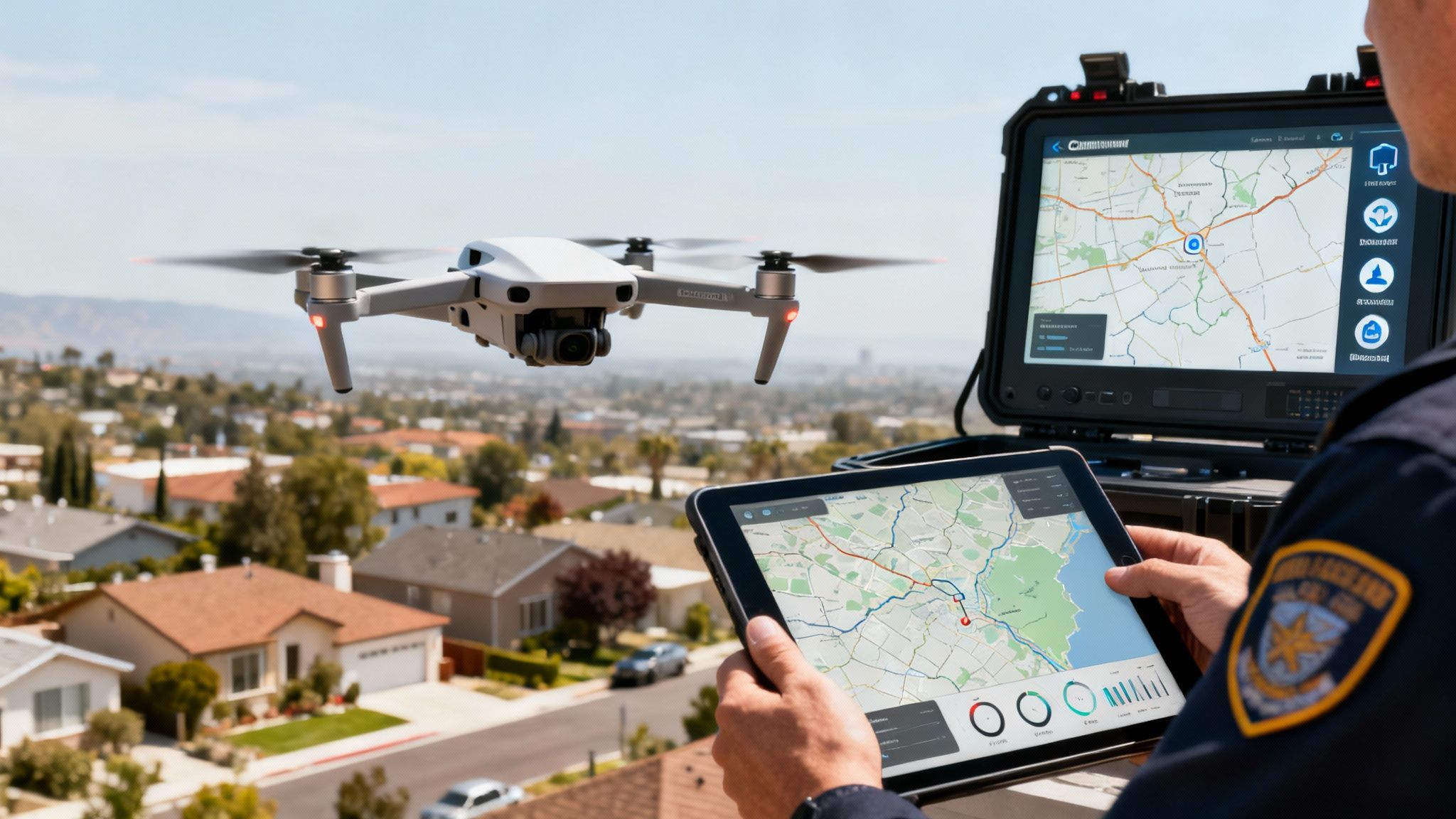
The image above is a perfect example of a modern command post. A drone gives a live, bird's-eye view of an incident, letting commanders make informed decisions from a safe distance. Pulling together multiple data streams like this gives agencies a powerful operational edge.
From Reactive To Predictive Operations
One of the biggest shifts is moving from a reactive model to a predictive one. Instead of just waiting for a 911 call, agencies are now using data to figure out where incidents are most likely to happen. This leads to smarter resource allocation and preemptive action.
AI-driven analytics can crunch historical incident data, weather patterns, and even social media chatter to flag potential hotspots for crime or accidents. This lets commanders deploy patrols or pre-position emergency assets where they'll be needed most, often stopping incidents before they escalate.
The impact is staggering. The public safety analytics market is on track to explode from $12,141.2 million in 2025 to $43,084.5 million by 2032. This isn't just hype; it's driven by real-world results. Some law enforcement agencies using AI have reported crime reductions of up to 89%. Real-Time Crime Centers that process live data feeds have boosted their operational effectiveness by 92%, proving just how much technology is redefining outcomes. You can dive deeper into the top public safety technology trends for 2025 to see what's coming next.
Making Advanced Technology Affordable
For years, one of the biggest hurdles to adopting new tech was the massive upfront cost. Agencies had to sink huge amounts of money into on-premise servers, expensive software licenses, and the specialized IT staff needed to keep it all running. This kept powerful tools out of reach for smaller departments and volunteer organizations.
The real game-changer has been the shift to cloud-based, Software-as-a-Service (SaaS) platforms. This model gets rid of the need for huge capital spending, replacing it with a predictable, affordable monthly subscription.
This approach makes top-tier technology accessible to agencies of all sizes. Instead of buying and maintaining a complex server room, departments can now access powerful dispatch, communication, and resource management tools right from a web browser. It's a fundamental shift in how public safety tech is bought and managed.
The Money-Saving Power Of Cloud-Based Systems
The bottom line is clear: moving to the cloud saves a significant amount of taxpayer money. Shifting to a SaaS platform helps agencies sidestep some major costs:
- Hardware Purchases: No need to buy expensive servers or networking gear.
- Maintenance Contracts: Forget about those costly annual contracts for hardware and software support.
- IT Overhead: Reduce the need for dedicated IT staff to manage and update systems.
We've seen firsthand how agencies struggle with the high costs and complexities of traditional systems. The piecemeal approach—buying separate software for CAD, personnel management, and communications—creates data silos and drives up costs. A modern, integrated platform solves that.
Cost Comparison: Traditional vs. Modern Public Safety Platforms
| Cost Factor | Traditional Systems | Resgrid Platform |
|---|---|---|
| Initial Setup Cost | $50,000 – $250,000+ (Hardware, Software Licenses) | $0 (Included with Subscription) |
| Annual Maintenance | $10,000 – $50,000+ (Support Contracts, Updates) | $0 (Included with Subscription) |
| IT Staffing | Requires 1-2 FTEs (Server management, security) | Managed by Resgrid (No dedicated staff needed) |
| Software Upgrades | Costly & Disruptive (Often requires new licenses) | Automatic & Seamless (Included with Subscription) |
| Scalability | Difficult & Expensive (Requires new hardware) | Instant & Flexible (Adjust plan as needed) |
The numbers speak for themselves. This modern approach not only slashes costs but also improves responder safety and operational efficiency. Integrated platforms like Resgrid provide a single source of truth, making sure everyone—from dispatch to boots on the ground—is working with the same real-time information. You can explore the full range of integrated features available in modern dispatch systems to see how they connect every piece of an operation. This level of connectivity is the new standard for effective public safety.
Measuring Success Through Community Trust
Sure, fast response times and low crime rates look great on paper, but they don't paint the whole picture. The real test of any public safety strategy boils down to one thing: community trust. You can have all the advanced tech, powerful analytics, and state-of-the-art gear in the world, but it means very little if the public doesn't have confidence in the agencies and people using it.
This is where the modern definition of public safety really comes alive. It’s a move away from a purely operational mindset to one that embraces transparency, accountability, and a genuine partnership with the community. When people feel safe and believe their public safety agencies are fair, a powerful cycle of cooperation kicks in.
Building Confidence Through Transparency
Trust doesn’t just happen. It’s earned through consistent, transparent action. More and more, agencies are getting creative about fostering this confidence, moving beyond stale press releases to give people a direct look into how they operate.
Some key initiatives that are making a real difference include:
- Community Policing Programs: This isn't just a buzzword. It's about assigning officers to specific neighborhoods so they can build actual relationships and solve local problems with the residents.
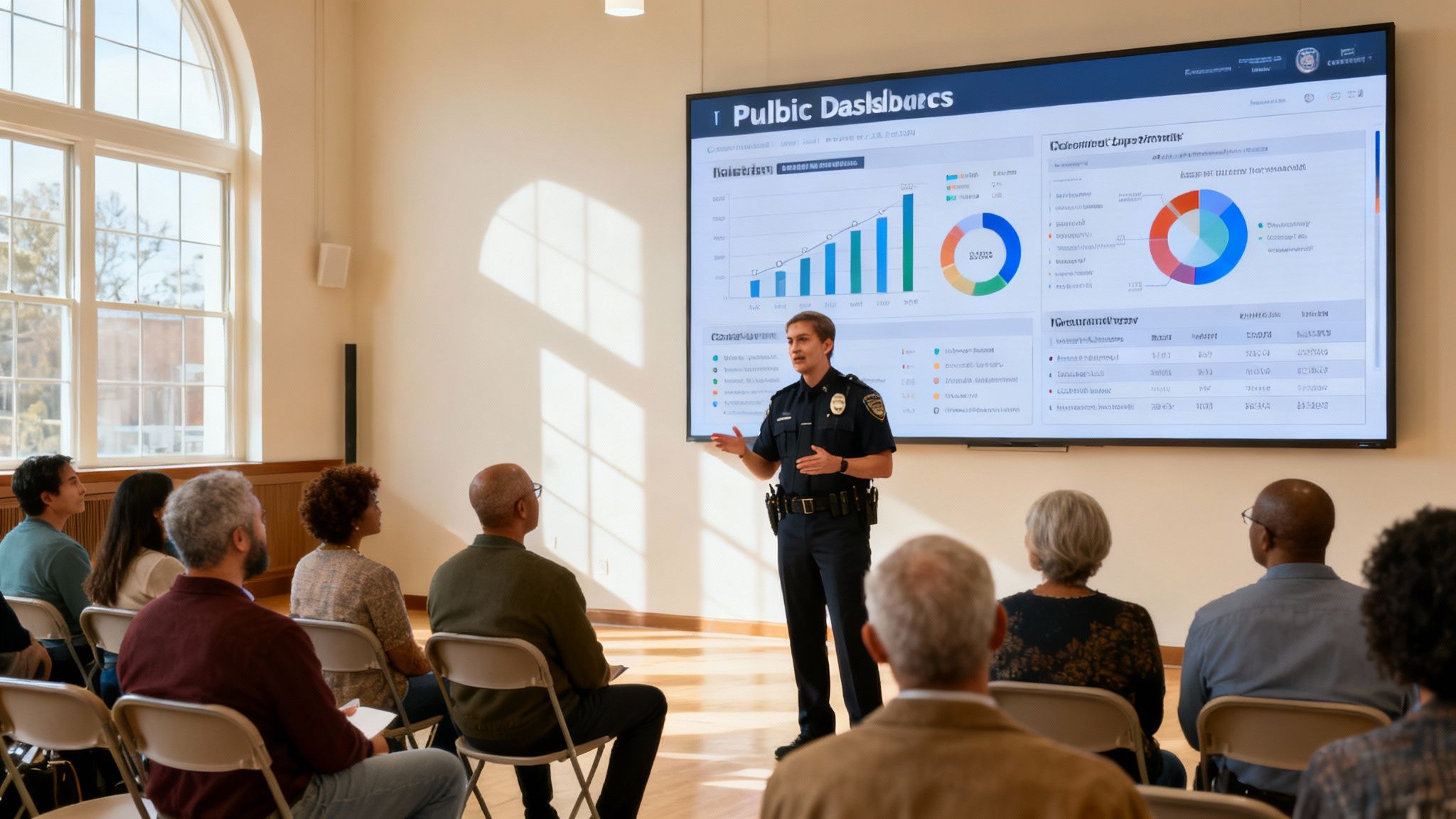
- Public Data Portals: Agencies are launching online dashboards that display crime stats, response times, and even use-of-force data. It gives citizens unfiltered access to the facts.
- Regular Town Halls: Creating open forums where community members can ask tough questions and voice concerns directly to agency leaders. No filters, no gatekeepers.
These efforts prove a commitment to accountability, and that directly impacts how people feel. The good news is that these strategies seem to be working. A recent study found that 73% of adults worldwide feel safe walking alone at night—the highest level in nearly two decades. In the U.S., confidence is also on the upswing, thanks to crime reductions and dedicated community engagement. In fact, 78% of agencies now use data analytics to build trust. You can dig into the numbers and learn more about these global safety perceptions and the data behind them.
Automating Accountability to Save Money
Now, building trust can sound like a massive, time-consuming, and expensive undertaking. But modern tech gives us a powerful, cost-saving shortcut. The operational data that agencies already collect can be repurposed into a tool for building community confidence with surprisingly little effort.
The key insight here is that the same platform used for dispatch and resource management can also power public transparency. It’s about making your operational data do double duty—improving internal efficiency while building external trust.
Here’s a practical example: a modern dispatch platform automatically logs every detail of an incident. It knows when the call came in, which units were assigned, and exactly when they arrived on scene. This data can then be automatically compiled and fed into a public-facing dashboard. Just like that, routine operational tasks become a powerful demonstration of accountability.
This approach saves a significant amount of money. Instead of paying staff to manually pull and compile reports for public release, the system does it on its own. This action alone can save hundreds of administrative hours per year, freeing up personnel for higher-value tasks. It turns operational data into a high-value, low-cost asset for community relations. It ensures every piece of the system, right down to ensuring robust system security, is working toward the goal of a safer, more connected community.
Overcoming Today's Public Safety Challenges
Public safety agencies everywhere are feeling the squeeze. Budgets are getting tighter, experienced people are retiring faster than new ones can be trained, and the calls we respond to are getting more complicated. We're dealing with everything from large-scale, multi-agency incidents to a sharp rise in mental health crises. It’s forcing leaders to get creative and find ways to do more with less.
This is where smart technology comes in. An integrated platform can be a genuine force multiplier, taking over the manual, time-sucking tasks that get in the way of the real work. For instance, automating the call-out process for volunteer firefighters can save dispatchers 10-15 minutes per incident, which adds up to hundreds of hours over a year. Things like scheduling, filling overtime shifts, and report generation can be automated, freeing up your people to focus on what only they can do.
The High Cost of Disconnected Systems
One of the biggest, and often hidden, drains on an agency's budget is what I call vendor sprawl. It’s what happens when you buy a separate piece of software for every little thing: one for dispatch, another for messaging, a third for scheduling, and a fourth for tracking units. Each one comes with its own price tag, its own learning curve, and its own support contract.
This piecemeal approach creates a couple of major headaches:
- Financial Drain: Those separate subscriptions add up, and fast. Before you know it, you've got a bloated software budget that’s eating into funds that could be used for training, new gear, or vehicle maintenance. Pulling all those functions into one platform can mean immediate, substantial savings.
- Operational Silos: When your systems don't talk to each other, information gets stuck. A dispatcher might not have the most current personnel roster from the scheduling software. A commander in the field can't easily see which specialized units are actually available from the resource tracker. This lack of a single source of truth slows down your response and, frankly, increases risk.
The solution is simple: vendor consolidation. By moving to an all-in-one system for dispatch, messaging, and resource management, agencies can cut out all those redundant software bills. It drastically cuts monthly costs and makes the entire IT setup a whole lot simpler.
A Practical Example of Saving Thousands
Let me give you a real-world example. I know a volunteer fire department that was trying to run their operations with a patchwork of tools. They used text message chains for call-outs, a shared spreadsheet for scheduling, and yet another paid service for mass notifications. Not only was it inefficient, but it was also costing them over $3,000 a year in subscription fees for a bunch of tools that couldn't even work together.
By switching to a single, unified platform, they rolled all those functions into one system with one, much lower, monthly fee. The result? They cut their annual software spending by more than 60%. On top of that, they gained new capabilities like real-time personnel tracking and automated reporting. For a volunteer department, saving thousands of dollars a year means more money for critical personal protective equipment (PPE) and training.
This screenshot from the Resgrid Pricing page shows how a modern platform can offer affordable, scalable plans without locking an agency into a big, scary contract.
The big takeaway here is the shift away from expensive, long-term commitments. A flexible, self-service model empowers agencies to pick a plan that fits their exact budget and needs, and to adjust as they grow.
Redefining Public Safety With Smart Investments
Overcoming these modern challenges is core to how public safety is defined today. It's not just about having the best trucks or the newest gear; it's about having the smartest, most efficient systems in place to support your people. A fragmented tech stack is a liability. It costs too much money, creates communication gaps, and piles unnecessary administrative work onto already busy crews.
The most effective way to save money and improve operations is to simplify. An integrated platform pays for itself not just by cutting subscription costs, but by reclaiming countless hours lost to manual processes and miscommunication.
This approach makes powerful tools accessible to agencies of any size, from large municipal departments to small volunteer squads, without breaking the bank. By making a strategic investment in a unified system, leaders can build a more resilient, responsive, and financially sustainable organization that's ready to face whatever comes next.
Your Blueprint for a Safer Community
As we've seen, modern public safety is a world away from just reacting to emergencies. It’s a proactive, collaborative commitment to building a truly resilient community, powered by smart technology. This isn't just some high-level theory; it delivers real, tangible benefits that agency leaders can see in their operations and, just as importantly, in their budgets.
When you adopt this mindset, you're creating a unified ecosystem where every single piece works together seamlessly. The results speak for themselves: better situational awareness for commanders, faster and more accurate responses for crews on the ground, and a much stronger foundation of trust with the community you protect and serve. It’s all about building a system that’s as ready for tomorrow's unknown challenges as it is for today's emergencies.
The True ROI of Modern Public Safety
Frankly, the biggest advantage is the ability to get better outcomes with fewer resources. An integrated platform delivers powerful cost savings by letting you consolidate vendors and automate the soul-crushing manual administrative work. Instead of juggling multiple subscription fees for separate dispatch, scheduling, and messaging tools, a unified system brings it all under one roof, immediately cutting your overhead.
This financial breathing room allows agencies to put funds back where they matter most: training, equipment, and personnel. For volunteer departments, this can mean thousands of dollars saved every year—money that can be put directly back into life-saving gear.
The core principle is simple: your operational platform should save you money, not just cost you money. By moving away from expensive, long-term contracts and siloed software, you gain both financial flexibility and operational superiority.
Take the Next Step
The journey to a more resilient and secure community starts with a hard, honest look at your current systems. Are your communication tools creating silos between agencies? Are you spending way too much on multiple software subscriptions that don't even talk to each other? Are you locked into an expensive, outdated contract that just isn't cutting it anymore?
Answering these questions is the first real step toward a smarter, more cost-effective future. Modern, flexible platforms like Resgrid give you the power to build a more effective response without the financial weight of old-school systems. By embracing a unified approach, you can give your responders the tools they need to protect your community effectively, ensuring you’re ready for whatever comes next.
Frequently Asked Questions
What’s The Difference Between Public Safety And Law Enforcement?
That’s a common question, and it's easy to see why. Law enforcement is a huge, highly visible part of public safety, but it’s still just one piece of a much larger puzzle.
Think of public safety as the entire ecosystem of emergency services. It includes fire departments, EMS, emergency management agencies, and even public health officials. All these groups work together to prevent bad things from happening, respond effectively when they do, and help communities recover afterward. Law enforcement is a critical player on that team, but they aren't the whole team.
How Can Smaller Agencies Afford Modern Technology?
In the past, this was a massive hurdle. You needed a huge capital budget for servers, software licenses, and IT staff. That's all changed, thanks to cloud-based, subscription (SaaS) platforms.
This model flips the script entirely. Instead of a massive upfront cost, agencies pay a predictable monthly fee. This is a game-changer for smaller departments and volunteer units, giving them access to powerful dispatch, communication, and coordination tools that were once only affordable for large, metro-sized agencies.
It really levels the playing field. You get the same high-end tech without the budget-breaking price tag, which is a practical way to boost response capabilities while being responsible with taxpayer money. Actionable Insight: Look for platforms with no long-term contracts. This allows you to scale your costs up or down as your needs and budget change, preventing you from being locked into an expensive plan.
What Is The First Step To Improving Agency Coordination?
Start by hunting down your communication silos. Seriously, where do things fall apart during a call? Where do messages get lost, delayed, or misinterpreted between different teams or agencies? Be honest about it.
The most practical first step is to look into a unified platform that pulls everything together—dispatch, messaging, and real-time location tracking. For example, when a fire department, police unit, and EMS crew all see each other's locations on the same live map, it prevents staging errors and redundant responses, saving fuel and personnel time on every call. When everyone is looking at the same map and the same information, you eliminate the guesswork and create a single source of truth. That’s how you close the most dangerous communication gaps during an incident.
Ready to connect your teams and build a more efficient public safety ecosystem? Resgrid offers a unified, affordable platform that gets rid of those communication silos and saves your agency money. You can learn more and get started over at https://resgrid.com.