
What Is a PSAP? Your Guide to Emergency 911 Call Centers
When you dial 911, you're not just making a phone call; you're activating an entire emergency response ecosystem. At the very heart of that system is the Public Safety Answering Point, or PSAP.
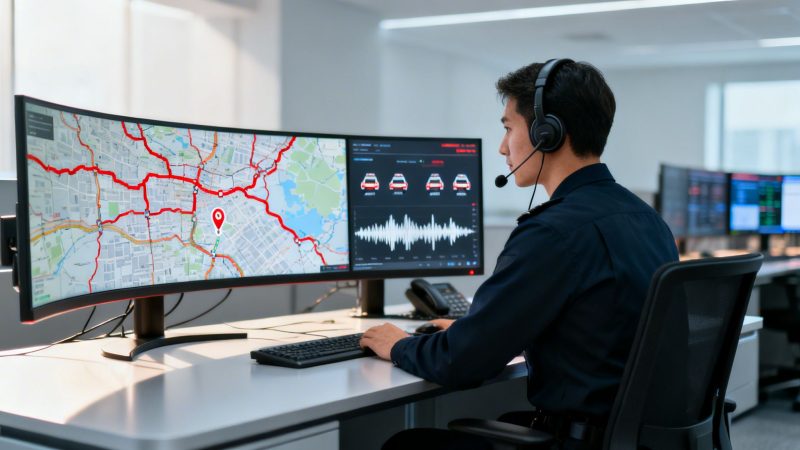
Think of a PSAP as the air traffic control tower for every crisis in a community. It’s the physical or virtual place where a highly trained telecommunicator answers your call and immediately begins coordinating police, fire, and medical teams, guiding them exactly where they need to go.
The Critical Role of a PSAP in Public Safety
Every single day, communities depend on an invisible lifeline that connects them to help at a moment's notice. That lifeline is the PSAP. It serves as the first, and most critical, point of contact during an emergency. The core job is simple to state but incredibly complex to execute: receive emergency calls, process life-or-death information under immense pressure, and dispatch the right first responders without delay.
The scale of this operation is staggering. In the United States alone, PSAPs handle a massive 240 million 911 calls every year. What’s even more telling is that roughly 80% of those calls now come from wireless devices, which adds layers of complexity to locating callers. If you want to dive deeper into the numbers, the National 911 Profile Database Report offers some incredible insights into the scope of this work.
Core Functions of a PSAP
So, what actually happens inside a PSAP? It’s more than just answering phones. Every function is a vital link in the chain of survival, from the second a call is picked up to the moment help arrives on the scene.
A PSAP's efficiency isn't just about the latest tech. It's about the seamless fusion of human skill, proven procedures, and robust systems that turn a cry for help into a coordinated, life-saving response.
To really get a feel for what goes on, let's break down the core functions with some real-world examples.
Core Functions of a Public Safety Answering Point
This table shows the primary jobs of a PSAP and what they look like in action.
| Function | Description | Practical Example |
|---|---|---|
| Call Reception | Answering emergency calls (911) and gathering initial information from the caller. | A dispatcher answers a 911 call from a driver reporting a multi-car accident on a busy highway. They get the highway name and nearest mile marker. |
| Information Processing | Verifying the location, assessing the nature of the emergency, and logging all details. | The dispatcher uses GPS data to confirm the location and asks about visible injuries, trapped passengers, and if any vehicles are on fire. |
| Resource Dispatch | Alerting and sending the correct emergency services (police, fire, EMS) to the scene. | Based on the information, the dispatcher alerts the State Highway Patrol, two ambulances, and a local fire department's heavy rescue truck. |
| Communications Support | Relaying updates between the caller, dispatch, and responding units until the incident is resolved. | The dispatcher tells the responding units that a car is smoking and advises the fire chief that one driver is reporting chest pains. |
From call-taking to radio communications, each step is designed to get the right help to the right place as quickly and safely as possible. It’s a high-stakes, high-pressure job that keeps our communities running.
The Lifesaving Journey of a 911 Call
So, what actually happens when you dial 911? That simple three-digit call kicks off a lightning-fast sequence of events inside a PSAP, a place where human expertise and powerful technology meet to turn a cry for help into a coordinated response. This journey is really the core of what a PSAP is and what it accomplishes day in and day out.
Let’s walk through a scenario. Imagine a medical emergency unfolding at a public park. A bystander dials 911. Instantly, that call gets routed to the nearest PSAP where a trained telecommunicator answers, their voice calm and steady. The first questions are always the same: "Where is your emergency?" and "What is happening?"
Even as the caller explains the situation—someone has collapsed and isn't breathing—the dispatcher's screen is already lighting up with information. Technologies like Automatic Location Identification (ALI) are working in the background, using cell tower triangulation or GPS data to pinpoint the caller's location, which the dispatcher then works to confirm verbally.
From Information to Action
This is multitasking on another level. The dispatcher is giving pre-arrival instructions, maybe talking the caller through how to perform CPR, while simultaneously logging every single detail into the Computer-Aided Dispatch (CAD) system. This isn't just for notes; the information is instantly shared with other dispatchers who can start lining up the right resources.
Based on the type of call, the CAD system will suggest the best response plan. For this medical emergency, it's an ambulance and a fire department crew, since firefighters often carry defibrillators and oxygen. The dispatcher selects the closest available units and hits the button to send the alert.
This flowchart breaks down the basic steps in the PSAP workflow.
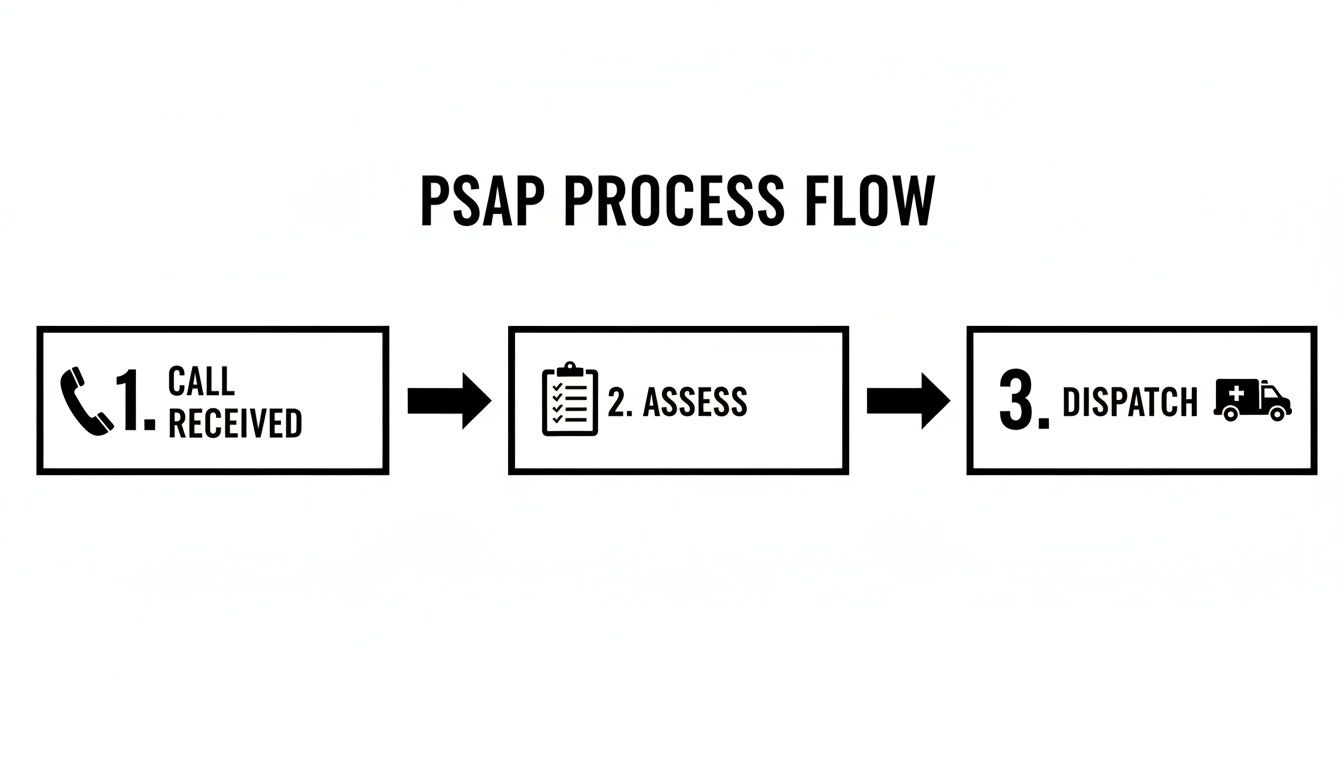
As you can see, the process moves logically from a simple call for help to a structured, multi-agency operation in just a few clicks.
A Coordinated and Cost-Effective Response
While the first dispatcher stays on the line with the caller, a separate radio dispatcher is now talking directly to the responding units. They're relaying the critical updates: the patient’s exact spot in the park, their condition, and any potential hazards on scene. This two-pronged approach is brilliant—it ensures the caller has a constant lifeline while the crews in the field get real-time intelligence.
Every single step in this process is designed to shave precious seconds off the clock. In an emergency, seconds save lives. The entire workflow, from the first ring to dispatching help, often takes less than 60-90 seconds.
This efficiency isn't just about speed; it's also smart resource management. By correctly identifying the emergency's severity and location right away, the PSAP avoids sending too many units or the wrong kind of help. Sending the right responders the first time saves fuel, reduces wear and tear on expensive equipment, and most importantly, keeps other units free for the next call. It’s a system that directly saves taxpayer money and maximizes public safety.
The Technology Powering Modern PSAPs
Behind every dispatcher’s calm, steady voice is an impressive suite of technology that makes a coordinated response even possible. This digital toolkit is the central nervous system of any modern PSAP, turning the raw data from a 911 call into actionable intelligence for first responders. These systems are built from the ground up for speed, accuracy, and rock-solid reliability when every single moment counts.
At the heart of it all is the Computer-Aided Dispatch (CAD) system. The easiest way to think of a CAD is as the PSAP's digital brain. It's where dispatchers log every critical detail of an incident, track the real-time status and location of emergency units, and manage resources on the fly. It's the primary screen a dispatcher is glued to, providing a complete operational picture from the first call to the final "all clear."
Of course, none of that works without clear communication. That's why a cornerstone of modern PSAP tech is the use of advanced digital standards like P25 radio technology, ensuring those life-or-death communications are always reliable.
The Shift to Next Generation 911
The technology inside a PSAP is in a constant state of evolution. The single biggest shift we're seeing right now is the move to Next Generation 9-1-1 (NG911).
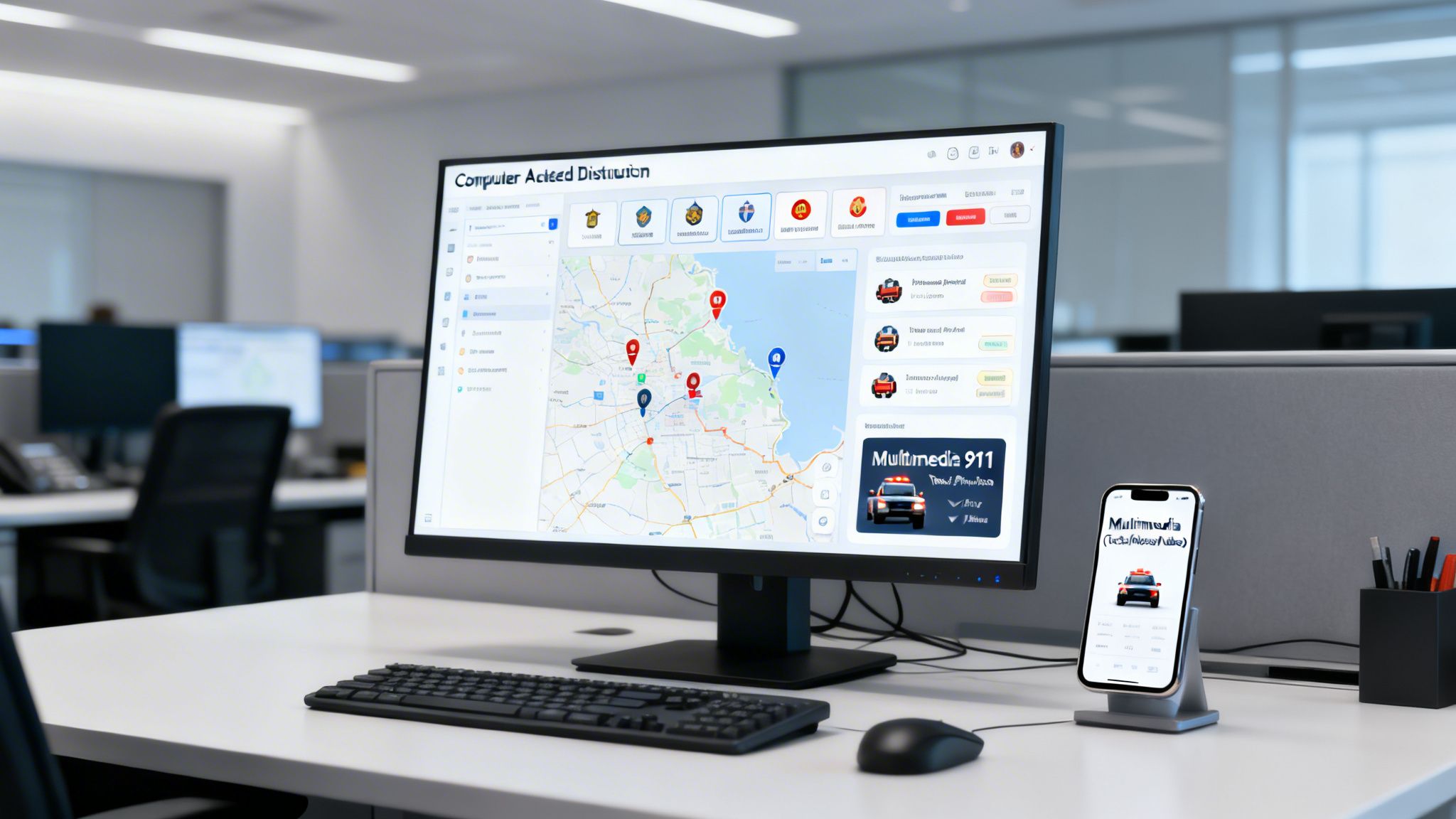
If traditional 911 was a landline phone, NG911 is a smartphone. It’s an internet-based system that can handle not just voice calls but also texts, images, and videos. This gives dispatchers a much richer, more accurate understanding of an emergency as it’s actually unfolding.
This upgrade is absolutely crucial for public safety. By 2021, 2,287 PSAPs in the U.S. were already using advanced IP networks for NG911, which was a 5% increase from the year before. The transition is essential for improving location accuracy from mobile devices and simply keeping up with the modern ways people communicate.
Save Money by Extending Legacy Systems
Here's a challenge many PSAPs face: they have aging but still-functional CAD systems. A full "rip and replace" can cost millions of dollars, which just isn't in the budget for many smaller agencies. This is where smart integrations come in, offering a real, cost-saving solution.
Actionable Insight: Integrating a flexible platform like Resgrid with a legacy CAD system can extend its life and add modern features—all without the massive expense of a complete overhaul.
Instead of paying a fortune for expensive custom development, agencies can use Resgrid to plug in functionalities that their old CAD just can't handle. This approach saves a significant amount of money and creates a unified, modern operational view.
Here's a practical example of how this saves money:
- Problem: A county PSAP needs to manage scheduling for 20 different volunteer fire departments. Their old CAD system doesn't have this feature, and the vendor quoted $50,000 for a custom add-on.
- Solution: They integrate Resgrid for a low monthly fee. It handles all volunteer scheduling, availability, and automated callouts.
- Result: The county avoids a massive capital expense, improves volunteer response times, and frees up dispatchers from making dozens of phone calls for a single incident. The ROI is immediate.
By adding these kinds of capabilities, Resgrid allows agencies to modernize their operations at a fraction of the cost. It ensures their PSAP technology remains effective and, just as importantly, secure. For more information, you can read about Resgrid's commitment to security for public safety agencies.
Understanding Different Types of PSAPs
Not all 911 centers are built the same. When you hear the term PSAP, it’s really an umbrella for a few different operational models, each set up to handle the specific demands of a city, county, or region. Getting a handle on these differences is the first step to seeing the full picture of how a 911 response gets coordinated.
The most basic way to slice it is by separating centers into primary and secondary roles.
A Primary PSAP is exactly what it sounds like: the first place your 911 call lands. It’s the initial point of contact for every emergency call within a specific geographic area, like a large city or an entire county. Their job is to grab the essential details—where and what—and figure out who needs to go.
In many situations, that primary center will directly dispatch its own local police, fire, or EMS units. But what if the call requires a more specialized response? That’s where a Secondary PSAP enters the picture. These centers are specialists, handling dispatch for a single agency or a unique type of incident.
Primary vs Secondary PSAP Example
Let's walk through a real-world scenario. Picture a major pile-up on an interstate highway. A driver calls 911.
- The call is automatically sent to the county-level Primary PSAP, which is the catch-all for that area.
- A dispatcher answers, quickly getting the location and the basics of the crash. They recognize the incident is on a state highway, which puts it in the jurisdiction of the State Highway Patrol.
- The Primary PSAP dispatcher then transfers the call—along with all the info they just gathered—over to the State Highway Patrol’s Secondary PSAP. This is the specialized center responsible for dispatching state troopers.
This handoff is critical. It makes sure the agency with the right legal authority and training for that specific location is the one sending help, cutting down on confusion and getting responders on the road faster.
Consolidated vs Standalone Models
Beyond the primary/secondary distinction, PSAPs are also organized as either large, consolidated hubs or smaller, independent operations. Each approach has its own set of pros and cons, and the choice often comes down to budget, politics, and local needs.
This table gives you a quick breakdown of how the two models stack up.
Consolidated vs Standalone PSAP Models
| Feature | Consolidated PSAP | Standalone PSAP |
|---|---|---|
| Scope | Serves multiple towns, cities, or an entire county from one central location. | Serves a single jurisdiction, such as one city's police or fire department. |
| Benefits | Cost sharing for technology and staff, improved inter-agency coordination. | Deep local knowledge, direct control over operations and agency-specific procedures. |
| Drawbacks | Can lose nuanced local knowledge, potential for complex inter-agency politics. | Higher operational costs per capita, potential for technology and staffing gaps. |
Ultimately, there’s no single "best" model. A consolidated center can create incredible efficiencies and make multi-agency responses seamless, while a standalone PSAP offers a level of local expertise that's tough to replicate.
Actionable Insight: Businesses and large event organizers can create their own private 'mini-PSAP' for internal security and operations using a platform like Resgrid. Instead of paying for expensive external dispatch services for non-emergency coordination—like directing security patrols at a music festival—you can manage your own team in real time. This approach dramatically saves money by bringing dispatch capabilities in-house, giving you direct control over your assets and personnel without the high contract fees.
Enhancing PSAP Efficiency and Reducing Costs
Every PSAP director is living with the same challenge: how do you improve response times and keep your community safe when you're constantly fighting a budget that never seems to be big enough? The answer isn't always a multi-million dollar rip-and-replace of your core systems. Often, the smartest move is a strategic one—finding ways to boost efficiency that also happen to cut operational costs.
This is exactly where modern dispatch support platforms come in. They offer a practical, money-saving way to solve some very real problems.
Think about a common headache: dispatching a volunteer fire department. Without the right tools, this simple act can tie up precious radio channels. The dispatcher is stuck in a back-and-forth, trying to figure out who is actually responding, if they're qualified, and when they might get to the station. All that chatter adds noise and mental strain right when focus is most critical.
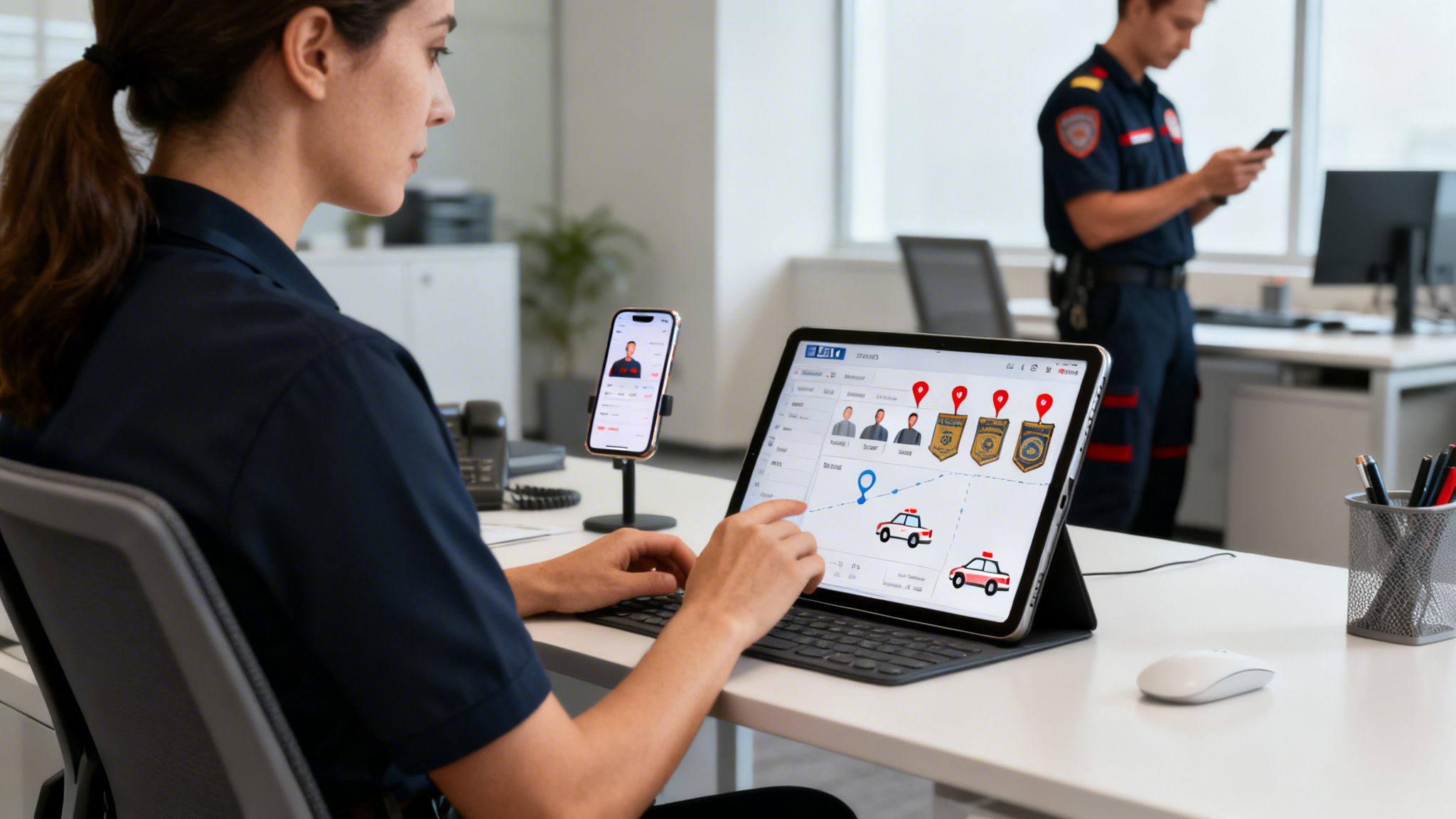
Now, imagine a platform like Resgrid handling that entire process in the background. It automatically tracks who’s available, sends out the alerts, logs their ETAs, and confirms their qualifications—all without a single word over the radio. Suddenly, your dispatcher is free to focus on the actual emergency, not the administrative churn.
Offloading Tasks to Save Real Money
The sheer scale of coordination a PSAP manages is staggering. Just look at France, where PSAPs handled 74.5 million calls in 2022, juggling incidents across police, EMS, and fire services. As you can see from global PSAP reports, any small inefficiency gets multiplied by millions, bogging down the entire system.
Actionable Insight: By using a supplemental platform to offload tasks like personnel management and internal messaging, PSAPs can save a significant amount of money. This approach avoids the need for expensive, custom add-on modules for legacy CAD systems, which can easily cost tens of thousands of dollars for a single feature.
Instead of paying for a massive, disruptive upgrade, an agency can plug in a cost-effective solution to solve specific operational gaps.
A Practical Example of Saving Money
- The Problem: A rural county PSAP dispatches for 15 volunteer fire departments. For a structure fire, a dispatcher spends 5-10 minutes on the radio trying to confirm if they have enough personnel responding. This delays other critical tasks and ties up a primary communication channel.
- The Actionable Solution: They implement a supplemental dispatch system. When a call is dispatched, an alert automatically goes to firefighters' phones. They tap a button to confirm they are responding.
- The Cost Savings: The dispatcher now sees a live roster of responders on their screen instantly, saving hours of radio time per week. This allows the county to defer a costly radio system upgrade and reduces the need for dispatcher overtime, saving thousands of dollars annually.
By offloading these logistical burdens, the platform empowers dispatchers to do what they do best: manage the emergency. It’s a targeted approach that not only improves response times but also delivers a direct and significant return on investment by getting more life out of the technology you already own. You can explore some of these dispatch support features to see just how they can be applied.
Clearing Up Common Questions About PSAPs
When you dig into the world of emergency response, a few questions always pop up. It's totally natural. Let's walk through some of the most common ones to give you a clearer picture of how these critical operations work behind the scenes.
Is a PSAP the Same Thing as a 911 Dispatch Center?
Yep, they're one and the same. You're not missing anything here; it's just a matter of industry jargon versus everyday language.
"PSAP" is the official, technical term for the facility that answers emergency calls. "911 dispatch center" is just what most of us call it. Think of it like a "physician" versus a "doctor"—two different words for the exact same professional.
How Does a 911 Center Find Me If I Call From a Cell Phone?
This is where technology has made some incredible leaps. When your call first connects, the PSAP gets a general fix on you from the cell tower your phone is pinging. That might only narrow it down to a few blocks. But then, more advanced systems kick in.
Modern Enhanced 911 (E911) can tap into your phone's own GPS for a much more accurate location. It’s a game-changer.
Even with all this tech, Next Generation 9-1-1 (NG911) is pushing for even greater accuracy. But here's a pro tip from the field: always, always state your location out loud if you can. Technology can have a bad day, but your voice provides a direct confirmation for responders.
Can I Really Text 911?
In a lot of places, you absolutely can. PSAPs that are equipped for Text-to-911 can receive and respond to text messages, which is a lifeline for anyone in a situation where making a voice call is dangerous or impossible.
The one catch is that it's not available everywhere yet. That's why the official guidance is simple and smart: "Call if you can, text if you can't." A voice call is still the fastest, most reliable way to get complex details across to a dispatcher.
What Kind of Training Do 911 Dispatchers Get?
The training for PSAP telecommunicators is intense, and for good reason. They are the first first responders, and their skills can mean the difference between life and death. It starts with state-mandated certifications for handling police, fire, and medical emergencies.
But it goes way deeper than that. They also receive specialized training in:
- Crisis intervention and de-escalation techniques
- Emergency Medical Dispatch (EMD) protocols, which allow them to give life-saving instructions over the phone before help arrives
- Mastering complex technologies like CAD systems and multi-channel radios
- Constant, ongoing education to stay sharp and up-to-date on new procedures
This isn't a one-and-done course; it's a career-long commitment to being ready for anything. And if you're curious about how agencies handle the sensitive data that comes with this work, you can read about our commitment to privacy.
Resgrid offers a comprehensive, open-source platform that integrates dispatching, personnel management, and real-time communications to support first responders and businesses. Discover how our cost-effective solution can enhance your operational efficiency at https://resgrid.com.