
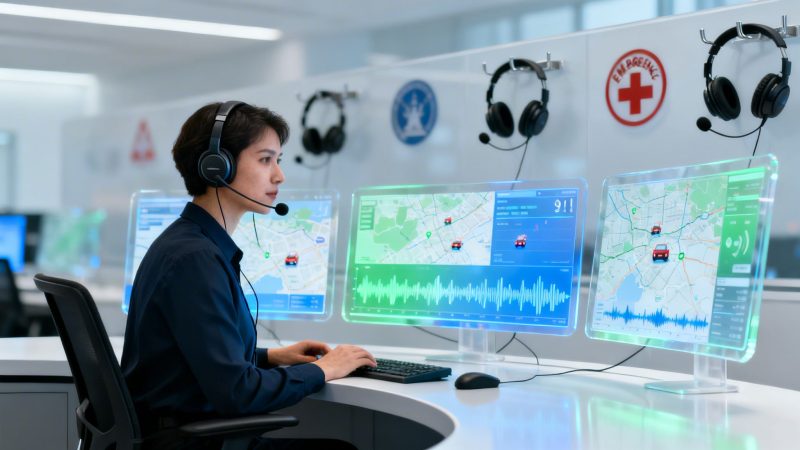
What Do 911 Dispatchers Do? A Guide to Their Critical Role
When you think of an emergency, you probably picture flashing lights and sirens. But before any of that happens, before a single fire truck or ambulance hits the street, another first responder is already on the scene—the 911 dispatcher.
They are the central nervous system of any emergency response. The calm, steady voice on the other end of the line when your world is falling apart.
The Unseen First Responder in Every Emergency
It’s probably best to think of a 911 dispatcher as the air traffic controller for a city's emergencies. They’re the first point of contact, sitting in a dark room full of screens, turning panicked, fragmented calls into a coordinated, life-saving response. Their job isn’t just to answer a phone; it's to make critical, life-or-death decisions in a matter of seconds.
This goes way beyond just taking a message and passing it along. Dispatchers are the initial strategists, assessing the chaos to figure out exactly who and what needs to be sent. And the scale of this is just massive. In 2021 alone, 45 states reported a staggering 213,652,929 total 911 calls. You can dig into the numbers yourself in the full national 911 data report.
Core Responsibilities of a Dispatcher
A dispatcher’s day is a constant juggle of intense communication, triage, and coordination. They have to listen to what’s being said—and just as importantly, what isn't being said—to get a real handle on the situation.
Their main functions really boil down to three key areas:
- Information Gathering: They have to pull the "who, what, where, and when" from callers who are often terrified, in pain, or can barely speak. Practical Example: In a domestic violence call, the dispatcher needs to calmly ask if weapons are involved, if children are present, and if the aggressor is still on scene—details that dictate the entire police response.
- Emergency Triage: This is all about prioritizing. A call about a house on fire is going to jump the line ahead of a fender bender with no injuries. It’s about getting the right help to the most critical incidents, fast.
- Providing Pre-Arrival Instructions: Sometimes, the most important work happens before help ever arrives. Dispatchers are trained to walk callers through life-saving steps like CPR, controlling bleeding, or getting out of a dangerous spot.
Think about a parent calling because their child is choking. A dispatcher can calmly guide them through the Heimlich maneuver, step by step. Those instructions, delivered over the phone in the few minutes it takes for an ambulance to arrive, can absolutely be the difference between life and death.
Actionable Insight to Save Money: Investing in solid dispatcher training pays for itself. A well-trained dispatcher knows how to correctly identify a non-emergency call that doesn't need a full-blown response, such as a noise complaint versus a break-in. By dispatching a community service officer instead of a sworn police officer for a minor issue, the agency saves on fuel, personnel hours, and the operational cost of deploying a high-priority unit.
To give you a clearer picture, here's a quick breakdown of what a dispatcher handles on a typical call.
Core Responsibilities of a 911 Dispatcher at a Glance
| Responsibility | Description | Practical Example |
|---|---|---|
| Call Taking & Triage | Answering the initial 911 call, assessing its urgency, and gathering essential details under pressure. | A caller reports a multi-car accident. The dispatcher determines the number of vehicles, potential injuries, and if lanes are blocked to prioritize it. |
| Information Gathering | Extracting the "who, what, where, when, and weapons" from callers who may be panicked or injured. | Obtaining a suspect's description and last known direction of travel during a robbery call. |
| Resource Dispatching | Assigning the appropriate police, fire, or EMS units to the incident based on nature, location, and priority. | Sending two engine companies, a ladder truck, and a battalion chief to a confirmed structure fire. |
| Pre-Arrival Instructions | Providing critical, life-saving guidance to the caller before responders arrive on the scene. | Walking a caller through how to perform CPR on an unresponsive person. |
| Radio Communications | Managing radio traffic, relaying updates between the field units and the command center, and running checks. | Running a license plate for an officer on a traffic stop and advising them of any wants or warrants. |
| Documentation | Creating a detailed, accurate, and chronological log of the entire incident in the CAD system. | Noting every update: call received at 14:02, Unit 12 dispatched at 14:03, on-scene at 14:08, transport to hospital at 14:25. |
Each of these duties is a link in a chain, and a skilled dispatcher ensures that chain never breaks, no matter how chaotic things get.
A Step-by-Step Look Inside an Emergency Call
To really get what 911 dispatchers do, let's ditch the theory and jump into the deep end with a high-stakes scenario. Picture a packed outdoor festival on a sweltering day when someone suddenly collapses. A bystander, panicking and not totally sure where they are in the chaos, dials 911. The dispatcher's clock starts now.
The first voice the caller hears is calm, collected, and in control. The dispatcher's number one job, right out of the gate, is to pin down that location. While the caller is shouting, "Someone passed out at the summer festival!" the dispatcher is already using advanced mapping tools to get a rough fix on the cell signal.
At the same time, they're firing off clarifying questions: "What stage are you near? Do you see a landmark, like the Ferris wheel or the main food court?" These aren't random questions; they’re designed to turn a vague spot into a precise point rescue teams can actually find.
From Chaos to Coordinated Response
Once the location is locked in—often within 15-30 seconds—the dispatcher pivots to medical triage. This is more than just asking what’s wrong; it's a structured protocol like Emergency Medical Dispatch (EMD) kicking into gear. They start giving clear, life-saving instructions directly to the caller.
- Actionable Instruction: "Okay, I need you to check if they are breathing. Put your ear next to their mouth and tell me if you feel air."
- Safety Assurance: "Help is on the way. I'm going to stay on the line with you until they arrive. You are not alone."
While walking the caller through these steps, the dispatcher is simultaneously typing coded information into a Computer-Aided Dispatch (CAD) system. This creates a digital trail and instantly sends the incident to the radio dispatcher, who is already alerting the closest ambulance and fire engine.
This graphic really shows that rapid, three-part process in action: gathering info, giving instructions, and getting help rolling.

It’s a masterclass in multitasking. They take a single, panicked call and turn it into a multi-agency response without ever missing a beat.
Prioritizing and Managing Resources
But here's the thing: this medical emergency isn't happening in a vacuum. The dispatcher has to weigh it against every other active call in the city. While this one is a high priority, it might be just one of a dozen different incidents they're juggling in that single hour.
Actionable Insight to Save Money: Proper call classification prevents unnecessary resource deployment. For example, by accurately identifying a minor fall without injury using EMD protocols, a dispatcher can send a single Basic Life Support (BLS) ambulance instead of a more expensive Advanced Life Support (ALS) paramedic unit with a fire engine escort. This optimizes the use of high-cost medical assets, keeping them available for true life-or-death emergencies and saving significant operational funds.
Dispatchers handle an incredible mix of calls. In fact, studies show that disturbances and traffic incidents are the most common calls for service. The top five police dispatch categories are disturbance/nuisance (22.6%), traffic incidents (12.7%), theft (12.5%), domestic disturbances (7.2%), and suspicious persons (7.0%).
You can dive deeper into the distribution of emergency police calls if you’re curious. It just goes to show how skilled dispatchers are at shifting gears from one type of crisis to another, minute by minute.
The Technology Powering Emergency Response
If you’re picturing a dispatcher with just a single phone and a headset, it’s time for an update. Today’s dispatch centers are high-tech command hubs, where every piece of equipment is designed to shave seconds off response times when it matters most.
The heart and soul of this entire operation is the Computer-Aided Dispatch (CAD) system. Think of CAD as the dispatcher's digital co-pilot. It’s a powerful piece of software that logs every call, keeps tabs on where every police car, fire truck, and ambulance is, and creates a meticulous, second-by-second record of an entire incident. It’s the single source of truth that cuts through the chaos.

But the CAD system doesn't work alone. It’s plugged into a whole suite of other critical tools, creating a seamless flow of information that’s absolutely vital for managing an emergency.
Key Tools in the Dispatcher's Arsenal
Beyond the CAD, dispatchers have a whole toolbox of tech they rely on. Each tool adds another layer of crucial information, helping them make smarter, faster decisions.
- Geographic Information System (GIS) Mapping: This is way more than your car's GPS. GIS gives dispatchers incredibly detailed maps showing not just a caller’s location but also things like the closest fire hydrants, specific building layouts, and the live location of every single responding unit.
- Multi-Channel Radio Consoles: A dispatcher is a master communicator. They're constantly juggling multiple radio channels at once—talking to police on one, the fire department on another, and EMS on a third. They are the central hub connecting everyone in the field.
- Next-Generation 911 (NG911) Systems: The future is already rolling out. NG911 lets people send texts, photos, and even videos directly to 911. This gives dispatchers eyes on a scene before units even arrive, which can be a complete game-changer.
Being able to see which units are closest and actually available saves precious time when seconds can literally mean the difference between life and death.
The Power of an Integrated Platform
The real magic happens when all these separate pieces of tech stop acting like individuals and start working as a single, cohesive team. A truly integrated system breaks down the dangerous information silos, making sure the call-taker, dispatcher, and the crews in the field are all on the same page, looking at the same live data.
Actionable Insight to Save Money: For agencies, there's a huge money-saving benefit here. Instead of juggling and paying for a half-dozen different software licenses for CAD, mapping, and messaging, a single, unified system cuts down on both subscription costs and IT complexity. It also reduces training time and expenses for new dispatchers, as they only need to learn one integrated interface instead of multiple disconnected programs, getting them effective much more quickly.
With a single interface, a dispatcher can see a new call pop up on a map, instantly view the closest available units, send them out with a click, and push critical updates straight to their in-vehicle computers or phones. You can see how specific dispatch management features make this a reality. This level of integration isn't a luxury anymore; it's the new standard for modern, effective emergency response.
The Skills Required to Be the Voice of Calm
Forget the glowing screens and complex tech for a moment. The single most powerful tool in any dispatch center is the dispatcher themselves. Answering that call requires a very specific mix of formal training and personal strengths you just can't learn from a textbook. It's a career built on a foundation of both technical skill and profound human resilience.
The journey starts with months of rigorous training and certification. New dispatchers dive deep into classrooms and intensive on-the-job training, mastering everything from local geography and radio codes to life-saving protocols like Emergency Medical Dispatch (EMD). This is where they learn the structured, systematic approach to turning pure chaos into an orderly response.

This ongoing education is critical, but it’s the so-called "soft skills" that truly define a great dispatcher. They are the absolute bedrock of an effective emergency response, allowing them to perform under a level of pressure that would shatter most people.
Core Traits of an Effective Dispatcher
Certain personal qualities are completely non-negotiable if you want to succeed behind the console. These are the skills that empower them to be the steady voice when everything is falling apart.
- Unflappable Composure: The ability to remain completely calm and focused while a caller is screaming, crying, or can't even speak clearly is paramount.
- Rapid Problem-Solving: Dispatchers have to think on their feet, piecing together fragmented information to make life-or-death decisions in a matter of seconds.
- Empathetic Listening: It’s about hearing what’s being said—and what isn’t. A subtle shift in a caller's tone can reveal a danger they're too afraid to say out loud.
"Something is changing for them in that moment, and we witness that through their voices," explains one 21-year veteran dispatcher. This raw ability to connect with callers on a human level, even in the most traumatic moments, is what allows them to pull out the critical details needed to send the right help.
Practical Example: Picture a call from a terrified driver whose car just went off a bridge into a river. The dispatcher has to simultaneously keep their own adrenaline in check, deliver clear step-by-step instructions on how to escape a sinking vehicle ("Unlock your doors, unbuckle your seatbelt, and roll down the window now"), coordinate dive teams and medical units, and document every single detail.
This isn't just multitasking; it's a high-wire act of mental and emotional agility performed without a safety net. This kind of resilience is what truly defines what 911 dispatchers do. Actionable Insight: Smart agencies invest in psychological support and wellness programs. This helps maintain these critical skills, reducing burnout and the high costs associated with employee turnover, recruitment, and overtime pay for remaining staff.
Navigating the High-Stakes World of Dispatch
Technology and training are mission-critical, no doubt. But the real weight of dispatching rests on the human element. The job of a 911 telecommunicator is one of the most psychologically taxing roles in public safety, period. It’s defined by a constant stream of trauma, split-second decisions with lives on the line, and relentless pressure.
This isn't just a tough job; it's a role that asks dispatchers to be the calm voice in the storm, absorbing a community's worst moments, day in and day out. That continuous exposure leads to some serious challenges, like emotional burnout and compassion fatigue, where the very capacity for empathy gets overloaded. It’s a heavy, hidden toll that drives stress through the roof and contributes to high turnover.
Making a tough situation worse? Chronic staffing shortages that stretch already-thin resources to their breaking point. This forces dispatchers to juggle even more calls with less backup.
The Reality of Staffing Shortages
These aren't just stories from the comms center floor; the data backs it up. Widespread staffing issues are putting an incredible strain on the entire emergency response system.
A 2023 survey found the average vacancy rate in 911 centers across the country was around 25% between 2019 and 2022. Think about that: for every four dispatcher chairs, one was sitting empty. Even more alarming, 36% of centers reported having fewer filled positions in 2022 than they did back in 2019, pointing to a trend that’s going in the wrong direction. You can dig into the full 2023 national survey data to see the scope of the problem.
Actionable Insights for Agency Leaders
Tackling these pressures isn’t just a wellness initiative—it's a smart operational and financial strategy. When you invest in your dispatchers' well-being, you see a direct impact on lowering costs tied to turnover, sick leave, and recruitment.
Practical Example: An agency can bring in modern dispatch software specifically designed to cut down on a dispatcher's cognitive load. By automating routine but necessary tasks like status checks or unit messaging, the system frees up precious mental bandwidth. This lets dispatchers focus their full attention on the active, life-threatening emergency in front of them, acting as a crucial buffer against burnout and reducing costly human errors.
Here are two key strategies that deliver real returns:
- Invest in Peer Support Programs: Building a structured program where dispatchers can talk confidentially with trained peers who get it is a low-cost, high-impact way to build resilience. It helps break down the stigma around mental health in a profession where toughness is often the default and can reduce sick leave usage.
- Modernize the Toolkit: Nothing adds frustration to an already stressful job like clunky, outdated software. Investing in a streamlined, intuitive system doesn’t just make the team more efficient; it boosts morale and job satisfaction. We cover more on how solid dispatch security and reliability create a foundational layer for a supportive work environment.
By focusing on both the people and the technology they use, agencies can create a more sustainable environment that protects their most valuable asset—the calm, professional voice on the other end of the line.
How Modern Platforms Transform Dispatch Operations
Knowing what a 911 dispatcher does is one thing. Giving them the right tools for the job is a whole different ballgame. For years, dispatch centers have been stuck wrestling with a patchwork of systems—clunky radio traffic, manual tracking on whiteboards or spreadsheets, and information that always seems to be a step behind the action.
Modern, integrated platforms were built to tackle these exact headaches. They help shift an entire operation from being reactive to proactive. Instead of just being a voice on the radio, a dispatcher can become a true information commander, seeing the entire board and making smarter, faster decisions. This leap forward is never clearer than during a big, messy, fast-moving incident.
A Real-World Scenario: Wildfire Management
Practical Example: Picture a dispatcher in the hot seat during a wildfire that's picking up speed and spreading fast. In a traditional setup, they're chained to the radio console, trying to mentally map where dozens of units are based on scratchy voice check-ins. Every move has to be logged by hand. It's pure, controlled chaos—stressful, exhausting, and a breeding ground for mistakes.
Now, let's give that same dispatcher a modern platform. Suddenly, their screen isn't just a call queue; it's a strategic command center. They see the real-time GPS location of every single firefighter and vehicle laid out on a map, with the fire's perimeter updated dynamically.
When the wind suddenly shifts—a firefighter's worst nightmare—the dispatcher doesn't have to jam up the radio with frantic, individual calls. Instead, they can draw a line on the map and send a single, targeted mass alert to every crew member in the newly endangered zone. That alert can include updated evacuation routes and muster points, all delivered silently and instantly. This keeps the airwaves clear for actual emergencies and guarantees everyone gets the critical message.
The screenshot below gives you a glimpse of how a dispatcher can see the real-time status of all their personnel in one clean view.
This kind of visual dashboard lets a dispatcher confirm who is available, responding, or already on-scene without a single radio call, shaving precious seconds off the response.
Making It Actionable: Better Ops and Real Cost Savings
So, what's the takeaway for your agency? It's simple: take a hard look at your current workflows and find the bottlenecks. Where are you losing time to manual status checks? Where do crews have to call in for information that should be at their fingertips? Every one of those friction points is a risk and, frankly, a waste of money.
The financial upside is real and immediate. Think about it. Instead of paying for separate software for mapping, another for messaging, and a third for personnel tracking, you consolidate it all into one platform. That alone slashes software and licensing fees right off the bat.
Actionable Insight to Save Money: The bigger savings come from smarter resource management. When you can dispatch the right people with the right skills and equipment to the right place with no guesswork, you stop wasting fuel, personnel hours, and operational overhead. The response doesn't just get safer and more effective—it makes a tight budget stretch a whole lot further.
This table really breaks down the old way versus the new way.
Comparing Traditional vs Modern Dispatch Workflows
The jump from legacy methods to a modern, unified platform isn't just an upgrade; it's a fundamental change in how an agency operates. The table below highlights the practical differences, showing how swapping outdated processes for integrated technology leads to tangible savings in time, money, and stress.
| Feature | Traditional Method (The Problem) | Modern Platform (The Solution & Cost Savings) |
|---|---|---|
| Personnel Tracking | Relies on manual radio check-ins, which clogs channels and is prone to human error. | Live GPS tracking provides real-time visibility, improving safety and accountability while reducing radio traffic. Saves time and prevents costly errors. |
| Mass Communication | Requires individual radio calls or unconfirmed group messages, causing delays. | Sends instant, targeted alerts to specific groups or all personnel via multiple channels. Saves critical seconds and ensures message delivery. |
| Status Monitoring | Dispatchers manually log unit statuses, increasing cognitive load and distraction. | Personnel update their own status via a mobile app, automating the process. Reduces dispatcher workload and boosts efficiency, lowering the chance of burnout. You can see how different mobile apps for first responders create this seamless connection. |
By moving to a unified system, agencies can fundamentally improve what their 911 dispatchers do every single day. Their incredibly demanding job becomes safer, more efficient, and a little less stressful.
Frequently Asked Questions
Even after breaking down the day-to-day of a 911 dispatcher, a few questions always seem to pop up. Let's clear up some of the most common ones about this tough but critical profession.
What Education Do You Need to Be a 911 Dispatcher?
Officially, a high school diploma or GED is usually the only requirement to get your foot in the door. But don't let that fool you—the real education happens over months of intense, on-the-job training and certification programs. That's where dispatchers truly learn the protocols and technology that run the dispatch center.
Honestly, agencies are looking for specific character traits more than college degrees. They need people who can show unflappable calm, juggle a dozen things at once under immense pressure, and communicate with crystal clarity when it matters most.
Is a Call-Taker Different from a Dispatcher?
In bigger communication centers, you bet. They're two distinct, specialized roles. The call-taker is your first point of contact—the person who answers the 911 call, gets the crucial details, and punches it all into the system.
From there, a radio dispatcher takes over. They're the ones talking to the units in the field, managing the radio traffic, and coordinating the entire on-scene response. Of course, in a lot of smaller agencies, one incredibly skilled person does both jobs, seamlessly switching between talking to a panicked caller and directing responders to the scene.
How Is Technology Changing the Dispatcher's Job?
Technology isn't just changing the job; it's completely reshaping it for the better. The rollout of Next-Generation 911 (NG911) is a huge deal. It allows people to send texts, photos, and even video clips, giving dispatchers a level of real-time situational awareness that was unthinkable just a decade ago.
Actionable Insight to Save Money: For any agency, adopting a modern dispatch platform is a straight-up cost-saving move. When you automate the routine stuff—like tracking unit status or managing resources—you free up your dispatchers from a ton of manual work. That means they can focus their mental energy on what really counts: making high-stakes, life-saving decisions. This not only boosts performance but also helps fight the burnout that leads to expensive staff turnover, overtime costs, and recruitment expenses. These systems turn a dispatcher from an operator into a true information manager, making the whole response faster and more effective.
Ready to see how the right tech can empower your team and clean up your operations? Resgrid puts dispatching, communication, and personnel tracking into a single, unified platform. Learn more about how Resgrid can transform your dispatch center.