
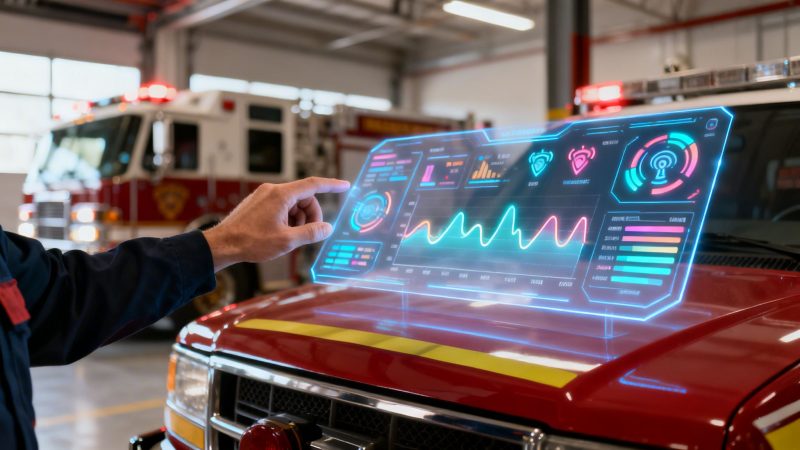
Software Predictive Maintenance: Cut Failures and Boost ROI
What if your most critical fire engine or ambulance could tell you it's about to break down, weeks before it actually happens? That’s the core promise of software predictive maintenance. Instead of reacting to failures or working off a fixed service calendar, this approach uses real-time data to see problems coming and stop them in their tracks.
A Strategic Advantage for Critical Fleets

Think of it like a sophisticated health tracker for your equipment. It’s constantly watching the vital signs—engine temperature, fluid pressure, vibration patterns—to catch the subtle warnings that signal future trouble. This proactive strategy turns maintenance from a costly, disruptive chore into a real operational advantage.
For first-responder fleets, where a breakdown can have life-or-death consequences, this shift is huge. It’s the difference between an ambulance failing on the way to a call and getting an alert that its alternator is showing early signs of stress, letting you schedule a cheap and easy repair during off-hours.
The Financial Case for Predicting Problems
The biggest win here is a direct, measurable cut in costs. Reactive maintenance—fixing things after they’ve already broken—is hands down the most expensive way to manage a fleet. It’s a world of emergency repairs, technician overtime, and the steep price of unexpected downtime.
Software predictive maintenance completely flips that script. By knowing what’s coming, you can:
- Schedule repairs proactively: This gets you out of paying a premium for emergency service and last-minute parts. For example, scheduling a $300 bearing replacement during the day saves you from paying a $1,200 emergency call-out fee on a weekend.
- Keep operational downtime to a minimum: A vehicle in the shop on a planned Tuesday morning is way less disruptive than one that gives out during a major incident on a Friday night. This avoids the high cost of renting a replacement unit or straining mutual aid resources.
- Extend the life of your assets: Catching small issues before they snowball into major system failures keeps your valuable equipment in service for longer. A simple, proactive fix can prevent a cascading failure that might otherwise take a $750,000 fire engine out of service permanently.
This is such a powerful model that it’s become a core part of modern operational strategy. The market definitely reflects this, with software solutions that bundle data collection, monitoring, and failure prediction leading the charge. In fact, software has grabbed the largest share of the predictive maintenance market and is on track to account for over 80% of revenue by 2025, pushed forward by platforms using IoT and AI for real-time asset monitoring.
How It Works: A Practical Example
Let’s walk through a real-world, money-saving scenario. A fire department’s main ladder truck has a complex hydraulic system to operate its aerial ladder. A sensor buried in that system picks up on a tiny, almost unnoticeable increase in fluid temperature and a slight change in pressure every time the ladder extends.
To a human inspector, everything looks perfectly fine. But the predictive maintenance software, which has been analyzing months of data, recognizes this exact pattern. It knows this is an early warning sign of a hydraulic pump failure that’s likely to happen within the next 60-90 operating hours.
Actionable Insight: The system shoots an alert to the fleet manager: "Warning: Ladder 1 hydraulic pump shows 85% probability of failure within 60 hours. Recommend immediate inspection."
Instead of a catastrophic failure during a multi-story building fire—which would mean a costly on-site emergency repair and taking a critical community asset offline—the department schedules a $500 pump replacement during planned downtime. That simple, data-driven move just prevented a potential $15,000 emergency repair and, more importantly, ensured the truck is always ready to roll.
At its heart, this entire process is about intelligent software. To get a better handle on how to effectively leverage artificial intelligence for software growth, you might find this guide pretty insightful.
Understanding the Data That Powers Predictions
Predictive maintenance isn't some black-box magic. It’s a practical tool powered by specific streams of data that act as your equipment's voice, telling you a story about its health. The software is built to listen to that story, pick up on the early warning signs, and alert you long before a tiny hiccup turns into a catastrophic, budget-breaking failure.
Getting a handle on where this data comes from is the first step toward unlocking some serious savings.

Think of it like a doctor making a diagnosis. They don't just eyeball a patient and make a wild guess. They collect specific data—a heartbeat from a stethoscope, temperature from a thermometer, and answers to questions about symptoms. In the same way, predictive maintenance software pulls in data from multiple sources to build a complete, accurate picture of an asset's real-time condition.
Telemetry The Live EKG for Your Fleet
The most foundational data source is telemetry. Don't let the technical term throw you off. It’s simply the live, streaming data your vehicles and equipment are already generating every second they're running. Think of it as a constant EKG for your police cruiser or ambulance, tracking its vital signs in real time.
This constant stream includes the critical metrics that tell you how hard an asset is actually working.
- Engine RPM and Speed: Shows if a vehicle is constantly being pushed to its absolute limits.
- Oil Pressure and Temperature: These are classic early indicators of lubrication problems or overheating.
- Fuel Consumption: Any sudden spike or dip can point to engine inefficiencies or fuel line issues.
Here’s a practical, money-saving example: an ambulance engine's oil pressure suddenly drops by 5 PSI during a high-speed run, a change too small to trigger a dashboard warning. But the predictive maintenance software flags this anomaly instantly, letting the fleet manager pull that unit for an immediate inspection. This single alert prevents a $25,000 engine replacement by catching the problem when it’s still just a failing $150 oil pump.
IoT Sensors Specialized Health Monitors
While telemetry gives you a great baseline, Internet of Things (IoT) sensors are like specialized health monitors. They target specific components that a vehicle's standard onboard systems simply don't watch. These small, often inexpensive devices can be added to just about any piece of critical equipment to track very precise conditions.
Actionable Insight: By placing sensors on high-failure-rate components, you create a focused, cost-effective monitoring system. You don't need to monitor everything—just the parts most likely to break and cause expensive downtime. A $50 vibration sensor on a critical pump is a smarter investment than monitoring a dozen low-risk components.
Imagine attaching a tiny vibration sensor to the main pump on a fire engine. This sensor does one job and does it well: it measures microscopic changes in vibration. Over time, the software learns the pump's normal, healthy "hum." When a bearing starts to wear out, it creates a slightly different vibration pattern—a change far too subtle for any human to notice during a routine check.
The software catches that deviation and flags it. This lets the maintenance team schedule a $300 bearing replacement during the next planned service, completely preventing a full pump seizure during a fire. That kind of failure wouldn't just sideline a critical apparatus; it would lead to a $12,000 emergency repair.
Operational Logs The Asset’s Daily Diary
Finally, we have operational logs. This data source is the equipment's daily diary, capturing how it's actually being used out in the field. It’s not just about engine hours; it’s about the context of that use, which is absolutely vital for making accurate predictions. This information provides the backstory that telemetry alone can't.
Key data points from operational logs include:
- Dispatch Records: How many calls has this specific unit responded to?
- Idle vs. Active Time: A police car that idles for eight hours a day experiences very different wear and tear than one constantly on patrol.
- Siren and Light Activations: This is a clear indicator of high-stress, high-speed operation.
By combining these operational logs with sensor data, the software can build incredibly accurate failure models. For instance, it might learn that a specific model of police interceptor is 90% more likely to have transmission issues after 800 hours of high-speed pursuit conditions. Armed with that knowledge, you can schedule proactive transmission fluid changes and inspections that save thousands in rebuild costs.
All of this information contributes to a more secure and efficient operation. You can learn more about how we handle data by reviewing our policies regarding user privacy and information.
Key Software Features That Deliver Real Savings
It’s one thing to collect data, but it’s another thing entirely to turn that raw information into actionable, money-saving insights. That's where the real power of software predictive maintenance comes into play. These aren't just abstract functions; think of them as your digital watchdogs, expert analysts, and institutional memory, all working around the clock to keep your critical assets mission-ready and your budget intact.
Each feature has a direct line to cutting costs and stopping operational nightmares before they happen. It’s all about spotting the small signs before they mushroom into big, expensive problems. Let's break down how these core components actually work.
Real-Time Condition Monitoring
Think of real-time condition monitoring as a 24/7 digital watchtower for your fleet. This feature gives you a live dashboard, a window into the vital signs of every single monitored asset. It’s like having a dedicated technician watching over each vehicle and piece of equipment, every second of every day, without the impossible labor cost.
This isn’t just about putting numbers on a screen; it's about immediate awareness. If the hydraulic pressure on a rescue tool dips even slightly outside its normal range, you know instantly. This constant oversight is your first and best defense against sudden, unexpected failures.
Practical Example: A fire engine's cooling system sensor shows a gradual temperature increase of just a few degrees over several hours—a trend too slow to trigger a standard dashboard warning light. The condition monitoring dashboard, however, flags this as an abnormal pattern. A quick inspection reveals a slowly failing water pump, which costs $400 to replace. This early catch prevents a catastrophic engine overheat during a call, an incident that would have resulted in a $25,000 engine replacement and taken a primary apparatus out of service for weeks.
Automated Anomaly Detection
If condition monitoring is your watchtower, then automated anomaly detection is the AI-powered expert on duty. This feature uses machine learning to learn the unique "heartbeat" of each piece of your equipment. It gets to know what normal operation looks like under all kinds of conditions—idling in the bay, responding to a call, or operating at a scene.
Its only job is to spot the outliers—the faint signals that even a trained human eye might miss. This is where the serious savings are found, as the system identifies problems that would otherwise go completely unnoticed until something breaks down completely. For a deeper dive into how platforms like Freshservice ITSM use these kinds of features and AI to modernize operations, this resource offers some valuable insights.
- Practical Example (Vibration): The system picks up on a new, microscopic vibration in an alternator, signaling bearing wear weeks before it would fail and leave an ambulance stranded. The alert allows for a proactive $150 bearing fix, preventing a $900 alternator replacement and the high cost of a tow.
- Practical Example (Voltage): It can flag inconsistent voltage from a police car's electrical system, pointing to a failing regulator before it fries sensitive and expensive onboard electronics like the radio and mobile data terminal, saving over $3,000 in replacement costs.
Failure Pattern Recognition
Finally, failure pattern recognition acts as the system's long-term memory and sharpest diagnostician. This feature looks at historical data from your entire fleet to identify recurring issues and predict future failures with startling accuracy. It learns from every single maintenance event, getting smarter and more precise over time.
Actionable Insight: When one ambulance in your fleet has an alternator failure, the software analyzes all the sensor data that led up to it—the voltage drops, the subtle temperature spikes, the changes in RPM. It then actively scans the rest of your fleet for that same deadly combination of factors.
This "fleet learning" is a massive cost-saver. It turns an isolated failure on one vehicle into a fleet-wide preventative measure. You're no longer just fixing what’s broken; you’re actively inoculating your other assets against the same fate. This approach is central to maintaining readiness across a large fleet, a core principle behind the various features available in advanced fleet management systems. The software essentially tells you, "I've seen this before, and here's what's about to happen to Vehicle 7 if you don't step in now."
Your Practical Implementation Roadmap
Rolling out a predictive maintenance program isn't just another software installation; it's a strategic overhaul of how you manage your fleet. If you get it right, the savings are massive. But success depends on a thoughtful, step-by-step approach that connects the technology to clear financial and operational wins. Skipping the groundwork is the fastest way to turn a powerful tool into an expensive system nobody uses.
This roadmap will walk you through the essential stages to make sure your investment in software predictive maintenance delivers real, measurable savings from day one. It’s all about building a solid foundation before you even look at a software demo.
This flow shows how the software turns a stream of data into an intelligent, automated action.

The key takeaway? Effective software doesn't just watch the data. It spots anomalies and recognizes patterns to trigger a specific, cost-saving response.
Step 1: Define Clear Financial Goals
Before you do anything else, you need to define what "success" looks like in dollars and cents. A vague goal like "reduce downtime" isn't going to cut it. You need specific, measurable targets that justify the investment and keep the project laser-focused on what really matters to your budget.
Your goals should tie directly to your biggest maintenance headaches.
- Reduce overtime repair costs by 20% within the first year. This is a direct shot at the high cost of emergency, after-hours work.
- Cut spending on outsourced emergency repairs for critical assets by 30%. This focuses on preventing the most expensive and disruptive failures.
- Decrease the failure rate of Engine 3's hydraulic system to zero. This hones in on a known, recurring problem vehicle that's draining resources.
Setting these financial targets first gives you a clear benchmark to measure performance against. It makes proving the ROI down the road a simple exercise.
Step 2: Prioritize Your Most Critical Assets
Trying to implement predictive maintenance across your entire fleet at once is a recipe for disaster. It’s too expensive, completely overwhelming, and dilutes your focus. The smart move is to start small with a high-impact pilot program focused on your most critical assets.
Figure out which pieces of equipment would cause the biggest operational mess or financial hit if they went down.
Actionable Insight: Ask yourself this question: "If one vehicle had to go down during a major incident, which one would be the absolute worst?" The answer is where you start. For a fire department, that’s probably the primary ladder truck. For an EMS agency, it’s the frontline advanced life support ambulance.
By focusing on these high-value assets first, your initial efforts are aimed where they can deliver the biggest and most visible wins. Proving the concept on one or two critical units builds momentum and makes it much easier to make the case for expanding the program later.
Step 3: Select the Right Technology Stack
Once your goals are set and your target assets are identified, you can start looking at technology. Your "stack" isn't just one piece of software; it's the whole package—the sensors, the connectivity, and the predictive maintenance platform itself. You have to make sure the software can actually monitor the specific failure modes of the assets you've chosen.
Practical Example: If you’re keeping an eye on a ladder truck's hydraulic system, you need a platform that’s great at analyzing pressure and temperature data. If engine health is your main concern, look for a system that excels in vibration and thermal analysis. Don't buy a powerful vibration analysis tool if your main problem is electrical failures; match the technology to the problem to maximize your ROI.
Step 4: Integrate with Your Existing Systems
This final step is what turns predictive alerts into seamless, money-saving action. A standalone system that just shoots off emails is wildly inefficient. The real value is unlocked when you integrate the predictive maintenance software with the tools your team already uses every single day, like dispatch and asset management platforms such as Resgrid.
Here’s how that works in the real world:
An IoT sensor on an ambulance engine detects a sustained high-temperature anomaly. Instead of just sending an alert, a fully automated workflow kicks off:
- The predictive software sends an API call to your dispatch system.
- The ambulance (Unit 101) is automatically tagged with a "Requires Maintenance" status, stopping dispatchers from assigning it to a call.
- A priority notification is sent directly to the fleet manager's phone with the specific fault code.
- A service ticket is automatically created in your asset tracking system, scheduling an immediate inspection.
This kind of seamless integration closes the loop, turning a single data point into a preventative action without anyone having to lift a finger. It stops a compromised vehicle from being sent into the field and streamlines the entire repair process, which saves time, cuts down on human error, and ultimately, saves a significant amount of money.
Calculating Your ROI and Avoiding Common Pitfalls
Let's be honest, adopting new tech isn't just about cool features—it's about the money. For software predictive maintenance, building a powerful business case is surprisingly straightforward because the savings are direct and you can actually measure them. The key is to stop thinking of maintenance as just another cost center and start seeing it as a strategic tool for getting financially lean. If you can quantify this return, you'll get the buy-in you need and prove the program's value for years to come.
The Return on Investment (ROI) here isn’t just about dodging one catastrophic failure. It's a snowball effect, a cumulative benefit built on several pillars of savings. By adding up these impacts, you can paint a very clear picture of how much cash this software puts back into your organization's pocket every year.
A Simple Framework for Calculating Your ROI
To make a compelling financial case, you have to put real numbers to the savings. Don't get bogged down in complex formulas. Start with the big, tangible costs that predictive maintenance tackles head-on. If you focus on these three core areas, you'll have a solid calculation.
- Reduced Unplanned Downtime Costs: This is your biggest win, hands down. Tally up the real cost of having a critical asset out of service when you least expect it. That includes technician overtime, the premium you pay for rush-shipping parts, and the cost of renting a replacement vehicle to stay operational.
- Optimized Spare Parts Inventory: How much money is tied up in spare parts just sitting on a shelf "just in case?" Predictive maintenance lets you shift to a just-in-time inventory model. You order parts only when the data says a replacement is on the horizon. This can easily free up 10-20% of your parts budget annually.
- Extended Asset Lifespan: When you proactively fix small issues, you prevent the cascading failures that send equipment to the scrapyard years too soon. A conservative estimate of a 10-15% life extension on a $500,000 fire engine translates into massive long-term savings by deferring its replacement cost.
Practical Case Study: A mid-sized fire department rolled out predictive maintenance on its primary engines and ambulances. In just 18 months, they slashed unexpected vehicle breakdowns by 60%. This directly saved them over $80,000 a year in emergency mechanic call-outs, overtime, and last-minute part sourcing.
Sidestepping the Pitfalls That Undermine Success
Even the best software on the market will fail if it's implemented poorly. The line between a massive ROI and a frustrating money pit often comes down to avoiding a few common, and entirely preventable, mistakes. Knowing these pitfalls from day one is your best insurance policy.
The most critical mistake is ignoring the quality of your data. The entire system is built on the "garbage in, garbage out" principle. If your sensors aren't calibrated right or you're feeding the software incomplete operational logs, the predictions it spits out will be unreliable at best—and dangerously misleading at worst.
Another huge hurdle is failing to get your team to buy in. Your frontline technicians and vehicle operators have to trust the system's alerts. If they see the software as "Big Brother" or just dismiss its recommendations in favor of old habits, the program is dead on arrival.
Actionable Insight: Involve your most experienced technicians in the pilot program from day one. When the system generates an alert, ask them to validate it. When they see the software confirming their own gut feelings or catching things they would have missed, they will become your biggest advocates.
Turning Alerts Into Action
Finally, the most common reason for failure is the simplest: people ignore the alerts. A system that flags an impending failure is completely useless if that alert sits in an unread inbox until the vehicle is dead on the side of the road. This all comes down to process. You need a clear, non-negotiable workflow for what happens the moment a critical alert is triggered.
This workflow should be automated, spelling out exactly who gets notified, what immediate action is required (like pulling the unit from service), and how the repair gets prioritized. This is what ensures every data-driven insight gets converted into a concrete, money-saving action. For more information on how different plans can support these workflows, you can explore various pricing options and included features.
Your Top Predictive Maintenance Questions, Answered
Jumping into a data-driven maintenance strategy brings up a lot of questions. It's a big shift, and if you're a fleet manager or running operations, you need straight answers before you commit. This section cuts through the noise and tackles the most common questions we hear about software predictive maintenance.
We'll skip the dense technical jargon and get right to what you actually care about: how much it costs, what the real challenges are, and how it applies to first-responder fleets. Think of this as the final briefing before you deploy a strategy that can save your department a ton of money and keep your critical gear ready to roll.
How Much Does Predictive Maintenance Software Actually Cost?
The price tag can swing pretty wildly. You might see basic systems for a small fleet starting at a few hundred dollars a month, while enterprise platforms with all the bells and whistles can run into the thousands. It usually boils down to how many assets you're tracking and how complex the software is.
But honestly, the subscription fee isn't the number to focus on. The real metric is your Return on Investment (ROI). The financial picture only makes sense when you stack up the software's cost against the money it saves you.
Actionable Insight: Frame the conversation around the cost of inaction. Preventing just one catastrophic engine failure on a fire engine (a $30,000+ repair) can easily pay for the software subscription for years. When you ask for quotes, always tell them exactly how many assets you need to monitor to get a real number, and ask for case studies showing their average customer's ROI.
What Is the Biggest Challenge When Getting Started?
Nine times out of ten, the biggest hurdle isn't technical; it's cultural. The hard part is getting your team to shift from the old "fix it when it breaks" routine to a proactive, data-first mindset. Your mechanics and operators have to actually trust what the system is telling them.
The best way to get past that skepticism? Start small and show them it works with a clear, undeniable win.
- Launch a Pilot Program: Pick one or two of your most critical—or most notoriously unreliable—assets for a trial run. This keeps the initial investment low and creates a focused case study for success.
- Highlight a Clear Win: When the software flags a potential failure that saves the department thousands, make that story known. A real-world victory, like a $200 sensor alert that prevents a $15,000 hydraulic pump failure, builds trust faster than any slideshow ever will.
Once your crew sees the software as a tool that prevents headaches and catastrophic failures, you'll get the buy-in you need to expand.
Can This Be Used for More Than Just Vehicles?
Absolutely. Any piece of equipment where failure could compromise safety or a mission is a perfect candidate for predictive maintenance. The core idea—using data to see problems coming—is universal and can slash costs across your entire inventory.
Think beyond the engine bay. What other critical tools do you rely on?
- Practical Example (Rescue Tools): Monitoring hydraulic pressure and temperature on rescue tools ("Jaws of Life") can give you a heads-up on seal failures before they happen on a rescue scene, preventing a tool failure during a critical extrication.
- Practical Example (SCBA): Tracking SCBA compressor runtime and vibration can signal when it's time for proactive servicing, making sure you always have clean air and avoiding a costly system rebuild.
- Practical Example (Generators): Keeping an eye on portable generator vitals and electrical output can prevent a failure right when the power goes out at a major incident scene.
- Practical Example (Station Equipment): Even fixed assets like station bay doors or HVAC units can be monitored to avoid expensive, disruptive breakdowns that impact response times or crew living conditions.
How Does This Integrate with Our Dispatch and Logistics Software?
This is where the magic really happens. Solid integration is what turns a simple predictive alert into a powerful, automated action that saves time and money. Modern software predictive maintenance platforms are built to talk to other systems, like dispatch and asset management tools, through APIs.
This connection creates a seamless workflow, closing the loop between spotting a problem and actually getting it fixed.
Here’s a practical, money-saving example: A sensor on an ambulance flags a critical fault in its electrical system. Instead of just shooting off an email, an automated workflow kicks in instantly:
- The software makes an API call to your dispatch console, automatically changing the ambulance’s status to "Requires Maintenance." This prevents a compromised unit from being sent to a 911 call.
- A high-priority alert hits the fleet manager's phone with the specific fault details.
- A service ticket is automatically created in your asset tracking system, scheduling the unit for immediate inspection.
This kind of automation cuts out human error, guarantees a faulty piece of equipment is never deployed, and streamlines the entire repair process from start to finish. This saves money by reducing manual data entry, preventing miscommunication, and ensuring the fastest possible turnaround time for repairs.
Ready to transform your maintenance strategy from reactive to predictive? Resgrid provides the tools you need to manage your assets, streamline dispatch, and keep your team connected. Discover how our comprehensive platform can enhance your operational readiness by visiting https://resgrid.com.