
Public Safety VHF vs UHF Radio: Choosing the Right Spectrum, 2026
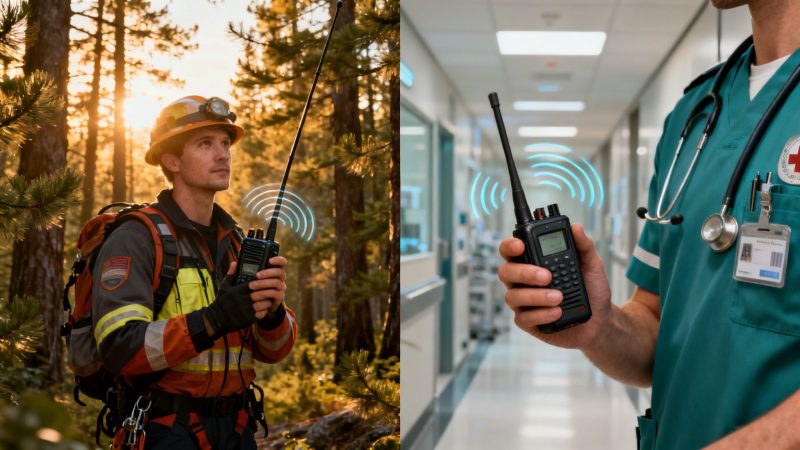
When it comes to VHF vs. UHF radio, there's no single 'best' choice. The right answer depends completely on where your team operates. VHF is built for long-range communication across open, rural terrain with clear line-of-sight, think wildland firefighting. In contrast, UHF is essential for urban environments because its shorter wavelength can punch through concrete and steel.
The Direct Answer for Mission-Critical Communications

For first responders, the VHF (Very High Frequency) vs. UHF (Ultra High Frequency) debate isn't about preference. It's a critical decision that directly impacts crew safety and the success of an operation. Getting this wrong can lead to communication blackouts during an incident—an unacceptable risk. It also means wasting budget on equipment that’s guaranteed to underperform right where you need it most.
The first step is understanding the basic physics. VHF waves are longer and travel farther in open spaces, making them the go-to for covering large, unobstructed areas. The trade-off? Those same long waves just can't get through solid structures.
This is where UHF shines. Its shorter waves are much better at navigating the dense maze of obstacles you find in cities and inside buildings.
Practical Scenarios and Cost Savings
Think about a sheriff's department patrolling a huge rural county. VHF radios give them the long-distance coverage they need without forcing them to build out an expensive network of repeaters. For example, a department covering 300 square miles of rolling hills and farmland could use a single VHF repeater tower to achieve full coverage, costing roughly $25,000. To get that same coverage with UHF, they might need three or four towers, pushing the infrastructure cost well over $75,000. In this scenario, choosing VHF is a direct, actionable way to save a ton of money.
Now, flip the script to a fire department responding to an alarm in a high-rise. In that dense, vertical environment, VHF signals would almost certainly fail, cutting off crews inside from the command post outside. UHF is the non-negotiable choice here, ensuring reliable comms through layers of concrete and steel. The higher initial cost of a UHF system is easily justified by the massive boost in safety and operational effectiveness.
Actionable Insight: Selecting the correct radio frequency for your primary operational environment is the single most effective way to optimize your communications budget. It prevents the costly mistake of purchasing a system that fails in critical moments, forcing an expensive and urgent replacement.
This table breaks down the core differences to help you figure out which band is the right fit for your agency.
VHF vs UHF Quick Comparison for Emergency Services
| Attribute | VHF (Very High Frequency) | UHF (Ultra High Frequency) |
|---|---|---|
| Primary Environment | Open, rural, and outdoor areas with few obstructions. | Urban, indoor, and densely obstructed environments. |
| Signal Penetration | Poor penetration through concrete, steel, and buildings. | Excellent penetration through walls and structures. |
| Signal Range | Longer range in clear, line-of-sight conditions. | Shorter range but more reliable in cluttered areas. |
| Best Use Cases | Wildland firefighting, county-wide patrol, maritime comms. | Urban policing, high-rise fire response, hospital security. |
| Antenna Size | Longer and more cumbersome. | Shorter and more compact for better portability. |
When VHF Excels in Open Terrain Operations

When your crews are spread out across wide, open country, Very High Frequency (VHF) radio isn't just an option—it's your best bet. The core advantage of VHF comes down to physics: it has a longer wavelength. Think of it like sound. A low-frequency bass note travels much farther and can seem to pass through walls, while a high-pitched squeal dies out quickly.
VHF signals, which operate between 30-300 MHz, behave the same way. They're much better at hugging the earth's curvature and bending over rolling hills, dense forests, and other natural obstacles. This physical trait makes it the go-to choice for any agency that has to cover a lot of ground with minimal gear. In the real-world VHF vs. UHF debate, this means better comms over longer distances, plain and simple.
Maximizing Range and Slashing Infrastructure Costs
For any department working in rural, wilderness, or even maritime settings, that extended range is a game-changer. Picture a search and rescue team trying to coordinate across a massive national park. With thick tree cover and rolling terrain, staying connected is literally a matter of life and death. VHF gives them the reach they need to link up team members who might be miles apart, making sure every command and status update gets through.
This superior range also leads directly to some serious cost savings.
- Fewer Repeaters Needed: Because VHF signals travel so much farther, a rural county sheriff’s department can often cover its entire jurisdiction with just a single tower, or at least far fewer repeaters than a UHF system would require.
- Lower Upfront Investment: Fewer repeaters mean less money spent on equipment, site leases, and installation right out of the gate.
- Less Maintenance Headaches: With less hardware to manage, your ongoing maintenance budget and the number of potential failure points drop significantly.
By choosing VHF for open terrain, you’re not just picking a frequency band; you're adopting a smarter, more cost-effective communications strategy. It stops you from overspending on a dense and expensive UHF repeater network just to get the same coverage.
Actionable Insight: For a rural agency covering 500 square miles, going with a VHF system can easily save $50,000 to $100,000 in initial repeater costs compared to what a UHF setup would demand. That's capital you can put back into other critical gear or personnel.
Better Battery Life and On-the-Ground Reliability
Beyond just range, VHF radios offer another huge plus for teams in the field: longer battery life. For years, VHF frequencies (30-300 MHz, with public safety bands typically at 136-174 MHz) have been the standard for outdoor operations for a reason. Field tests consistently show that in open terrain, VHF beats UHF in range by up to 50-100%. It's why over 70% of U.S. forest services rely on VHF for their vast territories.
Just as important, VHF radios deliver 20-30% longer battery life, which is a lifeline during long 12- or 24-hour shifts. This isn't just a minor convenience.
That extended battery performance comes from needing less power to push a signal over long distances in an open environment. For a wildland firefighter on a 24-hour deployment or a deputy on a long patrol, it means their radio is far more likely to last the whole shift without a battery swap. That directly impacts personnel safety, reducing the risk of a dead radio when someone is in trouble. Better battery life means your teams stay connected, accounted for, and ultimately, safer. This is the kind of on-the-ground reliability that modern systems for personnel and resource tracking are built upon.
Why UHF Is Essential for Urban and Indoor Environments

While VHF is king out in the open, the moment you step into a dense, obstructed environment, Ultra High Frequency (UHF) radios take over. For any team working in cities—from fire departments and hospital security to event staff at a massive stadium—reliable communication isn't just a nice-to-have. It's the bedrock of safety and operational control.
Plain and simple, UHF is built to work where VHF signals just die.
The whole game comes down to wavelength. UHF signals, which live in the 300 MHz to 3 GHz range, have much shorter waves. Picture yourself trying to get through a dense forest. A long, stiff pole (that’s your VHF wave) is going to get snagged on every single tree. But a short, nimble stick (your UHF wave) can easily find its way through the gaps.
This is exactly why UHF signals are so good at punching through concrete, steel, and drywall. In any serious talk about VHF vs. UHF radio for city-based agencies, this single fact makes UHF the only real choice.
Unmatched Reliability in Complex Structures
That ability to keep a clear signal inside a building is where UHF truly earns its keep. Imagine a tactical team clearing a multi-story office building. They need flawless comms between floors and with the command post outside. VHF signals would get absorbed or bounced into oblivion by the building's guts, creating dangerous radio silence.
UHF, on the other hand, finds a way. Its shorter signals can bounce around and wiggle through hallways, stairwells, and even elevator shafts to stay connected. This isn't just a technical detail; it's a lifeline when every second counts.
- High-Rise Firefighting: Crews deep inside a skyscraper are counting on UHF to report conditions, call for backup, and coordinate the evacuation. A dropped signal there is a recipe for disaster.
- Hospital Security: When security has to respond to an incident in a sprawling medical center full of thick walls and electronic interference, they need UHF to stay in touch.
- Large Venue Management: During a sold-out concert, paramedics and event staff use UHF to coordinate responses in a packed, concrete-heavy environment where other signals wouldn't stand a chance.
Actionable Insight: The higher cost of a UHF system isn't just for a better radio; it's a direct investment in your team's safety and operational integrity. By preventing even one communication failure during a critical event, the system pays for itself by avoiding potential liability, injury, or worse. You're buying insurance against failures that can have catastrophic human and financial costs.
Justifying the Investment in Urban Operations
There's a reason urban first responders and security teams overwhelmingly go with UHF. The performance difference is night and day. Its shorter wavelengths are just better at squeezing through walls and steel. In fact, real-world penetration tests show UHF signals can hold onto 70-80% of their strength inside concrete buildings. VHF? You're lucky to get 30-40%.
A 2018 study on NYC fire responses found that UHF radios had an 85% communication success rate inside high-rises, compared to just 55% for VHF. That difference directly led to 25% faster evacuations.
Look around, and you'll see over 80% of warehouse, retail, and medical communications run on UHF. A big part of that is because its higher bandwidth can handle two to three times more channels and more data—which is critical for systems like Resgrid that depend on real-time personnel and equipment tracking. You can dig into more of the professional advantages of UHF by reviewing these findings on two-way radios.
This capability also means UHF antennas can be much smaller and more compact. That's a huge plus for anyone already weighed down with gear. A shorter "stubby" antenna is less likely to snag on a doorway or get tangled in equipment, making it easier to move and reducing fatigue over a long shift.
For any agency operating primarily within city limits or inside large buildings, this isn't about preference. Choosing UHF is a fundamental requirement for operating safely and effectively.
A Practical Comparison for First Responders
Picking between VHF and UHF radios isn’t just about comparing spec sheets. It’s about understanding the environment your team actually operates in, day in and day out. Getting this wrong is more than an inconvenience—it’s a direct threat to crew safety and a huge waste of your budget.
So, let’s get practical and look at how these frequencies perform where it really counts: in the field.
Scenario 1: Wildland Firefighting vs. High-Rise Incident
Picture a wildfire tearing across a huge, remote forest. You’ve got crews spread over miles, with command posts, air support, and ground teams all needing to stay connected. In this situation, VHF is the only real choice. Its long wavelengths are brilliant at covering massive distances over open country, bending over hills and punching through foliage where a UHF signal would just fizzle out. A VHF system lets an incident commander maintain control without spending a fortune on a dense repeater network.
Now, flip the script. You're at a fire inside a 30-story skyscraper. Firefighters are deep inside, pushing through smoke-filled halls and concrete stairwells. Here, VHF signals are completely useless. The building’s steel and concrete would absorb and scatter them instantly. For this job, UHF is absolutely essential. Its shorter wavelengths are built to penetrate these dense materials, making sure crews inside can talk to each other and, more importantly, to the command post outside.
Actionable Insight: Matching the radio to the terrain prevents catastrophic communication failure. Choosing VHF for a wildland response could save an agency $50,000+ on repeater infrastructure. But for a high-rise fire, picking UHF is a priceless investment in firefighter survival, potentially saving millions in liability costs from a single failed communication.
Scenario 2: Highway Patrol vs. Campus Security
Think about a highway patrol unit covering a long, straight shot of interstate running through rural farmland. Their biggest need is long-distance comms to coordinate traffic stops, report accidents, and call for backup over dozens of miles. Again, VHF delivers the superior range they need for this wide-open, linear patrol zone. It ensures officers can talk reliably from one end of their beat to the other.
Contrast that with a security team at a sprawling university hospital campus. Their world is a cluttered mix of multi-story buildings, underground garages, and packed courtyards. In this messy environment, UHF is the only technology that makes sense. It gives them the solid building penetration needed to keep in touch with officers inside patient wings, offices, and boiler rooms. Plus, the greater number of available channels on UHF helps manage traffic for different teams—security, facilities, medical response—without everyone talking over each other.
To really nail down the differences, we've put together a table that breaks down the technical and operational tradeoffs you'll face.
Technical and Operational Showdown VHF vs UHF
This table gives a head-to-head look at the key performance factors and what they mean for your team on the ground. It's designed to help you weigh the pros and cons based on your specific operational needs.
| Factor | VHF Analysis for First Responders | UHF Analysis for First Responders | Cost & Safety Implication |
|---|---|---|---|
| Signal Integrity | Strong in open areas but prone to failure inside structures. Susceptible to atmospheric noise. | Weaker over long distances but highly reliable in dense urban and indoor settings. | Mismatching leads to signal loss in critical moments. UHF is safer for urban teams; VHF for rural. |
| Equipment Suitability | Longer antennas are required for optimal range, which can be cumbersome for personnel on foot. | Shorter, more compact antennas are ideal for mobility and won't snag on gear or doorways. | UHF equipment improves mobility and reduces fatigue for urban responders, a key safety factor. |
| Interference Potential | Fewer channels available, leading to higher potential for co-channel interference in populated areas. | A wider spectrum with more channels reduces interference and allows for more complex comms plans. | UHF is better for complex incidents with multiple agencies, preventing dangerous cross-talk. |
| Repeater Requirements | Can cover vast areas with fewer repeaters, significantly reducing infrastructure costs. | Requires a denser network of repeaters for wide-area coverage, increasing initial and maintenance costs. | VHF saves significant capital for rural agencies. UHF repeater costs are a necessary safety expense for urban ones. |
| Power Consumption | Generally more power-efficient for long-distance transmission, offering better battery life in the field. | Consumes more power to achieve penetration, which can result in shorter battery life per charge cycle. | VHF's longer battery life is critical for extended rural or wilderness deployments, enhancing crew safety. |
Ultimately, the choice comes down to one question: Where will your people be when they press the push-to-talk button? Answering that honestly is the first step toward building a reliable and safe communications system.
The Rise of Multi-Band Radios
What about agencies that deal with both kinds of environments? A county sheriff’s department, for instance, might patrol rural backroads and dense downtowns in the same shift. A single-band radio is a tough compromise here.
This is where modern multi-band radios come in. These devices can operate on both VHF and UHF, letting a single radio adapt to any situation. They cost more upfront, but they eliminate the need to carry two different radios and guarantee seamless communication—a lifesaver in mutual aid scenarios. You can also supplement radio traffic by exploring integrated platforms; learn more about our advanced messaging features for coordinated response and see how they can fill in the gaps.
Picking between VHF and UHF is just the first step. You've also got to navigate the world of regulations, and that means dealing with the Federal Communications Commission (FCC). This isn't just bureaucratic red tape—it's what keeps departments from stepping on each other's critical communications.
Both the VHF and UHF bands have channels specifically set aside for public safety. Using them without the right license isn't an option. The FCC has a formal licensing process for a reason: it ensures frequencies are managed so that when things get chaotic, your comms don't. You can't just buy a box of radios and start talking; you have to apply for a license for specific frequencies in your operational area.
The Challenge of Interoperability
So, what happens when a major incident goes down? Think large-scale natural disasters or a multi-agency manhunt. Everyone needs to talk to each other, period. But if your fire department is on a VHF system and the neighboring police agency is on UHF, they might as well be speaking different languages. They can't communicate directly, and that's a dangerous gap.
This is exactly why digital radio standards were created. The two you’ll hear about most in public safety are:
- P25 (Project 25): This is the go-to standard in North America for making sure public safety radios can talk to each other, no matter who made them. If it's P25, it should work.
- DMR (Digital Mobile Radio): A global standard that's gained a lot of traction, especially with agencies looking for a cost-effective but feature-rich option. It's common in the business world but has found a home in some public safety circles, too.
These digital systems are the key to bridging the VHF vs UHF radio divide, allowing different agencies to share talkgroups and channels securely.
Actionable Insight: Make sure your radio purchasing lines up with your regional interoperability plan from day one. Buying P25-capable radios upfront can save an agency tens of thousands of dollars by avoiding the need for expensive gateway devices or a full system replacement just to meet mutual aid rules.
Future-Proofing Your Investment and Saving Money
A lot of regions now flat-out require P25 compliance for any agency involved in mutual aid agreements. If you want to talk to state police or federal partners during a major event, your gear has to be P25-compatible. It's as simple as that.
Ignoring this reality when buying new equipment is a mistake that will cost you dearly down the line. An agency might save a little money today by opting for cheaper, non-P25 radios. But when that interoperability mandate lands on their desk, they're stuck.
Let’s take a small fire district as an example. They buy ten analog-only UHF radios to save a few bucks. A couple of years later, the county requires P25 for all emergency comms. Now they have two terrible choices:
- Scrap the old radios: The money they initially "saved" is gone. Now they have to buy ten new, much more expensive P25 radios.
- Purchase a gateway: This is a temporary fix that can run $15,000 to $30,000 or more. It's another piece of equipment that can fail, adding a weak link to their communications chain.
By planning ahead and investing in P25-capable radios from the start, you ensure your equipment will be ready for any collaborative response. This kind of strategic thinking not only guarantees you can talk to your partners but also prevents massive, unplanned expenses. This forward-thinking approach is fundamental to building a resilient communications network, which can be further supported by robust software solutions. You can learn more about how our platform supports first responders in our guide on advanced dispatching features.
Making the Final Decision for Your Agency
At the end of the day, picking the right radio comes down to a hard look at where you work, what you can spend, and who you need to talk to. The whole VHF vs. UHF debate isn’t about which one is universally better, but which one is better for your agency’s reality on the ground. Getting this right from the jump is the single best way to protect your people and your budget.
A bad match between your needs and the gear you buy is a fast track to dropped calls and wasted money. To keep that from happening, let’s walk through a few real-world scenarios.
Agency Profiles and Recommendations
Rural Volunteer Fire Department: These folks cover huge, sparsely populated areas full of hills and trees. Money is always tight. The only sensible choice here is VHF. Its ability to travel long distances over open country means they can cover their whole district with fewer repeaters, saving tens of thousands of dollars right out of the gate.
Urban Police Force: This department is working in a dense downtown packed with high-rises, underground parking, and tons of steel and concrete. For them, UHF is the only way to go. You absolutely need its superior signal penetration to keep comms up inside these complex buildings where VHF just won’t reach. It’s a matter of officer safety, plain and simple.
Multi-Jurisdiction Emergency Management Agency: This agency is the glue holding together responses across city centers and the rural counties around them. During a major incident, they have to talk to everyone. The only logical play is a hybrid/multi-band P25 system. It gives them the flexibility to use UHF in the city and VHF in the country, and the P25 standard ensures they can actually talk to mutual aid partners when it counts.
This decision tree breaks down the critical choice between going with a P25 system or trying to patch things together with gateway solutions, all based on whether a regional plan is in place.

As you can see, if there’s a regional plan, aligning with it from the start by choosing P25 is the straightest path. If there's no plan, you're often forced into costly and complicated gateway workarounds later on.
Actionable Insight: Before you sign a single purchase order, demand a live field demo. Have the vendor bring the proposed radios to your most challenging response area—whether it’s the basement of a high-rise or a remote canyon. This simple test cuts through all the sales talk and gives you undeniable proof of what works and what doesn't. It’s the easiest way to prevent a five or six-figure mistake.
Your Final Decision Checklist
To feel confident in your investment, every agency leader needs to have solid answers to these questions. This isn't just a checklist; it's a framework to make sure the system you buy works for you today and is ready for what’s coming tomorrow.
- What’s our primary terrain? (Are we 90% urban, 90% rural, or a 50/50 split?)
- What does our regional interoperability plan demand? (P25, DMR, or something else?)
- What’s our real budget? (Think initial purchase and the long-term cost of keeping it running.)
- Is our call volume high enough to need the extra channels UHF offers?
- What will our response area and mutual aid needs look like in the next 5-10 years?
Common Questions We Hear About VHF and UHF Radios
When you're dealing with radio communications, especially when lives and budgets are on the table, a lot of questions pop up. We get them all the time. Getting straight answers is the only way for a public safety agency to build a communication plan that actually works in the field.
Can I Use a VHF Radio to Talk to a UHF Radio?
No, you can't. It's a question we hear a lot, but VHF and UHF radios are fundamentally incompatible. They operate on completely different frequency bands. It’s like trying to get an AM station on your FM car radio—the hardware just isn't built to listen on those frequencies.
Actionable Insight: If you absolutely must connect VHF and UHF systems, your only real options are a multi-band radio that can handle both, or a piece of gear called a "cross-band repeater" to translate signals back and forth. Honestly, if you foresee this need, investing in multi-band radios upfront will save you a ton of money and headaches compared to adding expensive gateway hardware later.
Which Is Better for Concrete Buildings, VHF or UHF?
For penetrating concrete, steel, and all the other dense stuff you find in modern buildings, UHF is hands-down the winner.
Its shorter wavelength is much better at wiggling its way through obstructions inside a building. A longer VHF wave just gets absorbed or bounced back.
If your crews operate mostly in urban areas or inside large structures like hospitals, schools, or warehouses, choosing UHF isn't just a preference—it's a critical safety decision. The extra cost is a direct investment in making sure you can hear them when they're inside. For example, a single communication failure in a hospital lockdown could lead to a security breach costing hundreds of thousands in damages and liability.
Is VHF or UHF Better for Long Distance?
Out in the open, with a clear line of sight, VHF is better for long-distance communication. Its longer waves can travel farther and have a knack for bending over natural terrain like hills and through foliage.
Think about a rural search and rescue team working in a national park. VHF lets them cover several miles without needing a repeater on every peak, which directly saves tens of thousands in infrastructure costs. But the second they go into a dense canyon or a building, that advantage is gone.
Ready to build a resilient and cost-effective communication system for your team? Resgrid provides the software tools you need to manage dispatch, track personnel, and keep your crews connected, regardless of their radio system. See how we can help by visiting https://resgrid.com today.