
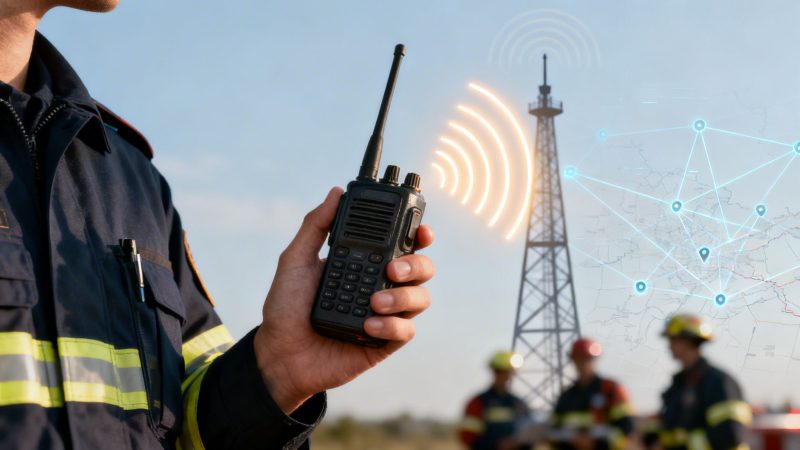
What is lmr: what is lmr and how it powers mission-critical communications
Picture this: a major hurricane just ripped through, taking out cell towers and power lines for miles. Chaos. How do firefighters, police, and medics possibly coordinate a life-saving response? The answer, for decades, has been Land Mobile Radio (LMR).
In the simplest terms, LMR is a private, two-way radio system purpose-built to work when everything else has gone dark.
Understanding LMR and Why It Is So Essential
You can think of LMR as a professional-grade walkie-talkie network, but on a massive, hyper-reliable scale. It’s designed for organizations that absolutely cannot afford a dropped call.
While your cell phone depends on a public network that gets jammed or damaged during a crisis, LMR runs on dedicated, private infrastructure. This gives an agency complete control over its own communications, guaranteeing instant and clear voice contact is always there.
Practical Example: During the Boston Marathon bombing, public cell networks were so overloaded with calls and data that they became unreliable. First responders, however, continued to communicate seamlessly using their dedicated LMR network, coordinating medical aid and securing the scene without interruption.
This is exactly why LMR has been the foundation of mission-critical communications for first responders and public safety agencies all over the world. These tough-as-nails radio networks provide secure and reliable voice contact, especially when cellular networks are overloaded or completely down.
LMR Is More Than a Tool It Is an Insurance Policy
Just calling LMR a "communication tool" doesn't quite capture the whole picture. For any group responsible for public safety, critical infrastructure, or major logistics, LMR is a form of operational insurance. It's an expense that guarantees you can keep talking and functioning during a full-blown crisis.
It really boils down to a few key advantages:
- Total Control: You own the network. You're not fighting with the public for bandwidth during a major incident.
- Extreme Reliability: LMR systems are built tough. They often have backup power and reinforced tower sites designed to survive severe weather and other disasters.
- Instant Connection: Push-to-Talk (PTT) means communication is immediate. No dialing, no ringing, no waiting for someone to pick up.
An Actionable Insight for Your Budget
When you're looking at purchasing decisions, don't just put the upfront cost of an LMR system next to a cellular plan. That's the wrong way to look at it. Instead, you have to frame the investment as a risk management strategy.
Sit down and calculate the potential cost—in dollars and operational chaos—of a total communication failure for one hour, one day, or one week.
Actionable Money-Saving Insight: A public utility manager calculated that a two-hour communication blackout during a power outage would cost their company over $250,000 in delayed repairs, crew downtime, and SLA penalties. The entire cost of their LMR system was less than this single incident. This reframes the expense from a simple purchase to a necessary investment in operational integrity.
This simple shift changes the whole conversation from "Can we afford LMR?" to "Can we honestly afford to be without it?" It’s all about building a resilient organization, a concept that leaders at companies like Resgrid have been focused on for over a decade. It ensures your team can communicate when it matters most.
How LMR Systems Actually Work
To really get why Land Mobile Radio is so rock-solid, you have to pop the hood and look at how it’s built. It might seem complicated, but it all comes down to a few core ideas that put reliability above everything else. It’s less like magic and more like expertly engineered physics.
Think of the spectrum as the foundation. It’s like a set of private, invisible highways built just for radio signals. This isn't like the public cellular network, which can feel like a gridlocked city street open to anybody. LMR operates on licensed frequencies that your organization owns and controls.
On that private highway, you have channels—think of them as dedicated lanes. A really simple system might just have one channel, which means only one conversation can happen at a time. It’s a single-lane road.
This is why you see LMR systems everywhere, from public safety to utilities and transportation. They're the backbone for critical communications.

As you can see, LMR is the foundational communication tool for a ton of essential sectors. It’s just that versatile.
Analog Simplicity vs. Digital Clarity
The biggest fork in the road for LMR tech is the choice between analog and digital. Each one has a completely different feel, sort of like the difference between a vinyl record and a high-quality MP3.
- Analog LMR: This is the classic, old-school walkie-talkie signal. It's a direct wave transmission—the vinyl record of radio. It’s simple and it works, but it's prone to static and interference. The farther you get from a tower, the worse the audio gets.
- Digital LMR: This is where everything is now. Your voice gets converted into binary code (a stream of 1s and 0s) before it’s sent out, just like an MP3. The result? Crystal-clear audio that stays perfect right up until you fall completely out of range. No more gradual fade-out into a sea of static. It also piggybacks extra data, like GPS coordinates and text messages, right along with the voice call.
The entire industry has been moving this way for years. The switch from analog to digital is now over 70% complete in most markets, and for good reason. It has boosted spectrum efficiency by up to 40%, letting more users talk on a single channel. That's a huge deal in crowded urban areas, and you can get a better feel for the market shift in this detailed LMR industry analysis.
The Power of Digital Standards
Once everyone started going digital, we needed some common languages so different radios could actually understand each other. These standards are what make interoperability happen, which is non-negotiable when you have multiple agencies responding to the same incident.
You’ll typically run into one of these three:
- P25 (Project 25): This is the gold standard for public safety in North America. It was built from the ground up to ensure a fire department using Motorola radios can talk seamlessly with a police department using Harris gear during a major event.
- DMR (Digital Mobile Radio): This is a popular, cost-effective standard you see all over the commercial world—think manufacturing, hotels, and logistics. It delivers great voice quality and data features without the massive price tag.
- TETRA (Terrestrial Trunked Radio): The dominant player in Europe and other parts of the world. It’s known for being incredibly secure and great with data, making it a go-to for major transportation networks and government agencies.
The Money-Saving Magic of Trunking
Now, let's talk about the single most important concept for making LMR affordable: trunking. In a basic, conventional system, you have a fixed number of channels. If they're all in use, everyone else has to wait their turn—even if it's an emergency. It’s like a small office with only two phone lines. Inefficient and frustrating.
A trunked LMR system is basically an intelligent air traffic controller for your radio channels. Instead of locking a channel to a specific group, it puts all the channels into a shared pool. When someone hits the push-to-talk button, the system finds an open channel in a split second and assigns it just for that single conversation.
This is where the serious savings happen. A trunked system can let hundreds, or even thousands, of people operate efficiently on just a handful of channels.
Actionable Money-Saving Insight: A city parks department needed 15 separate talk groups for maintenance, security, and event staff. A conventional system would have required licensing 15 separate channels, costing over $20,000 annually. By switching to a trunked system, they could support all 15 groups on just four shared channels, cutting their yearly licensing fees by more than 60% and saving over $12,000 per year.
LMR in Action for First Responders and Businesses
We’ve covered the technical side of Land Mobile Radio, but the real story is how it performs when everything is on the line. From a multi-agency disaster response to the daily grind of a busy warehouse, LMR is the workhorse that keeps teams connected and safe. It’s not about flashy features; it's about pure, unshakeable reliability.

Its dominance in public safety is no accident. Globally, LMR powers over 80% of mission-critical communications for first responders. If you want to dig into the numbers, you can check out the LMR market's global reach and trends on gminsights.com. This isn't just a preference; it’s a standard built on decades of trust in the moments that matter most.
How LMR Performs in High-Stakes Scenarios
Picture this: a wildfire is ripping through a rural area, and cell towers are either overloaded or completely down. Fire departments from three different towns, state forestry crews, and sheriff's deputies are all converging on the same chaotic scene. This is exactly where LMR proves its worth.
An Incident Commander can immediately organize the chaos by assigning dedicated radio channels:
- Tactical Channel 1: Ground crews use this to coordinate their attack on the fire line and shout out safety hazards.
- Air-to-Ground Channel: A lifeline between pilots in the air and spotters on the ground, ensuring water drops are precise and effective.
- Command Channel: This is for the brass—incident commanders talking with agency chiefs and coordinating mutual aid.
This kind of channel separation is critical. It stops everyone from talking over each other and makes sure urgent messages get through instantly. Without LMR, you’d have a dangerous mess of duplicated efforts and life-threatening confusion.
LMR for Efficient and Safe Business Operations
LMR isn't just for emergencies. Countless businesses rely on it to keep their operations running smoothly and their people safe, especially in places where a cell phone is just a paperweight.
Take a massive logistics warehouse, the kind with endless aisles of steel racks and thick concrete walls. It's a dead zone for Wi-Fi and cellular signals. By setting up a simple, on-site DMR system, the company instantly creates its own private, reliable communication network.
Practical Example: A large resort hotel uses LMR for its housekeeping, maintenance, and security teams. When a guest reports a water leak, the front desk can instantly contact the nearest maintenance worker on their dedicated channel, while simultaneously alerting security to assist if needed. This prevents delays and improves the guest experience.
Forklift operators, shipping managers, and inventory teams are always just a push-of-a-button away from each other. A manager can broadcast a spill in aisle 12 to every driver at once, or a single operator can quietly call for help without disrupting the entire floor. This kind of instant coordination eliminates delays and keeps the entire operation moving.
How to Save Real Money on Your LMR System
Here's a critical, money-saving insight that comes from seeing LMR in action: match the technology to your actual operational needs. Not every organization needs a complex, multi-site trunked system that costs a fortune.
For example, a local security company covering three large properties all within a five-mile radius has no need for a regional network. Instead of shelling out for an expensive trunked system, they could go with a simple, conventional DMR system using a single repeater.
Actionable Money-Saving Insight: This one decision could easily save the company over $50,000 upfront on infrastructure compared to a larger trunked system. It also helps them avoid pricey recurring fees for spectrum they'll never use. By taking a hard look at their actual coverage map, they get 100% of the reliability they need for a fraction of the cost. It’s proof that the smartest LMR investment is the one that's perfectly tailored to the job.
Strengths, Limitations, and Modern Alternatives
Look, no piece of technology is a silver bullet. To really get a handle on where LMR fits in today's world, we need to have an honest conversation about what it does incredibly well and where it falls short. There’s a good reason Land Mobile Radio is the bedrock for mission-critical voice, but it’s not the only tool in the toolbox anymore.
The upsides are huge. When you own the LMR network, you get rock-solid reliability that doesn't care if the public cell towers are overloaded. You have complete control over who's on your network and how it’s configured. With digital LMR, the audio is so clear you can hear a transmission perfectly with a siren wailing right behind the person talking.
But that level of control and reliability comes at a price. The upfront cost to build out the infrastructure—the towers, repeaters, and base stations—can be a tough pill to swallow. LMR systems also just don't have the data muscle of modern cellular networks, so forget about streaming video. And on top of that, getting the spectrum licenses you need can be a painfully slow, bureaucratic slog.
The Rise of LMR Alternatives
Those limitations have really opened the door for new technologies that work alongside LMR systems. I don't see them as straight-up replacements, but more like powerful partners that fill in the gaps.
The biggest one you’ll hear about is FirstNet and other public safety broadband networks running on LTE and 5G. The easiest way to think about them is as a data-heavy companion to LMR's voice-first world.
- FirstNet/LTE: This is your go-to for anything that needs a ton of data. Think streaming video from a drone, pulling up building blueprints on a tablet in the field, or running sophisticated software on a mobile data terminal. It does everything LMR can't when it comes to data.
- Push-to-Talk over Cellular (PoC): This tech basically puts the PTT button from a radio onto a smartphone, running over commercial cell networks. It’s usually much cheaper and faster to get going since it just piggybacks on infrastructure that’s already there.
A lot of these new cellular-based options are built on the same principles that drive internet-based phone calls, so it's helpful to understand what VoIP is to see how it all connects.
Comparing Communication Technologies
To make sense of it all, it helps to see these technologies side-by-side. Each has a place where it shines and specific trade-offs you need to be aware of.
| Technology | Best For | Primary Limitation | Typical Cost Structure |
|---|---|---|---|
| LMR | Mission-critical voice, high-noise environments, areas with no cell service (with own network). | High initial infrastructure cost, low data bandwidth. | High Capital Expenditure (CapEx), low Operating Expenditure (OpEx). |
| PoC | Non-critical comms, rapid deployment for events, extending radio talkgroups to admin staff. | Relies on commercial cellular networks, which can get congested or go down. | Low/No CapEx, subscription-based OpEx. |
| Satellite | Extreme remote operations, disaster recovery when all terrestrial networks are down. | High per-device and per-minute/data cost, requires clear line of sight to the sky. | Moderate CapEx, very high OpEx (pay-per-use). |
Choosing the right mix is about balancing cost, risk, and operational need. There's no one-size-fits-all answer.
Making the Right Choice Without Overspending
The real takeaway here is to match the tech to your organization’s specific risks so you don’t burn cash unnecessarily. Not every team needs a multi-million dollar P25 system.
Let's walk through a real-world example. Imagine you’re the facilities director for a large university, and you need comms for your maintenance, security, and event staff across a huge campus.
Decision Point: Do you sink a ton of money into a private LMR system for everyone, or is a cheaper PoC solution "good enough"?
Actionable Money-Saving Insight: The director asks one critical question: What's the cost and operational impact if our communications fail during our highest-risk event? For this university, that’s a sold-out football game with 70,000 people. The local cell network is almost guaranteed to get completely swamped. A PoC system would become useless. In that scenario, the risk justifies a private LMR system for core security and emergency teams. However, for maintenance crews or ticket takers, a PoC app on their phones is fine for daily tasks. This hybrid approach saves the university from buying an expensive LMR radio for every single employee, potentially saving tens of thousands of dollars while ensuring critical communications are bulletproof. It’s all about putting your money where the risk is.
Integrating LMR with Modern Dispatch Platforms Like Resgrid
Your LMR hardware is tough. It’s the one piece of gear you know will work for mission-critical voice, no matter what. But on its own, it’s really just a voice pipe. To get the most out of that incredibly reliable connection, you need to pair it with intelligent software.
Think of it this way: your LMR system is the indestructible vocal cords of your operation, while a platform like Resgrid is the strategic brain.
This is exactly where Resgrid fits in. It doesn't try to replace your radios. Instead, it runs right alongside them, layering on the data, automation, and visual awareness that voice alone could never deliver. You end up with the best of both worlds—the proven reliability of LMR and the smart capabilities of modern software.

This image nails the concept. The radio handles the talk, but the software provides the bigger picture, showing a dispatcher exactly where everyone is in real time. This is the operational brain in action, turning simple voice check-ins into actionable, visual intelligence.
What Modern Platforms Add to Your LMR System
Bringing a dispatch platform into the mix fundamentally changes what your team can do. Instead of just hearing scattered voices, dispatchers can see the entire operation unfolding on a map. This context is a game-changer, leading to smarter, faster, and safer decisions.
Here are a few key functions a platform like Resgrid adds to your LMR setup:
- Live Mapping and Geolocation: See the exact location of all personnel and vehicles on a live map. This instantly cuts out the constant "What's your 20?" radio chatter.
- Automated Call-Outs and Staffing: Automatically blast out alerts for new calls or open shifts through text, email, and app notifications—not just over the radio.
- Real-Time Status Tracking: Responders can update their status ("En Route," "On Scene," "Available") with a quick tap, giving command an instant, at-a-glance overview.
- Detailed Incident Reporting: Every action, timestamp, and communication gets logged automatically. This creates perfect reports for after-action reviews, training, or billing without any extra work.
A Practical Example of LMR and Resgrid Working Together
Let's walk through how this looks in the real world. A volunteer fire department gets an alert for a structure fire.
The dispatcher keys up the LMR radio for that initial, can't-fail voice dispatch: "All units, Engine 1, Ladder 1, respond to a reported structure fire at 123 Main Street." That's the instant, bomb-proof alert.
At the exact same time, the integrated dispatch platform kicks off a series of automated tasks:
- Resgrid alerts all personnel with the call details via its mobile app.
- Firefighters tap "Responding" in the app, and the platform automatically starts calculating their ETA to the station.
- The chief can immediately see on a map who is responding and how far away they are.
- Once on scene, the incident commander uses the platform to see nearby hydrant locations and automatically log every timestamp for the official report.
In this scenario, LMR handles the critical voice channel, while Resgrid handles everything else: accountability, location tracking, resource mapping, and data logging. The two systems work in concert to create a complete operational picture. To see more of what this looks like, check out our guide on dispatching features and how they work.
The Actionable Insight Saving You Over $100,000
Here's the key takeaway, especially for smaller agencies, volunteer departments, or businesses: adopting a flexible, cloud-based platform like Resgrid can completely eliminate the need for a legacy, on-premise Computer-Aided Dispatch (CAD) system.
Traditional CAD systems often carry staggering price tags, sometimes exceeding $100,000 just for the initial setup—not including the pricey annual maintenance contracts. By pairing your existing LMR investment with an affordable SaaS platform, you get powerful, modern dispatching features on a predictable subscription.
Actionable Money-Saving Insight: A volunteer ambulance service with a limited budget kept their reliable LMR radios but replaced their outdated, expensive CAD with Resgrid. They saved an estimated $75,000 in upfront server and software costs and now pay a predictable, low monthly fee. This allowed them to redirect funds toward new medical equipment, directly improving patient care without sacrificing dispatch capability.
To explore the functions of modern dispatch platforms that integrate with LMR, you can find some great insights in other available guides.
Your Common LMR Questions Answered
Alright, we've covered the what and the how of LMR. But let's get down to brass tacks. When it’s time to actually spend money or plan for the future, the real-world questions start popping up. This is where the rubber meets the road, so we'll tackle the most common questions we hear from organizations weighing their options.
How Much Does an LMR System Really Cost?
This is always the first question, and the honest answer is: it depends. There's no single price tag. The cost exists on a huge spectrum that’s all about your scale and what you need the system to do.
For a small, self-contained operation—think a hotel or a single manufacturing plant—you might get by with a handful of handhelds and one repeater. A setup like that could come in under $10,000. On the other end of the scale, a county-wide, multi-site P25 public safety system with hundreds of encrypted radios can easily soar into the millions.
Your main costs will fall into a few buckets:
- Subscriber Units (Radios): The radios themselves. A basic commercial model might be $500, while a rugged, multi-band radio for a firefighter could top $7,000.
- Infrastructure: This is all the backend gear—towers, repeaters, base stations, and antennas that create your coverage footprint.
- Licensing: You have to pay the FCC (or your country's equivalent) for the right to use your chunk of the airwaves. These are typically annual fees.
Actionable Money-Saving Insight: The smartest way to manage LMR costs is to scale intelligently. Don't build a system on day one that’s designed for a once-in-a-century catastrophe. Instead, build a system that covers 95% of your daily needs affordably. For those rare, massive events, renting extra radios from a local vendor is infinitely cheaper than buying and maintaining hundreds of units that just collect dust on a shelf. A city planning for a large festival saved over $200,000 by renting 50 radios for a week instead of purchasing them outright.
Is 5G Making LMR Obsolete?
No, not at all. But it is forcing everyone to be clearer about LMR’s very specific job. Thinking 5G will replace LMR is like assuming a freight train makes a dirt bike obsolete. They’re built for completely different purposes.
5G and networks like FirstNet are data superhighways. They’re fantastic for streaming HD video, pulling down big files, and running complex apps. The catch? They run on commercial infrastructure that can get clogged or even fail completely when a major incident hits and everyone tries to use it at once.
LMR, by contrast, is your private, all-terrain backroad. It's the resilient communication lane you own and control, and it's always open for critical push-to-talk voice. The future isn't about choosing one over the other; it’s about using both in a hybrid approach.
- LMR: For the bulletproof, can't-fail, push-to-talk voice commands.
- LTE/5G: For the high-speed data that handles everything else.
What Is the Difference Between a Repeater and a Base Station?
This one trips people up all the time, but a simple analogy clears it up. Imagine your LMR network is a giant public address system at a fairground.
A base station is the main microphone and amplifier at the central command post or dispatch center. It's a powerful radio that lets a dispatcher transmit across the entire fairground, talking to everyone at once.
A repeater is like a remote speaker set up on a pole halfway across the fairground. It’s a smart device that listens for a weak signal from a handheld radio, gives it a massive power boost, and instantly re-broadcasts it over a much wider area.
Without a repeater, two people with handhelds might only be able to talk from a mile apart. But stick a repeater on a tall building or a hill, and those same two radios can now communicate from 20-30 miles apart. Pretty much every professional LMR system relies on repeaters to get the job done.
Can Different Brands of LMR Radios Talk to Each Other?
Yes, and this is absolutely critical. We call it interoperability. In the early days of radio, this was a huge mess. One agency using Motorola couldn't talk to the next town over using Kenwood. Thankfully, industry-wide standards have fixed this.
When you're digging into LMR, you'll see these standards mentioned everywhere:
- P25 (Project 25): This is the non-negotiable standard for public safety in North America. It guarantees a Motorola P25 radio works on a Harris P25 network, and vice-versa.
- DMR (Digital Mobile Radio): A popular open standard in the business and commercial world that ensures different brands of radios can all play nicely together.
- TETRA (Terrestrial Trunked Radio): A standard used heavily across Europe, Asia, and other parts of the world, serving the same purpose as P25 and DMR.
The key takeaway here is simple: always buy standards-compliant gear. For public safety, it’s a requirement. For everyone else, it’s just plain smart. It saves you from getting locked into one vendor and ensures you can communicate with neighboring agencies or partners when you need to work together. If you need more specific advice for your system, you can always reach out to our support team at Resgrid.com for more info.
With a powerful LMR system for voice and a smart platform for data and logistics, your organization gains a complete operational picture. Resgrid provides the command-and-control brain that complements your radio network, enabling live mapping, automated reporting, and seamless personnel management. See how you can build a more resilient and coordinated team by visiting https://resgrid.com.