
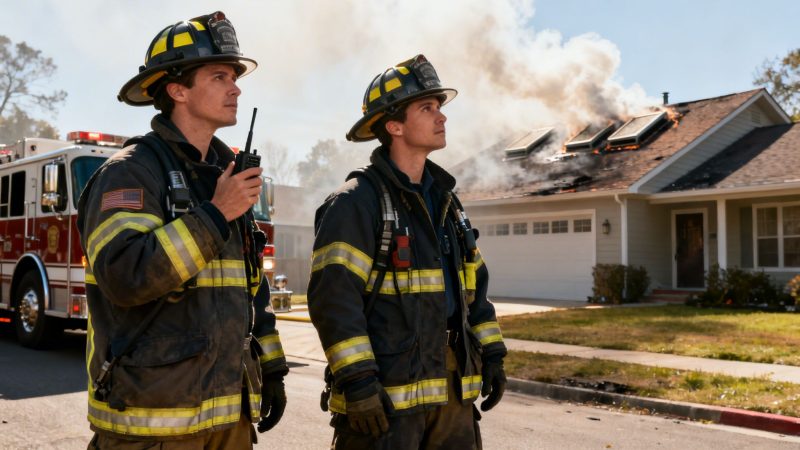
Scene Size Up Fire: Avoid Fatal Errors
Dispatch just dropped a structure fire. You are still a few blocks out. Smoke is visible above the tree line, the caller is frantic, and the first-in officer is already doing math. Occupancy. Access. Water. Staffing. Victim potential. What can go wrong before the first line is stretched.
That is where scene size up fire work begins.
A lot of people treat size-up like a phrase they say on the radio before getting to work. That is a mistake. Size-up is the work. It drives the first line, the first search, the first mutual aid request, and the first decision that keeps a routine room-and-contents fire from turning into a mayday, a collapse, or a funeral.
The fireground punishes shallow thinking. A weak initial read creates cascading problems. Companies commit to the wrong entrance. Crews miss extension. Command underestimates staffing. Radio traffic fills with corrections instead of assignments. You lose time, then options, then safety margin.
A strong size-up does the opposite. It gives incoming units a picture they can use. It helps command match resources to the problem. It also saves money in a way chiefs understand immediately. When you request accurately, stage intelligently, and track people and tasks in real time, you avoid both under-response and expensive over-commitment.
Why the First 30 Seconds Define the Next 30 Minutes
Those first seconds on approach are not dead time. They are decision time.
You are already reading the building before you stop the rig. Smoke location matters. So does smoke behavior. The block tells you things too. Tight setbacks, parked cars, overhead wires, attached exposures, and rear access limitations all shape what happens next. If the address is wrong, if dispatch notes are incomplete, if the occupancy is not what everyone assumed, your windshield size-up is the first correction.
A poor start creates a chain reaction. The wrong initial report draws the wrong apparatus placement. The wrong apparatus placement slows line advancement, laddering, water supply, and truck work. Then command spends the next ten minutes fixing avoidable problems.
A good start sounds simple because it is disciplined. Identify what you have. Identify what is threatened. State what you are doing. State what you need.
Size-up is a thinking skill
Checklists help, but no checklist replaces judgment.
The best officers do not just observe. They interpret. Light smoke from one area means one thing. Pressurized smoke from below grade means another. A front-side view can suggest a small incident while the rear shows a basement pushing hard, fire out a walkout, or victims at a window. That gap between what is visible and what is true is where firefighters get trapped by assumptions.
Practical takeaway: The first report should be useful enough that the second-due company can act before they arrive, not guess after they stop.
Technology helps when it supports judgment
Good software does not perform the size-up for you. It sharpens it.
When dispatch data, mapping, unit status, and personnel accountability are visible early, command can act on a clearer picture. That matters on the small jobs, where over-sending ties up units, and on the ugly jobs, where one delayed request can put crews behind the fire.
This highlights a key aspect. A disciplined scene size-up fire process is not paperwork, tradition, or radio theater. It is the foundation under every tactical decision that follows.
The Initial Arrival and 360-Degree Assessment
Arrival is where experienced officers separate urgency from hurry.
The rig is still moving, and the officer should already be building the first report. Start with the windshield size-up. That means reading what is visible from the approach, while also recognizing that the front view is rarely the whole incident.

What to read before the wheels stop
The first read should answer a few questions fast.
- What is the building: Single-family, duplex, mixed occupancy, strip commercial, garden apartment, lightweight residential build, older balloon-frame house.
- Where is the smoke or fire: Front window, eaves, basement windows, attic vents, rear deck, roof line.
- What is the access picture: Narrow drive, blocked hydrant, fences, grade changes, alley access, security bars, parked cars.
- What is the life hazard: Vehicles in the drive, people outside accounting for everyone, neighbors reporting occupants trapped, lights on in sleeping areas.
- What is the water picture: Hydrant close and usable, long lay needed, supply issue likely.
That sounds basic. It is not. Missing any one of those can bend the whole operation out of shape.
The 360 changes tactics
A front-only fireground view is incomplete by default.
A proper 360-degree walk-around often reveals the problem that matters. Fire conditions at the rear. Basement involvement. Collapse indicators. Victims not visible from the street. Better access for attack. Worse access for rescue. NIOSH firefighter fatality reports repeatedly cite failure to conduct a proper size-up as a key contributing factor in line-of-duty deaths, and a proper size-up including a 360-degree walk-around supports early command and accurate resource allocation, as noted in this FireRescue1 discussion of strong initial on-scene size-up reports.
If the officer cannot complete the 360 personally, the function still has to be done. Assign it. Get the report back. Make it part of your first operational rhythm, not an optional add-on.
A practical arrival sequence
A sound sequence on a working structure fire usually looks like this:
Read conditions on approach
Build the initial picture before you stop. Do not wait until you are standing in front of the house.Position with intent
Leave room for the truck. Protect access. Do not let one engine block the next three tasks.Establish command early
The radio report is not clerical. It creates order.Start or assign the 360
Confirm or correct the front-side impression.Commit the first line based on the true problem
Not the easiest problem. The true one.
What the first radio report should do
A useful initial report is short, specific, and directional.
The classic format still works because it forces clarity. Building. Occupancy. Conditions. Actions. Command. A report like this gives incoming companies a workable picture:
“Engine 7 on scene at 1234 Smith Street, one-story residential with light smoke from the A/D corner, laying supply line for offensive handline attack, Engine 7 Smith Street command.”
That style works because it tells everyone what you have and what you intend to do.
What does not work is the vague version: “We’re on scene investigating.” That buys nothing for incoming units. It withholds the exact information they need for placement, line selection, and task preparation.
Practical examples officers should recognize
Two fires can both be “smoke showing” and demand completely different tactics.
| Condition seen on arrival | What it may suggest | Immediate implication |
|---|---|---|
| Light smoke from one kitchen window | Smaller contained fire, possible limited extension | Fast interior attack may be appropriate if the 360 stays favorable |
| Heavy smoke from first-floor front, same smoke pushing from attic | Vertical extension already in play | First line still matters, but you need attic and upper-floor planning immediately |
| Smoke from front door area, heavy smoke and fire from rear lower grade | Basement fire with deceptive front view | Front-door push may put crews above the fire |
| No visible flame, pulsing smoke from openings | Ventilation-limited conditions | Entry and ventilation must be coordinated carefully |
How mapping improves the first few minutes
Preplans help, but only if crews can see them when they matter.
Digital mapping gives officers and dispatchers access to hydrants, access routes, site notes, and building information before the full picture develops on scene. A department using mapping tools for preplans and incident visibility can reduce wasted movement, choose better staging points, and keep later-arriving companies from crowding the wrong side of the incident.
That means money gets saved too. Better placement means less repositioning, less idle apparatus conflict, fewer unnecessary specialty requests, and shorter incident duration on smaller fires.
What not to do on arrival
Some errors keep repeating because they feel fast.
- Skipping the 360: Front-side comfort leads crews into rear-side problems.
- Talking too much on the radio: Long reports delay action and bury the point.
- Giving generic reports: “Heavy smoke showing” without location, occupancy, or strategy leaves everyone guessing.
- Parking without a plan: One bad spot can cripple truck work and water supply.
- Locking into the first assumption: The first impression should guide action, not handcuff it.
A clean arrival is not dramatic. It is controlled. That is what keeps the incident manageable.
Decoding Fire Behavior and Building Construction
Observation gets you to the front door. Interpretation keeps you alive after you get there.
A lot of bad decisions start with crews seeing conditions but not understanding them. Smoke is not background scenery. Building type is not a report-writing detail. Both tell you what the fire is doing now and what it is likely to do next.

Read the smoke for intent
Smoke gives clues about location, heat, confinement, and spread.
Light smoke from the eaves may point you toward attic involvement. Thick black turbulent smoke should raise concern for high heat and rapidly changing interior conditions. Pulsing smoke should get your attention for a reason. It may indicate a ventilation-limited fire with dangerous potential if crews change the air track carelessly.
Do not reduce smoke reading to color alone. Officers need to consider:
- Volume: Is there a little smoke or a lot of it
- Velocity: Is it drifting or pushing
- Density: Is it thin or packed
- Location: Window, soffit, basement opening, roof line, wall void area
A lazy smoke condition at one opening can change quickly once a door is forced or a window fails. That is why the initial read must connect directly to your entry, line placement, and ventilation timing.
Fire location changes the risk picture
Fire below you, beside you, and above you are three different fights.
A room fire on the first floor with no extension can support one plan. Fire in the basement under the entry path demands another. Fire already in the attic or cockloft requires immediate concern for extension and structural compromise.
A practical example. You arrive at a two-story house. Front side shows moderate smoke from the first floor. The rear reveals heavy fire venting from a walkout basement door. That is not a first-floor fire with smoke migration. That is a basement fire threatening the floor system and the stairs above it. If crews push through the front without understanding that, command has just put them over the seat of the fire.
Construction tells you how long the building will help you
The COAL WAS WEALTH framework remains useful because it forces officers to think beyond flame. Construction and occupancy shape your tactic before the first ceiling is opened.
Older ordinary construction, legacy dimensional lumber, lightweight trusses, renovated mixed occupancies, and void-heavy commercial spaces all burn and fail differently. Even if two buildings present the same amount of visible smoke, the safer tactic may differ because the structure differs.
Short version. You are not only fighting fire. You are fighting fire inside a system built a certain way.
| Construction cue | What it should prompt |
|---|---|
| Lightweight residential roof system | Limit time under or on the roof if attic involvement is suspected |
| Ordinary construction commercial row | Check for horizontal extension through voids and shared spaces |
| Mixed-use building with residential above commercial | Reassess life hazard and extension paths immediately |
| Sagging roofline or bowing wall | Shift attention to collapse potential and withdrawal timing |
Tip: If building age, renovation history, or roof system is unclear, command should act conservatively until conditions prove otherwise.
Common visual warnings crews miss
The fireground usually gives warnings before it takes something from you.
Watch for sagging roof lines, bowed masonry, smoke from unusual seams, changing window conditions, and fire showing where your plan did not expect it. Listen too. Creaking, hissing, and sudden changes in interior sound should trigger a pause and a reassessment, not blind commitment.
Good officers differ from aggressive officers at this juncture. Aggressive officers see a problem and drive harder. Good officers ask whether the building and the fire still support the plan.
A useful training video on reading conditions and applying size-up principles is below.
What works on the fireground
Crews do better when the officer turns visual clues into plain tactical language.
“Basement fire on the Charlie side. Do not commit above it until we control it.”
“Attic extension visible. Second line needs to protect the floor above.”
“Roof line is sagging. Keep companies out of the collapse path.”
Those are useful commands because they translate observation into action. The worst version of size-up is the officer who notices everything and communicates nothing.
What does not work
Three habits get firefighters in trouble here:
- Treating all smoke as equal: It is not.
- Assuming the fire is where the first flame shows: It often is not.
- Ignoring construction until things get bad: By then, the building has already started making decisions for you.
Sound scene size up fire practice means seeing the story before it becomes a report of what went wrong.
Aligning Resources and Integrating Command
A correct size-up with the wrong resource package still fails.
Command has to convert conditions into assignments, and assignments into staffing. That is where many incidents start drifting. The fire is real, the hazards are visible, but the resource plan stays vague. Too few hands. Too many units in the wrong place. No clear picture of who is on scene, who is committed, and who is still coming.
A landmark 1980 Ohio State University study found that when firefighter staffing dropped below 15 on a structural fire, the injury rate increased by 46.7%, as discussed in this review of fire scene size-up and staffing risk. That matters because poor size-up often causes poor staffing. If command underreads the incident, crews pay for it.

Match resources to the tasks required
Do not request “more stuff.” Request what the incident requires.
A working structure fire can demand several separate jobs at once:
- Fire attack
- Search
- Ventilation
- Water supply
- Exposure control
- Rapid intervention
- Accountability
- Medical support
- Relief crews
One engine company cannot do all of that at once just because radio traffic sounds confident.
A practical command mistake is assigning interior attack, primary search, and ventilation with the same limited staffing package, then acting surprised when one of those jobs lags. Another is holding back the second request because the incident might calm down. Fires do not care that command is trying to conserve resources.
Early requests save money when they are accurate
Departments can reduce unnecessary cost here without reducing safety.
If command knows which units are responding, what their estimated arrival looks like, and which personnel are qualified for the needed functions, resource requests get tighter. That means fewer blind mutual aid calls on smaller incidents and faster escalation on incidents that are outrunning the first alarm.
A platform such as Resgrid dispatching tools can support that by showing unit status, assignments, and personnel accountability in one place. That helps command avoid the expensive habit of overcommitting apparatus because no one has a clean status board. It also helps avoid the opposite problem, which is waiting too long because the incident commander assumes help is closer than it is.
A practical mutual aid example
Take a garden apartment fire with rear access problems and visible extension.
The first-due officer gives a strong initial report. The 360 confirms rear fire, upper-floor life hazard, and access constraints. Command should already be thinking in task groups, not just companies. One company for the first line. Another for search and laddering. Another for water and backup line. Truck assignment. RIT. EMS support. Safety function.
Now add mutual aid.
If incoming units arrive with no assignment discipline, radio traffic spikes and work slows. If command can see unit arrivals and assign them to divisions or functions before they pull in, the scene runs cleaner. The savings are not abstract. Cleaner scenes mean fewer idle companies, less duplicated effort, less apparatus congestion, and shorter commitment time.
What disciplined command sounds like
Short commands beat dramatic commands.
| Weak command language | Better command language |
|---|---|
| “Everybody keep working the fire” | “Engine 3, backup line to Division 2” |
| “Truck, do what you need to do” | “Truck 1, primary search and rear ladders” |
| “Someone check the rear” | “Battalion aide, complete rear conditions update to command” |
| “We may need more help” | “Dispatch, start the next-due engine and truck” |
Specific assignments let companies prepare before they reach the curb.
The trade-off every officer has to manage
There is always pressure to conserve resources. That pressure is real. Sending too much too early can leave coverage holes elsewhere. But sending too little creates a different bill. Longer incidents. More fire spread. More fatigue. More risk. More equipment committed later under worse conditions.
The answer is not to guess smaller. The answer is to size up better.
Key point: Good command saves money by being precise, not by being cheap.
That means your size-up should produce a resource picture as clearly as it produces a fire picture.
The Continuous Size-Up and Common Pitfalls
The most dangerous phrase on the fireground is often silent. It is the assumption that the first read is still correct.
A scene size-up is not complete when the first line goes through the door. It is only started. Conditions shift. Smoke changes. Wind changes. Access changes. Civilians lie, panic, disappear, or appear. Crews report heat where command expected progress. Buildings begin to fail in places no one could see from the curb.
That is why a one-and-done size-up is not just weak practice. It is a setup for injury.

Triggers that demand a reassessment
Command should treat certain changes as automatic triggers.
- Smoke gets darker, thicker, or more turbulent: Conditions are worsening or moving.
- Structural noises appear: Creaking or hissing can signal instability or utility issues.
- Wind shifts toward crews or apparatus: The hazard zone just moved.
- Interior crews report high heat with little progress: The plan may be behind the fire.
- Crowd behavior changes: The perimeter and access picture may be breaking down.
- Combative or unstable patients appear near the hazard area: The scene now has a human threat layer too.
The right response is simple. Step back mentally. Re-scan. Update command. Change the plan if the facts demand it.
Continuous size-up protects rescue decisions
Firefighterrescuesurvey.com data shows that 89% of successful rescues occur pre-knockdown, while survival drops to 46.6% for searches delayed past 12 to 15.5 minutes, as summarized in this discussion of ongoing scene size-up and rescue timing. That should shape command decisions.
Rescue opportunities are time sensitive. So are firefighter exposure limits. Continuous size-up helps command judge both at once. A building that offered a viable search path three minutes ago may not offer one now. A room that looked tenable from the exterior may not stay that way after extension overhead or a ventilation change.
This is why command has to keep asking hard questions. Is the search still viable. Is the line in the right place. Has extension changed the risk. Are we protecting the stairs. Are we operating above a basement fire. Are we staying because we can, or because we have not admitted the window has closed.
Tunnel vision is the classic failure
Tunnel vision is not a rookie problem. Senior officers get caught by it too.
A common pattern looks like this:
- The first line goes in.
- Command fixates on knockdown.
- New information arrives from another side of the building.
- Nobody integrates it fast enough.
- The plan keeps moving even though the incident has changed.
That is how crews get trapped by extension, lose egress, or keep pushing offensive operations after the building has already voted for defensive strategy.
Practical tip: Build a habit of deliberate pauses. Even a short reset can break fixation and improve command judgment.
Use a framework, but do not become a prisoner to it
COAL WAS WEALTH still helps because it keeps officers checking the full picture. Construction. Occupancy. Apparatus. Life hazard. Water supply. Auxiliary appliances. Street conditions. Weather. Exposures. Area. Location. Time. Height.
Used correctly, it is a prompt. Used poorly, it turns into a recitation detached from actual conditions.
A better way to use it on a working fire is to revisit selected elements as conditions change:
| Element | Reassessment question |
|---|---|
| Construction | Has fire entered a void space or structural component that changes collapse risk |
| Life hazard | Do we still have credible rescue potential in the areas not yet searched |
| Water supply | Can current flow support the tactic we are trying to maintain |
| Exposures | Is extension threatening adjacent occupancies or uninvolved sections |
| Weather | Is wind now changing smoke travel or apparatus placement risk |
The hard call officers must be willing to make
Switching from offensive to defensive is not failure.
The failure is delaying that call because crews have already worked hard inside, because command fears criticism, or because someone still wants the fire to fit the original plan. Continuous size-up requires emotional discipline. You have to let the current conditions outrank the old decision.
What works is direct language. Withdraw crews. Sound the change. Reassign water. Reset collapse zones. Confirm PAR. Then continue with a plan that matches the building you have, not the one you hoped you had.
What does not work is drifting into defensive posture without saying it. That leaves interior crews and outside companies operating from different assumptions, which is how confusion becomes injury.
Institutionalizing a Culture of Effective Size-Up
Departments do not get reliable size-up performance by accident.
They get it through repetition, standards, after-action honesty, and a command culture that values accuracy over theatrics. A strong officer on one rig helps. A department-wide system helps more. When every company gives the initial report the same way, performs the 360 the same way, and updates command with the same discipline, the scene runs cleaner before mutual aid even arrives.
That starts with training, but not only classroom training.
Build the habit under stress
Departments should drill on arrival reports, 360 updates, smoke interpretation, and changing strategy under pressure. Keep the scenarios short and decision-heavy. Force officers to verbalize building, conditions, action, and command. Force them to update that report when the scenario changes.
The goal is not polished language. The goal is accurate language delivered on time.
A useful internal standard includes:
- A required initial report format
- A clear rule for who completes the 360
- A trigger list for formal reassessment
- A standard for announcing offensive to defensive changes
- A simple accountability process that command can maintain
Review incidents for decision quality
After-action review should ask better questions than “Did we put the fire out.”
Ask these instead:
- Did the initial report match the actual conditions
- Did the 360 change strategy
- Were resource requests early enough
- Did command recognize extension quickly
- Was the tactical mode updated clearly
- Did companies understand their assignments without repeated radio clarification
Those questions improve future scenes. They also identify where departments are losing time, overusing apparatus, or creating avoidable exposure for members.
Technology should support standards, not replace them
Software has value when it reinforces disciplined process.
Departments that want more consistency can build reporting and assignment habits into digital systems. Shared checklists, dispatch visibility, personnel status, and post-incident documentation all help if they are simple enough to use during real operations. Workflow tools such as structured incident workflows can help agencies standardize assignments and documentation so command is not rebuilding the process from scratch at every incident.
That matters financially too. Standardized operations reduce duplicated effort, improve coverage decisions, and make training gaps easier to identify before they become expensive mistakes.
The bottom line is simple. If your department wants better outcomes on scene size up fire incidents, formalize the process. Train it. Review it. Enforce it. Support it with tools that make command clearer, not noisier.
Resgrid, LLC helps agencies organize dispatching, accountability, messaging, tracking, and incident management in one platform. If your department wants a more consistent way to support size-up decisions, manage assignments, and reduce the waste that comes from unclear resource tracking, review Resgrid, LLC and see whether it fits your operational model.