
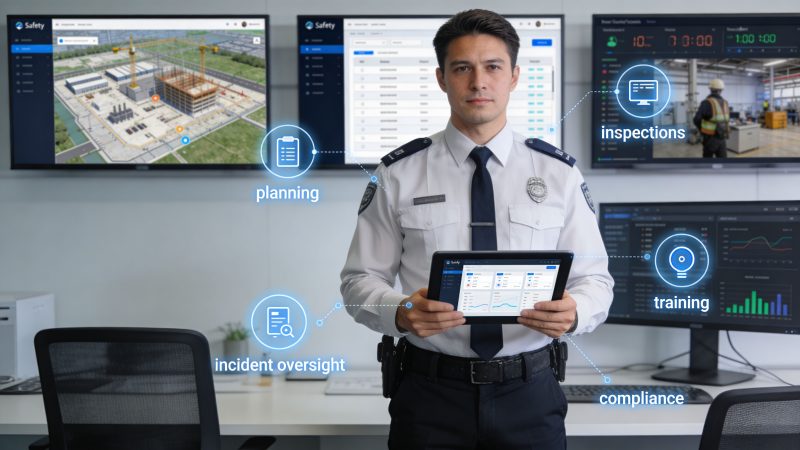
Master Safety Officer Responsibilities and Duties
A warehouse floor is in full motion. Forklifts are crossing aisles, radios are pulling supervisors in different directions, and one delayed decision can turn a routine shift into an injury, a shutdown, or an investigation. In that setting, a safety officer has to work inside operations, not outside them.
This is the core job behind safety officer responsibilities and duties. The title still covers inspections, policy work, training, incident review, compliance tracking, and emergency planning. What has changed is the pace. Hazards develop faster, records go stale faster, and small gaps in communication cost more than they used to.
Paper files and scattered spreadsheets create the same old failure points. A near-miss report sits in an inbox. A training record is saved in the wrong folder. A supervisor corrects a problem on the floor, but nobody logs it, so the same exposure shows up again next week. Safety programs break down in those handoffs.
Strong safety officers build a working system. They connect field observations, corrective actions, personnel status, training records, and incident communications so the operation can respond while the problem is still manageable. For teams that cover multiple buildings, yards, stations, or response areas, tools like incident mapping and location tracking help put hazards, resources, and people in the same operating picture.
That shift matters most in high-tempo environments such as warehousing, manufacturing, transportation, and public safety. A good safety officer does more than enforce rules. The role is to reduce repeat incidents, shorten response time, document action clearly, and give leadership a reliable view of risk before losses stack up.
Resgrid supports that approach by bringing messaging, personnel tracking, scheduling, reporting, and operational coordination into one system. Used well, it cuts duplicate admin work, closes follow-up gaps, and gives safety officers records that are useful. That saves time, protects budget, and turns the role from reactive and paper-based into proactive and data-driven.
1. Hazard Identification and Risk Assessment
Hazard identification is where the rest of the safety program either gets traction or falls apart. If the safety officer misses the critical exposure points, training will be generic, inspections will be shallow, and policies will solve the wrong problem.
A good assessment starts with the work as it is performed, not as it appears in a procedure manual. In a fire department, that might mean spotting trip hazards around apparatus bays, battery charging risks in equipment rooms, and backing risks during tight station departures. In EMS, it could mean bloodborne pathogen exposure during transport, stretcher loading strain, or loose equipment in the patient compartment. In a dispatch center, the hazard may be less dramatic but just as costly: poor workstation ergonomics, fatigue, and communication overload.

What works in the field
The fastest way to improve this part of safety officer responsibilities and duties is to stop assessing hazards alone. Frontline crews know where the shortcuts, blind spots, and recurring workarounds live.
Use a short, repeatable process:
- Walk the workflow directly: Follow a vehicle from dispatch to return, or follow a maintenance task from start to finish.
- Document with photos: A written note about “poor housekeeping” gets ignored. A photo of leaking fluid near a ladder gets fixed.
- Review near-misses and minor incidents: Small events usually point to larger system weaknesses.
- Reassess after changes: New equipment, staffing changes, remodels, seasonal weather, and new call types all change risk.
Resgrid helps by centralizing location-based information and making hazards easier to visualize across facilities and operational areas. For teams managing multiple sites or incident zones, Resgrid mapping gives the safety officer a cleaner way to connect places, people, and risk patterns.
Cheap safety programs guess. Effective ones map exposure, document it clearly, and revisit it after operations change.
What does not work is relying on a generic annual checklist and calling that a risk assessment. If the same issue appears month after month, the checklist is not the problem. The process is.
2. Safety Policy Development and Implementation
Most organizations do not suffer from a lack of policy. They suffer from bloated policy. If crews need ten minutes to find the rule, they will default to habit.
A safety officer has to write policies that people can use under pressure. For first responders, that means clear expectations on seatbelt use, apparatus movement, PPE requirements, rehab, driver conduct, scene lighting, radio discipline, and fatigue-related decisions. For a business operation, it may be lockout procedures, forklift traffic rules, spill response, contractor control, and visitor safety.
Write for use, not for display
Start with the jobs that create the most exposure. Write the rule in direct language. Then test whether a supervisor can explain it in one minute during a shift briefing.
Strong policy usually has four parts:
- Scope: Who the rule applies to.
- Trigger: When it applies.
- Required action: What people must do.
- Verification: How leaders confirm compliance.
A heat stress policy, for example, should not be a broad statement about hydration. It should define when modified work, additional breaks, rehab checks, or command notification are required. A pursuit safety policy should not rely on common sense. It should spell out conditions, decision authority, communication requirements, and termination thresholds.
Resgrid is useful here because policy distribution is often the weak link. Safety officers can push updates through messaging, track acknowledgments, and keep one current version available instead of letting old PDFs float around in email chains.
The cost savings are straightforward. Clear policies reduce duplicated retraining, reduce preventable mistakes, and cut the admin time spent proving who got what update. That is especially important when leadership asks whether a crew member received the revised procedure before an incident.
What does not work is copying another agency’s manual and swapping the logo. If the policy does not match your staffing, equipment, or operating tempo, crews will ignore it.
3. Training and Education Program Development
The test comes at 2 a.m., not in the classroom. A crew reaches for PPE, sets up for a confined space entry, or backs a unit into a tight bay. If training was weak, the mistake shows up fast and usually under pressure.
Training earns its keep when it changes behavior on the next shift. Safety officers are not paid to fill seats. They are paid to make sure people can do the job safely, under normal conditions and when the day goes sideways.
That means the program has to match the work. PPE instruction, for example, should cover selection, fit, inspection, limits, and replacement triggers. A worker who knows the policy but cannot spot damaged gear is still a risk. The same applies to lifting, driving, lockout procedures, patient handling, and any other task where a shortcut turns into an injury.
Train to the job, not just the due date
Annual refreshers still have a place. They satisfy recurring requirements and help reinforce baseline expectations. The bigger gains usually come from task-based training tied to operational changes and recurring problem areas.
Use training triggers like these:
- Driver and backing drills after a fleet change
- Bloodborne pathogen refreshers before seasonal demand spikes
- Confined space rescue review before facility maintenance work
- Dispatch console ergonomics coaching after workstation changes
- Heat illness training before summer operations
At this stage, safety officers often lose time. The hard part is not building a decent course. The hard part is scheduling the right people, documenting attendance, tracking expirations, and proving completion when a supervisor or regulator asks for it.
Resgrid helps turn that administrative mess into a working system. Training records can be tied to personnel profiles, schedules, and reminders, so the safety officer can see who is due, who missed a session, and where staffing gaps will show up if training is delayed. That cuts overtime waste and reduces the common mistake of pulling too many people off the line at once.
Records are part of the control
Bad records create cost. Expired certifications lead to missed assignments, repeated classes, last-minute coverage problems, and a lot of avoidable cleanup before an audit or after an incident. Digital records fix an old paper problem. The file is attached to the person, the expiration date is visible, and the follow-up action is clear.
Good programs also respect how adults learn. A five-minute hands-on drill beside the apparatus often produces better retention than an hour of generic slides. Walk the crew through the space. Put the equipment in their hands. Run the decision point they are likely to face in the field. That approach takes more planning up front, but it saves money later because people make fewer preventable mistakes and supervisors spend less time reteaching basics on the fly.
A training program should work like a digital command center, not a stack of binders and sign-in sheets. Once that system is in place, the safety officer can spend less time chasing paperwork and more time correcting the risks that injure people.
4. Incident Investigation and Root Cause Analysis
At 6:45 a.m., a worker goes down on a wet bay floor, the supervisor wants an answer before shift change, and everyone in the room already has a theory. That is when investigations go wrong. The safety officer’s job is to slow the guesswork down, secure the facts, and identify the conditions that made the injury possible.
Good investigations protect people and budget. A weak review stops at employee error and sends everyone back to work. A useful review finds the failed control, fixes it, and prevents the same loss from showing up again as another injury, damaged equipment, lost production hour, or claim.
A station slip-and-fall is a good example. “Careless employee” is not a root cause. The key questions are practical. Was the floor hazard reported before the incident. Was cleanup assigned and verified. Were lighting levels poor. Did the shift have the right footwear requirements. Had supervisors seen the same condition earlier and let it slide. Those answers point to controls the organization can repair.
Build the timeline before opinions harden
The first hours matter. People fill gaps in memory fast, and by the end of the day a confident story can be less accurate than a quiet one recorded early.
Start with sequence, not blame:
- Secure the scene: Capture photos, equipment position, environmental conditions, and anything that may be cleaned up or moved.
- Reconstruct the event: Document what happened before, during, and after the incident in order.
- Interview separately: Witness accounts get contaminated quickly when crews compare stories.
- Check the system around the event: Staffing levels, workload, maintenance status, supervision, communication, and prior reports often explain more than the final action.
- Assign corrective actions: Every fix needs an owner, due date, and verification step.
That last point is where many investigations fail. The report gets written. The recommendation gets accepted. Nothing changes in the field.
Resgrid’s reporting and incident logging help safety officers avoid that old paper problem. The record is time-stamped, photos and notes stay attached to the case, and corrective actions can be tracked to completion instead of disappearing into email chains or a binder on someone’s desk. That saves time during reviews and saves money by cutting repeat work after the same event happens again.
One rule is worth keeping in plain view.
If the same type of incident happens twice, the first investigation did not go far enough.
“Retrain the employee” is often the default corrective action because it is fast, familiar, and easy to document. It is also frequently incomplete. Training may be part of the fix, but many incidents come from layout problems, unclear procedures, deferred maintenance, rushed scheduling, or supervisors working around broken processes to keep production moving. A seasoned safety officer looks at those trade-offs directly. If the system rewards speed and tolerates shortcuts, the incident was built long before the event report was opened.
The best investigations turn into a working control system. Trends can be sorted by location, task, equipment, shift, or contributing factor. Leadership can see which hazards keep resurfacing, which managers close actions on time, and which fixes reduce exposure instead of creating more paperwork. That is the difference between a reactive program and a digital command center. It gives the safety officer a way to prevent losses with evidence, not hindsight.
5. Compliance and Regulatory Management
The phone usually rings at the worst time. A regulator asks for training records, fit-test documentation, vehicle inspection logs, and proof that corrective actions were closed. If the answer lives in file cabinets, shared drives, and a supervisor’s inbox, the problem is no longer just compliance. It is lost labor, delayed responses, and preventable exposure.
A safety officer’s job is to know which rules apply, then turn those requirements into a system people can follow on shift. That includes recordkeeping, hazardous materials documentation, medical evaluations, inspection schedules, licensing, equipment checks, and any agency-specific standard tied to the operation. The law sets the floor. Daily discipline keeps the organization off it.
Good compliance work is quiet. It runs in the background because dates, documents, and responsibilities are already assigned before anyone asks.
That takes more than a binder and a calendar reminder. Supervisors need clear ownership. Departments need one source of truth. Leadership needs a straight answer on three points: what is missing, who owns it, and when it will be fixed.
A practical approach looks like this:
- Set one record standard: Decide where documents live, who uploads them, how long they stay, and who reviews them before they expire.
- Track deadlines before they become findings: Medical clearances, fit-testing, license renewals, inspection intervals, and training cycles should trigger reminders early enough to act.
- Run small compliance checks often: A short monthly review catches gaps while they are still cheap to correct.
- Tie requirements to the work itself: Vehicle checks, equipment inspections, and documentation need to happen inside the normal workflow, not as end-of-month cleanup.
- Report exposure in plain language: Senior leaders do not need a lecture on citations. They need the operational risk, the cost of delay, and the decision required.
Resgrid helps turn that routine into a digital command center. Instead of chasing paper, safety officers can assign tasks, store records with timestamps, track completions, and pull reporting trails without rebuilding the file every audit cycle. That saves hours of admin time and cuts the familiar waste of duplicate requests, missing attachments, and expired documents nobody saw coming.
The trade-off is simple. A paper-heavy system can look cheaper until an audit, claim, or enforcement visit forces staff to reconstruct months of proof by hand. Digital tracking costs less than that scramble.
This matters in specialized compliance areas too. Respiratory protection is a good example, especially in agriculture and other field operations where exposure, training, and equipment use can shift quickly. The article what agricultural workers need to know about respiratory protection is a useful reminder that compliance is tied to worker protection, not just forms.
Compliance cannot sit with the safety officer alone. Fleet, operations, HR, training staff, and supervisors all control part of the evidence. If those handoffs are vague, the records will drift out of sync with the work. A seasoned safety officer closes that gap by building a system people use every day, with Resgrid supporting visibility, accountability, and audit readiness.
6. Personal Protective Equipment Management
PPE management sounds simple until you try to run it across multiple shifts, job types, sizes, and expiration cycles. Then it becomes a logistics problem.
The safety officer is responsible for more than ordering gear. The core job includes selection, fit, issue, inspection, cleaning, repair, replacement, and documentation. If any one of those steps breaks, the organization can have “PPE available” on paper and still leave people exposed in practice.

In high-risk sectors like construction, safety officers organize PPE training and emergency drills to ensure proper use, according to the ASSP article on the role of a safety officer in the workplace. That same discipline applies in fire, EMS, law enforcement, utilities, manufacturing, and agriculture.
The money is lost in poor tracking
A common waste point is duplicate purchasing. One employee says gloves were never issued, another has expired respirator paperwork, and a supervisor keeps spare stock because nobody trusts central inventory. That is not just messy. It costs money.
A better method looks like this:
- Issue by person, not just by department: Tie each item to a profile.
- Track expirations and fit status: Respiratory protection fails when records fail. For related practical context, see what agricultural workers need to know about respiratory protection.
- Inspect on a schedule: Gear should be checked before use and at defined intervals.
- Replace based on condition and standard: Not on guesswork.
Resgrid helps by linking personnel records to assignments and operational readiness. That gives safety officers a cleaner way to verify who has what, who needs updates, and where compliance gaps sit before a callout or inspection.
What does not work is selecting PPE without user input. If the equipment is uncomfortable, hard to access, or interferes with the job, crews will find ways around it.
7. Safety Inspection and Audit Programs
The failed audit rarely starts on audit day. It starts weeks earlier, when a leaking forklift is written off as maintenance’s problem, blocked exits get ignored because production is busy, and inspection forms are filed without anyone owning the corrections. By the time an injury, regulator, or customer audit exposes the gap, the organization is paying for delay.
Inspection programs exist to find weak control points early and force action while the fix is still cheap.
A useful inspection program tests whether the written safety system survives contact with the workplace. Clean paperwork does not mean the operation is safe. It usually means the checklist is too vague, the inspection is rushed, or nobody is verifying closure. Good inspections identify specific hazards, assign corrective action, and confirm the issue is controlled.
Build inspections around where failure costs you
Every area does not need the same level of scrutiny. Put more time into the places where a miss leads to injury, downtime, equipment damage, or compliance trouble.
For example:
- Apparatus bay: floor condition, eyewash access, charging areas, exhaust controls
- Vehicles: lights, restraint systems, loose equipment, maintenance status
- Stations and offices: exits, storage, electrical hazards, trip points
- Operational gear: serviceability, cleanliness, labeling, readiness
- Field practice: whether crews follow the written procedure under normal pressure
Specific findings get results. “Housekeeping issue in bay” goes nowhere. “Hydraulic fluid leak at rear left apparatus position creating slip hazard beside ladder storage” gives operations and maintenance something they can fix the same day.
That level of detail matters because inspection work is not free. If a supervisor spends an hour walking an area and produces notes nobody can act on, the organization loses time twice. First in the inspection. Then again when the hazard is rediscovered later.
Resgrid helps turn inspections into a working control system instead of a filing exercise. Using workflow-based corrective action tracking, a deficiency can be assigned to a named owner, tied to a due date, escalated if it stalls, and closed only after verification. That saves the safety officer from chasing updates through email, text messages, and paper binders.
I have seen the same pattern in shops, stations, and field operations. The inspection itself is usually not the failure. Follow-up is.
An inspection without follow-up is delayed acceptance of a known problem.
The practical standard is simple. Every finding needs an owner, a due date, and proof of correction. The safety officer does not need to fix every issue personally, but the safety officer does need a system that shows what was found, who is responsible, what is overdue, and which repeat findings keep coming back. That is where the role shifts from reactive and paper-based to proactive and data-driven. You spend less time hunting status updates and more time removing hazards before they turn into injuries, citations, or unplanned costs.
8. Workplace Injury Management and Return-to-Work Programs
The injury response starts long before a workers’ compensation form is filed. It starts the moment a supervisor decides whether to report the event promptly, preserve facts, and direct the employee to appropriate care.
This is one of the most overlooked safety officer responsibilities and duties because organizations often split it among HR, operations, and medical providers. That split creates delays, mixed messages, and avoidable cost.
Early organization matters
A well-run injury process does four things quickly:
- Documents the event accurately
- Coordinates medical evaluation
- Communicates restrictions clearly
- Plans productive return-to-work options
A sprain on a loading dock, for example, should trigger immediate reporting, supervisor documentation, review of the work area, and communication with the treating provider about job demands. If the employee can return with temporary restrictions, the organization should have useful light-duty tasks ready. Waiting passively often extends time away and increases deconditioning.
Resgrid can support this by centralizing injury reports, related communications, and staffing adjustments. That is valuable because the safety officer can see both the case details and the operational impact. If one unit is short staffed because a member is on restrictions, scheduling and duty assignment decisions can happen faster and with better documentation.
The trade-off most companies get wrong
Some organizations push people back too fast. Others leave them disconnected too long. Both approaches drive cost.
The better path is structured and practical. Keep the employee informed. Match restrictions to tasks. Review progress regularly. Use the case data to identify whether the injury points to a wider pattern in lifting, vehicle access, footwear, housekeeping, or supervision.
What does not work is treating every injury as a paperwork event instead of an operational signal. Each case should feed prevention.
9. Safety Culture Development and Behavior Management
A crew is behind schedule. Radio traffic is stacked up. A supervisor wants the task finished before shift change. In that moment, culture decides whether someone stops the job, reports the shortcut, and fixes the risk, or stays quiet and hopes nothing goes wrong.
That is the safety officer’s job in this area. Set the conditions so speaking up is normal, supervisors respond consistently, and corrective action happens fast enough that people see reporting as useful.
Near-miss reporting is one of the clearest signs. Higher reporting usually points to trust, attention, and a workforce that expects follow-through. Low numbers can mean the opposite. I have seen sites brag about quiet logs while crews traded workarounds in the parking lot because nobody wanted the hassle that came with reporting.
Build reporting systems people will use
Culture work fails when reporting feels slow, political, or pointless. People will not fill out a form that disappears into a binder, especially during a busy shift.
A better approach looks like this:
- Supervisors report their own misses and bad calls. That sets the standard faster than any slogan.
- Reports get a response. Even a short update matters if it explains what was checked, fixed, or escalated.
- Recognition focuses on judgment. Credit the employee who stopped a lift, questioned a rushed entry, or called out missing PPE.
- Coaching stays proportionate. Correct risky behavior clearly, but do not turn every mistake into a public lesson unless the situation requires it.
Resgrid helps turn that approach into a working system instead of a good intention. Shared messaging, logged updates, and visible assignments give crews one place to receive lessons learned, policy reminders, and follow-up actions. Teams that use digital dispatching and communication workflows can push safety notices across shifts, track who acknowledged them, and avoid the old problem where one supervisor briefs the issue and the next shift never hears about it.
That saves time. It also saves money. Safety culture problems get expensive when the same weak behavior keeps resurfacing because the warning, correction, and fix never reached the whole operation.
In first responder and field settings, behavior management is harder because conditions change fast. A strong culture makes it routine to challenge a poor parking position, question an incomplete handoff, or stop an entry that is drifting outside the plan. That is not a morale problem. That is operational discipline.
The trade-off is clear. If leaders overreact to every report, reporting drops. If leaders tolerate repeated drift in the name of being supportive, standards erode. The safety officer has to hold both lines at once. Keep reporting easy and low-friction. Keep expectations clear. Then use the record of reports, follow-ups, and recurring issues to spot where training, supervision, or staffing needs work before the next incident forces the point.
10. Emergency Response Planning and Preparedness
A quiet shift can turn in seconds. A weather warning escalates, a crew gets tied up on another call, radios start dropping traffic, and now the evacuation plan has to work with fewer people than the chart assumed. That is the true test of emergency preparedness. The safety officer’s job is to build a plan that still functions when staffing, communications, and timing all go sideways at once.

Good plans are plain, fast to use, and built for stress. They define who makes the call, what triggers the response, where people report, how accountability is confirmed, and what happens if the primary communication method fails. If a supervisor has to hunt through a binder to find the next step, the plan is already too slow.
Preparedness also has a budget side. Paper rosters, whiteboards, group texts, and separate scheduling tools create delays and duplicate work. A digital command center fixes that. Teams using dispatching and assignment coordination workflows can manage personnel status, tasking, and incident activity in one place, which cuts time spent chasing updates and reduces confusion during the incident review later.
Drills should test friction points, not produce a clean performance for management. Run the exercise during a shift change. Remove one supervisor from the scenario. Assume one vehicle is out of service. Force a handoff from routine operations into unified incident management. Those are the conditions that expose weak role definitions, bad contact lists, and evacuation routes that looked fine on paper.
A few scenarios usually reveal the gaps quickly:
- Severe weather hits during shift turnover
- Radio or dispatch outages interrupt a multi-unit response
- A hazmat incident expands past the first isolation estimate
- A facility evacuation starts while key apparatus or vehicles are unavailable
- A public event blocks normal emergency access routes
The trade-off is clear. More planning detail can improve control, but too much detail slows decisions in the field. Safety officers have to separate what must be scripted from what should be flexible. Evacuation triggers, accountability steps, and communication backups need tight structure. Unit-level tactics often need room for judgment.
Preparedness improves when every drill leaves a usable record. Track who was assigned, what failed, how long key actions took, and which corrective actions are still open. That is how the role shifts from reactive and paper-based to proactive and data-driven. It also saves money, because the same preventable breakdown does not keep resurfacing in every exercise and every real incident.
Safety Officer Duties: 10-Point Comparison
| Responsibility | Process complexity 🔄 | Resource requirements ⚡ | Expected outcomes ⭐ | Ideal use cases 💡 | Key advantages 📊 |
|---|---|---|---|---|---|
| Hazard Identification and Risk Assessment | High, systematic surveys and continual reassessment | Moderate–High, trained personnel, inspection time, tools | Strong, fewer incidents, prioritized controls | Preventive hazard mapping; pre-deployment risk checks | Proactive risk reduction; data-driven prioritization |
| Safety Policy Development and Implementation | Medium, drafting, review, and rollout cycles | Moderate, subject-matter input, communication, tracking | Consistent standards and legal documentation | Establishing org-wide rules (PPE, SOPs, duty limits) | Clarifies expectations; reduces liability |
| Training and Education Program Development | Medium–High, curriculum design and evaluation | High, instructors, training time, materials, tracking | Strong, improved competency; fewer human-error incidents | Certification, refresher training, new-hire onboarding | Builds capability; documents compliance |
| Incident Investigation and Root Cause Analysis | High, structured investigations and analysis | Moderate, investigators, time, reporting tools | Strong, prevents recurrence; systemic fixes | Post-incident learning, near-miss analysis | Reveals root causes; informs prevention actions |
| Compliance and Regulatory Management | Medium–High, ongoing monitoring and audits | High, compliance specialists, record systems | Strong, reduced fines; maintained legal standing | Regulatory audits (OSHA, NFPA, EPA) and license maintenance | Lowers regulatory risk; supports reputation and insurance |
| Personal Protective Equipment (PPE) Management | Medium, selection, fit-testing, maintenance | Moderate, procurement, replacement, training | Strong, reduced injury severity; regulatory readiness | Hazard-specific PPE programs (fire, hazmat, EMS) | Direct protection for personnel; trackable compliance |
| Safety Inspection and Audit Programs | Medium, scheduled inspections and follow-up | Moderate, inspectors, mobile forms, admin time | Strong, early defect detection; readiness assurance | Routine vehicle/equipment checks; facility audits | Prevents failures; documents due diligence |
| Workplace Injury Management & Return-to-Work | Medium, case management and coordination | Moderate, medical partners, admin, tracking systems | Strong, faster recovery; lower comp costs | Injury care, light-duty programs, claim management | Supports recovery; reduces long-term costs |
| Safety Culture Development & Behavior Management | High, long-term change and reinforcement | Moderate, leadership time, communications, recognition | Strong (long-term), sustained incident reduction | Organization-wide behavior change, near-miss reporting | Self-sustaining safety improvements; increased reporting |
| Emergency Response Planning and Preparedness | High, multi-scenario plans and frequent drills | High, planning, drills, interagency coordination | Very strong, improved crisis outcomes; faster response | Major incidents, natural disasters, active threats | Saves lives; reduces overall incident impact and cost |
From Responsibility to System Your Path to Proactive Safety
These ten responsibilities only look separate on paper. In practice, they are tied together every day.
A weak hazard assessment leads to weak policies. Weak policies lead to poor training. Poor training shows up in incidents. Poor investigations miss the underlying cause. Weak audits fail to catch the pattern. A thin reporting culture keeps leadership in the dark. By the time an emergency hits, the organization is relying on luck and experience instead of a functioning safety system.
That is why strong safety officer responsibilities and duties cannot live in disconnected spreadsheets, binders, text threads, and memory. The modern role is operational. The safety officer has to connect field conditions, personnel readiness, policy updates, inspections, investigations, and emergency coordination in a way that helps people act faster and document less.
Digital tools matter here because they remove avoidable friction. If a supervisor can report a hazard from a phone, assign a fix, notify the right people, and attach a photo in one workflow, that saves time. If training records, incident logs, and personnel status live in one system, the safety officer spends less effort chasing documents and more effort solving problems. If communications are centralized, the team wastes less time trying to reconstruct who knew what and when.
The financial side follows the operational side. Incidents cost money. Delayed reporting costs money. Duplicate admin work costs money. Missed training expirations, unmanaged PPE inventories, repeated hazards, and poorly coordinated return-to-work cases all cost money. Some of those costs are obvious. Others hide inside overtime, replacement purchasing, lost availability, and management time spent cleaning up preventable disorder.
That is also why the role should not be reduced to enforcement. A seasoned safety officer is part investigator, part trainer, part systems builder, and part operational advisor. The best ones know when to insist on a rule, when to redesign a process, and when to fix a communication gap that is creating repeated mistakes. They also know that paperwork is only useful when it leads to action.
A centralized platform can help turn those responsibilities into a working system. For agencies and organizations that need dispatching, messaging, personnel tracking, reporting, and operational coordination in one place, security incident response planning connects well with the same mindset. Resgrid, LLC is one relevant option for teams that want to bring those functions together without building a patchwork of separate tools.
The practical goal is simple. Make safety easier to run correctly than incorrectly. When the process is clear, records are accessible, and responsibilities are visible, compliance improves, follow-up improves, and people stop wasting time on preventable admin churn. That is how a safety officer moves from reactive oversight to proactive control. Not by doing more paperwork, but by building a system that keeps the work, the people, and the response aligned.
If you want to turn safety officer responsibilities and duties into one connected operating system, Resgrid, LLC gives first responders, dispatch centers, and organizations a practical way to manage messaging, personnel tracking, dispatching, reporting, and coordination from one platform. That can reduce administrative drag, tighten follow-up, and make your safety program easier to run every day.