
Master Emergency Operations Planning: Your Expert Guide
A lot of organizations think they have an emergency plan because there's a binder on a shelf, a PDF in SharePoint, or an old call tree someone built years ago. Then an actual incident hits. A flash flood closes roads, the dispatch center starts taking overlapping calls, a supervisor is on vacation, half the phone numbers in the contact list are wrong, and two different people order the same resources because nobody is sure who has authority.
That's when emergency operations planning stops being paperwork and starts being either operational control or expensive confusion. A solid Emergency Operations Plan (EOP) saves labor, reduces downtime, protects equipment, and gives leadership a way to make decisions under pressure without wasting time or money.
Why Your Current Emergency Plan Might Fail
The failure usually starts before the incident.
A dispatch center takes reports of rising water after a fast-moving storm. Staff know they have “a plan,” but the flood annex hasn't been updated since a facility move. The alternate command room is now storage space. One on-call manager left six months ago and is still listed as a primary contact. Field crews get conflicting instructions. Someone tells employees to shelter in place while another supervisor starts an evacuation. Nobody has a clean picture of who is where, what roads are passable, or which assets are already committed.
That kind of breakdown is common because many plans were written to satisfy an audit, not to run an incident.

The cost of weak planning is not abstract. FEMA is cited as estimating that 40% of businesses never reopen after a disaster, and a 2023 National Safety Council survey found that nearly 30% of workplaces still lack a written emergency action plan, as summarized in this workplace preparedness review. If your plan is incomplete, outdated, or untested, you're not managing risk. You're carrying it until the day it becomes a bill.
What fails in real incidents
The plans that collapse under pressure usually have one or more of these problems:
- They're too generic. A document that says “notify staff and assess the situation” doesn't help when communications are degraded and nobody knows who owns the decision.
- They assume perfect staffing. Real incidents happen on nights, weekends, holidays, and bad-weather shifts.
- They hide responsibilities. If people have to read ten pages to find out who opens the EOC, they'll improvise.
- They don't match operations. A plan that ignores how your dispatch, facilities, transport, or security teams work will fail fast.
Practical rule: If a supervisor can't pull your plan up and execute the first ten actions within minutes, the plan is too complicated.
Why leaders underinvest in planning
Many organizations still treat emergency operations planning as a compliance task because the benefits show up as avoided losses, not visible revenue. That's a mistake. The money savings are real:
- Less downtime when authority, communications, and resource requests are already defined
- Lower overtime waste because you don't duplicate assignments
- Fewer unnecessary purchases because logistics tracks what's already deployed
- Faster recovery because recovery tasks are built in before the incident, not invented after it
A practical EOP isn't impressive because it's thick. It's effective because people can use it when they're tired, short-staffed, and dealing with incomplete information. That's the standard that matters.
Laying the Foundation for Your EOP
Most bad plans don't fail during writing. They fail before writing starts, when the organization skips risk analysis and copies a template that doesn't reflect real operations.
Modern emergency plans are built around mitigation, preparedness, response, and recovery, and the all-hazards approach often starts with a Hazard Vulnerability Analysis (HVA), as outlined in NIH-hosted guidance on emergency operations planning. That framework matters because it keeps you from writing only for the dramatic moment. You also plan for prevention, continuity, and the long tail of recovery.

Start with a practical HVA
You don't need a consultant to do a useful HVA. You need the right people in the room and honest assumptions.
Pull together operations, facilities, dispatch, HR, IT, safety, and anyone who controls a critical dependency. Then list the incidents that could disrupt your organization. Not just the dramatic hazards. Include the boring failures that cause expensive interruptions, such as power loss, telecom outages, staffing shortages, hazardous materials incidents, access control failures, and transportation disruption.
A simple working method looks like this:
- List likely hazards. Natural, technological, human-caused, and operational.
- Assess impact on operations. What stops first? Dispatch? Payroll? Access to the site? Patient movement? Customer service?
- Identify single points of failure. One server room, one fuel vendor, one bad weather route, one key supervisor.
- Rank what needs planning depth. High-impact threats need stronger annexes, clearer triggers, and better resource agreements.
Don't spend half your planning time on a low-probability scenario while ignoring the outage, staffing, and communications failures you're more likely to face.
If you operate unmanned aircraft or rely on aerial support, risk review should cover that too. Teams that use drones for assessment or situational awareness should build flight restrictions, pilot authorization, and weather triggers into the HVA. A useful outside reference is JAB Drone's comprehensive drone safety guidelines, especially if your organization is adding aviation support without a mature risk program.
Build around the four phases
The four phases keep the plan balanced.
- Mitigation means reducing damage before the event. That can include flood barriers, backup power, redundant vendors, or moving critical records out of a hazard zone.
- Preparedness covers training, contact maintenance, exercises, and equipment checks.
- Response defines how you activate, who leads, and what happens in the first operational period.
- Recovery addresses restoration, documentation, alternate operations, and return to normal service.
A lot of organizations overbuild response and underbuild recovery. That's costly. If you don't define how departments resume essential functions, track losses, and return systems to service, the incident keeps charging your budget after the hazard is gone.
Before drafting, verify that your personnel data is organized and current. A clean system for personnel management and accountability makes the rest of the plan easier to maintain because roles, qualifications, and assignments don't live in disconnected spreadsheets.
Building the Core Plan and Command Structure
The base plan is the control document. It should answer three questions fast: who has authority, how the organization activates, and how information moves.
Too many EOPs bury those answers under policy language. That doesn't work in the first operational hour. The core plan needs plain language, clear triggers, and a structure that scales.

What belongs in the base plan
A useful base plan usually includes:
- Purpose and scope. What facilities, departments, shifts, and incident types the EOP covers
- Activation levels. What triggers monitoring, partial activation, or full activation
- Authorities and succession. Who can declare, who can spend, who takes over if leadership is unavailable
- Roles and responsibilities. Department-level duties, not vague shared ownership
- Communications concept. Primary and backup methods
- Resource coordination. How requests are made, approved, assigned, and tracked
- Continuity assumptions. Alternate sites, remote coordination, and essential functions
A good base plan is short enough to use and strong enough to govern annexes. If a detail belongs only to one scenario, move it to an annex. Don't overload the base plan.
Why ICS saves money, not just time
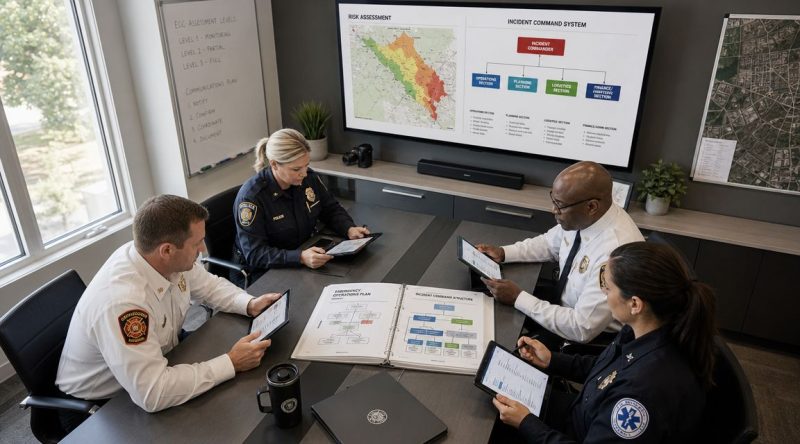
An Incident Command System (ICS) gives everyone the same operating picture and prevents two common drains on emergency budgets: duplicated effort and unmanaged span of control.
Think about a small office fire. One supervisor may handle the whole event with support from facilities and security. Now scale that to a campus evacuation or regional storm impact. You need someone managing tactics, someone collecting information, someone sourcing equipment and shelter, and someone tracking costs and claims. ICS expands to match the incident rather than forcing the same structure every time.
Many organizations incorrectly handle this aspect. They either overcomplicate the chart for minor incidents or skip the structure entirely during larger ones.
The core roles are straightforward:
- Incident Commander or EOC Director sets priorities and approves objectives
- Operations runs tactical actions
- Planning tracks status, builds action plans, and anticipates next steps
- Logistics gets people, equipment, facilities, and supplies where they're needed
- Finance and Administration tracks time, contracts, purchasing, and documentation
For teams that want a quick visual refresher, this short overview is useful before training sessions.
A weak command structure creates hidden costs. People order duplicate assets, assign crews twice, and escalate decisions that should already be delegated.
Dispatch integration matters here. If your response model depends on call intake, unit assignment, and status tracking, connect the EOP to the tools staff already use. A platform with dispatching workflows for incidents and units can support that operational handoff without forcing teams to jump between unrelated systems.
Integrating Communications and Resources
Communication failures and resource failures are usually the same problem viewed from different sides. If you can't reach the right people, you can't move the right assets. If you can't see what's assigned, every message turns into guesswork.
That's why some of the most damaging EOP flaws are administrative. Industry audits commonly find that personnel listed in plans no longer work there, contact information is wrong, and duties aren't assigned to the right people, as described in this review of common emergency response plan pitfalls. None of those sound dramatic. All of them create expensive confusion when an incident starts.
Build a communications model that survives friction
A communication plan should never assume one channel will stay available. Cell service degrades. Email gets ignored. Radios have dead zones. People miss app notifications when they're driving or working in PPE.
At minimum, define:
- Primary alert path. Who sends the first message, from what system, and to which groups
- Backup alert path. What happens if the primary system fails or key staff can't access it
- Operational updates. How supervisors receive situation reports and tasking
- External coordination. Who contacts partners, vendors, mutual aid, and families when applicable
- Message discipline. Who is authorized to send official incident updates
Households use the same logic on a smaller scale. LuminAID's guide to emergency communication strategies is a helpful reminder that redundancy and clarity matter at every level, from family reunification to agency command.
Track resources like money, because they are
Resource management gets treated like a logistics detail. It's a cost-control function.
If crews don't know what's already deployed, they request more. If finance doesn't know when equipment arrived, how long it was used, or who approved it, reimbursement and internal cost review become painful. If planning can't see staffing commitments, the next operational period is built on bad assumptions.
One modern approach is to keep personnel status, assignments, and incident messaging in a shared operational system instead of static documents. Tools such as WebEOC, Veoci, and team messaging for incidents and alerts can reduce the lag between decision and action by keeping contact lists and role-based notifications in one place. Resgrid, for example, combines messaging with personnel and incident management, which is useful when the same team needs to alert staff and confirm assignments without re-entering data.
A simple field rule helps: every resource request should answer five things before approval.
| Question | Why it matters |
|---|---|
| What is needed | Prevents vague requests |
| Who requested it | Establishes accountability |
| Where is it going | Supports delivery and tracking |
| When is it needed | Prevents premature or duplicate ordering |
| Who approved it | Protects finance and reimbursement records |
The organizations that control costs during incidents aren't always the ones with the biggest budgets. They're the ones with clean lists, disciplined approvals, and one shared picture of people and equipment.
Developing Actionable Annexes and Checklists
The base plan sets command and policy. Annexes tell people what to do.
Many EOPs become unreadable when teams dump every scenario detail into long narrative documents, then expect supervisors to use them under stress. That rarely works. Annexes should function like playbooks. Short action blocks, clear triggers, and checklists that match how work happens.
Separate functional annexes from hazard annexes
A practical EOP usually needs both.
Functional annexes cover actions that apply across many incidents. Examples include evacuation, shelter-in-place, communications, resource management, public information, continuity, and family reunification.
Hazard-specific annexes handle situations that need specialized decisions. Flooding, power outage, severe weather, hazardous materials release, and civil disturbance all create different operational problems even if the same command structure is used.
A useful test is simple. If the action applies to many incident types, keep it functional. If it depends on a specific hazard condition, put it in the hazard annex.
Build for people under pressure
When someone opens an annex during an active incident, they need action cues, not essays.
Use:
- Trigger statements that tell staff when the annex applies
- First-hour priorities so people know what happens immediately
- Role-based task lists tied to actual job titles
- Decision points for escalation, closure, relocation, or mutual aid
- Attachments for maps, vendor lists, facility shutoffs, and forms
Write annexes for the person covering the shift at 2 a.m., not the committee that reviewed the draft at 2 p.m.
Here's a simple sample you can adapt.
EOC Activation Checklist sample
| Task | Status | Notes |
|---|---|---|
| Confirm activation level and authority | ||
| Notify command staff and section leads | ||
| Open primary or alternate coordination site | ||
| Establish incident objectives for first operational period | ||
| Verify communications systems and backup methods | ||
| Start resource status tracking | ||
| Confirm staffing availability and critical shortages | ||
| Initiate situation report schedule | ||
| Document major decisions and approvals | ||
| Identify immediate access and functional needs support requirements |
Build access and functional needs into the annex itself
One of the biggest planning gaps is treating people with access and functional needs as an appendix topic instead of an operational priority. Inclusive emergency management work has emphasized bringing community experts into planning and pre-arranging resources like accessible transportation, which standard local fleets often don't provide, as discussed in this access and functional needs emergency planning presentation.
That means your evacuation annex should answer practical questions:
- Who identifies people who need mobility, communication, medical, or cognitive support?
- Who arranges transport?
- Where are accessible vehicles coming from?
- How will evacuees be tracked during relocation?
- Who coordinates durable medical equipment, service animals, medication access, or caregiver reunification?
If those answers aren't written into the annex, staff will improvise. Improvisation is slow, expensive, and often unsafe. Pre-arranged agreements with transportation providers, disability organizations, and medical partners cost less than trying to solve access needs in the middle of a moving incident.
Keeping Your EOP Alive Through Training and Improvement
A plan usually fails long after the binder is approved. It fails at 2:13 a.m. when the duty officer calls a number that no longer works, the backup site access code was changed six months ago, and the person assigned to order buses retired last quarter. By then, every gap is more expensive.
An EOP has to be maintained like an operational system. Training, exercises, and corrective actions keep it usable. Without that cycle, the document becomes a compliance artifact that looks finished and performs poorly under pressure.
The practical test is simple. Can people carry out their assignments with the staff, tools, and conditions they will have during an incident? If the answer is unclear, the plan is not ready.
Exercises expose low-cost fixes before an incident turns them into high-cost failures
Exercises should answer specific operational questions, not just satisfy an annual requirement. Start with the cheapest format that can reveal the problem you need to solve.
A tabletop works well when decision authority is muddy, notifications are inconsistent, or departments interpret the same annex differently. A functional exercise is better when the question is about EOC workflow, resource requests, documentation, or communications under time pressure. Full-scale exercises have value when field movement, perimeter control, evacuation, or outside-agency coordination must be tested in real conditions. They also cost more in staff time, scheduling, and disruption, so use them deliberately.
The Homeland Security Exercise and Evaluation Program lays out a practical framework for designing exercises, evaluating performance, and assigning improvement actions. That structure matters because vague exercises produce vague lessons, and vague lessons rarely lead to funded fixes.
Staffing assumptions need the same level of scrutiny. If an exercise assumes full attendance, perfect communications, and immediate vendor support, it teaches a fantasy version of response. Test the plan with absences, delayed approvals, damaged facilities, and overloaded phone lines. That is where the actual costs show up.
After-action discipline is what turns lessons into savings
Many organizations do the visible part. They run the drill, hold the hotwash, and capture notes. The money is saved or lost in what happens next.
After every exercise or real incident, document:
- What happened
- What worked
- What failed
- What changed in policy, staffing, equipment, or vendors
- Who owns each corrective action
- When each fix will be completed
Then track those actions like any other operational obligation. If no one owns the update, it will sit in a folder until the same failure happens again.
The strongest after-action programs separate cosmetic edits from operational fixes. Updating a phone number matters. Rewriting a resource ordering process, adding a second fuel vendor, or clarifying who can authorize evacuation transport matters more because those changes reduce delay, overtime, contract premiums, and service interruption during a real event.
A lesson only counts when it changes a checklist, a contact list, a purchasing decision, a contract, or a staff assignment.
Plans also drift because the organization drifts. People leave. Software changes. Facilities expand. Mutual aid relationships shift. Vendors stop serving your area. If the EOP is not reviewed against those changes, it starts giving staff false instructions, and false instructions are expensive.
A practical review cycle should be tied to actual business change, not just the calendar. Review the plan after exercises, after incidents, after leadership turnover, after facility or system changes, and after major contract changes. Annual review still matters, but it should not be the only trigger.
If your team needs a practical way to turn planning into execution, Resgrid, LLC is worth evaluating. It provides a unified platform for dispatching, messaging, personnel tracking, incident management, and reporting, which can help agencies and businesses keep emergency plans current and operational instead of scattered across spreadsheets, binders, and disconnected tools.