
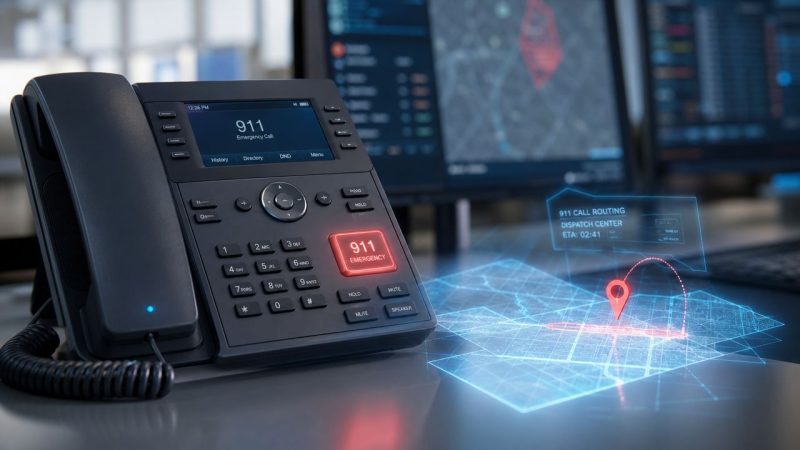
VoIP 911 Service: Your Guide to Compliance and Safety
A branch office opens on Monday. Phones work. Users can call customers, transfer calls, and join meetings. On Tuesday, someone dials 911 from a desk phone after a medical emergency, and the call routes based on the old office record still tied to that extension. The phone system did what it was configured to do. The problem is that the configuration no longer matched reality.
That's the central risk with VoIP 911 service. Most organizations treat it like a checkbox under telephony setup, when it's really a life-safety function sitting on top of an IP network, an address database, and human process. If one of those pieces drifts, emergency calling can drift with it.
For a public safety director, facilities lead, IT manager, or business owner, the important question isn't just whether your provider “supports 911.” The key question is whether your operation can still deliver an accurate, reachable, resilient emergency call when people move devices, the WAN goes down, or someone works from a temporary site. That's where the primary safety exposure is, and that's also where most avoidable cost sits.
The Critical Importance of Your VoIP 911 Service Setup
A bad VoIP 911 setup rarely looks broken during normal operations. Users place calls. Auto attendants work. The monthly bill looks fine. Then an emergency exposes the one record nobody updated.
Traditional landlines had a major advantage. The line was tied to a physical circuit at a fixed place. VoIP 911 service works differently. The emergency call depends on the provider having the right registered location for the device or user, then routing that call to the right Public Safety Answering Point, or PSAP.
That difference sounds small until you put it in operational terms. If a desk phone moves from headquarters to a satellite office and nobody updates the registered address, the caller may still reach emergency services, but the location information may be stale, incomplete, or routed to the wrong center. In an emergency, that's not a minor telecom defect. It's a response delay.
Practical rule: If your phone system is portable, your emergency calling process must be portable too.
The FCC's interconnected VoIP rules, adopted in 2005, required providers to furnish 911 and E911 capabilities, a key shift in emergency communications as U.S. 911 centers handle roughly 240 million calls annually according to the FCC's VoIP and 911 guidance. The volume matters because it reinforces what public safety leaders already know. Emergency calling isn't an edge case. It's constant, routine, and operationally unforgiving.
Where the money gets lost
Most organizations think about VoIP 911 only in terms of compliance risk. The more expensive problem is operational failure.
A single bad location record can trigger:
- Dispatch delays: responders go to the wrong site or need manual clarification.
- Internal disruption: staff stop work to troubleshoot phones during an active incident.
- Emergency workarounds: teams scramble to use personal mobile devices or alternate lines.
- Post-incident cleanup: IT, facilities, legal, and leadership all get pulled into preventable review work.
The cheapest fix is usually process, not hardware. Treat location management like asset management. Every move, add, and change to a phone endpoint should trigger a location check.
How VoIP Emergency Calls Are Routed
VoIP emergency routing is best understood through the analogy of mail forwarding. The phone number alone doesn't tell emergency services where the caller physically is. The system needs a registered location attached to that service so the provider knows where to send the call.
With a landline, the address was fixed to the line. With VoIP, that certainty disappears because the same device, extension, or softphone can be used from different places. The provider has to look up the registered location and send the call, the callback number, and the location data to the appropriate emergency services call center. The Vail public safety VoIP notice explains that this is the core technical constraint, and it's why routing is only as accurate as the last verified location record.

If your team needs a broader primer on how internet telephony works before evaluating emergency behavior, this VoIP business communication guide is a useful companion resource.
The call path in plain language
A typical VoIP 911 flow looks like this:
- The user dials 911: That may happen from a desk phone, a softphone, or another interconnected VoIP endpoint.
- The provider receives the call: The system checks the service record tied to that endpoint or user.
- Location and callback data are attached: The emergency call must carry the callback number and registered physical location.
- The call is routed toward emergency handling: The goal is to reach the appropriate PSAP or local emergency authority.
- Responders act on what they receive: If the location record is right, dispatch is faster. If it's wrong, the telecommunicator has to recover the location manually.
Why address records fail
The routing model itself is straightforward. The problem is operational drift.
Common examples include:
- Office moves: phones get unpacked before location records are updated.
- Shared devices: a phone gets reassigned without a clean handoff process.
- Remote work: a softphone is used from home, a client site, or a temporary office.
- IT change windows: extensions are migrated, but emergency location data isn't validated after cutover.
For public safety and business continuity teams, the practical move is to map endpoint location workflows the same way you map people and assets. A live operations platform with mapping tools for personnel and resources helps teams compare phone-system assumptions against what's deployed in the field or across facilities.
The phone system can only route from the location it knows. If your records trail reality, your emergency response trail does too.
Understanding FCC Rules and Your Responsibilities
The FCC made one point clear when it adopted interconnected VoIP 911 rules in the mid-2000s. Emergency calling isn't optional for this class of service. Providers must support 911 and E911 capabilities, and they must handle the emergency path differently from ordinary calling.
For a public safety director, the practical value of the rules is simple. They establish that shared responsibility is built into VoIP 911 service. The provider has obligations, and the customer does too.
What the provider is expected to do
At a minimum, interconnected VoIP 911 service must be enabled by default rather than left as an opt-in feature. The provider must transmit the emergency call, a callback number, and the caller's registered physical location to the appropriate emergency services call center or local emergency authority. Provider obligations also include routing emergency calls correctly and making customers aware of service limitations.
That matters because a lot of organizations still buy VoIP as if voice is voice. It isn't. Emergency calling sits under a different level of scrutiny because it's a regulated life-safety function.
What the customer is responsible for
Location accuracy is a common point of failure for many deployments. The customer has to provide and maintain accurate location information. If service is moved and the location record doesn't move with it, the system may still process the call but send stale data downstream.
The operational lesson is that compliance doesn't live in the contract. It lives in your daily admin behavior:
- Moves require updates: if a phone, ATA, or user service changes site, update the emergency address.
- Onboarding requires verification: don't hand out endpoints until location records are confirmed.
- Offboarding requires cleanup: retired or reassigned devices shouldn't retain old location assumptions.
- Remote work requires policy: hybrid users need clear rules for when and how to re-register location.
Compliance is cheaper than incident response
Organizations often resist discipline here because address validation feels administrative. It's still far cheaper than the fallout from a failed emergency call.
The expensive path looks like this:
- A location record is wrong.
- The call reaches the wrong place or arrives with bad location data.
- Staff improvise with alternate communications.
- Leadership asks why emergency calling “worked” technically but failed operationally.
That's avoidable. The practical standard is to tie emergency location maintenance to every telecom change request. If the move ticket doesn't include emergency-address verification, the ticket isn't complete.
The Hidden Risks and Limitations of VoIP 911
The most dangerous assumption in this space is that if a provider advertises E911 support, the problem is solved. It isn't. Compliance and resilience are different things.
Public-safety guidance is blunt on this point. VoIP 911 failure modes are usually caused by network dependency. Service can fail during a power outage, internet outage, or broadband congestion, and guidance recommends backup power and an alternate communications path such as a cellular or traditional line for critical users, as described in this VoIP 911 service advisory.

Power and transport are part of the emergency path
A desk phone on a VoIP system doesn't just need dial tone. It needs local power, network equipment, and working connectivity upstream.
If commercial power fails and you didn't protect the switch, router, firewall, access points, ATA, or PBX edge equipment, the phone may be dead even if the provider is up. If the ISP fails, the same thing happens. Staff often discover this too late because they tested call quality under normal conditions, not emergency survivability during failure.
A practical design baseline includes:
- UPS support for site equipment: protect the devices that make calling possible, not just the phone set.
- Generator planning where needed: especially for campuses, dispatch points, and facilities with critical occupancy.
- An alternate call path: cellular or traditional service for failover.
- Clear failover instructions: users need to know what to pick up when VoIP isn't available.
Later in this section, this short video is worth reviewing with both IT and operations staff because it reinforces how quickly emergency calling assumptions can break down in practice.
Mobility creates silent failure
The “nomadic user” problem is where many otherwise competent deployments fall apart. A user takes a work softphone home, to a hoteling desk, to a partner site, or into a temporary incident command post. The phone still works. The user assumes emergency service works the same way. It may not.
That's why stale location data is so dangerous. It doesn't produce obvious symptoms during routine use. The defect appears only when someone needs help.
If a device can move, your policy can't assume a fixed address.
Congestion and provider-side issues still matter
Even with power and internet available, VoIP 911 service can degrade under congestion or misrouting. Calls may complete poorly, drop, or reach a non-emergency administrative line rather than the intended emergency path. Those aren't theoretical edge cases. They're exactly the kind of operational defects that create confusion under pressure.
Security operations should look at emergency calling as part of a wider site resilience model, not as a standalone telecom feature. In practice, that means reviewing WAN dependency, single points of failure, and incident communications fallback together with broader operational security planning.
What doesn't work
Several habits repeatedly fail in real deployments:
- Set-and-forget provisioning: entering an address once during install and never validating it again.
- Assuming remote workers will self-manage: most won't update records unless the workflow forces it.
- Testing only after deployment: by then, the environment has already changed.
- Relying on one transport path: one ISP and no fallback means one outage can remove voice, location transmission, and callback reliability at the same time.
The cheaper path is disciplined redundancy and recurring validation. Outages will still happen. The goal is to make sure one failure doesn't take emergency calling with it.
Actionable Best Practices for Businesses and Public Safety
Good VoIP 911 service operations are built from routine controls. The organizations that avoid expensive failures don't rely on staff memory. They turn emergency location, backup calling, and site verification into standard work.
The FCC has repeatedly emphasized that interconnected VoIP providers must route emergency calls to the correct PSAP and provide a registered location, while users often must update that location. With U.S. 911 systems handling about 240 million calls in 2022, stale address data can delay response, as noted in the FCC's location accuracy requirements update.
What businesses should operationalize
For most businesses, the highest-value improvements are procedural.
- Tie address updates to moves: if facilities relocates a desk, office, trailer, or temporary workspace, telecom records must change in the same ticket.
- Build location into onboarding: every new user, extension, and shared phone should have a verified emergency service address before go-live.
- Control softphone use: remote users need a documented rule for registering their current work location.
- Assign one owner: if location accuracy belongs to everyone, it belongs to no one. Give the control to a named role.
A lot of continuity planning guidance focuses on broad disaster operations. For teams formalizing those workflows, this resource on maintaining public services in crisis is helpful because it frames communications resilience as an operational requirement, not just an IT task.
What dispatch and public safety leaders should require
Public safety agencies and dispatch-oriented organizations need a stricter standard because they often support distributed facilities, special events, field units, and temporary operating sites.
Use this checklist as a working baseline:
| Responsible Party | Key Responsibility | Action Item / Best Practice |
|---|---|---|
| IT or telecom admin | Maintain accurate endpoint location records | Require emergency address verification in every move, add, and change ticket |
| Facilities team | Report physical changes that affect endpoints | Notify IT before office moves, room renumbering, trailer deployment, or shared-space reconfiguration |
| Department supervisors | Enforce user compliance | Make staff confirm location setup when receiving a device or remote-work access |
| Remote or hybrid user | Keep current registered location accurate | Update service location whenever work is performed from a different regular site |
| Dispatch leadership | Prepare for bad or missing location data | Train call-takers to verify location verbally when VoIP data is incomplete or inconsistent |
| Site operations | Preserve emergency call capability during outages | Maintain backup power and an alternate calling path at critical locations |
| Security or incident management | Coordinate internal response | Define who gets notified when an emergency call occurs and what they do next |
Where cost avoidance actually happens
The best controls don't just reduce risk. They save money in ways leadership can understand.
Fewer emergency support scrambles
If the backup path is documented and tested, staff don't waste time during outages deciding whether to use personal phones, hunt for analog lines, or call the ISP first.Less rework after office changes
When facilities and telecom changes are linked, you avoid truck rolls, urgent ticket escalations, and after-hours cleanup because phones “mysteriously” route wrong after a move.Cleaner incident review
If you keep change records, location verification logs, and test history, post-incident review becomes factual. Teams spend less time reconstructing what happened.Better dispatch visibility
For organizations coordinating incidents across teams and sites, a platform that supports dispatching workflows and unit coordination can complement phone-system data by giving operations staff a live view of personnel, assets, and incident assignments. Resgrid is one example of that kind of tool.
The cheapest emergency-call failure is the one you prevent during routine admin work.
A practical operating rhythm
If you want one discipline that works, use a recurring cadence:
- At onboarding: verify the location record before the endpoint is handed over.
- At every move: require an address check as part of the move ticket.
- At each network change: confirm emergency routing assumptions still match the site.
- During continuity drills: include alternate calling path validation, not just evacuation or shelter procedures.
- At regular review intervals: compare your endpoint inventory against actual site occupancy and user assignments.
That rhythm is far more effective than buying a feature and assuming the problem stays solved.
How to Test and Verify Your VoIP 911 Service
The first rule is simple. Don't dial 911 just to see what happens unless you are following an approved test process coordinated with the proper authorities and your provider.
Most organizations can catch their biggest problems without placing a live emergency call. Start in the provider admin portal and review the registered E911 address for every critical endpoint, shared device, conference room phone, front desk phone, and remote user profile.

A safe verification routine
Use a repeatable process:
- Check the portal record: confirm the registered emergency address matches the physical location where the device is used.
- Review recent moves and changes: compare telecom tickets against facilities changes, remote-work changes, and device reassignments.
- Ask the provider about test procedures: many providers have non-emergency verification methods or documented testing guidance.
- Validate backup calling: confirm staff know what alternate device or line to use during a VoIP outage.
- Document the result: if you didn't record who checked what and when, the organization will drift again.
When to recheck
Make verification event-driven, not one-time.
Recheck when:
- A phone is moved
- A user goes remote or returns on-site
- An office opens, closes, or is reconfigured
- The WAN, PBX, or provider routing setup changes
- A shared phone changes ownership or purpose
Quarterly review is a sensible operating habit, but the more important trigger is physical or administrative change. Every move is a location-risk event until proven otherwise.
VoIP 911 Frequently Asked Questions
What happens if an employee calls 911 from a coffee shop using a work softphone
The risk is stale location data. In hybrid work and multi-site operations, if the address isn't updated, the call may reach the wrong PSAP or lose automatic location accuracy, as discussed in this analysis of mandatory VoIP E911 obligations. The practical answer is to avoid assuming that a mobile softphone always carries correct emergency location. Train users to know the limitation, keep location records current where supported, and use a direct local calling method when they are in a transient location.
What is the most cost-effective backup plan for outages
For many organizations, the cheapest resilient design is not a full duplicate voice stack. It's targeted backup. Protect key network and voice equipment with UPS power, identify which sites need generator support, and maintain a fallback cellular or traditional calling option for critical positions. Don't overbuild every office. Prioritize the locations where a failed emergency call would create the most operational harm.
How do we manage VoIP 911 for shared phones and temporary sites
Treat temporary sites like permanent sites for as long as they are in use. Shared phones need an owner, even if many people use them. Someone must be accountable for the registered location, device assignment, and move control. For events, field offices, and temporary operations centers, make emergency address confirmation part of setup and teardown checklists.
What is the most common failure you should expect
Operational drift. Not provider marketing claims. Not the idea of 911 support itself. The most common real-world problem is that the phone system record no longer matches where the user or device is.
Should dispatchers and supervisors still ask for location verbally
Yes. If a caller can speak, verbal confirmation is still one of the simplest safeguards against stale or conflicting data. Good systems help. Good questioning still matters.
If your organization needs a practical way to coordinate incidents, track personnel and equipment, and support dispatch-oriented operations around emergency communications, Resgrid, LLC provides an open-source platform built for first responders, dispatchers, businesses, and public safety teams. It's a useful fit for organizations that want stronger operational visibility without adding contract-heavy overhead.