
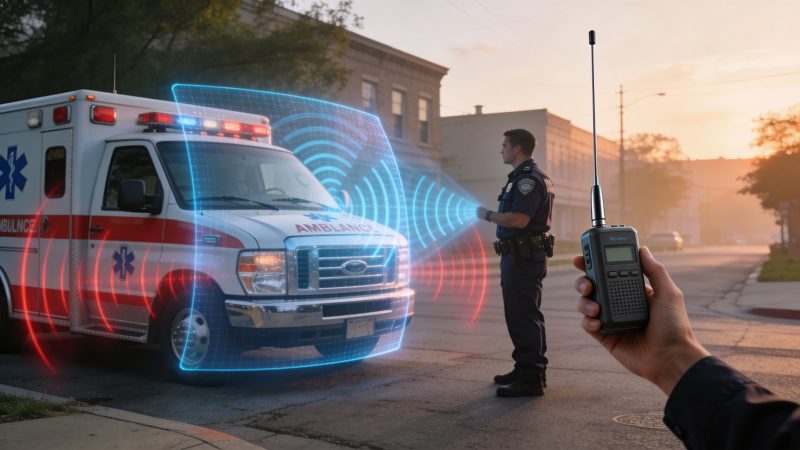
Anti Jammer Device: A Guide for First Responders
A crew is moving fast on a cardiac arrest call. The driver knows the route, but traffic control, unit tracking, and ETA updates all depend on live location. Then the map freezes. The mobile unit starts hunting for satellites. Dispatch sees the ambulance drift, then disappear.
That failure is easy to dismiss as a bad antenna, a dead zone, or software lag. Sometimes it is. Sometimes it is an intentional jamming event, and your stack was never built to handle it.
For first responders, security teams, event operations, and fleet managers, that distinction matters. If the problem is interference from a hostile device, resetting hardware will not fix the mission. You need a way to keep positioning and communications useful while the interference is active. That is where an anti jammer device stops being niche hardware and starts looking like operational insurance.
Your GPS is Gone What Do You Do Now
An urban response breaks down fast when location confidence disappears.
A patrol supervisor sends an ambulance and a support unit into a dense downtown corridor. Traffic is stacked. Buildings are tall. The route is already tight. Halfway in, the ambulance loses navigation lock and the dispatcher’s map stops showing clean movement.

At that point, the problem is not just “GPS is acting up.” The underlying problem is cascading uncertainty. Which unit is closest now? Is the crew still on the assigned route? Did the support vehicle miss the turn, or did the map stop updating? If your team relies on live vehicle location, resilient tracking hardware proves its worth here. Agencies already using systems like AVL units know the value of visibility. The gap appears when the positioning feed itself is vulnerable.
Why this is no longer a rare edge case
Cheap jammers and improvised interference tools are no longer a battlefield-only concern. They show up in cargo theft, surveillance evasion, high-risk events, and vehicle concealment.
The practical effect is expensive. Security Systems News reports that signal jammers undermine 25% of commercial and public safety tracking systems in major US/EU markets, costing an estimated $2.5 billion annually in false dispatches, lost assets, and operational failures. It also reports a 150% spike in search queries for “cheap anti jammer” solutions since October 2025 (Tualcom deep dive on GPS anti-jamming).
That matches what field operators have been saying for years. A jammer does not need to be complex to create real damage. It only needs to deny clean signal long enough to break navigation, tracking, or timing at the wrong moment.
What failure looks like in practice
For a first responder agency, jamming usually surfaces as one of these:
- Frozen map icons: Dispatch sees units stop moving while crews are still in motion.
- Route instability: Turn-by-turn guidance drops out in dense corridors or near event perimeters.
- Bad resource decisions: Closest-unit logic becomes unreliable, so response assignments get slower.
- Incomplete records: After-action review loses confidence in location history and timestamps.
If you cannot trust live location during the busiest five minutes of an incident, your problem is not mapping. Your problem is signal resilience.
An anti jammer device does not make your operations invincible. It does something more useful. It gives critical assets a better chance to stay visible and navigable when someone nearby is trying to make them blind.
Understanding the Threat What Is Signal Jamming
Signal jamming is simple in concept. Your receiver is trying to hear a very quiet signal, and a nearby transmitter drowns it out with louder noise.
The easiest analogy is a library. One person is whispering the answer from across the room. Another person stands next to you and starts shouting. The whisper did not disappear. You just cannot hear it anymore.
Why GNSS is easy to disrupt
Satellite navigation signals are weak by the time they reach the ground. That is why even modest interference can cause a loss of lock.
This is one reason the anti-jamming sector keeps expanding. The global anti-jamming market was valued at USD 5.43 billion in 2025 and is projected to reach USD 12.97 billion by 2034 (Fortune Business Insights on the anti-jamming market). Public safety buyers should read that less as a market headline and more as a warning. More systems now depend on satellite positioning, and more operators know those signals are easy to attack.
The two disruptions agencies feel first
Most non-military agencies run into two practical forms of jamming.
GPS and GNSS denial
This is the one fleet managers notice first. Vehicle location goes unstable, handheld navigation becomes unreliable, and time sync can degrade across systems that depend on satellite timing.
For an ambulance, that means route confidence drops. For law enforcement, asset tracking gets patchy. For an event security team, perimeter units may still be moving while the dashboard says they are stationary.
Radio interference
This article focuses on anti jammer devices for positioning, but field operations should think one level wider. If someone is willing to jam GNSS, they may also target local communications.
That creates a dangerous combination. Crews lose map confidence and then struggle to confirm verbally what is happening.
Crude jammers versus smarter interference
Not all threats are equal. Some are blunt tools. Others are targeted.
| Threat type | What it looks like | Typical operational effect |
|---|---|---|
| Broadband noise jammer | Loud, simple interference over a range of frequencies | Receiver loses lock quickly |
| Band-specific jammer | Focused on the navigation band your devices use | More efficient disruption with less wasted power |
| Mobile jammer | Installed in a vehicle or carried near a site | Interference appears and disappears with movement |
| Persistent local source | Fixed near a facility, route choke point, or event area | Repeated outages in the same zone |
Crude jammers are often enough to cause trouble in civilian settings. The receiver does not care whether the attacker spent a little or a lot. If the noise is stronger than the legitimate signal, the result is still denial.
Where the threat tends to show up
You do not need to assume every outage is hostile. You do need to identify where jamming risk is higher.
- Cargo routes and logistics yards: Theft crews may hide vehicles or trailers from tracking.
- Large public events: Unauthorized devices can interfere with perimeter operations.
- Border and conflict-adjacent zones: Intentional denial is more common.
- High-risk surveillance environments: Adversaries may use jammers to break visibility before moving.
Treat repeated “random” GPS loss in the same area as an RF problem until proven otherwise.
The hard lesson is this. Most fleets already have tracking. Far fewer fleets have tracking that keeps working when someone actively tries to stop it.
How Anti Jammer Devices Fight Back
An anti jammer device works a lot like noise-canceling headphones. It does not make the original signal stronger in some magical way. It detects the bad noise, figures out where it is coming from, and suppresses its effect so the receiver can keep using the legitimate signal.
That distinction matters because many buyers chase the wrong fix. A better dashboard, another mapping app, or a replacement GPS puck will not solve deliberate interference. You need front-end protection at the signal level.

The core idea behind mitigation
A jammer wins by overpowering weak satellite signals. An anti jammer device fights by reducing the jammer’s influence before it ruins the receiver’s view of the sky.
That usually starts with the antenna system and the signal-processing hardware connected to it.
Controlled reception pattern antennas
A CRPA, or controlled reception pattern antenna, uses multiple antenna elements instead of a single passive antenna. That multi-element design lets the system compare what each element is seeing and identify the direction of interference.
Once it knows where the noise is coming from, it can do something useful with that information.
Nulling
Nulling means the device creates a low-sensitivity zone in the direction of the jammer. In plain language, it turns down its ears toward the source of interference.
If the jammer is on a nearby rooftop, in a passing vehicle, or parked near an event entrance, the anti jammer device can reduce how much of that energy reaches the receiver path.
Beamforming
Beamforming is the other half of the job. The system preserves or improves sensitivity toward the satellites while reducing sensitivity toward the jammer.
That balance is why good anti-jam hardware outperforms simple filters. The problem is rarely “all RF is bad.” The problem is one or more bad signals arriving from a direction you can isolate.
What good performance looks like
A credible anti jammer device should come with specific performance claims, not vague language.
NovAtel’s GAJT provides over 40 dB of interference suppression. In the vendor’s example, a standard GPS receiver disrupted by a 10W jammer at 30 km can continue functioning effectively at 300 meters from that same jammer, which is a 100-fold improvement in resilience (NovAtel GAJT anti-jamming).
That does not mean every deployment will match that exact scenario. It does show why real anti-jam hardware belongs in a different category from consumer “signal boosters” or generic antennas.
What works and what does not
Buyers waste money when they treat all mitigation gear as interchangeable.
What tends to work:
- CRPA-based systems: Best when the mission can justify added hardware and integration.
- Integrated anti-jam modules: Useful when you need something that fits existing receivers and vehicles.
- Layered navigation design: Pair anti-jam hardware with inertial backup and route discipline.
What usually does not work:
- Passive antenna swaps alone: Helpful for placement and durability, not enough against active jamming.
- Consumer boosters: They do not solve deliberate interference.
- Software-only fixes: If the receiver never got clean signal, software has little to recover.
Ask vendors one direct question: “What specifically happens when a jammer is nearby, and what does your device do before the receiver loses lock?”
Why first responders should care about the antenna, not just the app
Dispatch software only shows what the field hardware can deliver.
A clean anti-jam front end means the rest of your stack gets usable data. Without that, your CAD, map, or fleet screen can be elegant and still wrong. From an operations standpoint, anti-jam protection is less about electronics theory and more about preserving one basic thing under pressure: a trustworthy position.
Choosing the Right Mitigation Strategy for Your Agency
The right anti jammer device is not always the most advanced one. It is the one that protects the right assets, fits your power and mounting limits, and does not create more maintenance burden than your team can absorb.
Public safety agencies make expensive mistakes when they buy to a military brochure instead of a mission profile.
Start with the mission, not the catalog
A city EMS fleet, a volunteer fire department, a sheriff’s office, and an event security contractor do not face the same threat pattern.
Use a simple decision lens:
| Agency profile | Likely risk pattern | Better fit |
|---|---|---|
| Urban EMS | Route disruption, dense RF environment, high dispatch tempo | Vehicle-mounted protection on front-line ambulances |
| Rural fire | Lower routine risk, long-distance navigation dependence | Protection on command vehicles and mutual aid leaders |
| Law enforcement tactical units | Intentional interference more likely in targeted operations | Higher-grade anti-jam systems on selected vehicles |
| Event security | Temporary hotspots, perimeter disruption, mobile threats | Portable or quickly deployable gear for command and patrol assets |
The common budgeting mistake is a fleet-wide rollout before you know where signal denial hurts you most. Start with assets whose failure creates the highest downstream cost.
The trade-offs that matter
Cost versus consequence
Some agencies protect every truck on paper and protect none in reality because the budget never survives review.
A better approach is selective hardening. Put anti-jam hardware on:
- Primary response vehicles
- Supervisory units
- Mobile command
- Assets that anchor mutual aid coordination
This saves money because you harden the nodes that dispatch depends on most.
Simplicity versus protection level
High-end systems can deliver stronger protection, but they usually bring more installation work, cabling, placement sensitivity, and training requirements.
If your technicians are already stretched, a simpler integrated device may outperform a superior system that gets installed poorly or never maintained correctly.
Single-band versus broader resilience
Some deployments only need to protect a narrow navigation dependency. Others operate in environments where interference is less predictable.
If your incidents cluster around downtown corridors, ports, or event zones, ask harder questions about how the device handles varied interference patterns and whether it integrates cleanly with your receiver stack.
Match the anti jammer device to your existing stack
A mitigation device does not live alone. It has to fit your vehicles, dispatch workflows, maintenance process, and communications plan.
That is why I tell agencies to look at the full chain:
- Signal protection at the antenna
- Receiver compatibility
- Vehicle power and mounting
- Map and dispatch workflow
- Fallback communication path
If your messaging and coordination process is weak, hardening GPS alone will not save the operation. Agencies building resilient field workflows should also tighten how crews confirm status and route changes through systems such as team messaging for operational coordination.
Do not ignore the network side
Some interference incidents expose another weakness. The field unit may survive, but the network appliance back at the edge cannot segment, secure, or prioritize traffic cleanly.
If your response vehicles feed through industrial or facility networks, it is worth reviewing how an industrial security appliance fits into the larger resilience picture. It is not an anti-jam tool, but it is relevant when protected positioning data has to move through hardened operational infrastructure.
Buy for the cost of mission failure, not for the pride of owning the most advanced hardware.
A budget-conscious rollout model
Use three phases instead of one big buy:
- Phase one: Instrument the highest-consequence vehicles and command assets.
- Phase two: Train dispatch and field supervisors on jamming recognition and fallback procedures.
- Phase three: Expand only where incident data shows repeat exposure or where protected assets prove operational value.
That sequence saves money because you learn from live use before standardizing across the fleet. For most agencies, that is the difference between a realistic resilience program and a grant-funded shelf ornament.
Navigating Legal and Operational Realities
A jammer and an anti jammer device are not the same thing.
That sounds obvious to engineers, but it still causes confusion in procurement meetings and command staff briefings. A jammer is designed to interfere with communications or navigation. A defensive anti-jam system is designed to preserve lawful operations by resisting interference.
The legal distinction matters
In public safety, legal ambiguity slows procurement. Teams hear “anti-jamming” and worry they are buying something that transmits aggressively or breaks spectrum rules.
They are not the same category. Defensive anti-jam systems are used to protect reception. That is very different from operating a jammer to deny service to others.
This distinction is not academic. The broader anti-jamming industry grew out of real operational need in both military and civilian contexts, and legal frameworks generally target the use of offensive jamming equipment, not protective reception technologies.
Real-world disruptions changed the conversation
The Russia-Ukraine war forced many organizations to treat GNSS denial as an operational issue instead of a theoretical one. Widespread jamming near the Black Sea in April 2022 disrupted commercial airline navigation, and the same period accelerated procurement activity, including BAE Systems’ delivery of advanced M-code anti-jammers to Germany for vehicle fleets in July 2022.
For first responder agencies, the lesson is not “buy military gear.” The lesson is that jamming spills beyond the battlefield, and organizations that depend on positioning need procedures, not just hardware.
Your SOP should answer these questions
When a crew reports location instability, what happens next?
Recognition
Operators should know the common symptoms:
- Navigation suddenly drops in an area that normally works
- Multiple units show the same abnormal behavior nearby
- Tracking freezes while voice contact remains normal
- Devices recover after leaving a small geographic zone
Immediate action
When the signal becomes suspect, crews need a playbook:
- Acknowledge degraded navigation
- Confirm route and assignment by voice or alternate messaging
- Switch to landmark-based navigation where practical
- Log the area and time for follow-up review
Continuity
The mission still has to continue. That is where backup navigation discipline matters.
Crews should be trained on dead reckoning basics, route familiarity for high-frequency response zones, and verification through alternate means. Dispatch should know when to stop trusting the map as the primary truth source and start using direct crew confirmation.
Hardware helps before signal loss. Procedures help after it starts.
Build jamming awareness into training
Most agencies already train for radio failure, severe weather, and system outage. Add jamming recognition to the same mindset.
Good training is not complicated. Use brief scenario drills:
- Unit enters a known trouble zone and loses location
- Dispatch sees a frozen icon but voice remains up
- Supervisor decides whether to reroute, continue, or stage
- Technical staff logs the event for RF review
That kind of drill does two things. It lowers confusion in the moment, and it reveals whether your anti-jam investment connects to field behavior.
Keep the paperwork aligned with reality
Procurement, policy, and training should use clear language. Specify that the agency is acquiring defensive anti-jamming or GNSS resilience equipment for lawful reception protection.
That wording helps legal review, clarifies intent for command staff, and avoids the common mistake of treating “jammer” and “anti-jammer” as if they were interchangeable. They are not. One creates the problem. The other helps you keep working through it.
A Practical Procurement and Deployment Checklist
Most anti-jam purchases go wrong in one of two ways. The agency buys too little and gets no meaningful protection, or buys too much and cannot deploy it cleanly.
A checklist fixes both problems.

Procurement checklist
Start with vendor questions that expose whether the product is real anti-jam hardware or just a rugged GNSS accessory.
- Suppression performance: Ask what interference suppression level the device is rated for and under what test conditions.
- Receiver compatibility: Confirm exactly which GNSS receivers, connectors, and power requirements are supported.
- Operational fit: Ask whether the system is intended for vehicles, fixed sites, or personnel use.
- Installation method: Require a clear description of antenna placement, cable constraints, and calibration needs.
- Failure mode: Ask what the user sees when interference exceeds the device’s protection envelope.
- Support model: Find out who handles firmware, field support, replacement units, and warranty turnaround.
One practical benchmark matters for mobile public safety use. Modern anti-jammer units designed for first responders can be highly integrated, with specifications such as less than 0.75W power draw, an IP67 waterproof rating, operation from -40°C to +85°C, and a weight of 150g (Safran GPSdome anti-jammer). Those specs matter because they tell you whether the hardware can realistically live on a vehicle or portable kit without creating a new environmental problem.
Deployment checklist
Placement
An anti jammer device is only as good as its view of the RF environment.
- Sky visibility: Mount where the antenna can see the sky with minimal obstruction.
- Separation: Avoid crowding it next to noisy electronics or poorly shielded emitters.
- Consistency: Standardize placement across similar vehicles so performance is repeatable.
Power and cabling
Low draw helps, but power planning still matters.
- Power source quality: Use stable vehicle power and document the circuit.
- Cable routing: Protect cable runs from pinch points, heat, and unnecessary length.
- Service access: Install so technicians can inspect and replace components without tearing apart the vehicle.
User behavior
Even strong hardware fails if operators do not understand what it can and cannot do.
- Train supervisors: They need to recognize signal denial indicators.
- Train drivers and crews: They should know what changes in the user interface may signal interference.
- Train dispatch: They must know when to trust telemetry and when to fall back to direct confirmation.
Spend where protection changes outcomes
Do not harden every asset by default.
A cost-conscious agency should rank assets in three tiers:
| Priority tier | Asset examples | Protection approach |
|---|---|---|
| Tier one | Ambulances, command vehicles, tactical supervisors | Protect first |
| Tier two | Secondary patrol units, specialty support | Add based on risk exposure |
| Tier three | Low-consequence or rarely deployed assets | Use SOP fallback before hardware buy |
Here, money gets saved. Protecting the wrong vehicles gives you a nice inventory line and little operational benefit.
Pilot before standardizing
Run a short controlled deployment on a small set of critical assets.
During the pilot, track:
- Where interference symptoms appear
- Whether crews notice less disruption
- Whether dispatch sees better continuity
- How much technician time the hardware consumes
You do not need a giant trial. You need enough field use to answer one honest question: did this anti jammer device reduce operational confusion where it matters most?
The cheapest anti-jam program is usually the one that protects a few high-value assets well, instead of protecting an entire fleet poorly.
Enhancing Situational Awareness with Resgrid
Protected signal is only useful if operators can act on it.
That is why resilient location hardware and mapping software belong in the same conversation. The anti jammer device helps keep the data clean. The platform turns that location stream into dispatch decisions, accountability, and a usable incident picture.

Why stable location changes command decisions
A dispatch screen is only trustworthy when unit location remains believable under stress.
With hardened positioning feeding into a platform such as mapping tools for live unit visibility, dispatchers can maintain a cleaner picture of where crews, vehicles, and equipment are. That helps with routing, closest-unit selection, staging, and post-incident review.
The value shows up in ordinary operations, not just rare emergencies. If one unit keeps a stable track through an interference-prone corridor while another drops in and out, supervisors gain immediate context on which assets can be trusted for route-critical assignments.
Practical ways this saves money
Reliable tracking does not just improve safety. It also reduces waste.
When location holds up better during interference events, agencies can avoid:
- Misallocated responses: Sending a farther unit because the nearer one vanished from the map
- Repeat voice checks: Dispatch spending extra time verifying location manually
- Incomplete incident logs: Weak records that complicate review, reimbursement, or liability questions
- Asset confusion: Losing confidence in the location of support vehicles or personnel
Those costs are rarely booked under “jamming,” but they are real. Every time dispatch has to rebuild situational awareness manually, someone is paying in time, attention, and delay.
Better data supports better fallback
An anti jammer device does not guarantee perfect location forever. But if it extends usable tracking during the first part of an incident, command gets a stronger baseline before any fallback is needed.
That matters in practice:
- A supervisor can see the last trustworthy movement path.
- Dispatch can confirm whether a unit reached a checkpoint before signal degraded.
- Command can compare live and historical tracks without guessing which icon froze first.
The strongest operational benefit is not technical elegance. It is giving dispatch and command a map they can trust longer.
Common sense integration advice
If your agency is considering hardened tracking, connect the effort to actual dispatch workflows.
Ask these questions:
- Which units need trusted mapping most during high-pressure calls?
- How will dispatch flag suspected interference events?
- What should supervisors do when one protected asset remains visible and others do not?
- How will the agency use location logs in after-action review?
Those answers matter more than flashy hardware demos. The right anti jammer device is the one that improves decisions on the screen your dispatchers already use.
Resilient tracking starts with stronger field hardware, but the payoff comes when dispatch can use that data. Resgrid, LLC gives first responders, dispatchers, and operational teams a practical way to turn live mapping, messaging, personnel tracking, and reporting into a single working system. If your agency wants a cost-effective platform that helps you act on reliable location data instead of chasing it, Resgrid is worth a close look.