
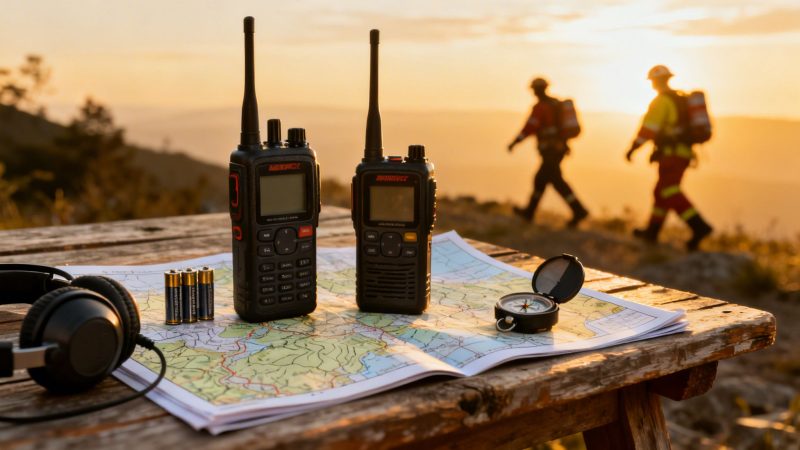
Choosing the Best Emergency Walkie Talkie for Your Mission
Let's be blunt: the best emergency walkie talkie isn't a specific model you can just buy off a shelf. It's the one that absolutely will not fail you when everything else has. For mission-critical work, that means professional-grade digital radios running on licensed VHF or UHF bands. These are the tools that deliver the reliability, range, and sheer toughness you need when lives are on the line.
Why the Right Emergency Radio Is Your Most Critical Asset

When things go sideways, the simplest tools are often the most dependable. We all love our smartphones, but cell networks are notoriously fragile. A single storm can knock out a tower, and a large-scale event can overload the network in minutes. Suddenly, your high-tech device is a paperweight, leaving your teams disconnected and flying blind.
This is where dedicated two-way radios prove their worth. An emergency radio system is a self-contained lifeline, built for the brutal reality of a crisis, not for casual use.
The Real Cost of Communication Failure
Picking the wrong radio is more than an inconvenience; it’s a massive operational risk. A radio with spotty range, a battery that dies halfway through a shift, or a housing that cracks on the first drop can lead to devastating miscommunications.
An informed choice does more than improve efficiency—it saves lives through better coordination. Selecting equipment designed for your specific environment prevents failures under pressure and delivers a far greater return on investment.
Think about a search and rescue team in a dense forest. A cheap, low-power radio from a big-box store will struggle to get a signal through the trees, cutting a team member off from command. A properly selected VHF radio, on the other hand, is built for that exact environment, maintaining a constant link. That one equipment choice directly impacts mission success and, more importantly, safety.
Comparing Communication Lifelines
The gap between a consumer gadget and a professional emergency radio is huge. These aren't just minor differences; they're fundamental distinctions that affect both performance and your budget.
| Feature | Consumer-Grade Walkie Talkie | Professional Emergency Radio |
|---|---|---|
| Reliability | Depends on fragile public networks. | Operates independently. It just works. |
| Durability | Mostly plastic, no real water/dust rating. | Ruggedized (IP-rated) for abuse. |
| Range & Power | Limited range (1-2 miles), low power. | Extended range (5+ miles), high power (licensed). |
| Security | Open, unencrypted channels anyone can hear. | Secure, encrypted communication options. |
Getting this right from the start saves serious money down the road. You avoid having to replace flimsy hardware or buy expensive signal boosters to make up for weak radios. Even better, modern dispatch platforms like Resgrid integrate directly with professional radios, turning a simple voice tool into a powerful command asset. This connection lets dispatchers see personnel locations, manage resources, and keep a complete operational picture when every second is critical.
Comparing Radio Technologies: VHF, UHF, and P25
Picking the right emergency radio starts with understanding the invisible backbone of your communications: the radio waves themselves. The technology you land on will define your range, clarity, and security. Getting this wrong isn't just an inconvenience—it can be a costly mistake, forcing you to spend a fortune on repeaters just to patch up coverage gaps you didn't anticipate.
The two workhorse analog radio bands you’ll run into are Very High Frequency (VHF) and Ultra High Frequency (UHF). They operate on different wavelengths, and that seemingly small difference completely changes how they perform in the real world.
VHF: The Long-Range Specialist
VHF waves are long. They like to hug the ground and can travel incredible distances over open, clear terrain. This makes them the go-to choice when you have a clear line of sight and need to cover a lot of ground.
Practical Example: A wildland fire crew is spread out across rolling hills. In that kind of environment, VHF is king. The incident commander can stay connected with teams miles away on the fire line without the signal getting swallowed up by dense forest.
Here's an actionable insight: if your operations cover large outdoor areas—like a farm, a sprawling outdoor event, or a wilderness search and rescue mission—choosing VHF can save you from buying expensive signal boosters. You get that long-distance coverage baked right in, no extra infrastructure needed.
UHF: The Obstacle Penetrator
UHF waves are the opposite. They're shorter and punchier, giving them a serious edge when it comes to getting through concrete, steel, and the general chaos of urban environments. While they won't travel as far as VHF in open air, their ability to navigate cluttered spaces is second to none.
Practical Example: An EMS team responds to a call inside a high-rise office building. This is where UHF shines. Those signals are built to bounce around and push through walls, floors, and metal frames, keeping responders inside connected to the command post on the street.
This kind of rugged, reliable performance is exactly why the professional radio market is booming. It's grown from a USD 5.46 billion industry in 2024 to a projected USD 11.95 billion by 2033. Features like GPS and encryption have pushed digital radios to the forefront, and they now account for over 60% of all professional sales. You can get a deeper dive into these trends by checking out the full report on the walkie-talkie market evolution.
The Digital Evolution: P25 and DMR
VHF and UHF define the road your signal travels on, but the next decision is the vehicle—analog or digital. Digital protocols like Project 25 (P25) and Digital Mobile Radio (DMR) bring some massive advantages to the table for mission-critical work.
P25 is the gold standard for public safety interoperability in North America. Its entire purpose is to let different agencies—police, fire, EMS—talk to each other on a shared network during a major incident, no matter who made their radios.
That interoperability is everything. Imagine a large-scale disaster where city police, county fire, and state EMS all show up. With P25, they can all jump on a shared channel and establish a unified command in seconds. It just works.
To help clarify the options, here’s a quick breakdown of how these technologies stack up against each other.
Radio Band and Protocol Comparison
This table gives a high-level look at the common radio technologies, where they excel, and what their trade-offs are. Use it to match the right tool to your specific operational environment.
| Technology | Best For | Key Advantage | Primary Limitation |
|---|---|---|---|
| VHF | Long-distance comms in open, rural, or outdoor environments. | Excellent range over unobstructed terrain. | Poor penetration of buildings and urban structures. |
| UHF | Urban settings, indoor use, and areas with many obstacles. | Superior ability to penetrate concrete, steel, and dense structures. | Shorter range in open-air environments. |
| P25 | Public safety and agencies needing to interoperate. | Standardized for multi-agency communication; high security. | Higher cost and more complex infrastructure. |
| DMR | Commercial, industrial, and logistics operations. | Doubles channel capacity; excellent audio quality and data features. | Not the standard for public safety interoperability. |
Choosing the right protocol from the get-go ensures your investment actually lines up with what you need to do on the ground.
If your team regularly works alongside public safety, investing in P25-capable radios is a no-brainer. It gives you a seat at the table, allowing you to plug directly into their command networks during a crisis—a capability that’s priceless when things go sideways. Yes, P25 gear costs more, but that price is justified by the absolute need for interoperability.
On the other hand, DMR is a more budget-friendly digital option that's incredibly popular in the commercial world. It offers crystal-clear audio and doubles your channel capacity, but it's not built with that public safety-first focus. Making the right call here ensures your comms plan is solid from day one.
What to Look For in a Mission-Critical Radio

When you're picking out a radio for emergency use, the spec sheet isn't just a list of features. It's a promise of how that device will perform when things get really bad. Consumer-grade radios might look tough, but they just don't have the hardened engineering needed for true mission-critical work. These features aren't luxuries; they're the bedrock of safety, reliability, and operational success.
Ignoring the details here can lead to catastrophic equipment failure at the worst possible moment. A radio that dies in a downpour or shatters after a drop on concrete is a liability, not an asset.
Built to Survive The Mission
Durability is your first and most critical checkpoint. Start by looking for an Ingress Protection (IP) rating, which tells you exactly how sealed the device is against dust and water. A radio with an IP67 rating, for example, is completely dust-tight and can handle being submerged in a meter of water for 30 minutes.
Practical Example: For a firefighter, an IP67 rating means their radio will keep working even after getting blasted by a fire hose. For a search and rescue team working in a dusty, debris-filled collapse zone, it means their comms won't get choked by fine particles. Investing in this level of ruggedization from the get-go saves a ton of money on repairs and replacements down the road.
Powering Through The Longest Shifts
Battery life is the absolute lifeline of your communications. A radio is a paperweight if its battery dies mid-incident. You need to be looking for high-capacity lithium-ion (Li-ion) batteries that can deliver at least 12-16 hours of real-world use on a single charge. Some of the top-tier professional models can even push through a 48-hour shift.
Actionable Insight: If you're outfitting a team, get a gang charger or multi-unit charging bay. Instead of buying individual chargers for every single radio, one gang charger can juice up six or more units at the same time. This doesn't just cut down on hardware costs—it makes deployment way easier, ensuring every radio is topped off and ready for the next shift.
Sticking with quality, manufacturer-approved batteries is another long-term cost-saver. Cheaper, off-brand batteries often have a shorter overall lifespan and have a nasty habit of failing without warning, which is a massive safety risk.
Advanced Safety and Audio Clarity
Beyond just being tough and long-lasting, the best emergency radios have features specifically designed to protect your people and ensure every single word is heard. These functions can turn a simple comms device into a life-saving tool.
- Emergency Alert Button: This is a dedicated, easy-to-find button (usually bright orange) that sends an instant, high-priority distress signal across the network. It often includes the user's ID and last known location.
- Lone Worker Function: A critical safety feature that requires the user to check in at set intervals. If they miss a check-in, the radio automatically triggers an emergency alert, letting dispatch know that a team member might be in trouble.
- Advanced Noise Cancellation: In the middle of chaos—sirens, heavy machinery, high winds—a standard microphone is useless. Look for radios with dual-microphone noise-canceling tech. This can filter out up to 90% of background noise, making sure transmissions are crystal clear.
The demand for these mission-critical features has cemented the walkie-talkie's role in disaster management. The global market, valued at USD 4.3 billion in 2024, is projected to grow at a 9.4% CAGR through 2034, all driven by the need for dependable field communications. To see how manufacturers are stepping up, you can learn more about the walkie-talkie market's growth and key features. Many of these advanced radio features can also be integrated with dispatch platforms, and you can see the full list of features Resgrid offers to build out a unified command center.
Navigating Radio Licensing and Legal Requirements
Pressing the transmit button on a radio is easy. Doing it legally and effectively is another story. Operating on the wrong frequency or with too much power can interfere with critical public safety communications, and the Federal Communications Commission (FCC) doesn't take that lightly—the fines can be staggering. Understanding the rules isn't just about compliance; it's about making sure your team can communicate without putting others at risk.
The first and most important decision you'll make is choosing between license-free and licensed radio services. This choice fundamentally impacts your radio's power, range, and overall reliability when you need it most.
License-Free Options: FRS
If you’re a family putting together a basic emergency kit or a small group that just needs simple, close-range comms, the Family Radio Service (FRS) is where you'll likely start. You can walk into almost any big-box store and buy a pack of FRS radios. They're ready to go right out of the box, with no license required.
But that convenience comes with major trade-offs. The FCC strictly limits FRS radios to a maximum of 2 watts of power. This means their "up to 30 miles" range advertised on the box is pure fantasy. In the real world, you might get a mile or two in an open field, but in a city or dense woods, that can drop to just a couple of hundred feet. For any serious operational use, FRS just doesn't cut it.
Licensed Services: The Real Deal for Power and Range
For any team that depends on reliable communications, getting a license is non-negotiable. It's the only legal way to unlock higher power, which is the single biggest factor in getting better range and a signal that can punch through obstacles.
Here are the primary licensed options you'll be looking at:
- General Mobile Radio Service (GMRS): This is the logical next step for preppers, outdoor groups, or even small businesses. A single, affordable GMRS license covers your entire immediate family and opens the door to much more capable equipment. Handhelds can legally transmit at up to 5 watts, and vehicle-mounted or base station radios can go up to a whopping 50 watts. That power boost makes a world of difference in your effective range.
- Business/Commercial Bands: This is the professional standard. If you're running a security team, managing a large event, or coordinating a formal response team, you need a business radio license. This gets you access to your own dedicated VHF or UHF frequencies in your operational area. No more sharing channels with kids playing in the neighborhood—just clear, private communications for your team.
Actionable Insight: Investing in a GMRS or business license can actually save you a ton of money. Instead of spending thousands on expensive repeaters and signal boosters to make underpowered radios work, you can simply use legally higher power to achieve the coverage you need right out of the box.
Staying on the Right Side of the Law
Let's be clear: compliance is about more than just avoiding a fine. Using the wrong frequency or an illegally modified radio can bleed over onto police, fire, or EMS channels. You could be interfering with a real emergency, and that's a risk no one should ever take.
Before you buy anything, check for its FCC certification and know what service it's built for. If you see a powerful handheld radio being advertised with a massive range, it's almost certainly not a license-free FRS radio. Taking a moment to understand these simple rules ensures your team can communicate with confidence and integrity when it counts.
Matching Your Radio to Your Operational Needs
Let’s get one thing straight: when you’re looking for the best emergency walkie talkie, there’s no silver bullet. The "best" radio is the one that actually works for your team in your specific environment. A high-tech digital unit that’s perfect for a security team in a concrete high-rise would be a dangerous piece of dead weight for a wildland crew deep in a national forest.
The key to a smart, cost-effective choice is to stop looking at generic feature lists and start analyzing your team’s real-world challenges. This is how you avoid burning cash on features you’ll never use while making sure you don't skimp on the capabilities that are absolutely mission-critical. It's about turning your investment into real safety and efficiency on the ground.
This decision tree helps visualize how licensing needs split depending on whether you're using radios for personal use or for professional, commercial operations.

As you can see, the path for a casual user is very different from what's required for professional teams who need clear, dedicated frequencies to operate reliably. Below, we'll dig into what that looks like for four common professional scenarios.
Urban EMS and First Responders
When you're navigating a dense cityscape, you’re up against a wall of signal-blocking materials—concrete, steel, and endless vehicle traffic. In these environments, UHF radios are the only serious choice. Their shorter wavelengths are just far better at punching through these kinds of obstructions to keep comms clear.
Practical Example: A paramedic crew responding to a cardiac arrest on the 30th floor of a skyscraper needs a UHF radio. A VHF signal would likely be completely blocked by the building's steel frame, but UHF can bounce and penetrate its way through, ensuring the crew stays connected to dispatch and incoming backup units.
Urban EMS Spec Checklist
- Radio Type: Digital UHF (450-470 MHz)
- Durability: Minimum IP67 rating. It needs to survive rain, dust, and being dropped.
- Power: 4-5 watts for maximum building penetration.
- Key Features: Multi-channel scanning, aggressive noise cancellation, and a big, obvious emergency button.
Wildland Firefighting and Search and Rescue
Out in the wilderness, it's a completely different ballgame. For crews spread across vast, open terrain like forests and mountains, range is everything. This is where VHF radios shine. Their longer wavelengths travel for miles over hills and through moderate tree cover where a UHF signal would die out fast.
Practical Example: A Search and Rescue team is coordinating a multi-day search in a national park. The command post is at the trailhead, while ground teams are miles deep in the backcountry. VHF radios ensure that everyone, from the search planners to the K-9 handlers, remains in constant communication across long distances.
Wildland Firefighting Spec Checklist
- Radio Type: Analog or Digital VHF (150-174 MHz)
- Durability: Rugged build is a given. Intrinsically safe options are vital for hazardous environments.
- Battery: Look for an extended-life battery rated for 16+ hours of real-world use.
- Key Features: High-visibility color (so you can find it if dropped), large controls you can use with gloves, and a very loud speaker.
Large-Scale Event Management
Coordinating a big event like a music festival or a marathon brings a unique problem: channel congestion. When you have hundreds of staff—security, medical, logistics—all trying to talk at once, analog channels become a chaotic mess.
This is where Digital Mobile Radio (DMR) systems are a game-changer. DMR uses a technology called Time-Division Multiple Access (TDMA) to create two independent talk paths on a single frequency. You effectively double your channel capacity without having to buy more licenses.
This efficiency is huge. It lets different teams operate on their own "virtual" channel, so a critical medical call doesn't get buried under chatter about parking. DMR also typically supports text messaging, which is perfect for sending quiet updates in a loud environment. If you’re trying to figure out which tools are right for your operation, you can explore a comparison of dispatch solutions to see how they stack up.
Event Management Spec Checklist
- Radio Type: DMR (Digital) UHF works best for mixed indoor/outdoor venues.
- Channel Management: High channel count with zone programming to keep teams organized.
- Key Features: Text messaging, private call capability, and a lightweight design that won't weigh staff down.
- Actionable Insight: A DMR system can seriously cut your licensing costs by making every frequency work twice as hard. This means you can support a larger team without needing to pay for additional frequency licenses.
Corporate and Industrial Security
For security teams, two things matter most: discretion and confidentiality. Whether you're protecting a corporate campus or a sensitive manufacturing facility, your comms can't be open for anyone to eavesdrop on. This makes digital encryption non-negotiable.
Practical Example: A security team at a large tech campus uses encrypted digital UHF radios with covert earpieces. When they need to coordinate a response to a potential threat, their communications are completely private. This prevents the subject from monitoring their movements and allows for a more controlled, effective resolution.
Corporate Security Spec Checklist
- Radio Type: Digital UHF with strong encryption (like AES-256).
- Form Factor: Compact, lightweight, and professional-looking.
- Key Features: Covert earpiece jacks, private call modes, and batteries that will last through a long shift.
Integrating Radios with Modern Dispatch Systems

A professional-grade radio is an incredible tool on its own. It's reliable, direct, and built for tough spots. But its real power gets unlocked when you plug it into a modern dispatch system. That’s when a simple voice device becomes the central nervous system of a unified command structure—a true force multiplier for any team.
When you bridge your radio network with a platform like Resgrid, you’re no longer just talking. You're seeing the whole picture in real time. This leap moves your team beyond simple voice chatter and into a world of data-driven situational awareness, which is absolutely critical for making smarter, faster decisions when the clock is ticking.
Creating a Unified Operational Picture
The biggest win here is creating a single source of truth. Instead of dispatchers just listening to radio traffic and trying to build a mental map, they can see a dynamic map populated with personnel locations, track incident timelines, and manage resources, all from one screen.
Practical Example: During a large-scale event, a medical tent requests assistance for a patient. The dispatcher, using an integrated system, instantly sees all nearby medical personnel on a map. They can identify the closest available responder, see their current status, and dispatch them directly, shaving critical minutes off the response time.
Actionable Insight: This technology saves money by streamlining communications and preventing costly information gaps. Instead of purchasing separate GPS trackers, communication loggers, and alerting systems, a single integrated platform handles it all, significantly reducing hardware and software expenses.
Actionable Integration Benefits
Connecting radios to dispatch software isn't just about cool features; it delivers tangible advantages that directly improve safety and efficiency. This kind of setup lets dispatchers do more than just listen in—they can actively manage and support crews in the field in powerful ways.
Here’s a look at what you actually gain:
- Live Personnel Tracking: GPS-enabled digital radios can send location data straight back to the dispatch platform, painting a real-time picture of everyone's position on a map.
- Automated Voice Logging: Every single radio transmission can be automatically recorded, timestamped, and archived. This is invaluable for after-action reviews, training, or protecting against liability claims.
- Direct Digital Messaging: Dispatchers can push text alerts, instructions, or updates directly to the displays of compatible digital radios. It’s perfect for sending sensitive information without broadcasting it over an open channel.
Investing in a system that can tie all this together transforms your radio from a standalone tool into an intelligent node in a connected network. To see how these tools really come together, you can learn more about how Resgrid’s applications create a complete command system.
Frequently Asked Questions About Emergency Radios
When you're digging into the world of emergency communications, a lot of questions pop up. Getting straight, real-world answers is the only way to make a smart investment and ensure your team is connected when every second counts.
How Far Can an Emergency Walkie Talkie Really Transmit?
The range you see printed on the box is pure fantasy—it's a best-case scenario, usually measured over open water with zero obstructions. In the real world, your environment is everything. A 5-watt UHF radio that’s a powerhouse in one setting might struggle to push a signal more than a few blocks in a dense city core packed with concrete and steel.
Take that same radio, but switch to VHF in a rural, open-field environment, and you could easily hit 5-7 miles or more. Terrain is king, period.
Actionable Insight: Don't get caught up chasing maximum wattage if your environment is the real bottleneck. For urban teams, it's a much smarter play to invest in UHF radios that are built to penetrate obstacles, rather than buying a high-power radio whose signal will just get soaked up by buildings anyway.
Are Digital or Analog Radios Better for Emergencies?
This really boils down to what you value more: crystal-clear audio or dead-simple reliability. Analog is the classic, battle-tested workhorse. It's straightforward and dependable, but as the signal gets weaker, you start getting that familiar hiss and crackle until the audio becomes useless.
Digital radios, on the other hand, maintain perfect audio clarity right up to the absolute edge of their range, then they just drop off. They also bring serious advantages to the table like built-in encryption for secure comms and significantly better battery life.
Actionable Insight: A digital radio might cost more upfront, but its perfectly clear audio can prevent misunderstandings that lead to costly mistakes. For security or medical teams where every word is critical, that improved clarity delivers a huge return by cutting down on errors and improving operational efficiency.
What Is the Most Important Maintenance Step?
Without a doubt, the single most critical maintenance task is routine battery management. A radio with a dead battery is just an expensive paperweight. You need to run regular charge-and-discharge cycles and, more importantly, replace your batteries every 18-24 months, even if they seem to be holding a charge just fine.
Beyond that, a simple pre-shift check can save you a world of trouble:
- Antenna Check: Make sure the antenna is screwed on tight. A loose connection will absolutely kill your range and can even damage the radio's transmitter over time.
- Audio Test: Do a quick "radio check, one-two-three" with another team member to make sure your mic and speaker are working as they should.
This two-minute ritual protects your gear and makes sure your lifeline actually works the moment you need it.
At Resgrid, we build the dispatch and management software that transforms your reliable radio hardware into a seamless, unified command system. Learn how Resgrid can bring your team's communications together.