
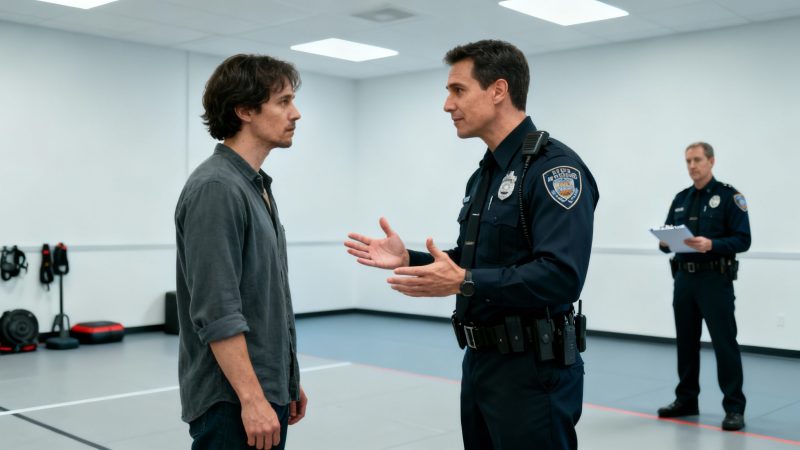
A Guide to De-Escalation Training for Law Enforcement
De-escalation training isn't just a buzzword; it's a specific set of skills that equips officers with the communication, assessment, and tactical tools needed to calm down volatile situations with minimal force. It's absolutely critical for cutting down on use-of-force incidents, rebuilding trust with the community, and ultimately keeping everyone safer—officers included. This is about moving past theory and giving officers practical, street-ready tools for managing those high-stress calls.
Why De-Escalation Training Is a Non-Negotiable Investment

The pressure on modern law enforcement to reduce use-of-force incidents has never been higher. Smart agencies are now treating de-escalation training not as a one-off workshop but as a core piece of their operational strategy. It represents a fundamental shift from a purely reactive mindset to a proactive one that puts conflict resolution first.
Let’s be clear: this isn't about making officers hesitate when lives are on the line. It’s about giving them more tactical options. When an officer is skilled in tactical communication and crisis recognition, they gain more control, often stopping a situation from ever turning physical in the first place.
Tangible Returns on a Crucial Investment
Investing in solid de-escalation training for law enforcement brings back real, measurable returns that go way beyond just public perception. In fact, the financial impact alone makes a powerful case.
Just think about the astronomical cost of a single excessive force lawsuit. These can easily run into the millions when you factor in settlements, legal fees, and administrative time. A well-run de-escalation program is one of the most effective forms of risk management an agency can adopt.
By training officers to resolve conflicts verbally, agencies can see a significant drop in citizen complaints, use-of-force reports, and the subsequent financial fallout. This is a direct, measurable way to save taxpayer money while improving public safety outcomes.
Here’s a practical example. A department might spend $50,000 to certify its own instructors and run immersive, scenario-based training. If that program prevents just one lawsuit that would have cost $500,000, the ROI is immediate. That doesn’t even begin to touch on the savings from fewer officer injuries and reduced workers' compensation claims. You can learn more about our mission to support first responders and build better systems for them.
Proven Success and Measurable Results
The value of this training isn't just theoretical—it’s backed up by hard data from agencies all over the country.
Look at the Las Vegas Metropolitan Police Department. After they fully committed to a de-escalation program, they saw a dramatic drop in officer-involved shootings. The Dallas Police Department’s focus on de-escalation led to a staggering 64% decrease in excessive force complaints between 2009 and 2014. These kinds of results have spurred a national trend, with more and more states mandating this type of training.
This data highlights a critical point: this is not about "soft" policing. It is about smarter, safer, and more effective policing that protects lives, rebuilds community trust, and makes sound financial sense.
Building a Curriculum That Actually Works on the Street
A stack of certificates and a binder full of PowerPoints mean absolutely nothing if the skills don't translate to a chaotic scene on a Friday night. Real de-escalation training for law enforcement needs to move past the theoretical and build muscle memory for those high-stress, high-stakes encounters.
The entire point is to build a program that your officers find credible and immediately useful on their very next shift. This isn't about checking a box for compliance; it's about giving them the confidence and the tools to handle tough situations more safely and effectively. It all starts by focusing on core modules that address the situations they actually face, day in and day out.
The Foundational Pillars of an Effective Curriculum
For any of this training to stick, it has to be built on a few key competencies. Think of them as the building blocks that support every other de-escalation tactic. Each part of your curriculum should feel distinct but also woven together, constantly reinforcing the same core principles of communication, assessment, and sound tactics.
A rock-solid program will always include these pieces:
- Crisis Recognition: This is ground zero. Officers need to be trained to quickly spot the signs of a behavioral health crisis, whether it's from mental illness, substance abuse, or a developmental disability. Practical example: An officer responds to a shoplifting call and finds the subject mumbling incoherently and reacting to unseen stimuli. Instead of escalating to immediate physical control, the trained officer recognizes these as potential signs of psychosis, slows down, creates distance, and uses a calm, simple communication style to reduce agitation.
- Tactical Communication: This goes way beyond just "talking to people." We're talking about specific, trainable skills like active listening, using non-threatening body language, and applying what some call "tactical empathy" to build a sliver of rapport and bring the temperature down. Practical example: During a heated domestic dispute, an officer uses active listening to repeat back one person's concerns ("So, what I'm hearing is you're upset because you feel he isn't listening to you."), validating their feelings without taking sides, which lowers their defensive posture and makes them more receptive to instructions.
- Operational Safety Tactics: Let's be clear: de-escalation is a safety tactic. This component is critical because it integrates communication skills with core officer safety principles—things like managing distance, using cover, and intentionally slowing a situation down to give yourself more time to think and act. It drives home the point that your words are one of the most powerful tools on your belt for maintaining control.
Designing Scenarios Based on Real-World Data
If you want immediate buy-in from your officers, the training has to be undeniably relevant to their job. Generic, canned scenarios about situations they never see will get tuned out in a hurry. The solution is simple: use your own data.
Pull your agency’s call-for-service data from the last 12-24 months. Look for the patterns. What are your most common high-friction calls? They're probably things like:
- Heated domestic disputes
- Welfare checks that could go sideways
- Public disturbances involving someone in an obvious crisis
- Encounters with agitated people under the influence
When you build your hands-on drills around these real-world events, the training becomes instantly credible. An officer running through a scenario that mirrors a call they handled last week will immediately see the value. This isn't just about buy-in, either. It's a smart use of resources. By focusing on high-frequency events, you're training to reduce the very incidents most likely to lead to use-of-force, injuries, and lawsuits.
An effective curriculum doesn't just teach techniques; it prepares officers for the specific challenges they will face in their community. Data-driven scenario design is the bridge between the classroom and the street.
Adopting a Proven Framework Like ICAT
Look, you don't have to reinvent the wheel here. Several evidence-based models provide a fantastic foundation to build upon. One of the most respected is the Integrating Communications, Assessment, and Tactics (ICAT) program from the Police Executive Research Forum (PERF).
ICAT gives officers a clear decision-making framework for handling situations with people who are unarmed or armed with something other than a firearm. It’s not just a collection of tips; it's a structured approach that emphasizes gathering information, assessing risk, and running through legal and policy guidelines before taking action.
Adopting a proven model like this saves your agency a ton of time and money you'd otherwise spend developing a curriculum from scratch. More importantly, it ensures you're implementing tactics with a documented track record of reducing use-of-force incidents.
Once you have a framework, managing the logistics of who gets what training and when can be a headache. Actionable Insight: Using a centralized system to schedule and track specialized training certifications prevents costly lapses and ensures compliance without pulling sergeants off the street for hours of administrative work. You can find a range of features for first responder management that help departments organize these complex operational needs. A structured approach like ICAT, supported by good management, gives officers a repeatable process they can fall back on under pressure. It turns de-escalation from a hopeful outcome into a deliberate skill.
Mastering High-Stress Scenarios Through Immersive Training
Classroom theory on de-escalation is one thing. But when you’re in the middle of a chaotic, high-stress encounter, that’s where the training really kicks in. This is why immersive, scenario-based drills are the single most critical piece of any effective de-escalation training for law enforcement. These simulations are built to do one thing and do it well: forge the "muscle memory" an officer needs to use communication and assessment skills when their heart is pounding and adrenaline is pumping.
Knowing the right words is a start, but being able to access them under extreme pressure is a whole different ballgame. Realistic training closes that gap. It forces officers to manage their own physiological stress—that fight-or-flight instinct—while trying to apply tactical de-escalation. The end goal? Make these skills as reflexive as drawing a weapon or keying up the radio.
Creating High-Impact Scenarios on a Realistic Budget
Here's the good news: setting up immersive training doesn't have to demolish your budget. While high-tech VR systems are fantastic for creating repeatable, data-rich scenarios, plenty of agencies get incredible results with more traditional, budget-friendly approaches. It really comes down to creativity and a willingness to tap into community resources.
Here are a few practical ideas that won't break the bank:
- Partner with Local Theater Groups: Actors from a community theater or a university drama department are absolute gold. They’re trained to improvise, stay in character, and provide a level of realism that’s tough to get when you’re just running drills with fellow officers who already know each other’s tells.
- Use Donated or Decommissioned Spaces: Think outside the box for your locations. An empty warehouse, a closed-down school, or even a local business after hours can serve as a perfect training ground. These environments add a layer of authenticity you just can't get in a standard training room.
- Focus on Low-Prop, High-Stress Scenarios: The most effective drills often don’t need elaborate props. A scenario focused on verbally calming an agitated person in a small room, for example, really only requires solid role-players and a clear set of objectives for the officer.
This flowchart shows how a well-rounded curriculum builds up to these crucial, hands-on drills.
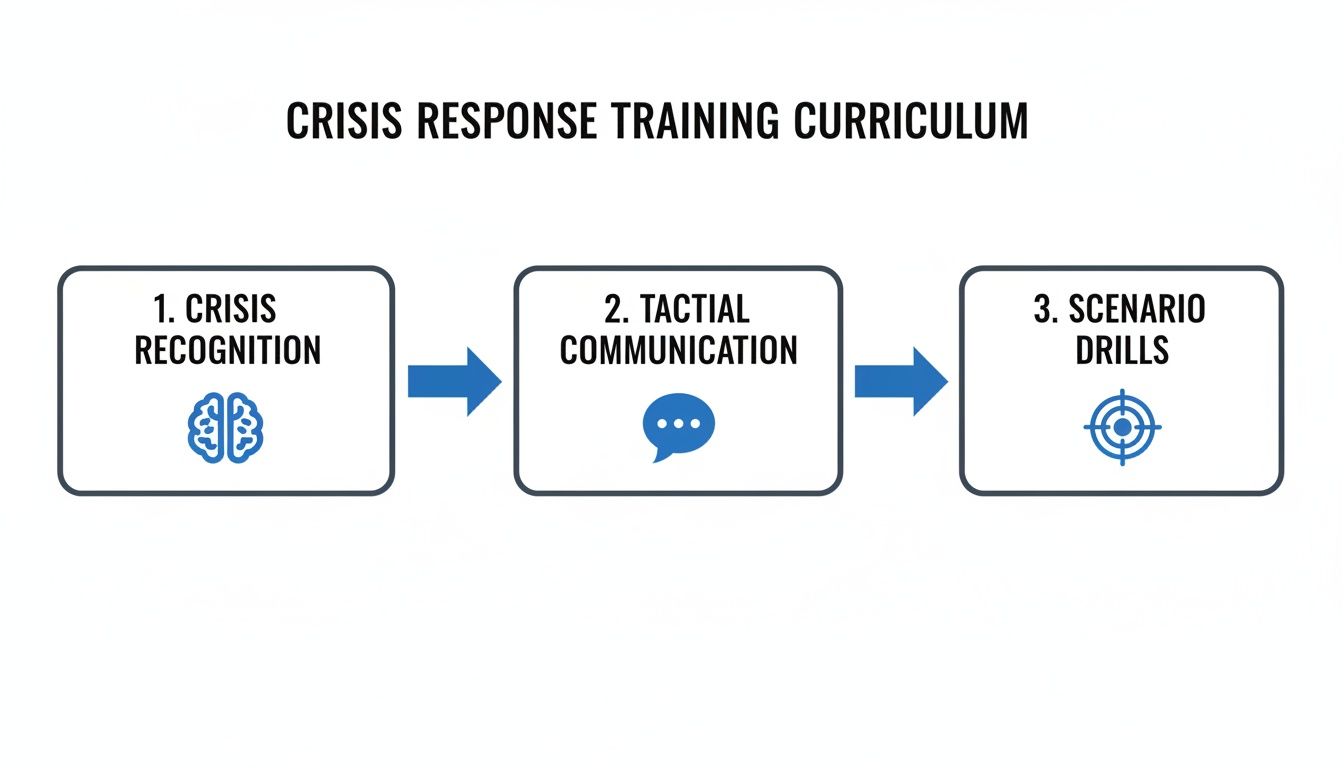
As you can see, immersive drills are the final step where officers have to pull everything together—crisis recognition, tactical communication—all under simulated pressure.
The Power of Practice in Action
Let's imagine a classic scenario: an officer responds to a "person behaving erratically" call at a public library. The role-player is unarmed but extremely agitated, shouting and refusing to listen to commands.
The training objective is straightforward: resolve the situation using only verbal skills and tactical positioning. No hands-on. The officer has to use active listening to figure out why the person is in distress, create distance for safety, and maintain a calm tone to bring the temperature down. Immediately after the drill, instructors jump in with feedback on what worked and what didn't.
This kind of focused, repetitive practice is what turns de-escalation from a concept into an instinct. It builds an officer's confidence in their ability to manage volatile encounters with a wider range of tools.
Of course, even with the best training, critical incidents can still happen. That's why having structured support like a Critical Incident Stress Debriefing (CISD) is a vital resource for officer wellness. The training aims to reduce these incidents, but support must be ready for when they inevitably occur.
Comparing De-Escalation Training Methodologies
When building out your program, you'll encounter several different training methodologies. Each has its strengths and is better suited for different departmental needs and budgets. Understanding the landscape can help you make a more informed choice.
| Methodology | Primary Focus | Cost-Effectiveness | Best For |
|---|---|---|---|
| Classroom-Based (Lecture) | Theoretical knowledge, legal standards, policy. | High | Foundational learning and policy updates for large groups. |
| Role-Playing Scenarios | Practical application, communication skills. | Medium | Developing muscle memory and testing skills in a controlled, live environment. |
| VR/Simulation Training | Decision-making under pressure, realism. | Low to Medium | Departments with larger budgets seeking repeatable, data-driven training experiences. |
| E-Learning Modules | Reinforcement of concepts, flexible scheduling. | High | Supplementing hands-on training and providing ongoing professional development. |
Ultimately, the most effective programs often blend these approaches. A solid classroom foundation followed by intensive role-playing and supplemented with e-learning creates a powerful, well-rounded curriculum that prepares officers for the realities of the street.
Measuring the Impact: The Proof Is in the Numbers
The benefits of this hands-on approach aren't just anecdotal—they show up in the data. When officers are repeatedly exposed to stressful situations in a controlled environment, their performance on the street gets quantifiably better. They get sharper at reading situations, managing their own stress response, and picking the right tool for the job.
The Louisville Metro Police Department is a perfect case study. After implementing its 16-hour ICAT training program for all 1,049 officers, the department saw a 28% drop in use-of-force incidents. The positive effects rippled out, leading to a 26% reduction in civilian injuries and an even more stunning 36% decrease in officer injuries. This shows that well-designed, immersive training doesn't just sound good—it keeps everyone safer and directly cuts the physical and financial costs of volatile encounters.
Calculating the Real ROI of Your Training Program
Trying to justify the budget for any training program can feel like an uphill battle, especially when every dollar is already spoken for. But here's the thing: when it comes to de-escalation training for law enforcement, viewing it as just another line-item expense is a fundamental mistake.
This isn't about ticking a box. Effective de-escalation training is one of the most powerful risk management tools an agency has. It delivers a very real, very substantial return on investment (ROI) by protecting your officers, your community, and your agency's finances.
To make your case, you need to move beyond simple completion certificates and start tracking real-world outcomes. The goal is to build a data-driven argument that shows stakeholders exactly how this investment saves money, reduces liability, and improves public safety. It’s not about fuzzy, abstract benefits; it's about drawing a straight line from your training to a healthier bottom line.
Key Metrics to Track Before and After Training
To really show the impact, you need a clear "before" picture. The first thing to do is establish a baseline of data from the 12-24 months before you roll out the new de-escalation curriculum. This gives you a rock-solid foundation for comparison and lets you demonstrate tangible improvements over time.
Your core metrics should paint a complete picture:
- Use-of-Force Incidents: Get the raw numbers. Break them down by type (e.g., empty-hand control, chemical agents, electronic control weapons, etc.). A drop here is your most direct indicator of success.
- Citizen Complaints: You'll want to monitor the volume and nature of complaints filed against officers, specifically digging into any that allege excessive force or unprofessional conduct.
- Officer and Civilian Injuries: Keep a detailed record of all injuries stemming from use-of-force events. Fewer injuries directly translate to lower medical costs and fewer workers' compensation claims. A win-win.
- Litigation and Settlement Costs: This is the big one. Tally up every dollar spent on lawsuits, legal fees, and settlement payouts related to use-of-force incidents.
This pre-training data is your secret weapon for proving a direct financial return.
Calculating the Financial Return
Once you have that baseline data, calculating the ROI becomes pretty straightforward. The formula is simple: you just compare what the training program cost to the direct savings it generated.
Let’s walk through a practical example. Say your agency spends $75,000 on a comprehensive de-escalation program. That cost covers everything—certifying instructors, buying role-playing equipment, and paying overtime for officers to attend.
In the first year after the program rolls out, you track your metrics and discover:
- A 20% reduction in use-of-force lawsuits, saving an average of $250,000 in settlement costs.
- A 30% drop in officer injuries, which cut workers' compensation claims by $40,000.
In this scenario, your $75,000 investment produced $290,000 in direct savings. In just one year. That's the kind of hard data that makes budget conversations a whole lot easier.
When you present the ROI in clear financial terms, the conversation shifts. De-escalation training is no longer an expense; it's a strategic investment that actively reduces your agency's largest financial liabilities.
Using Body-Cam Footage for Qualitative Analysis
Numbers are powerful, but they don't tell the whole story. Body-worn camera (BWC) footage offers invaluable qualitative proof that can be even more persuasive.
A really effective technique is to conduct pre- and post-training reviews of similar types of calls. Pick a few BWC videos of incidents that occurred before the training was implemented. Then, find footage of similar calls handled by officers after they completed the new program.
The difference is often night and day.
You can visually show the shift from a reactive, control-focused approach to a proactive, communicative one. Putting a side-by-side comparison up on the screen during a presentation can hit home harder than any spreadsheet ever could.
This visual evidence helps bring the data to life, illustrating exactly how officers are applying their new skills to get safer outcomes for everyone involved. Actionable Insight: Managing this kind of video data and linking it to specific incidents and training records can be an administrative nightmare. Using software that integrates personnel management, scheduling, and reporting saves significant administrative overhead, freeing up your training staff to focus on teaching, not paperwork. Exploring pricing plans for first responder software can offer cost-effective ways to handle these complex operational needs without getting hit by hidden fees. Proving the value of your de-escalation training builds an undeniable argument for continued investment and lasting cultural change.
Creating a Department Culture Where De-Escalation Thrives
Let's be blunt: a weekend training seminar, no matter how good, is never going to be enough. It won't fundamentally change how an officer behaves on the street when things get heated.
For de-escalation training for law enforcement to actually stick, it has to be woven into the very fabric of the agency’s culture. It has to stop being an "event" and become "just how we do things here." This is a heavy lift, requiring a conscious, top-down effort to embed these principles into every part of an officer's career—from day one at the academy to daily roll-call briefings.
A supportive culture is what turns classroom theory into a reflexive, street-smart skill that saves lives and careers.
Leadership Must Lead the Way
Real, lasting cultural change always starts at the top. Command staff can't just sign off on a training budget and call it a day. They have to champion de-escalation as a core agency value, walking the walk by integrating it directly into policy and procedure.
What does that look like in practice? A tangible first step is updating the use-of-force policy to explicitly require de-escalation tactics when it's feasible. This sends a powerful signal that verbal skills are just as crucial as physical ones. It shifts de-escalation from a nice suggestion to a standard operating procedure.
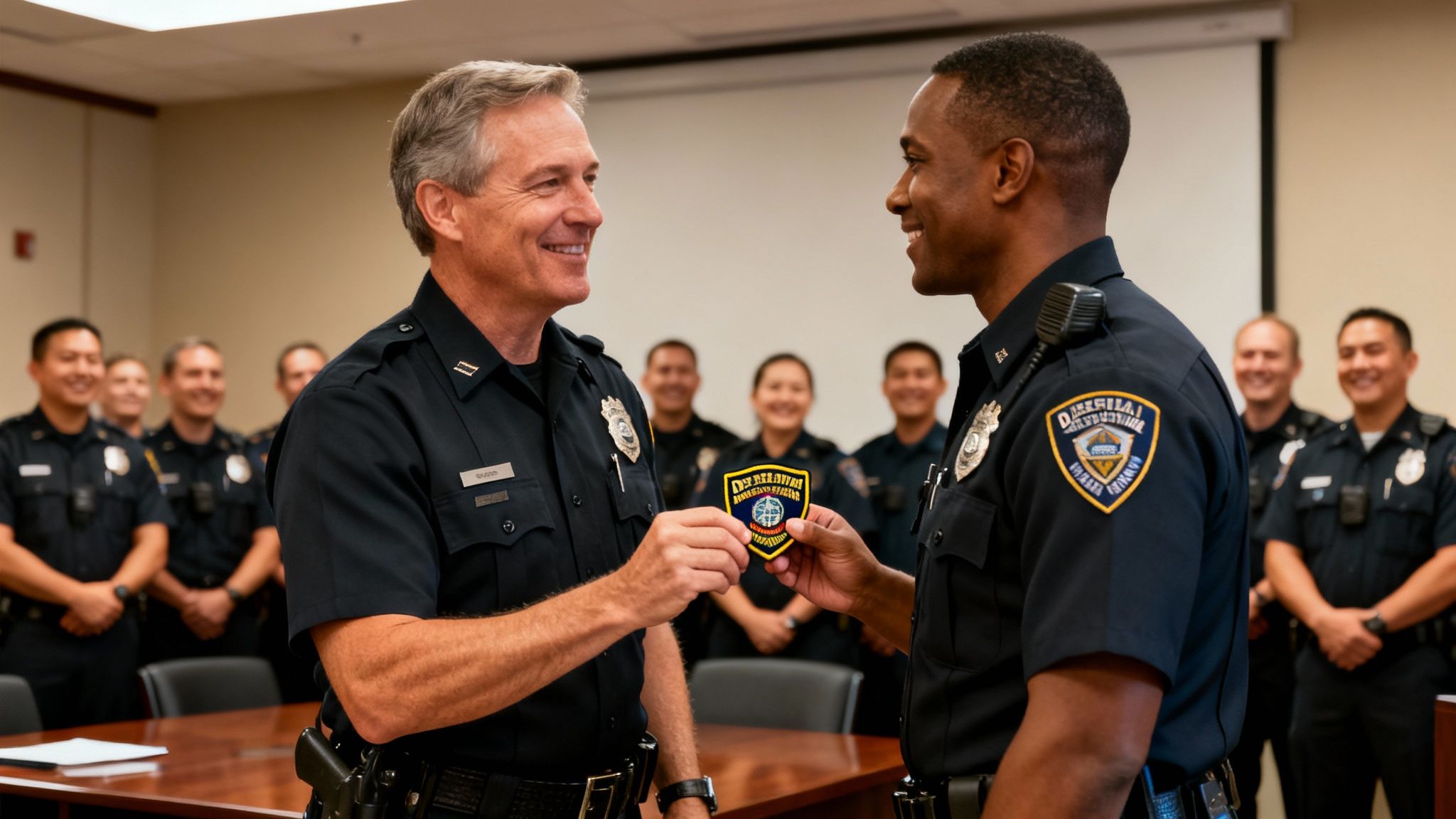
Another powerful tool is simple recognition.
- Create a De-escalation Award: Why not establish a formal commendation, just like a lifesaving award, for officers who skillfully resolve a potentially violent encounter without using force?
- Publicize the Wins: When an officer does a fantastic job talking someone down from a dangerous situation, share that story internally. Highlighting these successes reinforces what the department truly values.
These actions cost next to nothing but pay huge dividends by proving the department’s commitment is real.
Weaving De-Escalation into Daily Operations
To make these skills a constant presence, you have to bake them into the daily routines and systems. The goal isn't just an annual refresher course; it's about continuous reinforcement.
One of the most effective places to start is the Field Training Officer (FTO) program. Your FTOs are the true gatekeepers of your department's culture. When they model and demand solid de-escalation from probationary officers, those skills become foundational for the rest of their careers.
By making de-escalation a specific, graded component of a recruit's daily observation report (DOR), you ensure it gets the attention it deserves. It becomes a non-negotiable part of the job from day one.
Practical Example: A Field Training Officer and their trainee respond to a noise complaint. Instead of a "knock and talk," the FTO has the trainee practice tactical positioning and uses the interaction to coach the trainee on their communication style, tone, and word choice in real-time, then debriefs it on the drive back to the station. This constant, low-level coaching builds skills faster than any classroom session.
Gaining Buy-In from Veteran Officers
Let’s face it, one of the biggest hurdles can be overcoming skepticism from seasoned officers. Some may see de-escalation as "soft" or an unnecessary risk. Getting their buy-in is absolutely critical if you want the cultural shift to succeed.
The key here is framing. This isn't a social program; it's an advanced tactical skill. You have to emphasize how de-escalation enhances their safety and gives them more control in volatile situations. It’s about gaining a tactical advantage, not just about community relations.
A great way to do this is to use their peers to deliver the message. Identify respected veteran officers—the ones everyone listens to—who are also skilled communicators. Train them to be your lead de-escalation instructors. When a sergeant with 20 years on the street is teaching these techniques, the message carries a whole lot more weight and credibility.
Ultimately, this kind of training is a key component of leadership training for building high-performing teams. When veteran officers see de-escalation as a tool that reduces their risk of injury, citizen complaints, and internal affairs investigations, the resistance melts away. That's when true cultural change begins.
Answering the Tough Questions on De-Escalation Training
Let’s be honest. Even when the benefits seem obvious, bringing in a new training program—or expanding an old one—always kicks up some tough questions. Command staff needs real answers to justify the budget, get officers on board, and figure out the logistics to make it all work.
So, let's get into the weeds and tackle the most common questions and concerns we hear about de-escalation training for law enforcement. These are the conversations that can make or break an initiative. Getting out ahead of them with solid, practical answers is how you ensure your training actually sticks.
What's This Going to Cost Us?
This is always the first question, and it's a fair one. But the conversation needs to quickly pivot from cost to return on investment. The initial price tag can swing wildly, from a few thousand dollars to get your own people certified as instructors to a major investment in high-tech VR simulators.
But here's the thing: those upfront numbers are almost always dwarfed by the money you save by avoiding just a single use-of-force lawsuit.
Actionable Insight: The most practical, money-saving approach is to start by getting your own people certified as instructors through a recognized, evidence-based program like ICAT. This one-time expense allows you to run training sessions internally for years, dramatically lowering the long-term cost per officer and eliminating recurring consultant fees.
Think about it. Certifying two in-house trainers might run you $10,000. If they turn around and train 200 officers over the next two years, your cost-per-officer becomes incredibly efficient. It's a world away from the recurring expense of hiring outside consultants for every single class. Plus, this strategy builds expertise and ownership right inside your own agency.
Are We Putting Our Officers at Greater Risk?
This is a huge concern, but the data consistently shows the opposite is true. Good de-escalation isn't a liability; it's a powerful officer safety tactic. At its core, this training is about teaching officers how to gain more control by using communication, time, and distance as tactical tools.
It’s all about actively reducing the chances that a situation spins up into a physical fight in the first place.
- It Creates Tactical Options: Officers get more tools to work with beyond just physical force, giving them more ways to resolve an encounter safely.
- It Reduces Physical Confrontations: Calming a situation with words drastically lowers the odds of going hands-on, which is where most injuries happen.
- It Enhances Situational Awareness: The training sharpens an officer’s ability to read a scene, assess real threats, and pick up on behavioral cues, which leads to smarter decisions under pressure.
We've seen studies where agencies with solid de-escalation programs cut their officer injury rates by as much as 36%. This isn't about taking tools off an officer's belt—it's about adding more.
How Do We Get Veteran Officers to Buy In?
Getting skeptical, experienced officers to buy into this kind of training is make-or-break for changing the culture. You can’t just mandate it and hope for the best. The secret is all in how you frame it. This can't be presented as a "soft skill" or a reaction to public pressure. It has to be positioned as what it is: an advanced tactical competency that keeps officers safer and more in control.
Here’s a practical tip that saves you money and builds instant credibility: use your most respected senior officers as instructors. When a seasoned sergeant or a veteran FTO with years on the street is leading the class, the message lands differently. It’s not some abstract theory from HQ anymore; it’s a proven technique from one of their own. This internal train-the-trainer model is far cheaper than hiring outside consultants and builds institutional knowledge that stays with the department.
You can also use your own agency's data. Show them how similar training has already cut down on citizen complaints and IA investigations. That’s a direct benefit they can see: fewer write-ups, less time stuck in hearings, and a lower risk of a career-ending incident. This approach doesn't burn political capital by forcing a program on people; it creates genuine, lasting buy-in.
At Resgrid, LLC, we understand the complex operational needs of first responder agencies. Our platform helps you manage everything from personnel scheduling for training sessions to dispatching resources for real-world incidents, all in one unified system. Discover how we can support your mission at https://resgrid.com.