
Emergency Operations Plan Template: Essential Guide to Protecting Your Team
An effective emergency operations plan template is more than just a document you fill out; it's a strategic framework for building a truly resilient and actionable response to any crisis. It's what moves your agency from a simple checklist mentality to a state of genuine operational readiness, saving you countless hours and significant costs by providing a proven, expert-vetted foundation to build upon.
Moving Beyond the Basic Emergency Checklist
Let's be honest, we've all seen it: that dusty binder on a shelf labeled "Emergency Checklist." It’s not a plan; it’s a liability. A generic list of contacts and evacuation routes completely falls apart the moment a real, modern disruption hits—whether that's a sudden cyberattack that cripples your network or a supply chain collapse that grinds operations to a halt. A static document is often written for compliance, not for an effective response under extreme pressure.

This is where a dynamic, all-hazards Emergency Operations Plan (EOP) makes all the difference. It forces you to anticipate a whole spectrum of threats, not just the most obvious ones.
The Real Cost of Unpreparedness
So many organizations fall into a dangerous trap of prioritizing familiar risks while completely ignoring emerging threats. For instance, in the United States, 83% of organizations have plans for natural disasters, yet only 65% are prepared for cyber threats. That gap is a massive vulnerability, especially when you learn that 28% of U.S. companies admit they don't regularly test or update their plans.
Working from a standardized EOP template helps close these gaps. It enforces a structured approach to planning for multiple hazards, which is critical when a single year of disasters in the U.S. alone can cause $165 billion in damages. If you want to dive deeper, Fusion Risk Management has some great insights on the state of emergency preparedness.
A well-structured template gives you a strategic framework that can save hundreds of hours in development time and potentially thousands of dollars in consulting fees. Instead of staring at a blank page, you start with a proven foundation built on industry best practices and regulatory guidance.
Practical Example: A regional manufacturing firm relied on a basic fire evacuation checklist. When a tornado warning was issued, their plan was useless. The confusion led to a delayed shutdown of critical machinery, causing over $50,000 in equipment damage and two extra days of costly downtime. An all-hazards EOP would have included specific protocols for severe weather, saving them from that significant financial hit.
From Document to Dynamic Strategy
An EOP template isn't just about filling in sections. It's a tool that forces you and your team to think strategically about every part of your operation. It sparks the crucial conversations and tough decisions long before a crisis is knocking at your door.
- It Identifies Hidden Gaps: The structured format helps you spot weaknesses you might otherwise overlook, like single points of failure in your communication chain or a critical dependency on one key supplier.
- It Clarifies Roles and Responsibilities: This is huge. It completely eliminates the "who does what?" chaos during an incident, ensuring clear command and accountability from the very start.
- It Saves Money on Recovery: When you pre-plan your response, you shorten downtime, protect assets, and seriously reduce the overall financial impact of any disruption.
Ultimately, using an emergency operations plan template transforms your entire approach from reactive to proactive. You're not just checking a box; you're building a resilient organization capable of weathering any storm—whether it's digital, natural, or operational—by having a clear, executable, and practiced strategy ready to go.
Anatomy of a High-Impact EOP Template
Staring at a blank emergency operations plan template can be daunting. It’s easy to get lost in the jargon and bureaucratic-sounding sections, but trust me, every part has a purpose. They’re all designed to cut through the chaos and help your team make clear, decisive moves when the pressure is on.
Let's pull back the curtain and look at the core anatomy of an EOP. We're not just defining terms here; we're digging into the "why" behind each piece so you can build out your plan with real confidence.
Getting this right from the start saves a ton of headaches—and the expense of hiring a consultant just to translate the basics.
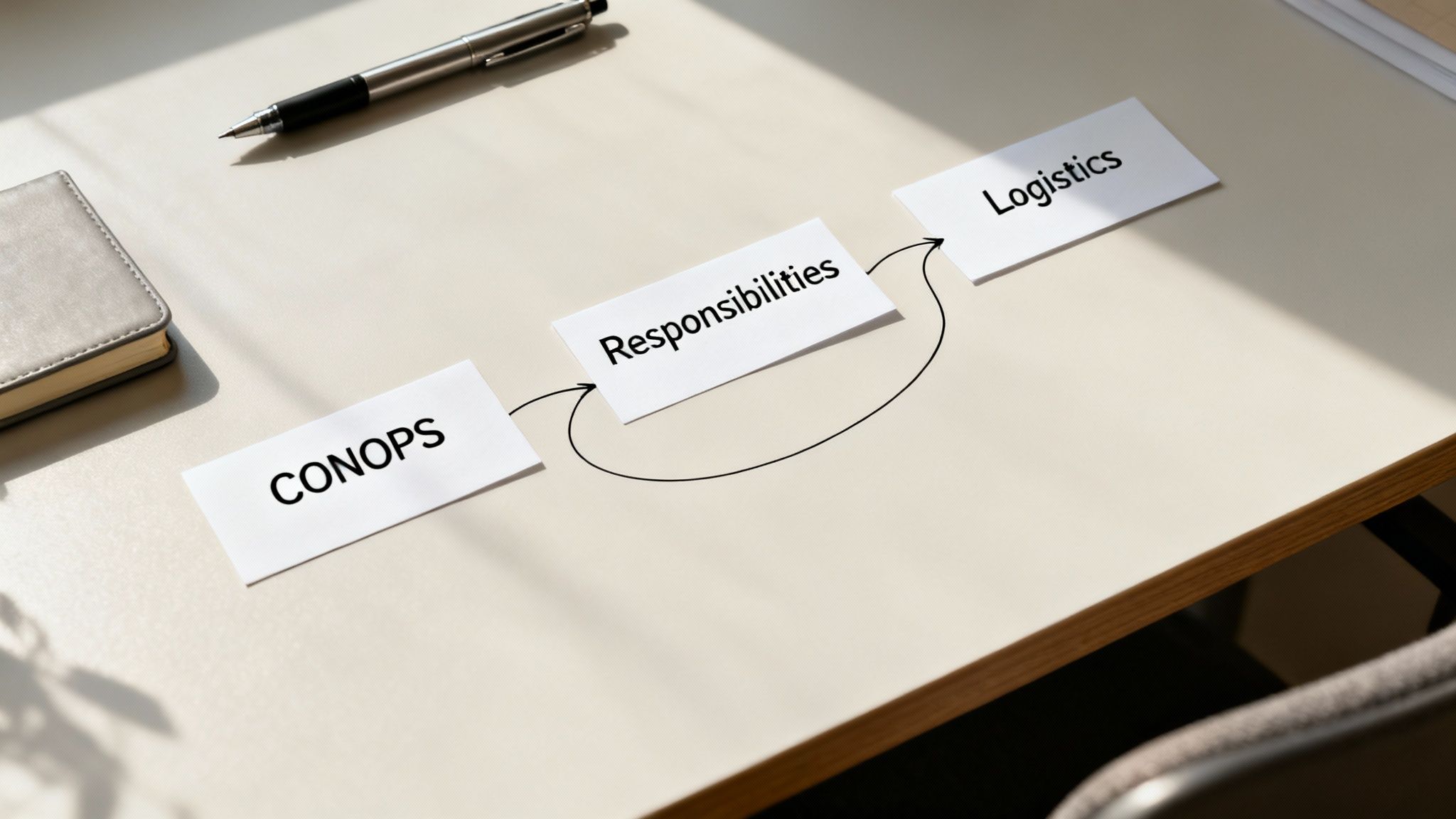
To give you a bird's-eye view, here's a quick breakdown of the core sections you'll be working with. Think of this as your cheat sheet for what goes where and why it matters.
Core EOP Sections and Their Functions
| EOP Section | Primary Function | Key Question to Answer |
|---|---|---|
| Concept of Operations (CONOPS) | Establishes the strategic direction and overall approach for the response. | "What's our big-picture strategy for managing this incident?" |
| Assignment of Responsibilities | Clearly defines roles, authority, and accountability for specific tasks. | "Who is responsible for what, and who's in charge?" |
| Logistics & Resource Management | Outlines how to secure, manage, and deploy necessary supplies and personnel. | "What do we need, where is it, and how do we get it?" |
| Annexes & Supporting Docs | Provides detailed, hazard-specific procedures and checklists. | "What are the specific steps for this particular type of emergency?" |
Each of these builds on the last, creating a comprehensive but still manageable plan. Now, let's dive into what makes each one tick.
Concept of Operations (CONOPS): The Strategic Blueprint
The Concept of Operations, or CONOPS, is the heart of your plan. This is the 30,000-foot view of how your team will tackle a major incident. It answers the most fundamental question: "How are we going to manage this?"
This isn’t a granular, step-by-step checklist. It’s about setting the direction, outlining the sequence of major actions, and defining the end goals. It’s the framework that holds everything else together.
Practical Example: A logistics company's CONOPS for a city-wide flood might state its primary mission is to secure its vehicle fleet first, then offer transport support to local emergency services. This single objective immediately shapes every decision, from staff call-outs to vehicle staging. It prevents wasted effort and costly vehicle damage when every second counts.
A solid CONOPS ensures everyone, from the top down, is rowing in the same direction without getting lost in the weeds.
Assignment of Responsibilities: Who Does What
If you want to see an operation grind to a halt, let there be confusion over who's in charge. This section is where you prevent that paralysis. The Assignment of Responsibilities component goes beyond job titles to define exactly who owns specific functions during a crisis.
Think about it: during a regional power outage, who fires up the backup generator? The Facility Manager who maintains it, or the IT Director who needs it for the servers? A good EOP settles that debate long before the lights go out.
Actionable Insight: This is where you see an immediate return on investment. An hour of operational downtime while two departments argue over a task can cost thousands. Clearly defining responsibilities in your EOP completely removes that ambiguity, saving money and shortening recovery time. This section is your best defense against costly indecision.
To see how modern tools can help manage these roles and track people in real-time, you can explore the features available in a system like Resgrid.
Logistics and Resource Management: The Supply Chain of Your Response
A great plan is useless without the resources to execute it. The Logistics section is your game plan for getting the right stuff—and the right people—to the right place at the right time. We’re talking about everything from first-aid kits and radios to fuel, food, and water.
This part of your EOP needs to answer a few key questions:
- What do we have? An honest inventory of your critical supplies and equipment.
- Where is it? Precise locations are key. No one has time for a scavenger hunt during a crisis.
- How do we get more? Think pre-negotiated vendor contracts or mutual aid agreements for resupply.
And don't forget the physical environment itself. Clear guidance for evacuation is a logistical function, and simple things like meeting emergency exit signage requirements are a critical, life-saving part of that framework. A properly marked route is as crucial as a charged battery.
Annexes and Supporting Documents: The Details That Matter
Finally, your core EOP is backed up by annexes. These are the detailed, "in the weeds" plans for specific hazards. You wouldn't handle a hazmat spill the same way you'd handle an active threat, and your annexes reflect that reality.
Each annex acts as a plug-in, providing specific checklists, contact lists, and procedures for a particular event. This modular approach keeps your main plan strategic and clean while making sure you have the tactical details ready to go. It’s how you build a robust, all-hazards plan that's both comprehensive and easy to use under pressure.
Making the EOP Template Your Own
Grabbing a downloadable emergency operations plan template is a solid first step. But the real work—the part that makes a plan genuinely useful—is in the customization. This is where you breathe life into a generic document, molding it to fit your specific world.
I’ve seen it happen too many times: an organization downloads a template, fills in a few blanks, and calls it a day. That plan looks great sitting on a shelf, but it falls apart the second it meets reality. Skipping the deep dive into customization is a critical mistake that leads to confusion and chaos when seconds count.
The goal here isn't just to check a box. It's to build a plan your people can actually use under extreme stress. Let's walk through how to do that.
It All Starts with a Simple Risk Assessment
Before you touch that template, you need to know what you’re planning for. A risk assessment doesn't have to be some drawn-out, consultant-led affair. It can be a practical, collaborative session with your key people.
Get your leaders from operations, IT, HR, and facilities in a room. Start brainstorming what could realistically disrupt your operations. Go beyond the obvious. If you're near the coast, hurricanes are a given, but what about a key supplier going out of business overnight? Or a city-wide power grid failure? An office in a high-rise needs to think about active threats, sure, but also a simple water main break flooding the lower levels.
Once you have a list, plot each risk on a simple matrix:
- Likelihood: How likely is this to happen? (Low, Medium, High)
- Impact: If it happens, how bad will it be for our people, operations, and finances? (Low, Medium, High)
This simple exercise immediately gives you focus. Zero in on the "High/High" and "High/Medium" boxes. Those are your priorities. This prevents you from wasting time planning for a zombie apocalypse when a prolonged power outage is a much more probable and damaging threat.
Defining Protocols That Actually Work for You
With your key risks identified, you can start tearing into the template's sections and replacing the generic language with precise, operational details. You're aiming to eliminate guesswork. Every detail you add here is a costly mistake you prevent down the road.
Let's look at how a healthcare clinic might tackle this.
Real-World Example: A Healthcare Clinic's Customization
Imagine a mid-sized clinic in a busy urban area. Their risk assessment flags three major concerns: an active threat, a multi-day power outage, and a hazmat spill from a nearby industrial park. Here’s how they customize their generic EOP template to address these real-world threats.
1. Patient Evacuation Protocols
The template has a basic "Evacuation" section. The clinic's team gets specific:
- Mobility-Impaired Patients: They map out two clear evacuation paths. One is for ambulatory patients, and the other is a wider, more accessible route for those in wheelchairs or needing help. They even assign specific staff to be "mobility partners."
- Critical Equipment: A checklist is created for essential portable medical gear, like oxygen concentrators. The plan assigns nursing staff to ensure this equipment goes with the specific patients who need it.
- Assembly Points: They don't just pick one spot. They designate a primary assembly point across the street and a secondary one two blocks away in case the first is unsafe.
2. Staff Accountability Procedures
This clinic runs two shifts, so a generic personnel tracking plan won't cut it. They adapt it:
- Shift Handoffs: They add a simple rule: the outgoing shift supervisor must confirm the on-site headcount with the incoming supervisor before leaving. No exceptions.
- Communication Tree: They build out a communication tree for each shift. The charge nurse calls the team leads, and each lead is responsible for confirming their direct reports are safe. This spreads the load and prevents one person from becoming a bottleneck.
- Off-Site Staff: A protocol is set for contacting off-duty staff who are scheduled for the next shift. This keeps them from unknowingly traveling into a dangerous area.
3. Family Notification Communication
This is a step that generic EOPs almost always miss. The clinic adds a dedicated annex for it:
- Designated Communicator: To keep information consistent and accurate, the Clinic Administrator is named the sole point of contact for family inquiries.
- Pre-Approved Scripts: They draft a few simple message templates for different scenarios (e.g., "The clinic is closed due to an emergency; all patients and staff are safe and have been relocated to [location]."). This prevents panicked, off-the-cuff remarks.
- Patient Privacy: The protocol explicitly reminds staff about HIPAA, ensuring private patient data isn't accidentally shared during a chaotic situation.
This level of detail is what separates a plan that works from one that fails. By defining roles and actions ahead of time, the clinic eliminates improvisation. This saves critical minutes, protects lives, and significantly reduces the organization's legal liability.
Common Customization Traps to Sidestep
As you get into the weeds of adapting your plan, watch out for these common pitfalls. They’re usually born from trying to get the plan "done" too quickly, but they create massive risks.
- Writing in a Vacuum: The absolute biggest mistake is having one person write the EOP in isolation. The plan has to be built with input from the people who will be on the front lines executing it. Without their operational perspective, it’s just a theoretical document.
- Being Too Vague: Kill phrases like "staff will be notified" or "evacuate as necessary." Get specific. "The Incident Commander will initiate a mass notification via the Resgrid mobile app" is actionable. "Evacuation will be ordered for any fire alarm activation" is a clear trigger.
- Ignoring Resource Limitations: Don’t write a plan that assumes you have an unlimited budget and an army of people. Be honest about your actual resources. If your plan hinges on a backup generator you don't own, it's not a plan—it's a wish list.
By taking a methodical, team-based approach to customization, your emergency operations plan template transforms from a simple document into a strategic asset that will actually protect your people and your organization.
Activating Your Plan with Modern Technology
An emergency operations plan template sitting in a binder is a start, but that's all it is—a static document. A paper plan is passive; a digital plan is active. The real power comes when you bring that plan to life with technology, turning it from a reference guide into a real-time command center.
This is where integrating your EOP with a platform like Resgrid changes the game. Suddenly, your carefully written protocols aren't just words on a page. They become executable commands, automated notifications, and a shared, live view of the entire operation. This leap saves critical minutes and cuts through the chaos of managing a crisis with disjointed phone calls and messy text chains.
From Paper to Real-Time Command
Let's walk through a common scenario: a flash flood. Your EOP's communication annex clearly states that all field personnel must move to higher ground and report to a designated staging area. On paper, that means someone starts making a long list of phone calls, hoping they reach everyone. It’s slow and prone to error.
Practical Example: Using an integrated system like Resgrid, the Incident Commander can send a single "Flash Flood Warning" message to a specific group—say, "Field Units"—with one click. The instructions are delivered instantly via multiple channels (app push, text, email) to ensure delivery. More importantly, the system provides real-time acknowledgements, so the commander knows exactly who has seen the message and who needs a follow-up call. This closes dangerous communication gaps that can put people at risk.
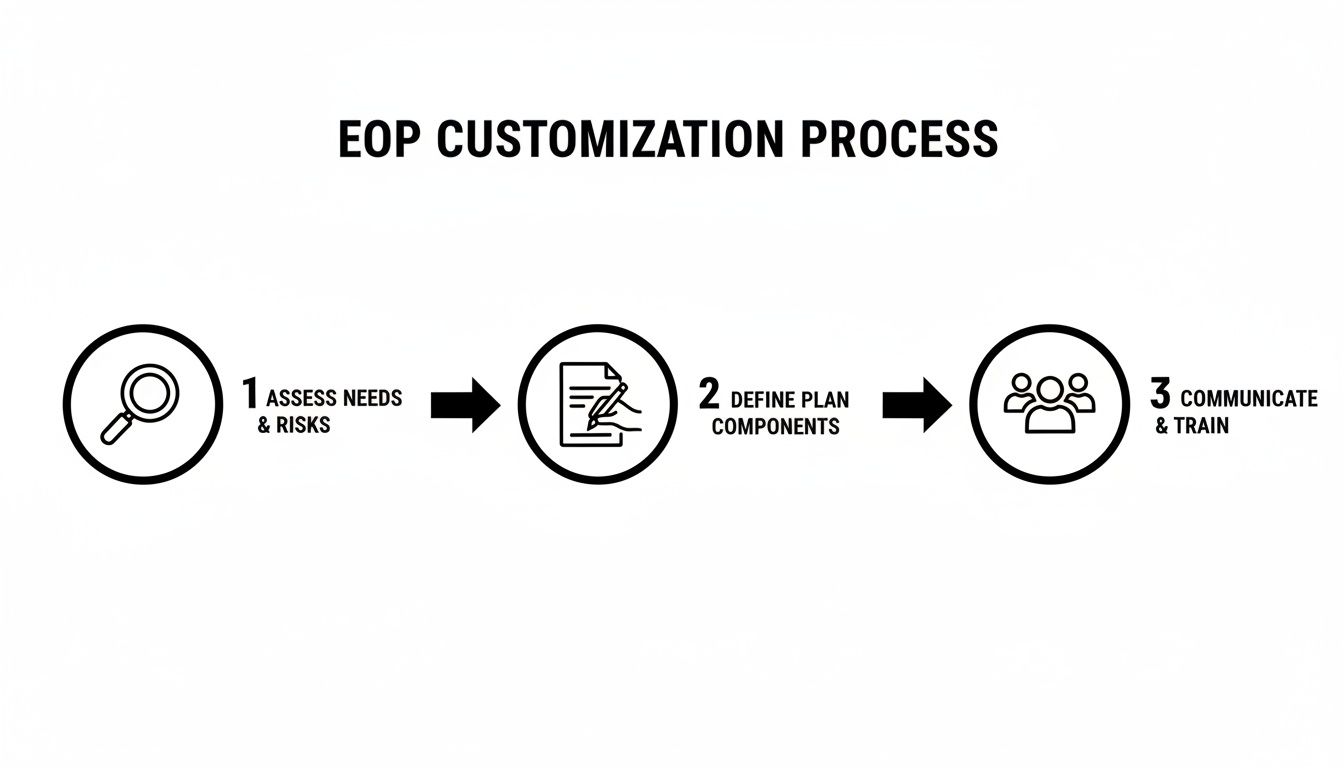
This is the core loop of making a plan functional: assess, define, and then communicate. Technology just puts that loop on overdrive.
Saving Money by Streamlining Your Tech Stack
During an emergency, one of the biggest hidden costs is inefficiency. This often comes from juggling a dozen different, expensive software tools. You might have one app for messaging, another for GPS tracking, a separate system for dispatching, and so on. This isn't just expensive; it’s a recipe for confusion and delay when every second counts.
Actionable Insight: Integrating your EOP with a unified platform like Resgrid consolidates these functions, often for less than the cost of a single-purpose application. By replacing multiple software subscriptions with one system, you directly reduce monthly overhead. This direct efficiency also minimizes financial losses from operational downtime and property damage by ensuring a faster, more coordinated response.
Think about the practical applications day-to-day:
- Dispatching Resources: Instead of tying up radio channels, a dispatcher sees available units on a map and assigns tasks directly through an app, complete with route guidance.
- Personnel Accountability: Your EOP demands you know where your people are. Real-time location tracking gives you that instantly, ensuring everyone is safe and accounted for without a time-consuming manual roll call. You can dig into these capabilities by exploring the various Resgrid apps.
- Flawless Communication: You can execute your communication plan perfectly by sending targeted alerts to specific teams or roles defined in your EOP. The right people get the right information at the right time. Every time.
The Financial and Operational Case for Integration
The shift to technology-driven emergency management isn't just a trend; it's backed by some serious numbers. The global emergency response market is projected to hit USD 244.38 billion by 2030, a clear sign that organizations are investing in better preparedness.
We’ve seen evidence that U.S. states with strong, tech-supported disaster plans achieved 25% faster response times during major hurricanes. On top of that, using Emergency Operations Centers and integrated technologies can slash critical decision-making times by up to 50%. When disasters cost the global economy over $520 billion annually, that kind of efficiency isn't just nice to have—it's essential.
By activating your EOP with modern tools, you're building a system that's not only faster and more reliable but also smarter with your budget. You cut down on multiple software subscriptions, reduce costly errors, and build a truly resilient organization.
Keeping Your Emergency Plan Relevant and Ready
Let's be honest: an untested emergency operations plan is just a theory on paper. A dusty binder on a shelf won't do anyone any good when things go sideways. To make sure your plan actually works under pressure, you have to move it from the binder to the briefing room with regular testing and maintenance.
This doesn't have to be some expensive, complicated production. In my experience, consistent, low-cost internal training is far more effective than a massive, infrequent simulation that breaks the bank.

It’s all about creating a culture of preparedness where the EOP is a living document, not some forgotten project you check off a list once.
Drills vs. Exercises: Finding the Right Fit
When it comes to testing your plan, you've got two main flavors, each with a different purpose and price tag. Knowing the difference helps you build a practical training schedule that actually improves readiness without blowing your budget.
-
Tabletop Drills: Think of these as low-cost, low-stress discussion sessions. You get the key players in a room, throw a hypothetical scenario on the table, and just talk through the EOP. The whole point is to find gaps in understanding and make sure everyone is clear on their roles and responsibilities.
-
Functional Exercises: These are a step up. They're more involved, hands-on tests of specific parts of your plan, like firing up your emergency comms system or physically setting up a command post. They take more resources, but the real-world practice you get is invaluable.
For most organizations, a simple mix works best: run quarterly tabletop drills to keep the plan fresh in everyone's mind, and schedule one annual functional exercise to really put a critical component through its paces.
Running a Simple Tabletop Drill
Let's walk through how you can run a quick and dirty drill. This kind of exercise takes about an hour and costs nothing but your team's time.
Scenario: A forklift just punctured a drum of some unknown chemical in the warehouse. We've got a hazmat spill.
How to run it:
- Initial Report: Kick things off by announcing the scenario. Turn to the warehouse manager and ask, "You just got the call. According to the EOP, what's your immediate first action?"
- Activation: Now look at your designated Incident Commander. "The situation is getting worse. How do you officially activate the plan and get the response team notified?"
- Communication: Point to your communications lead. "What message goes out to all employees? How are you sending it? What do you tell first responders?"
- Accountability: Finally, turn to your HR or safety lead. "How are you accounting for every single person during the evacuation?"
This kind of guided discussion will immediately expose the weak spots in your plan. You'll find things like unclear notification procedures or confusion over who's supposed to make the first call. If you hit snags like these, our support team can help you structure your communication and personnel management workflows in a way that makes sense.
Creating a Sustainable Maintenance Schedule
A plan is already getting outdated the moment you finish writing it. People change roles, contact numbers get updated, and risks evolve. A practical maintenance schedule is the only way to keep it relevant.
Actionable Insight: An EOP is not a one-and-done project. It's a continuous cycle of review, testing, and refinement that builds organizational muscle memory. This ongoing process is what turns a good plan into a life-saving one, and it significantly lowers your liability by demonstrating due diligence and a commitment to safety.
This isn't just a hunch; the data backs it up. Globally, 131 countries now report having national disaster risk reduction strategies. At the local level, that number is up to 73% for governments. This kind of structured planning, often built from solid templates, has been shown to cut disaster mortality by up to 30% in well-prepared regions. These numbers from the United Nations Office for Disaster Risk Reduction show just how critical it is to actively maintain your EOP.
Here’s a simple schedule you can adopt right now:
- Annual Review: Once a year, block out time to go through the entire plan, section by section. Update contact lists, check resource inventories, and refresh your risk assessments.
- Post-Incident Update: Any time you activate the plan—for a real event or just a drill—hold a hotwash afterward. Take the lessons learned and immediately roll them into the plan. Don't wait.
- New Staff Onboarding: Make the EOP part of your new hire orientation. A quick overview of the plan and their specific role is all it takes to get them up to speed.
This disciplined approach is what turns your plan into a reliable tool that's always ready to protect your team when it counts.
Common Questions About EOP Templates
Even with a solid emergency operations plan template in hand, questions always pop up. It’s the practical, real-world "what ifs" that really test how ready your team is. Getting those answered is what makes a plan go from a binder on a shelf to something that actually works when things go sideways. Let's dig into some of the most common questions we hear from agencies just like yours.
How Often Should We Update Our Plan?
Your EOP should be a living document, not a "set it and forget it" project. We've found the sweet spot is a full, top-to-bottom review at least once a year. That said, you need to tear it open and update it immediately after a few key events.
- You just handled a real incident. Every single emergency, no matter the scale, is a free lesson in what works and what breaks.
- A drill or exercise exposed a weakness. If a tabletop exercise reveals a gap in your plan, that's not a failure—it's a gift. Fix it right away.
- Your organization changes significantly. This could be anything from opening a new station, a major department restructuring, or even just changes in key leadership roles.
If you stick to that rhythm, your plan will never get stale. A dusty, outdated plan is a risk you just can't afford to take.
What Is the Biggest Mistake Organizations Make?
Hands down, the single biggest—and most damaging—mistake is building the plan in a vacuum. I’ve seen it happen time and again: one person or a small committee locks themselves in a room and writes the EOP without talking to department heads, field supervisors, or the frontline crews who will actually have to use it.
The result is always the same: a plan that looks great on paper but falls apart under the first sign of real pressure.
Actionable Insight: The best plans are built collaboratively. The people who will be executing the response must have a voice in its creation. This approach saves immense time and money by preventing the need for a total rewrite after the first real-world failure, where a flawed response could lead to damaged assets, regulatory fines, and costly litigation.
How Can We Ensure Our EOP Is Compliant?
Making sure your plan checks all the right boxes with agencies like FEMA or OSHA doesn't have to be a nightmare. The trick is to start with a template already built on a solid foundation, like FEMA's CPG 101. As you customize it for your agency, weave in the principles of the National Incident Management System (NIMS), especially the Incident Command System (ICS).
When it comes to OSHA, you’ll want to make sure the plan clearly outlines:
- Specific evacuation procedures and designated routes.
- A rock-solid method for accounting for all your people.
- Who is responsible for what, specifically for medical and rescue duties.
Once you think you're done, have your legal counsel or a compliance expert give it a final once-over. It's a small investment that can save you from massive fines and liability headaches later.
How Do We Get Our Team to Actually Remember the Plan?
Let's be realistic: nobody is going to memorize a 100-page document. You shouldn't even ask them to. The key is to break the EOP down into simple, practical tools for different roles. Think one-page job aids, checklists, and quick-reference guides that are pulled directly from the main plan.
Practical Example: A fire department might create a laminated "First 15 Minutes" checklist for its engine captains, outlining critical actions like establishing command, performing a 360-degree assessment, and confirming water supply. This isn't the whole EOP; it's the most critical part, made actionable for a specific role under pressure.
Focus your training on those tools. Short, frequent drills that build muscle memory are far more effective than an annual all-hands email telling everyone to "go read the plan." This makes preparedness a practical, everyday part of the job, not some huge document nobody ever looks at.
An effective emergency plan requires more than just a document—it needs the right technology to bring it to life. Resgrid provides the unified platform to manage dispatch, communications, and personnel tracking, turning your plan into a real-time command center. See how our tools can activate your EOP at https://resgrid.com.