

Mastering Fire Drill Logs for Compliance and Safety
Fire drill logs are the official record of your fire safety drills. But they're so much more than just a piece of paper you file away. Think of them as a living history of your organization's emergency preparedness, showing you exactly where you're strong and, more importantly, where you've got weaknesses in your evacuation plan.
Why Your Fire Drill Logs Are More Than Just Paperwork
It's tempting to see logging fire drills as just another box to check. We get it. But shifting your perspective to see these logs as a core part of your safety strategy unlocks their real power. They aren't just records of what happened; they're predictive tools that can help you stop a disaster before it starts.
When you keep meticulous logs, they stop being a passive requirement and become an active defense.
Practical Example: A fire breaks out in a multi-story office building. People start to evacuate, but it's pure chaos because a main stairwell is blocked—it's been used for storing old equipment for months. A properly documented log from a drill three months prior would have flagged that obstruction as a major problem, forcing it to be cleared long before it put lives at risk. That's the power of good logging—finding those fixable problems before they have tragic consequences.
Connecting Detailed Logs to Tangible Outcomes
Good fire drill logs lead directly to faster evacuations, fewer injuries, and a much smoother response from emergency crews. When first responders show up, having access to recent drill data is like giving them tactical intel. Information about evacuation bottlenecks or areas with poor communication lets them deploy their resources smartly and know what they're walking into.
The numbers really drive this home. The United States saw a staggering 1,389,000 fires in 2023 alone, causing thousands of deaths and injuries. The data is clear: consistent, well-documented drills have a direct correlation with the significant drop in fire-related deaths over the past few decades. For organizations using digital platforms to manage their logs, we've seen evacuation simulations run up to 25% faster. That's time that can mean the difference between a close call and a catastrophe. The U.S. Fire Administration has a ton of great data on the impact of preparedness.
A fire drill log is the story of your safety plan in action. Each entry is a chapter that reveals what works, what doesn't, and what needs to change to ensure a safe ending for everyone.
The Financial Case for Meticulous Logging
Safety is reason enough, but there are solid financial incentives to take your fire drill logs seriously, too. These records are your best defense against hefty fines for non-compliance with OSHA or NFPA standards. A failed audit can hit your budget hard, costing way more than it ever would to just keep good records in the first place.
Actionable Insight to Save Money: On top of that, your insurance provider is paying attention. Well-kept logs are concrete proof of a proactive risk management strategy, which can often lead to lower insurance premiums. A manufacturing client of ours negotiated a 5% reduction in their annual premium by presenting a year's worth of detailed digital fire drill logs to their insurer. The logs demonstrated a consistent reduction in evacuation times and proactive issue resolution, which lowered their risk profile. In that sense, every detailed entry in your log is an investment in both your people's safety and your company's financial health.
Creating a Fire Drill Log That Actually Works
Let's be honest, a fire drill log that just checks a box is a wasted opportunity. To really make a difference, your log needs to capture actionable intelligence, not just the date and time. It’s about shifting from a routine compliance task to creating a powerful tool for improving safety.
The goal is to create a document that tells a story. Instead of just noting that a drill happened, a great log explains the what, how, and why behind it. This approach transforms every single drill into a goldmine of data, highlighting what went right and, more importantly, pinpointing weaknesses before a real emergency does.
Moving Beyond Basic Data Collection
So many organizations fall into the trap of recording the bare minimum. A log entry that just says "Q3 Fire Drill" is basically useless. To make your fire drill logs actually work for you, you have to capture the context and the nitty-gritty details of the event. Think of it as the difference between a blurry photo and a high-resolution image—the details are what matter.
Practical Example: Vague notes won't cut it. "Communication problems" isn't helpful. "Radio dead spots identified in the west stairwell between floors 2 and 3" is a specific, actionable insight you can actually fix. This is the level of detail that regulators, insurance auditors, and your own safety team need to see.
The quality of your fire drill log is a direct reflection of your commitment to safety. A detailed log shows you're not just checking a box—you're actively working to protect people and property by identifying and mitigating real-world risks.
Actionable Insight to Save Money: This commitment has real financial benefits. Specific, well-documented logs demonstrate due diligence, which can help lower your insurance premiums. They also give you the hard evidence needed to justify budget requests for safety improvements—like new radios to fix those dead spots. Proposing a $2,000 radio repeater system is much easier when you can show log data proving communication failures in three consecutive drills, preventing a much more costly failure down the road.
Key Fields for an Actionable Log
To build a log that gives you genuine insight, you need to include fields that capture more than just who showed up. A well-structured template keeps everything consistent and makes it much easier to spot trends over time.
A truly useful fire drill log should be your go-to source for understanding your team's readiness. Here are the essential fields you should be capturing to get the full picture.
Essential Fields for an Actionable Fire Drill Log
A breakdown of the critical data points every fire drill log should capture to ensure compliance and gather meaningful safety insights.
| Field Name | Description | Example Entry |
|---|---|---|
| Drill Scenario | A brief description of the simulated emergency. | "Simulated kitchen grease fire on the third floor, north wing." |
| Evacuation Time | Total time from alarm to 'all clear', often broken down by area. | "Total: 4m 15s. Admin Wing: 3m 30s. Warehouse: 5m 05s." |
| Issues Observed | Specific, objective problems encountered during the drill. | "Secondary exit on the west side was partially blocked by pallets." |
| Participant Feedback | Notes from employees or drill observers. | "Staff on the 4th floor reported difficulty hearing the alarm." |
| Corrective Actions | The plan to fix the identified issues, including who is responsible. | "Facilities Manager to clear west exit route by EOD. Action: J. Smith." |
| Follow-up Date | A scheduled date to confirm the corrective action was completed. | "Follow-up inspection scheduled for 10/25/2024." |
Capturing these details turns a simple log into a dynamic safety record. It’s also smart to look at how this process fits into your wider safety framework. For instance, learning how to create a risk register for ISO 45001 compliance can provide a broader context for how your drill data informs overall risk management.
From Paper to Practical Application
Whether you use a paper checklist, a spreadsheet, or a digital platform like Resgrid, the core principles are the same. The real key is making the logging process as seamless as possible so that crucial details aren't forgotten in the heat of the moment.
Practical Example: Imagine a security team running a drill at a large event venue. An observer notices that a huge crowd is funneling toward a single exit, completely ignoring a closer, less congested one.
- A poor log entry: "Crowding at main exit."
- An effective log entry: "Congestion at Exit A. Approximately 70% of attendees used this exit, ignoring Exit B just 50 feet away. Corrective Action: Add two additional large, illuminated signs pointing to Exit B and station one security officer there during the next event to direct traffic."
See the difference? That specific, data-driven entry allows the team to make a targeted, low-cost fix that could drastically improve evacuation flow and save lives. Over time, reviewing these detailed entries helps build a comprehensive safety profile, making every drill an investment in a safer future. This is how a simple fire drill log becomes one of your most effective risk management tools.
How Digital Logs Cut Costs and Boost Efficiency
Let's be honest, the old way of logging fire drills—those binders stuffed with paper forms—is a mess. It’s a system practically designed for inefficiency. You're stuck deciphering sloppy handwriting, manually entering data for audits, and hunting down lost forms. When a safety officer is digging through a mountain of paper, it’s not just frustrating; it’s a massive waste of time and money.
These manual processes have a ton of hidden costs. Think about the administrative churn: printing forms, handing them out, chasing them down, and then physically filing everything. Each one of those steps eats up valuable hours that could be put toward actual safety improvements. Plus, trying to pull historical data quickly becomes a nightmare, turning a simple request from an auditor into a week-long headache.
Automating Safety with Digital Workflows
This is where digital solutions completely change the game. They automate the entire logging process, from start to finish. Platforms like Resgrid roll dispatch, real-time tracking, and reporting into one smooth workflow. This isn't just about swapping paper for a screen; it's about creating a smarter, more responsive safety system.
Practical Example: A dispatcher kicks off a drill with a single click. Instantly, a notification hits every participant's device through an app. As the drill plays out, the system automatically tracks who acknowledged the alert and how fast they responded. When it’s all over, a perfect, accurate fire drill log is generated and saved securely in the cloud—complete with precise timestamps, communication records, and participant details. You can see the full range of possibilities by exploring the dispatch and management features that make it all happen.
The real win with digital logs isn't just convenience—it's getting back dozens of administrative hours every single month. You can reinvest that time into analyzing drill performance and making life-saving improvements, turning what was once a cost center into a strategic safety asset.
This diagram gives you a simple look at how a digital system handles the key parts of a fire drill log.
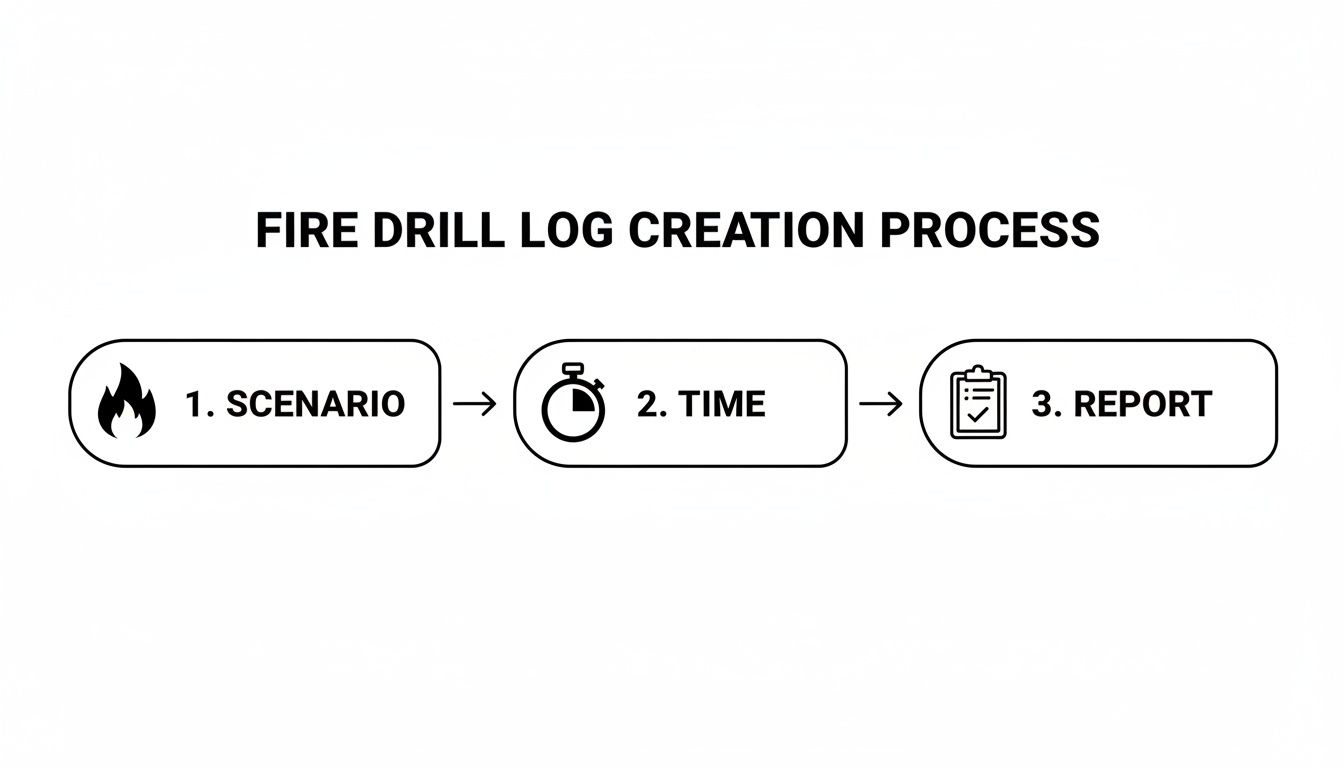
From setting up the scenario to timing the response and generating the final report, automation makes sure nothing gets missed.
The Tangible Cost Savings of Going Digital
The case for moving to modern fire drill logs is built on real, measurable savings and reduced risk. When you get rid of manual data entry and report building, the return on investment is almost immediate.
Actionable Insight to Save Money: Let’s look at a real-world example. A security manager at a big corporate campus used to spend 15-20 hours every quarter just preparing for and documenting fire drills. That included printing out checklists, manually timing evacuations with a stopwatch, collecting handwritten feedback, and then typing it all into a massive spreadsheet.
After they switched to a digital platform, everything changed.
- Time Savings: The admin time for each drill dropped to just 2-3 hours. That’s over 60 hours of productive time he got back every year. Calculating his hourly rate, this represented over $2,500 in labor cost savings annually.
- Resource Savings: They completely cut out costs for printing, ink, and physical storage, saving an estimated $500 per year on materials alone.
- Audit Readiness: When the local fire marshal asked for their records, the manager pulled a complete, compliant report covering two years of drills in less than five minutes. This instant access helped them avoid potential fines and showed they were on top of their game.
But beyond those direct savings, the biggest financial upside comes from better safety outcomes. Digital logs give you the data you need to spot and fix weaknesses in your plan—like a poorly lit exit sign or a slow-to-respond department—before they cause a disaster. By making your emergency response stronger, you protect your people, reduce liability, and keep the business running. That’s the ultimate return on investment.
Turning Your Log Data Into Life-Saving Insights

Your fire drill logs are way more than just a checkbox for compliance. Think of them as a goldmine of data just waiting to show you the future of your safety strategy. A logbook filled with evacuation times, jotted-down issues, and feedback from participants is an incredibly powerful analytical tool.
The real magic happens when you stop just collecting this information and start actively digging into it to find patterns and trends.
When you treat your logs like a source of intelligence, you can turn raw numbers into real, tangible safety improvements. It’s a shift in mindset, really. You move from a reactive, "just get it done" compliance mode to a proactive safety culture that uses past performance to predict—and prevent—future problems. The goal is to stop looking back at what happened and start looking ahead to prevent what could happen.
Spotting Trends and Identifying Weaknesses
The first step is learning to spot the recurring themes hiding in your fire drill logs. Are certain departments always the last ones out the door? Does that alarm pull station on the fourth floor keep getting flagged for being hard to access? These aren't just one-off incidents; they're data points forming a pattern.
A landmark study on fire drills with 230 firefighters proved this out. The crew’s mean perception of effectiveness jumped from 1.5435 before a drill to 2.4043 after. This shows how systematically logging outcomes—like response speed and coordination scores—translates directly into measurable gains. Fire departments that log over 50 drills a year even report 22% higher mental health scores. It’s clear that data-driven preparedness works. You can read more about the research on drill effectiveness and logging.
To get started with your own analysis, look for:
- Time-Based Trends: Compare evacuation times from one drill to the next. If the warehouse team's time has crept up by 30 seconds over the last three drills, that’s a red flag worth investigating.
- Location-Based Patterns: Map out where issues are popping up. If you consistently see notes about communication dead spots in the east wing stairwell, you have a clear need for a signal booster or a change in procedure.
- Equipment Failure Rates: Keep a running tally of faulty equipment mentions. If the same emergency exit light is reported as out in three straight drills, it's not just a bad bulb; it's a systemic failure.
Your fire drill logs are the diagnostic report for your building's emergency response system. Reading them carefully allows you to pinpoint chronic issues and prescribe the right cure before the condition becomes critical.
Case Study: Optimizing Patrol Routes
Practical Example: A security firm managing a large, multi-building campus had a problem with their evacuation patrols. Officers were supposed to sweep each floor to make sure everyone was out, but the routes were inefficient, and entire sections were getting missed. It was a mess.
By digging into their digital fire drill logs from the previous six months, the security manager spotted a clear trend. The logs, which had timestamps for when each officer cleared a zone, showed that patrols in Building C were taking 40% longer than anywhere else. On top of that, employee feedback consistently mentioned that "no one came by our office" in the north corner of Building C.
Once he saw the data, the manager realized the assigned patrol route was completely counterintuitive. It was forcing officers to double back on themselves, burning precious minutes.
The Actionable Insight:
The log data was undeniable proof that the existing patrol route was flawed. Using this info, the manager redrew the sweep pattern for Building C, creating a much more logical, linear path.
The Result:
In the very next drill, patrol time for Building C dropped by a massive 35%, falling right in line with the other buildings. Even better, the post-drill feedback confirmed every single area had been checked. This simple change, driven entirely by analyzing the log data, made the team more effective and the entire campus safer—all without spending a dime on new gear or people.
Staying Audit-Ready and Ensuring Long-Term Compliance
An upcoming audit from a fire marshal or an OSHA inspector shouldn't trigger a frantic search for paperwork. Let's be honest, we've all seen it happen. But with a well-organized system, an audit becomes a simple validation of the great safety work you're already doing.
The trick is to treat your fire drill logs not as historical documents but as living proof of your commitment to safety. This proactive mindset is what separates organizations that breeze through inspections from those who get bogged down with costly fines and operational delays. Your logs tell the story of your preparedness—when an auditor arrives, you want to hand them a clear, complete, and compelling one.
Decoding OSHA and NFPA Requirements
Regulatory bodies like the Occupational Safety and Health Administration (OSHA) and the National Fire Protection Association (NFPA) set the bar for fire safety. While the specific rules can shift depending on your industry and location, they all share some core expectations for fire drill logs. They're looking for consistency, detail, and proof that you follow through.
An inspector isn't just checking for a date and a signature. They want to see that drills are conducted regularly, that problems are actually identified, and that you have a documented process for fixing them.
- Log Retention: Most regulations mandate keeping logs for at least one to three years. Digital systems make this a non-issue, storing an indefinite history that you can pull up in seconds.
- Content and Accessibility: Logs have to be readily available upon request. An inspector isn’t going to wait around while you dig through a dusty file cabinet. Digital platforms let you generate a comprehensive report in minutes.
- Proof of Action: This is a big one. Your log needs to show that you not only find issues but also resolve them. A "Corrective Actions" field with clear completion dates is non-negotiable.
Of course, readiness isn't just about drills; it's also about your equipment functioning as intended. For instance, it’s critical that businesses prioritize fire door drop testing to ensure every safety component works correctly when it matters most.
The Power of Instant Access: A Real-World Example
Practical Example: An event organizer is managing a massive concert venue. Just hours before the doors open, the fire marshal makes an unannounced visit, asking for the last two years of fire drill records for the entire security and operations team. In a paper-based world, this is a show-stopping disaster that means hours of searching and panicked phone calls.
But this organizer uses a digital platform like Resgrid. He just pulls out his tablet, applies a few filters, and generates a complete, compliant PDF report detailing every drill, participant, and outcome. He emails it to the fire marshal on the spot. The inspection takes less than ten minutes, and the event goes on without a hitch.
That's the real financial benefit of being audit-ready. The organizer avoided thousands in potential fines and, more importantly, the massive revenue loss from a delayed or canceled event. In that single interaction, the cost of the digital system paid for itself many times over.
An Audit Preparation Checklist
The old saying is true: being prepared means you never have to get ready. Use this checklist to keep your fire drill logs audit-proof at all times.
- Is Your Storage Secure and Accessible? Whether you use a locked, fire-proof cabinet for paper files or a secure cloud server, you need to be able to retrieve records quickly.
- Are Your Logs Complete and Consistent? Every log should use the same template with all required fields filled out. Gaps and incomplete records are a huge red flag for auditors.
- Can You Demonstrate Follow-Up? Make sure every identified issue has a corresponding corrective action with a documented completion date. This closes the loop and proves your diligence.
- Is Your Team Trained on the Process? Everyone responsible for conducting drills and filling out logs needs to know the procedure and understand why it’s so important.
This need for meticulous logging isn't unique to fire safety. For example, data shows fire departments using digital logs that follow NFPA guidelines achieve 16% lower death rates per 1,000 fires. For organizations like those in the security services industry, this level of detail boosts personnel tracking accuracy by a staggering 40%. These figures really drive home how robust logging is a critical operational tool, not just a compliance checkbox.
Common Questions About Fire Drill Logs
Even with a solid system in place, questions always seem to pop up when you're creating and maintaining fire drill logs. Hitting these common challenges head-on is the best way to make sure your process stays compliant, efficient, and actually helps improve safety.
Getting the details right can feel like a lot, but trust me, most organizations wrestle with the same handful of issues. Let's clear up some of the most frequent points of confusion with some practical, straightforward answers.
How Often Should We Conduct and Log Fire Drills?
There’s no single, universal answer for how often you need to run and log your fire drills. It really depends on your industry, the type of building you're in, and what your local fire marshal requires. For most businesses, OSHA and NFPA guidelines point to quarterly or annual drills as a bare minimum. But that's just the starting line.
Facilities with higher risks have much stricter schedules.
- Hospitals and Healthcare Facilities: These places often need monthly drills in patient care areas. It’s a whole different ballgame when you're evacuating people who can't move on their own.
- Schools and Universities: They typically run drills every month while school is in session to keep the procedures fresh for students and staff.
- Industrial Plants: They might need more frequent, scenario-based drills, especially if there are hazardous materials on-site.
Actionable Insight to Save Money: Don't just check the box on the minimum requirement. Try mixing things up by running a drill during a shift change or over a lunch break. This gives you much more realistic data on your team's readiness without costing an extra dime. Using a digital platform to automatically schedule and send reminders for these varied drills ensures you never miss one, helping you sidestep a non-compliance fine that can easily hit thousands of dollars.
What Are the Biggest Mistakes to Avoid When Logging Drills?
The absolute worst mistake I see is people being too generic with their notes. An entry that just says "Drill complete" or "Issues noted" is useless for future planning and looks lazy to an auditor. When it comes to fire drill logs, specificity is everything.
Practical Example: Instead of writing "Communication problems," get detailed: "Radio dead spots in the west stairwell." Instead of "Slow evacuation," be specific: "The accounting department on the third floor took 2 minutes longer to evacuate than other teams due to confusion about the secondary exit route."
The biggest failure isn't just poor documentation—it's not closing the safety loop. Your log is incomplete until you've documented the corrective actions taken to fix the problems you found. This is the evidence that proves your diligence and transforms your log from a simple record into a powerful risk management tool.
Another classic error is inconsistent formatting. It makes it nearly impossible to spot trends over time. Adopting a standardized template, whether it's on paper or a digital platform, is a simple fix that pays off big time. For more help with this, you can always check out resources in our Resgrid support center.
Can Digital Fire Drill Logs Actually Save Our Organization Money?
Without a doubt. The return you get from a digital logging system is clear and comes from a few different places.
Actionable Insight to Save Money: First, you immediately cut down on administrative hours. Just think about the time your team spends printing, handing out, collecting, and then manually typing in data from paper forms. Automating that process frees them up to focus on analyzing the results and actually improving safety, not just shuffling paper. I know one facility manager who reported saving 15 hours every single quarter just by making the switch, which translated to over $2,000 in recovered labor costs annually.
Second, you reduce your overall risk. Better data leads to smoother, faster evacuations, which can dramatically lower the financial and human cost if a real emergency ever happens. Insurance providers often recognize this, and many will offer lower premiums to organizations that can show a well-documented, data-driven safety program.
Finally, you avoid expensive fines. A single failed audit can be a serious financial hit. A digital system gives you an organized, complete, and instantly accessible record, making audits a breeze and keeping you out of trouble.