
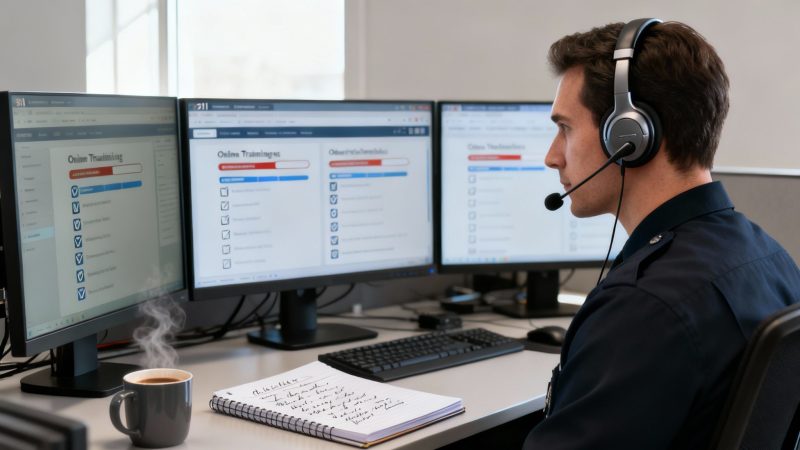
12 Top Sources for Free Online Training for 911 Dispatchers in 2026
In the high-stakes world of emergency dispatch, continuous learning is not just a professional goal; it is a critical component of public safety. Keeping skills sharp, mastering new technologies, and understanding evolving incident command protocols are essential for effective performance. However, accessing high-quality training can be challenging, often constrained by tight agency budgets and the high cost of specialized courses. This guide directly addresses that challenge by providing a comprehensive, vetted list of the best free online training for 911 dispatchers.
We have done the heavy lifting for you, curating a definitive collection of resources that can enhance your skills without impacting your agency's bottom line. Whether you are a new telecommunicator building foundational knowledge or a veteran dispatcher seeking advanced Continuing Dispatch Education (CDE) credits, this list is your gateway to career growth. Forget sifting through countless websites; we provide a clear, organized pathway to top-tier educational content from accredited and respected institutions.
Inside this guide, you will find a detailed analysis of each training provider, including:
- Actionable insights on how to apply the training on your next shift.
- Practical examples demonstrating how these free courses can directly save your agency money on training expenditures.
- Direct links and screenshots to help you navigate and register for courses with ease.
This resource is designed to be your go-to reference for professional development. By leveraging these free opportunities, you can elevate your performance, increase your value to your agency, and ultimately, better serve your community when it matters most. Let's explore the best free training available to you.
1. FEMA Emergency Management Institute (EMI) – Independent Study (IS) Program
The Federal Emergency Management Agency (FEMA) offers a comprehensive suite of free, self-paced online courses through its Emergency Management Institute (EMI). This platform is the gold standard for foundational emergency management principles in the United States, making it an indispensable resource for any Emergency Communications Center (ECC). While not exclusively for dispatchers, its curriculum provides the essential framework for understanding large-scale incident command and inter-agency coordination.
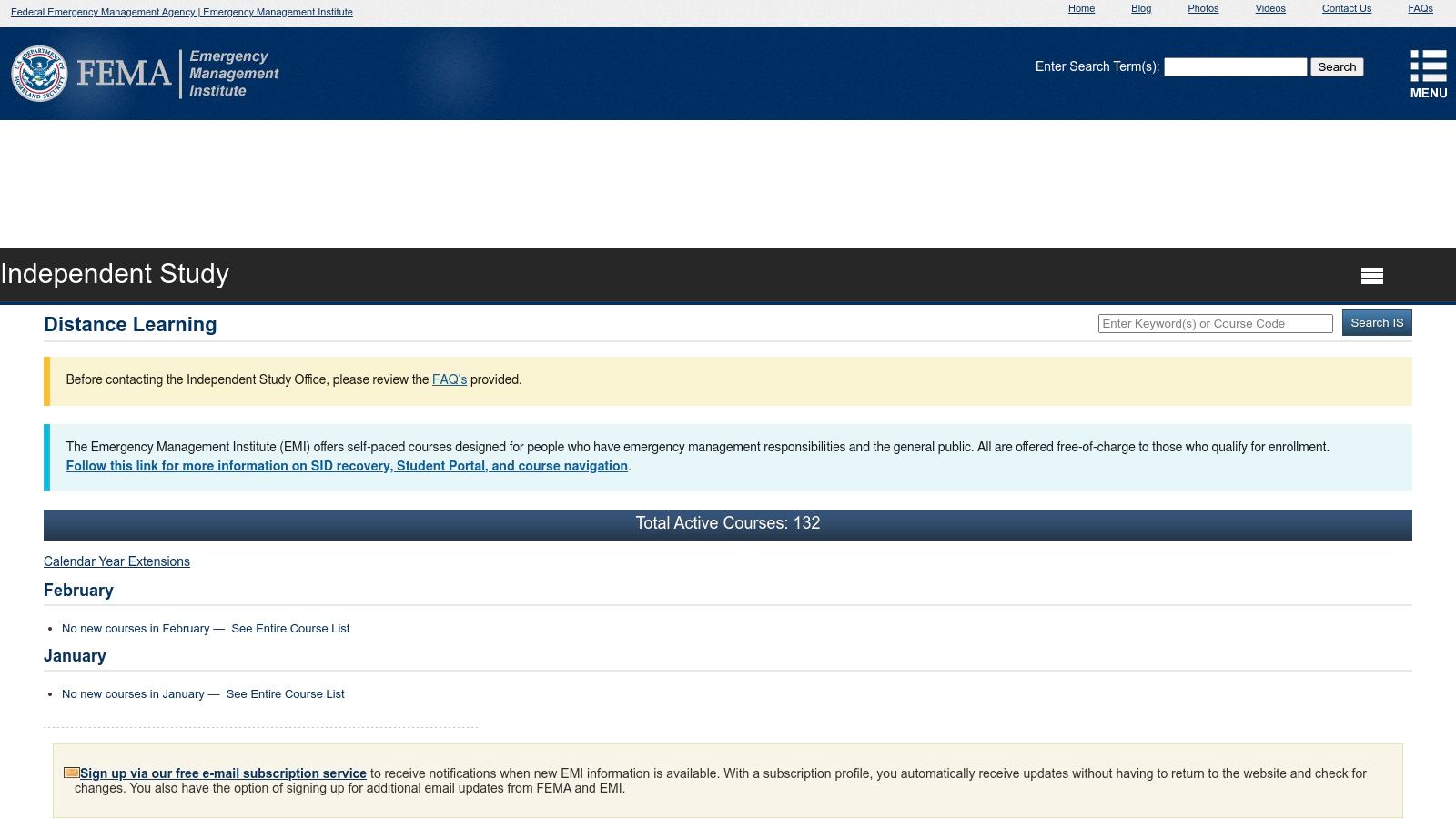
This platform stands out because its certifications are nationally recognized and often required by local, state, and federal agencies. For dispatchers, the National Incident Management System (NIMS) and Incident Command System (ICS) courses are particularly vital. Completing courses like IS-100, IS-200, IS-700, and IS-800 equips dispatch personnel with the common terminology and operational structures used by field responders during major events, from natural disasters to active shooter incidents.
How to Maximize This Free Resource
A key benefit is its cost-effectiveness. Agencies can save thousands on foundational training by integrating FEMA’s free online training for 911 dispatchers into their onboarding process. For a practical example, an agency can save over $150 per employee by using the free IS-100 course instead of a paid, in-person equivalent. New hires can complete prerequisite NIMS/ICS courses before even starting academy training, saving valuable classroom time. To get started, users simply need to register for a free FEMA Student Identification (SID) number, which allows them to take exams and receive official certificates and transcripts. An actionable insight is to require new hires to complete these four courses as part of their pre-employment paperwork, ensuring they arrive on day one with a baseline understanding of incident management.
Recommended FEMA IS Courses for Dispatchers:
- IS-100.C: Introduction to the Incident Command System
- IS-200.C: Basic Incident Command System for Initial Response
- IS-700.B: An Introduction to the National Incident Management System
- IS-144: Telecommunicators Emergency Response Taskforce (TERT) Basic Course
Website: https://training.fema.gov/is/
2. National 911 Program (911.gov)
The National 911 Program, managed by the National Highway Traffic Safety Administration (NHTSA), serves as the federal government's primary hub for the 911 community. While it is not a direct training provider like FEMA, it functions as an authoritative library of vetted resources, webinars, and critical information. It is an essential starting point for telecommunicators and ECC leaders seeking to understand the national landscape of emergency communications, particularly regarding Next Generation 911 (NG911) standards.
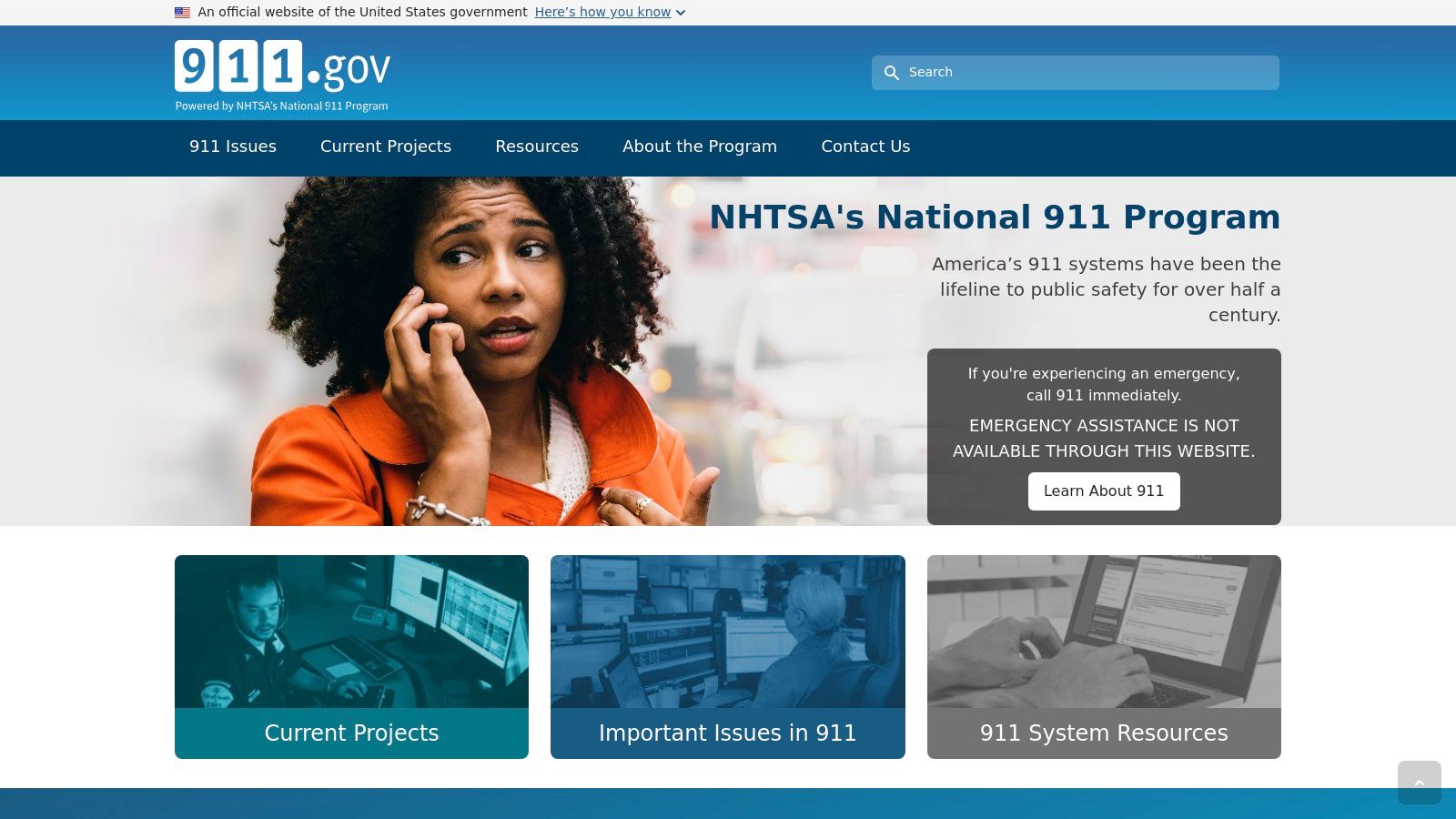
This platform stands out by offering high-level strategic insights rather than foundational skills. Its value lies in keeping dispatch professionals informed on policy, technology, and funding that directly impacts their operations. Accessing the archives of the "State of 911" webinar series, for example, provides free access to expert discussions on topics like GIS data management, cybersecurity for PSAPs, and implementing NG911 core services, all of which are crucial for career development and agency planning.
How to Maximize This Free Resource
The most significant cost-saving benefit of 911.gov is providing free access to strategic information that would otherwise require attending expensive conferences. For example, instead of spending $500+ on travel and registration for a national conference, an ECC manager can use a recorded webinar on NG911 funding as an in-service training session for their entire leadership team. This is a practical way to save thousands of dollars while keeping staff informed. An actionable insight for individual dispatchers is to review the NG911 resources to understand how text-to-911 and video calls will impact their future workflow. Keeping teams informed with these federal-level insights helps modernize agency operations, which is a key component of effective dispatch management systems that you can learn more about at Resgrid.
Recommended Resources on 911.gov:
- State of 911 Webinars: Access recordings on topics from NG911 implementation to dispatcher mental health.
- NG911 for Public Safety Leaders: A curated collection of documents and guides for understanding the transition to NG911.
- 911 Data & Information: Resources on data collection, GIS, and information sharing for PSAPs.
- Funding & Grants Information: Centralized information on federal funding opportunities available to ECCs.
Website: https://www.911.gov/
3. APCO International – Training & Continuing Dispatch Education (CDE)
The Association of Public-Safety Communications Officials (APCO) International is a leading professional organization dedicated to public safety communications. Its online portal offers a wealth of resources, many of which are specifically designed to meet Continuing Dispatch Education (CDE) requirements. While many of its in-depth courses are paid, APCO provides several valuable avenues for free online training for 911 dispatchers, particularly for its members.
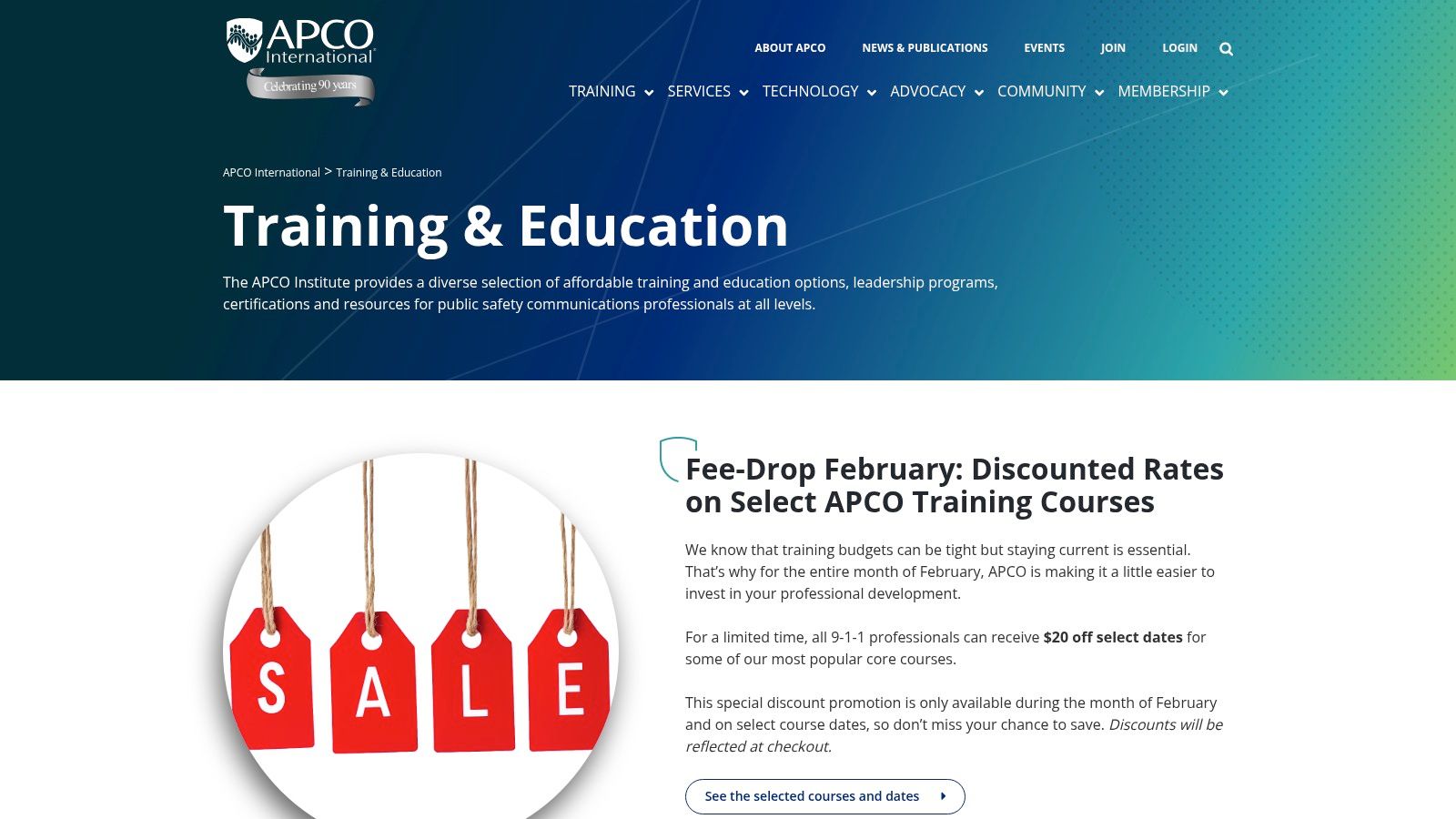
This platform is invaluable because it provides CDE credits that are widely recognized for state and national recertification mandates. Unlike more generalized emergency management training, APCO’s content is created by and for public safety telecommunicators. The free CDE article tests, based on their Public Safety Communications magazine, offer a consistent way to earn credits. Additionally, APCO frequently hosts free webinars for members on timely topics like mental health, Next Generation 9-1-1, and operational best practices, each providing certificates upon completion.
How to Maximize This Free Resource
The most cost-effective way to leverage APCO is through an agency or individual membership. This unlocks access to the library of free member-only webinars, which can fulfill a significant portion of annual CDE requirements without any additional cost. A practical example of saving money is having each dispatcher earn 4-6 CDE credits per year through the free magazine quizzes and webinars, potentially saving an agency over $200 per employee on paid CDE courses. An actionable insight is for a training coordinator to assign a specific magazine article and quiz each quarter as a standard, no-cost way to accumulate credits. Managing these completions can be further streamlined using modern dispatch management software that centralizes personnel and credentialing data.
Key Free Resources from APCO:
- CDE Article Tests: Read an article from Public Safety Communications magazine and pass a short quiz to earn one CDE credit.
- Member Webinars: Access a schedule of live and on-demand webinars that grant CDE credits, often free for members.
- APCO IntelliComm®: While a paid service, it sometimes offers free resources or trial access to its standards-based criteria.
Website: https://www.apcointl.org/training/
4. NENA – Free Training Resources
The National Emergency Number Association (NENA) serves as a central hub for the 9-1-1 community, and its free training resource page is a testament to that commitment. Rather than hosting its own courses, NENA acts as a valuable aggregator, curating a list of free online training opportunities from various reputable providers. This saves training coordinators and individual telecommunicators the significant effort of searching multiple websites for relevant, no-cost professional development.
This platform stands out because it is curated specifically for the 9-1-1 profession by the industry's leading association. The resources cover a broad spectrum of topics, from technical and operational skills to emergency preparedness and mental health. While NENA doesn't control the external content, its endorsement provides a level of vetting that helps dispatchers focus on quality materials. The convenience of finding multiple agency-specific courses in one place makes this an essential bookmark for any ECC.
How to Maximize This Free Resource
The primary cost-saving benefit of NENA’s page is time. Training managers can quickly scan the list for new webinars or on-demand courses to supplement their existing training plans without spending hours on research. A practical example is a training coordinator bookmarking this page and checking it monthly for new CDE opportunities, saving 2-3 hours of search time that can be reallocated to other duties. For individual dispatchers, an actionable insight is to set a personal calendar reminder to visit the site quarterly to find free online training for 911 dispatchers that aligns with their career goals. Some ECCs have successfully integrated these resources with scheduling platforms, and various dispatcher mobile apps can help teams stay informed about new training opportunities.
Example Resources Often Found on NENA’s Page:
- Webinars from public safety technology companies on NG9-1-1 topics.
- Online courses from federal partners like the Department of Homeland Security.
- Mental health and wellness training from non-profit organizations.
- Incident-specific training related to topics like active shooter events or natural disasters.
Website: https://www.nena.org/page/freetrainingresources
5. TEEX (Texas A&M Engineering Extension Service) – LET223 Active Attack Emergency Communications
The Texas A&M Engineering Extension Service (TEEX) is a nationally respected institution for public safety and emergency response training. While many of its extensive programs are fee-based, TEEX offers a critical, free online course specifically for telecommunicators: LET223, Active Attack Emergency Communications. This module addresses a high-stakes, low-frequency event type, providing dispatchers with essential knowledge for managing these complex and dynamic incidents.
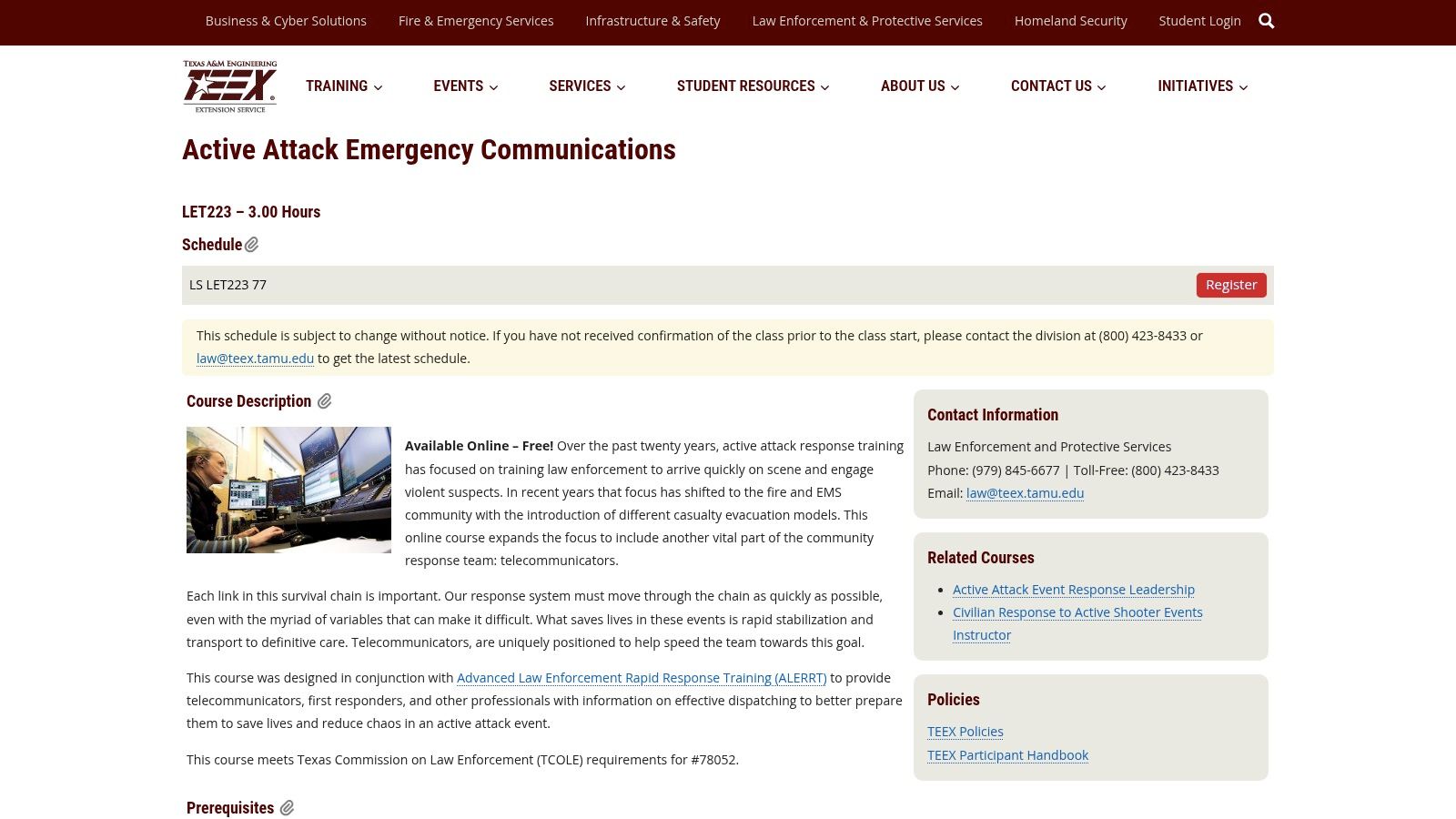
This resource stands out for its narrow and vital focus. Unlike general curricula, the LET223 course is tailored to the unique role the 911 dispatcher plays during an active attack. It covers critical topics such as identifying key pre-incident indicators, effective call-taking strategies during the event, and understanding the immediate information needs of responding law enforcement. The content is designed to be immediately applicable to an ECC's standard operating procedures for these events.
How to Maximize This Free Resource
The key benefit here is accessing specialized, expert-level training on a critical topic at zero cost. For a practical money-saving example, a specialized in-person active shooter course for dispatchers can cost an agency upwards of $300 per seat. Using this free TEEX course for all 20 dispatchers in a center saves the agency $6,000. An actionable insight for a training officer is to use this course as a prerequisite before conducting an in-house tabletop drill, ensuring all participants share the same foundational knowledge. Enrollment is simple through the TEEX online portal, requiring only a free account registration to access the course material and receive a certificate upon completion.
Recommended TEEX Course for Dispatchers:
- LET223: Active Attack Emergency Communications
Website: https://teex.org/class/let223/
6. FEMA Center for Domestic Preparedness (CDP) – Web-Based and VILT Courses
A sister organization to the Emergency Management Institute, FEMA’s Center for Domestic Preparedness (CDP) offers another tier of advanced, free training focused on all-hazards preparedness and response. While famous for its intensive in-person courses, its online catalog provides crucial awareness-level training on topics directly relevant to the dispatch floor, such as mass casualty incidents and hazardous materials events. This platform bridges the gap between foundational knowledge and advanced operational concepts.
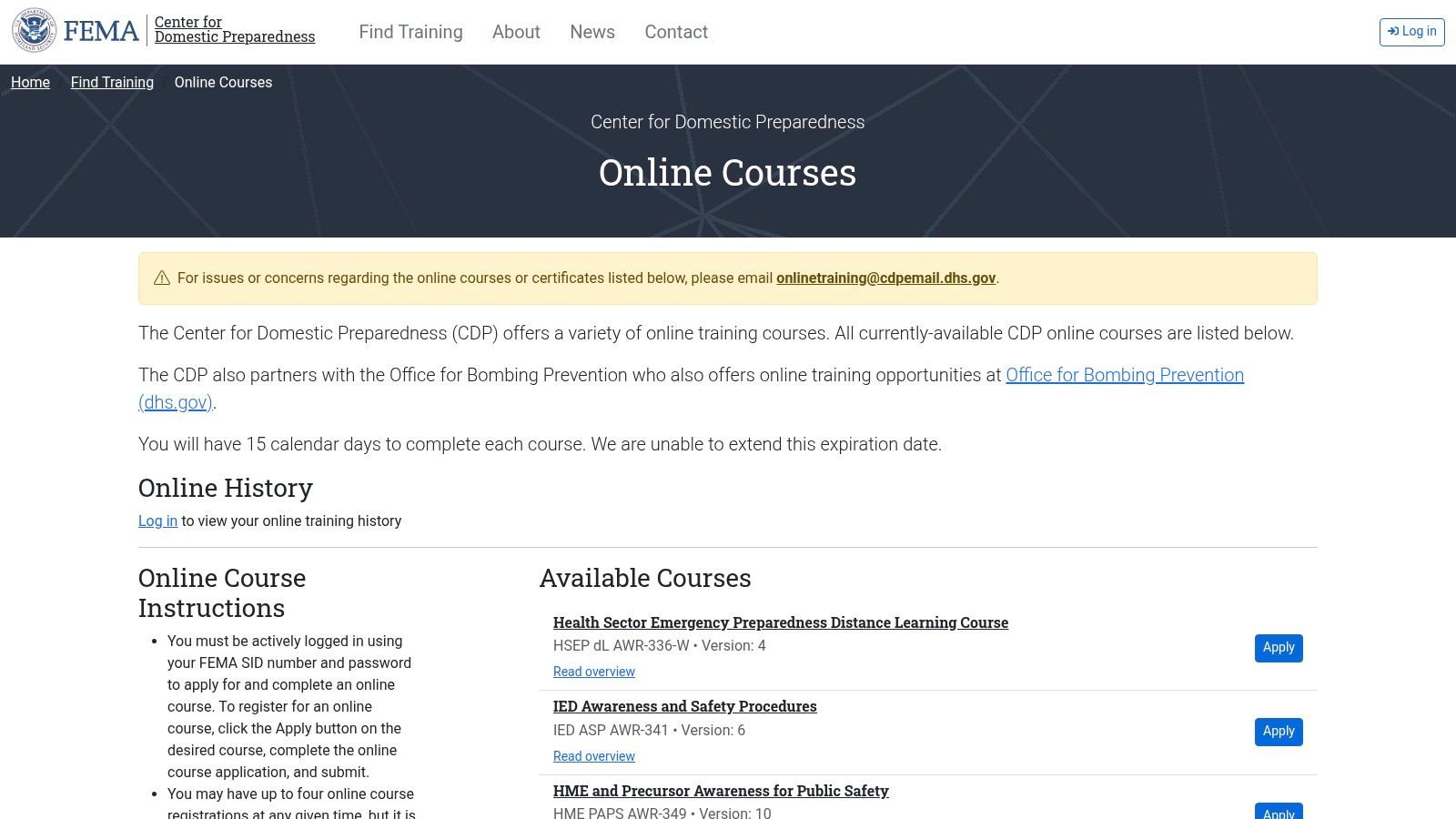
What makes the CDP platform unique is its blend of self-paced courses and Virtual Instructor-Led Training (VILT). This allows dispatchers to learn complex topics with the guidance of a subject-matter expert without any travel costs. These courses often carry nationally recognized certifications and may be eligible for Continuing Education Units (CEUs) or POST credit, depending on state requirements. For dispatchers, understanding the terminology and initial actions for a complex hazmat or mass casualty event can drastically improve responder safety and coordination from the very first call.
How to Maximize This Free Resource
The primary cost-saving benefit of CDP's online offerings is accessing expert-led, specialized training that would otherwise require significant travel and tuition expenses. For example, enrolling a dispatcher in the "Social Media Tools" VILT course saves the agency over $1,000 in travel and registration fees compared to an equivalent residential course. A practical insight is to have at least one dispatcher per shift complete the "Mass Casualty Incident Response" course to act as a subject matter expert during a large-scale event. To enroll, users must have a FEMA SID, and be aware that VILT courses have strict attendance policies and registration windows.
Recommended CDP Courses for Dispatchers:
- AWR-358 DL: Mass Casualty Incident Response for Hospitals at the Awareness Level
- PER-377: Social Media Tools and Techniques for Emergency Managers VILT
- AWR-328: All Hazards Preparedness for Animals in Disasters
- AWR-160-W: WMD/Terrorism Awareness for Emergency Responders
Website: https://cdp.dhs.gov/online_course
7. CISA Office for Bombing Prevention (OBP) – Virtual Instructor-Led Training (VILT)
The Cybersecurity & Infrastructure Security Agency (CISA) provides crucial, no-cost virtual training focused on counter-improvised explosive device (C-IED) awareness through its Office for Bombing Prevention. While highly specialized, these live, instructor-led sessions are invaluable for 911 dispatchers, who are often the first point of contact during bomb threats or reports of suspicious packages. The curriculum is designed to enhance situational awareness and improve initial threat assessment from the communications center.
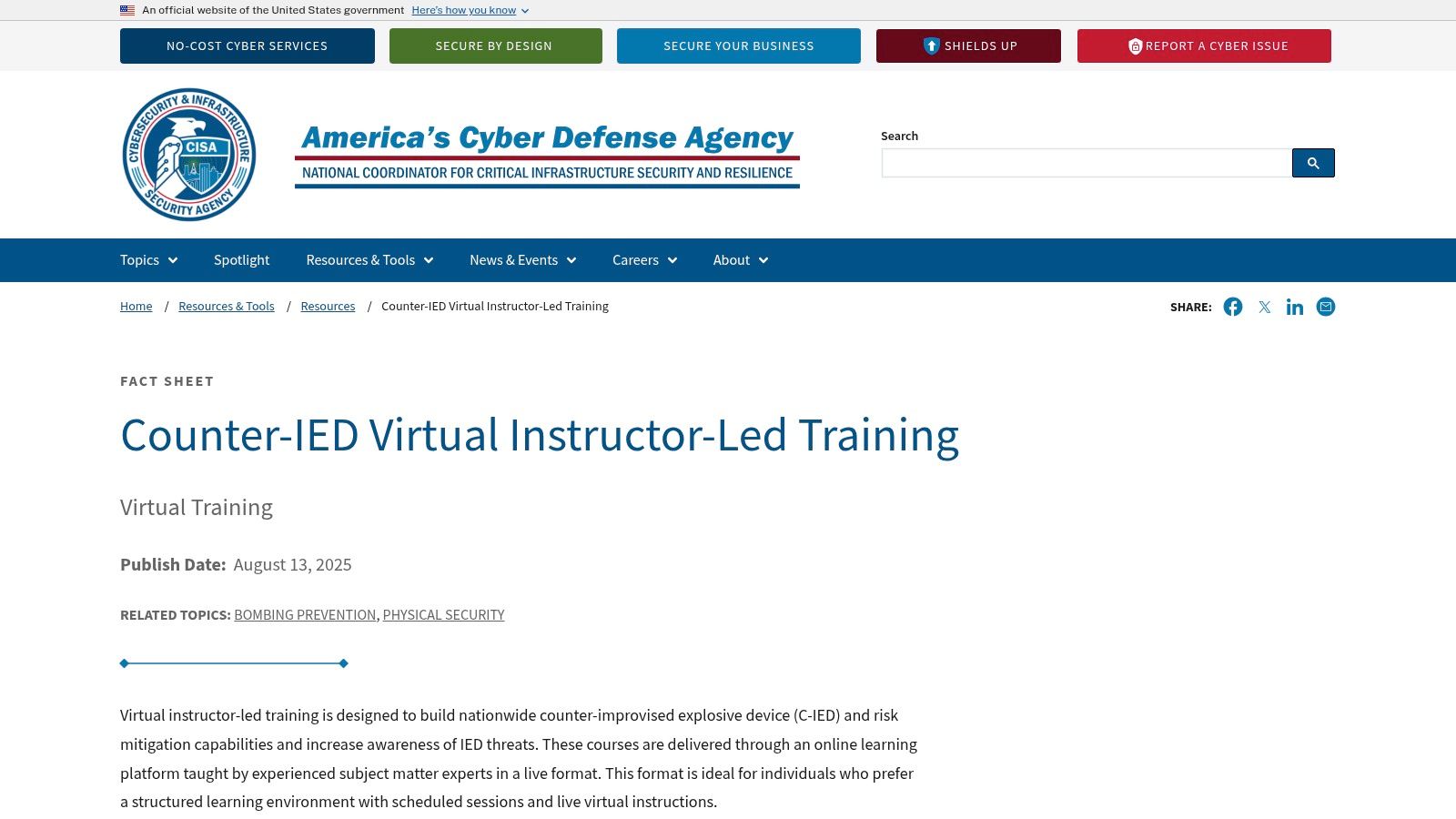
This platform is unique because it offers live, interactive training from federal experts, a format rarely available for free. Dispatchers learn to recognize key indicators of terrorist or criminal preparatory activities and understand the IED attack cycle. This knowledge directly translates to more effective call screening and information gathering, allowing telecommunicators to provide critical details to responding units. The availability of IACET Continuing Education Units (CEUs) and POST credit in some states adds significant, credentialed value.
How to Maximize This Free Resource
Agencies can leverage this resource to fulfill specialized or in-service training requirements without any budgetary impact. For a practical example, a private vendor might charge $2,000 to deliver a four-hour bomb threat management course to an agency; CISA's VILT provides equivalent, federally-backed training for free. An actionable insight is to enroll all telecommunicators in the "IED-Bomb Threat Management" course to standardize the agency’s initial response and questioning protocol, which can then be incorporated directly into policy. To participate, users simply browse the online training schedule and register for a session that fits their availability.
Recommended CISA VILT Courses for Dispatchers:
- AWR-333: IED-Bomb Threat Management
- AWR-337: IED Explosive Effects and Mitigation
- AWR-340: Bomb-Making Materials Awareness
- AWR-348: Suspicious Item VBIED Recognition and Response
Website: https://www.cisa.gov/resources-tools/resources/counter-ied-virtual-instructor-led-training
8. Responder Safety Learning Network (RSLN)
The Responder Safety Learning Network (RSLN) offers a specialized suite of free, on-demand modules focused entirely on roadway incident safety. While its curriculum is not dispatcher-specific, it provides critical knowledge for telecommunicators who are the first point of contact for traffic-related emergencies. Understanding the principles of Traffic Incident Management (TIM) enhances a dispatcher's ability to ask the right questions, relay crucial information, and appreciate the high-risk environment field responders are entering.
This platform is invaluable because it directly addresses one of the most common and dangerous call types: incidents on roadways. The training helps dispatchers recognize the importance of lane-blocking information, secondary crash potential, and the need for specific resources. Completing the National TIM Training Certificate path gives dispatchers a shared vocabulary and operational perspective with fire, EMS, and law enforcement partners, fostering better on-scene coordination from the moment the 911 call is answered.
How to Maximize This Free Resource
RSLN provides a powerful, no-cost way to enhance dispatcher awareness of field unit safety. ECCs can save significant funds by using this free online training for 911 dispatchers to supplement their existing programs. For example, instead of paying overtime for a 4-hour in-person class, dispatchers can complete these modules during downtime on shift, saving the agency hundreds in overtime costs per employee. A practical, actionable insight is to have all dispatchers complete the National TIM Training Certificate online, then use the certificate to petition the state highway patrol for a joint in-person exercise, fostering better inter-agency relationships. Registration is free and provides access to all modules and official completion certificates.
Recommended RSLN Courses for Dispatchers:
- National TIM Training Certificate: The core curriculum providing a multi-disciplinary perspective on safe roadway incident response.
- Blocking Procedures at Roadway Incidents: Teaches dispatchers the "why" behind apparatus placement on the highway.
- See and Be Seen: Emergency Lighting Awareness: Explains the dangers and best practices of emergency lighting, informing dispatcher situational awareness.
Website: https://learning.respondersafety.com/
9. FHWA National Traffic Incident Management (TIM) Responder Training
The Federal Highway Administration (FHWA) offers a nationally recognized curriculum focused on Traffic Incident Management (TIM). This training is crucial for telecommunicators who regularly handle roadway incidents, as it bridges the gap between the Emergency Communications Center (ECC) and field responders. The program’s core mission is to promote the safe and quick clearance of traffic incidents, and it provides dispatchers with the operational language and strategic understanding used by fire, EMS, and law enforcement on scene.
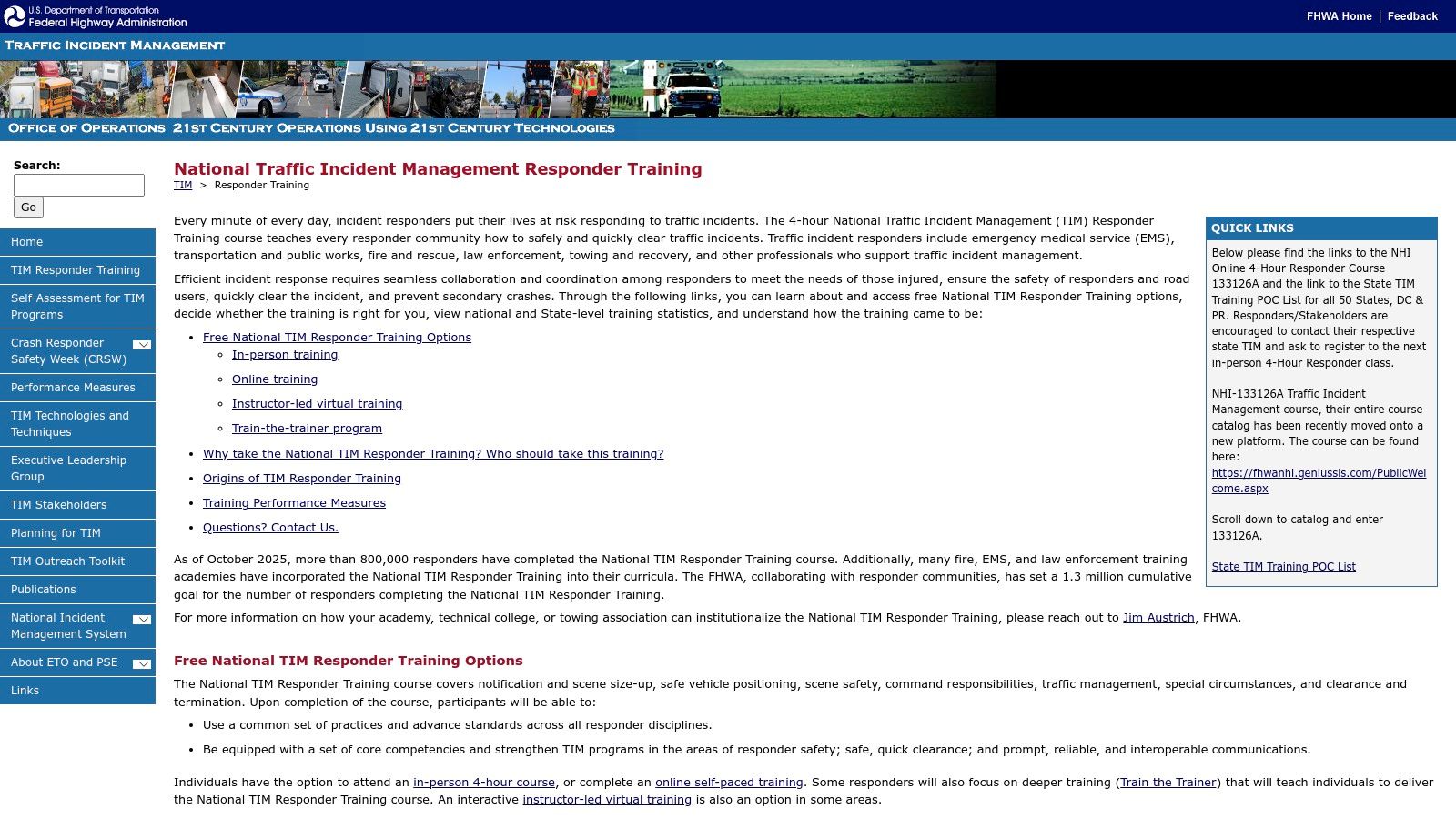
This platform stands out because it treats dispatchers as integral members of the incident response team. Understanding TIM principles allows telecommunicators to anticipate resource needs, provide more accurate pre-arrival instructions, and relay critical information about lane blockages or secondary hazards. Completing this training enhances dispatcher situational awareness and improves overall safety for both the public and the responders they are sending to the scene. It directly contributes to reducing secondary crashes, a major goal of the TIM program.
How to Maximize This Free Resource
Agencies can save money by using this free program to satisfy continuing education requirements for staff who handle traffic-related calls. The course certificate is a valuable, nationally recognized credential that demonstrates a commitment to interdisciplinary cooperation. A practical money-saving action is to use this free certification program in place of a paid, proprietary traffic incident course, saving an estimated $100-$200 per dispatcher. A concrete insight is to update your dispatch protocols for highway incidents immediately after your team completes the training, incorporating standardized TIM terminology for clearer communication with field units. To get started, users can choose between two free, self-paced web-based training options offered through the National Highway Institute (NHI) or the Responder Safety Learning Network (RSLN). Both paths lead to the same official certificate.
Key TIM Concepts for Dispatchers:
- Safe, Quick Clearance: Understanding the goals and strategies responders use on highways.
- Responder Safety: Learning about common on-scene hazards and safe vehicle positioning.
- Inter-Agency Communication: Using standardized terminology for clear, effective coordination.
- Incident Command: Recognizing how TIM fits within the larger Incident Command System (ICS) structure.
Website: https://ops.fhwa.dot.gov/tim/training/
10. Rural Domestic Preparedness Consortium (RDPC)
The Rural Domestic Preparedness Consortium (RDPC) is a DHS/FEMA-funded initiative offering free, certified training specifically tailored to the unique challenges faced by rural and tribal communities. While its scope is broad, many courses provide critical knowledge for dispatchers who often manage incidents in resource-scarce environments. The platform delivers both self-paced web-based training and virtual instructor-led courses covering topics from crisis management to agricultural emergencies.
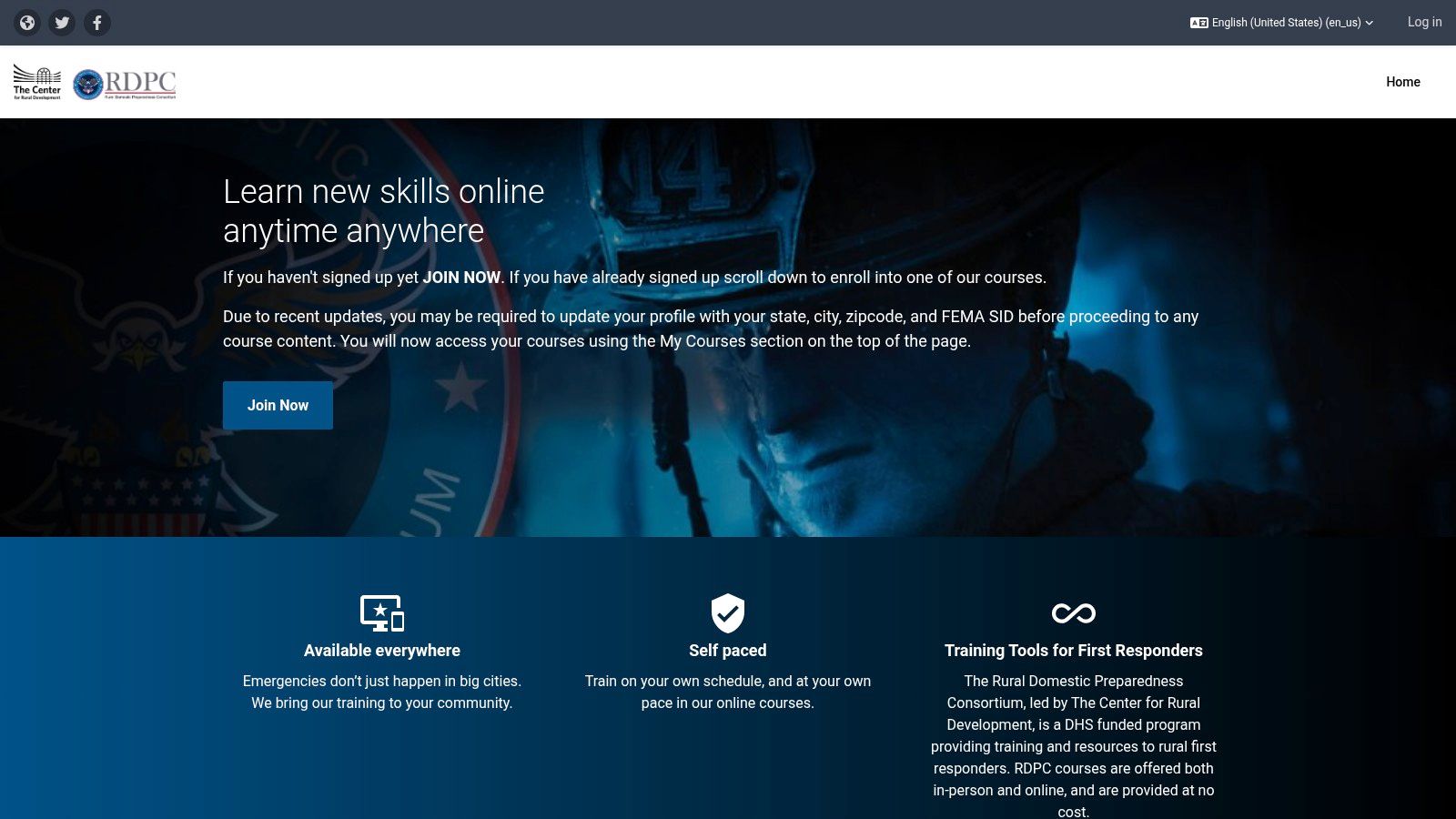
RDPC stands out by addressing scenarios often overlooked by urban-centric training. For an ECC serving a rural area, courses on managing large animal rescue incidents or responding to pipeline emergencies can be invaluable. This specialized focus ensures that telecommunicators are prepared for the specific hazards relevant to their jurisdiction, enhancing their ability to coordinate an effective response with limited on-scene assets. The training is nationally certified and recognized by many state POST programs.
How to Maximize This Free Resource
The primary benefit is cost elimination for specialized training. For a practical example, an agency in a farm community can use the "Large Animal Rescue" course to train its staff, saving thousands of dollars compared to flying in a specialized instructor. An actionable insight is to have dispatchers take a course relevant to a local hazard—like a grain elevator or major pipeline—and then present their key takeaways at the next team briefing to share the knowledge. Registering for a free account gives users access to a student portal to enroll in courses and track completions, providing easy documentation for continuing education credits. This allows managers to build a diverse training portfolio for their team at zero cost.
Recommended RDPC Courses for Dispatchers:
- AWR-209-W: Working with the Media: A Course for Rural First Responders
- AWR-352-W: Crisis Management for School-Based Incidents for Key Decision Makers
- MGT-403-W: Access and Functional Needs Preparedness Planning for Rural Communities
Website: https://online.ruraltraining.org/
11. U.S. Fire Administration – National Fire Academy (NFA) Online
As an affiliate of FEMA, the U.S. Fire Administration offers specialized free online courses through the National Fire Academy (NFA). While tailored for fire and EMS personnel, this resource is invaluable for 911 dispatchers, particularly those in consolidated centers or those who handle fire-specific dispatching. The platform provides a deeper understanding of fire ground operations, terminology, and safety protocols, which enhances a dispatcher's ability to support field units effectively.
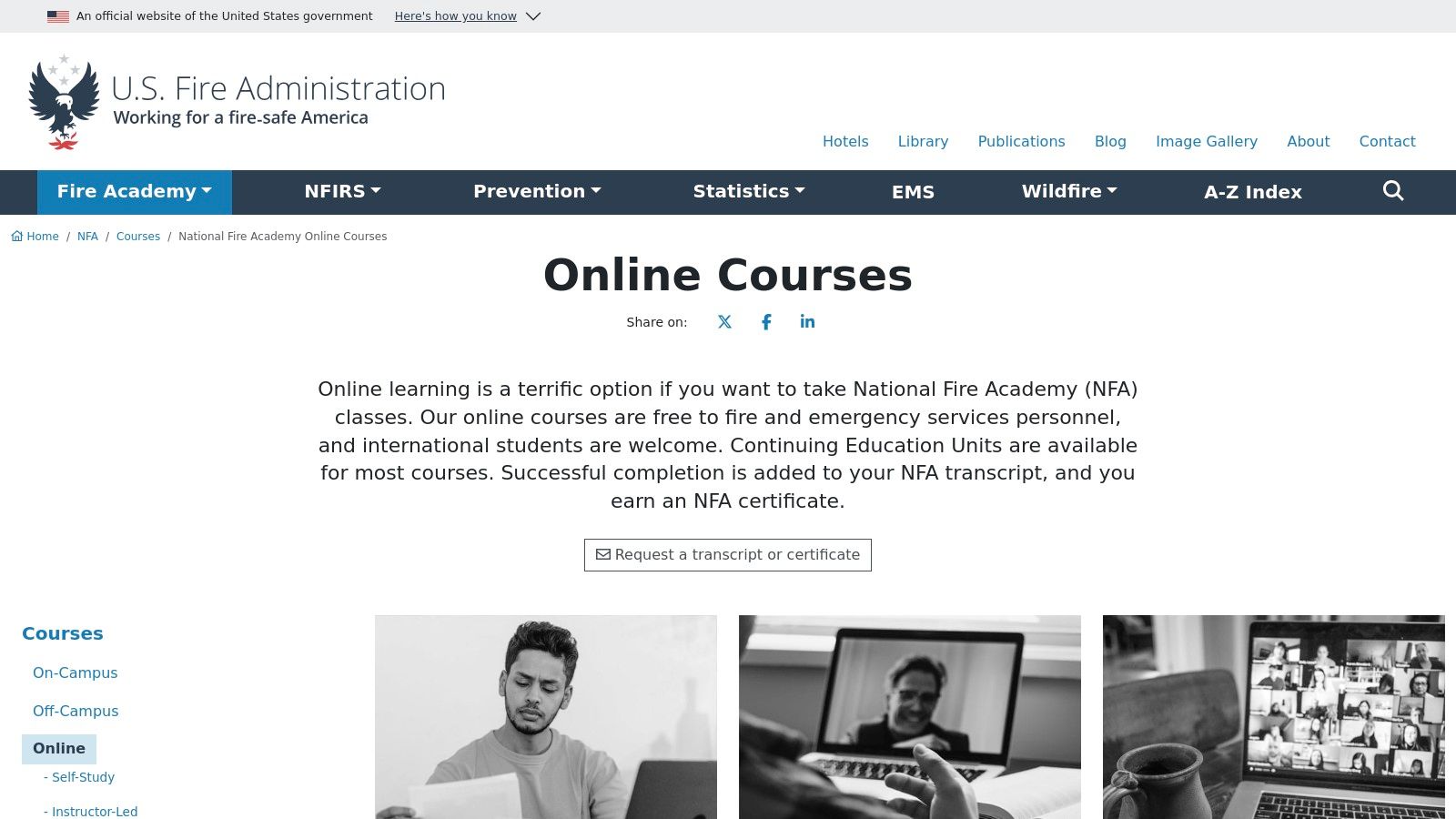
This platform stands out by offering dispatcher-relevant content from the fire service perspective, bridging a common knowledge gap in the ECC. Courses on incident safety, building construction, and hazardous materials provide critical context that can influence questioning protocols and resource allocation. A dispatcher who understands why a ladder truck is needed for a specific roof type is better equipped to serve both the caller and the responders. The certifications are nationally recognized and add significant credibility to a dispatcher's professional development portfolio.
How to Maximize This Free Resource
ECCs can save money by using the NFA's free online training for 911 dispatchers to fulfill continuing education requirements related to fire and EMS operations. For a practical example, instead of paying for a fire-service terminology class, a new dispatcher can take "Fire Protection Systems for Dispatchers" (Q0737) at no cost. An actionable insight is to have all dispatchers who handle fire calls complete the NFA's online ICS-100 and ICS-200 courses to ensure they use the same command terminology as their fire department counterparts. Like the FEMA IS program, a free FEMA Student Identification (SID) number is all that’s required to register, take courses, and track completions through an official transcript.
Recommended NFA Online Courses for Dispatchers:
- Q0137: Fire and Emergency Services Role in Terrorism Response
- Q0467: ICS-100, Introduction to the Incident Command System
- Q0468: ICS-200, Basic Incident Command System
- Q0737: Fire Protection Systems for Dispatchers
Website: https://www.usfa.fema.gov/nfa/courses/online/
12. DisasterReady.org
DisasterReady.org offers a massive e-learning library with over 1,000 free online courses focused on humanitarian aid and disaster response. While not created specifically for public safety telecommunicators, its curriculum provides essential soft skills training that directly enhances a dispatcher's ability to manage high-stress calls and maintain personal well-being. It is an excellent resource for building resilience and improving crisis communication techniques with distressed callers.
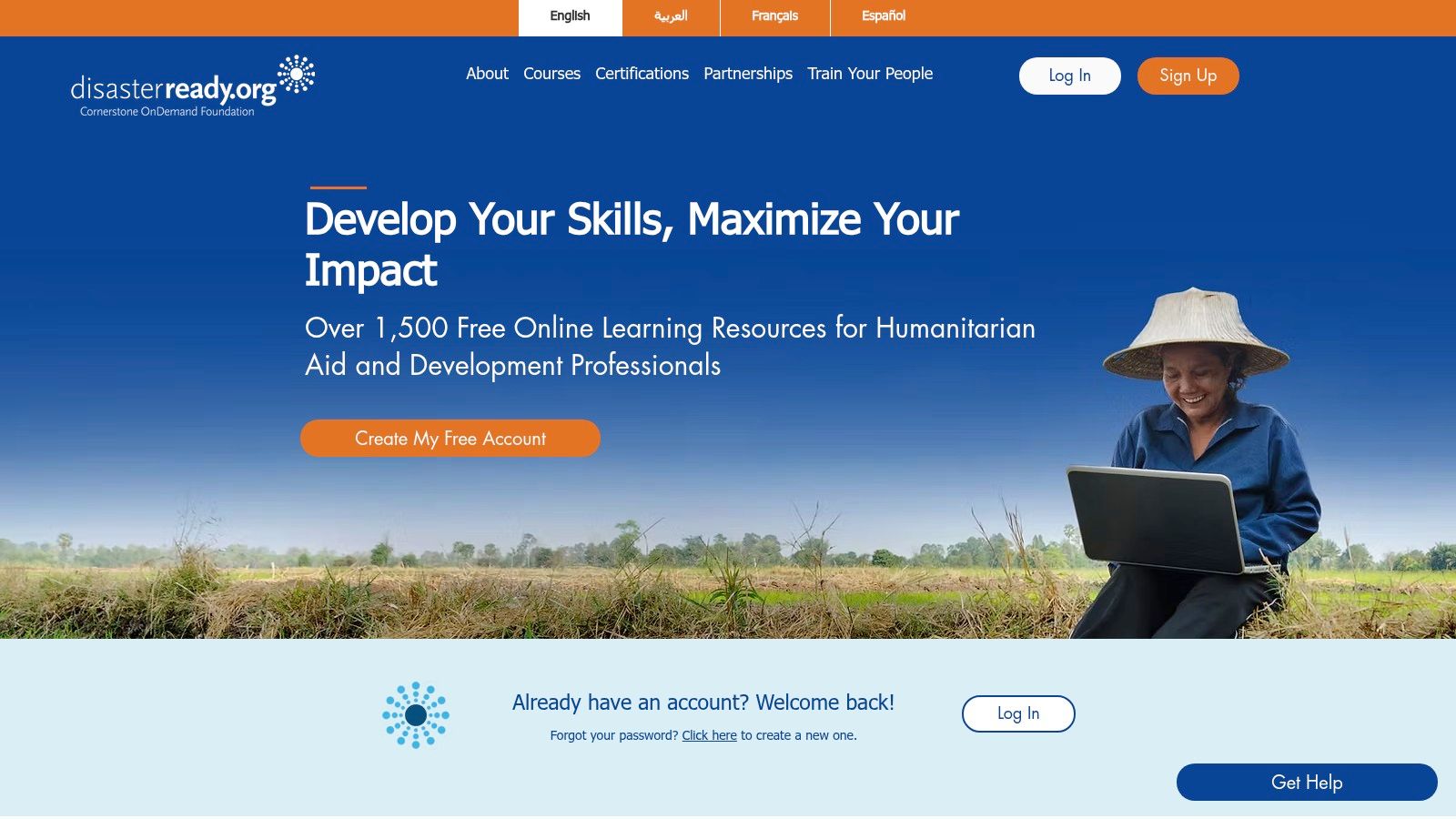
This platform stands out for its focus on mental health and psychological support, offering courses in Psychological First Aid (PFA) and stress management that are highly relevant to the ECC environment. The short, self-paced format (most courses are 2-7 hours) allows dispatchers to complete training during downtime or between shifts without a major time commitment. Certificates of completion are issued for each course, providing a simple way to document continuous professional development.
How to Maximize This Free Resource
Agencies can use DisasterReady.org as a cost-free supplement to their in-house wellness and resilience programs. A practical, money-saving approach is to create a learning path for new hires or tenured staff focused on mental health, effectively outsourcing this critical training at no cost. For example, requiring the "Psychological First Aid" course can give dispatchers a structured framework for assisting callers in emotional distress, potentially saving the agency thousands on hiring an external mental health consultant. An actionable insight is for a supervisor to take the "Stress Management" course and then use its techniques to lead a 15-minute de-briefing session after a particularly difficult shift. Users must create a free account to access the entire library and track their progress.
Recommended DisasterReady.org Courses for Dispatchers:
- Psychological First Aid: Learn to provide practical and emotional support to people impacted by crisis.
- Stress Management: Techniques for building personal resilience in a high-stress profession.
- Crisis Communication Essentials: Core principles for communicating effectively during emergencies.
- Personal Safety and Security: Foundational knowledge for maintaining awareness and safety.
Website: https://www.disasterready.org/
12 Free Online Training Resources for 911 Dispatchers — Comparison
| Resource | Core features | Quality (★) | Price / Value (💰) | Target audience (👥) | Unique selling points (✨ / 🏆) |
|---|---|---|---|---|---|
| FEMA EMI IS Program | 130+ self‑paced IS courses, NIMS/ICS curriculum, FEMA transcripts | ★★★★ | 💰 Free — high value for foundational creds | 👥 ECCs, telecommunicators, onboarding | ✨ Federal standard certificates & wide agency acceptance 🏆 |
| National 911 Program (911.gov) | On‑demand State of 911 webinars, vetted resource library, NG911 guidance | ★★★★ | 💰 Free — curated federal hub | 👥 ECC leaders, policy & tech staff | ✨ Central authoritative guidance on NG911, funding & standards 🏆 |
| APCO International – CDE | Dispatcher‑focused CDE article tests, webinars, Training Central tracking | ★★★★ | 💰 Free CDE options; member perks & paid certs | 👥 Telecommunicators seeking CDE/recert | ✨ Recognized CDE credits & training tracking 🏆 |
| NENA – Free Training Resources | Aggregated free training links across tech, ops, preparedness | ★★★ | 💰 Free — saves discovery time | 👥 Training coordinators, 9‑1‑1 staff | ✨ Curated aggregator tailored to the 9‑1‑1 community |
| TEEX – LET223 Active Attack | Free LET223 module on telecommunicator role in active attacks | ★★★★ | 💰 Free (single focused module) | 👥 Telecommunicators involved in active‑attack planning | ✨ Course tailored to call‑taker active‑attack response |
| FEMA CDP – Web & VILT | Free self‑paced and virtual instructor‑led FEMA courses, CEU/POST options | ★★★★ | 💰 Free with recognized credentials | 👥 ECC staff seeking CEUs/POST credit | ✨ FEMA‑backed CEUs and extensive live training offerings 🏆 |
| CISA OBP – VILT | Live VILT on suspicious items, counter‑IED awareness, IACET CEUs | ★★★★ | 💰 Free; CEU/POST eligible in some states | 👥 ECCs for threat assessment & triage | ✨ Federal counter‑IED focus with IACET/POST credits |
| Responder Safety Learning Network (RSLN) | On‑demand roadway/TIM modules, certificates, TIM track | ★★★★ | 💰 Free; supports National TIM certificate | 👥 ECCs handling traffic incidents | ✨ Professionally produced TIM pathway & transcripts |
| FHWA National TIM Training | Free TIM training options (NHI/RSLN), national curriculum & certification | ★★★★ | 💰 Free; nationally recognized | 👥 Telecommunicators supporting roadway events | ✨ Nationally accepted TIM curriculum & coordination focus |
| RDPC (Rural Domestic Preparedness Consortium) | Free WBT & virtual courses tailored to rural/tribal responders | ★★★ | 💰 Free; federally funded | 👥 Rural/tribal ECCs & first responders | ✨ Rural‑scenario focus and easy enrollment |
| U.S. Fire Administration – NFA Online | ICS, safety, fire/EMS courses with CEUs and certificates | ★★★★ | 💰 Free; authoritative fire/EMS content | 👥 Telecommunicators dispatching fire/EMS | ✨ Deep fire/EMS domain knowledge & CEUs 🏆 |
| DisasterReady.org | 1,000+ short e‑learning courses (PFA, crisis comms, resilience) | ★★★ | 💰 Free; shift‑friendly short courses | 👥 Call‑takers, shift staff, resilience training | ✨ Short practical courses for caller support & staff wellbeing |
Integrating Your Training for Maximum Impact and Zero Cost
The journey through the extensive landscape of free online training for 911 dispatchers reveals a powerful truth: budget constraints no longer need to be a barrier to professional excellence. From the foundational emergency management principles taught in FEMA's Independent Study courses to the highly specialized active attack response training offered by TEEX, the resources available are both comprehensive and of exceptional quality. This collection of tools, when strategically utilized, empowers individual dispatchers and entire Public Safety Answering Points (PSAPs) to build robust, modern, and highly effective skill sets without spending a single dollar on tuition.
The key takeaway is that effective training is not just about completing individual courses; it's about building a cohesive and continuous learning program. The most impactful approach involves curating a personalized curriculum from the diverse providers we've explored. By thoughtfully combining these free offerings, you can close specific knowledge gaps, meet continuing education requirements, and prepare your team for the complex, evolving challenges of emergency communications.
Building Your Zero-Cost Professional Development Plan
To truly capitalize on these resources, a structured approach is essential. Simply browsing courses ad-hoc will yield limited results. Instead, consider creating a deliberate learning path tailored to your agency's specific needs and an individual's career goals.
- For New Hires: A foundational track could begin with FEMA's IS-100, IS-200, and IS-700 courses to establish a firm grasp of the Incident Command System (ICS). This can be followed by NENA's basic topic-specific resources and the Responder Safety Learning Network's modules on roadway incident safety to build core competencies from day one.
- For Veteran Dispatchers: Focus on advanced or specialized topics to sharpen existing skills. This could involve CISA's VILT courses on bombing prevention, TEEX's active attack training, or the Rural Domestic Preparedness Consortium's courses for specific geographic challenges. Using APCO's CDE articles and NENA's webinars can satisfy annual continuing education mandates for free.
- For Supervisors and Training Officers: Your focus should be twofold. First, take leadership-oriented courses from providers like FEMA EMI to enhance management skills. Second, use this guide to build internal training programs for your team, assigning specific modules to address identified performance gaps or prepare for upcoming community events.
The Critical Step: Tracking and Implementation
Discovering and completing these valuable training modules is only half the battle. The real return on investment comes from integrating this knowledge into daily operations and having a verifiable system for tracking completions. Without a centralized record, certificates become scattered digital files, and it becomes nearly impossible for supervisors to get an accurate, real-time view of their team's qualifications and readiness.
This is where integrating your training efforts with a dispatch management platform becomes a force multiplier. Instead of relying on manual spreadsheets or disorganized email chains, a system that allows dispatchers to upload their certificates of completion for FEMA, TEEX, or CISA courses provides immediate visibility. Supervisors can then easily pull reports to verify CEU compliance, identify who is qualified for specialized call types (like a TIM or active shooter incident), and make more informed staffing decisions during a critical event. This simple act of integration transforms a collection of individual achievements into a strategic asset for the entire agency, ensuring that the time invested in learning translates directly to enhanced operational capability and improved public safety outcomes.
By being strategic in your selection of free online training for 911 dispatchers and diligent in tracking your progress, you can build a world-class professional development program on a budget of zero. This proactive approach not only elevates individual careers but strengthens the first, critical link in the chain of emergency response.
Ready to streamline your training documentation and operational management? Resgrid, LLC provides a comprehensive dispatch, management, and communication system where your team can easily upload and track training certificates, ensuring your agency's qualifications are always up-to-date and instantly accessible. Visit Resgrid, LLC to see how you can connect your free training achievements to your daily operations.