
A Guide to Modern Police Communication Technology
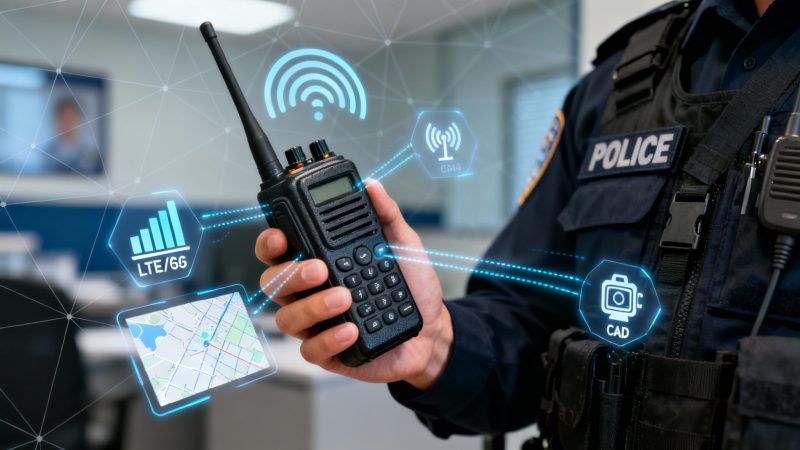
When you boil it down, police communication technology is the nervous system of modern law enforcement. It’s what allows for that real-time flow of critical information, the very thing that keeps officers safe and communities protected. These systems are the lifelines connecting dispatch, patrol officers, and other emergency services, turning them into a single, cohesive unit. We’ve come a long way from simple call boxes to the interconnected digital platforms of today.
The Lifeline of Modern Policing
In any emergency, communication is everything. That’s not hyperbole. For law enforcement, the ability to coordinate, share intel, and call for backup in a heartbeat isn't just a nice-to-have—it’s a matter of life and death. The whole web of modern police communication tools is designed for one thing: getting the right information to the right person, right now.
Think about a high-speed pursuit. The dispatcher is the director, feeding live updates on the suspect's location. Patrol officers are on the radio, coordinating to set up a perimeter. All the while, supervisors are monitoring the situation, deciding where to send resources. This whole dance depends on a seamless, rock-solid communication network. Take that away, and you have chaos, putting both officers and the public in serious danger.
From Call Boxes to Digital Ecosystems
The history of police communication is a story of incredible leaps forward. Early policing was almost entirely reactive. An officer on foot patrol had no way to call for help or report an incident without hoofing it back to the station or finding a public phone. That kind of isolation made the job incredibly dangerous and inefficient.
The game changed completely with the introduction of two-way radios in the 1930s. This was a pivotal moment that transformed how police departments operated. In 1933, the first police radio system was deployed, and it evolved at lightning speed from one-way broadcasts to fully operational two-way radios by 1934. For the first time, patrol officers could have a real conversation with dispatch. To really get a sense of how big a deal this was, it’s worth reading up on the role of technology in modern policing.
That single advancement marked the shift from reactive to proactive law enforcement. Departments could finally operate as a unified team instead of a collection of lone individuals.
Let's take a quick look at how we got from there to here. This table outlines some of the biggest steps forward in police communication.
Table: Key Milestones in Police Communication
A summary of the most significant technological advancements in law enforcement communication and their primary impact on policing operations.
| Era | Key Technology | Primary Impact on Policing |
|---|---|---|
| 1920s | Police Call Boxes | Provided the first fixed points for officers to report in and receive orders. |
| 1930s | Two-Way Radio | Enabled real-time voice communication between dispatch and patrol cars, revolutionizing response coordination. |
| 1960s | 911 Emergency Number | Standardized the way citizens request emergency assistance, centralizing incoming calls. |
| 1980s | Computer-Aided Dispatch (CAD) | Automated call-taking and dispatching, improving resource allocation and record-keeping. |
| 1990s | Mobile Data Terminals (MDTs) | Gave officers in-car access to databases for license plates and criminal records. |
| 2000s | Digital Radio Systems (P25) | Improved audio clarity, security, and interoperability between different agencies. |
| 2010s+ | LTE/5G and Body-Worn Cameras | Provided high-speed data, video streaming, and evidence collection capabilities in the field. |
Each of these milestones didn't just add a new gadget; it fundamentally changed how policing was done, making it faster, safer, and more data-driven.
Building on Foundational Milestones
Every technological leap has built on what came before it, creating the complex systems we rely on today. It's a lot like building a house: you can't put up the walls until you have a solid foundation.
- The Foundation: Two-way radios gave us the basic structure for real-time voice communication.
- The Walls: Computer-Aided Dispatch (CAD) systems came next, adding a layer of digital intelligence to organize calls and track resources.
- The Roof: Now, modern LTE/5G networks and integrated data platforms provide a protective layer of high-speed information, from live video streams to instant database lookups.
Today, a department's communication infrastructure is more than just a box of tools; it's an interconnected ecosystem. A failure in one part can cripple the entire operation. This reality highlights just how critical reliability, integration, and continuous improvement really are. It also shows why investing in solid police communication technology directly translates into safer communities and more effective law enforcement.
The Core Components of a Digital Precinct
To build a modern police department, you need more than just dedicated officers; you need a solid technological backbone. The core pieces of a digital precinct work together like the specialized departments of a hospital—each part does a critical job, but they all communicate seamlessly to save lives. Every piece of police communication technology plays a distinct, vital role in creating a complete operational picture.
At the very heart of this system is the Land Mobile Radio (LMR). Think of the LMR network as a private, secure superhighway built exclusively for first responders. Unlike the cell networks everyone else uses, which can get jammed up during a big event, LMR systems give officers a dedicated line for mission-critical voice commands. That way, a call for backup always gets through.
For instance, picture a city-wide power outage. Cellular towers get overwhelmed with everyone trying to make calls. While citizens are struggling to get a signal, officers on their LMR radios are communicating without a hitch, coordinating traffic control and emergency responses as if nothing happened. That level of reliability is non-negotiable in public safety.
The Brain of the Operation: Computer-Aided Dispatch
If LMR is the voice, then Computer-Aided Dispatch (CAD) is the brain. This is the software that runs the command hub, processing incoming 911 calls, pinpointing incident locations, and sending the nearest available units with pinpoint accuracy. It takes a chaotic flood of information and turns it into an orderly, actionable response plan.
A CAD system does more than just assign calls; it gives dispatchers critical context. It can pull up a caller's history, flag addresses with known risks, and even suggest the most efficient routes for responding officers. This digital intelligence empowers dispatchers to make smarter, faster decisions, which directly translates to better officer safety and quicker response times for the community.
The following visual shows how these technologies have built upon one another, evolving from simple call boxes to the integrated digital systems we see today.
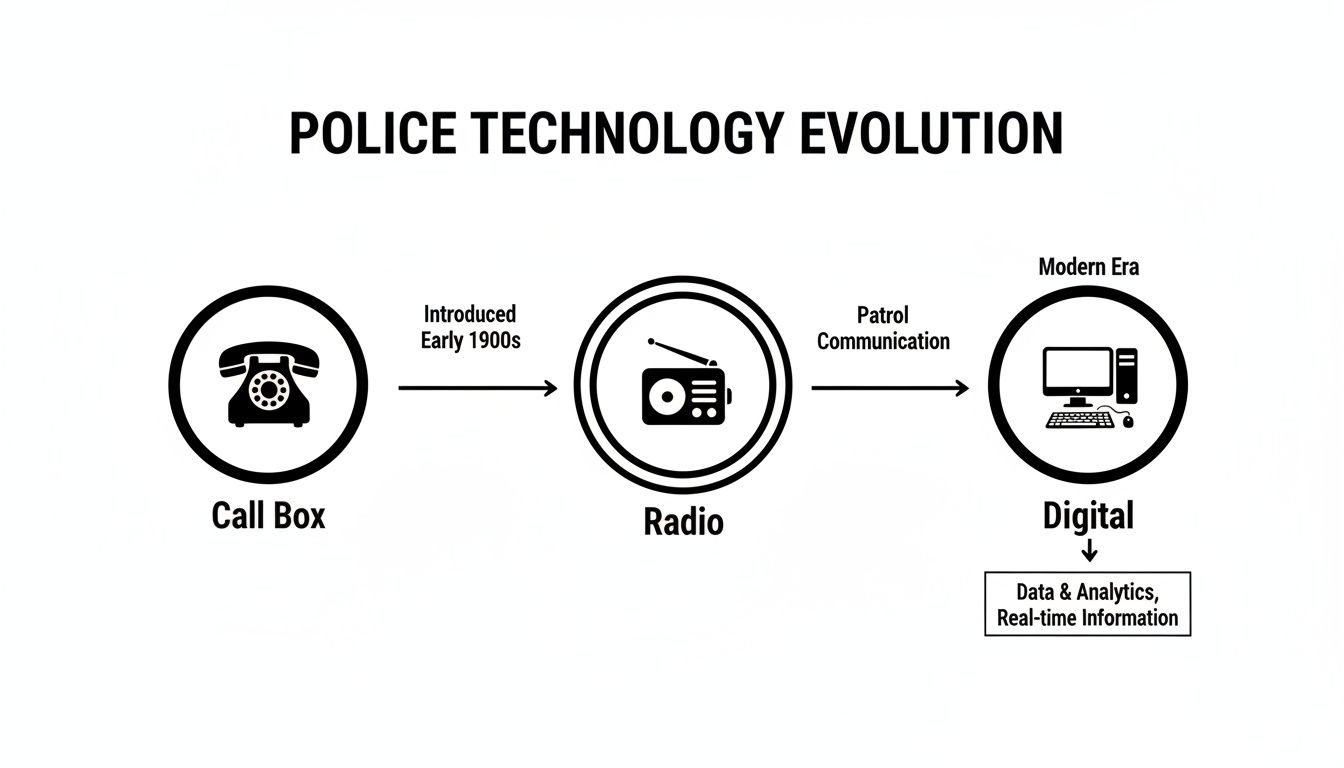
This evolution points to a clear trend: greater connectivity and data integration. We've moved from isolated voice calls to a rich, multi-layered information environment. To make it all work, a solid grasp of modern voice infrastructure, including understanding DID numbers, is essential for effective integration.
Digital Witnesses and Data Highways
Next up are the impartial digital witnesses: Body-Worn Cameras (BWC) and in-car video systems. These devices do a lot more than just record what happens. They boost transparency, help build community trust, and provide solid evidence for investigations and court cases. They capture an objective record that protects both the public and the officer from false claims.
But collecting all that high-definition video is only half the battle. You need a high-speed lane to move that massive amount of data. This is where LTE/5G networks, especially the dedicated FirstNet system, come into play.
These networks provide the bandwidth needed for:
- Live video streaming from an officer's BWC or a drone right back to the command center.
- Instant access to databases to run license plates or check for warrants from a patrol car's computer.
- Sharing large files like building blueprints or suspect photos among multiple units out in the field.
A key money-saving insight for agencies is to view these components as an integrated ecosystem, not as separate purchases. Procuring a BWC system without considering the data storage and transmission costs can lead to massive, unexpected budget overruns. A holistic plan that accounts for network capacity and evidence management from day one is crucial for long-term financial sustainability.
By combining the unwavering reliability of LMR, the intelligence of CAD, the transparency of video, and the speed of modern data networks, a digital precinct can operate with a level of situational awareness that was just a dream a decade ago.
Solving the Critical Challenge of Interoperability
Interoperability in police communication technology remains one of the most stubborn and dangerous hurdles in public safety. It’s a problem that shows up in nearly every major incident.
Picture a wildfire tearing across county lines. The local fire department, county sheriff's office, and state police all converge on the scene. But their radios can't talk to each other. It’s like they're all using different cell carriers in a dead zone with no roaming—they can see each other, but they can't communicate.
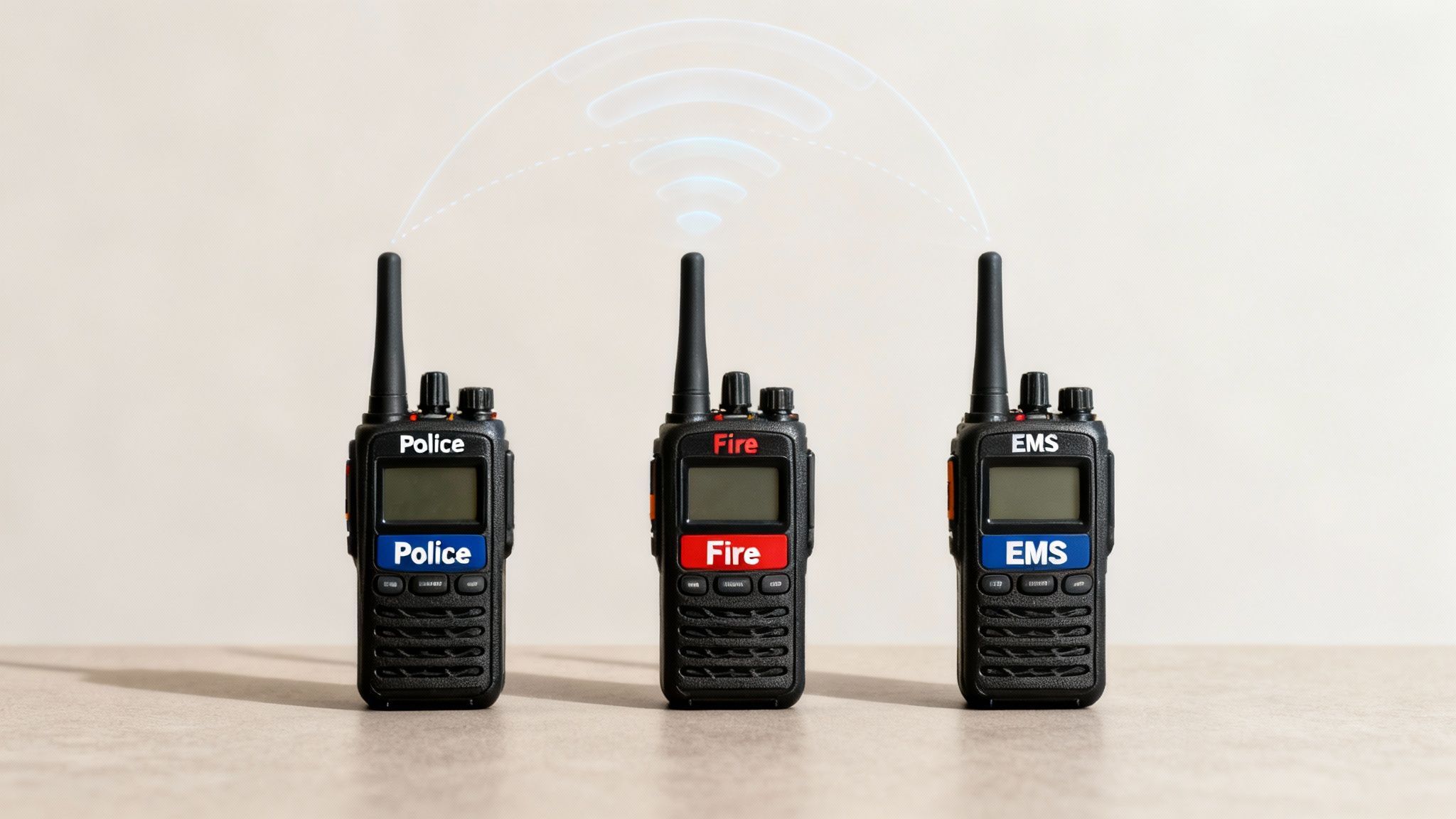
This failure to connect creates dangerous communication silos. When agencies are walled off from sharing real-time intelligence, the entire emergency response becomes fragmented. A police officer might spot a new threat, but without a shared channel, they have no way to instantly warn a firefighter just a few hundred feet away. This gap leads to duplicated efforts, delayed responses, and a much higher risk for both first responders and the public.
Why Is Seamless Communication So Difficult?
Getting everyone on the same page is a tangled mess of technical and administrative roadblocks. Agencies often operate on completely different radio frequency bands or use proprietary equipment from competing manufacturers. It’s not as simple as just flipping to the same channel; the underlying technology might be fundamentally incompatible.
On top of the technical headaches, you have a whole host of administrative problems:
- Varying Budgets: A well-funded state agency might have the latest digital radios, while a small, rural police department is still making do with older analog systems.
- Different Protocols: Agencies develop their own unique operating procedures and radio codes over years, creating a recipe for confusion during a joint operation.
- Governance and Control: The simple question of who manages—and pays for—a shared communication system can spiral into a complex political turf war between jurisdictions.
Overcoming these barriers requires a deliberate, coordinated strategy. You have to move beyond what one agency needs and focus on the health of the entire public safety ecosystem. Federal investments have played a huge part here. Following 9/11, the U.S. Department of Justice's COPS Office launched key programs, and in 2006, it awarded $66.5 million to 14 communities specifically to build integrated networks for police, fire, and EMS. These efforts have helped bridge critical gaps. To see the full timeline, you can explore more on the COPS Office history page.
Building Bridges Between Agencies
The solution is all about finding common ground, both in the tech and in the procedures. One of the most effective strategies has been the adoption of national standards, with Project 25 (P25) leading the way. P25 is a suite of standards that forces digital radio equipment from different manufacturers to play nice with each other.
Actionable Money-Saving Insight: Instead of a complete "rip and replace" of existing radio systems, agencies can use gateways and network bridges. Think of these devices as translators, connecting older analog systems to modern P25 digital networks. This phased approach lets departments achieve interoperability without a massive, immediate capital outlay, squeezing more life out of their current gear.
This standard allows a local police officer using one brand of radio to speak directly with a state trooper or federal agent using another. It finally breaks down the technical walls and creates a unified command channel.
Beyond standards, many regions are forming shared networks, where multiple jurisdictions pool their resources to build and maintain a single, powerful communication infrastructure that everyone can use. Solutions like these not only improve safety but also drive down long-term costs through shared maintenance and purchasing power. You can also learn more about how Resgrid offers open-source dispatch solutions that help agencies coordinate without getting locked into expensive proprietary software.
Smart Procurement Strategies That Save Agency Budgets
Getting the right communication technology for your officers often feels like a tug-of-war between operational must-haves and the harsh reality of the budget. The price tags on modern radio systems, CAD software, and body cameras can make your head spin, but smart procurement isn't about spending more—it's about working smarter. Agencies can absolutely get the tools they need without breaking the bank by taking a more forward-thinking approach.
One of the best ways to manage costs is to look past the traditional model of buying and maintaining on-premise hardware. Moving to cloud-based solutions, usually offered as Software-as-a-Service (SaaS), gets rid of the need for bulky, expensive servers and the IT staff to babysit them. This simple shift turns a huge, unpredictable capital expense into a stable, predictable operating expense.
Finding and Securing Grant Funding
You don't have to go it alone when funding technology upgrades. There's a whole ecosystem of federal, state, and private grants out there specifically to help public safety agencies get the gear they need. The trick is knowing where to look and how to tell a compelling story in your application.
- Federal Grants: Programs from the Department of Homeland Security (DHS) and the Department of Justice (DOJ) are the heavy hitters, often providing significant funding.
- State and Local Funding: Don't overlook your own backyard. Many states have grant programs designed for the specific needs of their local departments.
- Private Foundations: A number of private foundations are dedicated to improving public safety and offer grants for very specific technology projects.
A winning grant proposal needs a clear narrative. You have to draw a straight line from the technology you're asking for to concrete benefits like improved officer safety, better community outcomes, or streamlined operations. For agencies looking into regional funding, guides on securing grants for public safety can offer some great insights on how to prepare applications and spot opportunities.
The Power of Cooperative Purchasing
Cooperative purchasing is another incredibly powerful tool for making your budget go further. These agreements let multiple public agencies team up to buy equipment in bulk. This unlocks serious volume discounts that a single department could never hope to get on its own.
Think of it as a group discount at a wholesale club. By joining a purchasing cooperative, your agency suddenly has the buying power of a much larger organization. This not only drives down the cost of radios, cameras, and software but also massively simplifies the whole procurement headache by using pre-vetted vendors and contracts.
Actionable Insight: Don't fall into the trap of thinking you need one massive purchase to solve every communication gap. A good, honest needs assessment will point you to the specific pain points. You might find out your core radio system is solid, but you have no modern way to track personnel during a big event or send out mass notifications. This is where targeted solutions give you the best bang for your buck.
Augmenting Systems for Maximum ROI
Instead of a painful and expensive "rip and replace" of your entire infrastructure, think about augmenting what you already have with flexible, affordable platforms. This is where a service like Resgrid can deliver a ton of value right away, at a fraction of the cost of a full system overhaul.
For instance, you can layer a platform like Resgrid over your existing systems to add modern capabilities they just don't have:
- Personnel & Vehicle Tracking: Get real-time situational awareness on any device, no expensive proprietary hardware needed.
- Mass Messaging & Alerts: Push out critical departmental alerts without jamming up your primary radio channels.
- Secondary Dispatch: Manage non-emergency calls or special event logistics, freeing up your main CAD for the calls that matter most.
This approach lets you modernize piece by piece, tackling your most urgent needs first and seeing an immediate return on your investment. By looking at the different tiers available, you can find a plan that fits your agency's exact needs and budget. For a detailed breakdown, check out the Resgrid pricing structure to see just how affordable these enhancements can be.
How Resgrid Enhances Your Existing Communication Systems
Let's be honest: a full-scale rip-and-replace of your department's entire communication infrastructure is a massive undertaking. We're talking years of planning and a budget that makes even city managers sweat. But what if you could bring powerful, modern capabilities to your existing systems right now, without the crippling cost and complexity?
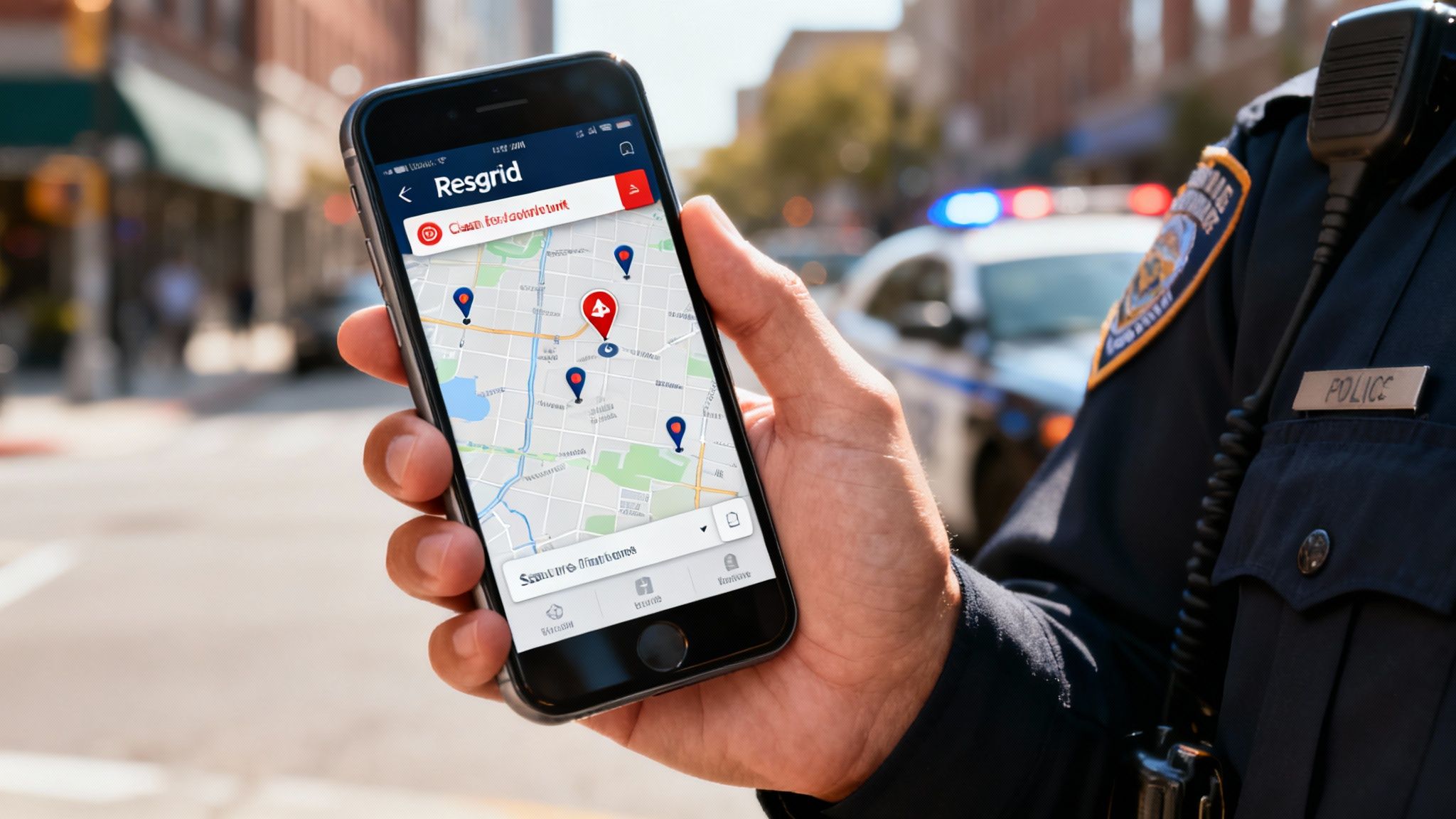
This is exactly where a platform like Resgrid comes in. Think of it as a force multiplier—it fills the critical gaps in traditional police communication tech. Instead of a complete overhaul, Resgrid layers on top of your current setup, adding functionality that streamlines operations, boosts situational awareness, and saves your agency's valuable time and money.
Augmenting Your Dispatch Capabilities
Your primary CAD system is the heart of your response operations, but its resources are both finite and expensive. During large-scale events—or even routine city-wide functions like parades or marathons—dispatch channels can quickly get bogged down with non-emergency traffic.
Resgrid provides a practical, cost-effective solution by acting as a secondary dispatch system. Imagine managing all the logistics and personnel for a special event by routing non-critical communications through the Resgrid app on officers' smartphones. This simple move frees up your main CAD and radio channels to focus exclusively on high-priority incidents, making sure that emergency calls get the immediate attention they demand.
A supervisor in the field can create and assign tasks right from their phone without ever tying up a primary dispatcher. It keeps the command structure clear and the radio channels open.
Secure Messaging Without Radio Clutter
Radio airtime is precious. It should be reserved for essential, real-time operational commands. The reality? Departmental announcements, shift updates, and even BOLO alerts can clog the airwaves, creating distractions that might delay a truly urgent call for help.
Resgrid’s integrated messaging system gives you a secure, dedicated channel for all that other traffic. You can instantly send targeted messages to specific units, groups, or the entire department.
- Real-World Example: Need to share a photo of a missing person or send out a mass notification during a weather emergency? Use Resgrid. Every officer gets the information instantly on their mobile device, keeping your primary radio channels clear for tactical comms. This one change can dramatically improve operational efficiency with zero additional infrastructure cost.
Real-Time Tracking for Enhanced Safety
Situational awareness is non-negotiable for officer safety, especially during dynamic situations like a foot pursuit or a large-scale search. While most patrol cars have GPS, tracking individual officers once they're away from their vehicle has always been a major challenge for older systems.
With Resgrid, you get live personnel and vehicle tracking accessible from any internet-connected device. A commander can pull up a real-time map showing every unit's location, making it easier to coordinate perimeters, direct backup, and ensure no officer is ever truly isolated. This is the kind of capability that used to be reserved for elite tactical teams, but now it's affordable and accessible for any department.
We've seen how traditional systems often have blind spots when it comes to modern operational needs. The table below shows a direct comparison of where those gaps are and how Resgrid fills them.
Resgrid Features vs Traditional System Gaps
| Common Challenge | Traditional System Limitation | How Resgrid Provides a Solution |
|---|---|---|
| Radio Channel Congestion | Voice-only radio channels get easily cluttered with non-urgent administrative traffic, delaying critical comms. | Provides secure, text-based messaging for announcements, BOLOs, and shift updates, keeping radio channels clear for tactical use. |
| Dispatch Overload | Primary CAD systems are strained during large events, managing both emergency and non-emergency logistics. | Functions as a secondary dispatch system for special events, allowing dispatchers to focus on high-priority calls. |
| Lack of Officer Tracking | Limited or no ability to track individual officers once they are out of their GPS-equipped vehicles. | Offers live personnel and vehicle tracking on a map, viewable from any device, for superior situational awareness and officer safety. |
| Information Silos | Data like reports, images, and documents are often stuck on specific devices or in-office systems, not easily shared in the field. | Enables instant sharing of data, including photos and documents, directly to officers' mobile devices. |
| Complex Reporting | Manual or cumbersome reporting processes that take officers off the street and consume valuable time. | Includes automated reporting and auditing tools that simplify documentation and record-keeping. |
These are just a few examples. By integrating a flexible tool like Resgrid, agencies can address long-standing challenges without needing to completely abandon their trusted legacy systems.
To see how these capabilities and others can solve common operational challenges for your agency, you can explore the full list of Resgrid features.
The Future of Law Enforcement Communication
The world of police communication is on the verge of another massive leap forward. We're moving beyond just voice and data into a future driven by predictive analytics and a web of interconnected devices. This isn't about ripping out and replacing the core systems that agencies rely on. Instead, it’s about augmenting them with intelligent tools that let departments be more proactive, data-driven, and responsive than ever before.
The Rise of Artificial Intelligence in Policing
For a long time, Artificial Intelligence (AI) felt like something out of a sci-fi movie, but it's quickly becoming a practical tool for law enforcement. Instead of just reacting to incidents after they happen, agencies are starting to use AI to get ahead of them. By digging into historical Computer-Aided Dispatch (CAD) data, AI algorithms can spot patterns and predict potential crime hotspots with some pretty impressive accuracy.
This allows for much smarter, more efficient resource allocation. Picture this: an AI system crunches years of break-in data and then suggests optimal patrol routes and schedules. It can pinpoint specific neighborhoods and times where incidents are most likely to occur, allowing you to concentrate officers where they'll have the biggest impact. It's a proactive approach that helps prevent crime before it even happens.
Actionable Money-Saving Insight: You don't need a Silicon Valley-sized budget to start exploring AI. Many modern CAD and records management systems now offer built-in analytics modules as an affordable add-on. By simply activating these features, small to mid-sized agencies can tap into predictive insights using their existing data, completely sidestepping the massive cost of building a custom AI platform from scratch.
Smart Cities and the Internet of Things
The Internet of Things (IoT) is turning our cities into massive networks of live sensors, and law enforcement is starting to tap into that firehose of data for unbelievable situational awareness. We're talking about much more than just traditional surveillance cameras. In policing, IoT covers a whole spectrum of connected devices.
Imagine a city-wide network of smart sensors that can:
- Instantly detect the sound of gunshots and triangulate the exact location for dispatch.
- Monitor traffic flow in real-time and automatically change traffic signals to clear a path for responding emergency vehicles.
- Stream live video from public cameras, drones, and traffic cams directly to a Real-Time Crime Center (RTCC).
This constant, live feed of information gives commanders a bird's-eye view of their entire jurisdiction, enabling responses that are faster and more coordinated. An officer heading to a call can get real-time updates on traffic, see potential hazards, and even view live video from the scene before they even arrive.
Next Generation 911 (NG911)
The old 911 system, originally built for landline phones, is getting a critical upgrade to handle the realities of our mobile-first world. Next Generation 9-1-1 (NG911) is an IP-based system that changes the game, allowing the public to communicate with dispatchers in ways we couldn't have imagined a decade ago—sending texts, photos, and even videos directly from their smartphones.
This kind of rich media gives dispatchers invaluable context. A witness can now text 911 silently during a home invasion or send a quick photo of a suspect’s getaway car. The shift is already delivering powerful results. By 2025, U.S. 911 centers will be handling about 240 million calls every year, with NG911 being rolled out in 40 states. These new systems integrate text, video, and GPS data, achieving an incredible 99% location precision, even from mobile devices.
Just look at Atlanta, where data-linked 911 upgrades helped slash high-priority response times by 5.8%. You can learn more about these impactful NG911 findings and see just how much of a difference this technology is making.
Common Questions, Answered
When you're trying to wrap your head around police communication technology, a few key questions always seem to pop up. Let's tackle some of the most common ones to give you a clearer picture of how these critical systems work.
What’s the Biggest Security Risk in Police Communication?
You might think it's someone listening in on a radio channel, but the biggest risk today is actually unauthorized access to sensitive operational data. While modern systems have rock-solid encryption to protect transmissions, the human and software elements are where things get tricky.
The real danger lies in cybersecurity threats like phishing attacks that trick an officer into giving up their login credentials, or a hacker exploiting a piece of unpatched software. Agencies are constantly fighting this battle with tools like multi-factor authentication, regular security audits, and—most importantly—continuous training to help personnel spot and sidestep these threats before they can do any damage.
How Can Smaller Departments Afford This Advanced Tech?
It's a classic problem: small town, big needs, tight budget. Smaller departments have to get creative to get the tech they need. One of the most effective strategies is jumping on federal and state grants from organizations like the Department of Homeland Security (DHS).
Here's a real-world example: A small municipal police department can piggyback on a statewide cooperative purchasing agreement. This lets them buy brand-new P25-compliant radios at the same heavily discounted price a large state agency gets. Just like that, they’ve got modern, interoperable radios for a fraction of what they would have paid alone.
Another smart move is using cloud-based services like Resgrid. Instead of a massive upfront cost for servers and hardware, they get advanced dispatch and tracking capabilities for a predictable monthly fee. It turns a huge capital expense into a manageable operational one.
What Is P25 and Why Does It Matter So Much?
P25, which stands for Project 25, is basically the common language for public safety digital radios. It's a set of standards that ensures one agency's radio can talk to another's, which is a concept we call interoperability.
Think about a major disaster where local police, state troopers, and even federal agents have to work together. If their radios can't communicate, the response is chaotic and ineffective. P25 makes sure everyone is on the same page, allowing for a seamless, coordinated effort when it counts the most. It's the technical backbone of teamwork in public safety.
At Resgrid, we built a platform that’s both flexible and affordable, designed to plug the gaps in your existing systems and give you better operational awareness. Learn how Resgrid can work for your agency.