
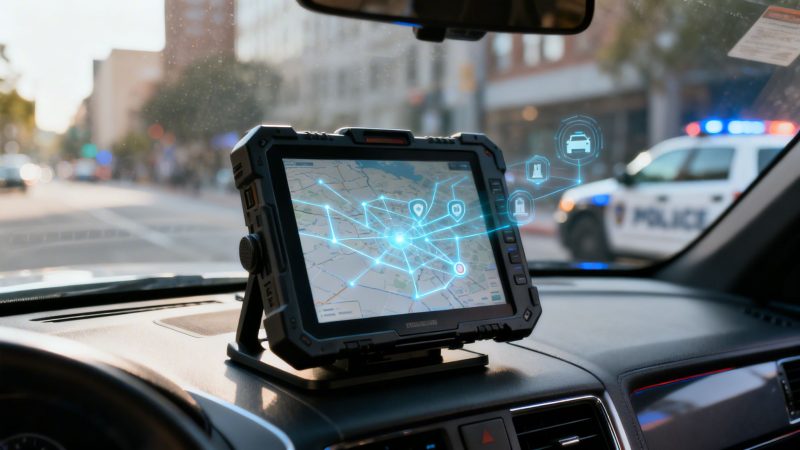
Your Guide to the Modern Police Mobile Data Terminal
Forget grainy dashboard cameras and crackly radio calls for a moment. The real revolution in patrol work over the past couple of decades has been the police mobile data terminal (MDT). This is the rugged, in-vehicle computer that acts as a digital lifeline for officers, connecting them directly to dispatch, databases, and critical incident information. It effectively transforms the patrol car into a mobile command center, sharpening an officer's awareness and dramatically speeding up response times.
The Digital Partner in Every Patrol Car

It’s best to think of an MDT less as a gadget and more as an officer's dedicated digital partner. It's the central nervous system of a modern patrol vehicle, fundamentally shifting policing from a reactive posture to a proactive, data-informed operation. This single device empowers officers to operate with a level of efficiency and safety that was once unimaginable.
The whole point of an MDT is to give officers direct, secure access to the information they need, right when they need it most. Instead of tying up the radio with license plate checks or waiting for a dispatcher to relay information—which can be congested or overheard—an MDT delivers critical data silently and instantly.
From Radio Chatter to On-Screen Data
At its core, a modern MDT handles a huge range of tasks that used to be clunky and slow. Before MDTs, every piece of information had to be relayed by voice over the radio. Today, officers can get what they need with a few taps on a screen.
This table gives you a clear picture of just how much things have changed:
Core Functions of a Modern Police MDT
| Core Function | Traditional Method Without MDT | Modern MDT-Enabled Method |
|---|---|---|
| Receiving a Call | Dispatcher verbally relays call details, address, and suspect info over the radio. | Call details appear silently on the MDT screen with GPS mapping to the location. |
| Checking a License Plate | Officer radios the plate number to dispatch and waits for them to run it and read back the results. | Officer types the plate number directly into the MDT and gets an instant, private response. |
| Verifying an ID | Officer radios a driver's license number and waits for dispatch to check for warrants or status. | Officer swipes the license or enters the number for an immediate on-screen verification. |
| Filing a Report | Officer takes handwritten notes in the field, then drives back to the station to type up the full report. | Officer starts, updates, and even files the report directly from the vehicle's MDT. |
| Communicating with Units | Voice-only communication over a shared radio channel. | Secure, text-based messaging between units and with dispatch, freeing up the radio for emergencies. |
This shift to digital isn't just about convenience; it’s about effectiveness. By keeping officers in the field and giving them instant access to information, MDTs create a more visible and responsive police presence.
The impact of this technology is undeniable. The global market for police MDTs has shot up to USD 1.85 billion, and today, roughly 90% of U.S. police officers depend on them. It’s not just a trend; it's a standard. Studies show that agencies using MDTs can slash call response times by 20-30% in high-volume areas, which is a massive operational win. You can dig into more of these market trends in this comprehensive industry report.
Actionable Insight: Here’s a major money-saving tip we’ve seen work time and again: decouple your hardware and software. Instead of getting locked into an expensive, proprietary all-in-one system, agencies can buy commercial-off-the-shelf rugged tablets and pair them with a flexible, affordable software platform like Resgrid. This approach completely avoids vendor lock-in and can slash the total cost of ownership by over 40%. For example, a small department might save over $50,000 in upfront costs on a 10-vehicle fleet.
Deconstructing the MDT: Hardware and Software
A police mobile data terminal is a powerful tool, but it's really a combination of two distinct elements working together: the tough-as-nails hardware built for the field and the specialized software that brings it to life. Understanding how these two sides of the coin operate is key to making smart procurement decisions that improve officer efficiency without breaking the bank.
Think of it like a high-performance smartphone. You have the physical device itself (the hardware) and the operating system and apps that run on it (the software). An MDT is no different, just built to a much higher, more demanding standard of durability and security.
Built for the Patrol Environment
The hardware of a police MDT isn't your standard laptop or tablet bolted to a dashboard. It’s a purpose-built system designed to survive the extreme conditions of daily patrol work. These devices are subjected to constant vibrations, potential spills, and abrupt temperature changes that would destroy consumer electronics in a heartbeat.
A standard consumer-grade tablet might last a few weeks in a patrol car before failing. Rugged MDT hardware, however, is engineered for this specific environment, making it a long-term investment rather than a recurring expense. For example, a coffee spill that would fry a regular laptop is a non-issue for a spill-resistant MDT keyboard, preventing costly replacement and vehicle downtime.
To ensure reliability, agencies look for specific durability certifications. The most common is MIL-STD-810G, a U.S. military standard that tests a device's ability to withstand drops, shocks, and extreme temperatures. Frankly, this isn't a negotiable feature; it's the baseline for any serious police MDT.
Beyond the main unit, a few essential peripherals complete the setup:
- Secure Vehicle Mounts: These are not simple phone holders. They are locking docks that provide power and data connections while ensuring the device won't become a projectile during a collision.
- Backlit Keyboards: Officers often work in low-light conditions. A spill-resistant, backlit keyboard allows for accurate report writing and data entry at any time of day.
- High-Visibility Screens: Screens have to be sunlight-readable, often boasting brightness ratings of over 1,000 nits so officers can see critical information clearly, even in direct glare.
The Software Brains of the Operation
If the rugged tablet is the body, the software is the brain. This is where the real power of a police mobile data terminal comes into play. The software stack typically has two main layers. The first is a hardened operating system, usually a secure version of Windows or Android, which provides the basic foundation.
On top of that runs the specialized police application software. This is what connects an officer to dispatch, databases, and other units. The interface provides access to crucial law enforcement systems like Computer-Aided Dispatch (CAD) for receiving calls and Records Management Systems (RMS) for pulling up criminal histories or past incident reports.
This is where agencies have a huge opportunity to save money and increase flexibility. Traditionally, departments were forced to buy expensive, proprietary software bundled with specific hardware. This created vendor lock-in, making upgrades difficult and costly.
Today, a more modern and cost-effective approach is available. By choosing adaptable, platform-agnostic software, departments can gain powerful functionality without the high price tag. Flexible systems can run on a wide variety of off-the-shelf rugged hardware, freeing agencies from restrictive contracts. You can learn more about how Resgrid's features provide this level of adaptability by visiting our platform overview. This strategy allows departments to build a powerful, customized MDT solution at a fraction of the traditional cost.
How MDTs Plug Into the Rest of Your Systems
A police mobile data terminal isn't some island of technology sitting on its own; it's the central nervous system for a much bigger public safety network. Its real magic comes from how it seamlessly connects with other critical systems. This integration is what turns a patrol car into a mobile command post and seriously multiplies an officer's effectiveness out in the field.
When everything is connected, the MDT stops being just a simple communication screen and becomes an intelligent partner. You have to have a solid network infrastructure to make it all work, of course, because that's what allows the data to flow securely between the vehicle and central command. The whole setup is designed to get the right information to the right officer at exactly the right time.
The CAD Connection
The most crucial link for any MDT is its tie-in with the Computer-Aided Dispatch (CAD) system. Think of the CAD as the department's brain—it processes all the 911 calls and manages where every unit is and what they're doing. The MDT is its direct line to the officers on the street.
When a call for service comes in, a dispatcher creates an event in the CAD. Instead of trying to relay a ton of complex details over a busy radio channel, the CAD system pushes all of it directly to the assigned officer's MDT. Instantly, they see:
- Call Details: The address, the nature of the call, and who the complainant is.
- GPS Mapping: The location is automatically plotted on a map with turn-by-turn directions.
- Premise History: Any known hazards or previous calls at that same address are flagged right away.
This "silent dispatch" frees up precious radio airtime for genuine emergencies, slashes the chances of miscommunication, and gives the officer a full picture of the situation before they even roll up on the scene.
The diagram below gives you a good look at how the MDT sits at the center of this ecosystem, connecting all the different pieces that make it work.

As you can see, the MDT is only as good as the sum of its parts—the hardware, the OS, and the specialized software all have to work together perfectly.
Accessing Records and Seeing the Bigger Picture
Beyond just getting calls from dispatch, the MDT acts as a secure window into a huge amount of other databases. This is what provides that vital context during an interaction, and it makes things dramatically safer for both the officer and the public.
The connection to a Records Management System (RMS) is an absolute game-changer. During a simple traffic stop, an officer can run a license plate or a driver's license and instantly pull up information that used to take minutes of back-and-forth radio chatter. This includes things like:
- Criminal history and any prior arrests.
- Active warrants or protection orders.
- Known associates and other vehicle information.
Actionable Insight: Hooking your MDT into an RMS doesn't just make the streets safer—it saves a ton of money on administrative overhead. Agencies report that officers can complete and file their reports up to 50% faster right from their vehicles. That frees up thousands of hours every year that used to be wasted on paperwork back at the station. For a 50-officer department, this could equate to reclaiming over 10,000 patrol hours annually.
Another key piece is integrating with Automatic Vehicle Location (AVL) systems. This lets an officer see the real-time location of every other unit on their MDT map. This kind of situational awareness is absolutely critical during a pursuit or when you're calling for backup because you know exactly who is closest and can get to you the fastest.
Think about a patrol car weaving through traffic. Suddenly, its MDT pings an alert about a stolen vehicle's license plate just up ahead. That's thanks to integrated ALPR tech, which is now used by about 40% of U.S. police agencies. This single integration has revolutionized how vehicle-based crime is handled, boosting stolen vehicle recovery rates by over 25% in the agencies that use it.
As the entire public safety software market explodes—it's expected to hit USD 36.47 billion by 2030—MDTs are at the heart of it all. Modern cloud storage is making cybersecurity simpler and enabling subscription models that keep software constantly updated. For first responders, this means having teams equipped with powerful, real-time tools—the kind of capability we focus on providing at Resgrid.
MDT Deployment and Security Best Practices

Getting a police mobile data terminal into every patrol car isn't just a purchase order; it's a full-blown strategic project. A successful rollout requires some serious planning that goes way beyond the device itself. You have to think through everything from the physical installation to the ironclad security needed to protect sensitive law enforcement data.
The initial planning phase really sets the stage for success. It all starts with a thorough needs assessment to figure out exactly how your officers will use the device day-to-day. You also have to deal with the physical realities of the patrol car, keeping ergonomics and officer safety front and center. That MDT mount, for example, absolutely cannot obstruct airbag deployment zones or become a projectile in a collision.
Securing the Digital Lifeline
Once you’ve got the physical setup figured out, the focus has to pivot to data security. A police MDT is a direct gateway to Criminal Justice Information Services (CJIS) data and other highly sensitive records. Protecting that connection is non-negotiable.
When you're deploying MDTs, building in robust security for remote access is paramount to shield that data from threats. As detailed in resources about how to secure remote access, you need a multi-layered approach. It's not about one single solution; it's about creating a hardened defense with several key measures working together:
- Two-Factor Authentication (2FA): A password alone just doesn't cut it anymore. 2FA requires a second proof of identity, like a code from a mobile app or a physical token, making sure only authorized officers can get in.
- Full-Disk Encryption (FDE): This scrambles all the data on the MDT's hard drive. If a device is ever stolen, the information on it is completely unreadable and useless to whoever has it.
- Secure VPN Connectivity: A Virtual Private Network creates a secure, encrypted tunnel between the MDT and your agency's network. This shields all data transmissions from anyone trying to intercept them.
Actionable Insight: For agencies on a tight budget, implementing these security layers can seem daunting. A practical money-saving tip is to choose MDT software that has these security features built-in. This avoids the need to purchase and manage separate security applications, reducing both upfront costs and IT overhead. A platform with integrated VPN and 2FA can save hundreds of dollars per unit per year in licensing fees.
Creating a Human Firewall
Let's be real: technology is only part of the solution. The most advanced security measures can be completely undermined by human error. That’s why comprehensive user training and crystal-clear policies are just as critical as the tech itself.
Officers need to understand not just how to use their MDT, but why specific security protocols are in place.
Your training should be practical and scenario-based. For example, walk officers through the exact process of what to do if their MDT is lost or stolen. This is where a remote-wipe capability becomes essential. Your IT admins must have the ability to remotely erase all data from a compromised device, turning it into a brick.
Clear, written policies should cover acceptable use, data handling procedures, and the consequences for not following the rules. These policies create a consistent standard across the department and empower every officer to be an active part of your agency’s security posture.
For a deeper dive into how modern systems handle these safeguards, you can explore the security measures we’ve built into Resgrid to protect first responder data here: https://resgrid.com/security. Ultimately, a successful MDT program is a combination of durable hardware, secure software, and well-trained people.
Smart Procurement and Calculating Your ROI
Figuring out how to pay for a police mobile data terminal isn't just about looking at the price tag on the box. For anyone making the final call, the real conversation is about the Return on Investment (ROI). It's about seeing how these devices pay for themselves over and over through smarter operations, safer officers, and huge time savings.
A smart buying strategy starts by putting a number on those benefits. Every minute an officer saves by filing a report in their vehicle instead of driving back to the station is a real, tangible cost saving. That translates directly to more time on patrol, which means more visibility in the community without having to hire more people.
It's the same story with radio traffic. When dispatch is silent and officers can pull up records directly, the main channels stay clear for actual emergencies. That can be the difference-maker in a critical incident. Add in the fuel saved from more efficient routing on every single call, and you can see how the financial wins start to stack up fast.
Decouple Hardware and Software to Save Big
If there's one single strategy that can have the biggest impact on your budget, it's this: decouple your hardware and software purchases. Too many agencies get locked into expensive, all-in-one proprietary packages. These deals almost always come with vendor lock-in, pricey long-term maintenance contracts, and very little room to adapt.
A proprietary, all-in-one system might cost an agency $8,000 per vehicle right out of the gate, and that’s before the mandatory annual support fees. By decoupling, that same agency could find a commercial rugged tablet for $3,000 and pair it with a flexible software subscription. Over five years, that simple change could cut the total cost of ownership in half.
This flexible approach puts you back in control. You can buy commercial, off-the-shelf rugged hardware that meets your durability standards and then pair it with an adaptable software solution that fits like a glove. It’s the best way to avoid getting stuck with one vendor and gives your department the freedom to build a system that actually fits your budget and operational needs.
Comparing MDT Procurement Models
To really see the difference, let’s break down what each approach looks like. The flexible model is all about adaptability and long-term value, not just a single, bundled purchase.
Cost Comparison of MDT Solutions
Here's a quick look at the costs and savings you can expect when choosing between a traditional all-in-one MDT package and a more flexible hardware-software approach.
| Cost Factor | Traditional Proprietary System | Flexible Approach Using Resgrid |
|---|---|---|
| Initial Hardware | High cost, bundled with software. | Lower cost, purchased separately. |
| Software Licensing | Often a large, perpetual license fee. | Affordable, predictable subscription model. |
| Vendor Lock-In | High; tied to one vendor for all needs. | None; hardware and software can be upgraded independently. |
| Maintenance & Support | Expensive annual contracts are common. | Included in the subscription with no hidden fees. |
| Customization | Limited and costly to implement. | Highly adaptable to meet specific agency needs. |
This table makes it clear how unbundling creates a much more sustainable financial model for your agency. Instead of a massive one-time capital expense, software becomes a predictable operational cost.
By taking this strategy, departments can get the absolute maximum value for every dollar spent. To see how this works in the real world, you can explore the straightforward subscription options with Resgrid pricing. This method ensures your police mobile data terminal investment serves your agency effectively for years to come—without any unexpected financial headaches.
The police mobile data terminal is far from a static piece of technology. Think of it as an evolving platform right at the forefront of public safety. The device you see in patrol cars today is really just a preview of what's coming down the pipe, as big leaps in connectivity and data processing are about to give officers a whole new level of awareness and foresight.
The backbone of all this change is the rollout of next-generation networks. High-speed, low-latency connections like 5G and dedicated first responder networks like FirstNet are set to completely change the game. We're talking about the kind of massive bandwidth needed for things like real-time video streaming directly to the MDT.
Just imagine an officer arriving at a chaotic scene. Instead of just getting text updates, they could see a live drone feed from overhead, pinpointing a suspect's location, all right there on their MDT screen. This single capability transforms the terminal from a simple data lookup tool into a live, interactive command and control interface.
The Rise of AI and Predictive Analysis
It's not just about getting data faster; it's about getting smarter data. The real future of the police MDT lies in integrating artificial intelligence (AI) and machine learning to bring predictive analysis right into the patrol car. So instead of just reacting to calls as they come in, the MDT will start helping officers anticipate them.
An AI-powered system, for instance, could analyze historical crime data, current weather patterns, and local event schedules to highlight potential crime hotspots on an officer's map in real-time.
You might see an MDT flag a specific neighborhood block where burglaries have spiked on rainy Friday nights. That prompts an officer to increase patrols in that area proactively. It's a fundamental shift from a reactive posture to one of prevention, which is a core goal of modern policing.
This isn't science fiction. Some departments are already testing systems where an MDT can identify subtle patterns in traffic stop data across the city. The terminal becomes an analytical partner, helping to uncover larger criminal networks that would otherwise go completely unnoticed.
Augmented Reality and True Interoperability
Other emerging trends will only amplify an officer's effectiveness. Augmented reality (AR) has the potential to overlay critical information—like building floor plans or the location of utility lines—onto an officer's map during a high-stakes incident. An officer could see the layout of a building on their screen before ever stepping foot inside.
At the same time, a huge push for greater interoperability will finally start breaking down those frustrating communication barriers. During a multi-agency response to a large-scale emergency, MDTs will be able to seamlessly share data and location information between police, fire, and EMS units, no matter what software each agency uses. This creates a unified command picture, ensuring every single first responder is on the same page.
These future capabilities might sound complex, but they all hinge on an open and adaptable software foundation. This is where forward-thinking platforms provide a crucial, money-saving advantage. Systems like Resgrid, built on a flexible, open framework, are designed from the ground up to integrate with these emerging technologies. By choosing an adaptable solution now, an agency ensures its investment in MDTs remains valuable for years to come, ready to incorporate the next wave of public safety tools without needing a complete and costly overhaul.
A Few Common Questions About Police MDTs
When your department starts looking into mobile data terminals, a lot of practical questions come up. After working with countless agencies, we've found a few that pop up every single time. Here are some straight-up answers based on our experience in the field.
How Much Does a Police Mobile Data Terminal Cost?
You can expect to spend anywhere from $3,500 to over $8,000 per vehicle. The final price tag really boils down to how tough you need the hardware to be and how complex the software is. Things like the device's durability rating (look for MIL-STD-810G), screen size, and whether you're buying a locked-in, all-in-one system or building a more flexible setup all play a part.
Here's a pro tip: The single best way to get more for your money is to separate your hardware and software decisions. By picking a solid commercial rugged tablet and pairing it with a powerful but affordable software platform like Resgrid, you can slash your total costs by 40% or more. Plus, you avoid getting locked into one vendor for everything.
What Are the Biggest Implementation Challenges?
Honestly, the biggest hurdles are almost always budget constraints, getting officers trained up, and making sure your existing IT setup can handle the new gear. Finding the money is usually the first roadblock. After that, it's about getting veteran officers who are used to doing things a certain way comfortable with the new tech. That takes a good, hands-on training plan, not just a manual.
To get past these, we've seen agencies have success with a few things:
- Look for Grants: There are often federal or state technology grants out there specifically for law enforcement. Go hunt them down.
- Phase the Rollout: Don't try to do every car at once. Start with a smaller pilot group to work out the kinks and build some internal champions for the project.
- Invest in Good Training: A solid training program built around real-world patrol scenarios makes all the difference in getting officers to actually use and trust the new system.
Can We Just Use Regular Tablets Instead of Rugged MDTs?
We get this question all the time. Using a consumer tablet like an iPad looks like a great way to save a buck upfront, but it almost always costs you more down the road. It's a classic case of being penny-wise and pound-foolish. These devices simply aren't built for the constant vibration, extreme temperatures, and hard knocks of daily patrol work.
Consumer tablets fail often, create some serious security risks, and don't have screens that are bright enough to be read in direct sunlight. Purpose-built rugged MDTs are a much smarter investment. They deliver the reliability and critical features needed to keep your officers safe, connected, and effective when it matters most.
Ready to put together a powerful and affordable police mobile data terminal solution for your department? Resgrid gives you a flexible, feature-packed platform that works with the hardware that's right for your budget and needs. Learn more about what Resgrid can do for you.