
A Business Owner’s Guide to Private Fire Services
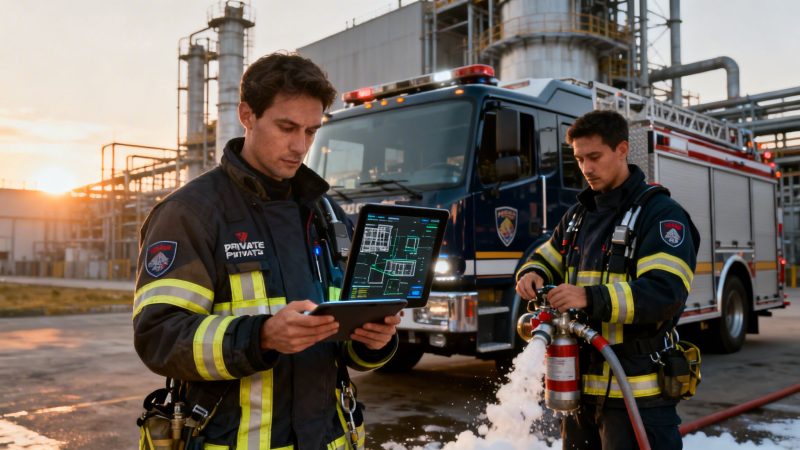
Ever wondered what it would be like to have a fire team that knows every corner and every risk of your business? That’s the simple idea behind private fire services. We're talking about dedicated, contract-based teams whose sole job is to protect specific, high-value assets and back up public fire departments.
The Rise of Private Fire Services
When the alarm goes off, every second is critical. For a lot of businesses, especially those with unique hazards or in remote locations, waiting for the public fire department can feel like an eternity. That gap, that vulnerability, is exactly where private fire services come in. They aren't a replacement for public services, but an added, specialized layer of protection.
I like to use a medical analogy. Your local hospital's ER is fantastic for handling all sorts of community health problems. But for complex open-heart surgery, you need a specialist. Public fire departments are the community's ER, ready for anything. A private fire service is your facility's specialist surgeon, trained for its specific, high-stakes risks.
More and more businesses are seeing the logic in this. They’re realizing it’s smarter—and cheaper—to get ahead of a disaster instead of just reacting to one.
Why Businesses Are Making the Switch
So what's driving this shift? A few things. Public fire departments are staffed by incredible, skilled professionals, but they're often dealing with tight budgets and have to spread their resources across an entire city or county. This can mean longer response times or not having the exact specialized gear for an unusual industrial emergency.
For a business with high-value assets, that gap can represent a multi-million dollar problem. A few extra minutes of response time at a chemical plant, a massive data center, or an industrial manufacturing site can be the difference between a minor incident and a full-blown catastrophe.
The real value of a private fire service boils down to one thing: risk reduction. By investing in a team that’s already on-site and knows the layout, a business can stop a small fire from becoming a major disaster. It’s not just about protecting buildings; it's about business continuity and keeping employees safe.
This isn't just a niche trend. The global private firefighting and rescue service market is growing, and it's expected to expand in a big way from 2026 through 2032. Companies across North America, Europe, and Asia are looking to fill these protection gaps. You can read up on the market projections to see just how fast this sector is moving.
Actionable Insight Saving You Money
One of the clearest financial wins is in proactive risk management. Take a remote luxury resort in a wildfire-prone area, for example. They might bring in a private wildland crew.
- Before fire season: The crew is there clearing brush, creating defensible space around buildings, and hardening structures against embers. This isn't just an expense; it's a direct investment in prevention.
- During a wildfire threat: That same crew is on-site, ready to jump on spot fires the second they start, keeping them from ever reaching the main buildings.
The financial return is massive. The cost of that proactive work is a tiny fraction of what it would cost to rebuild a multi-million dollar resort, not to mention the lost revenue and skyrocketing insurance premiums after a total loss. Suddenly, a safety line item becomes a strategic investment with a very clear ROI. Another practical example is negotiating lower insurance premiums. By demonstrating to your insurer that you have a professional, on-site fire service actively reducing risk, you can often secure a significant discount on your policy, saving money year after year.
Public vs. Private Fire Protection: What's the Real Difference?
When you hear “private fire department,” it’s easy to wonder why you’d ever need one. After all, aren’t public fire services already on the job? It’s a fair question, but it’s not really an either/or situation. The choice becomes much clearer once you realize they have fundamentally different missions, funding, and a completely different rulebook.
Think of it this way: your local public fire department is the versatile, all-purpose safety net for the entire community. They’re funded by our taxes and have to be ready for anything—house fires, car wrecks, medical emergencies, you name it. They are the jacks-of-all-trades we all rely on.
Private fire services, on the other hand, operate on a direct contract. Their focus is laser-sharp, dedicated only to the client who hired them. This isn't about replacing public services; it's about adding a specialized layer of protection for specific, high-stakes risks.
This diagram breaks down the basic idea. Private fire protection is all about specialized capabilities, built around a direct-contract model.

The key takeaway here is that private teams are purpose-built to handle unique dangers that are just outside the normal scope of a community-wide fire department.
To make this even clearer, let's look at a side-by-side comparison of how these two models operate in the real world.
Public Fire Departments vs. Private Fire Services
| Attribute | Public Fire Services | Private Fire Services |
|---|---|---|
| Funding | Taxpayer-funded | Client-funded via contracts |
| Jurisdiction | Serves an entire municipality or district | Serves a specific property or client |
| Primary Mission | Broad community protection | Targeted asset protection & business continuity |
| Specialization | Generalist; equipped for diverse incidents | Specialist; equipped for site-specific risks |
| Response Model | Reactive (responds to 911 calls) | Proactive (prevention, mitigation, and response) |
This table really highlights the core operational split. Public departments are our essential first line of community defense, while private services act as a dedicated, expert guard for a specific high-value asset.
It All Comes Down to Specialization
The biggest difference you'll see on the ground is specialization. A public department has to be proficient at everything. Their crews are incredibly skilled, but their training and gear are generalized to serve a wide range of public needs.
A private fire service is a master of one. They’re brought in to live and breathe the unique risks of a single environment.
- Here’s a real-world example: A public engine company rolls up to a fire at a chemical plant. Their go-to tool is water, which works great for most structure fires. But at this plant, the on-site private fire brigade knows that water will react violently with the specific chemicals involved. They’re already deploying a specialized foam suppression truck because they've trained for this exact scenario dozens of times.
That kind of niche, critical knowledge comes from having a singular focus. They can train and equip for risks a municipal department might see only once in a career, a practice governed by standards like OSHA's Fire Brigades rule (which, by the way, is currently under review for a major update).
Shifting Your Perspective on Cost
I get it. At first, hiring a private service looks like an extra expense, especially when public services feel "free" (since they're paid through taxes). But this is where you have to shift your thinking from cost to a strategic investment in keeping your business running.
The real value of a private fire service isn't measured by the fires they put out, but by the disasters they prevent entirely. That upfront contract cost is an insurance policy against catastrophic downtime, liability, and total asset loss.
Just think about the financial bleeding from a prolonged shutdown. For a big manufacturing plant, every single hour of downtime can mean tens of thousands of dollars in lost production. If a private team can knock down an incident in minutes—versus the longer response and setup time of an outside crew—they’ve already paid for themselves for years to come.
A Practical Tip for Immediate Savings
One of the most effective ways to leverage a private fire service—and save money—is by using them for proactive risk mitigation, something public departments simply aren't funded or staffed to do at a deep level.
Actionable Insight: Hire a private fire service for pre-incident planning and prevention, not just emergency response.
- For an industrial facility: Have the private team conduct regular, intensive fire safety audits that go way beyond a basic compliance check. Their specialized eyes can spot subtle risks a general inspector would easily miss. For example, they might identify a recurring overheating issue in a specific machine and recommend a simple ventilation fix. Preventing just one small equipment fire can save you hundreds of thousands in repairs and lost revenue.
- For a property in a wildfire-prone area: A private wildland crew can create and execute a detailed vegetation management plan. We know that nearly nine out of 10 wildfires are human-caused, and simple preventive work makes all the difference. By clearing flammable brush and building defensible space, they dramatically lower the odds of your property going up in smoke—an asset worth millions, protected for the cost of a seasonal contract.
Finding the Right Private Service for Your Needs
Deciding to bring in private fire protection is a big move, but it's not a one-size-fits-all solution. The reality is that not all private fire services are the same, and picking the wrong one is like hiring a world-class ski instructor to teach you how to surf—you’ve got an expert, but their skills are completely mismatched for your situation.
To get it right, you have to honestly assess your own risk profile and find a provider whose specialty aligns with it. These services break down into a few distinct categories, each built to tackle a specific kind of threat. Once you understand the differences, you can make a choice that actually delivers a real return on your safety investment.

Industrial Fire Brigades
If you’re running a chemical plant, refinery, or a massive manufacturing site, you’re dealing with fire risks that are incredibly technical and unique. A local fire department, as good as they are, probably isn’t equipped to handle a volatile chemical spill or a fire deep inside a complex piece of machinery. That’s where an industrial fire brigade becomes a necessity.
These are teams, either on-site or dedicated off-site, who know your facility inside and out. They understand the layout, the specific hazards, and the emergency protocols because they train for your worst-case scenarios with specialized gear like industrial foam trucks or HazMat equipment.
Actionable Insight to Save Money:
The biggest financial win with an on-site brigade is their speed and specialized knowledge. Picture a small fire starting in a critical piece of machinery. Your on-site team, already there and familiar with the equipment, gets it out in five minutes. A public crew might take 15 minutes or more just to arrive and figure out what they’re looking at. That ten-minute head start is the difference between a minor repair and a destroyed multi-million dollar production line. The savings from avoiding a single major incident can dwarf the brigade's annual contract cost.
Wildland Firefighting Contractors
For any property near the Wildland-Urban Interface (WUI)—think resorts, vineyards, ranches, or private communities—wildfire is the monster in the closet. Wildland firefighting contractors are the specialists you call to manage that exact threat.
These crews do more than just show up when there’s smoke on the horizon; their real value is in the work they do before the fire. They are experts in creating defensible space, managing vegetation, and hardening buildings against the ember attacks that destroy the vast majority of homes in a wildfire.
Actionable Insight to Save Money:
Think about a luxury resort tucked into a fire-prone canyon. They hire a private wildland crew for seasonal protection. Before the fire season even starts, that crew spends weeks clearing out flammable brush and creating a "fuel break" around the property line. When a massive wildfire eventually tears through the region, it hits that managed zone and loses its intensity, giving firefighters the chance to successfully defend the resort. The property avoids a total loss valued at over $50 million for the price of a seasonal contract. That’s a massive and clear-cut return on investment.
Event Fire Safety and Standby Services
Big events like music festivals, sporting events, or corporate conferences essentially create temporary cities, and with them, temporary high-risk environments. With thousands of people packed into a concentrated area, a small incident can spiral out of control in seconds. Event fire safety teams are brought in to provide on-site medical and fire standby services to keep things from going sideways.
These teams are pros at crowd dynamics, EMS response, and rapid fire suppression in temporary setups. They work directly with organizers to build emergency action plans and ensure every detail complies with local fire codes—a non-negotiable step for getting your event permits approved.
Managing your own personnel, whether for events or other operations, requires the right tools to keep everyone coordinated. If you're exploring your options, you might find our https://resgrid.com/compare helpful.
A Smart Approach to Contracting Fire Services
Bringing on a private fire service is a huge commitment, both for your operations and your bottom line. It’s a process that demands a smart, methodical approach—one that goes way beyond just picking a name off a list.
Get this partnership right, and you've made a real investment in your business's ability to withstand a crisis. Get it wrong, and you're left with wasted money and, even worse, a false sense of security.
The first step has nothing to do with a sales call. It starts with a detailed, brutally honest risk assessment of your own operations. You have to know your specific weak points. Are you a chemical plant dealing with unique hazardous materials? A remote resort facing down seasonal wildfire threats? The answers to those questions will tell you exactly what kind of capabilities you need to shop for.
Vetting Your Potential Partners
Once you have a clear picture of your needs, the real vetting begins. This is where you separate the true professionals from the rest. You need to look for providers with a proven track record and verifiable credentials that actually line up with your specific risks.
- Certifications: Are their people properly certified by recognized bodies like the National Fire Protection Association (NFPA)? If you run an industrial site, are their crews trained to NFPA 1081 for Industrial Fire Brigades? For a wildland contractor, do they follow the NFPA 1143 standards? Don't just take their word for it.
- Client Testimonials and References: Forget the slick marketing brochures. Ask for references from current or past clients who have a risk profile similar to yours. Nothing beats a frank conversation with a peer who has already used their services.
- Equipment and Staffing: Take a hard look at their gear. Is it modern, well-maintained, and right for your specific hazards? Just as important, do they have enough qualified staff to deliver on their promises without stretching their people too thin?
And for any companies providing these services, knowing how your potential client buys is just as critical. When you're trying to work with government agencies, for instance, a solid grasp of public sector procurement can make all the difference in landing a contract.
Structuring a Contract That Protects You
The contract is the absolute foundation of your partnership. A weak or poorly written agreement can leave you wide open to liability and a flood of unexpected costs. To ensure both safety and financial accountability, your contract needs to be crystal clear on a few key points.
A strong contract is your best tool for ensuring accountability. It transforms a service agreement into a performance-based partnership where the provider is directly invested in preventing incidents and responding effectively when they occur.
This is especially true in the high-growth corners of the private fire market. The aerial firefighting sector, for example, is made up mostly of private contractors and was valued at USD 1.4 billion in 2025. With wildfire threats driving that number up, the need for airtight contracts has never been more obvious.
Actionable Insights to Save Money
A well-negotiated contract is your best shot at controlling costs while getting the most value. Don't just sign the standard agreement they slide across the table; push for terms that give you tangible financial benefits.
Negotiate a Service Level Agreement (SLA): This is non-negotiable. Your contract must have a detailed SLA with guaranteed response times. For an on-site team, this might be a commitment to be on the scene of any incident within three minutes. You have to tie these performance metrics to financial terms, with real penalties for failing to meet them. This way, you're paying for performance, not just presence. For example, stipulate a 5% contract fee reduction for any month where the average response time exceeds your agreed-upon limit.
Explore a Shared-Service Model: If the cost of a dedicated, full-time team is just too steep, look into a shared model. You might be able to partner up with neighboring businesses to co-fund a private fire service that covers all of your properties. It’s a great way to split the cost while still getting a much faster, more specialized response than you could from public services alone. For example, three industrial businesses in the same park could share one private engine company, each paying one-third of the cost.
Using tools that help you manage your own resources can also go a long way in optimizing what you spend. You can see how a clear cost structure supports this kind of operational efficiency by checking out our https://resgrid.com/pricing.
Integrating Technology for Smarter Response
A private fire team is only as good as its coordination. In the middle of an emergency, having the right gear and well-trained people is only half the battle. You need a central nervous system that makes sure everyone and everything moves in sync. Modern tech provides that system, turning a group of individual responders into a single, effective force.
Without a shared platform, things get messy fast. When different teams use different ways to communicate, you end up with information silos. The result? Confusion, delayed responses, and critical minutes lost when every second counts toward protecting people and property.

This is a huge problem when you're trying to integrate private and public responders. A unified command platform is the only real answer, acting as a common language that both teams can understand on the fly.
Unifying Command for Seamless Operations
Let's walk through a scenario. A fire breaks out at your industrial facility. Your on-site private fire services team jumps into action, but the fire is growing, so the local public department is dispatched, too. This is where the right technology completely changes the game.
Instead of trying to piece together what's happening from disjointed radio chatter, both the private crew chief and the public incident commander are looking at the exact same real-time map on their devices.
- Shared Situational Awareness: Everyone sees the fire's location, where every responding unit is (both private and public), and the layout of critical infrastructure like hydrants or hazardous material storage.
- Instant Communication: Forget the "he said, she said" confusion. Teams can push updates, photos, and messages through one channel, so everyone is on the same page.
- Resource Management: Your private team can mark a hydrant as in-use, and that status instantly pops up on the public department's map. That simple action prevents them from wasting time trying to hook up to an already-tapped water source.
This level of integration is more than just a nice-to-have; it's what saves lives and property by turning two separate teams into a powerful, coordinated force. A huge part of this is just knowing where your people and vehicles are. You can learn more about how to track your units with Automatic Vehicle Location and see how it boosts this capability.
Actionable Insights for Saving Money
Beyond just managing incidents, technology delivers real, measurable cost savings by taking the day-to-day administrative headaches off your plate.
A common mistake is thinking of response technology only as an emergency tool. Its biggest financial impact often comes from automating the mundane—the compliance tracking, scheduling, and record-keeping that eat up your safety budget.
Think about all the admin work that goes into running a private fire team. You have to track certifications, juggle shift schedules, and document every single training drill and inspection to stay compliant. It's tedious, time-consuming work that's ripe for human error.
Automate Compliance and Scheduling
Here’s a real-world example of how tech saves you money. Let's say your private team has 15 members. Each one needs to keep up with multiple certifications (like HazMat Ops, First Aid/CPR, or specific NFPA qualifications), all of which expire on different dates.
- The Old Way: A manager spends hours every month wrestling with a spreadsheet to track these dates. If they miss one and a certification lapses, the team is suddenly non-compliant, opening up a massive liability risk. Building a schedule is a nightmare of back-and-forth emails and phone calls.
- The Tech-Enabled Way: A management platform does the work automatically. The system sends alerts 90, 60, and 30 days before a cert expires, giving everyone plenty of notice. Scheduling is done through a self-service portal where team members can see their shifts and request swaps, turning a multi-hour process into a few clicks.
The savings are immediate. By automating these tasks, you can easily cut administrative overhead by 5-10 hours per week. For a salaried manager, that can add up to thousands of dollars a year. That’s money you can put back into better equipment or more training, turning a smarter response into a more affordable one.
Real-World Wins with Private Fire Services
It’s easy to talk about ROI in a spreadsheet, but the real test of a private fire service is what happens when the alarm bells actually go off. The value isn't just about extinguishing a fire; it’s about preventing a small problem from becoming a catastrophic, company-ending disaster.
These aren't just hypotheticals. We're talking about real situations where having a specialized team on-site has saved companies millions. These are the moments that turn a safety budget from a line-item expense into one of the smartest investments a business can make.
Case Study 1: The Chemical Plant That Averted Disaster
Picture this: a massive chemical processing facility. Suddenly, a high-pressure line ruptures, spilling flammable liquids that ignite almost instantly. The potential for a chain-reaction explosion was terrifyingly real. The public fire department was dispatched, but their ETA was over ten minutes—an eternity in a chemical fire.
Luckily, the plant had its own industrial fire brigade. These weren't just firefighters; they were specialists who trained at that facility every single week. They knew the layout, the specific chemical hazards, and exactly what to do.
Within seven minutes of the alarm, the private brigade had the spill fire contained with specialized foam agents. They stopped it from reaching nearby storage tanks, preventing an explosion that would have easily caused over $50 million in damages and knocked the facility offline for months.
That’s the difference-maker. The team's rapid response was only possible because they were already there. Their intimate knowledge of the plant and its unique hazards meant they used the right tool for the job (foam, not water), stopping a multi-million-dollar catastrophe before it could truly begin. The annual cost of that private team was a rounding error compared to the loss they prevented in a single afternoon.
Case Study 2: The Community Saved by a Fire-Proof Zone
Now let's look at a different scenario. A residential community, tucked away in a high-risk wildland area, found itself directly in the path of an approaching wildfire. High winds were fanning the flames, and regional public fire crews were stretched thin, fighting the blaze on multiple fronts. Things looked grim.
But years earlier, the homeowners' association had made a critical decision. They contracted a private wildland fire crew to create a proactive defense strategy. This wasn't a one-and-done job; it was a year-round effort to make the entire community more resilient.
The private crew's main job was to build and maintain a 'fire-proof' buffer zone. They systematically cleared out the fuel that wildfires feast on.
- Defensible Space: They created a wide perimeter around the community by clearing highly flammable underbrush and thinning trees.
- Proactive Hardening: They also worked with homeowners to harden their actual houses against ember attacks, advising on and installing things like non-combustible roofing and fine-mesh screens on vents.
When the wildfire finally slammed into the community, it hit that buffer zone and stalled out. The flames, starved of fuel, dropped from the treetops to the ground, losing their terrifying momentum. This gave firefighters the chance they needed to make a stand.
The result? Zero homes were lost. Millions in property value were preserved, and residents were spared the financial ruin and endless insurance battles that follow such disasters. The investment in prevention paid for itself a thousand times over.
Here's the rewritten section, crafted to match the specified human-written style and tone.
Answering Your Questions on Private Fire Services
Thinking about bringing in a private fire service? It’s a big decision, and you’re bound to have some questions. We get it. Let’s cut through the noise and talk about the practical stuff—the rules, the costs, and how it all actually works.
Are These Services Even Legal?
The short answer is yes, but it's not a free-for-all. Operations are dictated by state and local laws. Most places are fine with private crews protecting private property, but there are always rules on how they have to work with the public 911 system.
You absolutely have to partner with a provider who knows the local legal landscape inside and out. The last thing you want is a compliance nightmare when you’re trying to improve safety.
What's This Going To Cost, and Is It Really Worth It?
There’s no single price tag. The cost can be anything from an annual retainer for a wildland defense crew that’s on-call, to a multi-million dollar contract for a dedicated, full-time industrial brigade.
The real question is about risk. You have to weigh the cost against the potential loss.
For a high-value asset like a data center or a chemical plant, the cost of a private service is usually just a fraction of what you’d lose in a single fire. We’re talking business interruption, property damage, and liability claims. It's a straight-up investment in keeping the lights on.
How Can We Use Tech To Manage a Private Team Without Breaking the Bank?
This is where smart tools come in. Modern platforms aren't just another expense; they're built to make things more efficient. You can manage your people, keep an eye on qualifications for compliance, handle dispatch, and automate scheduling. All of that slashes administrative time and operational overhead.
Let’s say you're building your own team from scratch. You could start with a flexible, no-contract software model. It’s the perfect way to get professional response capabilities without a huge upfront cost. This ensures your safety budget is actually spent on protection, not paperwork, making a smarter, more affordable response possible.
Streamline your operations and enhance your team's effectiveness with Resgrid, LLC. Our comprehensive platform offers a unified solution for dispatch, communication, and management, empowering your team to respond faster and more efficiently. See how we can support your mission at https://resgrid.com.