
10 Real-World Situational Awareness Example Scenarios for 2026
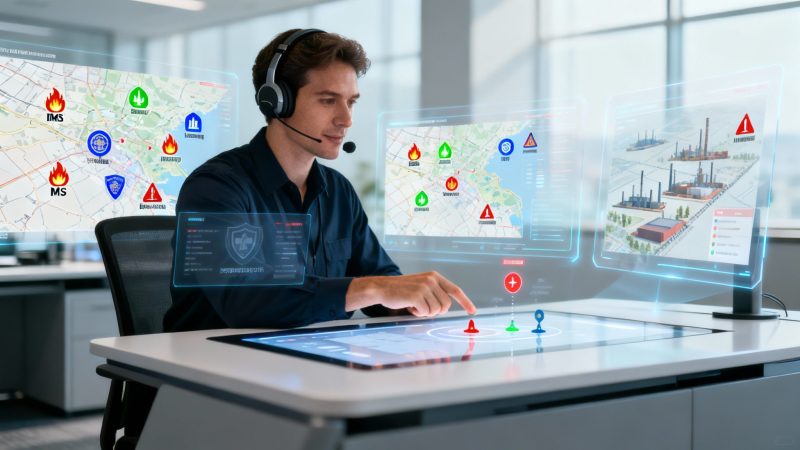
Situational awareness is more than just a concept; it’s the critical, real-time understanding of an evolving environment that separates successful outcomes from catastrophic failures. It's the dispatcher seeing the whole board, the incident commander anticipating a fire's next move, and the security chief spotting a threat before it escalates. This article breaks down 10 distinct situational awareness example scenarios from the front lines of public safety and business operations.
Each example will go beyond theory to provide a strategic analysis of the cues, actions, and lessons learned. For many operations, having eyes in the field and receiving real-time updates through tools like a trail camera with remote viewing capabilities is essential for maintaining this awareness.
Most importantly, we'll offer actionable insights and demonstrate how integrated platforms like Resgrid can transform data into decisive action. This approach ultimately improves efficiency, saves lives, and reduces operational costs. We’ll show you how seeing the bigger picture isn’t just a best practice; it’s a budget-saver that directly impacts your bottom line.
1. Active Shooter Response in Schools
An active shooter incident in a school is a catastrophic event where real-time situational awareness is not just beneficial, it's a matter of life and death. This complex scenario demands a synchronized flow of information between dispatch, law enforcement, EMS, and school personnel. The goal is to create a common operating picture that tracks the suspect's location, the status of students and staff (injured, safe, or unaccounted for), and the precise deployment of responding units. Without this shared awareness, response efforts become chaotic, delayed, and less effective.
This is a powerful situational awareness example because it highlights the need for immediate, multi-agency coordination under extreme pressure. Effective response relies on pre-established protocols and technology that can handle a massive influx of dynamic data.
Strategic Breakdown
- Key Cues: Initial 911 calls, security camera feeds showing the suspect, real-time updates from staff inside the building, and sensor alerts like gunshot detection systems.
- Immediate Actions: Dispatchers must immediately relay critical information while simultaneously coordinating a multi-agency response. Officers must enter the facility to neutralize the threat, while school staff initiate lockdown or evacuation procedures based on their proximity to danger.
- Lessons Learned: Events like the Parkland shooting underscored the devastating consequences of communication breakdowns. In response, agencies now prioritize interoperable communication systems and joint training exercises to ensure a unified command structure from the outset.
Strategic Insight: The most critical failure point in a complex incident is often the initial information gap between the first call and the arrival of a coordinated response. Closing this gap with technology saves lives.
Actionable Takeaways
Implementing a robust incident management platform is crucial for maintaining control. Centralizing communications and resource tracking prevents information silos and reduces radio traffic confusion. A practical example is using a system with pre-planned response templates for active shooter events. This can slash deployment times by automatically notifying and dispatching specific tactical teams, saving critical minutes and reducing the payroll costs associated with inefficient manual call-outs. For more information on how technology can enhance safety protocols, explore how Resgrid supports security operations. This proactive investment ensures that when an incident occurs, every stakeholder has the critical data needed to act decisively.
2. Emergency Dispatch Center Operations
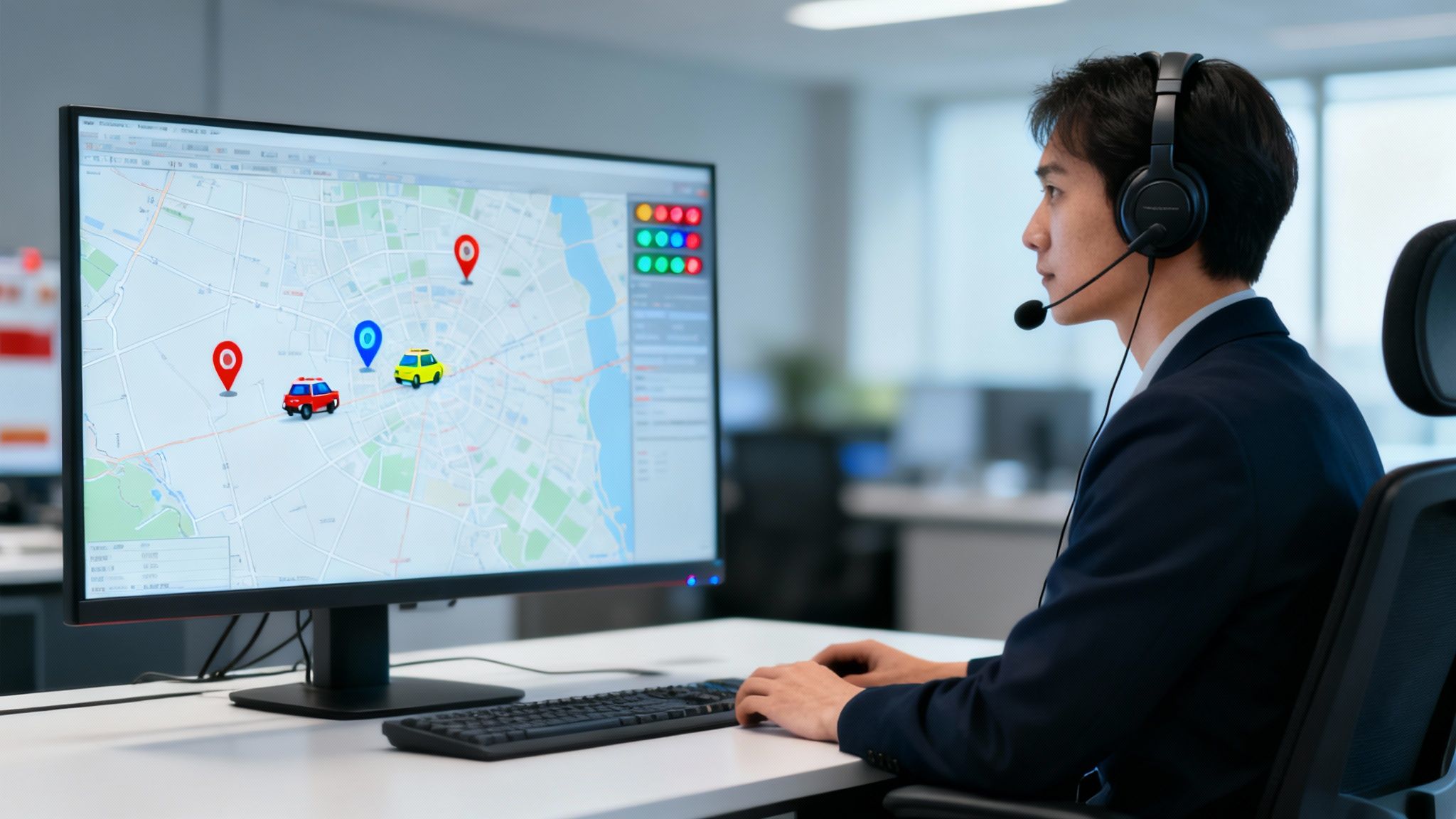
An emergency dispatch center is the nervous system of public safety, where situational awareness is synthesized from countless data streams into life-saving decisions. Dispatchers are tasked with managing incoming 911 calls, tracking unit locations, assigning resources, and maintaining a common operating picture across multiple, often simultaneous, incidents. Every action, from allocating an ambulance to relaying suspect information, hinges on the accuracy and speed of their awareness. Without a clear, centralized view, response times lengthen and responder safety is compromised.
This is a quintessential situational awareness example because it demonstrates how technology and human expertise must merge to manage chaos. The dispatch center’s ability to process information effectively determines the efficiency of every unit in the field.
Strategic Breakdown
- Key Cues: Incoming call data, AVL/GPS unit tracking, alarm system activations, officer status updates, and traffic camera feeds.
- Immediate Actions: Dispatchers must rapidly assess incident priority, identify and assign the closest available units, provide pre-arrival instructions to callers, and continuously feed real-time updates to responders.
- Lessons Learned: Major events, like large-scale natural disasters, have shown that legacy systems can quickly become overwhelmed. This has driven the adoption of cloud-based, scalable dispatch platforms that ensure operational continuity and prevent a single point of failure during high-stress scenarios.
Strategic Insight: The most significant resource drain in dispatch operations is manual status monitoring and redundant voice communication. Automating unit status and location tracking frees up dispatchers to focus on critical decision-making.
Actionable Takeaways
Modernizing with a Computer-Aided Dispatch (CAD) system is fundamental for enhancing situational awareness. Centralizing data onto a single screen prevents information overload and ensures every dispatcher has the same operational view. For a practical example of cost savings, a platform with integrated AVL/GPS automatically suggests the nearest available unit, preventing the dispatch of a more distant responder. This simple change significantly cuts fuel costs, reduces vehicle wear and tear, and gets help to the scene faster. To see how these advanced capabilities work, you can explore the dispatch features Resgrid offers. This investment streamlines operations and ensures the right help is sent, faster and more efficiently.
3. Traffic Incident Management on Highways
A major highway incident, like a multi-car pile-up, creates a high-risk, dynamic environment that extends far beyond the crash site itself. Effective traffic incident management requires a unified command structure involving law enforcement, fire departments, EMS, and transportation departments (DOT). The objective is to secure the scene, provide medical aid, clear the roadway, and restore normal traffic flow as quickly and safely as possible. This requires constant situational awareness of on-scene hazards, approaching traffic, and resource positioning.
This scenario is a classic situational awareness example because it demonstrates the cascading impact of a single event on a larger system. A failure to manage the scene and surrounding traffic can lead to secondary accidents, which are often more severe than the primary incident, creating a dangerous and costly domino effect.
Strategic Breakdown
- Key Cues: Initial 911 calls reporting the accident, live traffic camera feeds from a DOT operations center, sensor data showing slowing traffic, and on-scene reports from the first arriving units.
- Immediate Actions: Dispatchers must coordinate a multi-agency response while providing real-time updates on lane closures. First responders establish a safe work zone, assess injuries, and begin extrication, while DOT units set up traffic diversions.
- Lessons Learned: Programs like Georgia’s HERO (Highway Emergency Response Operators) have shown that dedicated, quick-clearance service patrols drastically reduce secondary accidents and congestion. This approach proves that proactive scene management is as critical as the emergency response itself.
Strategic Insight: The greatest risk in highway incident response is a secondary collision. Protecting the responders and the public requires establishing a secure perimeter and managing traffic flow miles before the actual incident scene.
Actionable Takeaways
Integrating a centralized dispatch and resource management platform is key to preventing operational chaos. By providing all responding agencies with a shared, real-time map of unit locations, traffic conditions, and incident details, commanders can make faster, more informed decisions. For instance, pre-configuring response plans for specific highway segments can automate unit dispatch. A practical cost-saving example is that faster, more efficient scene clearance directly reduces fuel consumption from idling emergency vehicles and tow trucks. More importantly, it minimizes the immense economic impact of prolonged road closures, saving the community millions in lost productivity and commerce.
4. Wildfire Suppression Coordination
Wildfire suppression is a massive logistical challenge where a lack of situational awareness can lead to catastrophic losses of life, property, and natural resources. Incident commanders must manage hundreds of personnel, air and ground units, and unpredictable fire behavior across vast, rugged terrain. Creating a common operating picture that tracks the fire's perimeter, resource deployment, personnel location, and evacuation zones is essential for safe and effective operations. Without this shared awareness, units can become isolated, command decisions can be based on outdated information, and firefighter safety is severely compromised.
This is a critical situational awareness example because it demonstrates the need for synchronized, multi-agency operations in a dynamic, large-scale environment. Effective wildfire management hinges on the ability to process real-time data from disparate sources into a single, coherent view.
Strategic Breakdown
- Key Cues: Real-time weather data (wind shifts), thermal imaging from aerial assets, GPS data from ground units, spot fire reports from lookouts, and updates on fuel conditions.
- Immediate Actions: Incident Command must dynamically reallocate resources to contain breakouts, issue timely evacuation orders based on fire progression models, and ensure all personnel are accounted for via regular check-ins (PAR checks).
- Lessons Learned: Events like the 2018 Camp Fire in California revealed how rapidly a fire can escalate beyond initial projections, overwhelming communication channels. This has driven agencies like Cal Fire to adopt more robust, real-time tracking and communication platforms to maintain command and control during fast-moving incidents.
Strategic Insight: In a wildfire, the most dangerous variable is the information lag between a change on the ground (like a wind shift) and the operational response. Minimizing this lag through technology is paramount to firefighter safety and public protection.
Actionable Takeaways
Utilizing a system that provides live GPS tracking and automates personnel accountability is a non-negotiable for modern fire agencies. Centralizing this data ensures command always knows where every firefighter and apparatus is, preventing units from being entrapped. A practical money-saving example is using automated status requests (like PAR checks) through an app. This eliminates the extensive radio clutter of manual check-ins, freeing up critical bandwidth and providing a time-stamped record of crew safety. This direct operational efficiency reduces the risk of costly accidents and ensures expensive aerial assets are deployed precisely where needed, avoiding wasteful drops based on old intel. To see how these features support fire ground operations, learn more about Resgrid's fire department solutions.
5. Large-Scale Event Security and Crowd Management
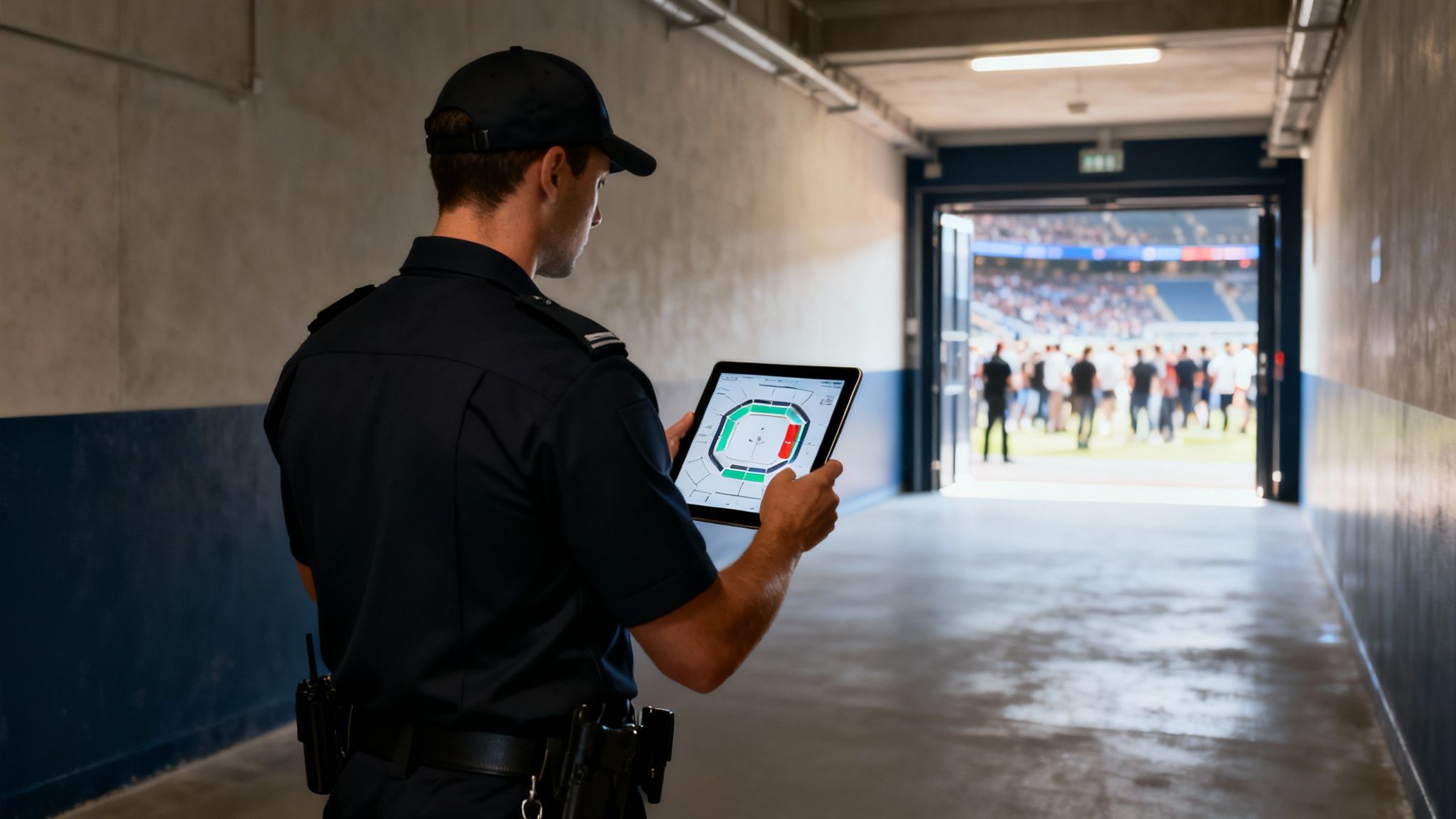
Managing large-scale events like concerts, festivals, or major sporting games requires a high degree of situational awareness to ensure public safety. Security and medical teams must monitor crowd dynamics, track personnel, identify potential threats, and manage incidents across a sprawling, often chaotic venue. A unified command center needs real-time data on everything from crowd density in specific zones to the location of medical personnel to prevent incidents from escalating into tragedies.
This is a critical situational awareness example because it demonstrates the challenge of maintaining a cohesive operational picture with thousands of moving parts. The tragic events at the Astroworld Festival in 2021 are a stark reminder of what happens when this awareness is lost, leading to catastrophic crowd crush incidents and delayed medical responses.
Strategic Breakdown
- Key Cues: Reports of crowd surges from on-ground staff, spikes in medical calls from a specific sector, social media posts indicating distress, and live drone or CCTV footage showing dangerous crowd density.
- Immediate Actions: Security teams must reroute foot traffic away from congested areas. Medical teams need to be dispatched to precise locations, and command must communicate clear, actionable directives to all personnel simultaneously.
- Lessons Learned: Post-incident analysis of events like Astroworld has highlighted the necessity of pre-planned incident action plans and robust, centralized communication platforms. Relying solely on radio chatter is insufficient for complex, large-venue incidents.
Strategic Insight: In crowd management, proactive monitoring is everything. The moment a response becomes purely reactive to on-the-ground chaos, control has already been lost.
Actionable Takeaways
Event organizers can significantly enhance safety by using a dispatch and management system to create a dynamic common operating picture. Pre-mapping the venue with designated zones, medical stations, and security posts allows for faster and more accurate resource deployment. A practical example is tracking all personnel on a live map. When a medical emergency occurs in Zone C, the commander can instantly dispatch the closest medic team instead of broadcasting a general call. This drastically cuts response times, improves outcomes, and allows for more efficient staffing models, directly reducing payroll costs without compromising safety. To see how these tools can be applied, learn more about Resgrid's support for event management.
6. Multi-Vehicle Traffic Accident Response
A multi-vehicle traffic accident on a major highway is a rapidly evolving, high-stakes event that demands exceptional situational awareness. Responders face a chaotic scene with multiple injuries, hazardous material risks, and logistical challenges like road blockages. Effective management requires a unified command structure where dispatch, fire, EMS, and law enforcement share a common operating picture to triage patients, manage traffic, and ensure scene safety. Without synchronized awareness, resources are mismanaged, patient care is delayed, and secondary accidents become more likely.
This is a critical situational awareness example because it demonstrates the need for structured, scalable incident command in a dynamic environment. The ability to track every patient, vehicle, and responder is paramount to restoring order and saving lives.
Strategic Breakdown
- Key Cues: Initial reports indicating multiple vehicles and potential entrapment, visual confirmation of a large debris field, reports of hazardous material placards, and a high volume of calls for medical assistance.
- Immediate Actions: The first arriving unit must establish command, conduct a rapid scene size-up, and relay a concise report to dispatch. This includes the number of vehicles, approximate patient count, and any immediate hazards. EMS begins triage while fire crews address vehicle hazards and extrication needs.
- Lessons Learned: Major pileups have taught agencies the importance of pre-planned traffic incident management areas (TIMAs) and staging zones. A failure to quickly establish a clear command structure and request adequate resources early often leads to prolonged scene times and increased risk to both responders and the public.
Strategic Insight: In a mass casualty incident on a roadway, the most valuable resource is accurate information. Knowing the exact number of patients, their triage status, and their transport destination prevents hospitals from being overwhelmed and ensures no one is left behind.
Actionable Takeaways
Utilizing an incident management system is key to overcoming the chaos of a large-scale traffic accident. A practical example is using the system to digitally log every patient with a unique ID and track their movement from the triage tag at the scene to the destination hospital. This digital record-keeping streamlines operations, drastically reduces the risk of a patient being lost in the system, and provides an accurate count for resource allocation. This avoids the costly mistake of calling for too many (or too few) ambulances, saving on fuel and personnel hours while ensuring every patient gets the right level of care.
7. Hospital Emergency Department Surge Management
During a mass casualty incident or public health crisis, a hospital emergency department (ED) becomes the epicenter of the response. Situational awareness in this high-stress environment is critical to prevent the system from collapsing. Staff must manage a sudden influx of patients, track bed availability, allocate medical personnel, and monitor equipment status in real-time. A breakdown in this complex information flow leads to treatment delays, overwhelmed staff, and compromised patient outcomes.
This is a vital situational awareness example as it demonstrates the need for a highly coordinated, internal common operating picture. Effective surge management depends on the ability to see the entire system at a glance, from ambulance arrivals to bed occupancy, allowing for rapid, life-saving decisions.
Strategic Breakdown
- Key Cues: Pre-arrival notifications from EMS, sudden increases in patient walk-ins, real-time bed capacity dashboards, alerts on low levels of critical supplies (like ventilators or blood), and communication from public health officials about an emerging threat.
- Immediate Actions: The charge nurse or ED director must activate the hospital's surge plan. This includes triaging incoming patients to prioritize the most critical cases, reassigning staff to high-need areas, and communicating capacity updates to regional dispatch centers to divert new ambulances if necessary.
- Lessons Learned: Events like the COVID-19 pandemic and large-scale disasters revealed that many hospitals lacked dynamic visibility into their own resources. This led to the adoption of digital command center technologies that provide real-time data on patient flow, staffing, and equipment, enabling proactive management instead of reactive chaos.
Strategic Insight: In an ED surge, the most significant risk is not the number of patients, but the inability to efficiently match available resources to patient needs. Overcoming this requires a live, centralized view of the entire emergency care ecosystem.
Actionable Takeaways
Using a command and control platform to manage resources is essential for an effective surge response. By digitizing staff and equipment tracking, hospitals can see exactly who and what is available at any moment. For a practical money-saving example, a real-time asset tracker can instantly locate the nearest available IV pump or ventilator, eliminating the time (and paid staff hours) wasted searching for critical equipment. This automation allows nurses to spend more time on patient care, improving throughput and reducing the need for costly overtime or surge staffing during a crisis.
8. Search and Rescue Operations
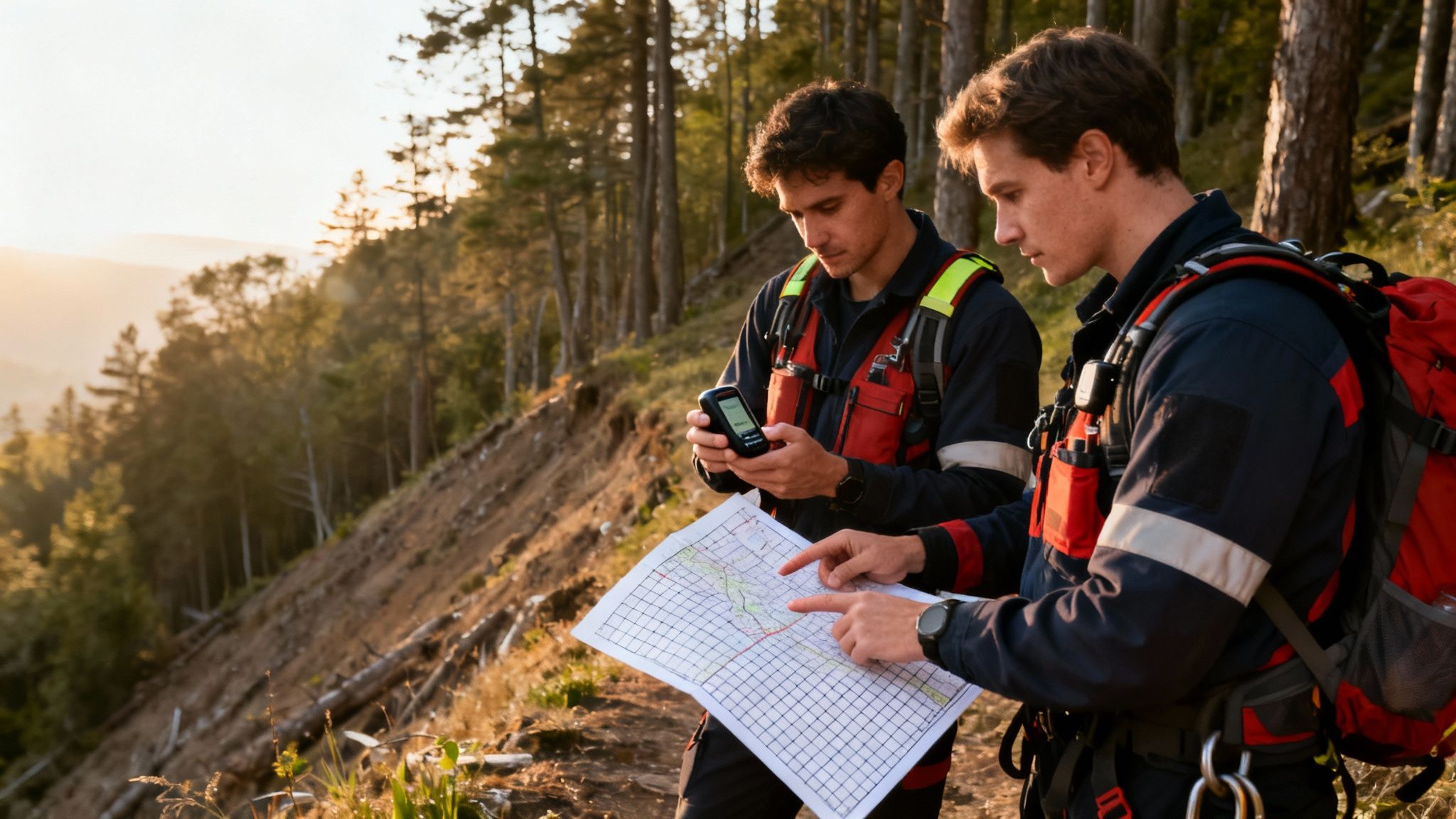
Search and Rescue (SAR) operations are a prime example of situational awareness in action, requiring the coordination of multiple teams across vast, often hazardous terrain. Command must maintain a clear picture of search grids, team locations, changing weather, and incoming clues to find a missing person. From a lost hiker in a national park to survivors in a disaster zone, the success of the mission hinges on a shared, real-time understanding of the operational environment. Without it, search efforts are duplicated, gaps in coverage appear, and valuable time is lost.
This is a critical situational awareness example because it demonstrates the challenge of managing dynamic variables over a wide area. The ability to track assets, process intelligence, and adapt the search plan in real-time directly impacts the chances of a successful rescue.
Strategic Breakdown
- Key Cues: The last known point (LKP) of the missing person, weather forecasts, terrain analysis, eyewitness reports, and clues found by search teams (footprints, discarded items).
- Immediate Actions: Establish a command post, define search sectors using grid mapping, and deploy teams with clear assignments and communication check-in times. All incoming information must be logged and mapped to adjust search priorities.
- Lessons Learned: Past SAR missions have shown that volunteer or multi-agency teams can quickly become disorganized without a central information hub. Uncoordinated teams may search the same area twice or fail to report vital clues, leading to inefficiency and mission failure.
Strategic Insight: In a large-scale search, the greatest risk is not just the environment but the loss of team accountability. Knowing where every searcher is at all times is as important as knowing where the missing person might be.
Actionable Takeaways
Using a personnel and resource tracking system is non-negotiable for modern SAR. Centralizing team locations on a live map prevents redundant searches and ensures teams don't stray into dangerous, unassigned areas. A practical example of saving money is creating digital search grids and tracking team GPS locations in real-time. This eliminates the need for teams to physically return to the command post to debrief, saving countless hours and significant fuel costs. This efficiency accelerates the search and ensures volunteer or paid personnel time is used effectively to achieve the mission.
9. Police Tactical Operations and SWAT Coordination
During high-risk tactical operations, such as a hostage situation or a high-risk warrant service, situational awareness is the invisible shield protecting officers and civilians. Command staff must maintain a real-time, three-dimensional view of the entire operational theater. This includes tracking SWAT team movements, the suspect's location and actions, hostage welfare, and potential environmental threats like explosive devices. Failure to achieve this shared consciousness can lead to catastrophic friendly-fire incidents, failed negotiations, or unnecessary loss of life.
This is a critical situational awareness example because it demonstrates the need for disciplined information management under intense, life-threatening conditions. Success depends entirely on a unified operational picture that allows commanders to make split-second decisions with clarity and precision, turning chaos into a controlled resolution.
Strategic Breakdown
- Key Cues: Intelligence from spotter teams, live drone or camera feeds, communications from hostage negotiators, and real-time updates from entry teams on tactical channels.
- Immediate Actions: Establish a secure command post and a clear command structure. Brief all personnel on the objective, suspect information, and rules of engagement. Deploy assets methodically while maintaining constant, clear communication using plain language.
- Lessons Learned: Post-incident reviews frequently reveal that poor communication and a fragmented view of the battlespace are primary contributors to negative outcomes. As a result, modern tactical teams heavily emphasize interoperable communication tools and rigorous, scenario-based joint training to ensure every team member operates from the same playbook.
Strategic Insight: In tactical situations, the most dangerous variable is uncertainty. Reducing uncertainty about team and suspect locations through technology is the fastest way to increase officer safety and operational success.
Actionable Takeaways
Effective coordination demands a centralized platform for tracking personnel and assets. This eliminates confusion from conflicting radio reports and provides commanders with an unambiguous view of the field. A practical example is using a mobile app to provide a "blue-on-blue" tracker, showing every officer's real-time location on a map of the structure. This drastically reduces the risk of friendly-fire incidents, which not only saves lives but also prevents immense financial and legal costs associated with such tragic errors. To see how mobile technology supports dynamic field operations, explore the tools available through Resgrid apps.
10. Business Security Operations and Threat Response
In a corporate environment, situational awareness moves beyond simple surveillance to become the central nervous system of security operations. When a threat emerges, whether it's an act of workplace violence or an external intruder, the security team must instantly transition from monitoring to active response. This involves tracking personnel locations, isolating threats using access control and camera feeds, and communicating clear instructions to employees and first responders. Without a unified operational picture, the response can become disjointed, leading to confusion, increased risk, and potential harm.
This is a critical situational awareness example because it demonstrates the need for proactive threat management within a civilian setting. Effective corporate security hinges on integrating technology, personnel, and pre-planned protocols to create a secure bubble that can be defended and controlled during a crisis.
Strategic Breakdown
- Key Cues: Silent panic alarms, access control system alerts for unauthorized entry, unusual behavior flagged on surveillance cameras, or direct reports from employees about a disturbance.
- Immediate Actions: Security operations centers (SOCs) must validate the threat, dispatch on-site personnel, initiate building lockdown or evacuation protocols, and establish a direct line of communication with law enforcement.
- Lessons Learned: Incidents of workplace violence have shown that early detection and rapid, decisive internal response are paramount. Companies now invest heavily in threat assessment teams, de-escalation training, and integrated security systems that provide a single pane of glass for monitoring and response.
Strategic Insight: The most significant vulnerability in business security is the lag time between threat identification and a coordinated, building-wide response. Closing this gap with automated alerts and clear communication protocols is essential.
Actionable Takeaways
A centralized dispatch and management platform is key to orchestrating an effective response. It allows security leaders to track guard locations, manage incident checklists, and disseminate mass notifications simultaneously. For a practical example, using pre-configured response plans for a "Suspicious Person" alert can automatically send a checklist to the responding guard's phone and notify the shift supervisor. This ensures procedural compliance, creates a digital audit trail, and can significantly reduce liability and insurance costs by demonstrating a structured, professional response. To see how technology can streamline these complex operations, learn how Resgrid empowers security operations. This investment transforms a reactive security posture into a proactive, data-driven defense strategy.
Situational Awareness — 10-Scenario Comparison
| Item | 🔄 Complexity | ⚡ Resource requirements | ⭐ Expected effectiveness | 📊 Ideal use cases | 💡 Key advantages / tips |
|---|---|---|---|---|---|
| Active Shooter Response in Schools | Very high — multi-agency, continuous situational tracking | High — real-time tracking tech, trained staff, redundant comms | High ⭐ — faster response, fewer friendly-fire incidents | K–12 and campus active-threat incidents, drills | Improves evacuation coordination; Tip: regular drills and color-coded statuses |
| Emergency Dispatch Center Operations | Very high — central nerve center, constant multitasking | Very high — CAD, multi-channel comms, trained dispatchers, redundancy | Very high ⭐ — centralized decisions, data-driven allocation | City/regional 24/7 emergency coordination, multi-incident response | Creates permanent records and scalable coordination; Tip: redundant systems and automation |
| Traffic Incident Management on Highways | Medium-high — multi-agency routing and diversion | Medium — traffic cameras, sensors, DOT coordination | High ⭐ — reduces congestion and secondary incidents | Highway accidents, disabled vehicles, congestion mitigation | Speeds clearance and safety; Tip: use cameras/sensors and pre-position units |
| Wildfire Suppression Coordination | Very high — large scale, rapidly evolving behavior | Very high — air/ground assets, GPS, mapping, logistics | High ⭐ — improves safety and resource redeployment (variable by conditions) | Large wildfires, multi-jurisdiction incidents, evacuation operations | Enhances firefighter accountability; Tip: GPS tracking and regular check-ins |
| Large-Scale Event Security & Crowd Management | High — complex venue layouts and zone monitoring | High — personnel, crowd sensors, comms systems | High ⭐ — prevents surges, speeds medical/security response | Concerts, sports events, festivals, mass gatherings | Reduces bottlenecks and response times; Tip: pre-event maps and consistent radio protocols |
| Multi-Vehicle Traffic Accident Response | High — triage, hazmat, multi-agency coordination | High — EMS, fire, police, hazmat teams, staging resources | High ⭐ — organized triage and scene management | Pileups, tanker hazmat incidents, major roadway collisions | Supports rapid victim care; Tip: establish IC, staging, and patient tracking early |
| Hospital ED Surge Management | Medium-high — patient flow, triage, bed/equipment tracking | Medium — staff, beds, tracking systems, coordination with EMS | High ⭐ — optimizes care and reduces delays during surges | Mass casualty events, disaster surge, pandemic peaks | Improves patient throughput; Tip: color-coded tracking and pre-positioned staff |
| Search and Rescue Operations | High — large/remote areas, terrain and weather impacts | Medium-high — GPS devices, trained teams, logistic support | High ⭐ — increases search efficiency and safety | Missing persons, disaster survivor searches, mountain/urban SAR | Prevents duplicate searching; Tip: clear search grids and GPS check-ins |
| Police Tactical Operations & SWAT Coordination | Very high — high-risk, dynamic tactical decisions | High — tactical units, secured comms, specialized gear | High ⭐ — reduces officer exposure, improves resolution outcomes | Barricades, hostage situations, high-risk warrants | Prevents friendly fire; Tip: establish command post and tactical frequencies |
| Business Security Ops & Threat Response | Medium — facility monitoring, occupant communication | Medium — surveillance, security staff, building integration | Medium-high ⭐ — improves employee safety and incident handling | Corporate campuses, office buildings, workplace threats | Enables rapid threat response; Tip: detailed facility maps and regular drills |
Turning Awareness into Action and Savings
Throughout this exploration of situational awareness examples, from managing a multi-vehicle pile-up on a highway to coordinating a tactical SWAT operation, a single, undeniable truth emerges. Situational awareness is not a passive state of observation; it is an active, continuous cycle of perception, comprehension, and projection that directly drives effective action. The difference between a chaotic, resource-draining incident and a controlled, efficient response often comes down to the quality and speed of shared information.
The scenarios we've dissected, including wildfire suppression, event security, and emergency dispatch, reveal that isolated knowledge is insufficient. A firefighter’s ground-level view, a dispatcher’s call data, and a commander’s strategic overview must converge into a single, coherent picture. When this synthesis fails, the consequences are immediate and costly.
From Theory to Financial Reality
Mastering situational awareness is not merely an operational ideal; it's a critical financial strategy. Every situational awareness example highlighted in this article underscores this connection. A well-coordinated response reduces waste, minimizes damage, and contains incidents faster, leading to tangible savings.
Consider the direct financial implications:
- Reduced Overtime: Faster incident resolution means fewer personnel hours logged, directly cutting payroll costs.
- Optimized Resource Allocation: Knowing exactly where assets are and what they are doing prevents sending unnecessary units, saving fuel, maintenance, and supply costs. A prime example is avoiding the dispatch of an advanced life support ambulance when a basic life support unit is all that is required.
- Lowered Liability: A clear, documented, and coordinated response provides a powerful defense against potential litigation, reducing insurance premiums and legal expenses.
- Enhanced Mutual Aid: Seamless integration with neighboring agencies prevents costly communication breakdowns and ensures that aid is requested and deployed efficiently, not wastefully.
Investing in the tools that build this shared consciousness is not an expense but a direct investment in fiscal responsibility. It transforms operational data into a strategic asset that protects both lives and budgets.
Your Next Step: Building a Unified Command Structure
The core lesson from every situational awareness example is that success hinges on a unified operational picture accessible to everyone, from the frontline responder to the command post. The key is to break down information silos and create a real-time data ecosystem. This begins with adopting a platform designed for this specific purpose.
To move forward, focus on these actionable steps:
- Audit Your Current Systems: Identify the gaps in your communication and tracking. Where does information get lost or delayed?
- Prioritize Interoperability: Ensure any new technology can communicate seamlessly across departments, agencies, and jurisdictions.
- Implement a Common Operating Picture: Adopt a system like Resgrid that provides real-time mapping, personnel tracking, and integrated communication in one accessible interface.
By making situational awareness a technological and cultural priority, your organization can replicate the successful outcomes detailed in these examples, turning reactive chaos into proactive, cost-effective control. This proactive stance is the hallmark of modern, effective emergency and business response.
Ready to transform your team's situational awareness from a concept into a powerful, cost-saving reality? See how Resgrid, LLC provides the affordable, all-in-one platform to manage personnel, resources, and incidents with unparalleled clarity. Explore the tools that make every situational awareness example we've discussed a manageable and efficient operation by visiting Resgrid, LLC today.