
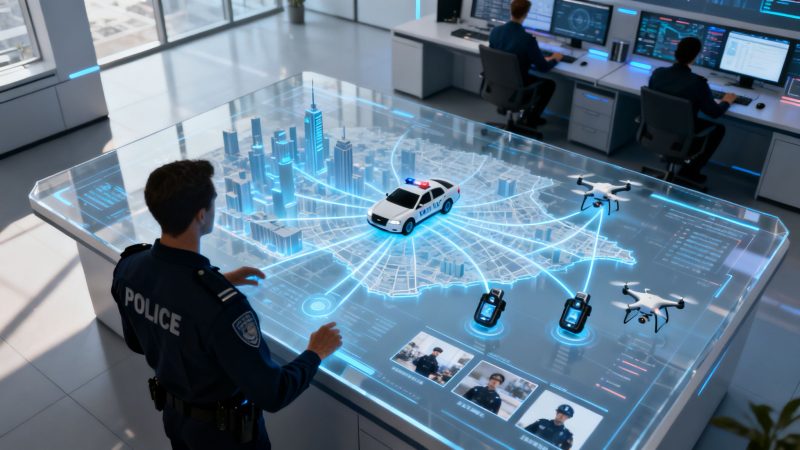
Technology and Law Enforcement: Insights into technology and law enforcement
When you look at modern public safety, it’s clear that technology in law enforcement has completely changed the game. Agencies are finally moving from a purely reactive stance to one that’s proactive and driven by real-time information. The tools available today let dispatch centers and officers on the street handle incredibly complex situations with more speed, precision, and safety than ever before. This isn't just about getting new gadgets; it's about building a fundamentally smarter, more connected way of operating.
The Digital Transformation of Public Safety
The days of just relying on crackly radio chatter and paper maps are fading, and fast. Today’s challenges—everything from coordinating a massive emergency response to tackling complex urban crime—demand a far more sophisticated approach. Agencies are ditching outdated, disconnected legacy systems that only create information silos and slow down critical decisions when seconds count.
Think of a modern dispatch center like an air traffic control tower for first responders. Just as controllers have to guide dozens of planes at once, dispatchers need to coordinate every single asset—patrol cars, officers on foot, K-9 units, you name it—all in real-time. To do that effectively, they need a complete, unified view of the entire operational picture.
A Unified Operational Nervous System
This is where integrated technology platforms come in. They act like the central nervous system for an entire agency, pulling together all the different streams of information into one cohesive and actionable view. Instead of juggling one tool for communications, another for location tracking, and a third for reporting, a unified system creates a single source of truth.
This consolidation isn't just a matter of convenience; it brings huge benefits that directly impact safety and efficiency:
- Improved Situational Awareness: Dispatchers can see the exact location of every officer and vehicle on a live map. This lets them send the closest unit to an incident, shaving precious seconds off response times.
- Enhanced Officer Safety: Knowing an officer's precise location during a high-risk call is a critical safety net. It means backup can be sent to the right spot, immediately, if things go sideways.
- Streamlined Communications: Integrated messaging and data sharing make sure everyone, from the dispatcher to the boots on the ground, gets the same critical information at the same time. This drastically cuts down on miscommunication.
Actionable Insight to Save Money: Imagine an agency paying separate annual license fees for a dispatch system ($10,000), a personnel tracking service ($5,000), and a messaging app ($2,000). By consolidating into a single, integrated platform like Resgrid, they could eliminate the redundant fees, saving thousands of dollars annually. This also cuts hidden costs like training staff on multiple systems and dealing with interoperability failures, which can lead to expensive operational errors.
By adopting a modern, integrated approach, law enforcement agencies are just better equipped to protect their communities and their own people. This technological foundation is essential for building a more efficient, accountable, and effective public safety model—one that builds community trust and delivers better outcomes for everyone.
The Technology Running a Modern Police Force
At the core of any modern law enforcement agency, you’ll find a set of technologies that act as the digital backbone for every single operation. We're not talking about fancy, futuristic gadgets here. These are the essential tools that turn a flood of raw data into intelligence officers can actually use, making them safer, smarter, and far more effective.
Think of it like an ecosystem. Each piece serves a distinct but connected purpose. A dispatch system fields the calls, a tracking service shows where everyone is, and communication platforms keep the team in sync. When these elements work together seamlessly, they create a powerful, unified view of the field that can make all the difference when seconds count.
Computer-Aided Dispatch (CAD)
A Computer-Aided Dispatch (CAD) system is the digital brain of any dispatch center. It’s the central nervous system where every emergency call is received, logged, and managed. But a modern CAD does a whole lot more than just take notes—it's an intelligent hub for allocating resources where they're needed most.
When a 911 call comes in, the CAD system instantly processes the information and puts it right in front of the dispatcher. By integrating with Geographic Information Systems (GIS), it can pull up the incident location on a live map, showing the real-time positions of every available unit nearby.
Let's say there’s a multi-car pileup on the freeway. The CAD system lets a dispatcher see the crash site, identify the three closest patrol cars, and send them on their way with a single click. This takes all the guesswork out of the equation and shaves critical seconds—sometimes minutes—off response times. The system also logs every action, creating a perfect digital trail for after-action reviews and legal documentation.
Real-Time Location Services (RTLS)
While CAD handles the what and where of an incident, Real-Time Location Services (RTLS) are all about the who. This technology gives dispatchers precise, up-to-the-second location data for every officer and critical asset, both in their vehicles and on foot. It’s like knowing exactly where every player is on the field at all times.
For law enforcement, this provides an absolutely vital layer of safety and coordination. If an officer calls for backup or suddenly goes quiet, dispatchers know their exact location instantly, whether they're inside a building or out on the street.
Actionable Insight to Save Money: I've seen agencies pay for one GPS tracking service for their vehicles and a totally separate app for tracking personnel. An integrated platform that combines CAD and RTLS into a single solution gets rid of that redundancy. This consolidation doesn't just cut down on software licensing fees; it also reduces the training headache since your team only has to learn one system. You can see how some modern platforms unify these functions by looking into integrated first responder applications.
Secure Communication Platforms
Reliable communication is completely non-negotiable in law enforcement. Traditional radio is still king for a reason, but modern secure communication platforms add layers of functionality that radios just can't touch. These platforms offer encrypted text messaging, photo and video sharing, and dedicated group channels that keep everyone on the same page.
This allows an officer to share sensitive information—like a photo of a suspect or the floor plan of a building—without blasting it over an open radio channel for anyone to hear. This kind of secure, silent communication is critical during tactical situations where you can't afford to give your position away. It also creates an automatic digital log of all communications for a given incident.
Body-Worn Cameras (BWCs)
Perhaps the most visible piece of technology and law enforcement today is the Body-Worn Camera (BWC). These are the small, tough cameras worn by officers to record video and audio of their interactions with the public. Their main job is to provide an objective, unbiased record of what happened.
The adoption of technologies like BWCs has exploded. A major 2016 survey of U.S. law enforcement agencies showed that 70% were using in-car cameras and 68% used information-sharing platforms. Back then, only about a third of agencies had adopted body-worn cameras, but that number was expected to grow significantly. You can dig into the specifics by reading the full report on law enforcement technology trends.
BWCs bring a few key benefits to the table:
- Accountability: They create a clear record that can be used to review an officer's conduct or investigate a citizen's complaint.
- Evidence Collection: The footage is invaluable digital evidence for criminal investigations and courtroom proceedings.
- De-escalation: Studies have found that when people know they are being recorded, both officers and citizens tend to act more professionally, which can often cool down a tense situation.
To bring this all together, let’s look at a few of the key technologies you’ll find in a modern department.
Key Technologies in Law Enforcement
| Technology | Primary Function | Operational Benefit |
|---|---|---|
| CAD System | Manages and dispatches emergency calls | Speeds up response times and optimizes resource allocation |
| RTLS | Tracks officer and vehicle locations in real-time | Enhances officer safety and improves situational awareness |
| Secure Comms | Provides encrypted text, image, and data sharing | Allows for silent, secure information sharing in the field |
| Body-Worn Cameras | Records interactions with the public | Increases transparency, accountability, and evidence quality |
| Analytics Platforms | Analyzes crime data and operational trends | Supports data-driven policing and identifies crime hotspots |
When these core technologies are unified, they create a powerful and efficient ecosystem. A CAD alert can be pushed to an officer's phone, their location is tracked via RTLS, they communicate securely with their team, and the whole interaction is captured on their BWC. That integration is what modern, effective, and accountable policing is all about.
Dispatch systems and reliable communications are the bedrock of any emergency response operation, but the real game-changer today is what you can do with all the data those systems generate. This is where Artificial Intelligence (AI) and data analytics come in, acting as a massive force multiplier. They give agencies the power to comb through enormous volumes of information, finding patterns and connections that would be completely invisible to the human eye.
Think about it this way: a single patrol officer can only observe what’s happening on their street corner at that moment. An analytics platform, on the other hand, can look at a decade's worth of crime data across the entire city. It connects the dots between seemingly random events, turning raw information into intelligence that helps departments get ahead of crime instead of just reacting to it.
Making Sense of Predictive Policing
The phrase "predictive policing" sounds like something straight out of science fiction, but the reality is much more practical and grounded in data. It's not about predicting a specific crime with pinpoint accuracy. It's really about smarter resource allocation.
AI algorithms chew through historical crime data—looking at the time, location, and type of incident—to identify statistical "hotspots." These are areas where certain crimes are statistically more likely to happen. This allows command staff to deploy patrols with a purpose, putting officers in the right places at the right times to act as a deterrent.
- Practical Application: Let's say an agency is dealing with a rash of car break-ins. Instead of just blanketing the city with extra patrols, they feed the incident data into an analytics tool. The system might reveal that 75% of the break-ins are happening on Thursday and Friday nights between 10 PM and 2 AM in two specific downtown parking garage districts.
- Actionable Insight to Save Money: Now, the agency can schedule targeted patrols in those exact areas during those specific hours. This surgical approach maximizes their deterrent effect without stretching resources thin or paying for unnecessary city-wide overtime. It's a far more efficient and cost-effective strategy than just guessing.
The demand for this kind of tech is exploding. The global law enforcement software market is projected to hit a staggering USD 40.76 billion by 2033. This growth isn't just a trend; it's a reflection of a worldwide push for smarter, data-driven public safety. You can dive deeper into the market drivers with Grandview Research's full report on law enforcement software.
Uncovering Leads with Advanced Tools
Beyond just identifying hotspots, AI and analytics are becoming indispensable investigative tools. They're helping detectives connect the dots in complex cases by flagging suspects, tracking movements, and uncovering hidden criminal networks.
Automated License Plate Readers (LPRs)
You've probably seen these on patrol cars or mounted on traffic poles. LPRs are high-speed cameras that constantly capture and read license plates, checking them against databases for stolen vehicles or cars linked to wanted persons. It’s a simple concept with a massive impact.
Facial Recognition Technology
This is a more controversial but undeniably powerful tool. It compares images from sources like CCTV footage against a database of known photos (like mugshots) to help put a name to an unknown suspect. Its use is, rightly, carefully regulated to balance investigative needs with privacy rights. In almost all cases, it's used to generate leads, not as the sole reason for an arrest.
The real power here isn't just one tool working in isolation. It's about how they all work together. An LPR might flag a car leaving a robbery, and facial recognition could then help identify a suspect from a gas station's security camera down the street. That kind of integration can shave weeks or even months off an investigation.
The diagram below gives a good visual of how these separate technologies—CAD, comms, and even body-worn cameras—can be pulled together into a single, cohesive platform.
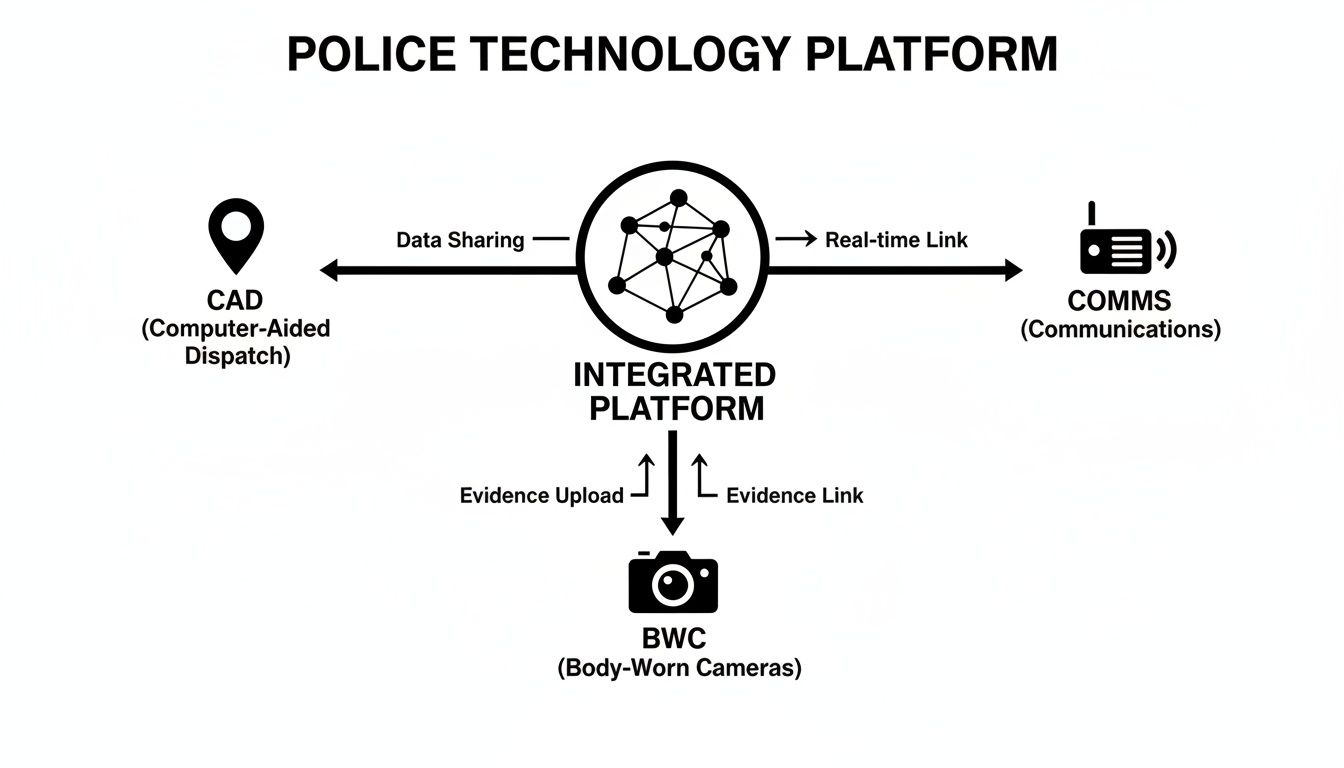
This kind of unified view is what turns isolated bits of information into a clear operational picture that everyone can act on.
A Practical Example of Analytics in Action
Imagine a city is dealing with a string of daytime home burglaries spreading across multiple neighborhoods. The crimes seem random, and detectives are hitting one dead end after another.
Frustrated, they feed all the case data into their analytics platform. The software gets to work, cross-referencing addresses, times, methods of entry, and lists of stolen property. In just a few minutes, it spits out a pattern no one had noticed: every single burglary happened within a two-block radius of a city bus stop, and always on a Tuesday or Thursday.
That single insight completely changes the investigation. Detectives pull transit camera footage from those stops on the days of the crimes and quickly spot the same individual appearing in multiple locations. A swift arrest is made, and a dozen cases are closed at once. Without analytics, finding that link might have taken months of painstaking work, if it was ever found at all.
Actionable Insight to Save Money: A few years ago, this kind of analytical muscle was only available to huge, well-funded federal agencies. Not anymore. Cost-effective, cloud-based AI tools are now accessible to departments of all sizes. A smaller agency can now subscribe to these services for a fraction of what it would cost to build their own system, leveling the playing field and giving them access to the same powerful capabilities without the high cost of in-house servers and specialized IT staff.
Navigating Privacy, Bias, and Security Challenges

While the new wave of technology in law enforcement brings a ton of benefits, it also opens up a Pandora's box of challenges we absolutely can't ignore. Every new tool, whether it's a city-wide CCTV network or a body camera on an officer's vest, comes with a heavy set of responsibilities. To use this tech successfully, you have to get out in front of the tough questions about public privacy, algorithmic bias, and digital security.
Trying to sidestep these issues just isn't an option. It eats away at community trust and can spiral into costly legal battles and PR nightmares. The only way forward is to manage these risks proactively and transparently, ensuring technology serves public safety instead of undermining it.
The Challenge of Public Privacy
Let's be honest: surveillance tools like drones and widespread CCTV cameras are incredibly good at monitoring large areas and collecting evidence. But their very presence sparks legitimate concerns among citizens about being watched constantly.
People worry about a "Big Brother" scenario where every move they make is tracked and logged. This isn't just some abstract fear; it's a real obstacle to building the kind of community trust that's essential for good policing. If the public feels that technology is just a tool for invasion of privacy, their willingness to cooperate can drop off a cliff.
Actionable Insight to Save Money: A practical step to save money and build trust is to establish a crystal-clear, publicly accessible policy on data collection before deploying new surveillance tech. This policy should define exactly what data is collected, how long it is stored, and who can access it. Being upfront prevents costly reactive measures, like fighting lawsuits or launching expensive PR campaigns to repair a damaged reputation after public trust is lost.
Demystifying Algorithmic Bias
Artificial intelligence can be a powerful partner in crunching crime data, but it has one big weak spot: it's only as good as the data it learns from. If you train an AI system on historical arrest data from an era of inequitable policing, the algorithm can learn and even amplify those same biases.
This is what's known as algorithmic bias. It can lead to predictive policing models that unfairly target certain communities or facial recognition systems that are less accurate for specific demographics. The result isn't just unfair; it reinforces systemic problems and damages the credibility of the entire agency.
Actionable Insight to Reduce Costly Errors
To fight this, agencies have to take real steps to ensure their tools are fair and accurate. This approach doesn't just build trust; it helps avoid the huge costs that come with wrongful arrests or discriminatory enforcement.
- Conduct Regular Bias Audits: Bring in independent, third-party auditors to periodically test your AI tools. They can help spot and fix inherent biases—a small investment compared to the legal fees from a class-action lawsuit.
- Demand Vendor Transparency: When you're buying AI software, don't be afraid to push vendors for clear documentation on how their algorithms were trained and what they've done to mitigate bias.
- Diversify Training Data: Work with your vendors to make sure the data used to train AI models is diverse and truly represents your entire community, not just one slice of it.
Securing Sensitive Law Enforcement Data
The last piece of the puzzle is cybersecurity. Law enforcement agencies are a goldmine for cyberattackers because they hold massive amounts of incredibly sensitive information. We're talking about everything from confidential informant details and active case files to tactical operational plans.
A data breach could be catastrophic. It could compromise investigations, put officers in danger, and expose citizens' private information. The financial fallout from a breach—including cleanup, fines, and legal settlements—can be crippling, especially for smaller departments running on tight budgets. For a deeper look at data protection, you can learn more about creating robust privacy policy and secure data handling procedures.
Investing in solid cybersecurity isn't just an IT expense; it's a fundamental operational need. This means using multi-factor authentication, running regular security training for everyone on staff, and having an incident response plan locked and loaded. By treating these challenges with the seriousness they deserve, agencies can use technology responsibly to build safer, more just communities.
A Practical Roadmap for Agency Technology Adoption
Bringing new technology into an agency is a lot more than just buying the latest gadgets. It requires a clear, deliberate plan. I've seen it happen too many times: a rushed rollout leads to wasted money, frustrated officers, and expensive tools that just sit on a shelf, collecting dust.
The only way to get it right is to treat it as a phased process. It all starts with a brutally honest look at what your agency actually needs on the ground. This roadmap breaks that journey down into real-world, manageable steps, from initial assessment to getting everyone trained up and online.
Starting with a Needs Assessment
Before you even think about talking to a vendor, the very first step is a solid needs assessment. This means taking a hard look at your current operations and identifying the specific choke points. Are your dispatchers fighting with a clunky, outdated CAD system? Are your people in the field complaining about dead zones in their radio coverage?
Don't just guess. You have to get direct feedback from the people who will actually be using this stuff every day—dispatchers, patrol officers, investigators, and your command staff. Their perspective is pure gold.
Actionable Insight to Save Money: A practical way to save some serious money here is to focus on what hurts the most. Instead of trying to fix every little problem at once, prioritize the one or two biggest operational headaches. This keeps you from blowing your budget on shiny features you'll never use. For example, if your biggest problem is slow dispatch, focus on a CAD/RTLS solution first, rather than a costly predictive analytics suite you aren't ready for.
Evaluating Vendors and Launching Pilot Programs
Once you know what problem you're trying to solve, it's time to see who can solve it. But don't get taken in by a slick sales pitch. A pilot program isn't just a good idea; it's a non-negotiable step that can save you from a massive financial blunder.
Pick a small, representative group of officers to put the tech through its paces in the real world for a set period, like 30 or 60 days. This is how you find out how the tool actually performs under pressure, not just in a perfect demo environment.
Vendor Evaluation Checklist
- Interoperability: Does this new tool play nice with the systems you already have, or is it going to create yet another data silo?
- Security: How are they protecting your sensitive data from getting breached? What's their security posture?
- Long-Term Support: What happens after the check is cashed? You need to know what their customer support and ongoing training look like.
- Scalability: Can this solution grow with your agency, or will you be right back here in three years, starting all over?
Actionable Insight to Save Money: A critical cost-saving tactic is to prioritize solutions that offer flexibility. Platforms built on open standards or those that are open-source can prevent expensive vendor lock-in, giving you more control over your technology stack and future upgrades. You can explore the benefits of these systems and how open-source technology saves agencies money.
Planning for Full Implementation and Training
After a successful pilot, you're ready to start planning the full rollout. This phase is all about managing change. You've got to get buy-in from everyone, from the newest recruit right up to the chief. That means clearly explaining the why—how this new piece of tech will make their jobs safer, easier, or more effective.
The final piece of the puzzle is comprehensive training. And I don't mean a single, one-off workshop. Plan for ongoing training sessions and identify a few internal "super-users" who can become the go-to experts for their colleagues.
The North American market for law enforcement software is exploding, holding over 36.23% of the global market. That growth is being fueled by advanced tools like AI and analytics. Big agencies are leading the charge, with 81% using GIS for crime analysis and 70% deploying license plate readers. It just goes to show how critical these technologies have become, and why a smart, well-planned adoption strategy is no longer optional.
Answering Your Key Questions on Police Technology
Whenever departments start looking at new tech, the same practical questions always come up from leadership and the officers on the street. It usually boils down to cost, ethics, and safety. Let's tackle some of the biggest concerns head-on with some straight answers to help you figure out what's right for your agency.
How Can Smaller Agencies Afford Advanced Technology?
This is the big one, isn't it? For most departments working with a shoestring budget, this is the number one question. The good news is that powerful technology isn't just for massive, well-funded agencies anymore. You just have to be strategic and find tools that give you the biggest bang for your buck without breaking the bank.
One of the smartest money-saving moves you can make is to find a unified, open-source platform. Think about it: instead of paying separate licensing fees for a CAD system, a personnel tracking service, and a secure messaging app, you can roll all of that into one solution. That immediately slashes your software costs and gets rid of the hidden expense of training your people on three or four different, clunky systems.
Practical Example: A small rural department might be paying $5,000 a year for a commercial GPS tracking service for its vehicles and another $3,000 for separate dispatch logging software. By switching to a self-hosted, open-source platform, they could knock those recurring software costs down to almost zero. The only real cost becomes server maintenance. That’s thousands of dollars freed up in the budget for things that really matter, like training or new equipment.
Also, keep an eye out for scalable, cloud-based services that use a subscription model. This approach lets you avoid a huge upfront investment and you only pay for what you actually use. It makes powerful tools like data analytics accessible for a predictable, manageable monthly fee.
What Is the First Step to Ensure New Tech Is Used Ethically?
Ethical use starts way before a single piece of new gear is deployed. The absolute first, most critical step is to hammer out a clear, transparent, public-facing policy that dictates exactly how the technology will be used. This isn't just another document to file away; it's a promise you make to your community, and it's essential for building trust.
This policy needs to be specific. It should clearly define:
- What data is being collected: Be upfront about the exact types of information the technology is gathering.
- How long the data is stored: Set concrete retention periods. No indefinite data hoarding.
- Who can access the data and under what circumstances: Create a strict access protocol to prevent it from being misused.
Actionable Insight to Save Money: By getting this framework in place before the tech ever hits the streets, you get ahead of privacy concerns and show everyone you’re committed to being accountable. This one simple, proactive step can save your agency from ugly legal battles and PR nightmares down the road. It turns a potential problem into a real chance to strengthen your relationship with the community.
How Does Integrating Systems Improve Officer Safety?
Integrated systems are a game-changer for officer safety because they create a single, clear operational picture for everyone involved. This is what we call situational awareness. When dispatch, location tracking, and communications are all separate, information falls through the cracks and the response gets disjointed. A truly integrated platform makes sure everyone is on the same page, in real-time.
Picture an officer responding to a domestic disturbance. In a disconnected system, they might just have the address and that's it. But with an integrated platform, the dispatcher can see that officer's exact location on a map, push premise history (like prior calls to that same address) right to their in-car terminal, and watch their status live.
Practical Example: If that officer suddenly goes silent or hits their emergency button, the system can automatically light up every nearby unit with their precise GPS coordinates. Backup isn't just sent to a general address; it's sent to the officer's exact location, whether they're in the front yard or around the back of the house. This shaves critical seconds—and sometimes minutes—off the response time for backup. That's a time frame that can absolutely be the difference between a safe resolution and a tragedy. The tech becomes a digital safety net for every officer you have in the field.
By answering these questions honestly and proactively, your agency can build a smarter, safer, and more trusted approach to modern policing. For agencies looking to unify their systems and cut costs, platforms like Resgrid offer a comprehensive, open-source solution for dispatch, tracking, and communication. Learn more at https://resgrid.com.