
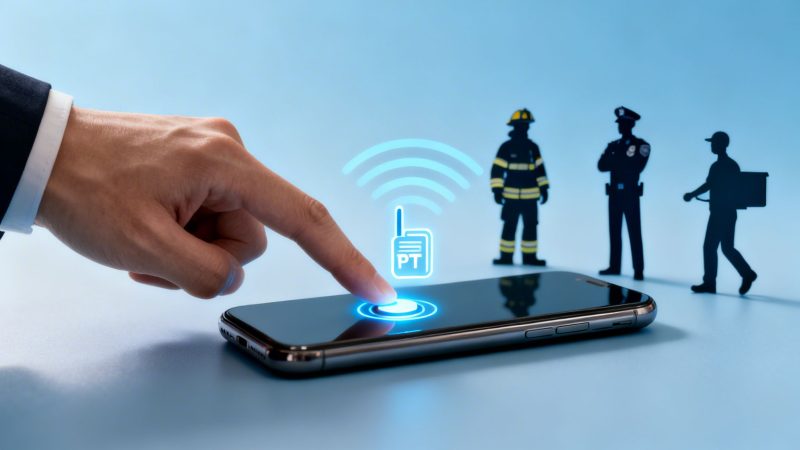
What is Push to Talk: Instant Communication Explained
You've probably used a walkie-talkie before. Press a button to talk, release it to listen. It's simple, direct, and gets the job done. That, in a nutshell, is the core of push to talk—but it's been supercharged for the modern world.
What Is Push to Talk in Simple Terms?
Push to Talk (PTT) is a communication system designed from the ground up for speed and coordination. Unlike a regular phone call where everyone can talk at once (what we call full-duplex), PTT is half-duplex. This means only one person can speak at a time.
That one-person-at-a-time rule isn't a bug; it's the most important feature. It forces a level of discipline that's impossible on a chaotic group conference call. By eliminating cross-talk and confusion, it brings order to high-pressure environments like logistics, event security, and emergency response.
From Radios to Smartphones
For a long time, PTT meant carrying around expensive, bulky radio hardware that only worked within a limited range. That's all changed. The technology has evolved into what we now call Push to Talk over Cellular (PoC). This approach delivers the exact same instant group communication, but it runs as an app right on the smartphones your team already carries.
This shift isn't just about convenience; it's a direct path to saving money. With PoC apps, you can sidestep:
- The massive upfront cost of buying dedicated radio handsets for every single person.
- The recurring fees that come with radio network access and maintenance contracts.
- The logistical nightmare of managing, charging, and replacing yet another piece of equipment.
Practical Example: A construction company, for instance, can outfit its entire crew with a PTT app on their existing phones for a simple monthly fee. This can save them thousands when you consider that a single ruggedized two-way radio can easily cost over $500 per device.
This modern technology works by converting voice into digital data and sending it over your existing 4G, 5G, or Wi-Fi network. Suddenly, your team isn't tied to a local radio tower—you have global range. It’s the best of both worlds: the one-to-many efficiency of a radio combined with the coverage and power of a smartphone.
Push to Talk (PTT) vs Standard Phone Call at a Glance
To really get a feel for why PTT is so different, it helps to see it side-by-side with a standard phone call. They seem similar, but they're built for completely different jobs.
| Feature | Push to Talk (PTT) | Standard Phone Call |
|---|---|---|
| Communication Mode | Half-Duplex (One person talks at a time) | Full-Duplex (Multiple people can talk at once) |
| Connection Speed | Instant—press a button to talk immediately | Delayed—requires dialing, ringing, and answering |
| Primary Use Case | Group Coordination & One-to-Many Broadcasting | One-to-One Conversation |
| Conversation Flow | Structured & Disciplined | Free-Flowing & Potentially Chaotic |
| Hardware | App on a smartphone or a dedicated PTT device | Standard mobile phone or landline |
| Group Size | Scales easily to hundreds of users in a channel | Becomes unmanageable with more than a few people |
As you can see, a phone call is great for a conversation, but PTT is built for command and control. When you need to get a clear message to a large group right now, nothing beats the speed and simplicity of Push to Talk. To see how PTT fits into a complete communications plan, you can explore comprehensive messaging and communication tools for teams that bring all your channels together.
How Modern PTT Technology Works
The idea behind PTT is simple, but the technology powering it has come a long, long way. Today's systems mostly fall into two camps: the old-school Land Mobile Radio (LMR) and the much more flexible Push to Talk over Cellular (PoC). Getting the difference between them is the key to seeing how you can save a ton of money and make your operations run smoother.
Think of traditional LMR systems like setting up your own private FM radio station. It's reliable, for sure, but it requires you to build and maintain the entire infrastructure—expensive radio towers, repeaters, and all the licensing that goes with it. The signal is powerful but locked into a specific geographic area.
The Power of Push to Talk Over Cellular
In stark contrast, Push to Talk over Cellular (PoC) basically turns the internet into your own global radio network. Instead of dedicated radio waves, PoC piggybacks on the cellular networks (4G LTE, 5G) and Wi-Fi that are already everywhere. It works by taking your voice, chopping it into tiny digital data packets, and zipping them across the internet to the right people or groups.
This is exactly how we're able to build crystal-clear PTT right into the Resgrid app, running on the same phones your team already has in their pockets. The flow is incredibly straightforward.

That whole four-step loop—press, talk, transmit, and listen—happens in a blink. It connects your entire team almost instantly, whether they're across the street or across the country.
Significant Cost Savings with Modern PTT
The real game-changer with PoC is that it lets you completely bypass the need for costly, private infrastructure. Because it just runs on existing cell networks and standard smartphones, your organization doesn't have to sink capital into buying and maintaining its own radio network. The cost savings are immediate and massive.
Actionable Insight: A mid-sized security company can save over $10,000 in upfront costs by adopting a PoC app solution instead of purchasing 20 dedicated two-way radios at $500 each. This doesn't even account for the additional savings from avoiding radio network access fees and maintenance contracts.
If you've ever looked into modern business communication, this might sound familiar. The tech behind PoC is very similar to how enterprise VoIP services work, digitizing voice so it can travel over IP networks. For any organization, moving to PoC means getting better communication tools while slashing your spending on specialized hardware.
The Evolution of Instant Communication
To really get what makes modern PTT so powerful, you have to look at where it came from. This isn't just a history lesson; the journey from clunky military radios to the app on your phone explains why Push-to-Talk has been the go-to for critical comms for almost a century.
The whole concept was born out of necessity. Long before we had cell service, people in high-stakes jobs needed a way to get a single, clear command out to an entire group, instantly. The early gear was expensive and cumbersome, reserved for operations where a split-second delay could mean failure.
From the Battlefield to Main Street
The story of Push-to-Talk really begins in the early 20th century, completely changing how teams work together. The first true two-way radio showed up in 1923. By 1933, the Bayonne, New Jersey police department was already putting transceivers in their cars for live dispatch.
But it was World War II that cemented PTT’s legendary status. It became absolutely essential for the military, letting commanders bark out orders to troops with simple handheld devices. You press to talk, and you release to listen. This half-duplex style was crucial—it cut out the chaos of everyone talking at once, a core principle that’s just as vital today. You can dive deeper into the history and market of PTT in this detailed industry report.
For decades after, that same disciplined, one-way transmission style made PTT the lifeblood of public safety. Police, fire, and EMS crews depended on it. For most businesses, though, this kind of power was out of reach. The cost of the radios and the private network to run them was just too high.
Making PTT Accessible
The next big jump came with specialized cellular networks—most people remember Nextel. Suddenly, businesses could get PTT without building their own radio towers. This was a huge step forward, but it still meant buying expensive, single-purpose phones for every person and getting locked into pricey contracts.
Actionable Insight: Back in the late '90s, a small landscaping company might have dropped over $3,000 just to get PTT phones for a 10-person crew. That's before the hefty monthly bills. Today, that same crew can get far better communication by just installing an app on the smartphones they already have, bringing the hardware cost down to zero.
Finally, we've arrived at today's flexible, app-based PTT over Cellular (PoC) solutions. This is the breakthrough that tore down the last barriers. By running on the internet-connected devices everyone already carries, PTT is no longer a niche tool.
Any organization can now tap into the same instant, coordinated communication that was once exclusive to military command centers and first responders. It's a massive shift that cuts operational costs while making teams more efficient than ever.
Key PTT Features for Efficient Teams
If you still think of Push to Talk as just a walkie-talkie app, you’re missing the bigger picture. The simple talk button is just the start. The real value in today's PTT over Cellular (PoC) systems comes from the features built around that core function—tools designed to fix specific operational headaches and, frankly, save you money.
These aren't just bells and whistles; they’re designed to consolidate your team’s entire communication stack into a single device.

When done right, you can ditch multiple subscriptions and extra hardware, letting you run a much leaner operation.
Dynamic Group Calls
Picture a big construction site. You've got plumbers, electricians, and a concrete crew all working at once. A single, open radio channel would be pure chaos—distracting, inefficient, and a recipe for mistakes. This is exactly the problem Dynamic Group Calls were built to solve.
Practical Example: A foreman can spin up a temporary 'Concrete Pour' talkgroup in seconds. It includes only the concrete crew, the mixer driver, and the quality inspector. Instructions are crystal clear, preventing a costly miscommunication that could ruin a pour. Once the job’s finished, the group is dissolved. No more noise, no more confusion.
This ability to create focused, temporary channels is a game-changer. It means the right people get the right message at the right time, without bothering anyone else.
Priority Calling and Emergency Alerts
Let’s be honest: not all messages are urgent. But when they are, you can’t afford to wait. A supervisor or dispatcher needs a way to cut through the chatter with a critical update, and that’s what Priority Calling delivers. It's an "override" function that lets an authorized user interrupt any non-critical conversation on a channel.
This goes hand-in-hand with Emergency Alerts. Think of it as a one-touch panic button that instantly signals a crisis. When someone triggers it, the system can blast a loud notification to everyone on the channel or send it directly to dispatch, usually with the user's live location attached.
Here’s where these features really prove their worth in practical scenarios:
- Security: A guard at a concert spots a medical emergency. Instead of fumbling for a phone, they hit the emergency button. The entire security team and on-site medics are notified instantly, with the exact location.
- Logistics: A dispatcher sees a major pile-up on the highway. They use a priority call to broadcast a road closure alert to the entire fleet, overriding all other driver chatter and preventing dozens of trucks from getting stuck.
- Hospitality: A hotel manager needs to coordinate an evacuation. A single priority call goes out to all staff radios, ensuring everyone gets the same clear, authoritative instructions simultaneously.
These tools do more than just improve safety; they establish a rock-solid chain of command. Knowing who’s actually available is just as vital. That’s where Presence indicators come in, showing you at a glance who’s online, offline, or set to "Do Not Disturb." You stop wasting time trying to reach people who aren't there.
By rolling all this into one app on a single device, you get rid of the need for separate radios, panic buttons, and phones. The impact on your bottom line is direct: fewer devices to buy, manage, and maintain.
How Teams Use PTT to Improve Performance
Theory is one thing, but seeing push-to-talk technology work in the real world is another. PTT isn't just a fancy feature; it's a powerful tool for solving specific operational headaches, boosting team performance, and saving organizations real money. Let's look at a few concrete examples of where the rubber meets the road.

Logistics and Dispatch Efficiency
Practical Example: Imagine a logistics company running a fleet of 50 delivery trucks. A major accident shuts down a highway, instantly creating a massive traffic jam. Without instant, group-wide communication, drivers would get stuck one by one, wasting hours of time and burning expensive fuel. With a PTT app, the dispatcher can broadcast a single, clear message to their "Eastbound Route" talkgroup. Right away, all affected drivers get the alert and can reroute in real-time.
Actionable Insight: That simple PTT broadcast can save hundreds of dollars in fuel and prevent late delivery penalties in a single afternoon. Over a year, avoiding just one of these incidents per month can save thousands. To get a better feel for how this works, check out how modern platforms handle real-time dispatching for logistics and field services.
Event Security and Hospitality
Practical Example: Think about a hotel hosting a large, multi-day conference. Instead of renting 50 two-way radios at $20/day for three days—a $3,000 hardware cost—the security team can just install a PTT app on their existing smartphones.
Actionable Insight: This drops the hardware cost to zero, leaving only a small subscription fee. The savings are immediate and significant, allowing even small events to have professional-grade coordination without the professional-grade price tag.
First Responder Coordination
The public safety sector is where PTT really shines. For police, fire, and EMS teams, instant, one-to-many communication is simply non-negotiable. It's the backbone of coordinating a response. With Push to Talk over Cellular (PoC), agencies are bypassing the limits of traditional radio, a need that became crystal clear during widespread emergencies. It's no surprise the global PTT market hit USD 37.96 billion in 2026 and is projected to keep growing, driven by these critical needs.
Consider a multi-agency response to a large structure fire. You have firefighters from three different departments arriving on the scene. Using a pre-configured PTT channel, the incident commander can talk to all team leads at the same time. This ensures a unified strategy, preventing the kind of dangerous, siloed efforts that can happen when communication breaks down.
Outdoor and Field Operations
For teams working outdoors, clear communication is just as vital. But out in the field, you often need specialized accessories to make standard devices practical.
For example, teams involved in hunting or other outdoor pursuits can benefit from products like a Walker Razor Walkie Talkie Attachment. This kind of gear integrates PTT capabilities directly with equipment they already use, ensuring seamless coordination without having to juggle multiple devices.
Your Guide to Implementing PTT
So, you're looking to get Push to Talk set up for your organization. The good news is that getting started is a lot more straightforward—and affordable—than you might think. The real trick is simply picking the right path for your team's unique needs and, of course, your budget.
Modern PTT really breaks down into three main camps. You can go the traditional route with dedicated hardware, get flexible with smartphone apps, or go all-in with fully integrated software. Each option presents a different mix of cost, functionality, and on-the-ground practicality.
Choosing Your PTT Implementation Method
Taking a moment to understand the trade-offs here is the key to making a smart, cost-effective decision. While those rugged, dedicated radios definitely have their place in harsh environments, it's getting harder and harder to ignore the financial sense of app-based solutions.
This table breaks down the three main ways you can deploy Push to Talk, which should help you decide what's most practical for your organization's needs.
| Implementation Method | Best For | Typical Cost | Key Advantage |
|---|---|---|---|
| Dedicated PTT Hardware | Harsh industrial settings | High (Upfront hardware costs) | Extreme durability |
| Smartphone PTT Apps | Most business teams | Low (Subscription-based) | Uses existing devices (BYOD) |
| Integrated Software | Dispatch-heavy operations | Variable (Part of a larger platform) | Unified workflow |
For the vast majority of teams we see, the clear winner is a PTT over Cellular (PoC) app. This path lets everyone use the smartphones they already carry, a model people often call Bring Your Own Device (BYOD).
Making this one choice completely sidesteps massive upfront hardware costs, which can easily climb into the thousands. You're not just saving money on the initial purchase; you're also dodging the ongoing costs of maintaining and eventually replacing all that specialized gear.
Actionable Insight: By opting for a PoC app, you avoid shelling out $300-$800 per person for a dedicated PTT handset. For a 20-person team, that's an instant savings of $6,000 to $16,000 on hardware. That’s real money you can put back into other critical parts of your operation.
A Simple Rollout Checklist
Once you've settled on a PoC app, getting your team up and running is just a few quick steps away. Think of it less as a costly overhaul and more as a scalable, immediate upgrade.
Here's a basic checklist to get you rolling:
- Define Your Talkgroups: First things first, set up logical channels for your teams. Think 'Security,' 'Logistics,' or 'Event Staff.' This keeps conversations focused and cuts down on the noise for everyone else.
- Conduct Brief Training: Good PTT etiquette is simple: keep your messages short, clear, and to the point. A quick 15-minute session is usually all it takes to get everyone on the same page.
- Integrate with Existing Tools: The real power comes when you connect your PTT app with the scheduling or dispatch software you already use. To see just how deep this can go, check out how powerful apps from Resgrid can centralize your entire workflow.
Following these steps gets you a fast, affordable, and successful rollout. Before you know it, you'll have turned your team's existing smartphones into powerful communication tools.
The Big Questions About Push to Talk
When people start looking at what push to talk can do for their teams, a few questions always pop up. It makes sense. You need to know how this stuff stacks up against the old ways and if it's really the right call for your operations. Let's get straight to the answers.
Is PTT Over Cellular as Reliable as Radio?
This is probably the number one question we get, and it's a fair one. For decades, Land Mobile Radio (LMR) was the only game in town for true reliability. You keyed the mic, and you knew it worked.
But things have changed. A lot. With today’s massive 4G and 5G networks, Push to Talk over Cellular (PoC) often blows past the range limits of traditional radio. We're talking clear communication across entire cities or between different states, something that's just not feasible with a fixed radio tower.
For first responders and other mission-critical teams, providers even offer priority services. This carves out a dedicated lane for your PTT traffic, so even if the network is slammed with people streaming videos, your comms get through. It closes that old reliability gap and gives you robust communication without being tethered to a tower's range.
How Much Data Does a PTT App Really Use?
I see this worry all the time: organizations are afraid that a constant communication app will chew through their mobile data plans and lead to some nasty surprise bills.
The reality is that PTT voice is incredibly efficient. The audio is highly compressed, so a transmission only sips a few kilobytes of data per second. It’s not like streaming video or music.
Actionable Insight: We've found that even if a team member is using PTT heavily all day, the app will probably use less data than someone scrolling through social media for 15 minutes. This means you don't need to upgrade your corporate mobile plans, saving you from a hidden monthly cost increase.
Are PTT Conversations Actually Private?
Security is one of the biggest wins for modern PTT. Anyone with a cheap scanner can listen in on old analog radio chatter, which is a huge risk for any sensitive operation.
Leading PoC applications were built from the ground up with security in mind. They use powerful encryption standards like AES-256 to scramble every single voice transmission. This means your operational comms are locked down tight and protected from eavesdropping, offering a level of privacy that most traditional radio systems just can't match.
Ready to see how modern PTT can transform your team's communication? Resgrid brings dispatching, messaging, and PTT together into a single, powerful platform. Learn more about what Resgrid can do for you.