
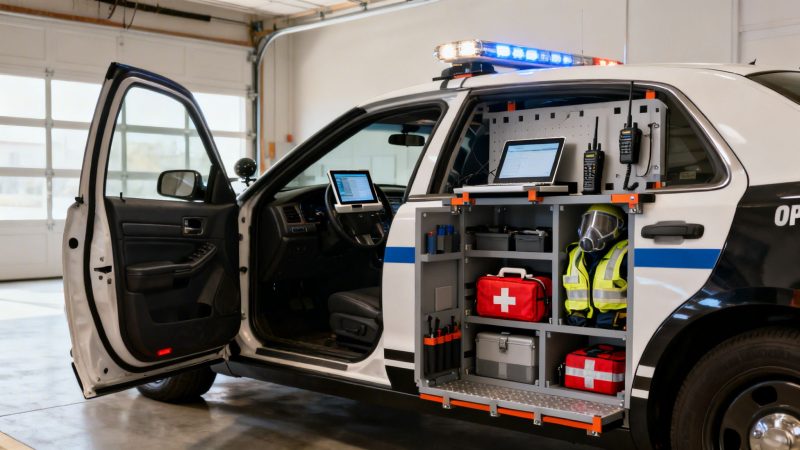
Your Guide to Patrol Vehicle Equipment in 2026
When we talk about "patrol vehicle equipment," we're talking about far more than just the basics. It's the entire ecosystem of tools and systems that transform a standard vehicle into a mobile command center for law enforcement, security, and emergency responders. This covers everything from the lights and sirens that clear a path to the communications gear that keeps your team connected.
Getting this right isn't just a matter of checking boxes. Properly outfitting a vehicle is absolutely fundamental to officer safety, mission success, and maintaining public trust.
The Blueprint for a Mission-Ready Vehicle
Building out an effective patrol car is a lot like putting together a highly specialized toolkit. Every single component has a job to do, designed to tackle a specific challenge you'll face in the field. Whether it’s a high-speed pursuit or a routine traffic stop, having the right gear can be the deciding factor between a smooth operation and a critical failure.
This isn’t just about slapping some lights and a siren on the roof. It’s about methodically creating an integrated, reliable, and functional mobile office that can withstand the rigors of daily duty.
The market reflects this need for specialization. The global police vehicle market was valued at USD 8.2 billion in 2024 and is on track to hit USD 13.5 billion by 2033. That’s a huge jump, and it shows just how much agencies are investing in advanced, purpose-built vehicles. It really drives home the point that making smart equipment choices is more critical than ever.
To truly understand what goes into a modern patrol vehicle, it's best to look at the equipment in categories. Below is a quick breakdown of the core components and why they matter.
| Equipment Category | Key Components | Primary Function |
|---|---|---|
| Emergency Systems | Lightbars, sirens, controllers | Signal authority, clear traffic, and provide scene safety. |
| Communications | Multi-band radios, antennas, modems | Maintain contact with dispatch and other units; enable interoperability. |
| In-Car Technology | MDTs, rugged laptops, printers | Access records, file reports, navigate, and manage incidents from the field. |
| Officer Safety | Partitions, weapon mounts, push bumpers | Protect officers from threats inside and outside the vehicle. |
| Prisoner Transport | Secure seats, camera systems | Safely and securely transport detainees. |
| Storage & Organization | Trunk organizers, gear bags, console vaults | Keep essential equipment secure, organized, and readily accessible. |
| Power Management | Auxiliary batteries, idle-reduction tech | Ensure all electronic systems have reliable power without draining the main battery. |
| Vehicle Mounting | Computer docks, console plates, antenna mounts | Securely install all equipment to prevent injury and damage during vehicle maneuvers. |
Each of these categories plays a vital role in creating a vehicle that's ready for anything the shift throws at it.
Core Equipment Categories
A properly equipped vehicle is a careful balance of visibility, communication, safety, and efficiency. Each piece of gear serves a distinct purpose, and knowing what they are is the first step toward building a fleet that works.
Let's dig a little deeper into the foundational components.
Emergency Lighting and Sirens: This is the most obvious gear, used to assert authority and move through traffic. Modern LED lightbars are incredibly versatile, offering multiple flash patterns for different scenarios—like an all-out emergency response versus a directional pattern to guide traffic at an accident scene.
Communication Systems: A first responder's radio is their lifeline. A solid setup includes a multi-band radio that supports interoperability, which is just the ability to talk to other agencies during a major event. You also need a quality antenna to ensure that lifeline stays clear and connected, even in rough terrain.
In-Car Technology: This is the mobile office component. It includes Mobile Data Terminals (MDTs) or ruggedized laptops for running plates, filing reports, and getting directions. Just as important are the secure mounting solutions that keep this gear from becoming a dangerous projectile in a crash.
Officer Safety and Security: Partitions, weapon mounts, and prisoner transport seats are non-negotiable. They create a secure barrier between the officer and detainees while ensuring firearms are both accessible to the officer and secured from everyone else. These aren't luxuries; they're essential for creating a safe workspace.
Practical Insights for Smart Outfitting
When you're choosing equipment, it's easy to get fixated on the upfront cost. But you really need to think about the total cost of ownership. A cheap lightbar that burns out in two years is going to cost you more in downtime and replacement fees than a more durable, warrantied one would have from the start.
Actionable Insight to Save Money: Prioritize modular equipment. For example, choosing a lightbar controller that can be updated via software means you don't have to buy new hardware if your department's flash pattern protocols change. This avoids a costly replacement and installation fee, saving hundreds of dollars per vehicle.
Here’s a practical example: a private security firm can save a ton of money by opting for high-visibility amber and white lightbars that aren't pursuit-rated. They provide an excellent visual deterrent and meet their operational needs perfectly, but at a fraction of the cost of the red-and-blue systems required for law enforcement. It's a strategic choice that fits the mission without overspending on capabilities they can't legally use anyway.
Ultimately, every single piece of patrol vehicle equipment should have a clear purpose tied directly to your agency's day-to-day operations. When you start with that fundamental understanding, you can build a fleet that’s not only effective but also fiscally responsible.
Of course, once you have all this gear, you have to manage it. Keeping track of inventory, maintenance schedules, and assignments becomes a lot simpler with integrated platforms. You can see how our apps at Resgrid help streamline these exact processes.
Matching Your Equipment to Your Mission
Outfitting a patrol vehicle isn't a one-size-fits-all task. A huge and surprisingly common mistake is buying gear that just doesn't fit the mission. It’s an easy way to burn through a significant chunk of your budget.
Think about it: the needs of an urban cop navigating dense city blocks are worlds apart from a rural sheriff’s deputy covering hundreds of square miles of open country.
When you match your patrol vehicle equipment to your primary mission, you not only build a more effective fleet but also make much smarter financial decisions. It's a strategy that ensures every single dollar spent directly supports your team's safety and ability to get the job done right.
Urban Law Enforcement Loadout
For an urban police department, high-intensity, compact equipment is the name of the game. These officers operate in a world of tall buildings that chew up radio signals, bumper-to-bumper traffic, and constant close-quarters encounters. The vehicle setup has to reflect that reality.
- Lighting: Compact, multi-level lightbars are critical. You need powerful alley and takedown lights to punch through the darkness and illuminate building sides. A practical example is using a lightbar with integrated side-facing "alley lights" to check addresses on buildings without having to stop and use a spotlight, increasing efficiency on patrol.
- Communications: A robust multi-band radio is a given, but the antenna system is just as crucial. You'll want low-profile, high-gain antennas to fight through the signal interference that’s so common in cities. Clear comms are non-negotiable.
- Safety: A push bumper is practically standard issue. It provides a tactical advantage and protects the vehicle during tight urban maneuvers. And given the higher volume of transports, a full-cage partition and a dedicated prisoner camera system are vital for officer safety.
This decision-making process is laid out in the flowchart below. It’s a great visual guide for walking through your choices for lighting, comms, and safety based on your core functions.

As you can see, your operational environment should directly drive your equipment choices, steering you toward a truly purpose-built patrol vehicle.
Rural and County Sheriff Loadout
A rural sheriff's office plays by a completely different set of rules. Deputies are often patrolling vast, remote areas with limited backup and spotty-at-best cell service. Their patrol vehicle has to be a lifeline, prioritizing durability, long-range capability, and self-sufficiency.
Actionable Insight to Save Money: For rural agencies where vehicles idle for long periods at remote scenes, investing in an automatic idle-reduction system can save thousands of dollars per vehicle in fuel costs and engine wear over its lifespan. The system automatically shuts down the engine but keeps electronics running on the auxiliary battery, paying for itself in fuel savings alone.
Key gear for a rural vehicle includes long-range radio antennas, ruggedized computers that can take a beating on bumpy backroads, and powerful spotlights for searching open fields or long, dark driveways. Since many county roads are unlit, a full-size lightbar offering 360-degree visibility is far more practical than a slick, low-profile urban bar.
Private Security Details
Private security operates under a different mandate altogether. The goal is almost always deterrence and observation, not high-speed pursuit and enforcement. This distinction is where you can find some major opportunities for cost savings.
A security firm can project a strong, authoritative presence without having to shell out for expensive law enforcement-grade systems.
Actionable Insight for Saving Money:
Private security can opt for high-visibility, non-pursuit-rated lightbars. These systems use amber and white LEDs to create a powerful visual deterrent at a fraction of the cost—often saving 50% or more compared to the red-and-blue pursuit-rated bars. This approach perfectly meets their operational need for visibility and presence without paying for features they can't legally use anyway.
By aligning equipment choices with these distinct mission profiles, any department or company can build a more capable and cost-effective fleet.
Installing Equipment for Safety and Reliability

Picking out the right gear for your patrol vehicles is the first step, but how that equipment gets installed is what really determines if it’s an asset or a liability. It’s no exaggeration to say that a sloppy installation can turn thousands of dollars of equipment into a dangerous hazard, causing everything from equipment failure and vehicle fires to officer injuries.
Getting this right is about much more than just bolting parts down. It's a methodical process that demands a deep understanding of power management, ergonomics, and secure mounting. A single bad wire or a poorly placed control head can cause a world of hurt down the road.
Mastering Power Management
Think of your car's electrical system like the circuit breaker in your house. Plug too many things into one outlet, and you'll trip it. It's the same principle in a patrol car. The factory electrical system was never meant to handle the simultaneous load of a lightbar, siren, radio, and computer.
An overloaded electrical system is a critical point of failure. Proper power management isn't just about preventing dead batteries; it’s about ensuring that an officer’s lifeline—their communications and emergency warning systems—never goes dark at a critical moment. A practical example of failure is a radio shutting down during a call for backup because the siren, lightbar, and computer drew too much power.
To get around this, a dedicated power distribution system is a must. This isn't optional for a professional upfit. It typically involves:
- Auxiliary Batteries: A second battery is used to run all the extra gear, completely isolating it from the vehicle's main battery. This means you won't be left with a car that won't start.
- Power Distribution Blocks: These are essentially specialized fuse boxes that provide protected, individual circuits for each piece of equipment. This is your first line of defense against overloads and electrical fires.
- Low-Voltage Disconnects: This is a smart little device that monitors battery voltage. If it drops too low, it automatically shuts down non-essential equipment to make sure there's always enough juice left to start the engine.
This is the non-negotiable trifecta for powering a modern patrol vehicle.
Ergonomics and Secure Mounting
Where you physically put the equipment inside the cab is just as critical as how you power it. Screens, mics, and control heads have to be placed with both officer safety and workflow in mind. The whole point is to minimize distractions and make sure controls are right where you need them, without forcing the driver to take their eyes off the road.
The market for patrol vehicle equipment is huge—estimated at USD 15 billion annually—and constantly evolving. With key features like ADAS for collision avoidance now standard in 60% of new procurements and comms systems integrating with fusion centers, the stakes for correct installation have never been higher. You can learn more about the scale of these advancements by exploring the research on the modern police vehicle market.
To keep things safe and functional, your installation checklist must include these best practices:
- No Airbag Obstruction: Nothing—not a single wire or bracket—should ever be mounted in a way that could interfere with airbag deployment. This is a life-or-death rule.
- Secure Mounting Points: Always use vehicle-specific mounting brackets that bolt directly to the frame or other solid points. Drilling random holes in the dashboard is asking for trouble.
- Clean Wiring Runs: All wires need to be neatly bundled, secured, and routed far away from pedals, seat tracks, and sharp metal edges. This prevents chafing, which can lead to shorts and fires.
Actionable Insight to Save Money:
Use pre-made, vehicle-specific wiring harnesses instead of paying for hours of custom wiring. A harness might cost $150-$300, but it can cut installation time by several hours, saving $400 or more in labor costs per vehicle. It also ensures consistent, error-free connections, preventing costly electrical problems down the road.
Proactive Maintenance to Protect Your Investment

Your patrol vehicle equipment is a major line item in the budget. Let's be real—it's a massive investment. The single best way to protect that investment is a proactive maintenance plan, because nobody wants to deal with the staggering costs of emergency repairs when a critical system dies in the middle of a call.
This is all about shifting from a "fix it when it breaks" mindset to a "prevent it from breaking" strategy. A simple, consistent inspection schedule gives your team the power to spot tiny issues before they snowball into mission-critical failures. It saves money, reduces downtime, and keeps vehicles on the road where they belong.
Daily and Weekly Checks for Officers
The most effective maintenance programs I’ve seen are built on simple, repeatable checks that just become second nature. These quick inspections, done right at the start of a shift, are your first line of defense against equipment failure.
Daily Checks (Less than 2 minutes):
- Lights and Sirens: Flip on all the emergency lights and cycle through the siren tones. A single burnt-out module can seriously reduce a vehicle's visibility and safety.
- Comms Check: Do a quick radio check with dispatch. You need to know you can transmit and receive clearly before you need it.
- In-Car Tech: Power up the mobile data terminal (MDT) or laptop. Make sure it boots up correctly and connects to the network.
Weekly Checks (Less than 5 minutes):
- Antenna Mounts: Physically wiggle the antennas to make sure the mounts are tight. A loose antenna leads to signal problems and can eventually just snap off.
- Cable Inspection: Glance over the wiring around the console, computer mount, and partition. Look for any pinched, frayed, or loose cables.
- Lens Cleaning: Grab a soft cloth and wipe down the lightbar and other exterior light lenses. Dirt and grime build up fast and can really dim the brightness.
This kind of consistent attention to detail is vital, especially as our vehicles get packed with more and more complex tech.
Actionable Insight to Save Money: A weekly wipe-down of lightbar lenses with a non-abrasive cleaner prevents UV damage and hazing. This simple, free action can extend the usable life of a $2,000+ lightbar by years, saving your agency from a premature replacement and maximizing your initial investment.
Monthly and Annual Maintenance
While daily checks catch the immediate stuff, monthly and annual inspections are for tackling long-term wear and tear. These deeper dives are usually handled by a fleet manager or a certified upfitter and are absolutely crucial for the entire system's integrity. To get a handle on all the moving parts, it helps to use a good preventive maintenance checklist template.
With the law enforcement equipment market expected to grow by USD 1.45 billion between 2024 and 2028, these proactive measures are more important than ever. The fastest-growing slice of that pie is surveillance and monitoring systems—tech that relies on consistent upkeep to stay reliable in the field.
A structured maintenance schedule like this transforms routine checks from a chore into a powerful cost-saving strategy. It ensures every piece of your patrol vehicle equipment works like it's supposed to, protecting both your people and your budget.
Budgeting and Procurement Strategies That Work
Outfitting a patrol vehicle on a tight budget isn't about finding the cheapest gear—it's about being smart. In this line of work, the cheapest option today can quickly turn into your most expensive problem tomorrow. A truly strategic approach looks past the initial price tag and zeroes in on the total cost of ownership, making sure every dollar spent delivers rock-solid reliability out on the street.
This means you have to look at the entire life cycle of a piece of equipment. What’s the warranty like? How much power does it draw? How durable is it, really? When you start asking these questions, budgeting stops being about cutting corners and starts being about making a strategic investment in your agency’s readiness.
The Power of Life-Cycle Cost Analysis
Let’s walk through a real-world example that saves agencies a ton of money. Say you're deciding between two lightbars for your fleet.
- Option A: A modern LED lightbar for $1,500. It has a 5-year warranty, a low amperage draw, and is built like a tank.
- Option B: An older halogen lightbar for $800. This one comes with a 1-year warranty, sucks down a lot more power, and you’ll be replacing bulbs constantly.
On paper, the $800 bar looks like a steal. But it’s a trap. Its high power draw means more fuel burned and more strain on the vehicle's entire electrical system. On top of that, you’ll be dealing with constant downtime and labor costs every time a bulb blows.
Actionable Insight to Save Money: The $1,500 LED lightbar is the smarter buy. Over a 5-year period, the halogen bar could easily cost an extra $500 in replacement bulbs and labor, plus hundreds more in added fuel consumption due to its higher power draw. The LED bar's higher initial price is quickly offset by near-zero maintenance and lower operational costs, making it the more cost-effective choice.
That’s life-cycle cost analysis in a nutshell. It’s a simple but powerful way to make fiscally sound decisions that prioritize long-term performance and shield your budget from nasty surprises down the road.
Actionable Strategies for Saving Money
Beyond just analyzing products, there are bigger-picture strategies you can use to make your budget go a lot further. It’s all about changing how you buy, not just what you buy.
One of the most effective tactics is using cooperative purchasing contracts. These are massive, pre-negotiated deals that let smaller agencies get the kind of bulk pricing usually reserved for huge departments. Instead of haggling for five lightbars, you get the price as if you were buying five hundred. This can save 15-20% on major equipment purchases.
Another key move is to actively hunt for federal and state grants. You'd be surprised how many grant programs are out there specifically to help agencies fund equipment upgrades for their patrol fleets. These can help you get essential gear that would otherwise be completely out of reach. Of course, managing all these assets and their costs is another piece of the puzzle. Exploring different pricing models for management software can help you find a system that works for your budget. For a clear idea of what’s out there, you might want to learn more about platform pricing options like those offered by Resgrid.
By pairing a smart life-cycle approach with these kinds of procurement tactics, you can equip your vehicles with high-quality, dependable gear without blowing your budget.
Putting Your Fleet Management on Autopilot with Resgrid

Alright, so your vehicles are finally kitted out with all the right gear. The big job’s done, right? Not quite. Now the real challenge begins: keeping track of it all. If you’re trying to manage hundreds, or even thousands, of assets with a tangled mess of spreadsheets, you’re setting yourself up for lost equipment, major headaches, and countless wasted hours. This is where a dedicated management system completely changes the game.
Modern platforms like Resgrid are designed to yank you out of those outdated, manual workflows and into an automated, digital world. It’s not just about saving time—it’s about unlocking smart strategies to slash costs and boost accountability across every single vehicle in your fleet.
Ditch the Logbooks and Digitize Your Inventory
First things first: you need to get a handle on what you actually have. The only way to do that is to create a digital record for every single piece of gear. Think of it as a birth certificate for every asset, from that expensive mobile data terminal all the way down to a basic fire extinguisher.
Moving away from paper logs for good is simpler than you might think. Here’s a practical example of how it works:
- Create a New Item: In the system, you add an asset—let's say a new "Toughbook Laptop, Model CF-33."
- Log the Vitals: Next, you plug in the important details: serial number, purchase date, cost, and warranty expiration.
- Assign It: Finally, you digitally assign that specific laptop to "Patrol Unit 12."
Boom. You now have a permanent, searchable record. Anyone with the right permissions can see exactly what gear is in which vehicle, when you bought it, and what it’s worth. That simple process creates a single source of truth for your entire inventory. No more guessing who has what.
Actionable Insight to Save Money: Use your inventory system to set automated service reminders. For example, create an alert that notifies you 30 days before a lightbar's warranty expires. This simple step ensures you can file a claim for repairs or replacement while it's still covered, saving your agency from an unexpected out-of-pocket repair bill that could easily cost over $1,000.
Build an Unbreakable Audit Trail for Every Asset
One of the biggest wins with a digital approach is creating a complete, auditable history for every single piece of patrol vehicle equipment. When it's time for the annual audit or when a piece of gear inevitably goes missing, you’re no longer digging through stacks of paper. Instead, you have an instant, time-stamped log of that asset’s entire life.
This detailed history is a massive advantage for a few key reasons:
- Painless Audits: When the auditors show up, you can generate a full report in minutes, not days.
- Stronger Budget Requests: Need to ask for new equipment? You can walk into that budget meeting with hard data showing the age, repair history, and service life of your current gear. It builds a rock-solid case for upgrades.
- Clear Accountability: If a radio is damaged or lost, its assignment history shows exactly who was last responsible for it.
Of course, a great software solution is just one part of the puzzle. It’s also crucial to understand the bigger picture of fleet management. For a deeper dive on that front, expert guides like the 10 Fleet Management Best Practices for 2025 can offer some valuable strategic thinking.
By putting a system like Resgrid in place, you’re turning asset management from a reactive nightmare into a proactive, data-driven strategy that saves money and simplifies your day-to-day operations. If you want to see the tools that make this happen, you can explore the full range of features available over on our platform. Find the link here: https://resgrid.com/features
Frequently Asked Questions About Patrol Vehicle Equipment
When you're outfitting a fleet, a ton of questions always come up. Here are some of the most common things we hear from fleet managers and officers about picking, maintaining, and budgeting for patrol vehicle equipment. We'll give you clear answers to help guide your decisions.
What Is the Most Important Piece of Patrol Vehicle Equipment?
While every piece of gear has a job, your communications systems are the absolute lifeline. Nothing else comes close. An officer's radio is what connects them to dispatch, lets them call for backup, and allows for coordination during a big incident.
Without clear and dependable comms, every other tool in the vehicle becomes far less effective. A practical example is a pursuit situation: without a radio, an officer can't coordinate with other units to set up roadblocks or get air support. For this reason alone, prioritizing a quality multi-band radio and a properly installed antenna system is a fundamental investment in officer safety.
How Can I Future-Proof My Equipment Purchases?
This is a big one. The key is to focus on equipment that is modular, scalable, and software-updatable. Tech moves fast, and the last thing you want is for your expensive gear to be obsolete in a year or two. This approach builds adaptability right into your fleet from day one.
Here’s what that looks like in the real world:
- Lighting Controllers: Go with a controller that can be reprogrammed with a simple software update. If your agency’s lighting protocols change down the road, you won't be stuck with a costly hardware replacement.
- Computer Docks: Instead of buying a dock made for one specific laptop model, choose an adjustable or universal dock. This lets you accommodate different devices as you upgrade your computers over time.
- Modular Consoles: Use console systems that have interchangeable faceplates. This allows you to swap out radios or controllers without tearing out and replacing the entire console structure.
Actionable Insight to Save Money: Using a universal laptop dock might cost an extra $50 upfront compared to a proprietary one, but it saves you from spending $500-$800 on a brand-new dock every time you upgrade your vehicle fleet or computer models. Over the life of two vehicle cycles, that's a saving of hundreds of dollars per car.
How Much Does It Cost to Outfit a Patrol Vehicle?
Honestly, the cost to upfit a patrol vehicle varies dramatically depending on its mission. A basic security vehicle with minimal lighting and no partition might run as little as $10,000. On the other end of the spectrum, a fully-loaded highway patrol car with pursuit-rated systems, advanced communications, and integrated video can easily top $50,000.
The main cost drivers are almost always the same few items:
- Pursuit-Rated Lighting and Sirens: This gear is built to a much higher standard for durability and performance, and the price reflects that.
- Multi-Band Radios: The ability to talk across different radio bands and systems is expensive, but it's essential for interoperability with other agencies.
- Integrated Video Systems: Multi-camera, in-car video systems represent a huge but vital investment in evidence collection and officer accountability.
By carefully matching the equipment to the vehicle's specific role, agencies can avoid overspending on features they don’t actually need and keep their upfitting budgets under control. A practical example is a campus security vehicle: it doesn't need a $6,000 multi-band radio when a standard $800 single-band radio will cover its entire operational area perfectly.
Managing every piece of equipment, from purchase date to maintenance logs, is crucial for protecting your investment. Resgrid provides a powerful, open-source platform to track inventory, automate service reminders, and streamline your entire fleet management process. Learn more and see how it works at https://resgrid.com.