
Fire Department Radios: Enhance Communication & Safety
When you’re in the thick of it, a fire department radio is an unbreakable lifeline. It’s your eyes and ears when smoke and noise make seeing or hearing next to impossible. This isn't just a piece of hardware; it’s the critical link that connects crews on the line, the command staff outside, and the dispatchers coordinating it all.
Let's break down the tech, best practices, and systems that make this lifeline actually work when it matters most.
The Unbreakable Lifeline in Every Fire
Think of a firefighter's radio as their most vital sense on the fireground. When you’re in a smoke-filled hallway with zero visibility and the fire is roaring, it’s the only way to get orders, report what you're seeing, or call for help. That one piece of gear can be the difference between a controlled scene and a total disaster.
It wasn't always this way. Before two-way radios became common, departments were stuck using basic phone systems or even sending runners to get mutual aid, which cost precious time. The real shift started in the late 1940s when the first two-way radio systems were adopted. By 1966, pagers began replacing the old alert sirens and horns. This evolution, which you can read more about in the FCC's history of public safety communications, was a game-changer for response times and on-scene coordination.
From Analog Static to Digital Clarity
The jump from those early analog systems to today's digital networks has been massive for firefighter safety and capability. The old analog radios worked, but they were often full of static, had limited range, and weren't secure. Modern digital systems, on the other hand, give you crystal-clear audio even in the loudest environments and unlock features we couldn't have dreamed of back then.
These features are the building blocks of a truly connected communication system. For instance, radios today can transmit a firefighter's exact location in real time. This is where platforms like Resgrid come in, integrating what was once just voice communication into a complete command-and-control system.
Actionable Insight: You don't always need to buy all new hardware to dramatically improve coordination. By integrating your existing radios with a modern dispatch platform, you can add powerful features like live mapping and personnel accountability for a fraction of the cost of a full system overhaul. It extends the life and value of the gear you already have.
This integration creates a common operating picture. A dispatcher no longer just sees an incident on a map; they see the precise location of every unit and firefighter. You can learn more about how Resgrid's AVL for units turns simple radio check-ins into powerful, data-driven situational awareness that keeps everyone safer.
Choosing the Right Radio for the Job
Picking the right fire department radios is the bedrock of any solid communications plan. This isn't about memorizing model numbers; it's about knowing which tool to grab for which job. It's just like a mechanic's toolbox—you wouldn't use a sledgehammer to tighten a small bolt.
And just like every other piece of technology, radios have come a long, long way. The journey from simple point-to-point voice to the integrated data networks we rely on today has been a game-changer.

This evolution is all about creating more connected, more capable systems. Let's break down the three workhorse radios your department will lean on every single day.
The Three Pillars of Fireground Communication
Every radio has a specific job, but they all have to work together to spin a seamless web of communication. If you don't understand their distinct roles, you'll struggle with operations and likely waste money on your next purchase.
Here's the breakdown:
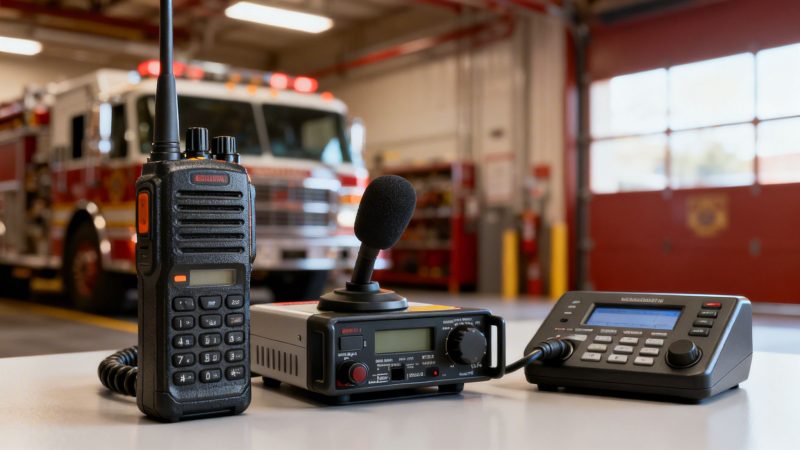
Handheld Portable Radios: This is a firefighter's personal lifeline inside a structure fire. It’s the compact unit they carry on their turnout gear, built for short-range communication with their crew and the Incident Commander just outside. Practical Example: An interior attack crew uses their handhelds on a dedicated "talk-around" channel to coordinate searching two different rooms simultaneously, while the Incident Commander outside listens in.
Mobile Radios: Think of these as the powerful communications hub mounted right in the dash of your engines, trucks, and ambulances. They have way more punch than a handheld, ensuring the crew in the apparatus can talk to dispatch and other units from miles away. Practical Example: An engine company responding from a substation 10 miles away uses its mobile radio to get a size-up report directly from the first-arriving unit, allowing them to prepare for a water supply operation before they even get on scene.
Base Stations: This is command and control. Located at the fire station or a central dispatch center, the base station is the most powerful piece of the puzzle. With massive transmitters and sophisticated antennas, it’s what allows dispatch to coordinate the entire response across a county or region. Practical Example: During a major wildfire, a dispatcher at a county base station coordinates air tanker drops and ground crew movements from four different departments, all operating on different channels that are patched together at the dispatch center.
To get the most out of your budget and your equipment, it's crucial to see how these pieces fit together. This comparison should clear things up.
Comparison of Fire Department Radio Types
| Radio Type | Primary Use | Typical Power | Pros | Cons |
|---|---|---|---|---|
| Handheld | Individual firefighter on-scene | 3-5 Watts | Highly portable, personal device, intrinsically safe options available | Limited range and battery life, signal can be blocked by structures |
| Mobile | In-vehicle communication | 25-50 Watts | Excellent range, uses reliable vehicle power | Fixed to the apparatus, not for on-foot operations |
| Base Station | Dispatch and wide-area command | 50-100+ Watts | Maximum power and range, integrates with other systems | Immobile, requires significant infrastructure and investment |
Ultimately, choosing the right radio is about understanding the mission for each device. A firefighter entering a building doesn't need a 50-Watt radio on their hip, but the engine they arrived in absolutely needs that power to stay connected to dispatch. Matching the tool to the task keeps everyone safer and your budget healthier.
Must-Have Features for Modern Fire Radios

When you're looking to buy or upgrade your department's radios, it's incredibly easy to get buried in a mountain of technical specs. But let's cut through the noise. There are a handful of features that are absolutely non-negotiable for keeping your crew safe and effective on the scene.
These aren't just acronyms on a sales brochure; they are the mission-critical capabilities that you bet your life on when the tones drop. Getting this right isn't about spending more money—it's about investing every single dollar into what actually matters in a real-world firefight.
The Standard for Seamless Teamwork
If there’s one feature you can't compromise on, it's P25 Compliance. Think of P25 (Project 25) as the universal language for all public safety radios. It's what guarantees a radio from one manufacturer can talk directly to a radio from a completely different brand, as long as they're both on the P25 standard.
Practical Example: You're called to a large-scale structure fire in the next county over. Their department uses a different radio system, but because you are both P25 compliant, your Incident Commander can switch to a pre-programmed mutual aid channel and communicate directly with their command staff. This prevents a dangerous communications blackout that could lead to tragedy.
Actionable Insight: When you're writing grants, like the Assistance to Firefighters Grant (AFG), make it a point to state you’re seeking funds for P25-compliant radios to improve interoperability. This shows you’ve done your homework, understand regional needs, and have a solid plan, which can seriously strengthen your application and save your department thousands on gear you have to have.
Built for the Harshest Environments
The fireground is a chaotic, brutal place, and your equipment has to be tough enough to take a beating. This is where a couple of key ratings come into play that should be mandatory for any frontline radio.
Intrinsically Safe (IS) Rating: This isn't a luxury; it's a lifesaver. An IS-rated radio is specifically designed so its internal electronics can't create a spark. Practical Example: At a car accident with a leaking fuel tank, only IS-rated radios should be used within the hot zone. A tiny spark from a non-IS radio could ignite the fuel vapors, causing a catastrophic explosion.
MIL-STD-810 Durability: This is a U.S. military standard that proves a device can handle being dropped, shaken, frozen, baked, and dunked in water. A radio with this rating is built for the gritty reality of firefighting. It won't die on you just because it got dropped on the pavement or blasted with water from a 2.5" line.
Features That Enhance Situational Awareness
Beyond just being tough, today’s radios offer features that give Incident Command a much clearer picture of what's happening on the ground. These capabilities turn a simple voice device into a powerful command and accountability tool.
GPS Location has been a complete game-changer for firefighter accountability. When a radio transmits its location, command staff can see exactly where that firefighter is on a map in real-time. This is invaluable for tracking crews inside a massive warehouse or, in a worst-case scenario, finding a firefighter who has called a mayday.
Then you have Channel Scanning, which lets an officer or chief monitor several radio channels at once. Practical Example: An Incident Commander can program their radio to scan the main fireground tactical channel, a secondary water supply channel, and the EMS channel. This allows them to maintain total situational awareness without having to constantly switch channels manually, ensuring they don't miss a critical request for a charging line or a transport update from a medic. Juggling all that traffic can get complicated, but good messaging and dispatch software can really help simplify the flow of information.
Why Radio Communications Still Fail and How to Prevent It
Even with the best fire department radios money can buy, comms still go down on the fireground. It’s a terrifying and stubborn problem. A modern radio is an incredible piece of kit, but it’s no magic wand. Failures are going to happen, whether it's the gear itself, a human mistake, or a communication gap between responding agencies.
The first step to building a rock-solid communication plan is understanding exactly why these lifelines break down. These aren't just theoretical issues; they have brutal, real-world consequences.
The Sobering Reality of Communication Breakdowns
History has taught us some hard lessons about the cost of failed communications. Tragically, radio failures have been a direct factor in firefighter line-of-duty deaths. Look back at the 1978 Syracuse, NY fire where four firefighters died after their portable radios failed. Or the 1986 Hackensack Ford fire, where a staggering 50% of radio transmissions were never acknowledged, contributing to the deaths of five firefighters.
These events, detailed in a Fire Engineering analysis of radio communication history, threw a harsh spotlight on the urgent need for better systems and clear protocols. They also exposed three core failure points that we still battle with today:
Environmental Obstacles: Radio waves hate trying to punch through concrete, steel, and even the low-E glass common in new buildings. Basements, stairwells, and sprawling commercial structures can quickly turn into "dead zones," rendering a portable radio completely useless.
Interoperability Gaps: Just because your department and the mutual aid company both have shiny new digital radios doesn't mean you can talk to each other. Without shared channels and real P25 compliance, you're essentially operating in isolated bubbles, blind and deaf to one another.
Human Factors: Throw in the chaos and extreme stress of a fire, and mistakes are inevitable. A firefighter might accidentally bump their radio to the wrong channel, key up before the channel is clear, or have their mic muffled by turnout gear, turning a critical message into garbled noise.
Building Redundancy and Resilience
Fixing this isn't about chasing one perfect radio. It's about building a system with layers of resilience. When one communication method fails—and it will—another needs to be there to pick up the slack.
Actionable Money-Saving Insight: You don't need a massive grant to improve your radio skills. Get creative and build your own in-house "radio obstacle course." Send your crew into the basement or the deepest, most shielded part of your station and have them practice transmitting clear, concise messages. It costs nothing but time and will immediately expose the weak spots in your gear and your team's proficiency.
Simple, iron-clad protocols are just as vital. Every single member must know, without hesitation, how to declare a "Mayday" and exactly what information that transmission must contain. The only way to get there is through rigorous, repetitive training until it becomes pure muscle memory.
To really fortify your communications, start taking these steps now:
Implement Rigorous Radio Drills: Don't just talk about using radios; practice it constantly. Run drills that simulate the worst conditions, like high-noise environments or trying to communicate clearly through an SCBA mask.
Establish Simple, Clear Protocols: Make your "Mayday" protocol second nature. Standardize your radio terminology for reporting progress and conditions so there's zero room for confusion on the fireground.
Create Redundant Pathways: Radios are your voice lifeline, but you need a data lifeline, too. This is where modern software comes in. Platforms like Resgrid can push critical updates, maps, and pre-plans directly to mobile devices. This gives you a secondary information channel that doesn't eat up precious voice radio bandwidth.
Integrating Radios with Modern Dispatch Software

This is the modern command post. Voice comms are still king, but now they're backed up by critical data on a tablet. This fusion of reliable radio traffic and visual, on-screen information is what makes incident command smarter and faster than ever before.
Your department’s fire department radios are absolute workhorses, but they really only do one thing well: transmit voice. On a chaotic scene, relying on voice alone means the airwaves can get jammed up fast. This is where a little modern magic comes in—integrating your existing radio network with dispatch software gives you a massive upgrade without having to replace every piece of hardware.
Think of it like adding a smart data layer over your trusted voice network. Your crews are still using their radios for the critical stuff—"Charge the line!" or "Victim found, second floor!"—but the software is quietly working in the background, painting a rich, visual picture of the entire operation. For this all to work smoothly, you need solid Data Center Connectivity Solutions to keep data flowing reliably from the dispatch center out to the field.
A Practical Example in Action
Let’s walk through a real-world scenario. A dispatcher gets a panicked call over the radio: structure fire, possible entrapment. The adrenaline spikes, and you know the radio channels are about to light up. But with a platform like Resgrid, the dispatcher isn't just a voice on the radio anymore.
Instead of only juggling radio traffic, they can now:
- See the Whole Board: Instantly view every available unit on a live, dynamic map.
- Dispatch with a Click: Send the closest, most appropriate engine, truck, and medic unit based on their real-time location.
- Push Tactical Intel: Simultaneously send incident details, hydrant locations, and pre-plan documents directly to the tablets in responding units.
This all happens while the dispatcher keeps an open line for voice comms. The crews get the call on the radio, but they also get a ton of tactical data pushed to their screens that they can review while en route. It's a two-channel approach that keeps the airwaves clear for what truly matters.
The Smart Way to Save Money
Frankly, the best part of this approach is how it impacts the budget. A full-blown, proprietary CAD (Computer-Aided Dispatch) system can easily run into the six-figure range. For most volunteer and many smaller municipal departments, that's just not going to happen.
Actionable Money-Saving Insight: Modern dispatch platforms like Resgrid deliver powerful, CAD-like functionality for a tiny fraction of the cost. You get better coordination, live personnel tracking, and automated run reports without the eye-watering price tag of a traditional system. It's all about making the most of the investment you already have in your fire department radios.
To handle the 26,959,000 incident runs U.S. fire departments managed in 2020, you have to be efficient. Layering a flexible tool like Resgrid over your existing radio infrastructure is the smartest way to boost performance without breaking the bank. You can see exactly what this looks like by checking out Resgrid's dispatching features.
Frequently Asked Questions About Fire Department Radios
As technology in the fire service moves forward, it’s natural to have questions. Getting straight answers is key to making smart, safe, and cost-effective choices for your department's communication gear. Let's tackle some of the most common ones we hear.
What Is P25 and Why Is It Important for My Department?
P25 (Project 25) is a set of standards that makes sure digital two-way radios can talk to each other, no matter who made them. You can think of it as a guaranteed common language for public safety.
This becomes absolutely critical during a large-scale incident where multiple agencies—fire, police, and EMS from different jurisdictions—need to coordinate on the fly. Without P25, you end up with "digital islands" where one crew's radios can't communicate with another's. That's a huge safety risk. Investing in P25-compliant gear isn't just about new tech; it's a foundational piece of effective mutual aid.
How Can My Volunteer Department Afford Modern Radio Tech?
Let's be honest: cost is a massive hurdle for many departments, especially volunteer ones. But you don't have to break the bank to get modern capabilities.
Actionable Money-Saving Insight: The biggest and most immediate impact often comes from software, not hardware. A platform like Resgrid can give you advanced dispatch, mapping, and personnel tracking features for a tiny fraction of what a traditional CAD system costs. This approach squeezes every last drop of value out of your existing fire department radios by layering on powerful new tools for a minimal investment.
Beyond software, here are a couple of other smart strategies:
- Pursue Grants: Get aggressive with grant writing. Programs like the Assistance to Firefighters Grant (AFG) are specifically designed to fund these kinds of communication upgrades.
- Phase Your Upgrades: You don’t need to replace everything at once. Plan it out. Maybe you focus on upgrading portable radios this year and tackle the mobile radios in the apparatus next year. This spreads the cost out and makes it much more manageable.
Can I Use a Smartphone Instead of a Dedicated Fire Radio?
The short answer is an emphatic no. While smartphones are fantastic tools for getting supplementary data from apps like Resgrid, they absolutely cannot replace a purpose-built fire radio for mission-critical voice comms.
Your radio is built tough, it's often intrinsically safe for hazardous atmospheres, and it operates on a dedicated, reliable public safety network. A commercial cell network, on the other hand, will get congested and fail you during a major emergency—it's not a matter of if, but when.
Practical Example: During a major natural disaster like a hurricane or earthquake, cell towers are often the first things to go down or get overloaded. Your dedicated public safety radio system, however, is built with hardened infrastructure and backup power, ensuring it stays operational when you need it most. Use the radio for your essential "go/no-go" voice commands, and use the smartphone to receive non-critical data like maps, building pre-plans, and personnel status updates.
Ready to boost your department's communication without a budget-breaking overhaul? Resgrid offers a powerful, affordable, and open-source platform to manage your dispatch, messaging, and personnel tracking. Get started today and see how you can amplify your existing radio network at https://resgrid.com.