
Mastering Your Fire Alarm Fire Drill: Safety & Efficiency in 2026
For a lot of people, the phrase "fire alarm fire drill" just means a disruptive, time-wasting exercise. But we've seen firsthand how a well-run drill is so much more than that. It's a critical test of your safety plan and a chance to turn a chaotic scramble into a data-driven training exercise that can genuinely save lives and protect your bottom line.
Why Your Fire Drill Strategy Needs an Upgrade
Let’s be honest: most fire drills feel like a bothersome obligation. The alarm blares, everyone shuffles outside, and all work grinds to a halt for a while. It’s a pain.
But what if that routine drill could uncover a critical flaw? Something like a newly blocked exit path or a communication dead zone that could spell disaster in a real fire. This is exactly why you need to rethink your approach.

A modern fire drill isn't just about getting people out the door. It’s about collecting real, actionable data to make your safety protocols stronger. The moment you shift your mindset from obligation to opportunity is when you start seeing the real value.
A well-planned drill can be broken down into a few key phases, each with a specific goal.
Key Phases of a Modern Fire Drill
| Phase | Objective | Key Action |
|---|---|---|
| 1. Planning & Coordination | Set clear goals and ensure everyone knows their role. | Define the scenario, brief fire wardens, and schedule the drill. |
| 2. Execution & Monitoring | Run the drill and observe how the evacuation unfolds in real time. | Trigger the alarm, monitor evacuation routes, and track timing. |
| 3. Documentation & Data | Capture performance metrics and any issues encountered. | Log clear times, note bottlenecks, and record communication successes or failures. |
| 4. Analysis & Improvement | Review the data to identify weaknesses and create an action plan. | Hold a post-drill debrief and update the emergency plan with lessons learned. |
Treating each phase seriously is what transforms a simple evacuation into a powerful tool for readiness.
From Box-Checking to Building Muscle Memory
The data doesn't lie. The push for mandatory alarm systems and regular drills helped drive a 66.1% drop in U.S. fire death rates between 1979 and 2007. Drills that trained people to get out in under three minutes were especially effective at cutting down fatalities caused by panic and confusion. You can dig into the specifics of these life-saving measures from the U.S. Fire Administration.
This really highlights a crucial point: a well-practiced evacuation plan is one of the most powerful safety tools you have. It's all about building muscle memory for everyone in the building, from your newest hire to your designated fire wardens.
Actionable Insight: Treat your next fire drill like a data collection event, not just an evacuation. Time how long each floor takes to clear. Watch for communication breakdowns. See where people hesitate or get confused. This data will show you the hidden weaknesses that simple observation always misses.
The Financial Case for Better Drills
An effective drill strategy also has a direct impact on your finances. Sure, it helps you avoid non-compliance fines, but the real savings come from cutting down on operational risks and potential liabilities down the road.
Practical Example: A manufacturing facility we worked with ran a drill and discovered that a new machinery layout had blocked a secondary exit, doubling the evacuation time for that whole section. By catching this during a controlled drill for the cost of a few hours of downtime, they dodged a potential tragedy and the massive legal and financial fallout that would have followed a real emergency.
This is where a modern platform like Resgrid gives you a clear leg up. Instead of juggling stopwatches and clipboards, you can use a system built for this kind of real-time coordination.
With Resgrid, you can:
- Automate Notifications: Send out clear "DRILL" alerts through the app, text messages, and email. This cuts down on panic and minimizes costly operational downtime.
- Track Progress in Real-Time: Fire wardens can mark areas as "clear" right in the app. This gives you a live, bird's-eye view of the evacuation and helps you spot bottlenecks instantly.
- Generate Actionable Reports: The system automatically creates data-rich reports that pinpoint inefficiencies. This makes it easy to justify safety improvements and prove due diligence without spending hours on paperwork.
A fire drill that’s just about getting everyone out the door is a missed opportunity. A truly effective drill isn't just about compliance; it's a powerful diagnostic tool for your entire safety protocol.
The goal is to move past a simple headcount and start digging into specific, measurable metrics. This is where you find the real chances to improve and, frankly, save money down the line.
Are you testing how quickly your fire wardens on the third floor respond? Trying to see if a mass notification actually reaches everyone? Maybe you’re simulating a blocked stairwell to see how people react and adapt.
Defining these goals before the alarm ever goes off transforms a disruptive event into an incredibly valuable data-gathering exercise.
Defining the Scope and Objectives
First things first: you need to decide what you're trying to accomplish. A drill can be as simple as a single-floor walk-through or as complex as a full-blown, multi-building simulation coordinated with local first responders.
Think about what you really want to test. Here are a few practical objectives to get you started:
- Test Communication Systems: Did the alert hit every device? What about remote staff or people working in loud, industrial parts of the building?
- Measure Evacuation Times: Clock how long it takes for specific departments or floors to clear out and get to their assembly point.
- Evaluate Warden Effectiveness: Watch your fire wardens. Are they confidently guiding people, helping those with mobility issues, and reporting back clearly?
- Simulate a Specific Threat: This is a big one. Put "Do Not Use" signs on a primary exit route. See if people follow the signs and use the alternative paths you've planned.
Actionable Insight for Saving Money: The biggest savings come from finding the small problems before they turn into catastrophic failures. A drill that uncovers a faulty backup generator for your alarm system costs you a few hours of productivity. A real fire exposing that same flaw could cost you everything.
It's like a sports team practicing a specific play. You're not just running around; you're rehearsing a coordinated response to a very specific challenge. As you plan, think about how establishing clear systems of safety routines and automation can really boost your team's efficiency during an actual evacuation. This mindset shifts your drill from a checkbox item to a strategic exercise.
Communication and Coordination
Once your objectives are set, communication is everything. You need to let employees know what's happening without causing a panic or disrupting critical work more than necessary. Honestly, a poorly communicated drill can cause more chaos than a real emergency.
A simple, clear pre-drill announcement can make all the difference.
Practical Example: Pre-Drill Email Template
Subject: ANNOUNCEMENT: Planned Fire Drill on [Date]
Hi Team,
Just a heads-up, we'll be conducting a fire drill on [Date] at approximately [Time].
The goal here is to make sure our safety procedures work and that everyone knows the evacuation routes. When the alarm sounds, please calmly use the nearest safe exit and meet at our designated assembly point at [Location].
This is only a drill and should take no more than [Number] minutes. Your participation is key to keeping everyone safe.
Thanks for your cooperation.
This kind of clear communication cuts down on anxiety and lost productivity. That directly translates to cost savings by reducing the drill's overall impact. The data shows this works. Global fire statistics from 1993 to 2023 reveal consistent drops in fire-related death rates. More specifically, schools that ran quarterly drills saw a 25% reduction in child fire deaths over decades, proving that regular practice saves lives. You can dig into the full analysis of these global fire statistics on CTIF.org if you're interested.
Leveraging Technology for Smart Planning
The planning phase is where you can reclaim a ton of administrative time and money. Manually assigning roles, sending reminders, and setting up communication channels is a massive time-sink.
This is where a platform like Resgrid comes in. You can automate a huge chunk of this prep work.
For example, with Resgrid's scheduling and workflow features, you can pre-plan the whole event.
- Assign Roles in Advance: Digitally assign roles like 'Fire Warden' or 'Observer' to specific people. Everyone knows their job before the drill even starts.
- Automate Notifications: Schedule your pre-drill announcements and the "DRILL START" alert to go out automatically at a specific time. No manual sending needed.
- Set Up Communication Channels: Create a dedicated "Fire Drill" group or channel in the system for real-time updates while the drill is running.
Automating these steps frees you from hours of manual work. Instead of chasing people down and sending one-off emails, the system handles it. This lets you focus on the strategic goals of your drill, not the administrative headaches. You can discover more about how to streamline these processes with Resgrid's workflow tools. Good prep work ensures your drill runs smoothly, giving you the clean data you need for meaningful analysis later on.
Executing a Flawless and Data-Rich Evacuation
Okay, you've done the prep work. Your goals are set, and everyone knows a drill is coming. Now it's time to see how the plan holds up when the alarm sounds. This is where theory gets a reality check.
A truly successful fire alarm fire drill is more than just getting people out the door. It’s about running a coordinated, safe event that actually gives you useful data. We need to get away from the old days of chaotic radio traffic and messy clipboard checklists. Think of this as a live data-gathering exercise, where every single action gives you an insight. Modern tools have completely changed how we do this.
Kicking Off the Drill and Managing the Flow
The trigger is your starting gun. It's more than just flipping a switch on the panel; it's your first critical data point. This is where a dispatching platform becomes a huge asset, especially for cutting down on observer costs and eliminating confusion right from the start.
For example, when you initiate a "Drill" call in a system like Resgrid, it instantly pushes notifications out to everyone's app, text, and email. This one action solves several problems at once:
- Clarity: The "DRILL" message immediately tells everyone this is a planned event. This reduces any real panic and minimizes the hit to productivity.
- Automation: No more manual phone trees or garbled radio announcements. The alert goes out instantly and consistently to everyone.
- Timestamping: The system automatically logs the exact moment the drill began. This gives you a clean, undisputed start time for all your metrics.

As you can see, a good drill starts long before the alarm. It's built on clear goals, a well-defined scope, and making sure your team is notified effectively. This foundation is what sets you up for a smooth execution.
Once the alarm is blaring, the spotlight shifts to your fire wardens. Their role is absolutely critical, and measuring how effective they are is one of the main reasons we're doing this.
The Role of Fire Wardens in a Modern Drill
Your fire wardens are your eyes and ears on the ground. Their job isn't just to yell "get out!"—it's to guide people, assist where needed, and, most importantly, report back what's happening. In a data-focused drill, their actions become trackable events.
Imagine a warden on the 4th floor. Instead of just sweeping offices, they’re actively looking for specific problems. They might spot a few people hesitating by a stairwell, unsure which way to go. The warden calmly points them to the right exit and makes a quick note about the poor signage in that spot.
This is also where they handle anyone with mobility issues. A warden might find an employee who uses a wheelchair waiting at a designated "Area of Refuge."
Practical Example:
A fire warden finds an employee at the 3rd-floor west stairwell's refuge area. Using their Resgrid app, the warden updates their status, marking "Person Requiring Assistance at 3-West." That information is instantly visible on the command dashboard. The incident commander can then dispatch help without a single radio transmission. Meanwhile, the warden stays with the employee, providing reassurance until help arrives.
This is how you replace frantic guesswork with calm, clear coordination.
Actionable Insight for Saving Money: The real cost-saving comes from this clarity. Instead of hiring expensive third-party observers to shadow every warden, the technology does the tracking for you. You get a perfect, timestamped record of when each floor was swept and cleared, all logged automatically.
From Chaos to a Real-Time Command Center
In a traditional drill, the person in charge is usually drowning in information. Radios are squawking, runners show up with outdated news, and you never really know the true status of the evacuation until everyone's counted at the muster point.
This is where a real-time dashboard changes everything. As wardens sweep their zones, they just tap a button in their app to mark an area "clear."
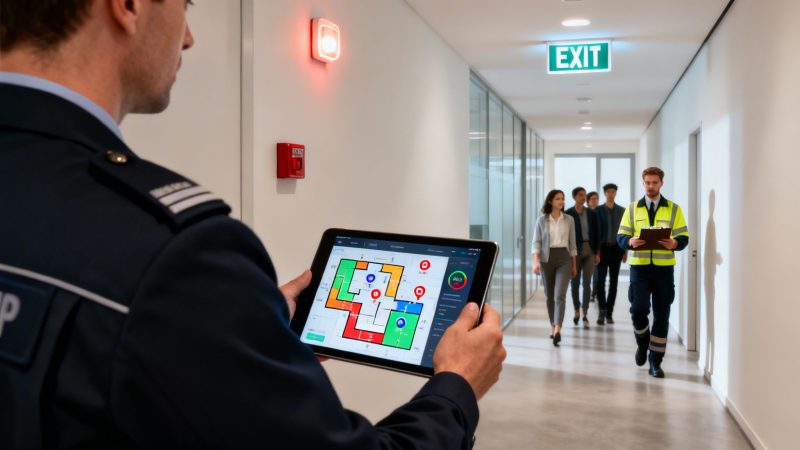
That simple action feeds directly into a live map or dashboard. The command lead sees a color-coded view of the building, with floors turning from red (evacuating) to green (cleared) in real time. If you want to see how this works, you can learn more about how centralized dispatching tools provide this bird's-eye view.
This immediate feedback is a massive money-saver because you can spot problems as they happen.
Practical Example of Cost-Saving:
On the command dashboard, you see the entire 2nd floor is still red ten minutes into the drill, while every other floor is green. A quick check-in with the 2nd-floor warden via the app's built-in messaging reveals the problem: a fire door that should have closed automatically has failed, and it's causing confusion about the correct exit path.
Without that real-time view, you might not discover this critical equipment failure until the post-drill debrief—if you find it at all. By identifying it live, you've found a major safety issue that can be fixed immediately. It prevents a potential disaster and shows a proactive approach to compliance. The drill itself becomes your best diagnostic tool, giving you instant, actionable insights.
The alarm silences, everyone is safe at the assembly point, and the headcount is complete. For most, the fire drill is over.
From years of experience, I can tell you this is precisely when the most important work begins. The real value isn't in just going through the motions; it's in digging into what just happened to find the hidden flaws and, frankly, the hidden savings in your safety plan. If you skip this part, you're just practicing the same mistakes over and over.
Turning Chaos into Actionable Data
During the drill, your observers and wardens shouldn't just be counting heads. They're your eyes on the ground, gathering the data that shows how your plan holds up under pressure. The old-school method is clipboards and stopwatches, but the goal remains the same: capture specific metrics that tell a story.
No matter how you capture it, you're looking for a few key things:
- Total Evacuation Time: The big one. From the first sound of the alarm until the last person is accounted for.
- Time to Clear by Zone: This is where it gets interesting. How long did the 3rd floor take versus the 1st? What about the warehouse versus the front office?
- Communication Gaps: How long did it take for wardens to report in? Did anyone have trouble getting a signal or being heard?
- Bottlenecks: Where did people bunch up? Was it a specific stairwell, a narrow hallway, or an exit door?
- Human Factors: Who hesitated? Did people stop for personal items? Was there confusion about the route?
Trying to track all this manually is a nightmare. It’s tough to synchronize stopwatches, and deciphering scribbled notes hours later is both time-consuming and riddled with errors. This is where modern dispatch tools really change the game.
The Shift to Automated Data Logging
The real breakthrough comes when you let technology handle the data collection. A system like Resgrid automatically logs a precise timestamp for every single action during the drill. This isn't just a convenience; it creates a perfect, second-by-second digital record of your drill, which is gold for both analysis and compliance.
This completely eliminates hours of paperwork and gives you data that's far more reliable than anything you can get from a stopwatch.
Actionable Insight: The goal here is to move from subjective feelings to objective facts. You stop saying, "The third floor seemed a little slow," and start saying, "The third floor took 4 minutes and 28 seconds longer to clear than the fourth floor, and their status reports were delayed by 90 seconds." That's the kind of concrete evidence that drives real improvements.
This data-first approach isn't just a nice-to-have; it's a proven life-saver. Data from CTIF's World Fire Statistics shows that industrialized nations have cut fire-related deaths by over 60% since the late 1970s, largely through systematic training and drills. The reports also highlight that workplaces with mandatory bi-annual drills see 30-40% fewer injuries. You can dig into the numbers yourself in the World Fire Statistics report. Tech-enabled analysis is just the next evolution of this principle.
A Real-World Example of Finding Savings
Let's walk through how this actually works. Imagine you’ve just run a drill using Resgrid. Every piece of data—from the alarm trigger to warden check-ins and "zone clear" reports—has been automatically logged.
When you pull the after-action report, a pattern jumps out: the west wing of your building consistently evacuates 30% slower than the east wing.
Digging into the timestamps, you see that the warden check-ins from that wing were all delayed. Using the platform’s mapping tools, you can overlay the warden locations with their reporting times. You'll see how real-time mapping provides these visual insights and makes spotting issues almost instant. The map shows a clear communication dead zone in the west-wing stairwell.
That right there is a critical, money-saving insight. You just found a major failure point in a low-stakes drill. The cost of a fix—maybe a simple cell signal booster—is tiny compared to the liability and chaos it would have caused in a real fire.
Manual vs. Resgrid-Powered Drill Management
The contrast between the old way and the new way is stark, and the savings go way beyond just time spent on paperwork. You're shifting from a compliance chore to a powerful diagnostic tool.
| Drill Aspect | Manual Method (High Cost) | Resgrid Method (Cost-Effective) |
|---|---|---|
| Data Collection | Multiple people with stopwatches; prone to human error and inconsistencies. | Automated, timestamped logging of every action; highly accurate. |
| Reporting | Hours or days spent manually transcribing notes and building a report. | Instantly generated after-action reports with clear, objective metrics. |
| Personnel Costs | Often requires dedicated staff or third-party observers just for timing. | The system is the impartial observer, freeing up your people to manage the drill. |
| Identifying Issues | Relies on anecdotal feedback ("it seemed slow"), often missing subtle problems. | Pinpoints specific bottlenecks and communication failures with hard data. |
By automating the process, you're not just making fire drills easier. You’re turning them into a data-rich asset that helps you justify safety budgets, prove due diligence to insurers, and—most importantly—make your facility quantifiably safer for every single person in it.
Turning Drill Insights Into Continuous Improvement

The drill is done, the data is in, and the after-action report is written. What now? Far too often, that report ends up collecting dust on a shelf. But that data is gold—if you know how to use it.
This is where the real work begins. It’s about turning those numbers and observations into real, tangible safety improvements. You’ve just run a diagnostic on your building’s emergency response; now it's time to act on the results.
From Report Findings to Corrective Actions
First things first, you have to translate your findings into a concrete action plan. "The west wing was slow" is an observation, not an action. You need to dig deeper and create tasks that are specific, measurable, and have a clear owner.
For every issue you flagged in your report, you need to assign a corrective action, a person responsible for getting it done, and a deadline.
Let's walk through a real-world example. Say your drill data shows the third floor consistently evacuates 90 seconds slower than every other floor. Your observers noted that people on that floor seemed confused about which stairwell to use.
- Problem: Slow evacuation on the 3rd floor due to route confusion.
- Corrective Action: Install three new, high-visibility directional signs pointing to the primary and secondary exits.
- Responsible Party: Facilities Manager.
- Deadline: End of the quarter.
- Verification: We’ll use the next drill's data to measure if evacuation times improve.
See the difference? This approach turns a vague problem into a trackable task. It creates accountability and gives you a clear way to measure success.
Making the Business Case for Safety Investments
Sometimes, fixing a problem costs money. This is where your drill data becomes your most persuasive tool. Going to leadership with hard numbers is infinitely more effective than just asking for more budget.
Practical Example: Instead of saying, "We need more fire wardens," you can frame it with data.
"Our drill showed a 4-minute delay in clearing the warehouse, an area where we have one warden for 75 employees. Based on our analysis, adding a second warden for an estimated annual cost of X could cut that evacuation time by 40%, significantly reducing risk to both our people and our operations. This investment mitigates a much larger financial risk from potential injury or operational shutdown."
Actionable Insight for Saving Money: This data-driven approach shifts the conversation from spending money to managing risk. You're not just asking for a new exit sign; you're presenting a cost-effective solution to a documented, quantifiable safety gap. That protects your people and the company's bottom line.
Refining Your Drill Scenarios for Future Tests
A key part of continuous improvement is making sure your future drills challenge your team in new ways. Don't just run the same simple evacuation drill year after year. Use what you learned to design more targeted and realistic tests next time.
If your last drill revealed a communication dead zone in a stairwell, the fix isn't just installing a signal booster—it's testing it under pressure.
- Last Drill's Finding: Poor radio communication in the west stairwell.
- Action Taken: Installed a new signal repeater.
- Next Drill's Scenario: We'll station an observer in that exact stairwell, tasked specifically with testing communication clarity and response time with the incident commander.
This makes each drill a validation of your previous improvements. We once worked with a school that discovered several fire doors were being propped open. Their next drill focused almost entirely on ensuring all fire doors closed and latched automatically when the alarm sounded. They learned that those doors are critical for containing smoke and fire, and they needed to test that function specifically.
It creates a simple but powerful loop: Test -> Find Flaw -> Fix Flaw -> Test Fix. Following this cycle turns your annual drill from a compliance chore into a strategic tool for building a truly resilient organization.
Common Questions About Fire Alarm Fire Drills
Even with a rock-solid plan, questions always pop up when you're gearing up for a fire alarm fire drill. We've been in the trenches with countless safety officers and facility managers, and we’ve heard just about every question in the book. Getting straight, practical answers is the difference between a drill that's just a compliant checkbox and one that actually makes people safer.
Let's tackle some of the big ones we hear all the time.
How Often Should We Conduct a Fire Drill?
This is probably the number one question we get, and the honest answer is: it depends on your facility and what your local fire marshal says. Most commercial buildings get by with an annual drill. But if you’re in a higher-risk environment like a school or a healthcare facility, you're likely looking at quarterly drills.
What’s more important than the exact frequency, though, is consistency. Regular, predictable practice is what builds the muscle memory that saves lives when things get real. It keeps safety from being an afterthought.
Actionable Insight for Saving Money: Missing a compliance deadline is an easy way to get hit with some hefty fines. We've seen it happen. A simple fix is to use a scheduling tool to automate drill reminders. It’s a small step that ensures you never miss a required drill and keeps your compliance record clean, saving you a ton of money and headaches.
How Can We Run a Drill Without Causing Panic?
The fear of causing a full-blown panic or grinding operations to a halt is real, but it’s completely manageable if you just communicate clearly. For most planned drills, all it takes is a heads-up to your occupants about the purpose, date, and rough time of the drill. That alone dials down the anxiety.
It also helps to plan the drill during a slower part of the day to keep the disruption to a minimum.
Practical Example: Use a notification system that can blast out a message clearly marked as a "DRILL." The moment people see that word, it separates the practice run from a real emergency. This one move drastically cuts down on panic and limits the costly downtime that comes with a confused workforce. You're protecting both your people's peace of mind and your bottom line.
What Are the Most Common Mistakes to Avoid?
The biggest mistake we see is just going through the motions. If you're not actually looking at the data and learning from your fire drill, you're just wasting everyone's time and creating a false sense of security.
Another classic error is failing to get an accurate headcount at the assembly point. This is a huge gap. Not knowing if someone is still inside is a nightmare scenario, and it's a problem that's easily solved with modern tools that give you real-time personnel tracking.
Finally, stop practicing the "perfect" evacuation. A truly good drill is designed to test your weak points. If your data shows a particular exit is always underused, the next drill should be designed around a scenario where that exit has to be the primary way out.
How Do I Handle Employees Who Don't Take Drills Seriously?
This is a culture problem, and it starts at the top. The first thing you need is visible buy-in from management. If leaders are blowing off the drill or rolling their eyes, you can bet your team will, too.
This is where data becomes your best friend. Use the after-action report to show the life-saving difference a few minutes can make in an evacuation. Frame participation not as an annoying interruption, but as a core professional responsibility.
Practical Example: Let's say the marketing department treats the alarm like background noise. Instead of a subjective complaint, your time-stamped data from a system like Resgrid gives you cold, hard facts. You can walk over to their department head and say, "Your team's evacuation time was 3 minutes slower than the company average. What can we do to fix this?" That shifts the conversation from an argument to a productive, fact-based problem-solving session.
It's time to transform your fire drills from a chaotic chore into a data-driven safety exercise. Resgrid, LLC gives you the platform to plan, run, and analyze your drills with precision. You'll save time, cut costs, and get a clear, quantifiable look at how much safer your facility is. See how we do it at https://resgrid.com.