
Basics of Inventory Management for First Responders
The call comes in, the crew rolls, and someone reaches for a critical item that should have been there. The seal is broken. The box is empty. Or worse, the item is there but expired.
That kind of miss doesn't feel like an inventory problem in the moment. It feels like a readiness failure. In emergency services, the basics of inventory management aren't back-office housekeeping. They're part of response capability, crew confidence, and patient care.
I've seen departments work hard, train well, and still get burned by loose supply habits. Nobody intended to leave a trauma bag short on dressings or let pediatric airway supplies drift out of date. It happened because the system depended on memory, paper checks no one trusted, and restocking that took place when somebody finally noticed a gap.
When Seconds Count and Supplies Are Missing
A medic opens a cabinet during a transport and finds the last of a critical consumable already used on the previous call. Another crew starts shift and assumes the jump bag was restocked overnight. It wasn't. A station supply room looks full at a glance, but the one item that matters on the next incident is buried, expired, or missing from the shelf entirely.
That is how inventory failure usually shows up in the field. Not as a spreadsheet issue. As a broken handoff between shifts, vehicles, stations, procurement, and accountability.
Readiness starts before the call
In a retail business, poor inventory control hurts margins. In emergency services, it can also slow treatment, force workarounds, and push crews into using substitute equipment under pressure. The stakes are different, but the fix starts with the same discipline. Know what you have, where it is, what condition it's in, and when to replenish it.
Three common failure points show up again and again:
- Missing items after use: Supplies get consumed on a call and never logged.
- Expired stock hidden in plain sight: Cabinets look full, but usable stock is thinner than expected.
- Uneven stocking across units: One ambulance is overloaded while another is short.
Field lesson: If crews can't trust the bag check, they'll build private stashes. That hides the real inventory problem instead of solving it.
Inventory is a readiness system
Good inventory management gives you something more valuable than a neat shelf. It gives crews a reliable starting point every shift. That means standardized loadouts, clear restock triggers, and simple checks that catch problems before a unit goes unavailable.
For first responders, the job isn't to build a perfect warehouse operation. It's to build a repeatable system that keeps critical items available without wasting money on excess stock, rush orders, or expired supplies.
Core Concepts Demystified for Responders
Most inventory terms sound more complicated than they are. In practice, they describe decisions your crew already makes every day. How much should stay on the truck. When should the station reorder. Which items need tighter control than others.

What counts as inventory
For responders, inventory usually falls into two practical groups.
- Consumables: Gloves, airway adjuncts, dressings, IV supplies, medications, oxygen accessories, batteries.
- Durable items: Monitors, radios, splints, hand tools, suction units, backboards, chargers.
Consumables disappear through use. Durable items stay in service but still need tracking because they move, fail, or go missing.
A third category deserves special attention: critical items. These are the things you can't improvise around. If they're absent, damaged, or expired, readiness drops fast.
Reorder point and safety stock
A reorder point is the stock level that tells you to buy or restock before you run out. It isn't a guess. It should reflect how fast you use an item and how long replacement takes.
Safety stock is the buffer you hold for demand spikes and supplier delays. For emergency services, this matters because normal usage can change fast after a storm, wildfire deployment, mass gathering, or back-to-back medical calls.
One commonly used formula for safety stock is cited by Lightspeed's inventory management guide: Safety Stock = (Max Daily Usage × Max Lead Time) – (Avg Daily Usage × Avg Lead Time).
That formula matters because it forces the right question. Not "How many do we usually use?" but "How bad does it get when usage jumps and delivery slows at the same time?"
Keep your safety stock for true volatility. Don't use it to hide poor restocking habits.
Lead time and par levels
Lead time is the time between placing an order and receiving the item. If you order electrode pads today and they arrive next week, that delay shapes how much you need to hold now.
Many departments use par levels, which are target quantities for a vehicle, bag, locker, or shelf. If a trauma bag should always carry a set amount of gauze, chest seals, and tourniquets, that par level becomes your standard.
A practical setup looks like this:
- Set the vehicle par level: What must be on the unit at shift start.
- Set the station backup level: What should be on the shelf to refill vehicles.
- Set the reorder trigger: When the station stock falls low enough to order more.
Prioritize what matters most
Not every item deserves the same control. High-value or high-criticality supplies need more frequent review. That's where ABC thinking helps. The most important items get the closest attention.
For teams that also need to coordinate staffing and equipment accountability, linking inventory practices with personnel tracking workflows helps identify who checked, used, or restocked gear during a shift.
Essential Inventory Management Processes
Concepts don't fix stock rooms. Daily habits do. The departments that stay ready usually have simple, boring processes that happen every time without debate.

Receive and store supplies correctly
A supply item starts creating risk the moment it arrives if nobody verifies it. The receiving step should confirm quantity, condition, lot or expiration where relevant, and destination location. If a shipment goes straight onto a shelf without being checked into the system, you've already introduced doubt into your count.
Store supplies so crews can find them fast and rotate them correctly. Similar packaging causes mistakes. High-use consumables should sit in obvious, labeled locations. Expiring items need placement that supports first-in, first-out use.
Poor data is one of the main reasons departments end up with both stockouts and overstocking. NetSuite's inventory management guidance notes that replenishment rules are only as good as the records behind them, and that effective demand planning depends on accurate historical usage data captured through systems such as barcodes and inventory software.
Track usage at the point of work
The worst method is end-of-week reconstruction. People forget. Bags move. Crews swap rigs. One item gets borrowed and never written down.
The practical standard is simple:
- After each call: Log what was used before the unit is considered fully back in service.
- After each transfer between locations: Record the move, even if the item wasn't consumed.
- After each equipment exchange: Mark the old item out and the replacement in.
A lot of agencies already use task tools to tighten this handoff. If your restocking process still depends on verbal reminders, something like the new project management tool from Pebb can help assign post-call replenishment tasks and close the loop before the next crew inherits a problem.
Audit before drift becomes failure
Cycle counts work better than waiting for one large annual inventory. Count a portion of stock on a routine schedule, compare physical count to system count, fix discrepancies, and look for root causes.
Use audits to answer practical questions:
- Did the item get used but not logged
- Was it moved to another unit
- Was the quantity entered wrong when received
- Is the item being stored in multiple unofficial places
This short walkthrough fits well into refresher training for logistics leads and supervisors:
If your count process only tells you that numbers are off, it isn't enough. The useful part is finding out why they're off.
What works and what doesn't
What works is standardized storage, immediate usage logging, and regular cycle counts.
What doesn't work is relying on memory, letting every station organize the same kit differently, or treating audits like a paperwork exercise. Those habits create hidden shortages, duplicate buying, and emergency ordering that costs more than disciplined routine ever will.
Key Metrics That Improve Readiness and Cut Costs
A storeroom can look full and still leave a crew short on the next call. That usually happens because teams track volume instead of readiness. The useful metrics are the ones that show whether the right items are available, in date, and positioned where crews need them.
Inventory turnover and what it tells you
Inventory turnover is calculated as cost of goods sold divided by average inventory. According to Shopify's inventory metrics reference, a ratio of 2 to 4 is often considered ideal. Lower turnover can point to excess stock and cash tied up on the shelf. Higher turnover can point to thin safety margins and a greater chance of running short.
In emergency services, turnover is a warning light, not a standalone decision tool. A low-turn item may still need to stay on hand because it supports a low-frequency, high-risk event. A high-turn item needs tighter reorder points, tighter receiving discipline, or both.
That trade-off matters. Readiness sometimes requires carrying stock that would look inefficient in a retail setting.
Translate business KPIs into field terms
Crews and supervisors need measures they can act on during a shift, after a call, and during monthly review. Four numbers usually tell the story:
- Critical item stockout rate: How often a required item is missing during a unit check or patient care event
- Expiration exception count: How many items fail inspection because shelf life has lapsed
- Days of supply on hand: How long current stock will last at normal usage
- Inventory accuracy: How closely the system count matches what staff can physically find
These metrics work because each one points to a clear response. A rising stockout rate usually means par levels, reorder timing, or station-to-vehicle replenishment is off. A growing expiration count usually means too much inventory was purchased, the wrong item was placed in front-line stock, or slow-moving supplies were never rotated.
A metric earns its place only if it changes a decision. It should tell someone to buy, move, count, rotate, or stop ordering.
Where savings actually come from
The savings show up in routine operations. Fewer rush orders. Fewer duplicate purchases. Less expired stock in cabinets and jump bags. Less paid time spent opening drawers, checking backup bins, and asking where an item was moved.
I have seen one simple metric review prevent both shortage and waste in the same month. A station was repeatedly reordering a specialty item because crews thought it disappeared too quickly. The actual problem was poor count accuracy on one unit and expired stock sitting untouched in another location. Once those numbers were visible, the agency corrected the count process, rotated usable stock, and stopped buying product it already had.
That is the standard to aim for. Better availability at the point of care, with less money trapped in supplies no one will use in time.
Practical Workflow for Vehicle and Station Checks
Shift checks fail when they're vague. "Check the truck" sounds clear until five people do it five different ways. What works is a short workflow, fixed responsibility, and a record of what was found.
A shift-start routine that people will actually follow
Assign the check to a role, not a floating expectation. On a vehicle, that may be the incoming crew lead. At a station, it may be the logistics officer or shift supervisor.
Use the same sequence every time:
- Open the checklist before touching stock
- Verify high-risk items first, including medications, airway supplies, bleeding control items, and power-dependent gear
- Count to par, not to memory
- Check expiration and packaging integrity
- Log discrepancies immediately
- Restock or escalate before the unit is marked fully ready
For readiness planning, Days Sales of Inventory can be reframed as Days of Supply, which tells you how long current stock will last. Netstock's inventory guidance also notes that reducing stockouts and overstocks through better tracking can lower overall inventory costs by 10%.
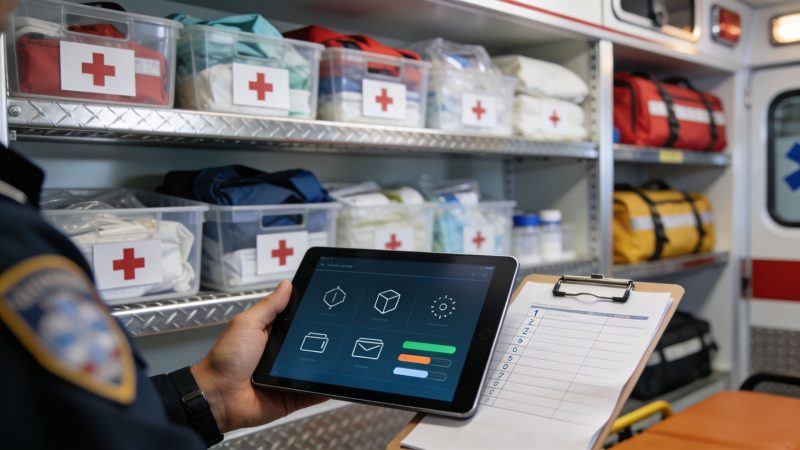
Sample Ambulance Inventory Checklist Critical Items
| Item | Required Par Level | On-Hand Count | Expiration Check Pass/Fail | Notes/Action Needed |
|---|---|---|---|---|
| Trauma dressings | ||||
| Tourniquets | ||||
| Adult BVM | ||||
| Pediatric BVM | ||||
| Defibrillator pads | ||||
| IV start kits | ||||
| Epi supply | ||||
| Suction canister |
What to check on the station side
Vehicle checks only solve half the problem. The station has to support fast refill without confusion.
Look for these issues:
- Unlabeled overflow stock: Supplies exist, but crews can't identify approved stock from random extras.
- Mixed expiration dates in one bin: Older stock gets buried behind newer deliveries.
- No separation by location or unit type: Specialty response gear ends up mixed with standard ambulance stock.
If your agency wants tighter accountability, station and apparatus checks become much easier when they're tied to repeatable workflow automations for public safety teams.
Checklists should prevent arguments, not create them. If a step is open to interpretation, rewrite it.
Keep the process short and strict
A good vehicle check shouldn't feel like a warehouse audit. It should feel like a cockpit check. Short, specific, and mandatory. If the checklist takes too long, crews will pencil-whip it. If it's too loose, they'll complete it without catching what matters.
The fix is discipline in design. Limit the critical checklist to items that affect immediate readiness, then handle broader supply counts on a separate cycle.
Choosing Simple Tools for Better Tracking
A spreadsheet usually holds up until the first real strain hits the system. One crew restocks from station supply. Another moves gear to a reserve unit. A supervisor orders replacements under a different item name. By the end of the week, the count on paper no longer matches what is ready for the next call.
That gap matters more in emergency services than it does in a typical stockroom. If a supply record is wrong, crews lose time checking bins, calling the station, or substituting gear under pressure. The right tool reduces that friction. It should tell you what the item is, where it belongs, how much is on hand, and what needs attention before readiness slips.
Good systems keep a few things separate from the start. Item records. Stock counts. Storage locations. Vendor information. Agencies that skip that structure usually end up with duplicate item names, muddled reorder history, and no clear trail when supplies go missing.
For first responders, the tool should support field use, not office theory:
- Mobile access: Crews need to update counts from the rig, supply room, or staging area.
- Barcode or scan support: Fast verification beats handwritten recounts.
- Low-stock alerts: Supply problems should surface before a unit goes out short.
- Expiration tracking: Medical items need active review, not a surprise found during a call.
- Location control: The system should show whether gear is assigned to a front-line unit, reserve apparatus, station stock, or specialty team cache.
Software choice comes after process discipline. Standard item names, standard par levels, and clear restock rules do more for accuracy than an expensive platform with poor setup. I have seen agencies buy capable software and still lose control because every station used different labels for the same item.
Tools also need to fit the pace of the job. If crews have to click through six screens to record one box of IV kits, they will delay the update or skip it. A better approach is a simple interface tied to the way public safety teams already work. Agencies that want tracking connected to staffing, incidents, and operational tasks can look at Resgrid apps for responder operations and inventory workflows.
The goal is straightforward. Use a system simple enough that crews will keep it current, and structured enough that supervisors can trust it. In this environment, better tracking is not about cleaner records. It is about putting the right supplies in the right place before the next call starts.