
What Is Quality Inspection: A First Responder’s Guide
A crew rolls up expecting routine execution. The address is right. The scene size-up is clean. Then the failure happens where it hurts most. A regulator won't hold pressure. A stretcher latch sticks. A vehicle warning light that “has been on for a while” turns into an out-of-service unit at the worst possible moment.
That kind of failure gets blamed on bad luck more often than it should. In practice, it usually points back to a weak inspection process. Someone looked, but didn't verify. Someone checked a box, but didn't test the function. Someone knew an item was marginal, but there was no record, no escalation path, and no follow-through.
That's why the question isn't just what is quality inspection. Instead, the question is whether your department treats inspection as paperwork, or as a readiness discipline that keeps people alive, keeps rigs in service, and keeps preventable failures off the incident scene.
When Seconds Count and Equipment Fails
The most expensive equipment failure isn't the one that happens in the shop. It's the one that happens on-scene.
A firefighter reaches for a tool that worked yesterday, but today the hydraulic line leaks under load. A medic opens a monitor bag and finds a battery that wasn't charged after the last transport. A dispatcher enters a call with incomplete location details because the verification step was skipped during a busy handoff. None of those failures start at the incident. They start earlier, during the unnoticed moment when inspection turned into habit instead of verification.
What failure looks like in the real world
In emergency work, people often separate equipment problems from process problems. That's a mistake. The dead battery, cracked facepiece seal, and incomplete dispatch record are all the same category of issue. They are readiness failures.
A pencil-whipped checklist creates false confidence. It tells supervisors that work was done when no meaningful inspection happened. It tells the next shift that the rig is ready when key items may be missing, expired, damaged, or degraded. It also destroys accountability, because once the record says “checked,” crews have to waste time figuring out what was inspected and what was assumed.
A failed check on shift is inconvenient. A failed check during rescue is catastrophic.
That same logic applies to communications and coordination. If your dispatch workflow doesn't force complete, traceable information flow, bad data moves just as fast as good data. Teams using structured dispatching workflows for emergency operations reduce the chance that missing details become field problems later, because the process itself supports verification instead of memory.
Why this is a command issue, not a clerical one
Command staff sometimes inherit inspection programs that were built around compliance optics. The forms exist. The signatures exist. The actual operational value is thin.
A real inspection program does three things:
- Finds defects early: It catches wear, drift, damage, and missing items before deployment.
- Creates action: It tells crews what happens next when something fails, including repair, replacement, or removal from service.
- Builds evidence: It leaves a usable record that can support maintenance decisions, budget requests, and post-incident review.
When that structure is missing, departments pay twice. They pay once in rushed repairs and unnecessary replacement. They pay again in slower operations, improvisation on-scene, and increased risk to responders and the public.
If you run incidents, you already understand this instinctively. You don't wait for collapse to start size-up. You don't wait for a mayday to confirm accountability. Inspection works the same way. It's the discipline of finding small failures before they line up into mission failure.
Beyond the Factory Floor What Quality Inspection Really Is
A factory is not the only place where inspection matters. In emergency services, inspection is the disciplined check that a vehicle, piece of PPE, medical item, or record meets the standard required for safe use before crews depend on it.
That sounds simple. It is also where departments either protect readiness or gamble with it.

Inspection works like patient assessment
Crews do not call a patient stable because the room looks calm. They assess airway, breathing, circulation, mental status, and trends, then compare what they find to known indicators. Equipment and records deserve the same discipline.
A front-line unit battery is not "probably fine." It either starts within expected conditions, holds charge, and supports the loadout, or it needs service. A helmet shell either remains within service limits, or it comes out of service. A dispatch log either contains the address detail, timestamps, unit actions, and shift accountability needed for clean handoff, or it leaves a hole in the operation. Departments that manage staffing and accountability across crews often tie these checks back to shift scheduling and coverage records so missing information is visible before it becomes an incident problem.
That is what quality inspection means outside manufacturing. It is a comparison between current condition and required condition.
Conformance matters more than appearance
Departments often confuse order with readiness. Clean gear can still be damaged. A stocked compartment can still contain expired meds, dead batteries, the wrong adapter, or a missing seal. A complete-looking report can still omit the one timestamp command will need during review.
Inspection focuses on conformance. Does the item meet the department standard, manufacturer guidance, regulatory requirement, and operational need? If the answer is no, the item is not ready, even if it looks acceptable on a quick glance.
The same logic used in industry still applies, but the field examples are different. First responders are not checking finished consumer products. They are checking whether mission-critical assets will perform under stress and whether records support decisions when conditions change fast.
For example:
- Critical defects: An SCBA regulator that fails flow checks, a stretcher latch that will not lock, a missing narcotics count, or a radio that cannot transmit from inside a structure.
- Major defects: Turnout closure damage, a suction unit with inconsistent power, a compartment door that sticks during deployment, or repeated omissions in CAD notes that slow the next unit.
- Minor defects: Cosmetic damage, worn labeling, or a non-safety accessory issue that does not stop safe use today but still belongs in the record.
Practical rule: If a defect can change firefighter safety, patient care, response time, or command decisions under pressure, classify it for operational impact, not for convenience.
Inspection protects readiness before the call
On-scene failure is the most expensive failure of all.
A scheduled replacement is manageable. A failure during response can trigger overtime, reserve unit movement, mutual aid coverage, delayed patient care, or a crew improvising with reduced options. The same principle applies to information. Catching a bad location format, incomplete apparatus note, or broken accountability trail during routine review takes little effort compared with correcting it in the middle of a working incident.
Quality inspection is not factory jargon dressed up for public safety. It is a readiness discipline. It gives departments a repeatable way to verify that vehicles, PPE, medical kits, radios, and dispatch records are fit for service before seconds start counting.
The Four Types of Readiness Checks Every Department Needs
Departments lose readiness when inspection is treated as a single event instead of a chain of control points. A unit can pass a morning check and still fail by afternoon if replacement supplies were stocked wrong, gear came back damaged after a call, or a crew assumed the last shift caught a problem.
The practical fix is to divide inspection into four check types. Each one answers a different operational question. Together, they cover what enters service, what happens during use, what gets verified before deployment, and whether the department's overall system is drifting.

Incoming checks
Incoming checks happen before an item reaches the floor, the rig, or the responder who has to trust it.
A case of gloves, a monitor battery, a replacement radio mic, or a new set of turnout gear should not enter service on the strength of a packing slip alone. Verify the item, inspect for shipping damage, confirm the model is approved for department use, and check that quantities and documentation match the order. That step prevents a supply mistake from spreading across every apparatus bay.
The same standard applies to bigger assets. Before a new unit joins the fleet, inspect installed equipment, communications programming, warning systems, compartment layout, and required records. Catching a mismatch in the shop is cheap. Finding it on a call is expensive.
In-process checks
In-process checks happen while equipment and information are already in circulation.
Daily apparatus checks fit here, but so do post-incident equipment reviews, SCBA bottle replacement checks, narcotics counts, and routine review of dispatch and incident documentation. Public safety work produces wear, depletion, contamination, and documentation drift. If crews only inspect at the beginning of the day, they miss the failures created during the day.
Ownership matters. If turnover responsibility is vague, inspection quality drops fast. Many departments tie these checks to shift management and handoff accountability so a named crew is responsible for the rig, the gear, and the status record at a defined time.
Pre-use checks
Pre-use checks are the final confirmation before commitment.
They are short by design. A firefighter verifies facepiece seal, PASS function, and cylinder status before entry. A medic confirms suction, oxygen delivery, monitor power, and drug access before patient contact. A dispatcher or supervisor confirms unit status visibility, location details, and call notes before a complicated incident builds on bad information.
These checks do not replace earlier inspections. They catch what changed since the last one. A battery dies. A strap gets cut. A setting gets bumped. A CAD entry carries the wrong apartment number forward into the next dispatch.
Periodic audits
Periodic audits test the system, not just the item in front of you.
Use them to look across stations, reserve units, supply rooms, PPE records, medication logs, and dispatch documentation. The goal is pattern detection. One failed radio battery is a maintenance issue. Repeated battery failures on one apparatus point to charging practice, replacement intervals, or supervision. Repeated gaps in dispatch logs point to training, workflow, or review standards.
This check type protects against slow normalization of bad habits. Crews can adapt to workarounds for a long time. Audits expose the workaround before it becomes the department's real process.
A department that uses all four check types closes the loop. Supplies enter service correctly, equipment and records stay under watch during use, crews verify mission-critical function before commitment, and leaders can see whether the system is holding or slipping. That is what quality inspection looks like in public safety. It keeps vehicles, PPE, medical gear, radios, and dispatch information ready before the call turns costly.
A Repeatable 5 Step Inspection Process
A repeatable inspection process keeps a bad cylinder, dead radio battery, missing drug seal, or wrong address note from reaching the call. On scene, failure gets expensive fast. It costs time, trust, backup resources, and sometimes a life.
The process has to work on a ladder truck, a trauma bag, a turnout coat, and a dispatch record. It also has to work at 0600, at shift change, and after a rough call when people are tired. A good system does not depend on one detail-driven crew member catching everything by instinct. It gives every crew the same sequence, the same thresholds, and the same actions when something is off.

Step 1 Define the standard
Crews cannot inspect to a feeling. They need a written standard.
Use manufacturer instructions, department SOPs, maintenance requirements, and actual field conditions to define pass or fail. For an apparatus, that includes warning lights, tire condition, fluid status, and required inventory. For PPE, it includes closures, reflective trim, contamination status, and retirement criteria. For dispatch records, it includes required fields, address accuracy, unit status visibility, and timestamp expectations.
“Looks fine” produces drift. Specific criteria produce repeatable decisions.
Step 2 Choose the method and frequency
Different failure modes need different checks.
A glance at a seal is enough for some items. A stretcher lock, suction unit, or portable radio needs a functional test. Incoming supplies can sometimes be checked by sampling if the item is standardized and the consequences of a hidden defect are low. Mission-critical gear that can fail without warning usually needs direct verification before service, not a sample-based shortcut.
Set frequency by risk and rate of change. Items that get handled, charged, washed, refilled, or reconfigured often need more frequent inspection. If failure would take a unit out of service or put a responder at risk, increase the depth of the check.
A short training clip can help crews standardize the process before you roll it out widely:
Step 3 Execute and document
An inspection only helps the organization if the result is recorded clearly enough for the next person to act on it.
The record should identify the item, the check performed, the standard used, the condition found, and the person who completed it. That applies to equipment and to information systems. If a CAD entry was corrected, note what was wrong and what was changed. If a vehicle battery tested weak, record the reading or condition that triggered the write-up instead of just marking “fail.”
A useful record includes:
- Observed condition: pressure, charge state, expiration status, visible damage, missing component, or documentation error
- Reference used: SOP, manufacturer specification, checklist item, or dispatch documentation standard
- Disposition: left in service, sent for repair, replaced, quarantined, or escalated to supervision
Teams building patrol or facility check routines can borrow structure from a free security patrol checklist and adapt the same discipline to apparatus bays, PPE rooms, medication storage, and communications workflows.
Step 4 Analyze and act
This is the step that separates a checkbox program from a readiness program.
If crews keep reporting the same failed charger, missing airway item, or repeated address-format error, the problem is no longer the individual defect. The problem is the system allowing it to recur. Supervisors need a simple action model. Remove critical defects from service immediately. Assign major defects to a named owner with a due date. Trend minor defects so they can be fixed before they stack up into a unit-level readiness problem.
Patterns matter. One torn glove is damage. Repeated torn gloves from the same storage location may point to packing, supply quality, or handling practice.
Step 5 Review and improve
Inspection standards should change when field experience shows they are too weak, too vague, or wasting time.
Keep the parts that catch failure. Cut the checks that never influence a decision. Add tighter controls where crews repeatedly find the same fault. The National Institute of Standards and Technology describes inspection as a planned comparison against specified requirements, which is the right mindset here. Compare real condition against a defined requirement, then update the process when the requirement or the risk changes, as outlined in the NIST glossary entry for inspection.
That is how a department gets from routine checking to operational readiness. The goal is not more paperwork. The goal is gear, vehicles, PPE, and dispatch information that perform when the call starts going bad.
Practical Inspection Checklists for First Responders
Teams don't need more theory. They need checklists that reflect what can fail in the field.
One of the biggest changes in modern inspection is the move from a final gate to a data-driven, in-process system. Introductory content often frames inspection as a check on finished output, but the more useful model is continuous verification tied to operations, especially when manual checks can miss variation in real time, as described in this overview of how inspection is evolving.
Daily vehicle inspection
A front-line unit should never leave readiness to assumption. The daily vehicle check is where crews catch the small mechanical and inventory issues that become response problems later.
| System | Check Item | Standard | Status (OK/Fail) |
|---|---|---|---|
| Engine | Oil and coolant | Within department standard, no visible leak concern | |
| Electrical | Battery and warning indicators | Starts cleanly, no unresolved warning condition | |
| Lighting | Headlights, scene lights, emergency lights | All required lights functioning | |
| Audible warning | Siren and horn | Functional and clear | |
| Tires | Condition and visible inflation issue | No visible damage or unsafe condition | |
| Pump or medical module | Operational readiness | Functional check completed per SOP | |
| Compartments | Critical inventory present | Required equipment accounted for | |
| Cab equipment | Radios, MDT, chargers | Powers on and functions correctly |
That table only works if crews are willing to write “Fail” when something is off. A fake green status is worse than no checklist at all.
PPE and personal kit check
A responder's personal gear often degrades slowly. That makes it easy to miss.
Check helmet shell condition, strap integrity, glove wear, eye protection, boot condition, closure systems, and any sealing surfaces that affect respiratory or contamination protection. For SCBA-related gear, inspect what can compromise safe use, not just whether the set appears complete.
Use defect language that crews understand:
- Remove now: Anything that changes protection or safe function.
- Repair soon: Wear that hasn't failed yet but is moving in that direction.
- Monitor: Cosmetic or low-risk issues that still deserve a record.
Specialized equipment check
Here, failures get expensive fast.
A defibrillator, thermal camera, hydraulic rescue tool, gas detector, or portable suction unit can sit unused for long periods, then become mission-critical without warning. These items need functional checks, not just visual confirmation.
For example, a useful specialized equipment inspection asks:
- Does it power on reliably?
- Does it hold charge or pressure through a test cycle?
- Are accessories present and usable?
- Is any consumable expired, depleted, or missing?
- Did the last user report an issue that still hasn't been cleared?
The best checklist is the one that catches the defect your crews actually see in the field, not the one that looks most complete on paper.
Dispatch and records audit
Quality inspection also applies to information. If dispatch logs, unit notes, or handoff records are incomplete, your response system is carrying hidden defects.
Audit for complete addresses, unit identifiers, timestamps, status changes, narrative clarity, and closure notes. In many organizations, a patrol-style checklist format helps supervisors review process quality consistently. A practical example is this free security patrol checklist from Overton Security, which shows how structured documentation can standardize routine verification work even outside emergency response.
The operational lesson is simple. Don't wait for the final report to find out the process was broken all shift long. Inspect the workflow while it's happening.
Modernizing Inspections with Digital Tools
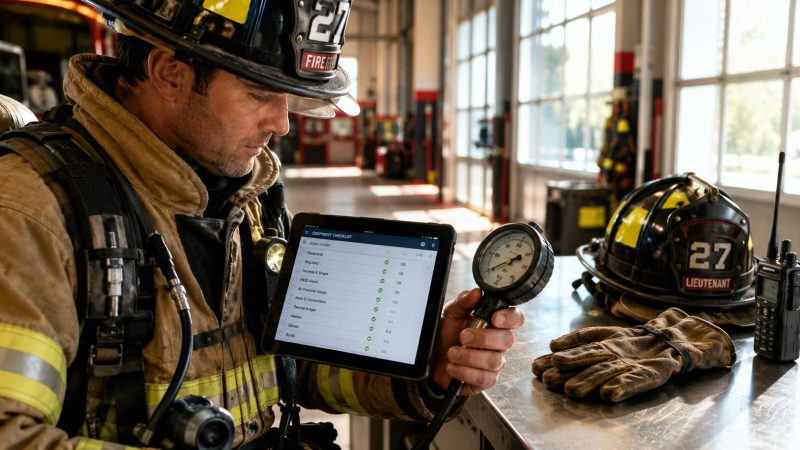
A paper checklist does not help much when an engine company rolls out with a generator that was marked "checked" three shifts in a row and still fails on scene. By the time that defect shows up at a fire, on a medical call, or during a search, the cheap inspection program has become an expensive operational failure.
Paper systems break in familiar ways. Sheets get lost. Handwriting is unclear. One crew checks a spare SCBA bottle one way, the next crew checks it another way, and no one sees the pattern until the same problem repeats. Command staff also lose the ability to answer a basic readiness question. Which assets fail most often, which stations miss inspections, and which defects keep coming back after "repair"?
Standards-based quality guidance puts risk at the center of inspection planning. The point is not to inspect everything with the same intensity. The point is to inspect high-consequence items often enough to catch failure before it reaches the field, while using records from past inspections to adjust schedules and follow-up, as explained in this risk-based quality inspection guidance.

Why digital beats paper in the field
The main advantage of digital inspection is control under pressure.
A digital system can require completion of critical fields, time-stamp the inspection, identify the user, and preserve photos, issue notes, and corrective actions in one record. That matters for vehicles, PPE, medical bags, narcotics counts, and dispatch documentation. If a crew reports a low tire, an expired mask, or a missing handoff note, the record should not disappear into a binder. It should stay attached to the asset, the unit, or the incident trail.
Digital records also make trend detection possible. If Medic 4 keeps failing the same suction check, fleet or logistics can see that history. If one station keeps missing narcotics seal verification or radio battery swaps, supervisors can address the process before the problem surfaces during a call.
What a useful digital workflow should do
A digital form by itself is not a readiness system. The value comes from what happens after the failed check.
Look for tools that support:
- Required verification steps: Critical items should not be skipped with a quick tap.
- Escalation paths: Failed items should notify the right person and create a maintenance, replacement, or review task.
- Asset history: Crews and supervisors should be able to see previous defects, repairs, and repeat failures.
- Operational linkage: Inspection results should connect to broader workflow automation for response and support tasks so defects move into action instead of sitting in a separate record.
This matters at the command level. Inspection findings should feed maintenance planning, reserve apparatus decisions, purchasing requests, training corrections, and after-action review. If the inspection record stops at "failed," the department gathered paperwork, not control.
How digital inspection cuts waste without lowering standards
Cost control in inspection means removing wasted effort and focusing attention where failure carries the highest operational price.
Paper programs create repeat work through duplicate entry, missing forms, inconsistent follow-up, and fixed schedules that treat low-risk and high-risk items the same. Digital systems help departments tighten checks where failures recur and ease off where performance has stayed stable over time. That gives leaders a cleaner basis for staffing inspection work, scheduling maintenance, and defending replacement budgets.
Good inspection data shows where risk lives. That is how departments avoid under-inspecting rescue tools that fail intermittently and over-inspecting items with a long record of stable performance.
The underlying idea is not new. Statistical quality control shifted inspection from end-point sorting to process control decades ago, as summarized in this statistical quality control backgrounder. First responder agencies can apply the same discipline without factory language. Check readiness in service, document defects where they occur, and route failures into action before the next dispatch.
Inspection still takes time, trained attention, and follow-through. Digital tools do not replace that work. They make it visible, consistent, and usable when the next call leaves no room for equipment failure.
If your team needs a practical way to turn inspections into documented, actionable readiness checks, Resgrid, LLC gives first responders and public safety organizations tools for dispatching, messaging, personnel coordination, workflows, and operational recordkeeping in one platform. If you want fewer missed checks, faster follow-up on failed items, and a cleaner audit trail across your operation, it's worth a look.