
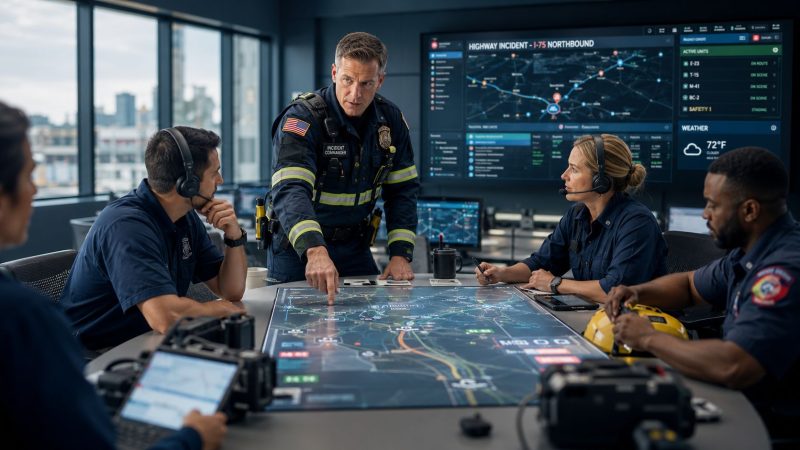
Incident Command Responsibilities: Effective Management
You're probably dealing with some version of this right now. A call starts small, then stretches. More units arrive. Mutual aid checks in. Someone asks for traffic control, someone else asks for medical, and two supervisors start giving different directions to the same crews.
That's the moment when incident command responsibilities stop being a training topic and become a budget issue, a safety issue, and a leadership issue.
When command is loose, responders duplicate work, expensive equipment gets ordered twice, staging turns into a parking lot, and the incident runs longer than it should. When command is clear, crews know who they report to, the plan stays simple, and resources move where they matter. That saves time. It also saves money in ways many new officers don't appreciate until they've had to explain overtime, damaged equipment, or an avoidable injury after the fact.
Bringing Order to Chaos with the Incident Command System
A foggy highway pileup is a good example because it punishes confusion fast. Cars are scattered, patients are spread out, traffic is still moving, and visibility is poor. If the first-arriving officer jumps straight into hands-on work without declaring command, the scene starts managing itself. That never goes well.
The Incident Command System, or ICS, exists to stop that slide. It gives one person the authority to set priorities, assign work, and build structure as the incident grows. That isn't bureaucracy. It's how you keep people from freelancing, missing critical hazards, or tying up resources in the wrong place.

What order looks like in the first minutes
The first officer on scene doesn't need a perfect plan. They need a clear one.
- Establish command immediately: Name the incident, announce command, and make it known over the radio.
- Set initial priorities: Life safety first, incident stabilization second, property and environmental conservation after that.
- Create early structure: Assign divisions, groups, or functional tasks before too many units self-deploy.
- Request what's needed, not everything available: Over-ordering feels safe in the moment, but it burns money, clogs access, and creates supervision problems.
A modern dispatch and status board helps here because command decisions are only as good as the information behind them. If your team needs tighter visibility on assignments and incoming units, a tool like Resgrid dispatching can support that early organization without adding extra radio traffic.
For workforce notifications beyond the scene itself, especially when you need to alert staff, support teams, or facility personnel quickly, HubEngage's employee alert system is the kind of separate communication channel that can reduce delays and keep non-field coordination from crowding the tactical net.
Practical rule: If people are asking “who's in charge?” after the first few minutes, the incident is already costing more than it should.
The Incident Commander Ultimate Authority and Responsibility
The Incident Commander is the strategic leader of the event. That role gets misunderstood all the time by new officers. They think command means doing the radio traffic, approving every move, and solving every tactical problem personally. It doesn't.
The IC's job is to set direction, keep the organization coherent, and make sure the operation stays safe and proportional to the problem. A good comparison is a CEO in a fast-moving crisis. The CEO decides priorities, allocates resources, and holds the big picture. The CEO doesn't run every task on the floor.
The IC sets objectives, not every tactic
The first responsibility is defining what success looks like right now.
On a commercial fire, that may mean primary search, exposure protection, water supply stabilization, and evacuation support. On a hazardous materials release, it may mean isolation, scene control, identification, and protective action guidance. The point is that the IC states the objectives in plain language so supervisors can act without guessing.
What doesn't work is vague command. “Handle it” is not a plan. “Take the east side, protect the exposure, report conditions in ten minutes” is.
A weak objective creates drift. Crews fill the silence with their own priorities. That usually leads to duplicated effort in one area and neglect in another. Financially, that means more units on scene longer, more specialty requests, and more time before the incident starts shrinking.
The IC owns responder safety at the system level
Every firefighter, medic, law enforcement officer, public works operator, and volunteer has a duty to work safely. The IC has a different responsibility. The IC must build a system where safe decisions are likely and unsafe ones are caught early.
That means watching span of control, maintaining accountability, controlling access, and refusing to let excitement outrun supervision. A busy incident with poor structure often looks productive from a distance. Up close, it's wasteful and dangerous.
Consider two command styles at a structure fire:
| Command approach | What happens on the ground | Likely cost result |
|---|---|---|
| Tight command | Units are assigned by function, staging is controlled, benchmarks are tracked | Shorter incident, less idle apparatus time, fewer preventable losses |
| Loose command | Units self-assign, no clear sectors, changing orders over the radio | Longer scene time, duplicated work, higher exposure to injury and damage |
An avoidable injury is not just a human loss. It can mean backfill, investigations, paperwork, equipment replacement, and liability exposure. Good command reduces the chances of that chain starting.
A disciplined command structure is cheaper than a confused one, even before you count the human cost.
The IC manages scarcity
Resources always feel limited. Sometimes that's because they are. Sometimes it's because command doesn't know what's already assigned, what's en route, and what can be released.
The IC has to make two mistakes less often than everyone else. Don't order too little, and don't order too much.
Under-ordering stretches crews and prolongs the incident. Over-ordering creates congestion, overtime, rehab burdens, and unnecessary apparatus commitments that leave the rest of the jurisdiction thin. Good ICs request resources in layers. They ask for what the next operational period is likely to require, not what their nerves want in the first three minutes.
The IC must resist micromanagement
New commanders often slip into task-level control because it feels safer. They start telling engine crews where to pull handlines, directing individual patient movement, or managing traffic posts one by one. Once that happens, they stop seeing the whole field.
Use subordinates. Trust section chiefs, division supervisors, and group supervisors to run their lanes. The IC should steer the ship, not row it.
When that discipline is missing, the bill shows up later in the form of bloated scene times, preventable confusion, and crews waiting for decisions that should've been delegated.
Your Command Staff The ICs Support Trio
A capable Incident Commander still fails if every outside demand lands on their shoulders. That's why Command Staff matters. These positions protect the IC's time, attention, and judgment.
Without them, the commander gets dragged into media questions, interagency friction, and unsafe acts in the hot zone while trying to make strategic decisions. That's where mistakes start.
Public Information Officer
Before a PIO is assigned, the IC gets peppered with questions. Media wants updates. Elected officials want summaries. Family members want answers. Internal staff want wording for alerts. Every interruption steals attention from the operation.
After a PIO is in place, one person manages message discipline. They gather verified facts, coordinate releases, and stop rumor from outrunning reality.
That matters operationally and financially. Bad public messaging can cause self-dispatching, crowd management problems, and reputational damage that creates extra work long after the incident ends.
A practical example: at a shelter activation, a poorly timed public message can send people to the wrong site, overwhelm one facility, and force late scrambling for staffing and supplies. A good PIO prevents that.
Safety Officer
The Safety Officer isn't there to decorate the command post. This role exists because the IC cannot watch every hazardous act while also running the incident.
Before this position is assigned, unsafe behavior tends to show up late. Crews work under unstable conditions too long. Rehab gets delayed. Access control weakens. Contractors or partner agencies operate under different assumptions.
After a strong Safety Officer steps in, someone is actively scanning for risk, correcting unsafe practices, and raising concerns before they become injuries.
- Stops bad momentum: Unsafe shortcuts often appear when crews are tired or rushed.
- Protects the operation: An injury can freeze progress, trigger investigations, and force reassignment.
- Protects the budget: Medical treatment, lost time, and equipment damage all cost more than early intervention.
A good Safety Officer pays for their own presence by catching one mistake before it becomes a reportable event.
Liaison Officer
The Liaison Officer solves one of the most expensive problems in multi-agency response. Different organizations arrive with different priorities, terminology, and procurement habits.
Without a Liaison Officer, outside agencies call command directly, make parallel requests, or coordinate sideways with field crews. That creates overlap fast. Two agencies may ask for the same specialized asset. A support team may show up at the wrong access point. A public works crew may start a task that conflicts with fire suppression or law enforcement evidence concerns.
With a Liaison Officer, outside partners have a single coordination point. That helps the IC stay focused while agencies stay aligned. It also supports personnel visibility when multiple organizations are entering and leaving the incident. Systems built for personnel accountability and status tracking are useful here because they reduce guesswork about who is assigned, who is available, and who has already been committed.
The Command Staff doesn't make the incident bigger. It keeps a growing incident from overwhelming the person in charge.
The General Staff Executing the Action Plan
If the Incident Commander sets direction, the General Staff turns that direction into movement. The cleanest way to remember the four main sections is to think of them as a working business under pressure.
Operations does the work.
Planning keeps the picture current.
Logistics gets what the teams need.
Finance and Administration tracks what the incident is costing and what must be documented.
That separation matters because trying to blend all four into one command function creates blind spots. Tactical urgency tends to crush tracking, support, and cost control unless someone owns those jobs outright.

Operations gets results
Operations is where the tactical mission lives. Fire attack, search, triage, evacuation, perimeter control, utility control, damage assessment, debris clearance. If it happens in the field to meet incident objectives, Operations probably owns it.
The common failure here is giving Operations no boundaries. If the Ops Chief has unclear objectives or too many direct reports, the field gets noisy. Supervisors chase radio traffic instead of outcomes.
What works is simple:
- Clear assignments: Division, group, branch, and strike team roles need to be specific.
- Tight feedback loops: Operations should report progress and barriers, not just activity.
- Controlled release of resources: Extra crews shouldn't drift into work without assignment.
An Operations Section Chief who knows what to hold back saves money. Not every arriving resource needs immediate deployment. Sometimes the cheapest unit is the one left in staging until it's needed.
Planning keeps the incident from outrunning command
Planning is often underappreciated early because it doesn't look dramatic. But once the incident grows, Planning becomes the memory and forecast function.
Planning tracks resources, updates status, gathers situational information, and prepares the next operational plan. Without that function, command relies on fragments. People start making strategic decisions based on what they heard ten minutes ago.
Here's the practical difference:
| With Planning | Without Planning |
|---|---|
| Resource status is current enough to support releases and requests | Command guesses who's committed and who's free |
| The next operational period is prepared before the current one fails | The team reacts late and scrambles |
| Documentation supports continuity and after-action review | Key facts disappear during shift changes |
A strong Planning Section shortens incidents because it prevents the command team from repeatedly rebuilding the same picture.
Logistics keeps the machine running
Logistics is the section everybody notices only when it fails. Radios, fuel, food, lights, medical support, replacement batteries, shelter supplies, traffic devices, sanitation, maps, sleeping arrangements, and transportation all land here.
The field often thinks Logistics is a support tail. It isn't. It's an operational multiplier.
One practical example: if crews wait for portable radios, replacement air cylinders, rehab supplies, or barrier materials, tactical progress slows even when Operations is ready. The incident gets longer, and personnel burn out faster. That means more relief crews, more wear on equipment, and more cost.
Finance and Administration protects reimbursement and accountability
This section gets ignored by agencies that treat ICS as only a field command model. That's a mistake.
Finance and Administration tracks time, procurement, claims, contracts, compensation issues, and cost documentation. On a larger event, if no one captures those details as they happen, recovering expenses later becomes difficult. Memory won't save you. Handwritten scraps won't save you either.
Field lesson: If it wasn't documented during the incident, somebody will later argue it didn't happen the way you remember it.
The smartest agencies staff Finance earlier than they used to. Not because it looks formal, but because cost recovery, auditing, and legal defensibility depend on records built in real time. That's especially true when mutual aid, rentals, damage claims, or special purchases start stacking up.
Delegation and Transfer of Command
A routine response can turn complex in a hurry. A single engine arrives for a reported vehicle fire on the shoulder. Within minutes, the officer finds fire extension into brush, a downed line nearby, traffic stacking behind the scene, and multiple callers reporting smoke crossing the roadway.
That first officer does the right thing. They establish command, give a size-up, request law enforcement for traffic, ask for additional suppression resources, and identify an initial tactical priority. For the first few minutes, that's enough.

When the incident grows faster than one officer can manage
Then the incident changes shape. More units arrive. Public works needs direction. Utilities are involved. A medical complaint comes from a driver trapped in traffic. Media starts calling dispatch. The original officer now faces a choice that defines many command failures.
They can keep trying to hold everything personally, or they can delegate.
The bad version is familiar. The officer stays on the nozzle problem, answers tactical questions from three sides, talks directly to every incoming unit, and never builds structure. Important details start getting missed. Staging blurs. Priorities become reactive.
The better version is disciplined. The officer assigns a tactical supervisor, designates staging, directs one person to handle traffic coordination, and keeps command at the strategic level until a higher-ranking officer arrives. Delegation doesn't mean losing control. It means organizing control.
What a proper transfer sounds like
A Battalion Chief arrives. At this juncture, sloppy departments create avoidable errors. Transfer of command is not a vague “you've got it.” It's a formal handoff.
At minimum, the briefing should cover:
- Current situation: What happened, what's burning or threatened, what hazards are present
- Objectives in progress: What crews are trying to accomplish right now
- Resource picture: Who is assigned, who is staged, who is still coming
- Safety concerns: Collapse zones, traffic hazards, utilities, weather, fatigue issues
- Communications plan: Tactical channels, command channel, any interoperability issues
- Immediate needs: Decisions the new IC must make next
A weak transfer loses momentum. A strong transfer preserves it.
After the handoff, the outgoing commander should either take an assigned role or clear from command responsibilities. What doesn't work is ghost command, where the old IC keeps making side decisions after the new IC has officially taken over. That confuses everyone below.
A useful visual walkthrough of command transfer and incident organization can help officers who haven't seen many formal handoffs in the field:
Why transfer discipline saves money
Poor transfers waste money in quiet ways. Incoming commanders repeat size-up tasks, order resources that are already en route, miss opportunities to release excess units, or continue tactics that no longer match conditions because the full picture wasn't passed on.
Good transfer discipline shortens that dead space between commanders. It keeps the operation moving, protects continuity, and reduces the expensive lag that appears when everyone has to figure out the same incident twice.
Practical Checklists for Key ICS Roles
Training sticks better when people can use it under stress. These first-thirty-minutes checklists are meant to prevent the common mistakes that drive up scene time, tie up apparatus, and create avoidable confusion.
The goal isn't paperwork for its own sake. The goal is to build habits that make incident command responsibilities easier to carry when the radio is busy and the facts are incomplete.

Incident Commander first thirty minutes
- Establish command early: Name the incident, announce command, and state your location if appropriate.
- Give a clear size-up: Describe conditions, hazards, immediate needs, and access issues.
- Set no more objectives than crews can remember: Start simple. Life safety, stabilization, conservation.
- Control the radio picture: Direct units where to report and prevent self-assignment.
- Ask for the next layer, not the whole county: Build resource requests based on likely progression.
- Create accountability from the start: Know who's on scene, who's assigned, and who's in staging.
- Think ahead to relief and duration: If the incident may run, start planning for rotation before crews hit the wall.
Operations Section Chief first thirty minutes
The Ops Chief should turn command intent into field action quickly.
- Build the tactical map: What work areas exist right now. North division, treatment group, perimeter branch, evacuation group.
- Match unit capability to assignment: Don't put specialty resources on generic tasks if a basic unit can do the job.
- Watch for congestion: Too many crews in the same work area slows progress and raises risk.
- Report progress by objective: “Exposure protected” is useful. “We're busy over here” is not.
- Identify what can be paused: Not every task deserves equal urgency.
Planning Section Chief first thirty minutes
Planning often starts with one person and a board. That's fine. What matters is discipline.
- Start a resource tracker immediately: Who is assigned, available, out of service, en route, or released.
- Capture a simple incident timeline: Key decisions, significant changes, hazards identified, major requests.
- Build the next operational picture: What will command need to know soon that they don't know yet.
- Verify information before pushing it upward: Planning loses trust when it spreads bad assumptions.
- Prepare for handoffs: If command changes or crews rotate, your notes become the continuity bridge.
Use checklists as memory support, not as a script. Good officers adapt them to conditions.
A simple tool choice that saves time
Many agencies still run these first thirty minutes through whiteboards, separate texts, and memory. That works until it doesn't. When assignments, dispatch activity, and task status need to stay aligned, a structured system can cut down on duplication and help supervisors release or redirect resources sooner. If your agency is tightening those processes, workflow tools for incident tasks and coordination can help standardize handoffs and reduce the cost of preventable missed steps.
A simple practice also helps. Keep a one-page checklist packet in command vehicles and supervisor bags. New officers use it as a prompt. Experienced officers use it to keep fatigue from stealing details.
Command as a Cost-Saving Strategy
Most agencies talk about ICS as a compliance framework or an operational model. It is those things. But in day-to-day practice, it's also one of the most effective cost-control systems you have.
Clear command cuts duplicate work. Proper delegation keeps supervisors from becoming bottlenecks. Good Planning shortens the time spent rebuilding the same situational picture. Strong Logistics prevents expensive delays caused by missing support. Early Finance tracking protects cost recovery and documentation. A disciplined transfer of command stops information loss from forcing the next command team to start over.
None of that is abstract. It affects overtime, apparatus availability, fuel use, claims handling, equipment wear, and injury exposure.
The agencies that get the most value from incident command responsibilities are not the ones with the thickest binders. They're the ones that make command simple, visible, and repeatable under pressure. They train officers to establish command early, build structure before the scene gets crowded, and hand work to the right people before the commander gets buried.
Modern platforms can support that discipline if they improve visibility without adding friction. Used correctly, they help command see resources, assignments, and personnel status in one place so crews spend less time chasing information and more time solving the incident.
Resgrid, LLC offers a practical option for agencies that want to support incident command with dispatching, messaging, personnel tracking, and reporting in one platform. If your team is trying to reduce resource waste, improve accountability, and keep command decisions tied to real-time field information, Resgrid, LLC is worth evaluating.