
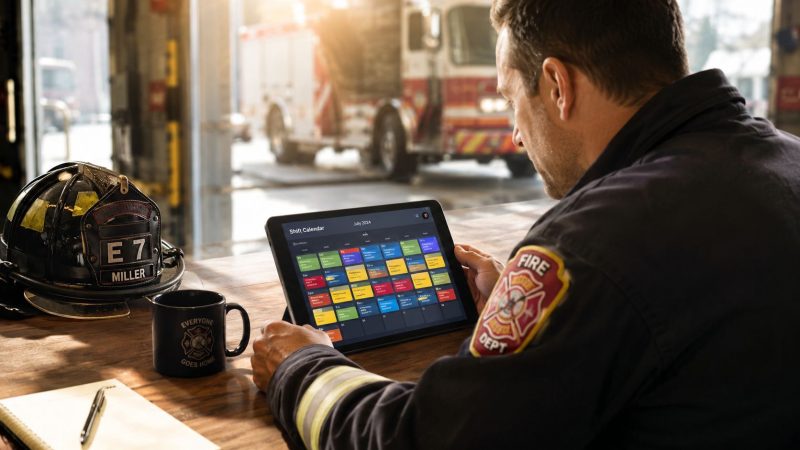
Best Shift Calendar for Firefighters: Master Your 2026
At a lot of departments, the shift calendar for firefighters still lives in three places at once. A spreadsheet on a battalion chief's laptop. A whiteboard at the station. A text thread that starts calm on Monday and turns into a scramble by Friday.
That setup works right up until someone calls out sick at 3 a.m., a training day knocks two people off a company, and payroll has to sort out whether a trade was even approved. At that point, the calendar isn't just a calendar. It's a budget problem, a fatigue problem, and a credibility problem.
A good firefighter schedule has to do more than show who works Tuesday. It has to support minimum manning, keep overtime from getting away from you, help families see the same schedule the department sees, and give command staff enough visibility to make staffing decisions before they become staffing emergencies.
The Hidden Costs of Outdated Firefighter Scheduling
The usual scene is familiar. A lieutenant is covering a vacancy with one hand, answering texts with the other, and trying to remember whether the open seat should go by seniority, equalization, or the last person who already got held over. Nobody feels in control, and the day hasn't even started.

What drains money isn't only the overtime itself. It's the chain reaction around it. Manual calendars create duplicate data entry, delayed notifications, accidental under-staffing, and payroll cleanup after the fact. When people can't trust the posted schedule, they start calling supervisors for confirmation. That steals officer time from inspections, training oversight, apparatus readiness, and actual incident follow-up.
Where the money leaks out
A department can lose control of labor costs without a single dramatic mistake. It usually happens through small misses repeated every week.
- Backfill gets reactive: Open shifts get filled late, which narrows your options and pushes supervisors toward whatever coverage is fastest, not cheapest.
- Leave stacks: Vacation, training, light duty, and sick leave land on the same day because nobody has a clear system view.
- Admin time disappears: Someone has to maintain the schedule, update trades, notify crews, answer disputes, and reconcile payroll notes.
- Burnout drives more absences: Inconsistent scheduling and poor visibility make crews feel like they're always one text away from losing a day off.
Practical rule: If your staffing process depends on memory, screenshots, and group texts, you're already paying more than the posted overtime line shows.
Why old methods stay expensive
Whiteboards are easy to post but hard to audit. Spreadsheets are flexible but easy to break. Phone trees move fast until they don't. None of those tools create a clean record of who was offered a shift, who accepted it, when leave changed, or whether the final assignment matched policy.
That's why an updated shift calendar for firefighters isn't an administrative luxury. It's a control system. It reduces friction before the callback starts, before the holdover is ordered, and before payroll has to untangle what happened.
The departments that get this right usually don't start with flashy software. They start by admitting that scheduling is an operations function tied directly to cost containment.
Decoding Common Firefighter Shift Patterns
The schedule itself shapes everything else. Fatigue. Morale. Commuting. Trade frequency. Training continuity. Even how often your officers have to explain the rotation to new hires and spouses.
The 24/48 shift calendar is the most common in the U.S., resulting in a 56-hour average work week, and many departments look at alternatives because that cycle is demanding. The same review of firefighter scheduling notes that the 48/96 also averages 56 hours weekly but gives longer recovery time, and firefighters transitioning in a low call-volume setting gained about 23 minutes of sleep per tour according to this staffing and schedule analysis.

Comparing the common rotations
| Schedule | Typical structure | What works | What causes friction |
|---|---|---|---|
| 24/48 | One day on, two days off, usually across three platoons | Familiar, easy to explain, stable company continuity | Recovery can feel short, especially in busy houses |
| 48/96 | Two days on, four days off | Longer off-duty blocks, fewer commutes, simpler personal planning | Two straight days on can be rough when nights are busy |
| Kelly variant | A 24-hour pattern with scheduled relief days | Gives periodic relief and reduces pressure compared with a straight 24/48 cycle | Harder to track manually because the relief pattern adds exceptions |
| 24/72 | One day on, three days off, usually with four platoons | More off-duty time, easier recovery, strong appeal for retention and recruiting | Requires more staffing depth and more attention to specialized coverage |
The 24/48 works until it doesn't
A lot of departments stay on 24/48 because it's familiar and operationally simple. Everybody knows the rhythm. Trades are easy to visualize. Three platoons fit cleanly into station culture.
The drawback is cumulative fatigue. A firefighter reports in the morning, works through the overnight period, leaves the next morning, and only has two full days off before the cycle resets. On paper, that looks balanced. In practice, a busy night can turn the first day off into a recovery day, which leaves one solid day before the next shift.
That matters financially because tired crews call out more often, seek more trades, and need more recovery flexibility. The calendar starts carrying the hidden cost of fatigue.
Why some departments move to 48/96
The biggest operational argument for 48/96 isn't the total hours. It's the way those hours are grouped. A firefighter gets a longer uninterrupted block off duty, and that often makes family planning, side responsibilities, and recovery easier.
A peer-reviewed study found that moving firefighters from 24/48 to 48/96 in a low call-volume setting was associated with about 23 additional minutes of total sleep time and a 3 to 4 percent increase in sleep efficiency per tour, along with improved insomnia and depressive symptom measures in follow-up, in this published study on shift transition outcomes.
Longer time off in one block often reduces the number of schedule-related headaches, even when the total weekly hours don't change.
The trade-off is obvious. If your call volume is high and nighttime interruption is constant, two consecutive duty days can be hard on older members and hard on company officers trying to keep everyone sharp on the second day.
The Kelly schedule helps, but it complicates administration
A Kelly-style setup gives departments a way to break up a hard 24-hour rotation with planned relief days. From a labor standpoint, that can improve buy-in because crews can see real breathing room built into the cycle.
From an admin standpoint, Kelly days are where manual systems start failing. A simple repeating pattern turns into a pattern plus exceptions. If your calendar isn't automated, someone has to remember relief days, leave overlaps, debit adjustments, and whether a posted opening is vacant.
Four-platoon schedules can change culture
A 24/72 can be attractive because it gives crews more time off and can stabilize morale. Fire department administrators in a study on 24/72 scheduling reported 100% satisfaction levels and 100% retention rates, along with better morale, recruitment, and reduced sick leave, in this Frontiers article on the 24/72 schedule.
That doesn't mean every department should switch tomorrow. A four-platoon model changes hiring needs, station staffing assumptions, and special team planning. It can be a major quality-of-life improvement, but only if the department can support the added structure.
Calculating Staffing Needs and Minimum Manning
Most scheduling failures start before the calendar is ever posted. They start when a department confuses minimum manning with actual staffing need.
Minimum manning is the number of people you need on duty to keep companies in service. It is not the number of people you need on payroll. Payroll staffing has to absorb vacations, sick leave, training, injury leave, details, and attrition. If you build your roster to the bare floor, overtime becomes your default staffing model.

Use a practical staffing formula
A clean way to think about this is:
Set your constant staffing target.
Start with the number of people you must have on every shift to keep apparatus and command functions covered.Add known regular reductions.
Include planned vacation use, mandatory training time, light duty, and normal absenteeism patterns based on your own records.Build a relief factor.
This is the buffer that converts constant staffing into total headcount. If you skip this step, you'll buy coverage with overtime every pay period.Test the result against real trouble days.
Look at holidays, summer leave periods, academy weeks, and annual physical windows. If those days collapse your staffing plan, the payroll number is still too low.
A simple example
Say a department needs one engine, one truck, and a battalion response staffed every day. On paper, command may decide the minimum number needed per shift and assume the roster is covered once those seats are assigned across platoons.
That's where departments get burned. The real question is this: how many of those assigned members are reliably available after approved leave, training pulls, and expected absences are accounted for?
A better workflow is to map every billet to an actual person and then use a system that tracks qualifications, assignments, and availability in one place. That's where a personnel management layer matters more than another spreadsheet tab. A dedicated personnel management view for public safety staffing makes it easier to see coverage by role, not just by name.
What command staff should check monthly
- Thin days by company: Identify dates where approved leave and scheduled training stack on the same crew.
- Qualification gaps: Don't just count bodies. Count drivers, medics, officers, and specialty-qualified members.
- Forced overtime patterns: If the same station or platoon repeatedly drives holdovers, the staffing model is underbuilt.
- Leave timing: Vacation approval should reflect operational impact, not just first-come, first-served habits.
The cheapest overtime hour is the one you prevent during roster design, not the one you argue about after a callback.
What works and what doesn't
What works is using the shift calendar for firefighters as the final display of a staffing model that has already been pressure-tested.
What doesn't work is posting a rotation first and hoping captains can patch the holes with trades and goodwill. That approach usually looks manageable in a normal week and falls apart during training cycles, illness spikes, or seasonal leave periods.
If your calendar requires daily improvisation to maintain minimum manning, the problem isn't discipline. The problem is that staffing math and scheduling design were never joined together.
Automate Your Schedule with a Digital Platform
Once the rotation and staffing assumptions are set, the next job is turning that plan into something crews can effectively use without a chain of calls and screenshots.

The biggest mistake departments make here is treating digital scheduling like a prettier spreadsheet. That only changes the interface. It doesn't remove duplicate work, rule confusion, or payroll cleanup. True savings come from automation tied to recurring patterns, role requirements, and notifications.
Build the rotation once
Start with the recurring pattern itself. Enter the platoon structure, create the repeating schedule, and label each unit correctly. If your engine company runs a different staffing template than your ladder or medic unit, reflect that in the setup from day one.
For example:
- A three-platoon house: Load the repeating 24-hour cycle by A, B, and C shifts.
- A four-platoon department: Build D shift into the template instead of adding it later as an exception.
- A Kelly environment: Enter relief days as part of the logic, not as notes in a comment field.
A digital shift tool earns its keep. A platform such as Resgrid shift scheduling for teams and agencies can store recurring schedules, assign people to shifts, and keep that view connected to the rest of the operation instead of isolating it in a stand-alone calendar.
Stop using manual notifications
The fastest way to waste officer time is making supervisors chase every opening by text message. A better setup publishes an open shift, applies your rules, and alerts the people who are eligible to take it.
That matters because not every vacancy should go to the same list. Some openings require rank, driver status, paramedic credentials, or special team qualifications. If the system can't filter for that, you're still doing manual screening.
A common frustration among firefighters and their families is the inability to easily sync complex fire schedules with personal calendars like Google or Apple Calendar. Dedicated platforms solve that with subscription links that push the schedule into everyday calendar tools, as discussed in this firefighter calendar discussion on Reddit.
If spouses, childcare providers, and side employers can't see the same schedule the firefighter sees, the department will keep answering avoidable scheduling questions.
Put coverage on one dashboard
Command staff need one screen that answers three questions quickly:
- Who's assigned today?
- Where are the gaps?
- Which openings are likely to become overtime?
That dashboard should also show upcoming leave, training impacts, and qualification mismatches. If a company is technically staffed but missing the right certification mix, that's a real gap, not a cosmetic one.
Here's a useful walkthrough for seeing how modern scheduling and response platforms handle visibility and coordination in practice.
Actionable ways automation saves money
A digital shift calendar for firefighters pays for itself through fewer manual touches and fewer preventable mistakes. The savings show up in labor control, not hype.
- Use recurring templates: Build the base schedule once instead of re-entering monthly rotations.
- Route openings automatically: Send open shifts only to qualified members instead of broadcasting to everyone.
- Publish approved trades into payroll-ready records: That cuts disputes over whether an exchange was authorized.
- Share calendar feeds externally: Families can subscribe instead of asking the member to manually copy duty days into Apple Calendar or Google Calendar.
- Flag thin staffing early: Supervisors can fix future shortages during daylight hours, not at the start of shift.
What doesn't save money is buying software and keeping the old habits. If your department still relies on side texts, shadow spreadsheets, and verbal approvals, the platform becomes another layer instead of the system of record.
Managing Overtime Leave and Shift Trades Fairly
Most departments don't lose control of scheduling on the base rotation. They lose it in the living part of the calendar. Sick calls. Vacation pulls. Swap requests. Mandatory holdovers. Last-minute training conflicts.
That's also where money leaks fastest.
A static calendar can look clean for the month and still produce daily arguments over who should get the overtime, whether a trade violated policy, or why one platoon keeps getting the worst callbacks. When those questions are handled by memory or habit, somebody will eventually claim favoritism, contract violations, or pay errors.
Fairness has to be visible
Crews don't expect every staffing decision to make them happy. They do expect the process to be consistent. If your department equalizes overtime, the record should show that. If your contract prioritizes seniority, the offer path should show that. If trades need supervisor approval, that approval should live in the system, not in a text message that disappears.
A centralized workflow matters here because it gives payroll, supervisors, and labor representatives the same record. A structured workflow system for approvals and staffing processes can document requests, approvals, and status changes in sequence, which is exactly what you need when a dispute lands on a chief's desk.
What a fair process looks like
- Overtime offers follow rules: Seniority, equalization, qualification, or station order should be built into the process.
- Trades leave an audit trail: The system should show who requested the trade, who accepted it, and who approved it.
- Leave changes update the roster immediately: Supervisors shouldn't have to compare a leave sheet to a separate staffing board.
- Payroll sees the same version operations sees: That prevents errors on premium pay, callback time, and holdover coding.
A fair system isn't one that eliminates complaints. It's one that can prove the rule was followed.
Why this also protects the department
Bad scheduling records don't just create morale problems. They can turn into wage and hour problems. If members are working extra time, getting held over, or performing compensable duties that aren't recorded correctly, the department needs a clean process and clean documentation. For agencies reviewing policy exposure around labor compliance, this overview of unpaid overtime wages is a useful reference point.
The practical takeaway is simple. If a trade, callback, or holdover changes pay, it belongs in a system with timestamps and approvals. Whiteboards don't do that. Group chats don't do that. A captain's memory definitely doesn't do that.
Beyond the Calendar Strategic Workforce Planning
A shift calendar for firefighters should do more than show tomorrow's lineup. If the department uses it well, it becomes a planning tool for hiring, training, and specialty team readiness.
That matters most when a department changes its staffing model. Moving to a four-platoon schedule can improve time off and retention, but command staff also have to plan for special team skill dilution. FireRescue1 notes that spreading specialized members across four shifts is a real challenge and can degrade Hazmat or USAR response quality if the department doesn't actively manage training and qualification depth, as discussed in this analysis of the move to a 24/72 D-shift schedule.
Use schedule data to make better command decisions
Historical schedule data helps answer questions that usually get argued with anecdotes:
- Are certain companies generating overtime because of chronic vacancies?
- Are mandatory classes being scheduled in ways that weaken on-duty coverage?
- Do special teams have enough depth on every shift, or only on paper?
- Is leave demand pointing to a need for more hiring, different relief staffing, or a revised training calendar?
That same planning lens applies to firefighter wellness. Departments often focus on sleep and fatigue, but daily performance also depends on hydration, meal quality, and station nutrition habits. For crews looking at practical wellness options that fit shift work, this guide to suplementos sin azucar para bomberos is a relevant example.
The point isn't to collect more data for its own sake. The point is to turn schedule history into staffing decisions that reduce avoidable overtime, protect special operations capability, and keep line companies reliable week after week.
If your department is still managing staffing through spreadsheets, whiteboards, and text threads, it's time to tighten the system. Resgrid, LLC gives fire and public safety teams one place to manage shifts, personnel, messaging, and operational workflows so the schedule supports the mission instead of creating extra work.