
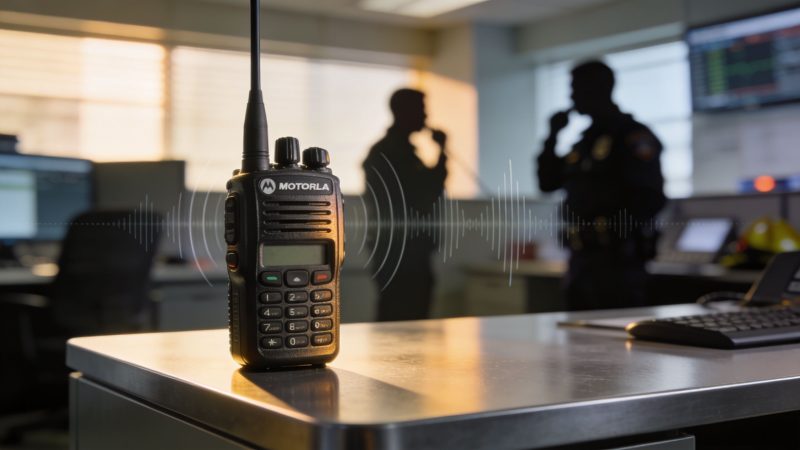
VHF Radio Motorola: A First Responder’s Complete Guide
You’re probably dealing with one of two problems right now. Either your agency already owns Motorola VHF radios and needs to get more life out of them, or you’re trying to buy the right radios without paying for features your crews won’t use.
That’s where most vhf radio motorola decisions go wrong. People shop by model number, brochure language, or whatever another department bought five years ago. They should be shopping by terrain, staffing pattern, mutual aid reality, and how the radio will fit into dispatch.
A VHF radio isn’t just a handheld. It’s part of a field workflow. A firefighter keys up from a dead spot. A school security team needs simple, predictable channel access. A county EMA group wants radios that still work when cellular data gets congested. If the radio plan, antenna choice, and dispatch workflow don’t match the operation, good hardware won’t save you.
The Critical Role of VHF Radio in Public Safety
Smartphones are useful. They’re not a replacement for land mobile radio.
A VHF radio system gives responders a dedicated path for voice traffic. Cellular networks share capacity with everyone else in the area. During a storm, wildfire, large event, or major crash, that matters. VHF is still the working backbone for many field teams because it stays simple, direct, and predictable when the environment gets messy.

Why VHF still works so well
Think of VHF as a dedicated rural highway. It isn’t always the fanciest route, but traffic moves cleanly and consistently. Cellular is more like a city street grid. It can be fast when conditions are good, but congestion, coverage gaps, and infrastructure dependency all change the result.
For first responders, that translates into practical trade-offs:
- Open-area strength: VHF generally works well across rural roads, farmland, parks, wildland areas, and suburban edges.
- Predictable push-to-talk behavior: Crews don’t need to ready screens, launch apps, or trust local carrier capacity.
- Simple fleet discipline: A radio knob, assigned channel plan, and trained users prevent a lot of confusion.
What VHF doesn’t do as well is solve every indoor or dense-structure problem by itself. In heavy concrete, steel, and deep-building environments, radio planning becomes more important. That’s why chiefs should think about the whole system, not just the portable.
Practical rule: If your people work outside, travel county roads, cover campuses, or operate over broad mixed terrain, VHF should stay in the conversation.
Why Motorola matters in this space
Motorola didn’t arrive late to public safety radio. The company helped define it. In 1940, Motorola advanced public safety communications by hiring Daniel E. Noble. That led to the first commercial line of Motorola FM mobile two-way radio equipment in 1941, first deployed in police cars in Philadelphia, and it set a new standard for clarity and resistance to interference over older AM systems, as documented in Motorola Solutions’ company history timeline.
That history still matters because the same core expectation remains. Field units need clear audio, disciplined channels, and equipment that survives daily abuse.
What dispatchers and chiefs should take from that
The best use of vhf radio motorola gear isn’t just “issue radios to staff.” It’s building a communication layer that keeps working when everything else gets uncertain.
A solid VHF plan usually includes:
- Defined channel purpose: Primary dispatch, tac, mutual aid, command, and backup each need a clear role.
- Simple user operation: If a radio takes too many steps to use under stress, people will misuse it.
- Coverage matched to geography: Don’t assume the same setup works for downtown, farmland, and wooded terrain.
- A dispatch workflow built around radio reality: If logging, staffing, and event management live somewhere else, crews lose time.
Navigating Motorola's VHF Radio Lineup
Motorola’s VHF catalog makes more sense when you ignore the marketing families and sort radios by who’s carrying them, where they’re working, and how much complexity the organization can support.
A chief buying for a volunteer fire company has different needs than a school district, utility crew, or county EMA team. Some agencies need ruggedized radios with stronger field controls. Others need simple, affordable units that staff can learn fast and replace without pain.

A practical way to sort the lineup
| Category | Best fit | What works | What to watch |
|---|---|---|---|
| Professional series | Public safety, hard daily use | Better durability, deeper feature sets | Higher cost, more admin overhead |
| Commercial series | Schools, security, facilities, events | Lower complexity, easier rollout | May be limiting for growing systems |
| Digital and analog capable | Agencies in transition | Helps bridge older fleets and newer workflows | Requires disciplined programming |
| Intrinsically safe models | Hazmat or hazardous environments | Safety-specific design | Costs more, should be mission-driven |
That framework prevents a common procurement mistake. A department buys a top-end radio for every user, then discovers half the fleet only needed dependable voice and a clean channel selector.
What specs actually mean in the field
A spec sheet matters when it maps to a field problem.
Motorola’s VZ-18 VHF portable radio has receiver sensitivity of 0.22 μV at 12 dB SINAD, which allows it to pick up very weak signals in fringe coverage areas, according to the Motorola VZ-10 and VZ-18 data sheet. For a first responder, that matters at the edge of a rural district, behind terrain, or in the kind of incident footprint where “I can almost hear you” becomes operationally dangerous.
That doesn’t mean the VZ-18 is automatically the right answer for every agency. It means weak-signal performance deserves more attention than cosmetic features.
If your crews routinely report broken audio in the same fringe areas, start by reviewing receiver performance, antenna setup, and programming discipline before you blame user error.
Matching radios to users
Use the job to drive the radio choice:
- Fire and field command staff: Lean toward models built for rough handling and faster operation with gloves or under stress.
- Event teams and school operations: Commercial VHF units often make more sense because they’re simpler to train on and easier to standardize.
- Mixed fleets: Radios that support analog and digital operation help agencies avoid a forced cutover.
- Hazardous locations: Only choose intrinsically safe models when the environment requires them. This is a safety decision, not a prestige feature.
What doesn’t work
Procurement gets expensive when agencies buy based on broad brand reputation alone.
Avoid these traps:
- Overbuying features: Not every user needs advanced data options.
- Underbuying durability: Cheap radios become costly if they fail in daily field use.
- Ignoring programming support: A capable radio with poor fleet programming turns into confusion on scene.
- Mixing too many models: Spare parts, batteries, accessories, and training all get harder when the fleet becomes a patchwork.
Managing Frequencies and Ensuring Interoperability
Buying a Motorola VHF portable is the easy part. Running it legally and making it work with neighboring agencies is where the essential communications work starts.
A lot of radio problems get blamed on hardware when the actual issue is frequency planning. If dispatch, fireground, EMS, law, and mutual aid channels aren’t clearly structured, users talk over each other, miss traffic, or end up carrying radios that technically function but don’t support the incident.

You can’t just turn on a radio and talk
Radio spectrum is shared and regulated. That means channel assignments, licensing, and programming discipline matter. Departments that treat programming as an afterthought usually create their own interference and confusion.
For a new dispatcher or chief, the useful takeaway is simple. Interoperability starts before the incident. It starts when the fleet is programmed, named, and trained consistently.
A clean channel plan should answer these questions fast:
- Which channel is daily dispatch
- Which channel is tactical
- Which channel is command
- Which channel is mutual aid
- Which channel is backup when the primary path fails
Narrowbanding and why it matters operationally
Narrowbanding sounds technical, but the practical point is straightforward. It helps fit more organized communications into shared spectrum and reduces harmful spillover into nearby channels when systems are configured correctly.
For example, Motorola’s VZ-10 and VZ-18 support 11KΦF3E at 12.5 kHz and 16KΦF3E at 25 kHz modulation, with 65 dB selectivity at 25 kHz and 60 dB at 12.5 kHz, according to the earlier-cited Motorola VZ-series documentation. In plain language, those are the kinds of specifications that help agencies operate in tighter channel plans with less adjacent-channel trouble.
That matters when multiple agencies converge on one scene.
A workable interoperability mindset
Interoperability isn’t only about major disasters. It shows up at county fairs, weather incidents, school events, and multi-unit vehicle crashes.
Use this checklist when reviewing your VHF plan:
- Name channels by function, not local jargon. “Tac 1” travels better than a nickname only one shift understands.
- Build mutual aid into every fleet template. Don’t leave it as an optional add-on.
- Standardize zone layouts where possible. A borrowed radio should still feel familiar.
- Test cross-agency use in training, not during an actual incident.
Here’s a useful explainer on radio fundamentals and field use:
The cheapest interoperability upgrade is often better planning, not more hardware.
What chiefs should push on
Don’t accept “they can talk if they really need to” as an interoperability plan.
Ask your communications lead or vendor:
- Which channels are common across all frontline units
- How are radios labeled in the field
- What happens when crews from another agency arrive
- Which channels are programmed for shared incidents
- How often the fleet template is audited
That line of questioning saves money because it avoids panic purchases later. Agencies often buy additional gear when the actual fix was better frequency coordination and a saner programming template.
Integrating Motorola Radios with Modern Dispatch Platforms
Most agencies aren’t replacing all their radios at once. They’re trying to keep proven Motorola VHF hardware in service while improving dispatch, staffing, accountability, and reporting. That’s a practical problem.
The hard part isn’t voice. Motorola radios already handle voice well. The hard part is turning field radio activity into something the dispatch side can track, organize, and use without locking the agency into an expensive proprietary stack.

Where the gap usually appears
A unit calls in over VHF. Dispatch hears it. Somebody writes it down, updates a whiteboard, or types a note in a separate system. Personnel tracking lives somewhere else. Event assignments live somewhere else again.
That split wastes time and creates avoidable mistakes.
A key challenge for agencies is the integration of VHF Motorola radios with open-source dispatch platforms like Resgrid, because proprietary ecosystems can be costly and often lack clear guidance on API syncing for real-time personnel tracking, a critical need in emergency management, as noted in Motorola material for the RMU2080 and RMV2080 radio family.
What a practical integration workflow looks like
You don’t need to think in terms of replacing radio with software. Think in terms of connecting radio events to digital operations.
A workable flow often looks like this:
- Field unit transmits on VHF: The radio remains the primary voice tool.
- Gateway or interface passes activity onward: That can be a Radio over IP path or another bridging layer.
- Dispatch logs the event in one place: Incident details, staffing, and status stay visible.
- Supervisors track personnel and assignments digitally: Voice remains voice. Accountability becomes easier.
For teams evaluating options, it helps to review a platform’s dispatching workflow and feature set before trying to bolt software onto the fleet.
What works and what doesn’t
What works is incremental integration. Keep the Motorola radios your crews trust. Add structured dispatch and tracking around them.
What usually doesn’t work:
- Trying to digitize everything at once
- Assuming every radio model supports the same data features
- Ignoring field workflow during software selection
- Letting IT choose alone without dispatch and radio input
Start with one operational pain point. Incident logging, staffing visibility, or unit status. Solve that first, then expand.
Cost-saving moves during integration
You can save money without sacrificing capability if you sequence the work correctly.
A chief or communications officer should look for these wins:
- Keep functioning VHF portables in service: Don’t replace reliable field hardware just to satisfy a software project.
- Reduce duplicate entry: If dispatch enters incident information once instead of in multiple places, staff time improves immediately.
- Standardize templates: Reusable event and assignment structures reduce setup effort for planned details and recurring incidents.
- Train supervisors on the workflow, not just the tool: A platform only saves money if people use it consistently.
The strongest agencies treat radio and software as one operational system. Voice handles urgency. The digital layer handles memory, coordination, and accountability.
Cost-Saving Strategies for Procurement and Maintenance
The sticker price on a handheld is only part of the bill. Battery replacement, accessories, downtime, programming support, and training usually decide whether a fleet is affordable.
That’s why chiefs should think in total cost of ownership, not purchase price. A radio that costs less upfront can still become the expensive option if it burns through batteries, needs frequent swap-outs, or forces crews into workarounds.
Battery life is a budget issue
Motorola’s MOTOTRBO DP540 VHF can achieve up to 15 hours runtime on a high-capacity battery and can outperform standard batteries by 40%, which directly reduces ownership cost by cutting spare battery demand and mid-shift replacements, according to the MOTOTRBO DP540 data sheet.
That’s not just a battery spec. It affects how many chargers you buy, how many spares you stock, and whether crews have to swap batteries during long operational periods.
Questions that save money before you buy
Use a vendor meeting to force practical answers. Don’t let it stay at brochure level.
Ask:
- How many spare batteries will this fleet realistically require
- Which users need high-power operation all day
- Can the radio support the channel plan we expect to use over its service life
- What accessories are essential at deployment
- How difficult is programming support after purchase
For agencies comparing software costs alongside hardware costs, it helps to review current Resgrid pricing options and compare that model against long-term commitments elsewhere.
Spend more in the right places
Here’s where extra money often pays off:
| Spend more on | Why it usually makes sense |
|---|---|
| Battery capacity | Fewer swaps, fewer spare packs, less disruption |
| Common accessories | Standard mics, chargers, and carry options reduce confusion |
| Programming consistency | Bad templates create daily operational friction |
| Training for supervisors and dispatch | Good equipment fails when users improvise incorrectly |
Here’s where agencies often overspend:
- Feature creep: GPS, advanced signaling, or specialty functions that never become part of the workflow
- Too many accessory variants: Different chargers and batteries across similar user groups
- Top-tier radios for low-risk users: Not everyone needs the same class of unit
- Panic buying after a failure: Usually more expensive than planned replacement cycles
A better replacement mindset
Don’t wait for every radio to fail. Replace by role, age, supportability, and actual duty cycle.
A practical maintenance plan includes:
- Separate frontline units from low-use reserve units
- Retire accessories that create recurring failures
- Review battery performance before users start complaining
- Keep fleet programming documents current
The cheapest radio is the one that stays in service, stays understandable to the user, and doesn’t force extra labor around it.
Advanced Troubleshooting and Performance Optimization
When crews say a Motorola VHF radio has “bad range,” the radio is often only part of the story. Coverage problems usually come from a mix of terrain, antenna choice, power settings, channel design, and user habits.
That’s good news, because many of those issues are fixable without replacing the entire fleet.
Start with the antenna, not the complaint
Antenna choice gets ignored far too often. Agencies put one style on every vehicle or portable and then wonder why performance changes across the county.
A key but often overlooked optimization is antenna selection. Low-angle radiation antennas can extend rural coverage by 20 to 50% compared to the high-angle antennas often used in urban environments, according to the Motorola HAD4007 product discussion at RadioDepot.
That’s a major operational trade-off.
- High-angle radiation setups: Better suited to urban clutter and local obstruction.
- Low-angle radiation setups: Better for longer rural paths and wide-area travel.
- Mixed-terrain agencies: Should test, not assume. One antenna style rarely serves every district equally well.
A better way to diagnose poor reception
Don’t rely on signal bars alone. Use a repeatable troubleshooting order.
Try this sequence:
Check location pattern
If failures happen in the same places every time, this is likely a coverage or terrain issue, not random hardware failure.Compare users on the same channel
If one radio struggles and the others don’t, inspect the radio, antenna, battery, and accessory chain.Review programming choices
Wrong power settings, poor channel naming, or inconsistent templates create problems that sound like RF failures.Inspect accessories
Speaker mics, worn connectors, and damaged antennas cause a surprising amount of “radio failure.”
Small settings that improve field use
Optimization doesn’t always mean buying new hardware. It often means setting up existing gear with more discipline.
Useful adjustments include:
- Low-power use where appropriate: Save battery on close-range channels and reserve higher power for when needed.
- Clear zone and channel layout: Users make fewer mistakes when the radio mirrors the incident workflow.
- Squelch and audio review: If users are missing weak calls or fighting noisy audio, revisit the programming with the field environment in mind.
- Field testing with crews: Parking-lot tests don’t reveal what happens behind schools, inside plants, or along rural road cuts.
Support matters after deployment
A good support path keeps a communications problem from becoming an incident problem. If your agency is tightening workflows or trying to document recurring radio issues alongside staffing and response operations, a structured support process for operational tools helps keep technical friction from spreading into the field.
“Bad radio range” is often “bad system matching.” Fix the environment, the antenna, or the template before you condemn the fleet.
Frequently Asked Questions about VHF Motorola Radios
Can a VHF Motorola radio talk directly to a UHF radio
Not by itself. VHF and UHF operate in different frequency bands, so one handheld won’t directly talk to the other unless there’s a properly configured bridge, repeater arrangement, or other interoperability method in place.
What real-world range should I expect from a handheld
It depends on terrain, antenna setup, power setting, and obstruction. Open ground, high positions, and a good antenna help. Dense buildings, valleys, and poor antenna matching hurt. Don’t judge a radio only by what it does in a parking lot.
Do I need programming software for Motorola radios
Sometimes yes, sometimes no, depending on the model and what you’re trying to change. Some field changes are simple. Full fleet programming usually needs more structure and should be handled carefully so every radio matches the channel plan.
Should I choose analog only or analog and digital capable
If your agency expects to keep older equipment in service while gradually improving the fleet, dual-capable options are usually easier to live with. If your operation is simple and stable, analog may still be enough.
What causes the most avoidable radio problems
Three things come up constantly:
- Poor channel organization
- Wrong antenna choice for the terrain
- Inconsistent programming across the fleet
Is Motorola VHF still worth buying
Yes, when VHF matches your coverage area and operating style. For rural response, mixed suburban territory, campuses, school systems, event operations, and many utility or public safety workflows, vhf radio motorola equipment remains a practical choice.
Resgrid, LLC gives first responders, dispatchers, and operational teams a cost-effective way to manage dispatching, staffing, messaging, tracking, and reporting without the burden of expensive implementation cycles. If you’re trying to get more value from your existing radio fleet while modernizing the dispatch side, Resgrid is worth a serious look.