
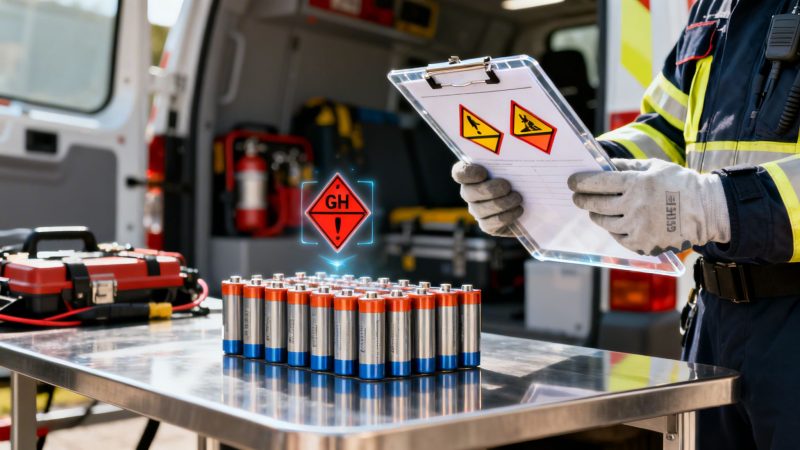
Master msds for lithium batteries: Essential Safety Guide for Responders
An MSDS for lithium batteries, which we now call a Safety Data Sheet (SDS), is more than just a piece of paper. For first responders, it's a field guide that spells out exactly how to handle the specific fire, explosion, and toxic gas risks of that battery. It provides the immediate, tactical information needed to manage an emergency safely.
From Compliance to Lifeline: Why Responders Need to Master the SDS
Imagine rolling up to a fire in an e-bike shop. You see flames, sure, but that’s only half the story. The real threat is the unseen potential for thermal runaway in dozens of lithium batteries charging inside. It’s a violent, explosive chain reaction that can turn a routine fire into a complete catastrophe.
This is exactly where understanding the MSDS for lithium batteries goes from a paperwork drill to a critical lifeline. For emergency crews, the SDS isn't just another document; it’s our tactical playbook. It gives us the intel needed for the split-second decisions that protect lives and property. Without it, you're flying blind against hazards that most standard fires just don't have.
The Cost of Being Unprepared
These dangers aren't just theoretical. A sobering example happened on Asiana Airlines Flight 214. A damaged lithium-ion battery in a passenger's medical device caught fire, scorching 25% of the aircraft's interior. The fire also pumped out toxic hydrogen fluoride gas—a key hazard you'll find detailed in a battery's SDS. It’s a stark reminder of how a small power source can cause devastating problems.
And mismanaging a lithium battery incident isn't just dangerous; it gets expensive, fast.
- Actionable Insight: By checking Section 5 of the SDS, a fire department can find the right firefighting agent. This simple step can stop crews from using water on certain battery types (like lithium-metal) that react explosively. It prevents a bad situation from getting worse and saves millions in potential damages.
- Practical Example: A warehouse manager who actually reads Section 7 (Handling and Storage) will learn the right way to space and charge batteries. These protocols cost nothing to implement but can prevent a multi-million dollar fire, saving the business and the jobs that go with it.
The SDS is your pre-incident intelligence. Knowing the specific UN number, the correct extinguishing agent, and the signs of thermal runaway before you even arrive changes the entire dynamic of the response. It turns chaos into a controlled, strategic operation.
In really complex hazmat incidents, a successful outcome often relies on collaborating with law enforcement and first responders and other specialized services. But it's the initial actions from the first units on scene, guided by that SDS data, that set the stage. Having this information instantly available through modern dispatching and management tools like Resgrid’s, which you can learn about here https://resgrid.com/features/dispatching, ensures every team member has life-saving intel from the moment the call drops.
Decoding the SDS: A Tactical Section-by-Section Guide
Don't think of a Safety Data Sheet (SDS) as just another long, boring compliance document. For a lithium battery incident, it’s your tactical playbook. This 16-section guide is laid out for a reason, and knowing where to find critical intel can make all the difference when you're on scene.
Instead of reading it cover-to-cover, treat the SDS like a field reference. You need to jump straight to the sections with the immediate, life-saving information. It’s all about cutting through the noise to get the data you need for fast, smart decisions. It's knowing what you need before you even step off the truck.
Section 2 Hazards Identification: Your Primary Threat Assessment
Before you get anywhere near a damaged battery, Section 2 is your first stop. This is your rapid-fire threat assessment, telling you exactly what you’re up against. For lithium batteries, it will flag the big dangers: explosion risk, flammability, and the potential for the battery to vent toxic or irritating gases when it's damaged or heating up.
To really get what you're seeing, you need a solid understanding of toxic hazard signs, especially the GHS pictograms and OSHA rules. These symbols in Section 2 are an at-a-glance summary of the primary dangers, helping you plan for the worst-case scenario.
A quick check here gives you the intel to set proper standoff distances, decide if you need air monitoring, and pick the right level of PPE from the get-go.
The image below breaks down the three main threats that Section 2 will be warning you about.

This visual shows the core threats—fire, explosion, and toxic gas release—which are the critical hazards an SDS is designed to help you manage.
Section 5 Fire-Fighting Measures: Your Tactical Response Plan
Once a fire kicks off, Section 5 becomes the most important page in your playbook. This is where you find specific, actionable guidance for tackling a lithium battery fire—straight from the manufacturer on what works and, just as importantly, what doesn’t.
Getting this part right can save a response from going completely sideways. For instance, the SDS for a lithium-ion battery will tell you to use huge amounts of water for cooling. But the SDS for a lithium-metal battery will strictly forbid water, warning that it can cause a violent, explosive reaction. Mistaking one for the other has catastrophic consequences.
This section gets right to the point, giving you critical details like:
- Suitable Extinguishing Media: Tells you whether to use water, Class D extinguishers, or other specialized agents.
- Unsuitable Extinguishing Media: Explicitly warns you away from things that will make the fire worse.
- Specific Hazards: Describes the real risk of reignition or delayed thermal runaway, even after you think the fire is out.
- Protective Equipment: Recommends the necessary PPE, which almost always includes SCBA because of the toxic fumes.
Section 7 Handling and Storage: Preventing Incidents and Saving Money
While other sections are about what to do in an emergency, Section 7 is all about preventing one from ever happening. This is a goldmine for business owners, facility managers, and anyone storing batteries. Following this advice translates directly into cost-saving safety protocols.
- Practical Example: A repair shop stores dozens of scooter batteries. The SDS in Section 7 recommends a 3-foot spacing during charging. Following this free advice prevents a single failing battery from starting a chain reaction, saving the shop from a total-loss fire that would cost hundreds of thousands of dollars.
- Actionable Insight: Implement a policy to review Section 7 of the SDS for all high-energy batteries in your facility. Use this information to create simple, visual guides for your staff on proper charging and storage. This low-cost training initiative is one of the most effective ways to prevent a catastrophic fire and avoid massive financial losses and insurance hikes.
Finally, Section 14 (Transport Information) provides the UN number, a universal ID for the hazardous material. Giving this number to dispatch, mutual aid, or hazmat teams ensures everyone is on the same page.
When you see a lithium battery fire, the flames are just the beginning. The real threat—the one that’s often invisible and dangerously underestimated—is what’s happening inside the battery itself. The biggest danger is something called thermal runaway, and your MSDS for lithium batteries is the best place to learn just how bad it can get.
The easiest way to think about thermal runaway is like a chain of dominoes falling, but it’s happening on a chemical level. It all starts when one cell inside the battery gets too hot, maybe from being damaged, overcharged, or even just exposed to an external fire.
Once that first cell hits a critical temperature, it sets off a violent, self-sustaining chemical reaction. This reaction generates an incredible amount of heat and vents flammable gas and molten material, which is a recipe for disaster.

That intense heat immediately jumps to the cells next to it, causing them to fail in the exact same way. In a matter of seconds, this cascade can rip through an entire battery pack.
Recognizing the Precursors to Disaster
The good news is that thermal runaway rarely happens without giving some warning. Knowing these signs is critical, as it gives you a chance to evacuate and set up a safe perimeter. Your own senses are your best first alert system.
Pay close attention to these signals:
- Hissing or Whistling Sounds: This is the noise of high-pressure gases escaping the battery cells as they start to fail.
- A Distinct, Sweet, or Acrid Smell: As the internal components break down, they release a unique odor. If you can smell it, you’re already too close.
- Swelling or Bulging Battery Casings: This is a dead giveaway that internal pressure is building fast. The battery is physically deforming and is on the verge of catastrophic failure.
- Venting Smoke or Vapors: You’re seeing the visible release of flammable and toxic gases right before they ignite.
The moment you spot any of these signs, your priority has to switch from firefighting to life safety. Evacuate the area immediately and establish a large exclusion zone. These warnings often appear just seconds before the battery ruptures violently.
The Dangers of Extreme Heat and Toxic Gases
The speed of thermal runaway is shocking. Looking through an MSDS for lithium batteries from a major manufacturer, you'll see data showing cell temperatures can jump from a critical point of around 80°C to over 600°C in just a few seconds.
This process generates extreme internal pressure, enough to make the battery explode and throw shrapnel and molten metal everywhere.
It also releases a nasty cocktail of extremely hazardous gases. The most infamous is hydrogen fluoride (HF), a highly corrosive and toxic gas that’s created when the battery's electrolyte mixes with moisture in the air. Inhaling even a small amount can cause severe lung damage that might not show up for hours. The battery will also off-gas things like carbon monoxide, hydrogen, and other hydrocarbons, creating an atmosphere that is both toxic and explosive.
With these batteries everywhere, this is a global issue. The U.S. Federal Aviation Administration documented over 300 aircraft fire incidents involving lithium batteries between 1991 and 2022, which shows just how vital these safety protocols are. You can dig into the lithium-ion battery industry trends in this report on Statista.
Post-Fire Hazards: The Invisible Threat
Even when the fire is out, the scene is far from safe. The area will be coated in toxic residue, and damaged batteries can continue to off-gas long after the incident seems to be over.
Here are the practical steps for dealing with what you can’t see:
- Maintain Full PPE: Don’t take off your Self-Contained Breathing Apparatus (SCBA) until you’ve confirmed the air is safe. Those toxic gases can stick around for hours.
- Conduct Air Monitoring: Before anyone enters without respiratory protection, use multi-gas meters to check for toxic and flammable gases.
- Plan for Reignition: A battery that has been cooled can still reignite hours or even days later. Isolate it in a safe, open area and keep monitoring it. This one step can prevent a second fire and save thousands in follow-on damage.
When you're rolling up on a lithium battery fire, your gut instincts and standard training for Class A or B fires can get you into serious trouble. The tactics that work on wood or gasoline are often useless—or even dangerously counterproductive—when dealing with these incidents.
Getting a handle on the right approach, which is always detailed in the MSDS for lithium batteries, isn't just about knocking down the visible flames. It’s about stopping a powerful chemical reaction dead in its tracks.
This is a major tactical shift. Your primary goal isn't extinguishing the fire; it's cooling the battery pack. Flooding the battery with massive amounts of water is the go-to strategy because it absorbs the intense heat and stops thermal runaway from jumping from one cell to the next. You're breaking the chain reaction at its source.
The Five-Step Incident Command Checklist
To keep these complex scenes from spiraling out of control, you need a structured game plan. A solid on-scene checklist makes sure all your critical bases are covered, which is essential for keeping your crew safe and minimizing damage. It’s about making smart, repeatable decisions when the pressure is on.
- Identify the Battery Type: Is it lithium-ion or lithium-metal? This one piece of information, found right in the SDS, will dictate your entire firefighting strategy.
- Establish Exclusion Zones: These batteries can explode and release a cocktail of toxic gases. Set up a large, secure perimeter to keep your people and the public out of harm's way. You can leverage situational awareness tools and mapping features to clearly define these zones for everyone on scene.
- Select the Right Agent: For lithium-ion, it's all about volume. Big water for cooling. For lithium-metal, you absolutely need a Class D agent like copper powder. Water is a no-go.
- Deploy Air Monitoring: The most dangerous threat here can be invisible. Toxic gases like hydrogen fluoride (HF) demand continuous air monitoring, even long after the fire is out.
- Plan for Runoff: All that water you're using for cooling? It's now contaminated hazardous material. You need a plan to contain it from the start, or you'll be facing steep environmental fines on top of everything else.
Actionable Insight: Planning for contaminated runoff from the start can save a municipality from six-figure environmental cleanup costs. Practical Example: During an EV fire, a crew used absorbent booms from their hazmat cache to dike a storm drain before applying water. This simple, pre-planned action prevented contaminated water from entering the local waterway, avoiding fines that could have easily exceeded $100,000.
Choosing the Correct Extinguishing Agent
Picking the right extinguishing agent is arguably the single most critical tactical decision you'll make at a lithium battery fire. The wrong choice can have literally explosive consequences, which is why the MSDS for lithium batteries for the specific product involved is your only trustworthy guide.
Recent events have tragically proven this point. For example, an SDS will tell you to never use water on a pure lithium fire because it reacts violently. Instead, it will call for a Class D agent. This exact guidance was critical during the 2022 New York warehouse fire, where 400 tons of batteries burned for three days. The incident cost $50 million and sent 12 responders to the hospital with hydrogen fluoride burns. With U.S. data showing lithium battery fires tripled between 2015-2023, knowing the right tactic is more urgent than ever.
With that in mind, it's crucial to understand what works and what doesn't.
Firefighting Agent Effectiveness on Lithium-Ion Batteries
This table breaks down how common firefighting agents stack up against lithium-ion battery fires, based on what you'll find in an SDS and fire engineering best practices.
| Agent | Effectiveness & Use Case | Critical Warning |
|---|---|---|
| Water | Highly effective for cooling lithium-ion batteries to stop thermal runaway from spreading to other cells. | NEVER use on lithium-metal battery fires; it causes a violent, explosive chemical reaction. |
| Class D Powder | The required agent for lithium-metal fires (e.g., copper powder). It works by smothering the fire. | Ineffective on deep-seated lithium-ion fires because it provides no cooling effect to stop the internal reaction. |
| Foam / CO2 / Dry Chem | Generally ineffective on lithium-ion fires. They cannot cool the cells enough to stop the thermal runaway process. | Can extinguish visible flames for a moment, but the battery will almost certainly reignite due to the trapped heat. |
Ultimately, for the most common lithium-ion fires you'll encounter, water is your best friend—and you're going to need a lot of it.
A Coordinated and Safe Response
When an incident involves not one, but hundreds or thousands of batteries, coordination is everything. This is where a platform like Resgrid becomes essential. It ensures every single person, from the first engine on scene to the hazmat specialists, is working from the same playbook.
When the Incident Commander establishes an exclusion zone or confirms the battery chemistry, that critical information is pushed out to everyone instantly.
This kind of real-time communication takes the guesswork out of the equation. It guarantees every action taken on the fireground is based on the same intelligence pulled directly from the MSDS for lithium batteries. This unified approach doesn't just improve responder safety—it dramatically reduces property damage and the long-term liability your organization could face.
How to Find and Use an MSDS in an Emergency
An MSDS is completely useless if it's buried in a filing cabinet when you're on scene. Knowing where to find the right MSDS for lithium batteries during a call is a skill just as critical as any firefighting tactic. In those first few moments, getting your hands on this data fast can be the difference between a controlled response and a total disaster.

You can get an SDS from a few different places. Your approach really just depends on whether you’re planning ahead or reacting on the fly.
Proactive Steps for Sourcing an SDS
The best time to track down an SDS is long before the tones ever drop. When you're prepared, you’re not scrambling for information when every second counts.
- Manufacturer Websites: Most good battery manufacturers have SDS documents right on their websites. Look for a "Support," "Downloads," or "Safety" section.
- Supplier or Distributor Requests: The company that sold the batteries is legally required to give you the SDS. Often, a simple request is all it takes.
- Online SDS Databases: There are a bunch of commercial and free databases that collect SDS documents. A quick search with the product name and manufacturer can usually get you what you need.
Actionable Insight: Create a Digital Hazard Binder
Here’s a practical strategy your department can put in place today without spending a dime. Instead of messing with paper copies, create a "digital hazard binder" for all the high-risk facilities and equipment in your response area. This just means storing all the relevant SDS documents in a secure, cloud-based system.
By making your SDS library accessible on mobile devices, you give every incident commander and crew member instant access to critical data. This simple prep work saves precious minutes on scene and leads to smarter tactical decisions that reduce property damage and better protect your people.
For first responder agencies, this is invaluable. In fact, a recent emergency management simulation found that coordinated dispatch with dedicated platforms could cut response times by as much as 40% during complex, multi-cell failures. As demand for these batteries keeps climbing, so does the risk, making good information sharing a top priority. You can dig into the projected growth of the lithium-ion battery market on Grand View Research.
A Ready-to-Use SDS Request Template
To make this even easier, here’s a simple email template your department's safety officer can use to request an SDS from a supplier.
Subject: SDS Request for [Product Name, e.g., Model XYZ Lithium-Ion Battery]
Body:
Dear [Supplier Name],
For our emergency preparedness and OSHA compliance records, we need a current Safety Data Sheet (SDS) for the following product:
Product Name/Model: [Insert Product Name/Model Number]
Order/Invoice Number (if available): [Insert Order Number]
Please send the SDS over in a digital PDF format when you can. Having this on hand is crucial for the safety of our personnel.
Thank you,
[Your Name]
[Your Title]
[Your Department/Company]
[Your Contact Information]
Using tools like the Resgrid mobile apps, you can store these collected SDS documents right inside your operational platform. This ensures that this vital safety information is always just a tap away for everyone in your organization.
Frequently Asked Questions About Lithium Battery MSDS
When you’re on a scene, you don't have time to wade through paperwork. You need clear answers, and you need them fast. Let's cut through the noise and tackle the most common questions we see about MSDS for lithium batteries.
Are an MSDS and an SDS the Same Thing?
Yes, for all practical purposes, they are. The Material Safety Data Sheet (MSDS) was the old standard here in the U.S. It's since been phased out in favor of the globally standardized, 16-section Safety Data Sheet (SDS).
You might still run across an old MSDS here and there, but the SDS is the correct, current document you should be looking for. The whole point of moving to the SDS was to create one uniform system, which makes everyone's job a little easier and a lot safer, no matter where you are.
What Is the Most Important Section for a First Responder?
Every section has its purpose, but in the heat of the moment, you'll want to jump straight to Section 2 (Hazards Identification) and Section 5 (Fire-Fighting Measures). These are the most critical for making immediate decisions on scene.
Here's how to think about it:
- Section 2 is your 30-second threat assessment. It tells you exactly what you’re up against—like the potential for an explosion or the release of toxic gas.
- Section 5 is your playbook. It gives you the specific tactics for fighting the fire, including which extinguishing agents to use and, just as importantly, which ones to avoid at all costs.
Can I Use Water on All Lithium Battery Fires?
Absolutely not, and getting this right can be the difference between a controlled incident and a catastrophe. Your game plan depends entirely on the battery's chemistry, which is why pulling up that SDS is non-negotiable.
For lithium-ion batteries—the kind in phones, e-bikes, and EVs—the SDS will almost always call for massive amounts of water. The goal here isn't really to extinguish the flames but to cool the battery pack down and stop thermal runaway from spreading to other cells.
But if you're dealing with a fire involving lithium-metal batteries, which are less common and usually found in specialty or military gear, the SDS will have a strict "no water" warning. Hitting a lithium-metal fire with water can trigger a violent, explosive reaction that makes the situation a hundred times worse.
Actionable Insight: The smartest, most cost-effective thing your department can do is proactively collect SDSs for the businesses in your first-due area. Store them in a shared digital system. This simple prep work pays for itself instantly. Confirming the battery type in seconds means your crew uses the right agent, preventing millions in property damage, avoiding environmental fines, and keeping responders from getting hurt. It’s a no-cost move with a massive return on investment.
Managing incidents effectively requires a platform that connects your entire team with the right information at the right time. With Resgrid, you can organize personnel, dispatch units, and share critical documents like SDSs instantly, ensuring a coordinated and safe response every time. Learn more and get started at resgrid.com.