
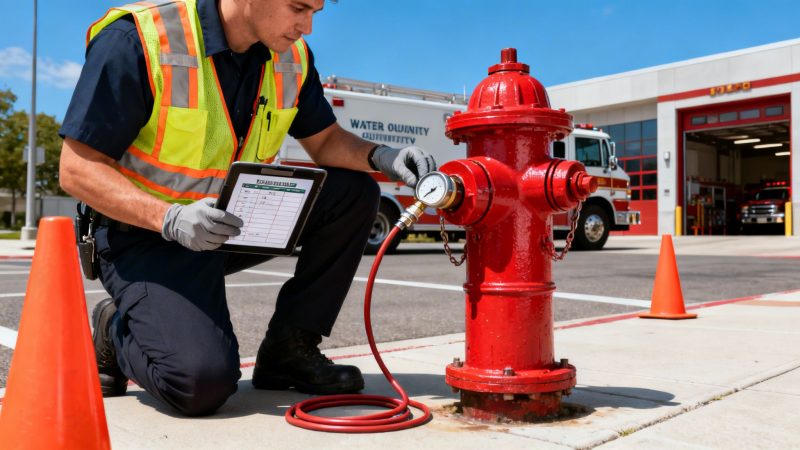
A Modern Guide to Fire Hydrant Inspections
Picture this: you roll up to a scene, flames are showing, and the closest hydrant is bone dry. It’s a gut-wrenching moment where every second lost searching for a working plug means the fire doubles in size. This isn't just a worst-case scenario; it's a preventable failure that rigorous fire hydrant inspections are designed to stop cold.
Why Flawless Fire Hydrant Inspections Are Non-Negotiable
We often take for granted that a hydrant will work when we need it most. But when one fails, the ripple effect is immediate. Crews have to waste precious time hunting for another water source or stretching hundreds of extra feet of hose. That delay can be the difference between a quick knockdown and a total loss.

The numbers really drive home the importance of reliable gear. Projections show the U.S. facing over 1.3 million fire incidents in 2026 alone. Standards like NFPA 291 call for annual checks and flushing for a reason, along with full flow tests every five years. In fact, research shows that inoperable hydrants can increase response times by up to 20% in some areas—a delay that has a direct impact on lives and property. You can dig into more data on functional fire safety equipment to see the broader trends.
Beyond Compliance to Fiscal Responsibility
Proper hydrant inspections aren't just about ticking a compliance box; they're one of the smartest financial moves a municipality or property owner can make. Being proactive means you catch the small stuff—a worn gasket, a missing cap, a bit of rust—before it spirals into a full-blown, budget-draining emergency.
Think about it in practical terms. An inspector finds a small leak at the base of a hydrant. Fixing it might mean replacing a gasket for a few hundred bucks. But if you let it go, that slow leak can erode the soil around the water main, leading to a catastrophic break. Now you're looking at an emergency repair that can easily top $20,000, not to mention the service disruptions and public safety headaches.
Proactive maintenance is not an expense; it's an investment. Every dollar spent on routine fire hydrant inspections can save ten or more dollars in emergency repairs and potential liability costs.
The Role of Modern Inspection Tools
The days of juggling paper checklists and trying to decipher handwritten notes are thankfully behind us. Modern platforms like Resgrid have completely changed the game, turning inspections into a streamlined, data-driven process. Instead of a chore, it becomes an opportunity to build real intelligence about your water system.
With a digital tool, your team can:
- Log data on the spot: Enter flow rates, pressure readings, and maintenance notes right from the field.
- Geo-tag every asset: Pin the exact location of each hydrant and snap photos of any defects you find.
- Automate your schedule: Set up recurring annual inspections so nothing ever gets missed.
- Generate reports instantly: Create clean, professional compliance reports for the fire marshal or insurance carriers with a few clicks.
This approach helps you build a powerful historical record. You can start to see trends, prioritize repairs intelligently, and ultimately ensure your water supply system is as reliable and resilient as it can be.
Preparing for a Safe and Efficient Inspection Day
Anyone who's spent a day inspecting hydrants knows that a good day starts long before you even leave the station. It's the prep work that separates a smooth, efficient run from a frustrating day of backtracking for forgotten gear or stumbling into preventable issues.
It really all boils down to having your ducks in a row.

Assembling Your Essential Inspection Toolkit
Think of your inspection kit like a go-bag. If you're missing just one critical piece, your entire operation can grind to a halt. We've all been there.
A solid, well-organized toolkit is the baseline for handling the visual, mechanical, and flow tests you'll be running. Your standard loadout should include:
- Hydrant Wrenches: Don't just bring one. You'll want a standard hydrant wrench for the operating stem and a good adjustable wrench for stubborn nozzle caps or other fittings.
- Pressure Gauges: Calibrated gauges are non-negotiable. You can't guess when it comes to measuring static and residual pressures.
- Pitot Gauge and Diffuser: Absolutely essential for conducting a proper flow test and, just as importantly, for managing the water stream safely.
- Traffic Safety Gear: High-visibility vests and a set of traffic cones are must-haves. Crew safety is paramount, especially when you're working feet away from live traffic.
- Digital Tools: A smartphone or tablet running an app like Resgrid is your command center for logging data on the fly. No more soggy paper forms.
If you're working near moving vehicles or in low-light conditions, make sure your high-vis gear is up to snuff. For a deep dive into the standards, check out A Practical Guide to CSA Z96-22 High-Visibility Apparel.
Communication Protocols That Save Time and Money
Good communication is just as important as a good wrench. When you start flushing hydrants, you're inevitably going to stir up sediment in the water mains. For nearby homes and businesses, that means temporarily discolored water—and a potential flood of panic calls to the water department.
A little proactive communication completely sidesteps this chaos.
Before you even start your inspections for the day, shoot a message to the local water department. Let them know where you'll be and what your schedule looks like. We've seen a fire district use Resgrid’s messaging to send a single alert to the water authority's ops team. The result? They cut public complaint calls by over 90%. That’s a huge win that frees up staff and keeps the community from worrying unnecessarily.
A five-minute call or a quick digital message before you roll out can save hours of administrative headaches later. It’s a simple, zero-cost way to boost efficiency and maintain good public relations.
Using Data to Plan Your Day Intelligently
Don't just head out and start at hydrant #1. The data from your last round of inspections is an invaluable tool for planning a smarter, more effective day.
Before leaving the station, pull up the records for the hydrants on your list. Did a specific hydrant have low static pressure last year? Was there one with a hard-to-turn operating nut? Flag it. Now your crew knows to budget a little extra time for that stop or to bring a specific tool they might need.
This turns a routine checklist into a more strategic operation. With the right software, you can even use an interactive map to see hydrant locations and their last known status. Learning how to use mapping features for asset management can seriously optimize your routes and planning. When you know which hydrants might be problematic before you get there, you can turn potential delays into a focused plan of attack.
Conducting Visual Checks That Prevent Costly Repairs
The first few moments you spend at a hydrant can tell you almost everything you need to know. This initial visual sweep isn't just a quick once-over; it's where a sharp eye can spot the small stuff that prevents a future catastrophe and saves tens of thousands of dollars in emergency repairs.
This is your chance to catch trouble early. We're talking about finding corrosion before it eats through the barrel, spotting missing caps that let all sorts of junk foul up the works, or noticing the subtle signs of a vehicle collision that could mean the hydrant will fail under pressure. This is where proactive maintenance really begins.
This simple process is a great mental checklist to run through for every visual inspection.

Running through paint, caps, and general damage in that order creates a repeatable habit that ensures nothing gets missed.
Beyond the Paint Job: What to Really Look For
A hydrant’s paint job is more than just cosmetic—it's a shield. If you see chipping, bubbling, or peeling paint, that’s your first warning sign. It often points to underlying corrosion that's weakening the cast iron.
Missing or busted nozzle caps are another huge red flag. An open nozzle is basically an open invitation for problems. I’ve seen hydrants clogged with everything from soda cans and rocks to squirrel nests. That debris can get sucked into a pumper's intake and cause thousands in damage, or even worse, completely block water flow when you need it most.
Just last season, one of our veteran inspectors felt a barely-perceptible wobble when he put his hand on top of a hydrant. It wasn't leaking and looked fine from the street. But that tiny bit of movement was the tell-tale sign of a failing flange gasket below ground.
That simple observation led to a proactive $300 repair. If it had been missed, that failing gasket would have turned into a major leak. The resulting emergency main break would have cost over $20,000 and shut down a major intersection for a full day.
Getting Hands-On: Operating the Stem and Listening for Trouble
After the visual scan, it's time to get your hands on the equipment. This doesn’t mean cranking it wide open just yet. It’s about a few simple mechanical checks that tell you a ton about its internal health.
Start by putting a hydrant wrench on the operating stem and giving it a gentle turn. You aren't trying to open the main valve, just feeling for how it moves.
- Does it turn smoothly?
- Or does it feel gritty and tight?
A stem that’s hard to turn could mean it needs lubrication, there’s corrosion on the operating threads, or sediment has built up inside the bonnet.
Next, listen. As you turn the stem, pay close attention to any strange sounds. They're often the first audible sign of an internal problem.
- Grinding or scraping: This could be debris caught in the mechanism or worn metal parts rubbing together.
- A "sloshing" sound: This is a bad sign. It often means the hydrant isn't draining properly and is holding water—a major problem in freezing climates.
- Whistling or hissing: This can point to air pockets or other structural issues inside the barrel.
There’s a reason for all this diligence. The global fire hydrant market, valued at over $7 billion, is expected to surpass $10.4 billion, and a huge driver is mandatory inspection regulations. In North America, standards like NFPA 291 require annual checks to combat issues like corrosion and vandalism, which can impact 10-15% of hydrants every year if they aren't maintained.
It's estimated that proper maintenance helps prevent 25% of fire-related property losses. That’s how these focused, hands-on checks translate directly into public safety and massive cost savings. You can learn more about the hydrant market's growth and the standards pushing it forward.
Mastering the Fire Hydrant Flow Test
A hydrant that looks good is one thing. A hydrant that performs under pressure is everything. Visual checks are just the start; the flow test shows you what a hydrant can actually do. This is the real performance review for your water supply system.

The whole test boils down to two key pressures. Getting this right is the core of figuring out what you can really expect from that hydrant on a fireground.
Understanding Static Versus Residual Pressure
Think about static pressure as the potential energy in the water main when nothing is flowing. It’s the baseline pressure in the system at rest.
Residual pressure is what’s left in the main while water is actively flowing from a hydrant. This is your true performance number. It tells you how well the system holds up under demand. A big drop between static and residual pressure is a sign of trouble.
A classic rookie mistake is only looking at static pressure. A hydrant might show a healthy 90 PSI when it’s static. But if that pressure crashes to 15 PSI the second an engine company opens it up, that hydrant is useless. The residual pressure tells the real story.
A low residual pressure is a massive red flag. It could point to a partially closed valve somewhere up the line, a major leak in the main, or heavy tuberculation (internal rust and corrosion) choking off the flow. Finding these problems during an inspection is infinitely better than discovering them at 3 AM with a structure on fire.
Conducting a Two-Hydrant Flow Test
The most reliable way to do this is with a two-hydrant test. You’ll have one test hydrant for taking pressure readings and a separate flow hydrant, usually downstream, where you’ll release the water.
First, pick your two hydrants on the same main. At the upstream hydrant (your test hydrant), pull a nozzle cap and hook up your pressure gauge. Open the main valve slowly but all the way, and write down the static pressure.
Next, head to the flow hydrant. Get a diffuser on one of the nozzles to manage the water stream and prevent damage. Then, open that nozzle completely.
Now for the important part: go back to your test hydrant and record the new pressure reading—this is your residual pressure. At the same time, have someone at the flow hydrant use a pitot gauge to measure the force of the water stream coming out of the open nozzle. This gives you all the data you need.
Calculating GPM and Making It Actionable
With the pitot gauge reading in hand, you can figure out the gallons per minute (GPM) flowing from the hydrant. The math is pretty straightforward, using a standard formula:
GPM = 29.84 x C x d² x √p
- C is the nozzle's discharge coefficient (typically 0.90 for a smooth nozzle).
- d is the nozzle opening's diameter in inches.
- p is your pitot gauge reading in PSI.
Here’s a real-world story of why this matters.
A crew doing routine inspections recorded a static pressure of 85 PSI. But when they opened the flow hydrant, the residual pressure at the test hydrant nose-dived to just 30 PSI. The pitot reading was garbage, too. These numbers were way off for that part of the water grid.
Instead of just shrugging and noting it, they dug in. They pulled the system maps and traced the main back. Almost a mile away, they found a gate valve that was only 25% open, probably from a previous repair job where the crew never fully reopened it.
That simple inspection found a critical failure point. A fire engine trying to draft from that hydrant would have been starved for water. The fix? Turning a valve. A zero-cost fix that prevented a potential multi-million dollar fire loss.
This is why flow testing isn't just about collecting data—it's about diagnosing the health of your system. To make this process even smoother, your team can log this data right from the field. Using a tool like the Resgrid mobile app, they can input static pressure, residual pressure, and calculated GPM on-site, building a complete, geo-tagged history for every single hydrant.
Streamlining Documentation With Modern Technology
Let’s be honest. Paper forms and clunky spreadsheets are where good data goes to die. After a long day of visual checks and flow tests, the last thing your crew wants is another hour hunched over a desk doing tedious paperwork. That administrative slog isn't just a headache; it's a real drain on your budget and a perfect recipe for expensive mistakes.
If you want to reclaim those lost hours and get truly accurate data from your fire hydrant inspections, it's time to modernize your documentation. It’s all about swapping out error-prone manual entry for the speed and precision of a digital system.
From Paper Piles to Powerful Data
We all know the old way of doing things. It's familiar, but it's also full of holes. An inspector jots down a static pressure of 85 PSI and a residual of 65 PSI on a soggy paper form. Later, someone back at the station can't quite read the handwriting and types 55 PSI into a spreadsheet. Just like that, a perfectly healthy hydrant gets flagged for an unnecessary work order, wasting time and money.
Now, imagine this instead:
- The inspector logs the static and residual pressures right on their phone using a custom form.
- That data is instantly time-stamped and saved to the hydrant's permanent digital record.
- If they spot a defect, they can snap a photo and attach it directly to the inspection report.
- The hydrant’s location is automatically geo-tagged, so there’s never any confusion about which asset was actually checked.
This is the real-world advantage of going digital. You eliminate transcription errors, get irrefutable photo evidence, and build a clean, searchable database of every single inspection your team performs.
Building Your Digital Inspection Form
Setting up a custom digital form is a lot easier than you might think. With a tool like Resgrid, you can design a workflow that perfectly mirrors your department's specific inspection process.
You can actually check out our guide on creating and managing workflows to see just how you can build these custom processes for your own team.
For a hydrant inspection, your form could have dedicated fields for things like:
- Static Pressure (PSI)
- Residual Pressure (PSI)
- Calculated GPM
- Condition of paint and caps
- Notes on any visible damage or leaks
- A simple "pass/fail" checkbox
This approach guarantees that every inspector is collecting the exact same critical data points, in the same format, for every single hydrant. No more guesswork.
For even greater efficiency, especially when inspectors need to add detailed notes with their hands full, integrating tools like voice to text transcription software can be a game-changer, cutting down on manual typing and improving the quality of your notes.
A Real-World Example of Money-Saving Efficiency
The true impact of this shift becomes crystal clear when you see the results. A mid-sized fire department we know was drowning in paperwork trying to manage its annual inspection program for over 1,500 hydrants. Their paper system was a logistical nightmare, making it nearly impossible to track progress or pull together compliance reports.
By moving to a digital platform, they were able to map out their entire annual schedule, assign specific hydrants to different crews, and see progress in real-time. The results were incredible.
In the first year alone, the department cut their administrative time by over 100 hours. More importantly, they finally had clean, powerful data to back up their budget request for hydrant replacements, showing exactly which assets were failing consistently and posing the biggest risks.
This isn't just a one-off story; it's part of a much larger trend. The smart fire hydrant monitoring market is exploding, projected to jump from $866 million to over $1.5 billion, all thanks to tech that makes predictive maintenance possible. This kind of technology, which aligns with NFPA 291, can proactively flag up to 80% of anomalies using sensors for flow and pressure. As inspections evolve from reactive checklists to data-driven operations, agencies can finally ensure first responders have the water they need, when they need it. You can discover more insights about the smart hydrant market on datainsightsmarket.com.
Common Questions About Fire Hydrant Inspections
When you're dealing with fire hydrant inspections, a lot of questions pop up. It happens. Getting the right answers means your team stays compliant, works efficiently, and is ready for whatever comes your way.
Here are a few of the most common things we get asked.
What Is the Color Code for Fire Hydrants?
Those colors on a hydrant's bonnet and nozzle caps aren't just for decoration. They're a critical signal for firefighters, giving them an instant read on the available water flow (GPM), based on NFPA 291 recommendations. It lets a crew know what they’re working with from a block away.
- Red: Class C, less than 500 GPM.
- Orange: Class B, between 500-999 GPM.
- Green: Class A, between 1000-1499 GPM.
- Light Blue: Class AA, 1500 GPM or more.
Who Is Responsible for Inspecting Fire Hydrants?
This one comes down to a simple question: is the hydrant public or private?
Public hydrants are almost always the responsibility of the local water utility or the municipal public works department. Your fire department will likely do its own operational checks to make sure they’re ready for a call, but the core maintenance falls to the city or utility.
If a hydrant is on private property—think commercial lots, industrial parks, or large apartment complexes—the property owner is responsible. They need to make sure inspections and maintenance happen according to local fire codes. This isn't something to put off; it's a huge liability and safety issue.
Here's a practical tip for property owners looking to save a few bucks: bundle your private hydrant inspections with other fire safety services like your sprinkler or alarm system checks. A lot of service companies will cut you a deal on a comprehensive service agreement, which keeps you compliant and lowers the total cost.
How Can We Avoid Alarming the Public?
Nothing gets the phones ringing like a whole neighborhood seeing brown water come out of their taps. Getting ahead of this with clear communication is everything.
Before your crew starts flowing hydrants in an area, put the word out. Use your department’s social media pages, community newsletters, or even old-school door hangers.
Just explain that the testing might stir up some sediment in the water lines and that it’s temporary. Tell them to run their cold water for a few minutes if they see any discoloration. A little bit of outreach makes all the difference and shows you're on top of things.
Ready to streamline your fire hydrant inspections and ditch the paperwork? Resgrid provides the tools you need to schedule, track, and report on every aspect of your program. Learn more and get started.