
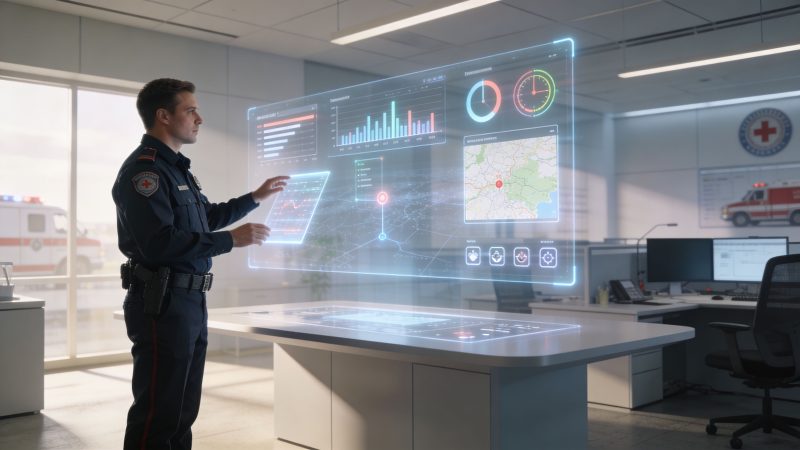
What Are Project Controls? A First Responder’s Guide
At 02:17, the plan still looks clean. Three engines are assigned. Mutual aid is en route. Dispatch has the addresses. The board says the operation is under control.
By 03:05, it isn’t.
One road closure wasn’t pushed to everyone. A crew got sent twice to the same task while another assignment sat open. Relief staffing arrived without a clear handoff. Fuel started running low on one vehicle no one thought to rotate. The incident commander wasn’t failing. The people weren’t failing. The operation was running on partial information, stale assumptions, and verbal updates that didn’t hold together under pressure.
That’s the moment first responders usually discover what project controls really are.
In corporate language, project controls can sound like spreadsheets, consultants, and meetings no one asked for. In the field, they’re something much more useful. They are the discipline of setting a plan, measuring what’s happening, spotting drift early, and correcting it before drift becomes waste, delay, or danger. If you’ve ever worked from an incident action plan, tracked resources by operational period, or adjusted assignments when conditions changed, you’ve already used the logic behind project controls.
The formal definition is straightforward. Project controls cover the data gathering, management, and analysis used to predict, understand, and influence time and cost outcomes across the life of an effort, from start to closeout, as described in Pat Weaver’s overview of project controls definition and practice. In emergency services, the twist is obvious. Your baseline can’t stay frozen while the incident keeps moving.
That’s why generic business advice only gets you so far. Some of the same thinking used in IT project management best practices still applies, especially around disciplined planning, communication, and change handling. But dispatch and field operations need a version built for shifting objectives, fast reallocations, and real-time consequences.
Bringing Order to Chaos An Introduction
What are project controls when you strip away the jargon? They’re the system that tells you whether the mission is still achievable with the time, people, vehicles, and money you have left.
In a station, that might mean tracking a planned training event, facility move, radio rollout, grant-funded equipment deployment, or a major planned event. In a live incident, it means something closer to operational control. You establish what success looks like for the next period, assign resources, watch actual conditions, and change course with discipline instead of improvisation.
What first responders already know
First responders don’t need a lecture on uncertainty. You already work in it. A wildfire shifts with wind. A flood turns one neighborhood into three problems at once. A dispatch center loses one trained telecommunicator on a busy shift and the whole room feels it.
Project controls fit that world because they answer four practical questions:
- What did we plan: The objective, resource assignment, timeline, and operating assumptions.
- What is happening now: Actual unit status, task progress, consumption, delays, and emerging threats.
- What changed: Scope, priorities, hazards, staffing, route access, or support needs.
- What do we do next: Reassign, escalate, defer, rotate, or close.
Project controls don’t replace command judgment. They give command judgment traction.
Where agencies usually get into trouble
Most agencies don’t fail because they lack commitment. They struggle because control processes are informal. Information lives in radio traffic, whiteboards, text threads, paper notes, and memory. That works right up until the operation gets bigger than one supervisor’s mental picture.
When that happens, three bad habits show up fast:
Static plans in a dynamic incident
The original plan becomes outdated, but no one formally updates the baseline for the next operational period.Resource decisions made on instinct alone
Crews stay where they started instead of where they’re now needed.Reporting that arrives after the decision window
By the time someone summarizes what happened, the cost has already been incurred.
A controlled operation doesn’t remove pressure. It makes pressure manageable.
The Core Mission of Project Controls
Project controls keep an operation from drifting. In a dispatch center or on a fast-moving incident, that means one job above all else. Keep the plan, the actual situation, and the next decision tied together while conditions keep changing.
That sounds simple until the incident starts pulling in three directions at once. A weather shift changes access routes. A unit goes out of service. A priority caller forces a reassignment. Without controls, command reacts to the loudest problem in the moment. With controls, command can see the deviation, judge the effect, and reset assignments before the whole operational period starts slipping.

The route, the gauges, and the corrections
In practical terms, project controls start with a baseline. For first responders, that baseline works much more like an incident action plan for the current operational period than a rigid promise made at the start of the mission. It sets the intended objective, timing, staffing, equipment use, and support load for the period you are about to run.
That baseline usually covers:
- Mission objective: What the team must achieve in this period
- Time expectation: When key actions must happen
- Resource commitment: Which people, units, and support assets are assigned
- Cost expectation: Labor hours, equipment usage, fuel, staging, and support burden
From there, supervisors compare plan to actual. Are crews where they were assigned. Did welfare checks start on time. Is apparatus time climbing faster than expected. Is one branch absorbing more support than planned while another falls behind.
The point is correction.
A good control process does not wait for the after-action review. It identifies drift early enough to act. That might mean changing the sequence of work, requesting mutual aid sooner, rotating exhausted personnel, trimming low-value tasks, or updating the baseline so the next operational period reflects reality instead of wishful thinking. Agencies that want a cleaner way to standardize those handoffs can use operational workflow templates for incident-driven teams to keep updates structured while the situation keeps moving.
Why this matters in emergency operations
In a business project, a late task may push a delivery date. In emergency operations, a late task can leave a neighborhood uncleared, delay patient movement, slow containment, or extend a communications outage into the next shift. The consequence is not abstract.
Cost works the same way. It is not just a finance line item. It shows up as overtime, fuel burn, contractor callouts, reserve apparatus usage, mutual aid strain, and crews starting tomorrow already behind. Good project controls make those trade-offs visible while leaders still have room to make a better choice.
| Control question | Field version |
|---|---|
| Are we on schedule? | Are critical tasks happening in the operational period we planned? |
| Are we within cost expectations? | Are labor hours, apparatus time, and support use drifting beyond what this mission can absorb? |
| Are we delivering the intended result? | Are actions producing containment, coverage, evacuation progress, or service restoration? |
What project controls are not
Project controls are operating discipline. They keep command from running an incident on memory, radio traffic, and gut feel alone.
They also do not replace judgment. A battalion chief still decides whether to pull crews back. A communications supervisor still decides whether to reroute call handling. Project controls give those leaders a cleaner picture of what changed, what it is costing, and which corrective move will do the least damage. When that system is working, supervisors can make deliberate decisions instead of expensive guesses.
The Seven Pillars of Operational Control
The easiest way to understand what are project controls in daily practice is to break them into seven operational pillars. Miss one, and the rest start carrying weight they weren’t designed to hold.

Scope control
Scope is mission discipline. It defines what you are trying to accomplish and what sits outside the assignment.
In first responder terms, this is the difference between “protect exposures on Division Alpha” and “handle anything that comes up over there.” The first gives crews a boundary. The second invites drift.
On scene, uncontrolled scope usually arrives disguised as good intentions. One team starts traffic support because it’s nearby. Another starts welfare checks outside the assigned zone. Helpful actions pile up, but the main objective slows down.
Why it matters on scene: If the mission keeps expanding without explicit approval, labor, time, and support usage will spread thin before command realizes it.
Planning and schedule control
Schedule control is about sequence and timing. It answers what has to happen first, what depends on something else, and how late one task can run before it hurts the whole operation.
A first responder version doesn’t need to look like a construction schedule in Primavera P6 or MS Project. It can look like operational periods, branch assignments, evacuation timing, relief windows, and logistical cutoffs. The principle is the same.
According to Hexagon’s overview of project controls, key functions include baseline definition and tracking performance with indices such as the Schedule Performance Index (SPI). The same source notes that weekly traffic-light reporting with green at ±5% variance, amber at ±10%, and red above 10% has been correlated with a 90% on-budget delivery rate in controlled portfolios.
For emergency agencies, a traffic-light method works because it’s simple. Green means continue. Amber means watch and prepare action. Red means command decision now.
Cost control
Cost control in public safety is often hidden in plain sight. People think only finance owns it. Operations drives most of it.
Here’s what cost looks like in the field:
- Personnel time: Straight time, overtime, callback, mutual aid duration
- Fleet burden: Fuel, idle time, mileage, maintenance wear
- Equipment use: Generators, pumps, portable radios, rehab supplies
- Support load: Food, staging, shelter, contractors, temporary facilities
A crew assigned longer than planned without a relief decision is a cost issue. A vehicle left idling through a long standby is a cost issue. A duplicate supply order because no one had current inventory status is a cost issue.
Risk control
Risk control is where mature agencies separate concern from action. A risk isn’t just “something bad might happen.” It’s a specific threat or opportunity you identify, assess, and manage before it forces your hand.
In project controls, risk registers and quantitative thinking support better forecasting. In emergency operations, your list may include weather shifts, communications dead zones, access restrictions, fatigue, contractor delays, or public behavior.
A useful field habit is to keep risks tied to triggers. If the trigger happens, the response is already understood.
Winds increasing toward an exposed subdivision isn’t just a weather note. It’s a pre-defined trigger for reallocation, evacuation messaging, and logistics movement.
Quality control
Quality is often overlooked because public safety teams assume effort equals effectiveness. It doesn’t.
Quality asks whether the work is meeting the operational standard. In your world, that can mean response time reliability, accurate dispatch information, complete handoffs, successful patient routing, or the percentage of assigned checks completed to standard.
Quality control matters because crews can be very busy and still miss the objective. The operation feels active. The results say otherwise.
Change control
Change control is formal discipline for changing the plan without losing the plot.
A fire crosses a line. A shelter opens earlier than expected. A communications outage changes dispatch routing. Those are valid changes. The mistake is not changing. The mistake is changing informally, without recording what shifted, who approved it, and what it does to time and resources.
Without change control, teams end up working three different versions of the same plan.
Agencies that want a more structured way to standardize approvals and handoffs often use workflow tools. A practical example is building repeatable approval and task paths through operational workflows so scope, assignment, and status changes don’t get buried in radio traffic or side messages.
Reporting and communication control
Reporting is where all the other pillars become actionable. If the right people don’t get the right status at the right time, the rest stays theoretical.
Good reporting in emergency operations is short, timed, and tied to decisions. It should tell command what changed, what is drifting, and what decision is needed. It should not read like a historical narrative while the incident is still moving.
A simple field-ready reporting format includes:
- Current objective status: On track, threatened, or missed
- Resource picture: What’s committed, what’s available, what’s overstretched
- Variance summary: Where time, effort, or support use is drifting
- Decision request: What command needs to approve or deny
Project Controls in Action A Wildfire Response Scenario
A wildfire starts as a brush fire along a county road at the edge of a residential area. Initial attack goes out fast. Dispatch tones mutual aid. Air support is requested but delayed. By late afternoon, the fire is no longer a single-task incident. It’s perimeter control, structure protection, evacuation support, road closures, public messaging, rehab, and overnight planning.
Generic project management advice tends to break down. Much of the mainstream material assumes fixed constraints and stable baselines, but emergency dispatch and field operations work with shifting scope, changing resources, and moving priorities. That gap is called out in ProjectManager’s guide to project controls, which notes that first-responder environments need adaptive control frameworks rather than static baselines.

Operational period one
At the start of the first operational period, command sets a working baseline.
The priorities are clear. Hold the fire west of the road. Protect the subdivision on the south edge. Support evacuation notices for two zones. Establish water supply continuity. Keep crews in safe rotation through the evening.
A project-controls mindset inside the command structure would immediately lock down a few basics:
| Control area | Wildfire application |
|---|---|
| Scope | Hold line west of road, protect structures, support targeted evacuation |
| Schedule | Complete line assignment before nightfall, rotate crews on a set interval, review conditions at shift handoff |
| Cost | Track crew hours, apparatus use, fuel burn, rehab consumption, contractor commitments |
| Risk | Wind shift, blocked routes, spot fires, fatigue, radio congestion |
| Reporting | Timed status updates to command, dispatch, logistics, and cooperating agencies |
No one on scene needs to call it “project controls” for it to work. They just need to run it that way.
Conditions change and the baseline moves
By early evening, the wind shifts. Spot fires jump beyond the original containment assumption. The southern edge now threatens a second neighborhood. That is a scope change, a schedule change, a risk escalation, and a cost event all at once.
Poorly controlled operations often handle this by shouting new assignments over the radio and trusting everyone to keep up. Stronger operations pause just long enough to reset the baseline for the next operational period.
That means:
- Revising the objective: Structure protection expands to the second neighborhood
- Reallocating resources: One task force moves from mop-up support to exposure protection
- Adjusting the timeline: Planned overnight line work is delayed in one division and accelerated in another
- Documenting impact: Additional labor, apparatus time, and support needs are logged against the revised plan
A live common operating picture is essential. Mapping tools make the new perimeter, division boundaries, closures, and assignment areas visible across agencies. A shared map also reduces one of the biggest hidden drains on cost and safety, which is duplicate effort. Teams that need better geographic control usually benefit from using real-time incident mapping to align command, dispatch, and field crews on the same incident picture.
What the controller role looks like in practice
In many agencies, there isn’t a person with the title “project controller” standing in the command post. The work still needs to happen.
Sometimes the planning lead carries it. Sometimes logistics does part of it. Sometimes dispatch fills critical gaps because dispatch sees timing, unit movement, and status changes before anyone else.
The practical responsibilities look like this:
Track planned versus actual resource deployment
If three strike teams were scheduled to hold one flank and one gets reassigned, someone needs to note the downstream effect immediately.Monitor the cost picture as operations unfold
Crew rotation delays, extended apparatus use, and support consumption shouldn’t be discovered the next day in finance.Flag variance early
If evacuation notifications are running behind because routes changed, command needs that early enough to choose between reinforcement, rerouting, or reprioritizing.Support concise decision briefs
“We are behind on southern notifications because one access route is blocked. We need either additional law enforcement traffic support or a revised zone sequence.”
That kind of update is gold in a moving incident. It gives command a decision, not a data dump.
A short training clip can help teams visualize how this kind of coordination feels under pressure:
End of shift, not end of control
The worst time to rebuild the record is after demobilization. Controlled operations preserve the record while the incident is still active.
At shift change, the command staff should be able to answer:
- What was the objective for the last operational period?
- Which assignments were completed, delayed, or changed?
- Which resources are still committed and for how long?
- What new risks changed the next operational period plan?
- What support burden is carrying into tomorrow?
That isn’t bureaucracy. It’s operational continuity.
When agencies skip that discipline, the next shift inherits a blurred picture. They spend the first chunk of their operational period rediscovering what the last one already knew.
Saving Budgets and Resources with Smart Controls
Public safety leaders rarely need convincing that money is tight. What they need is a method that saves money without weakening readiness. Project controls do that when they focus on the few cost drivers that grow unnoticed during routine operations and major incidents.
The clearest example is Cost Performance Index, or CPI. CPI compares earned value to actual cost and shows cost efficiency. A CPI below 1.0 signals overruns. A CPI above 1.0 shows efficiency. A simple example from Qualiant’s explanation of CPI in project controlling uses a project with a €10,000 budget where €6,000 has been spent and €8,000 worth of work has been completed, producing a CPI of 1.33. That indicates the work is 33% more cost-effective than planned.
What CPI means for a first responder agency
You may not calculate earned value in euros during a storm response, but the principle translates cleanly.
If your objective for the operational period was to complete evacuation notices, protect critical exposures, and establish overnight coverage, then you can compare the value of completed work to the labor and equipment burden used to get it done. That gives leadership a disciplined way to spot whether spending is producing progress or just motion.
The same PMI-linked source reports that organizations with mature project controls and consistent CPI monitoring experience 20 to 30 percent fewer cost overruns and that high-maturity organizations using EVM complete 71% of projects on budget versus 52% for low-maturity ones. It also notes an estimate of $2.5 trillion in annual global project waste tied to poor controls and that proactive adjustments can reduce risks by up to 25% in large project settings.
Where agencies usually save money first
The fastest savings usually come from operational basics, not heroic cuts.
- Overtime discipline: Track planned shift end, relief availability, and extension approvals in real time so callback and holdover don’t drift unnoticed.
- Vehicle and apparatus usage: Match staging, deployment, and release decisions to actual need so units aren’t burning fuel and maintenance life on habit.
- Supply control: Tie issue and resupply to assignment status so teams don’t over-order consumables “just in case.”
- Smarter routing and reassignment: If one area is stabilized, move resources early instead of carrying unnecessary coverage out of caution.
The cheapest correction is the one you make before overtime posts, before fuel is burned, and before a duplicate order leaves staging.
One practical crossover worth noting
Agencies increasingly rely on cloud-based systems for records, mapping, messaging, and coordination. That means cost control isn’t only a field issue. It’s also a systems issue. Teams thinking about governance in digital operations can borrow useful ideas from policy as code to automate cloud security, compliance, & cost controls, especially when they want controls that are repeatable instead of person-dependent.
What doesn’t work
Three habits waste money fast:
| What fails | Why it costs you |
|---|---|
| End-of-month review only | By then, the spending is already locked in |
| Separate ops and finance pictures | Command acts without cost visibility, finance reports after the fact |
| Manual reconciliation across tools | Staff time gets burned recreating the truth instead of managing it |
Smart controls don’t demand perfect accounting during a live event. They demand enough visibility to make the next decision cheaper and better.
How Resgrid Powers Your Incident Controls
Most first-responder agencies don’t have the luxury of a large dedicated project-controls office. They have supervisors, dispatchers, planners, logistics staff, and command personnel who already carry multiple jobs. That’s why tooling matters.
The people side of project controls is often neglected in standard guidance. The Association for Project Management’s overview of project controls highlights that structure and roles are frequently overlooked, and that lean teams in resource-constrained environments need tools that support cross-functional work and shift-based operations. That describes emergency services exactly.

Turning control theory into usable operations
A platform earns its place in emergency operations when it reduces handoffs, shortens the time between change and awareness, and preserves a usable record while the work is still underway.
For project controls, that usually means five capabilities have to work together:
- Unit and personnel visibility: You need current status, assignment, and availability.
- Shared communications: Status changes can’t live in scattered side channels.
- Operational reporting: Leaders need snapshots that support decisions, not raw activity noise.
- Shift continuity: Incoming personnel need the current picture without rebuilding it from memory.
- Auditable changes: Reassignments and task updates must be visible after the fact.
Why dispatch matters so much
Dispatch is one of the most important control points in any response system. Dispatch sees requests, assigns resources, tracks status, and often catches drift before the field can name it. That makes dispatching capability central to schedule control, resource control, and change control all at once.
If a team is trying to tighten operational discipline, one of the most impactful starting points is better dispatching coordination and status tracking. When assignments, acknowledgments, and movement are easier to see, command decisions get sharper and duplicate effort drops.
What lean teams should look for
A practical control platform for emergency services should help a small team behave like a larger, more disciplined one.
That means it should support:
Cross-functional use
Dispatch, command, logistics, and field supervisors all need access to the same operational truth.Shift-based continuity
The system should carry the record cleanly from one watch or operational period to the next.Fast change handling
When a plan changes, the update has to move quickly without becoming informal or invisible.Reporting that drives action
Good dashboards don’t impress people. They help them decide.
A lean agency doesn’t need more complexity. It needs fewer blind spots.
What good implementation looks like
The best rollout is usually narrow at first. Don’t try to formalize every control at once. Start where your agency already feels friction.
For one department, that may be tracking unit assignments and status changes during planned events. For another, it may be documenting relief and overtime decisions during storms. For a dispatch center, it may be preserving clearer records of task changes during multi-agency incidents.
Once the platform becomes the place where plan, status, and change come together, the agency stops rebuilding the picture every shift. That’s when project controls stop feeling theoretical and start feeling operational.
Your First Step Toward Controlled Operations
If this topic feels bigger than your current process, that’s normal. Most agencies don’t need a complete project-controls program on day one. They need one controlled habit that makes the next shift run better than the last one.
Start small and choose something you already care about.
A low-friction way to begin
Pick one of these for your next drill, event, or incident:
- Track one schedule baseline: Planned dispatch time, en route time, on-scene time, and clear time for a specific unit type or assignment category.
- Track one cost driver: Overtime extensions, fuel usage, or contractor hours during one operation.
- Track one change process: Every reassignment after initial dispatch gets logged with who approved it and why.
- Track one quality measure: Completion of welfare checks, handoff accuracy, or task closeout quality for one operational period.
Then do one more thing. Review it at the end of the shift while the memory is fresh.
Ask only three questions:
- What did we plan?
- What happened?
- What will we change next time?
That’s the beginning of project controls. Not a giant policy binder. Not a consultant deck. A repeatable discipline that helps your people protect time, money, equipment, and mission focus.
What are project controls in the first-responder world? They are the habits and tools that keep a moving operation from turning into an expensive guessing game.
Start with one baseline. One report. One corrective action. Then build from there.
Resgrid, LLC gives first responders, dispatch centers, and public safety teams one place to manage dispatching, messaging, personnel tracking, reporting, and operational coordination without adding unnecessary overhead. If you want a practical way to strengthen control over incidents, events, shifts, and resource use, explore Resgrid, LLC.