
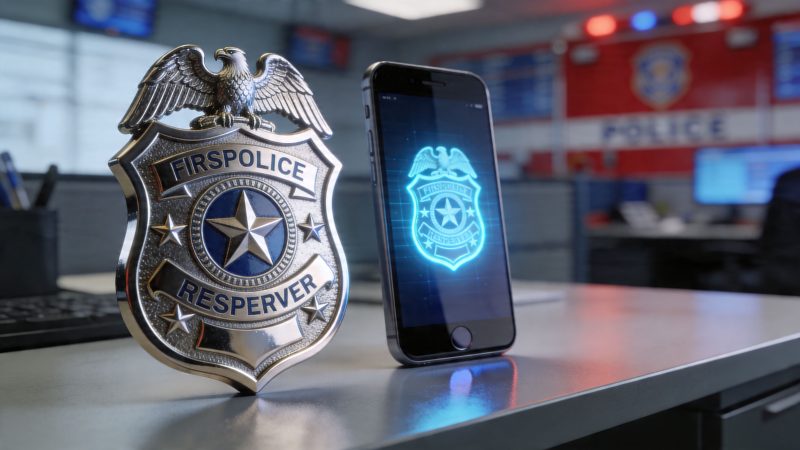
First Responder Badge: Your 2026 Essential Guide
A bad badge problem usually shows up at the worst time. You’ve got firefighters from one department, medics from a private ambulance service, deputies handling traffic, and a few volunteers who were brought in because the incident ran longer than expected. Somebody needs access past the perimeter. Somebody else says they’re cleared for patient care. The incident commander has seconds to decide whether that person belongs there and what they’re qualified to do.
That’s where the simple phrase first responder badge stops meaning “metal on a shirt” and starts meaning operational control.
On paper, badges sound straightforward. In the field, they’re not. Physical badges get forgotten in another uniform, left in a locker, bent, copied, or flashed too quickly to verify. During a multi-agency response, those little failures stack up. They slow assignments, create confusion at access points, and force supervisors to rely on memory when they should be relying on confirmed credentials.
The scale alone makes this hard. The U.S. first responder workforce includes over 1.2 million individuals serving as police officers, firefighters, and EMTs across public and private sectors, according to the U.S. Bureau of Labor Statistics overview of National First Responders Day. When that many people work across different agencies, ownership models, policies, and mutual aid systems, badge management stops being administrative trivia. It becomes part of safety.
A good badge system does three jobs at once. It identifies the person. It confirms authority. It helps command make better decisions fast.
That’s the standard to judge everything against, whether you’re carrying a traditional shield, issuing EMS ID, or trying to manage digital credentials inside a modern incident management platform.
Introduction More Than Just Metal and Authority

A large roadside incident is where badge weaknesses get exposed fast. Police lock down lanes. Fire handles stabilization. EMS triages patients. A supervisor from a neighboring agency arrives and starts assigning crews who nobody on scene knows personally. If the only verification method is “show me your badge,” command is already behind.
A physical badge still matters. It creates immediate visual recognition, gives the public a quick cue of authority, and helps responders identify one another under stress. But incidents don’t run on symbolism. They run on verified roles, current qualifications, and controlled access.
What command actually needs
At a real scene, command usually needs answers to a few specific questions:
- Who is this person: Are they attached to an agency or partner organization?
- What can they do: Are they cleared for patient care, suppression, perimeter control, transport, or command support?
- Where should they be: Do they belong inside the hot zone, staging, treatment area, or outer perimeter?
- Can that status change: If their assignment changes, can everyone else see it without a radio game of telephone?
That last point gets missed. A badge that only identifies but doesn’t connect to live status is limited. It helps at first contact, then it stops helping.
A badge that can’t be checked in real time is better than nothing, but it isn’t enough for a complicated incident.
Why this is an operational issue, not a branding issue
People outside public safety sometimes treat badges like tradition, image, or ceremony. Those things matter, and they matter more than most civilians realize. But in operations, the badge is part of a control system.
If a responder loses a physical badge and there’s no fast replacement process, supervisors improvise. If agencies can’t verify outside personnel quickly, staging gets clogged. If counterfeit prevention is weak, the risk isn’t abstract. It affects scene security, patient privacy, and chain of command.
That’s why the modern conversation has to include both sides. The physical badge still has value. The digital identity layer is what closes the gap between recognition and verification.
Anatomy of a Physical First Responder Badge

On a scene, nobody studies a badge for thirty seconds. They glance, make a call, and keep moving. That puts a lot of pressure on a small piece of metal to do three jobs fast. It has to signal agency and role, survive daily wear, and give supervisors some confidence that it belongs to the person wearing it.
A first responder badge is basic equipment, but the details matter. Poor construction leads to bent edges, loose pins, and unreadable lettering. Weak visual design slows recognition. Weak anti-counterfeit features create a security problem that gets exposed at the worst possible time, usually when outside personnel show up during a busy incident and nobody on scene knows them by name.
What the badge is made of
A working badge starts with material and build quality. Many agencies choose die-struck metal because it keeps its shape better than thinner stamped options and holds detail longer under routine use. That matters if the badge is getting clipped on and off uniforms, stored in gear bags, and exposed to sweat, rain, heat, and constant handling.
Finish matters too. A bright finish can improve readability under poor station lighting or nighttime scene lighting. Corrosion resistance matters in coastal, humid, or high-sweat environments. Attachment hardware matters more than people expect. If the pin assembly is weak, the badge becomes something crews are always reattaching, replacing, or leaving off altogether.
I learned early that agencies often spend time comparing artwork and very little time checking how the badge fails after six months in the field. That is backwards.
| Badge feature | Practical use in the field |
|---|---|
| Nickel plating | Holds up better in damp or humid conditions |
| Gold plating | Stands out more clearly in lower light |
| Rhodium finish | Resists tarnish and keeps a cleaner bright appearance |
| Die-struck construction | Handles daily wear, storage, and repeated mounting better |
What the symbols usually mean
Badge design is not random. Shape and iconography help responders sort authority, function, and service line at a glance.
- Shield shapes: Common in law enforcement and tied to formal authority and command structure.
- Stars: Often associated with sheriff’s offices or policing traditions tied to rank and office.
- Maltese cross: Closely associated with the fire service.
- Star of Life: Clear EMS identification for medical response and prehospital care.
- Eagles, seals, and banners: Usually mark jurisdiction, municipality, state affiliation, or agency identity.
A good badge reduces hesitation. If crews have to stop and interpret it, the design is already underperforming.
Security features that help in practice
Security features on a physical badge should support field verification, not just look impressive in a catalog. Serial numbers, controlled engraving, holographic elements, and scannable codes all help, but only if the agency has a process behind them. If nobody can check the code, if supervisors do not know what the serial format means, or if replacements are issued without updating records, the feature has limited operational value.
As noted earlier from the badge construction reference, some vendors now build anti-counterfeit options into the badge itself. That is useful, but it still leaves a gap. A metal badge can show who someone claims to be. It does not show live certification status, current assignment, access restrictions, or whether that credential was revoked this morning.
That gap becomes obvious during mutual aid, large public events, and multi-agency incidents.
Practical rule: Buy badges that are easy to read, hard to counterfeit, and durable enough for daily wear. Then tie them to a credential system that can be verified in real time.
Display rules and the limits of static credentials
Badge policy matters almost as much as badge design. Some agencies restrict display to approved uniforms. Some issue wallet credentials for off-duty identification. Some maintain separate dress and duty badges. If those rules are unclear or inconsistently enforced, scene access gets messy fast.
The bigger issue is that a physical badge is static. It identifies a role, rank, or affiliation, but operations change by the minute. Incident command needs to know more than what is engraved on metal. It needs current qualifications, assignment status, and whether the person standing at the line should be there right now.
That is why agencies are starting to treat the badge as one layer of identity, not the whole system. The metal still has value. It helps with immediate recognition and tradition. Real-time verification is what closes the operational gap between appearance and confirmed access.
For teams comparing long-term durability and finish choices, resources on custom metal business signs can also be useful for thinking through metal quality, surface treatment, and how materials hold up over time.
Managing Your Badge Lifecycle Procurement Verification and Replacement
A badge program goes bad in predictable ways. Procurement gets treated like a one-time order. Verification depends too much on visual familiarity. Replacement becomes a scramble after a loss. None of that holds up once you have turnover, mutual aid, reserve personnel, or contract EMS crews moving in and out of your operation.
The fix is boring, but it works. Treat the badge like controlled equipment with a documented lifecycle.
Procurement that doesn’t create future problems
When agencies shop for badges, the cheapest unit price often creates the most expensive long-term mess. Thin construction, weak pin hardware, poor engraving, and no meaningful serial or tracking process almost always come back as avoidable reorders.
A practical purchasing checklist should include:
- Construction standard: Match badge material to field use, not just appearance.
- Attachment method: Check whether the backing and pin assembly can survive daily uniform changes.
- Visual consistency: Make rank, unit, and agency identifiers readable at a glance.
- Security options: Add features your supervisors can verify in the field.
- Replacement workflow: Make sure the vendor can support reissue without redesign drama.
One mistake I’ve seen repeatedly is agencies buying a badge they love for ceremonies and then forcing the same model into everyday use. That usually fails. Dress uniform presentation and hard daily wear are not the same problem.
Verification in the field
Most badge checks happen under time pressure. That means the process has to be simple enough to use when everyone’s busy.
Here’s a field-friendly approach:
- Start with the person, not the metal. Ask name, agency, and assignment first.
- Check consistency. The badge, uniform markings, and verbal answer should all line up.
- Look at build quality. Counterfeit or novelty badges often look off in finish, lettering, spacing, or mounting.
- Use agency protocol. If there’s any doubt, verify through dispatch, staging control, or a supervisor.
- Control access while you confirm. Don’t let uncertainty drift into the hot zone.
A respectful verification process protects everybody, including legitimate responders who arrived from outside your normal system.
If a person gets offended by a credential check at a controlled scene, that’s less of a problem than letting the wrong person through.
Lost or stolen badge response
A missing badge needs immediate action because delay creates risk. The exact procedure varies by agency, but the operational steps are usually the same.
| Situation | What should happen right away |
|---|---|
| Lost badge | Notify a supervisor, document the loss, remove the badge from valid inventory |
| Stolen badge | Report it through command and law enforcement channels required by policy |
| Damaged badge | Turn it in if possible so the old credential can’t circulate later |
| Role change or separation | Recover the badge before the person leaves active access status |
What doesn’t work is informal reporting. “I think I left it at home” becomes “I can’t find it” and then nobody knows whether the credential is misplaced or out in the wild.
Replacement without chaos
Replacement should be structured, not improvised. The fastest systems usually do a few things well:
- They keep issuance records current. If nobody knows which badge number belongs to which person, replacement slows down immediately.
- They separate temporary access from permanent reissue. A temporary paper pass or controlled alternate ID can keep someone working while the permanent badge is replaced.
- They require deactivation of the old credential. Even for physical badges, the organization needs a clear “invalid” status.
- They budget for predictable loss. Agencies don’t need to guess exact rates. They do need to stop acting surprised when field gear occasionally disappears.
For individual responders, the rule is simple. Report fast, document cleanly, and don’t try to solve it off the books. An unreported lost badge is an agency problem waiting to happen.
The Unseen Value Emblems of Identity and Trust
A badge is equipment, but it’s never just equipment. Ask any firefighter who kept a retirement badge in a shadow box, any medic who still carries a coin from a hard call, or any officer who remembers the first day they pinned on a shield that meant authority. These objects carry memory.
That’s one reason departments are careful with badge design. The public sees an emblem. The responder sees the people who trained them, the agency they represent, and the standard they’re supposed to uphold.
Why coins matter in badge culture
The strongest parallel is the challenge coin tradition. In fire and EMS circles, challenge coins are now common at retirements, promotions, training completions, and major incidents. That tradition traces back to World War I, when a U.S. lieutenant distributed bronze coins to his squadron to build unit cohesion, and veterans later brought the practice into civilian emergency services, as described in this history of challenge coins in first responder culture.
The reason that tradition survived is obvious to anyone who has worked a hard assignment. People remember what was handed to them by a chief, a captain, or a crew after something meaningful happened.
Trust works both inward and outward
The public sees the badge as authority. Crews see it as belonging. Both matter.
- Inside the agency: It marks membership, rank, and earned trust.
- At the curbside: It reassures frightened patients and families that someone accountable is present.
- During mutual aid: It gives other responders a first clue about where you fit.
The badge earns its deepest value long before the public ever sees it. It starts inside the organization.
That emotional weight is why bad digital rollouts fail when leaders treat credentials like a spreadsheet problem. If you strip out the identity side, people resist the change for good reason. The best systems preserve the meaning while improving the verification.
The Shift to Digital Responder Identification

A storm strike at 0200 makes the problem obvious fast. Crews from three fire districts, a volunteer EMS squad, hospital teams, and public works all converge on the same staging area. Everyone has some form of ID. Command still needs to know who is cleared to enter the hot zone, who can transport, whose certs are current, and who just showed up to help but has no assignment.
That is the operational gap physical badges do not close.
A metal badge still matters for recognition, appearance, and public trust. It does one job well. It gives a quick visual cue. But incident command needs more than a visual cue once operations get busy, agencies mix, and assignments start changing by the hour. A modern credential has to be verifiable, current, and easy to check under pressure.
What a digital badge is in practice
At the field level, a digital badge is a scannable identity tied to a live responder record. In a stronger setup, that record includes role, agency, qualifications, assignment, and access status inside one system.
That changes the badge from a symbol into an operational tool.
| Physical badge | Digital credential |
|---|---|
| Static identity | Live identity linked to current records |
| Visual inspection only | Scannable and system-verifiable |
| Hard to update quickly | Can reflect role or status changes quickly |
| Difficult to revoke in the field | Can be deactivated centrally |
The trade-off is straightforward. Physical badges are simple and durable. Digital credentials are easier to verify, update, and control. Agencies that treat those as competing options usually stall. The better approach is to keep the badge culture crews respect and add a digital layer that helps command make safer decisions.
Why multi-agency incidents expose the weakness
Local familiarity works until it does not. During mutual aid, large public events, weather activations, or regional fire coverage, supervisors are often assigning people they have never worked with before. Shirt color, patch, and a wallet ID help, but they do not answer the questions that matter most in the moment.
Is this person cleared for this assignment?
Are their credentials current?
Are they attached to this operational period?
If they lose access or get reassigned, can command update that status immediately?
As noted earlier in the article, badge and identity problems become more serious when agencies have to verify responders across organizational lines. That is why more departments are shifting toward mobile credential access tied to dispatch, personnel records, and status tracking. Tools collected in the Resgrid app ecosystem point to the practical direction. Identity works better when it sits inside the same operating picture as assignments, messaging, and accountability.
Smart badges add another layer, with real trade-offs
Some badge programs go beyond identification and add sensing capability. The First Responder's Smart Badge concept paper describes badge designs that can detect airborne hazards and send alerts into connected systems.
That idea has value, especially for hazmat, overhaul, confined space work, and industrial response.
It also comes with field realities. Sensors need power. Hardware adds cost. Maintenance gets ignored if the process is unclear. If an agency cannot keep batteries charged, firmware current, and alert routing tested, a smart badge becomes another device crews stop trusting. For many departments, the first win is simpler. Start with verified digital identity and assignment control. Add sensor functions later if the agency can support them.
What works in the field
Digital identification helps operations when crews can use it in seconds and command can trust what it shows.
What works
- Fast verification: Scan or search, confirm identity, and move.
- Current status: Certs, permissions, and assignments reflect the live record.
- Quick revocation: Lost, stolen, or expired access can be shut off centrally.
- Offline planning: Weak connectivity does not break the whole process.
- Shared visibility: Staging, command, and dispatch see the same responder status.
What fails
- Too many steps: If checking a credential takes longer than a radio call, people skip it.
- Split systems: One roster in HR, another in dispatch, and a third in a badge database creates confusion.
- Poor field design: If the workflow was built for office staff instead of line supervisors, crews work around it.
- No replacement plan: A digital ID system still needs a fallback for dead phones, damaged devices, and bad coverage.
I have seen agencies lose time on scene because they could not answer a basic identity question quickly. I have also seen simple digital credentialing cut through that problem with very little overhead. The difference was not flashy tech. It was whether the system matched the way responders check in, get assigned, and move through an incident.
A digital badge earns its place when it gets the right person to the right task, with verified authority, fast and with less guessing.
Connecting Badges to Live Operations with Resgrid
At a large community event, the credential problem shows up fast. Staging has city EMS crews, off-duty medics, volunteer EMTs, private security, event staff, and mutual aid units all arriving through different entry points. A physical badge helps with recognition, but it does not tell command who is checked in, who is cleared for patient care, or who just got reassigned three minutes ago.
That gap matters on scene. I have watched supervisors lose time confirming basic details that should have been available with one lookup. If identity lives on a lanyard and operations live somewhere else, the line officer ends up doing the integration by memory, radio traffic, and handwritten notes.
A practical event example
A volunteer EMT from a nearby town reports to a medical tent with a clean-looking ID and the right shirt. The tent lead still has to answer operational questions before putting that person on a patient:
- Is this responder approved for this event?
- Are they assigned to this location or another post?
- Who is supervising them right now?
- If command shifts coverage, can that assignment change without a second check-in process?
Resgrid closes that gap by tying identity to the live incident record. The badge is no longer just proof that someone belongs to an agency. It becomes a way to confirm current assignment, status, and accountability inside the same system command is already using.
That matters for dispatch too. When identity and assignments sit inside incident and event dispatching workflows, command can route people based on verified status instead of chasing updates across radios, spreadsheets, and text threads.
Where the savings show up
The cost problem is usually framed the wrong way. Agencies hear "digital credentialing" and assume they need a separate badge project with new hardware, new admins, and another database to maintain.
The cheaper model is to connect responder identity to the operational platform already used for incidents, staffing, and accountability.
| Old approach | Better operational approach |
|---|---|
| Separate badge records and dispatch records | One responder profile tied to assignments and incident activity |
| Manual check-in sheets | Digital check-in tied to current personnel records |
| Badge replacement handled as a separate admin process | Credential status managed with the rest of personnel data |
| Extra hardware for field verification | Phones, tablets, and command devices already in use |
Those savings come from cutting duplicate work. Supervisors do not have to maintain one list for badges, another for staffing, and a third for incident assignments. Admin staff do not have to reconcile mismatched records after the fact.
Why the integration gap matters
As noted earlier, credential mismatches create real friction in multi-agency operations. The problem is not just whether a badge looks legitimate. The problem is whether that person is cleared, current, assigned, and visible to command right now.
A standalone badge process cannot answer those questions well enough during a live incident.
A connected system can. Command can see who is on scene, who has checked in, what role they hold, and where they are assigned without building a separate credential desk every time the incident grows.
What field leaders should insist on
Any badge-to-operations setup should meet a few field tests:
- Fast check-in: A staging officer should be able to verify someone in seconds.
- Live assignment data: Supervisors need current roles and placement, not last week's roster.
- Immediate status updates: Reassignment, removal, or restriction should show up without delay.
- Low admin overhead: If every change requires IT or a separate records process, crews will work around it.
This approach works for more than large agencies. Volunteer departments, school safety teams, event medical groups, and private response contractors run into the same identity gap once enough people from different organizations start moving through one command structure. Physical badges still have a place. They just need a live operational layer behind them if you want credentialing to help safety instead of slowing it down.
Building a Resilient Credentialing Strategy for Your Agency
Most agencies don’t need a flashy badge program. They need one that still works at two in the morning when a supervisor is short-staffed, mutual aid is rolling in, and nobody has time for detective work.
A resilient first responder badge strategy starts with three questions.
Ask the hard questions early
- Is it secure: Can you tell when a credential is valid, lost, outdated, or being misused?
- Is it efficient: Can a supervisor verify a person fast enough to keep operations moving?
- Is it scalable: Will the system still work when outside agencies, volunteers, or event staff join the incident?
If the answer to any of those is “usually,” that’s a warning sign.
Build around field reality
The best agencies keep the tradition and improve the control. They maintain professional physical badges because appearance, public trust, and agency identity still matter. Then they add a live credential layer that can support real operations.
A modern personnel framework should also connect identity with assignment, accountability, and access. That’s where tools built around personnel management for operational teams become more than software. They become part of the agency’s safety posture.
Good credentialing doesn’t just prove who someone is. It helps prove they’re in the right place, with the right authority, at the right time.
That’s the standard worth building toward. Not because it sounds advanced, but because it makes incidents run cleaner, keeps access tighter, and saves money by reducing duplication, unnecessary replacements, and avoidable confusion.
If your agency is tired of juggling separate tools for dispatch, personnel tracking, messaging, and credential visibility, Resgrid, LLC offers a practical path forward. It gives first responders, dispatch centers, event teams, and public safety organizations a self-service platform that can reduce admin overhead, avoid costly custom implementations, and keep identity tied to real operations instead of isolated spreadsheets.