
What’s the Difference Between EMS and EMT?
You hear a siren, see an ambulance roll past, and somebody says, “EMS is here.” A minute later, another person says, “The EMTs are on scene.” These terms are often used interchangeably.
They don’t.
That difference matters more than vocabulary. It affects who gets dispatched, what care happens on scene, how agencies staff units, and where money gets wasted. If you’re a new recruit, a supervisor, or someone trying to tighten up response operations, understanding what's the difference between EMS and EMT helps you make better decisions fast.
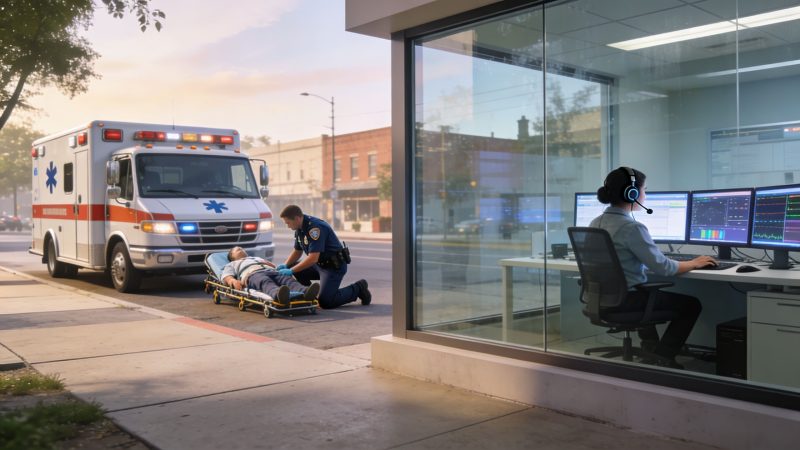
At street level, the easiest way to think about it is this. EMS is the whole machine. EMT is one job inside that machine. When people blur those together, they usually blur operations too. That’s when agencies send too much capability to minor calls, tie up advanced units, and create avoidable delays somewhere else in the system.
Understanding the Siren The System vs The Specialist
A bystander calls 911 for a fall at a grocery store. The call taker gathers the location, the dispatcher assigns the closest unit, a crew responds, a supervisor may monitor the incident, the patient gets evaluated, then transported, and the hospital gets a report before arrival. Those watching that scene often think only about the ambulance crew.
But the crew is only one part of what’s happening.

When someone asks what's the difference between EMS and EMT, they’re usually trying to name what they saw. They saw patient care, so they say EMT. They saw the ambulance service as a whole, so they say EMS. Both instincts make sense. The problem is that in operations, those labels mean different things.
Here’s the practical split. EMS includes the call intake, dispatch process, units, field providers, protocols, supervision, transport process, and hospital handoff. EMT means the certified provider delivering frontline care within that system.
That sounds basic, but it changes how you run a service.
Quick comparison
| Term | What it means | Main focus | Example |
|---|---|---|---|
| EMS | The full emergency medical services system | Coordination, response, transport, oversight | Dispatch assigns a unit and tracks the call through hospital handoff |
| EMT | A specific emergency medical technician role within EMS | Basic patient care and transport | Crew assesses a patient, controls bleeding, gives oxygen, and transports |
Practical rule: If you're talking about the organization, process, or response network, say EMS. If you're talking about the person treating the patient, say EMT.
That distinction keeps reports clean, training clear, and dispatch logic tighter. In a busy system, clear language saves time because crews, supervisors, and dispatchers stop talking past each other.
The Core Distinction EMS Is The System EMT Is The Provider
A chest pain call drops at 5:12 p.m. Dispatch screens it, assigns the closest appropriate unit, alerts the crew, tracks response time, and routes the patient to a hospital that can handle the case. The EMT steps into that process at the patient contact point. That is the split.
EMS is the service framework. EMT is one certified clinician working inside it. Propper’s breakdown of EMS vs EMT makes the same distinction. EMS covers the response chain from call coordination through transport and handoff. EMT refers to the frontline provider delivering basic life support and transport care. If you mix those terms up, you usually end up mixing up accountability too.
That matters in real operations. Agencies do not fix a dispatch delay with more EMT training. They do not fix weak airway management by rewriting deployment maps. Supervisors need to know whether the problem sits in the system or with the provider, because the fix, the cost, and the performance impact are different.
What belongs to EMS
EMS includes the parts of the job the public usually does not see, but every crew depends on:
- Call intake and triage, so the response matches the complaint
- Dispatch coordination, so the right resource gets sent without tying up higher-level units
- Unit deployment, including BLS, ALS, supervisors, and specialty resources
- Protocols, medical direction, and quality review, so care stays consistent across crews
- Transport decisions and hospital communication, so patients move into the right facility with usable information
That is why leaders should treat EMS as an operating model, not a generic label for an ambulance service.
What belongs to the EMT
An EMT handles direct patient care within a defined scope. On scene, that usually means assessment, bleeding control, oxygen therapy, CPR, basic airway support, splinting, packaging, monitoring, and transport support. EMTs are the hands on the patient, but they are not the whole response system around that patient.
In the field, that distinction shows up fast. A good EMT crew can do everything right and still lose time if call notes are thin, CAD logic is sloppy, or the wrong level of unit gets sent first. The opposite happens too. A well-built EMS system can place the right unit quickly, but the patient outcome still depends on the provider's skill, judgment, and scope.
Why agencies should care
This is not just wording. It affects staffing plans, dispatch rules, overtime, and fleet use.
If a manager treats every problem as an EMT problem, the usual answer is more training, more check-offs, and more labor cost. If the actual issue is system design, those dollars do not fix much. A better answer might be cleaner determinant codes, tighter posting plans, or better unit-status discipline.
The financial side is hard to ignore. Sending ALS to calls that a BLS crew can handle drives up cost per transport and leaves fewer advanced units available for high-acuity incidents. Sending too few resources creates avoidable callbacks, delays, and poor handoffs. Agencies that understand the EMS versus EMT split build smarter response plans. They match provider level to patient need, protect coverage, and cut waste without lowering care.
That is also where software earns its keep. A platform like Resgrid helps agencies manage the system side cleanly, including dispatch visibility, unit coordination, and resource tracking, so EMTs can stay focused on patient care instead of compensating for preventable process gaps.
Comparing Roles Training and Scope of Practice
A supervisor making the truck assignment for a breathing problem has to answer two questions fast. What level of care does the patient likely need, and what level of crew can handle it without wasting an ALS unit on a call that belongs in the BLS lane? That is where training and scope stop being classroom terms and start affecting coverage, overtime, and cost per call.

Training levels in the field
The provider side of EMS is tiered. As noted earlier, the usual ladder runs from EMR to EMT to AEMT to paramedic.
| Role | Typical training | General function |
|---|---|---|
| EMR | Introductory training | Limited support role, often before full transport care |
| EMT | Moderate entry-level training | Basic life support and transport |
| AEMT | Added education beyond EMT | Expanded medication and IV-related skills in many systems |
| Paramedic | Extensive classroom, lab, clinical, and field training | Advanced life support, advanced airway, cardiac care, broader medication use |
Training hours differ by program and state, so smart agencies avoid building staffing models around a single national number they found online. What matters operationally is the pattern. More training usually means a wider scope, closer medical oversight, and a higher cost to staff that seat on the truck.
What EMTs are trained to do well
An EMT works in the BLS lane. That includes patient assessment, airway support, CPR, bleeding control, splinting, oxygen administration, safe movement, monitoring, and transport.
That work carries a large share of the system.
A solid EMT crew can handle a big portion of daily call volume safely and efficiently. Falls, minor trauma, many medical complaints, interfacility transfers, and routine transports often do not need an ALS response. Agencies that respect that line keep advanced units available for seizures, airway compromise, STEMI alerts, overdoses with a poor respiratory drive, and other calls where advanced interventions may change the outcome before the hospital.
What AEMTs and paramedics add
AEMTs and paramedics bring a wider toolbox, but the exact tools depend on local protocol. In many systems, that means a broader medication formulary, IV or IO access, advanced airway options, ECG interpretation, cardiac interventions, and more independent decision-making in unstable patients.
Those added skills cost money. ALS staffing usually means higher wages, more continuing education time, tighter QA review, and more expensive equipment on the unit. If leadership sends that resource to low-acuity calls by default, the agency pays more while also increasing the chance that the next critical patient waits longer for the right crew.
Good deployment starts with honest scope matching.
Scope is set locally
A patch does not tell the whole story. State rules, medical director preferences, and agency policy all shape what an EMT, AEMT, or paramedic can do on duty.
I tell new field training officers the same thing every time. Teach to your protocol book, not to national assumptions. A provider who learned one skill in school may not be cleared to use it in your service, and a provider who can perform it clinically may still need a specific order, a supervisor consult, or a different destination plan.
That local variation also affects dispatch logic. If your EMT units can manage a certain complaint safely and your protocol supports BLS transport, your call-taking and unit recommendation rules should reflect that. Agencies that use dispatching tools built for resource matching and unit visibility make those decisions faster and with fewer avoidable upgrades.
What smart agencies review
Supervisors should track where scope and deployment keep missing each other.
Watch for these patterns:
- ALS units routinely sent to BLS-level calls
- EMT crews forced to request intercepts because determinant coding was too vague
- Protocol confusion between neighboring jurisdictions
- High-acuity calls delayed because advanced units were tied up on low-risk transports
- Training plans based on edge cases instead of actual call volume
The fix is rarely just “train harder.” Sometimes the answer is better call triage, cleaner posting plans, tighter destination rules, or stronger field feedback to dispatch and command staff.
Patients feel this distinction too. A family deciding between urgent care and an emergency department is asking a related question about level of service, and Carter's Walk-In + Urgent Care recommendations show how matching need to setting can prevent overuse and delay.
When people ask what’s the difference between EMS and EMT, this is the part that affects daily operations. EMS has to build the right mix of provider levels, and EMTs have to work inside a defined scope. Agencies that understand both sides run tighter coverage, spend less on unnecessary ALS deployment, and still get the right care to the patient.
A Dispatch Call From Start to Finish
A “person down” call is where the difference becomes obvious. The public sees one event. Dispatchers, supervisors, and field crews see a chain of decisions.

The call starts with the system
A caller reports that an older adult collapsed in a parking lot. The EMS side begins immediately. Call intake verifies the address, asks key questions, assigns a determinant, alerts the proper unit, and keeps gathering information while crews are moving.
That’s not EMT work. That’s system work.
The dispatch center also decides whether the call needs law enforcement for scene safety, whether fire should respond for lift assist or manpower, and whether the hospital should get an early heads-up. Effective resource discipline begins with these decisions. A bad dispatch decision can create a traffic jam of responders or leave a crew under-supported.
The crew arrives and the EMT role takes over
Now the EMT side becomes visible. The crew reaches the patient, checks responsiveness, airway, breathing, circulation, and obvious trauma. They gather history from bystanders, look for medical alert information, manage immediate threats, and decide whether transport should begin now or after additional resources arrive.
That is frontline provider work. It’s hands-on, protocol-driven, and time-sensitive.
For lower-acuity situations, it also helps to educate the public on when emergency transport isn’t the best doorway into care. A practical resource is Carter's Walk-In + Urgent Care recommendations, which explain when urgent care can make more sense than the emergency room. That kind of public guidance reduces avoidable system load.
Where operational savings show up
A smart dispatch process doesn’t just move units. It protects capacity. If the call information supports a BLS response, routing that incident correctly keeps advanced units available for strokes, major trauma, and airway emergencies. Teams that manage this well usually rely on structured dispatch tools, clear response rules, and a platform for tracking unit assignment and status changes such as dispatch coordination software.
Here’s the practical failure point I see most often. Agencies say they have tiered response, but their call coding doesn’t support it. So they over-dispatch by habit.
That burns fuel, ties up clinicians, and creates longer waits somewhere else.
A short training clip can help newer personnel visualize how dispatch and field operations overlap in real incidents:
The handoff closes the loop
At the hospital, the crew gives a report, transfers care, finishes documentation, and returns to service when cleared. That final step is another place where EMS and EMT differ. The EMT gives patient details. The EMS system tracks unit availability, turnaround, and readiness for the next call.
One person delivered care. The system made the care possible.
Exploring Career Paths and Work Environments
A common perception pictures one job setting: the back of an ambulance. That’s too narrow. EMTs work in ambulances, but the broader EMS world includes operations, supervision, communications, education, logistics, and administrative support.
If you’re hiring, that distinction matters because retention improves when people can see a path forward. If you’re new to the field, it matters because “EMT” isn’t the end of the road unless you want it to be.
Where EMTs and EMS professionals work
An EMT may work in:
- Private ambulance services: high call volume, interfacility work, 911 coverage, or both
- Fire-based systems: integrated response with fire suppression and rescue operations
- Hospital-affiliated services: close connection to emergency departments and transfer networks
- Industrial or job-site medicine: standby care at plants, construction sites, or remote operations
- Event medicine: concerts, sports, festivals, and large public gatherings
The broader EMS system also needs dispatchers, field training officers, supervisors, compliance staff, fleet coordinators, and educators. Those roles don’t always treat patients directly, but they shape how patient care happens.
A realistic career ladder
A common path starts at EMT, then moves into advanced certifications or leadership. Some providers stay in field care and become the dependable BLS backbone of an agency. Others move toward advanced care, teaching, supervision, or operations.
A practical career ladder often looks like this:
- Entry into EMT practice with strong fundamentals in assessment, transport, and scene discipline
- Advanced certification or specialty training for people who want a broader clinical scope
- Field leadership roles such as preceptor, shift lead, or supervisor
- System roles in scheduling, staffing, education, quality improvement, or communications
The people who last in EMS usually learn that career growth isn’t only about doing more procedures. It’s also about managing workload, keeping documentation tight, and avoiding burnout.
Some excellent EMTs never chase a higher patch. They become the crew members everybody trusts when the call load gets ugly.
That’s also why personnel visibility matters. Agencies that can track credentials, availability, shift assignments, and staffing gaps in one place usually manage people better than agencies working from spreadsheets and text threads. A platform for personnel management and scheduling helps leaders see who’s available, who’s qualified, and where coverage is thin before the shift becomes a problem.
For the individual provider, self-check matters too. Burnout creeps in subtly in this work. If you’re not sure where you stand, use a simple tool to evaluate your burnout score. It’s not a diagnosis, but it can help you decide whether you need recovery time, schedule changes, or a conversation with leadership.
How Resgrid Optimizes EMS Operations and Supports EMTs
A low-acuity chest pain call drops at 6:40 p.m. The closest ALS truck gets sent because nobody has a clear status board on the BLS units covering the east side. Ten minutes later, that medic unit is tied up on a patient who needs assessment, transport, and monitoring, but not advanced intervention. Then an urgent airway call hits two districts over. Now command is chasing coverage instead of running the incident.
That is the operational cost of confusing the system with the provider.
An EMT can do solid work on the right call. EMS leadership still has to build the machinery around that provider so the right crew gets sent, upgraded, relieved, and documented without wasting time or budget. Agencies that get this right protect ALS availability, reduce radio clutter, and avoid overtime caused by poor deployment decisions.

Smart allocation saves money
The financial piece is straightforward. Sending ALS to a BLS-appropriate call burns a higher-cost resource on a lower-acuity problem. You pay for that decision twice. Once in staffing and equipment on the current call, and again when the next critical patient waits longer for an advanced crew.
Supervisors see this every day in smaller ways too. A medic truck gets pulled across town for a call an EMT crew could manage. Standby coverage shifts. Another unit holds over past shift change. The payroll impact may look minor on one incident, but repeated over a month, it becomes a scheduling problem and a budget problem.
The better operating model is simple:
- Send EMT crews to calls that fit BLS response
- Hold ALS units for patients who are likely to need advanced care
- Track unit status live so dispatch can make the first assignment correctly
- Use clear upgrade triggers when scene findings show the call needs more than the dispatch notes suggested
Standard workflows reduce waste
Agencies lose time when dispatching depends on memory, side texts, and whoever happens to know the local workaround. That system fails under surge volume, special events, and shift change.
A better approach uses fixed rules for assignment, escalation, notifications, and follow-up. Incident and response workflows give agencies a way to build those steps in advance, so crews and dispatchers are not rebuilding the process call by call. That improves coverage and cuts down on preventable mistakes.
What EMTs feel in the field
EMTs usually experience system quality in very practical ways. They either get clean information, clear assignment, and a workable handoff, or they spend the first part of the call fixing avoidable confusion.
Good operational support looks like this:
- Clear unit assignments, including primary response, staging, and move-up coverage
- Reliable communications, with fewer missed updates and duplicate notifications
- Accurate mapping and access details, so crews spend less time hunting for the right entrance
- Cleaner status changes and handoffs, which reduces unnecessary callbacks and repeat radio traffic
I have seen capable crews lose time for no clinical reason at all. Wrong apartment building. Unclear staging location. Nobody marked available correctly. Those are system problems, not EMT problems.
Operational takeaway: The least expensive advanced unit is the one still available for the patient who actually needs it.
Agencies that understand the difference between EMS and EMT make better deployment decisions. They do not expect individual providers to compensate for weak coordination. They build a system that uses EMTs well, protects medic coverage, and controls cost without lowering care quality.
Clearing Up Common EMS and EMT Misconceptions
Some confusion sticks around because people hear these terms in public conversation, not in operations. Here are the ones that cause the most trouble.
EMS and EMT mean the same thing
No. EMS is the full emergency response system. EMT is one provider role inside it. If you confuse those, reports, staffing discussions, and training conversations get muddy fast.
A paramedic is just a more experienced EMT
Not exactly. A paramedic works at a higher certification and scope level. Experience matters, but the difference is training, authorization, and protocol. A veteran EMT may have excellent judgment, but that doesn’t grant paramedic scope.
Everyone in an ambulance is an EMT
Not always. Depending on the service, an ambulance may be staffed by EMTs, paramedics, or a mixed crew. The unit belongs to the EMS system. The certifications on that unit depend on staffing model and local requirements.
All first responders are EMS personnel
No. Police officers, firefighters, security staff, and rescue personnel may all arrive first. Some have medical training. Some don’t. Being first on scene doesn’t automatically make someone part of the EMS clinical structure.
More advanced care is always the better response
That sounds logical. It often isn’t. Over-sending advanced resources can weaken coverage for the next critical incident. The better response is the one that matches the patient’s likely need and can be upgraded quickly if the scene proves otherwise.
Frequently Asked Questions About EMS and EMT Careers
How long does it take to become an EMT
EMT training usually takes a few months, but the exact duration depends on the program format and your state requirements. A full-time course moves faster. Night and weekend programs take longer, which matters for agencies trying to fill openings without rushing people into the field before they are ready.
Can an EMT work in different states
Sometimes. An EMT certification does not automatically carry over everywhere, and agencies pay for that mistake if they assume it does. Before assigning shifts, confirm state reciprocity, local licensing, protocol approval, and any field orientation requirements. That check protects patients and prevents wasted scheduling hours.
Is EMT a good long-term career or just a starting point
It works both ways.
Some EMTs use the role as a path to paramedic school, nursing, fire service, or emergency management. Others stay in EMT roles for years and become the steady people every supervisor wants on the board: strong BLS clinicians, field training officers, dispatchers, logistics leads, or shift supervisors. Agencies need both groups. One builds the future pipeline. The other keeps daily operations stable and cost-effective.
What should agency leaders look for in new EMT hires
Look for reliability before ambition. A new EMT who communicates clearly, writes clean reports, manages routine calls well, and shows up ready for the next assignment usually saves an agency more time and money than the applicant who talks only about high-acuity medicine.
I would rather coach skills than fix habits. Good scene discipline, solid documentation, and consistent follow-through reduce billing problems, training delays, and avoidable operational friction.
What’s the simplest answer to what's the difference between ems and emt
Use this line: EMS is the organized emergency medical response system. EMT is the provider role that delivers frontline care within that system.
That distinction matters beyond terminology. Agencies that understand it staff smarter, dispatch the right level of response, and avoid tying up advanced units on calls an EMT crew can handle safely. Tools like Resgrid, LLC support that kind of control by helping teams manage personnel visibility, dispatch coordination, messaging, tracking, and reporting in one place.