
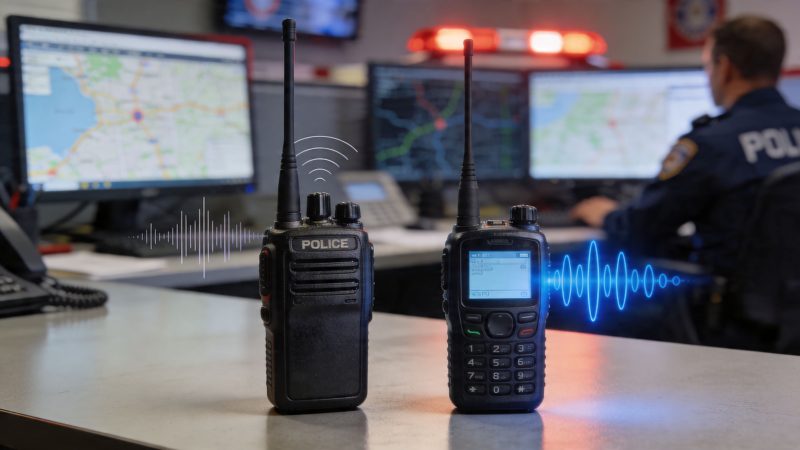
Digital Radio vs Analog: First Responder’s Guide
A chief is reviewing next year's capital plan. A dispatcher is asking for fewer missed transmissions. Crews are carrying radios that still work, but everyone knows the weak spots. A call gets scratchy at the edge of town. Two units step on each other during a working fire. A supervisor asks whether it makes sense to keep buying analog gear or finally move to digital.
That decision isn't really about gadgets. It's about whether your radio system still fits the way your agency operates now.
In the digital radio vs analog debate, the purchase price is often the initial focus. That's a mistake. The radio in a firefighter's hand is only part of the cost. The bigger questions are how much traffic your channels can handle, how much battery swapping your crews do, how well your system supports secure communications, and whether your dispatch workflow can make use of location, status, and messaging data without adding complexity.
The Unmistakable Sound of a Critical Call
The difference usually becomes obvious during a bad moment.
A unit calls in from a noisy roadway, from deep inside a structure, or from the far edge of your response area. On analog, the message may arrive with static, background noise, and that familiar wash of distortion that forces dispatch to ask for a repeat. Sometimes you still get enough audio to understand the message. Sometimes you don't. Either way, the incident tempo slows down.
Digital changes that experience. When the signal is solid enough, the transmission sounds cleaner and more controlled. The crew on scene spends less time repeating simple information. Dispatch spends less time guessing what was said. Command gets a clearer picture faster.

That matters even more when radio traffic is only one piece of the communications picture. Many agencies now pair voice traffic with unit-to-unit and command messaging through tools like incident messaging workflows, especially when they need to push non-urgent information off the main channel.
A radio system should reduce confusion, not add another layer of it.
The hard part is that analog still has real strengths. It's familiar, simple, and often cheaper to keep alive in the short term. Digital usually brings sticker shock. New subscriber units, programming, possible repeater work, training, and migration planning all show up at once. For a budget-conscious department, that's a serious hurdle.
But for chiefs and operations managers, the right question isn't "Which one is cheaper today?" It's "Which one costs less to operate well over time, and which one supports the kind of incidents we run?"
Analog and Digital Signals A Technical Primer
The simplest way to understand digital radio vs analog is to think about how each system carries your voice.
How analog carries speech
An analog radio sends voice as a continuous signal. If your voice rises, falls, or picks up wind noise, the radio signal mirrors that change. That's why analog often sounds natural. You're hearing a direct representation of the original audio.
The trade-off is that analog also carries the uglier parts of the environment. Engine noise, static, hiss, interference, and weak-signal distortion all ride along with the transmission. As coverage gets weaker, audio usually fades gradually. Users hear more noise and less usable speech.
A practical way to picture it is a dimmer switch. The light doesn't turn on or off. It gets progressively weaker.
How digital handles the same message
A digital radio takes your voice, converts it into data, and transmits that data over the air. The receiving radio reconstructs the audio at the other end. That process is why digital systems can filter noise differently and deliver a more consistent sound inside their intended coverage area.
Its behavior resembles a standard light switch. It tends to feel more binary. You get usable audio, then once the signal drops past a certain point, performance can fall off sharply.
That sharp drop is why many radio users talk about the digital cliff effect. With analog, a weak transmission may still be rough but partially understandable. With digital, audio can sound fine until it doesn't.
Field reality: If your crews work at the edge of coverage a lot, don't assume "digital equals more range" in every practical situation. Coverage design matters more than brochure language.
What crews notice at the edge of range
The two systems feel different in the hand.
With analog, a firefighter or medic may hear static building slowly as they move away from the tower or deeper into a building. They might decide to reposition, hold the radio differently, or move to a doorway before retransmitting.
With digital, the user may hear strong, clean audio across much of the working area. That consistency is valuable. But once the signal drops below what the system needs, the transmission can become unusable very quickly.
Here are the practical implications:
- Analog gives warning signs: Users often hear degradation coming and can react.
- Digital gives cleaner normal operation: Day-to-day traffic sounds better when the system is engineered well.
- Poor system design hurts both: Bad antenna placement, weak in-building coverage, and overloaded channels don't become acceptable just because the radios are newer.
Why this matters for leadership
Chiefs don't need to become RF engineers, but they do need the right mental model. Analog is more forgiving in how it degrades. Digital is more disciplined in how it performs. That difference affects user expectations, training, and infrastructure planning.
A small volunteer department with a compact service area may tolerate analog's imperfections because simplicity wins. A busier agency with dense traffic, noisy scenes, and expectations for data services may get more value from digital, provided the rollout includes proper coverage testing and user training.
Core Capabilities A Head-to-Head Comparison
Here's the comparison most agencies want early. The key is to look past the brochure words and tie each category to field operations and long-term cost.
| Capability | Analog radio | Digital radio |
|---|---|---|
| Audio behavior | Natural sounding, but picks up static and background noise more easily | Cleaner, more processed audio within intended coverage |
| Edge of coverage | Usually fades gradually | Often stays clear, then can drop sharply |
| Features | Basic voice-focused operation | Supports voice plus newer feature sets depending on platform |
| Security | Limited practical privacy | Better options for secure communications depending on system design |
| Fleet growth | Simpler for small, stable use cases | Better fit when traffic, users, or feature needs grow |
| Budget profile | Lower entry cost is common | Higher upfront cost, but can return value over time |

Voice clarity in real environments
Analog has one genuine advantage that experienced radio users often mention. Voices can sound more natural. That can help when the person listening already knows the speaker well and is trying to identify a voice through poor conditions.
But in high-noise environments, digital often wins the practical test. Dispatchers and field units usually care less about natural tone and more about whether the message comes through without hiss, engine rumble, and repeated requests for clarification.
If your traffic regularly includes roadway scenes, pump noise, alarms, crowd noise, or wind, cleaner audio usually saves more time than "natural" audio.
Capacity and channel efficiency
Digital can create a direct financial advantage, not just a technical one.
Digital radio systems can transmit double the capacity of analog systems using the same bandwidth allocation. Specifically, where two-way radios are limited to 12.5 kHz per transmit channel, analog supports one voice channel while digital systems using voice compression and DMR can support two simultaneous voice channels in that same bandwidth, according to Motorola Solutions' explanation of digital vs analog radio.
For a chief or communications manager, that means more than engineering trivia. It can mean:
- More conversations without new spectrum: Busy operations can support more traffic on existing allocations.
- Fewer licensing pressure points: If you can carry more traffic in the same bandwidth, you may delay or avoid additional frequency needs.
- Better dispatch separation: Tactical, command, and routine traffic become easier to organize when the system has more room to breathe.
This is the same reason many agencies compare radio modernization to telecom modernization. If you're also evaluating station phone infrastructure, the shift from legacy voice systems to IP-based communications follows a similar logic. SnapDial's guide to VoIP vs. POTS phone systems is useful because it frames how old and new communications systems differ in cost structure, scalability, and operational flexibility.
Battery life and the workday
Battery performance sounds minor until crews start swapping packs mid-shift or charging becomes a daily frustration. Digital systems are often attractive here because they can operate more efficiently than older analog setups.
For departments with long incidents, standby assignments, event coverage, or extended mutual aid, battery endurance becomes a staffing and logistics issue, not just a convenience issue. Fewer battery changes mean less micromanagement and fewer opportunities for a dead radio at the wrong time.
Features beyond voice
Digital usually opens the door to functions that analog fleets either don't support well or don't support at all. That can include text messaging, status signaling, GPS-related features, and selective communications depending on the platform and how it's configured.
Those features are only worth paying for if your agency will use them. Buying a digital system and then running it like a stripped-down analog channel plan is one of the most common ways agencies overspend.
Security expectations
If your operation handles sensitive law enforcement traffic, patient information, tactical movement, or security operations, analog's limitations become hard to ignore. In many public safety environments, "everyone can hear us" isn't an acceptable operating assumption anymore.
Digital doesn't solve security by itself, but it gives agencies much better options for building secure communications into normal operations.
What actually works
A direct way to evaluate digital radio vs analog is to ask four questions:
- Are crews repeating transmissions often?
- Are channels crowded during working incidents?
- Do you need secure or data-capable communications?
- Will your dispatch workflow use the extra features?
If the answer is yes to most of those, digital usually earns a serious look. Agencies comparing systems and workflow tools at the same time often use resources like public safety platform comparisons to map radio choices against dispatch, mapping, personnel, and messaging needs instead of treating them as separate purchases.
Operational Impact for First Responders
The technology matters because it changes how incidents are managed.
A radio isn't just a talk box. It affects command discipline, dispatch workload, crew accountability, and what information can move without tying up the main channel.
Security on live incidents
Analog is easy to live with until privacy matters. On a routine event detail or a simple public works operation, that may not be a major issue. On a law enforcement scene, a medical response, or a sensitive investigation, it can become a serious liability.
If you're discussing patient details, tactical positioning, or access instructions over a system that offers weak practical privacy, you're relying on good luck more than policy. That's not a communications plan.
Secure communications shouldn't be reserved for special incidents only. If crews need them, they need them to be routine and simple to use.
Digital platforms are often chosen because they support stronger security models and more controlled communications practices. That doesn't eliminate the need for discipline. Users still need channel plans, access management, and clear SOPs. But it gives agencies a stronger foundation.

Data changes command and control
At this stage, digital starts affecting more than voice quality.
When a radio system can support location data, status signaling, and message-based workflows, dispatch can operate with more precision. A unit doesn't have to occupy airtime for every small update. Command staff can see where people are moving. Supervisors can sort urgent voice traffic from lower-priority information.
In practical terms, that can help with:
- Unit visibility: Supervisors can identify who's closest, who's committed, and who's available.
- Reduced channel clutter: Minor updates move off voice when policy and tools support it.
- Better incident pacing: Dispatchers spend less time chasing status and more time managing the event.
Some agencies pair digital radio workflows with computer-aided dispatch tools so radio, unit status, mapping, and tasking support the same operational picture instead of living in separate silos.
Interoperability is where projects succeed or fail
A radio system can look perfect on paper and still create daily friction if neighboring agencies can't work with it cleanly.
This is one of the biggest trade-offs in the digital radio vs analog discussion. Analog is crude, but it's often straightforward to make basic voice communications happen across organizations. Digital adds capability, but it can also add complexity. Different standards, different programming practices, different feature sets, and different governance models can all complicate mutual aid.
The practical answer isn't to avoid digital. It's to plan for interoperability before procurement is locked in.
A strong migration and operations plan should include:
- Shared incident channels: Define what everyone can use during mutual aid responses.
- Programming governance: Keep naming, zones, and templates consistent enough that field users aren't guessing.
- Patches and gateways where needed: Mixed-system environments are common. Plan around that reality.
- Joint training: Interoperability fails when users don't understand channel plans under stress.
What doesn't work in the field
Agencies waste money when they treat digital as a status upgrade instead of an operational system. The common failures are predictable.
- Buying advanced radios without changing SOPs: Features sit unused.
- Skipping user training: Crews default to old habits and blame the equipment.
- Overbuilding for edge cases: The system becomes expensive and hard to maintain.
- Ignoring neighboring partners: Mutual aid gets messy fast.
A radio purchase should make incidents calmer, not more confusing. If a digital system adds menus, zones, and complexity without giving dispatch and command a measurable operational improvement, the project wasn't scoped correctly.
The True Cost of Communication A Lifecycle Analysis
Most chiefs feel the same thing when digital pricing lands on the desk. The upfront number hurts.
That reaction is reasonable. Analog equipment is often seen as the cheaper path, and one source notes analog radios are "usually less expensive." The problem is that this comparison often stops at purchase price and ignores the rest of the operating life, even though the same source notes a gap in detailed analysis around 40% longer battery life, doubled channel capacity reducing licensing costs, and enhanced coverage in the 25% to 40% range for digital systems in long-term public safety use, as described by VEI Communications' discussion of analog vs digital radios.
What belongs in your real TCO worksheet
A useful lifecycle review should include more than subscriber unit cost.
Look at these categories:
- Infrastructure expense: Repeaters, programming, installation, tuning, and any site work.
- Ongoing battery replacement: Longer battery life can reduce how often you rotate packs and buy replacements.
- Licensing pressure: More capacity on existing bandwidth can change the long-term frequency picture.
- Maintenance burden: Older analog fleets often look cheap until parts, failures, and support time start adding up.
- Training cost: Digital needs training. Ignoring that cost is sloppy budgeting.
A practical way to think about ROI
Don't try to prove the project with made-up savings. That's where bad radio proposals lose credibility.
Use an internal worksheet instead. Build your own numbers around your agency's actual conditions:
- List what you currently spend keeping analog functional.
- Add the recurring pain points that don't show on invoices, such as extra airtime, repeated transmissions, and battery handling.
- Estimate what digital would remove, reduce, or delay.
- Compare the systems across the full replacement cycle your finance team uses.
Budget test: If your proposal only compares radio purchase price, it isn't a TCO analysis. It's a shopping list.
For some agencies, analog still wins that worksheet. That's especially true when the service area is compact, traffic is light, and the current system already fits the mission. For others, digital starts expensive but becomes easier to justify once recurring licensing pressure, battery turnover, and operational inefficiency are included.
Where agencies actually save money
The cleanest long-term savings arguments usually come from three places.
First, battery management. If crews can run longer between charging cycles, the fleet needs less daily intervention and may cycle through replacements more slowly.
Second, channel capacity. If the system carries more traffic without forcing new spectrum decisions, that protects future budget flexibility.
Third, workflow efficiency. Even when it's hard to attach a precise dollar figure, fewer repeats, cleaner dispatch traffic, and better incident coordination reduce friction every shift.
That doesn't mean every digital project pays off quickly. It means the right way to judge the investment is over the full service life, not the first invoice.
Planning Your Migration From Analog to Digital
The safest migration is rarely a hard cutover. Most agencies should move in phases.
A mixed fleet is normal for a while. That's not a failure. It's often the smartest way to protect operations while spreading cost across budget cycles.

Start with the right users
Don't hand the first digital radios to everyone at once. Start where the operational payoff is obvious.
Good early candidates include:
- Command staff: They benefit quickly from cleaner communications and expanded control options.
- High-traffic units: Busy companies expose channel and clarity issues faster than rarely used units.
- Special teams with sensitive traffic: Security and coordination needs are easier to justify here.
This approach helps the agency learn before it scales. It also limits the cost of early mistakes.
Use dual-mode equipment when practical
Dual-mode radios can talk on analog and digital systems during the transition. For many departments, that's the bridge that makes migration financially possible.
That lets you:
- keep legacy channels active during rollout
- avoid forcing every neighboring partner to change at once
- replace older units in a planned sequence instead of a panic buy
The operational benefit is just as important as the budget benefit. Crews stay in contact while the communications plan matures.
Build the migration around operations, not procurement
Procurement teams often focus on devices. Operations leaders need to focus on outcomes.
A solid migration checklist includes:
- Coverage validation: Test the places where crews work, not just easy outdoor spots.
- Channel plan discipline: Keep naming conventions and zone structures simple enough for stressed users.
- Mutual aid coordination: Involve neighboring agencies early.
- Training by role: Dispatchers, field users, command staff, and radio administrators need different training.
- Policy updates: Define when to use voice, when to use messaging, and how status information is handled.
Rollouts fail when leadership assumes users will "figure it out." They won't, at least not consistently under stress.
Make the new features earn their keep
A digital migration should improve operations from day one. If the only visible change is a more expensive radio on the user's belt, the agency won't get full value.
That means deciding early whether you'll use GPS-related functions, text capability, status features, or integration with your dispatch workflow. If those tools won't be used, don't pay for complexity you won't manage. If they will be used, train to them immediately so crews build new habits while the rollout is still fresh.
Final Verdict Making the Right Choice for Your Agency
Analog is still a valid choice for some agencies. If you run a small operation, cover a limited area, have light radio traffic, and don't need secure or data-capable communications, a well-maintained analog system can remain practical and cost-conscious. Simplicity has value. Familiar equipment has value too.
Digital becomes the stronger case when your agency deals with crowded airwaves, sensitive traffic, rising coordination demands, or the need to connect radio activity to a larger dispatch and accountability picture. In those environments, the higher purchase price is often the least important part of the decision.
The right answer in digital radio vs analog isn't ideological. It's operational.
Choose analog when it still fits the mission cleanly and you can support it without constant workarounds. Choose digital when your crews need clearer routine communications, better channel efficiency, stronger security options, and a path to modern dispatch workflows that won't box you in later.
A good radio decision should hold up under three tests. It should support your incidents, fit your budget across the full lifecycle, and stay usable under stress. If a system fails one of those tests, keep looking.
If you're evaluating how radio workflows connect with dispatch, personnel tracking, messaging, and incident management, Resgrid, LLC provides an open-source platform built for first responders, dispatchers, and public safety teams. It's worth reviewing if you want one place to manage communications-related operations without locking yourself into a heavy implementation model.