
Emergency Management Coordinator: Role, Skills & Tech Guide
At 2:13 a.m., the phones start stacking up. A transformer failure has knocked out power across several neighborhoods. Traffic signals are dark. A lift station is at risk. The fire department wants road closure support. Public works needs a priority list. The city manager wants a briefing in ten minutes. Dispatch is already juggling calls that have nothing to do with the outage.
An emergency management coordinator earns their keep in these situations.
When the role is working well, the public rarely sees it. They see shelters open on time, clean information pushed out fast, resource requests routed to the right agency, and elected officials speaking from the same operating picture. When the role is weak, the same incident turns into duplicated effort, missed requests, bad documentation, and expensive cleanup after the fact.
The job isn't just writing plans. It isn't just running an EOC. It's the discipline of turning scattered people, equipment, agencies, and obligations into a system that can hold together when normal routines break.
The Calm in the Eye of the Storm
At 6:42 a.m., a water main break shuts down a major corridor on the same morning a storm line moves in. Public works is isolating valves. Police are rerouting traffic. The school district wants to know whether buses can get through. The hospital is asking which access road will stay open. Elected officials want one clear update, not five conflicting ones.
Without coordination, each department acts fast and still makes the incident worse.
Road closures go out on one channel while dispatch is working from an older map. A shelter decision gets made before staffing, access and ADA needs are confirmed. Mutual aid shows up with the right intent and no assignment. Finance gets pulled in late, which means cost tracking starts after equipment and overtime have already been committed. That is how routine incidents become expensive ones.
The emergency management coordinator keeps that from happening by connecting operations, policy, logistics, and documentation in real time. The role works best when it is practical, not ceremonial. Good coordinators keep a common operating picture current, push decisions to the right level, and make sure the information seen by dispatch, field supervisors, administrators, and public messaging staff matches closely enough to support action.
Technology matters here, and so does restraint. Agencies do not need another shiny platform that only one department logs into. They need tools that cut duplicate data entry, show resource status clearly, and work across police, fire, public works, schools, health partners, and volunteer groups without forcing everyone into separate spreadsheets and text chains.
One hard lesson from the field is simple. Siloed systems cost money twice. First during the incident, when staff lose time reconciling bad or incomplete information. Then after the incident, when records are too scattered to support reimbursement, after-action review, or procurement questions.
That is why strong coordinators care about adoption as much as features. A cheaper tool that everyone uses usually beats an expensive platform that sits half-configured. Budget pressure is real in this job, so the smart move is choosing systems that support inclusive planning, clean documentation, and cross-agency coordination without adding another administrative burden.
The same practical mindset applies after the water recedes or the smoke clears. Recovery starts early, and outside partners matter. If your team works with property owners and facilities staff after an incident, Restore Heroes' guide to restoration gives a useful plain-language view of what restoration companies handle and where coordination gaps often show up.
Calm is not a personality trait. It is a product of preparation, usable systems, and disciplined coordination under pressure. When those pieces are in place, the agency spends less time chasing information and more time making decisions that hold up.
Core Responsibilities of an Emergency Management Coordinator
At 2:13 a.m., a water main breaks under a hospital access road during a wind event. Public works is focused on the break. The hospital wants route updates. Police need traffic control points. The city manager wants a briefing in ten minutes. Finance is already asking who is tracking contractor costs. An emergency management coordinator steps into that mess and turns it into an organized operation.

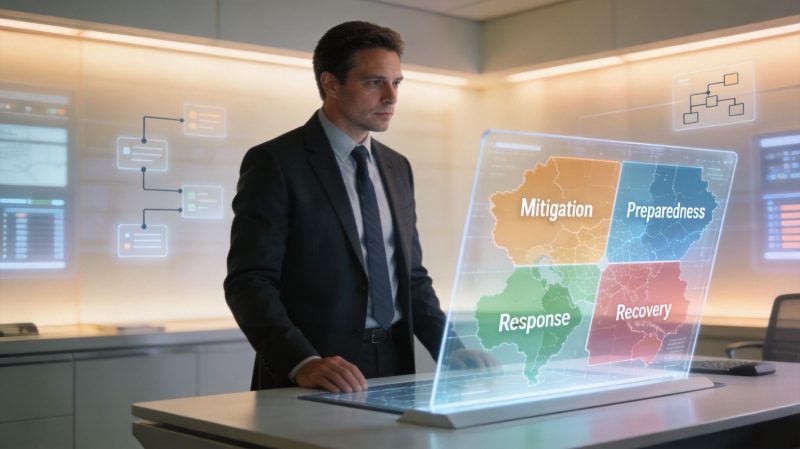
The job is usually described in four areas: mitigation, preparedness, response, and recovery. In practice, they run together. A shelter decision affects transportation, staffing, public messaging, and later reimbursement. A bad procurement shortcut during response can create months of recovery work. Good coordinators build systems that hold those connections together instead of treating each phase like a separate checklist.
Mitigation is risk reduction with a price tag attached
Mitigation work rarely gets applause because success looks like nothing happened. Still, in this regard, coordinators can save an agency real money.
The work includes hazard analysis, continuity planning, backup power reviews, flood and wildfire exposure checks, and identifying which buildings, systems, or vendors are single points of failure. The hard part is getting departments to act before there is visible pressure. Facilities may want capital funds for one project. IT may be focused on cybersecurity. Public works may be chasing deferred maintenance. The coordinator has to make the operational case and the budget case at the same time.
A solid mitigation effort does not stop at writing down the risk. It assigns owners, deadlines, and a realistic fix. If a site floods every year, the answer might be moving records, changing storage locations, pre-staging barriers, or funding a permanent project over two budget cycles. The right choice depends on cost, mission impact, and how often the problem repeats.
Preparedness is where plans either become usable or stay theoretical
Preparedness means people know what to do, who to call, and which system holds the current information. That sounds basic. It is usually where organizations struggle.
A coordinator is often responsible for keeping plans current, running exercises, maintaining contact lists, confirming resource availability, and working with outside partners before an incident forces introductions. The best programs also trim down tool sprawl. If operations uses one platform, public information uses another, and shelters rely on a shared spreadsheet no one updates, friction shows up fast during an incident.
Useful preparedness work usually includes:
- Exercises tied to real gaps: Tabletop discussions for policy issues, functional drills for coordination problems, and full-scale exercises only when they test something worth the cost.
- Current operational data: Duty rosters, vendor contacts, shelter capability, equipment status, and mutual aid points of contact.
- Cross-agency planning: Schools, hospitals, nonprofits, utilities, and neighboring jurisdictions should be working from compatible assumptions.
- Recovery partner awareness: Staff should understand who handles water damage, debris, smoke contamination, and sewage cleanup before residents start asking for help. Restore Heroes' guide to restoration is a practical reference for what restoration companies do once life safety operations settle down.
Preparedness also requires one uncomfortable decision. Coordinators have to choose tools people will use. A cheaper, simpler platform with consistent adoption usually produces better incident records than a larger system that only one trained person can operate.
Response is information control under pressure
During response, the coordinator protects decision quality. That means collecting reports, checking what is real, identifying the immediate priorities, and pushing clean updates to the people who need them.
Speed matters, but accuracy matters more. A fast wrong answer creates extra traffic, duplicate missions, and public confusion. Coordinators spend a lot of time confirming basics that should already be settled: which road closure list is current, whether a shelter is prepared to open, whether incoming mutual aid has an assignment, and whether elected officials are hearing the same message as field supervisors.
Here is what that often looks like in practice:
| Operational need | What the coordinator should do |
|---|---|
| Road closures changing fast | Confirm one authoritative list, then push updates to dispatch, public information, and field supervisors |
| Shelter request comes in | Verify site status, staffing, ADA access, supplies, security, and transportation support before announcing it |
| Mutual aid resources arrive | Match resources to mission assignments, staging locations, supervisors, and accountability procedures |
| Senior officials need a briefing | Give a short summary of impacts, current actions, constraints, and decisions that cannot wait |
Good response coordination is rarely dramatic. It is disciplined. It keeps the operation from splintering into side conversations, duplicate requests, and undocumented decisions.
Recovery starts early and rewards disciplined documentation
Recovery work begins long before the incident is over. If departments wait until demobilization to think about records, they are already behind.
The coordinator usually sets the process for cost tracking, damage documentation, procurement files, overtime logs, equipment use records, and task documentation. Finance, logistics, operations, and department heads all own parts of that record. Someone still has to make sure they are using the same rules and saving the same level of detail.
This is also where technology choices become very practical. If damage photos are stored in personal phones, mission requests live in email, and expense records sit in separate spreadsheets, closeout becomes slow and expensive. If one shared system captures assignments, timestamps, attachments, and status updates as the incident unfolds, reimbursement and after-action review get much easier.
This is the full scope of the role. An emergency management coordinator is not just writing plans or staffing an EOC. The coordinator is building a process that helps the agency act faster, document better, include the right partners, and avoid preventable costs after the incident ends.
Qualifications and Career Pathways
Few individuals begin their careers as an emergency management coordinator. They arrive from adjacent work where they learned how systems fail in real life. Fire service, EMS, law enforcement, public health, military operations, healthcare readiness, logistics, public works, and government administration all produce strong candidates. The common thread isn't the patch on the sleeve. It's whether the person can manage complexity without losing control of details.

The baseline is fairly clear. The U.S. Bureau of Labor Statistics projects about 1,000 annual job openings from 2024 to 2034, with median pay of $86,130 in 2024. It also notes that entry typically requires a bachelor's degree and over 5 years of experience, and that credentials such as the Certified Emergency Manager (CEM) can strengthen employability, according to the BLS outlook for emergency management directors.
What hiring managers usually value most
Degrees matter, but they don't carry a candidate by themselves. Hiring managers usually look for evidence that a person can operate across departments, not just within one.
The strongest backgrounds often include:
- Operational credibility: Work in emergency response, EOC support, public safety, healthcare coalitions, or field coordination
- Government literacy: Understanding procurement, policy, public records, and elected-official dynamics
- Planning experience: Writing annexes, updating procedures, or supporting exercises and after-action improvement items
- Public communication judgment: Knowing what to say, when to say it, and what needs verification first
A candidate who has written plans but never had to implement one under pressure may struggle. A candidate with field experience but no patience for documentation will also struggle. The role punishes one-dimensional skill sets.
Certifications and the real reason they matter
The value of a credential like CEM isn't just the letters. It's what the process signals. Someone who completed the training, documentation, and exam work has shown commitment to the discipline.
The BLS notes that the CEM requires 200 training hours and an exam in the occupational context above. In practice, the larger advantage is credibility. When a coordinator asks departments to follow standards, build corrective actions, or improve records, that request lands differently when peers know the coordinator has invested in professional development.
A good certification doesn't replace judgment. It gives structure to judgment and makes your decisions easier to defend.
A practical pathway that works
For people trying to enter the field, this sequence is still one of the most reliable:
- Get operational exposure through response, public health, government administration, or public safety support.
- Learn the planning side by helping update an annex, continuity plan, or exercise package.
- Build documentation discipline with grants, cost tracking, training records, or after-action items.
- Add a recognized credential once you have enough real-world experience to make the training useful.
- Show measurable outcomes in interviews. Don't just say you supported preparedness. Explain what process you improved and why it mattered.
For agencies hiring the role, the mistake is chasing a resume that looks polished but has never carried responsibility during a real incident. The role needs someone who can think in plans and act in operations.
A Day in the Life An EMCs Workflow
On a blue-sky day, the emergency management coordinator's work can look deceptively ordinary. They might spend the morning reviewing plan revisions, checking whether partner contact lists are current, and meeting with facilities staff about backup power assumptions. Before lunch, they may be on a call about a grant deliverable or training requirement. In the afternoon, they're refining exercise objectives and chasing down after-action items that departments promised to close last quarter.
None of that feels dramatic. It is still mission-critical work.
Blue-sky work is where costs get contained
A smart coordinator uses quiet days to reduce friction later. That means standardizing forms, tightening notification procedures, and making sure no one is keeping the "real" contact list in a private spreadsheet that nobody else can access. It also means building repeatable task flows, especially for shelter activation, damage assessment, and resource request routing.
If your team is still assigning those steps ad hoc, a structured process tool matters. Teams that want to standardize recurring operational tasks should look at workflow management for emergency operations, because repeatable workflows reduce the number of things staff have to remember under pressure.
Gray-sky work changes tempo instantly
Then the weather turns, a hazmat release happens, or a cyber disruption knocks out a critical service. The same coordinator who spent the morning cleaning up contact data is now standing up the EOC, validating reports, briefing leadership, and trying to separate rumors from confirmed impacts.
The workday usually compresses into a few core actions:
- Establish the operating picture: What happened, what's affected, what isn't confirmed yet
- Prioritize requests: Life safety first, continuity of operations close behind
- Track assignments: Who owns each task, when it was assigned, and whether it was completed
- Support public messaging: Make sure the PIO, call takers, and field supervisors are using aligned information
One of the biggest differences between average and strong coordinators is how they handle information flow. Average coordinators collect information. Strong coordinators force it into decisions.
When the EOC activates, nobody needs more email. They need a clean task list, one operating picture, and a way to see what's still unresolved.
Late in the incident, the coordinator is often already thinking ahead to the handoff into recovery. Which costs are being tracked. Which departments are documenting equipment use. Which unmet needs are going to surface when the immediate danger passes. That's the rhythm of the job. Strategic one hour, tactical the next, administrative right after that.
Key Competencies and Performance Metrics
The skills that matter most in this role aren't soft in the casual sense. They're operational. Leadership, communication, and judgment all have measurable consequences. If a coordinator can't impose clarity on a messy situation, the agency pays for it in slow decisions, duplicated work, and poor documentation.
The strongest coordinators prove their value through process control. They know how to turn requirements into habits. They make sure teams document labor, equipment, contracts, and incident actions in a way that survives audit and reimbursement review.

The metrics that actually matter
One of the clearest examples is reimbursement performance. Jurisdictions with rigorous EOC plans and documentation SOPs achieve 90% to 95% FEMA reimbursement rates, compared with 60% for those with inadequate processes. That can prevent over $500,000 in unrecovered funds per major event, based on the job description guidance published by Mid-America Regional Council's Emergency Management Coordinator description.
That's not a nice-to-have skill. That's money left on the table or money recovered.
A coordinator who can build disciplined documentation practices should be able to show performance in areas like:
| Competency | What good looks like |
|---|---|
| Documentation discipline | Departments use consistent incident cost and activity records |
| Cross-agency coordination | Resource requests don't stall because ownership is clear |
| Decision support | Leadership gets concise briefings with verified information |
| Recovery management | Damage, labor, and procurement records are usable after the incident |
Personnel visibility is a competency, not just a software feature
A lot of agencies still treat staffing accountability as an afterthought until the incident gets big. That's backwards. If you don't know who is available, qualified, assigned, or overdue for relief, your coordination picture is incomplete from the start.
Teams that need cleaner accountability should pay attention to personnel tracking for emergency operations. Even if you build your process in stages, visibility into staffing and assignment status prevents preventable waste. It also helps justify mutual aid requests with facts instead of guesswork.
What doesn't work
Some habits fail every time:
- Relying on memory: If a procedure only works because one veteran employee knows it, it isn't a durable process.
- Treating after-action items as paperwork: If corrective actions aren't assigned and revisited, the same failure shows up again.
- Separating operations from finance: Response decisions create reimbursement consequences. Those can't live in separate worlds.
- Waiting to fix accountability gaps: You can't build a resource picture in the middle of confusion if the basic roster was never maintained.
Strong coordinators don't just manage incidents. They protect the agency's financial position while the incident is still unfolding.
That last point often gets ignored in hiring. Agencies say they want a leader, but what they need is a leader who can produce defensible records and repeatable results.
Essential Tools for Modern Emergency Coordination
Most emergency management problems blamed on staffing are really workflow problems. The agency has one system for dispatch, another for scheduling, another for messaging, another for documents, and a few personal spreadsheets floating around to hold the gaps together. Then an incident stretches beyond one operational period and people act surprised that information goes stale.
That's not a technology problem alone. It's a coordination design problem.

What siloed systems cost you
The hidden costs show up in labor and error rates, not just subscription invoices.
A fragmented setup usually creates these failures:
- Duplicate entry: Staff type the same incident details into multiple places
- Conflicting records: The EOC board, dispatch notes, and field updates don't match
- Slow resource assignment: Supervisors spend time calling around to find available personnel
- Weak audit trails: Important decisions get buried in text messages or side conversations
That last point matters during reimbursement and review. If you can't reconstruct who requested what, who approved it, and when it happened, you're left defending the incident with partial records.
What better adoption looks like
Modern coordination tools should reduce friction, not add another portal. The best setups unify dispatching, team messaging, personnel visibility, and reporting into one operational picture. The reason to consolidate isn't fashion. It's cost control and decision speed.
If your agency wants a practical starting point, evaluate dispatching tools for multi-agency coordination against your current process. The test is simple. Can one supervisor see the incident, the available people, the assignment status, and the communications trail without chasing three separate systems?
That same logic applies when you bring in field intelligence tools. If your plans involve aerial assessment, UAVs for emergency response coordination are worth studying because drone operations only help when the imagery and tasking process tie back into the same decision cycle the EOC is using.
Budget-conscious choices that actually save money
You don't save money by buying the cheapest software. You save money by removing waste.
The best budget-minded technology decisions usually do four things:
- Reduce administrative duplication so staff spend less time re-entering or reconciling data.
- Improve assignment accuracy so you don't over-dispatch people or equipment you didn't need.
- Create usable records automatically so recovery documentation isn't rebuilt from memory.
- Scale without contracts that trap the agency when needs change.
The mistake many agencies make is adopting tools one function at a time with no integration plan. That creates local convenience and system-wide confusion. An emergency management coordinator should push the opposite direction. Fewer systems, clearer ownership, better visibility, and reporting that supports both operations and finance.
Buy for coordination, not for departments acting alone. Incidents don't respect your org chart.
Hiring and Becoming a Top-Tier EMC
If you're hiring, stop writing job descriptions that read like a generic public administration posting. Ask for evidence of coordination under pressure, exercise design, documentation discipline, and technology fluency. A modern emergency management coordinator should be able to explain how they manage situational awareness, corrective actions, cost recovery, and partner accountability.
A useful job description snippet looks more like this:
- Lead EOC coordination: Maintain a common operating picture, resource tracking, and decision support for leadership
- Manage exercises and improvement planning: Design, support, and evaluate HSEEP-aligned activities
- Oversee documentation and recovery readiness: Ensure departments maintain records that support reimbursement and after-action review
- Use modern coordination tools: Demonstrate comfort with integrated platforms for dispatch, personnel, messaging, and reporting
For candidates, the best move is to frame your experience in outcomes, not duties. Don't just say you supported preparedness. Say you revised plans, coordinated training, improved staffing accountability, or built documentation practices that held up after an incident.
One hiring signal matters more than many agencies realize. Jurisdictions that conduct annual full-scale EOC exercises designed using HSEEP have been shown to reduce emergency response times by 25% to 40% during actual disasters, according to Kensington Fire's emergency services coordinator job description examples. Ask candidates what kind of exercises they've planned, what gaps they found, and whether those fixes changed operations later.
The field is changing. The best coordinators aren't just planners or responders. They're disciplined operators who can connect people, systems, and budgets before the incident exposes the cracks.
If your agency needs a more practical way to coordinate dispatching, messaging, personnel tracking, and reporting without piling on more disconnected tools, take a look at Resgrid, LLC. It was built for real operational use by first responders, dispatchers, and public safety teams that need one place to manage the work and protect scarce budget dollars at the same time.