
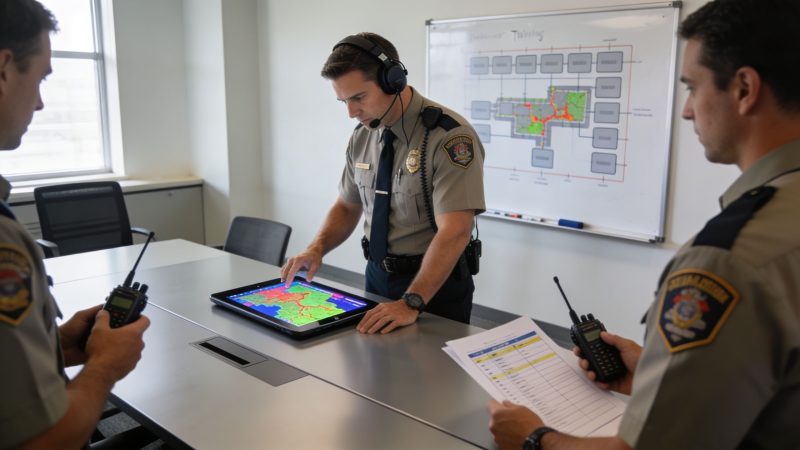
Master Your Incident Commander Training
You probably already know the problem. Your people completed ICS courses, passed the quizzes, and walked away with binders or PDFs. Then six months later a real incident hits, the radio traffic gets messy, resources start moving without clear assignments, and the person in command has to think, talk, track, and prioritize all at once.
That is where incident commander training programs often fail. They teach structure, but they do not build command judgment under pressure. They check the compliance box, but they do not create repeatable habits. They also lean too heavily on occasional classroom days and expensive exercises, when organizations typically require shorter, more frequent reps that fit real staffing and budget limits.
A good program is practical. It defines what competent command looks like, builds skills in layers, rehearses them in realistic conditions, and keeps them fresh with low-friction repetition. It also reflects how command happens now, with shared maps, digital logs, personnel visibility, messaging, and dispatch coordination happening alongside the traditional ICS chart.
Establishing Core Commander Competencies
The first mistake in incident commander training is training the role as if it's mostly about rank or personality. It isn't. A strong IC does a handful of things consistently under stress: sizes up fast, sets priorities, communicates clearly, assigns work cleanly, and keeps enough situational awareness to adjust before the incident outruns the plan.
That sounds simple until the incident is noisy, incomplete, and changing by the minute.
Research on decision-making in emergencies gives us a better target. Experienced incident commanders used Recognition-Primed Decision Making in upwards of 95% of cases, compared with less than 50% for inexperienced personnel, according to the USFA research summary on command decision making. The practical lesson is important. Good commanders usually don't stand there comparing a neat list of options. They recognize patterns, match them to prior experience, choose a workable action quickly, and refine as they go.

What a capable IC actually does
When I evaluate a command trainee, I'm not looking for polished speeches. I'm looking for observable behaviors:
- Forms an initial incident picture: They identify hazards, operational priorities, and obvious resource gaps without waiting for perfect information.
- Establishes command presence: People know who's in charge because assignments are specific, calm, and timely.
- Closes communication loops: Instructions are acknowledged, repeated back when needed, and tracked.
- Builds usable structure: They don't overbuild ICS in the first minutes, but they do create enough structure to keep span, accountability, and objectives from drifting.
- Thinks one operational period ahead: They don't just solve the current problem. They anticipate relief, logistics, information flow, and the next failure point.
Practical rule: Train command decisions around pattern recognition, not around classroom debate. If trainees spend more time discussing five theoretical options than selecting and validating one workable action, the drill is teaching the wrong habit.
The trade-off most programs miss
Many agencies overemphasize broad leadership language. “Be decisive.” “Stay calm.” “Communicate effectively.” None of that is wrong, but it's not enough to build performance. Trainees need repeated exposure to recognizable incident patterns: a fast-moving wildfire flank, a hazmat perimeter problem, a multi-casualty staging issue, a public event medical surge, a security incident with conflicting reports.
That's also where digital visibility matters. If you want commanders to make faster, cleaner assignments, they need to train with realistic accountability tools, not just whiteboards. A live personnel board such as personnel tracking tools for incident accountability changes the command task. Instead of relying on memory or a runner, the IC can verify who's assigned, who's available, and who hasn't checked in.
For teams that need a complementary planning framework on the security side, Overton Security's guide on incident response is a useful reference because it reinforces the same operational truth: plans matter, but clarity of roles and timely decisions matter more during the first operational push.
Your north star for training
A strong incident commander isn't the person who knows the most terminology. It's the person who can absorb incomplete information, choose a safe and effective direction, and organize people around it before confusion spreads.
Build your training around that standard. If a module, exercise, or checklist doesn't strengthen those behaviors, cut it or rewrite it.
Designing a Modular Training Curriculum
Most organizations don't need a giant command academy on day one. They need a curriculum that grows with the team, uses free material where it makes sense, and reserves custom work for the skills that generic courses don't cover well.
That's why a modular structure works better than a one-shot class. New supervisors can build the base. Developing leaders can practice local procedures. Experienced officers can work the ugly, high-friction incidents that expose weak command habits.

Tier one builds the foundation cheaply
Begin with standardized basics. Free or low-cost material earns its keep at this stage. FEMA and NIMS-aligned introductory content gives trainees the language of command, basic ICS structure, common forms, and role expectations.
Keep this tier narrow. It should cover:
- ICS fundamentals: Command, operations, planning, logistics, finance, span of control, and transfer of command.
- Local doctrine: Your terminology, dispatch flow, notification methods, and immediate life-safety priorities.
- Basic documentation habits: Initial notes, resource requests, and event logging.
Use short knowledge checks, not marathon classroom days. Foundational modules should make people operationally literate, not exhausted.
A practical example: a new duty officer completes foundational coursework, then runs a short tabletop on a vehicle crash with fire extension and conflicting reports of trapped occupants. The standard isn't advanced strategy. The standard is whether they establish command, identify priorities, request the right help, and keep communications orderly.
Tier two turns doctrine into local performance
Many incident commander training programs either achieve excellence or remain superficial at this stage. Intermediate training should move beyond abstract ICS and begin addressing how your organization functions under pressure.
Use this tier to cover:
Unit-specific SOP application
Can the trainee apply your evacuation thresholds, mutual aid triggers, security protocols, or medical escalation rules without pausing to search a binder?Communication discipline
Can they run one channel cleanly, split traffic when needed, and avoid flooding everyone with unnecessary transmissions?Resource tracking
Can they keep assignments, status changes, and reassignments straight as the incident grows?Documentation during motion
Can they log decisions without falling behind the incident?
Intermediate modules are also the right place for role transitions. A lieutenant who can command an initial scene may still struggle when a battalion chief arrives and command transfers. That handoff needs training on both sides.
Train the handoff, not just the first five minutes. Many incidents don't fail at the start. They fail when responsibility changes hands and assumptions go unspoken.
Tier three prepares leaders for complexity
Advanced training should be reserved for the people who will command larger or longer-duration incidents. This tier is where you spend more effort because the scenarios are harder to fake and easier to get wrong.
Focus on complexity that changes command behavior:
- Multi-agency coordination
- Extended operations
- Public information pressure
- Resource scarcity
- Simultaneous operational and political consequences
- Business continuity decisions for private-sector teams
Here, scenario design matters more than lecture time. A good advanced module might run a weather-driven evacuation, a campus security incident, or a regional infrastructure disruption that forces command to think beyond the first tactical objective.
A practical build order
If you're building from scratch, don't launch all three tiers at once. Use this sequence:
| Training tier | Primary purpose | Low-cost approach | What to customize |
|---|---|---|---|
| Foundational | Teach common ICS language and role basics | Use standardized introductory coursework and short internal briefings | Local activation triggers and reporting lines |
| Intermediate | Build local command performance | Tabletop drills using your own SOPs and communications plans | Dispatch procedures, resource tracking, accountability |
| Advanced | Stress-test leaders in complex incidents | Facilitated simulations with injects and after-action reviews | Multi-agency friction, extended ops, leadership transitions |
The money-saving move is simple. Don't pay custom-development costs for content that already exists in a usable form. Save your instructor time for the modules that reflect your hazards, your staffing model, your communications environment, and your decision bottlenecks.
A modular curriculum also solves a staffing problem. You can assign only the right tier to the right people. That avoids pulling senior personnel into beginner sessions or pushing junior members into scenarios they're not ready to run.
Running Cost-Effective Drills and Simulations
A lot of organizations still assume realism requires a full-scale field exercise. It doesn't. Full-scale drills have value, but they're expensive, disruptive, and hard to run often. For incident commander training, the best return usually comes from smaller simulations that stress decision-making, information management, and communication flow.
One of the most effective drills I've seen ran entirely from a training room. The IC got an initial dispatch, incomplete witness reports, a map, unit statuses, and periodic injects from controllers. Operations moved through radio traffic and digital updates. Nobody deployed apparatus. Nobody closed streets. But the trainee still had to prioritize life safety, assign resources, request support, and document decisions in real time.

Tabletop drills work when you make them friction-heavy
The weak version of a tabletop is a polite group discussion where everyone has time to think and nobody has consequences for delay. That teaches verbal fluency, not command.
The better version uses timed injects and incomplete information. For example:
- Minute 0: Initial report of a warehouse fire with one caller reporting workers still inside.
- Minute 4: Wind shift changes exposures.
- Minute 7: A mutual aid unit reports access is blocked.
- Minute 10: Social media posts create conflicting casualty information.
- Minute 14: A supervisor requests relief because the incident is expanding faster than staffing.
That kind of drill is cheap to run. It needs a facilitator, a realistic timeline, a communications method, and a way to display the operating picture. The trainee feels pressure because events keep moving whether they're ready or not.
Digital integration is no longer optional
A major training gap sits right here. A 2025 survey found that 68% of public safety agencies using open-source platforms reported 40% faster command communications during multi-agency incidents, yet only 12% of traditional IC training curricula include modules on digital tool interoperability, according to this incident commander course reference.
That gap shows up in drills all the time. Teams train command as if the only tools are radios, paper forms, and a status board. Then they respond in actual situations with shared maps, chat, personnel status updates, and digital incident logs. If the training environment doesn't include those tools, the first realistic rep happens during a live event.
For location-based coordination, a shared operating picture such as incident mapping and location awareness tools makes tabletop exercises much more useful. A facilitator can move units, place hazards, mark perimeters, and update incident geography while the trainee adjusts assignments.
If your command staff uses digital tools in real incidents, they should use digital tools in training. Otherwise you're rehearsing a version of command that no longer exists.
A low-cost simulation format that works
You can run a solid command simulation with a small staff:
| Role | What they do during the drill |
|---|---|
| Facilitator | Delivers injects, tracks time, controls pace |
| Dispatcher role player | Sends call updates and simulates field traffic |
| Incident commander trainee | Makes decisions, assigns resources, sets objectives |
| Evaluator | Uses a checklist to capture observable command behaviors |
| Optional agency partners | Add friction through realistic coordination issues |
A simple scenario for an event organizer or private security team might involve a crowd crush risk, medical calls, weather escalation, and conflicting instructions from venue leadership. A public safety agency might run a brush fire threatening structures, a transit disruption, or a mass casualty incident with staging and perimeter complications.
Later in the same program, add video-based injects or recorded radio clips so the trainee has to extract signal from noise rather than consume clean written prompts.
Here's a useful example of command communication in motion:
Actual cost savings come from frequency. Instead of waiting for one large annual exercise, run short digital command labs monthly or quarterly. You'll spend less on overtime, travel, setup, and field logistics, and your trainees will get more decision reps over the year.
Assessing Performance with Actionable Checklists
Most command evaluations are too vague to improve anyone. “Good job.” “Needs to speak up.” “Should be more organized.” None of that gives a trainee something they can fix on the next run.
A useful assessment tool focuses on observable behavior. Either the trainee established command or didn't. Either they assigned objectives clearly or left crews guessing. Either they tracked resource status or lost accountability halfway through the exercise.
What to measure during a drill
Start with a short checklist and use it live. Don't wait until the end and try to reconstruct what happened from memory.
| Core Competency | Observed Behavior (Example) | Evaluation (Needs Improvement / Meets Standard / Exceeds Standard) |
|---|---|---|
| Initial size-up | States hazards, incident type, and immediate priorities within the opening operational window | |
| Command establishment | Clearly announces command and identifies who reports to them | |
| Objective setting | Gives specific, actionable priorities tied to life safety, incident stabilization, and protection concerns | |
| Communication control | Uses concise messages, confirms assignments, and reduces unnecessary traffic | |
| Resource allocation | Requests, assigns, and reassigns resources based on changing needs | |
| Accountability | Maintains awareness of personnel status and assignment location | |
| Adaptability | Changes tactics or structure when injects alter the incident picture | |
| Documentation | Captures key decisions, requests, and transitions in usable form | |
| Transfer of command | Conducts a clear handoff with current situation, objectives, and resource status | |
| Professional command presence | Maintains composure and direction without freezing or overcontrolling |
How to run the hot wash
The best after-action review is short, direct, and specific. Run it immediately while the decisions are still fresh. Keep it focused on behaviors, not personalities.
Use a three-part sequence:
Self-assessment first
Ask the trainee what they think worked, where they lost the picture, and what they'd change.Evaluator observations second
Tie comments to checklist items. “You established command quickly, but you didn't confirm staging location after the access route changed.”One improvement target
End with one or two actions for the next drill, not ten.
A good hot wash reduces defensiveness because everyone can point to the same observed moments. It also keeps the conversation from drifting into blame.
What not to do
Avoid scoring style preferences as if they were command failures. Some ICs are brief and quiet. Others verbalize more. Style only matters when it affects clarity, accountability, or decision speed.
Also avoid overbuilding the form. If the evaluator needs five pages to assess a twenty-minute drill, the tool is too heavy. Keep the checklist tight enough that someone can use it while listening to traffic and watching the scenario develop.
The purpose of assessment isn't paperwork. It's making the next rep better than the last one.
Ensuring Continuous Skill Retention
The most expensive training program is often the one that looks cheapest on paper. A team attends a course, earns the certificate, and then lets the skill fade until the next annual requirement. That approach feels efficient because it condenses time and scheduling. In practice, it wastes effort because command is perishable.
The retention problem is well documented. Studies show skill retention erodes by 30 to 40% within 6 months after extensive NIMS/ICS training, based on the National Fire Academy evaluation of NIMS ICS training efficacy. That same evaluation points to quarterly spaced repetition drills as a way to combat that decay.
Why the one-and-done model fails
Command isn't just knowledge. It's recall under stress. A trainee might understand span of control in a classroom and still fail to build structure in a live drill because they haven't practiced using it quickly.
The one-and-done model also creates a budgeting trap. Organizations spend heavily on infrequent training events, then don't have enough capacity left for reinforcement. A lighter, recurring rhythm usually produces better readiness and spreads costs more evenly.
A sustainable training rhythm
Quarterly repetition is a strong baseline, but many teams benefit from even smaller monthly touches. These don't have to be large exercises. They can be short command reps built around one problem.
A practical retention schedule looks like this:
- Monthly micro-drill: A short scenario review with one command decision point and one communications challenge.
- Quarterly spaced repetition drill: A more structured exercise that forces the IC to size up, assign, adapt, and document.
- Semiannual role transition drill: Focused on transfer of command, relief, or expanding the organization.
- Annual capstone exercise: A broader scenario that validates the year's skill progression.
For recurring practice, a workflow platform such as automated training and operational workflows can handle reminders, inject distribution, task assignments, and follow-up actions. That lowers the administrative burden that usually kills repetition programs after the first few months.
Keep drills short enough to survive operations
Cost control meets realism in this context. If every drill requires half a day, backfill staffing, and a planning committee, the schedule will collapse. If a drill can run in fifteen or twenty minutes at shift change or during a scheduled training block, it has a much better chance of becoming routine.
A few examples:
- Radio inject drill: Dispatch pushes a developing incident. The trainee has to establish command and name the next three actions.
- Map-based micro-scenario: A hazard appears near a public event, and the IC must relocate staging and adjust ingress routes.
- Transfer drill: A supervisor briefs an incoming commander using a fixed handoff template.
- Documentation sprint: The trainee logs key decisions while controllers keep changing conditions.
Small, repeated reps beat rare, elaborate events for retention. Teams keep skills because they revisit them before they fade.
The cultural benefit matters too. Frequent short drills normalize command practice. People stop treating incident commander training like a special event and start treating it like part of operational readiness.
Frequently Asked Questions About IC Training
Who needs incident commander training besides public agencies
More organizations than commonly understood are involved. Data shows 55% of U.S. critical incidents now involve corporate response teams, and demand for business continuity ICS training has risen 30% since 2025, according to the L-950 course posting reference. That matters for manufacturers, hospitals, campuses, event venues, security firms, and large employers with internal response responsibilities.
Can private-sector teams use the same training model
Yes, but they should adapt it to their own risks. A factory emergency team doesn't need the same scenarios as a wildfire command staff. The structure still works: foundational ICS basics, local procedures, then scenario-based command drills built around actual hazards and decision points.
How do you keep costs under control
Use free standardized material for the basics. Save paid instructor time and internal planning effort for local SOPs, communication flow, and realistic exercises. Short digital or conference-room drills usually cost less than large field events and can happen more often.
How many people should be in a drill
Enough to create realistic communication and coordination pressure, but not so many that setup becomes the whole exercise. A facilitator, a trainee, a dispatcher role player, and an evaluator can produce a strong command rep.
What's the fastest way to improve command quality
Tighten the feedback loop. Run shorter drills, evaluate observable behaviors, and repeat the same weak areas until they improve. Teams often don't need more theory. They need more reps with useful feedback.
If you're building a modern command training program and want a practical platform for scheduling drills, tracking personnel, coordinating incidents, and supporting both public safety and private-sector operations, take a close look at Resgrid, LLC. It gives teams a cost-conscious way to run more realistic training without contracts or heavy implementation overhead.