
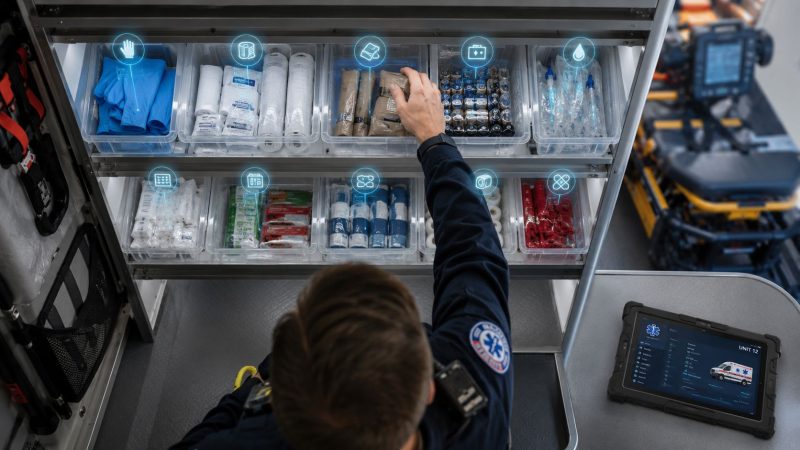
Materials Logistics Management: A First Responder’s Guide
A call can fall apart over one missing item.
Not a dramatic shortage. Not a total system collapse. One missing battery for a thermal camera. One airway size that should've been on the rig but wasn't. One trauma supply that expired in a side compartment because nobody had a clean process for rotating stock.
That's what makes materials logistics management so important for first responders. In business settings, people often talk about it like an efficiency exercise. In emergency operations, it's the discipline that keeps a preventable supply problem from becoming an operational failure.
The bigger context matters too. The United States used 7.8 gigatons of materials in 2019, 34% more than in 1970, and the logistics automation market that helps manage that flow is projected to grow from $65.25 billion in 2023 to $217 billion by 2033 (Inflow Inventory on materials management). That scale tells you something simple. Material control isn't a side task anymore. It's core infrastructure.
For responders, the question isn't whether you have a logistics problem. You already do. The primary question is whether you're managing it on purpose, or letting it manage you.
When a Missing Item Becomes the Whole Emergency
A unit arrives ready to work, but the setup is wrong.
The crew has the training. The officer has command presence. Dispatch gave solid information. Then somebody reaches for a piece of gear that should be there and isn't. Suddenly the scene slows down while responders improvise, borrow, substitute, or go without.
That's how supply failures show up in the field. They rarely announce themselves in advance. They appear as lost minutes, workarounds, and avoidable friction at the worst possible time.
Small misses create big problems
A few common examples show how fast this happens:
- A medical bag looks full until someone finds the critical item buried under unrelated stock or missing entirely.
- A vehicle check gets rushed at shift change, so a depleted battery or used consumable never gets logged.
- A station supply room has inventory on paper, but the usable stock is split across shelves, compartments, and personal stashes.
- Expiration dates get ignored because no one owns the rotation process end to end.
None of that sounds complex. That's why it keeps costing agencies money and time.
If crews are building their own shadow system with sticky notes, memory, and back-of-compartment checks, the formal system has already failed.
Materials logistics management is the professional answer to that problem. It covers how you buy, store, track, issue, replenish, and retire supplies and equipment so the right item is available when the call comes in.
Why this matters more now
Emergency services don't operate in a small, predictable bubble. They sit inside a much larger materials economy that keeps getting more complex. More gear types, more compliance requirements, more locations, more vendors, and more pressure to do more with the same budget.
That complexity punishes informal habits.
A missing splint, dead portable radio battery, or expired medication isn't just an inventory error. It's a breakdown in operational readiness. Good materials logistics management prevents those breakdowns before they reach the curbside, the fireground, or the patient.
What Materials Logistics Management Means for Responders
For a responder organization, materials logistics management is the full system that controls physical resources from purchase to use to restock. It covers the gloves in the trauma bag, the spare cylinders in the station, the batteries in charging rotation, and the specialty gear that only gets used during unusual incidents but must still be ready.
Think of it as your operational circulatory system. If that flow is healthy, crews get what they need without delay. If it's weak, every unit starts compensating in its own way.

It's about readiness first and waste control second
Most agencies feel the pain in two places at once. One is readiness. The other is money.
A useful benchmark explains why this gets leadership attention. Materials management can account for up to 60% of an organization's total expenditures (Nektar on materials management costs and ERP visibility). If that much spending is tied to procurement, inventory control, warehousing, and distribution, then supply discipline isn't clerical work. It's budget strategy.
For first responders, that means a better logistics system can protect service levels and free up money that would otherwise disappear into avoidable replacement purchases, overordering, expired stock, and duplicate buys.
What responders should include in the definition
In practical terms, responders should treat materials logistics management as five connected responsibilities:
| Area | What it means in the field |
|---|---|
| Buying | Getting the right items, in the right pack sizes, from reliable vendors |
| Storage | Putting supplies where crews can find them fast and rotate them correctly |
| Assignment | Making sure gear is actually issued to the right vehicle, station, or cache |
| Visibility | Knowing what you have, where it is, and whether it's usable |
| Recovery | Replenishing after calls and removing expired or damaged stock |
When agencies miss one of these, they usually create waste somewhere else. Cheap bulk purchasing sounds smart until expired cases get thrown out. Tight stock control sounds efficient until crews start hoarding backup items in lockers and jump bags.
Field test: If you can't answer “what do we have, where is it, and is it usable?” in a few minutes, your supply operation is running on guesswork.
What good looks like
Good materials logistics management doesn't mean having a giant warehouse or a full-time logistics division. It means using repeatable rules.
A station with one ambulance and a utility unit still needs par levels, issue procedures, expiration checks, and a clear restock owner. A regional agency with multiple stations needs the same things, just with tighter tracking and better data discipline.
The standard is simple. Crews shouldn't have to remember the system. The system should support the crews.
The Five Core Processes to Control Your Gear and Budget
The most reliable agencies usually do five things well. They buy with discipline, store with intent, distribute with accountability, track what moves, and replenish before shortages become incidents.

Procurement
Procurement mistakes lock in waste before the box even arrives.
Many departments buy based on habit, vendor relationships, or whoever noticed the problem first. That approach usually creates mixed product lines, inconsistent pack sizes, and too many emergency purchases. A better method is to standardize commonly used items by unit type and buy against approved lists.
A practical money-saving move is to compare purchase patterns by use case, not by catalog category. Medical consumables for frontline rigs shouldn't be ordered the same way as low-use specialty items for reserve units.
If your team needs a plain-language refresher on warehouse stock discipline, the guide to AUSFF inventory management is worth reviewing because it reinforces the basics that many agencies skip.
Storage
Storage is where departments incur hidden financial losses.
If fast-moving items are mixed with rare-use items, crews take longer to restock and rotate less consistently. If expiration-sensitive supplies are buried behind durable equipment, the oldest stock sits too long. If batteries, chargers, and accessories are split across rooms, nobody knows what's serviceable.
Try this simple layout rule:
- High-use items forward: Put the most frequently issued supplies in the easiest-to-reach locations.
- Expiry-sensitive stock visible: Keep dates facing outward and group those items together.
- Vehicle load items separated: Don't mix station reserve stock with what belongs on a rig.
- One shelf, one label, one purpose: Ambiguous storage invites substitute stocking and counting errors.
Distribution
Getting gear into the building isn't the same as getting it into service.
A common failure point is handoff. Supplies arrive, but the right bag doesn't get rebuilt, the reserve monitor doesn't get its battery, or the second-out vehicle doesn't receive the cache assigned to it. Distribution needs named ownership.
One fix that works is tying supply handoffs to a documented workflow instead of verbal reminders. Digital task routing through operational workflows helps assign who restocks, who verifies, and who closes the loop after equipment or consumables move.
Later in the process, teams should watch this quick overview for a practical operations mindset:
Tracking
If an item matters, track it before it goes missing.
That doesn't mean every gauze pad needs a scan history. It means high-value, high-risk, or easily misplaced items should have a clear chain of custody. Portable radios, airway kits, specialty bags, thermal cameras, and controlled supply bins all belong in that category.
A lot of agencies overcomplicate this part. Start with three questions:
- Who had it last
- Where should it be now
- What condition is it in
If your current system can't answer those reliably, simplify first and automate second.
Replenishment and disposal
Replenishment fails when agencies wait until the shelf looks empty.
Better practice is to define reorder triggers by item criticality. Trauma dressings and oxygen-related consumables need different treatment than office supplies. Expired, damaged, or recalled items also need a removal process that is just as clear as the reorder process.
Order points should be boring. If restocking depends on someone feeling uneasy about a shelf, it's too late.
The strongest supply systems don't rely on heroic memory. They rely on routine.
Overcoming Common Challenges in Emergency Logistics
Emergency logistics gets difficult where generic inventory advice stops helping.
A warehouse serving stable retail demand can optimize for efficiency and predictable replenishment. A responder agency has to handle call spikes, storm prep, equipment transfers, shelf-life limits, and the possibility that one stockout affects care or scene safety. In that environment, service continuity matters more than textbook efficiency. That's the core issue highlighted in mission-critical logistics work such as Buro Happold's discussion of materials management in healthcare.
The safety stock problem
Routine items and mission-critical items should not be managed the same way.
Gloves, printer paper, and cleaning supplies can tolerate a leaner replenishment model. Items that could interrupt emergency response if unavailable need a deliberate safety stock policy. The mistake is treating all stock as equal, either by hoarding everything or by cutting everything.
A practical decision rule looks like this:
| Item type | Better approach |
|---|---|
| Call-critical and hard to substitute | Keep a protected buffer and review after major incidents |
| Moderate-use but important | Set reorder points with regular supervisory review |
| Common and easy to source | Replenish more frequently, with lower reserve levels |
That mindset reduces waste without pretending every line item carries the same operational risk.
Demand surges and disruption
The ugly days break static plans.
Mass casualty incidents, weather events, prolonged searches, public events, and mutual aid deployments all distort normal usage. A fixed spreadsheet built for average weeks won't handle those conditions. Agencies need a way to reassign stock, reposition equipment, and change replenishment decisions quickly.
There's evidence that integrated planning for disruption can produce meaningful savings. A civil-engineering case study found that redesigning logistics around procurement scheduling, site planning, and dynamic facility relocation reduced Total Logistics Cost by 17.8% (case study on logistics optimization under disruption). The lesson for responders isn't to copy that environment exactly. It's to stop assuming static placement is always cheapest.
For mobile operations, teams can support dynamic repositioning by using AVL units for live resource visibility so logistics decisions reflect where assets are currently, not where the whiteboard says they should be.
Expiry, shrinkage, and multi-station drift
Some losses happen slowly enough that people stop seeing them.
Medications expire. Batteries age out. Specialty gear gets borrowed between stations and never fully returned. Vehicle compartments evolve into personalized layouts. Each one seems manageable on its own. Together they create a supply picture that leadership can't trust.
To tighten this up, use a monthly review focused on exceptions, not total counts:
- Items nearing expiration: Move usable stock to higher-consumption units first.
- Station-to-station variation: Compare loadouts and eliminate drift unless it's approved.
- Repeated emergency purchases: Treat them as signs of planning failure, not normal operations.
- Unverified reserve caches: Open and inspect them on schedule, not only after deployment.
The agencies that handle chaos best usually aren't the ones with the biggest stockpile. They're the ones that know what they have and can move it decisively.
How Technology Saves Money and Simplifies Management
Manual systems usually fail in the same places. People forget to log usage. Spreadsheets get copied instead of updated. Vehicle checks become check-the-box routines. Expiration dates live on paper lists that nobody has during an actual shift.
Technology helps when it removes those failure points, not when it adds one more dashboard nobody maintains.
Clean data matters more than fancy features
Most logistics software problems start as data problems. Duplicate item names, inconsistent vendor records, mismatched unit labels, and bad location lists all create workarounds. Those workarounds cost time, and they also distort reordering, fulfillment, and reporting.
There's solid evidence for that. Standardized supplier and product master data can improve data cleansing and governance speed, while poor data quality can reduce throughput. For day-to-day operations, implementing an adaptive Master Data Management platform can produce a documented 20% reduction in inventory holding costs and a 15% increase in order fulfillment accuracy (Profisee on supply chain master data management).
That's why the first tech upgrade shouldn't be “buy more software.” It should be “clean up item names, locations, owners, and reorder logic.”
What to automate first
Start with the work that people are least consistent at doing by hand:
- Scan-based issue and return: Use barcodes or similar tags for high-value gear and critical bags.
- Low-stock alerts: Flag shortages before crews discover them during a call.
- Expiry alerts: Surface what needs rotation or disposal before it becomes waste.
- Assignment visibility: Show which unit, station, or person is responsible for each asset.
- Map-based context: Let supervisors see where resources are positioned when reallocating equipment during incidents.
That's where a unified platform can help. For example, Resgrid combines operational coordination with tools such as mapping for resource visibility, which can support asset placement and field logistics when equipment and units need to be moved during active operations.

Don't separate supply systems from operations systems
A common mistake is putting logistics in one tool and operations in another, with no clean connection between them. Then dispatch, supervisors, and logistics staff all work from different assumptions.
If you're sorting through that architecture question, this primer on Understand SCM and ERP differences and integration is useful because it explains how supply functions and core business systems should complement each other instead of competing.
The best logistics software doesn't just count inventory. It helps the right person act on the right shortage before the shortage reaches the field.
What doesn't work
A few technology habits usually disappoint:
| Bad approach | Why it fails |
|---|---|
| Tracking everything at the same level | Staff stop using the system because the effort is too high |
| Keeping old naming conventions forever | Reports stay messy and automation never becomes reliable |
| Using software without process changes | Digital clutter replaces spreadsheet clutter |
| Leaving alerts unmanaged | People ignore warnings once false alarms pile up |
The right setup is usually simpler than people expect. Clean item data. Clear ownership. Limited but meaningful scans. Automated alerts on the items that matter. Good materials logistics management becomes easier when the software reflects real field operations instead of abstract warehouse theory.
Your Practical Materials Logistics Checklist
Most agencies don't need a total rebuild. They need a disciplined reset.
Use this checklist as an operational review, not a paperwork exercise. If you answer “no” or “not consistently” to several of these, you've found the places where money and readiness are leaking out of the system.

Inventory control
- Know your critical items: Identify the supplies and equipment that would disrupt response if unavailable.
- Verify actual counts: Compare shelf counts, vehicle loadouts, and reserve stock. Don't trust old sheets.
- Review expiration exposure: Check what expires, where it sits, and whether it can be rotated to higher-use locations sooner.
- Separate usable from questionable stock: Crews shouldn't need to inspect every item just to know if it's deployable.
Process discipline
- Assign ownership: Every restock task, inspection, and reorder decision needs a named owner.
- Set reorder rules: Critical items need defined triggers. Don't wait for visual shortages.
- Document transfers: When gear moves between stations, vehicles, or cache locations, record it every time.
- Create a disposal routine: Expired and damaged items need a formal removal path so bad stock doesn't drift back into service.
Operations check: If a reserve bag or specialty cache hasn't been inspected on schedule, treat it as unavailable until verified.
Storage and layout
Ask these questions during a walk-through:
- Can a new crew member find essential items without help
- Are high-use items stored for speed
- Are expiration-sensitive items visible
- Do station shelves match rig loadout standards
- Are reserve supplies clearly separated from active assignment stock
If the answer is no, reorganize before buying more product.
Technology and review cadence
Use technology where it removes repeated manual effort. High-value assets, expiring items, and cross-station transfers are usually the best starting points. Build reviews around exceptions such as shortages, upcoming expirations, and unresolved transfers.
A strong monthly review should include:
- Critical stock gaps
- Items repeatedly bought on short notice
- Assets with unclear location or status
- Supplies nearing expiration
- Loadout drift across units
Good materials logistics management isn't glamorous. It's disciplined, repeatable, and visible. That's exactly why it saves money.
If your agency needs a practical way to connect dispatch, resource tracking, mapping, personnel coordination, and operational workflows in one system, Resgrid, LLC is worth evaluating. It gives first responders and public safety teams a centralized platform for managing moving parts that too often live in separate tools, spreadsheets, and radios.