
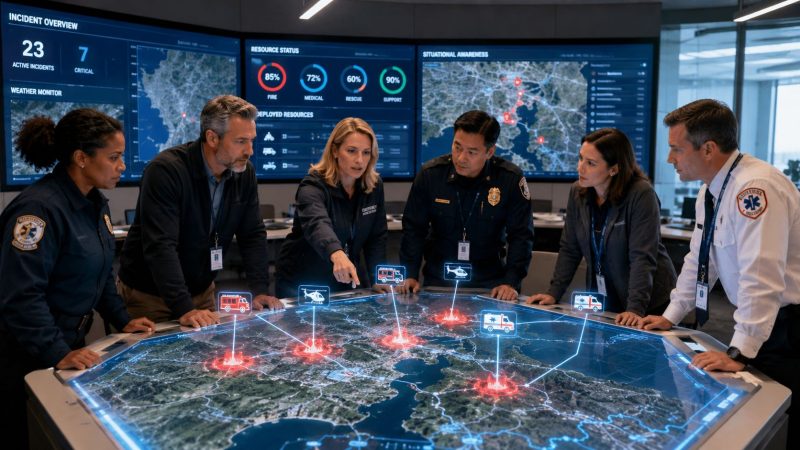
Multi Agency Coordination System: A Field Guide 2026
At some point, every public safety director gets the same rude lesson. A big incident doesn't fail because responders stop working. It fails because coordination breaks before effort does.
A wildfire jumps a county line. A flood knocks out roads in two jurisdictions at once. Dispatch starts fielding requests for barricades, buses, engines, shelter support, fuel, public works crews, and public messaging approvals. One agency sends resources early. Another holds them back because it isn't sure what's coming next. The EOC starts acting like a command post. Elected officials want answers. Incident Command wants assets. Finance wants documentation. Everyone is busy, and nobody is looking above the incident level.
That's where a Multi Agency Coordination System earns its keep. Not as bureaucracy. As a way to stop expensive confusion before it hardens into operational failure.
When Emergency Response Spirals Out of Control
The warning signs are familiar.
A storm cell passes through three cities and leaves debris, power loss, traffic crashes, and a sheltering problem behind it. Each local incident commander has a legitimate need. Each agency thinks its incident is the priority. Mutual aid starts moving, but nobody has a clean view of what is committed, what is available, and what should wait. Two departments request the same specialty asset through different channels. Public information officers issue messages that aren't aligned. Meanwhile, senior officials are asking strategic questions that field supervisors shouldn't have to answer in real time.
That is the moment when agencies either benefit from structure or pay for its absence.
What unmanaged competition looks like
Without a functioning coordination layer above the field, the same bad patterns repeat:
- Resource hoarding: Agencies keep equipment and personnel in reserve because they don't trust the broader picture.
- Duplicate requests: Logistics teams order or request the same support from multiple places.
- Priority drift: The loudest request wins, not the most urgent one.
- Message conflict: One jurisdiction tells residents to evacuate while another says to shelter in place nearby.
- Executive interference: Senior leaders start reaching into tactical decisions because no policy forum exists for them.
Those mistakes cost money fast. They also cost time, which usually costs more.
A chaotic response often isn't a staffing problem. It's a decision-routing problem.
I've seen agencies work hard and still waste hours because nobody had a disciplined way to compare competing requests across jurisdictions. In that environment, rumor starts to move faster than verified information. During a fast-moving event, that makes it worth reviewing practical tools for rumor control and verification, including this false information detection guide, because bad information can pull scarce resources in the wrong direction.
A well-run MACS gives senior leaders a place to set priorities, assign scarce resources deliberately, and keep policy decisions out of the tactical lane. It exists for the exact moment when normal coordination methods stop being enough.
What a Multi-Agency Coordination System Is
A Multi Agency Coordination System is not a single room, a software package, or a synonym for the EOC. It is the coordination architecture that sits above field operations and helps multiple agencies work from the same strategic picture.
Under current NIMS doctrine, the Multiagency Coordination System is a foundational component of the United States standardized Incident Command System and the Command and Coordination component integrates four structures: ICS for on-scene tactical response, EOCs for off-scene support, MAC Groups for policy-level decision-making, and the Joint Information System for unified public messaging (Wikipedia overview of MACS under NIMS).

Think of it like resource air traffic control
If ICS runs the incident on the ground, MACS helps decide where limited resources should go across the whole system. That's the useful mental model.
Field command still handles tactics. The EOC still supports operations with information and resource coordination. The JIS still aligns public messaging. The MAC Group still works at the policy level. MACS is the framework that lets those pieces function without stepping on each other.
What MACS is and isn't
A new director can avoid a lot of trouble by keeping these distinctions straight:
| Element | What it does | What it should not do |
|---|---|---|
| ICS | Runs on-scene tactical operations | Set policy for competing jurisdictions |
| EOC | Coordinates support, information, and resources off-scene | Take over field command |
| MAC Group | Sets policy direction and priorities across incidents | Direct crews in the field |
| JIS | Coordinates unified public messaging | Freelance messaging by agency |
The practical reason for this separation is cost control as much as doctrine. When the EOC behaves like an incident command post, requests get rerouted, approvals slow down, and field leaders start bypassing normal channels. When MAC Group members start issuing tactical directions, supervisors in the field get conflicting orders. Both failures create delay, duplication, and unnecessary spending.
Why the architecture matters
The phrase "multi agency coordination system" sounds abstract until several incidents compete for the same people, equipment, facilities, or executive attention. Then it becomes concrete very quickly.
A functioning MACS helps agencies:
- Prioritize incidents consistently instead of reacting to pressure.
- Allocate scarce resources deliberately instead of first-come, first-served.
- Resolve policy conflicts early before they stall operations.
- Maintain a common operating picture across jurisdictions.
Practical rule: If your senior officials are debating strategy inside the same channel where field units are asking for barricades, your coordination structure is already off balance.
The best agencies treat MACS as part of routine preparedness, not a concept to rediscover in the middle of a crisis.
Key Roles and Responsibilities Within MACS
The first operational mistake to prevent is simple. MACS coordinates above the field level. It doesn't command the incident.
The two elements most agencies use most often are the EOC and the MAC Group. EOCs coordinate information and resources to support on-scene command, while MAC Groups are policy-setting entities composed of agency administrators and executives who do not exercise direct incident command (NIMS Logic explanation of EOCs and MAC Groups).
Who belongs in the MAC Group
The MAC Group should consist of people who can make policy decisions, settle cross-jurisdiction issues, and authorize strategic direction. That usually means agency administrators, department executives, and elected or appointed officials with real authority.
It should not be staffed like an operations meeting. If the table fills up with people who want to direct tactics, the group loses its purpose.
What the MAC Group should actually do
The MAC Group is most valuable when it handles decisions that field command shouldn't own alone:
- Set priorities across incidents: If two incidents need the same scarce asset, the MAC Group decides which one gets it first.
- Resolve policy conflicts: If neighboring jurisdictions have different thresholds for road closures, evacuations, or protective actions, the MAC Group settles those conflicts.
- Authorize strategic direction: Leaders can align the response with broader community objectives and legal authorities.
- Support senior-level coordination: Agency heads and elected officials get a forum for decisions without crowding the incident channel.
What the MAC Group must stay out of
A MAC Group should never start telling division supervisors where to place apparatus, when to open a branch, or how to run tactics on the line. That belongs to ICS.
That distinction isn't academic. When policy leaders drift into tactical control, accountability gets muddy and response tempo slows. Field leaders start waiting for approvals they shouldn't need. Executives start absorbing details that don't help them make strategic choices.
If a MAC Group member is asking where to stage engines, the group is operating one level too low.
The EOC has its own boundary. It supports incident command with information, coordination, and resource support. It should not become an alternate command post just because it's staffed, connected, and visible.
For a new public safety director, one practical safeguard works well. Put role boundaries in writing before the incident. Then rehearse them. During an activation, people revert to the system they've practiced, not the org chart they meant to learn later.
MACS Activation and Information Flow
Most agencies don't struggle with the idea of MACS. They struggle with when to activate it and how information should move once it's active.
Activation usually becomes necessary when an incident exceeds the practical capacity of one agency or jurisdiction, or when multiple incidents compete for the same finite resources. That's the point where informal coordination stops being efficient and starts becoming expensive.
How requests should move
The cleanest flow is straightforward.
Field command identifies a need. That request is documented and pushed through the established support and coordination channels. The EOC or coordinating entity consolidates requests, validates status, and passes strategic conflicts upward when necessary. The MAC structure evaluates priority against other incidents and helps allocate scarce resources based on a shared picture rather than local pressure.
That keeps tactical decision-making with ICS while allowing strategic allocation above it.
A request for generators is a good example. If one jurisdiction needs them for a shelter and another needs them for a water system support site, that isn't a field-level problem anymore. Someone has to compare consequences, available alternatives, timing, and policy implications across the system.
How prioritization prevents waste
The Washington MAC guidance is useful here because it describes the mechanics directly. MACS coordinates above the field level and provides the architecture for incident prioritization and scarce resource allocation. Operational execution uses Situation Status, Resource Status, and a Scoring System to generate a Priority List when scarce resources are requested for multiple simultaneous events (Washington MAC guide on prioritization variables).
That matters because it forces agencies to compare requests with discipline.
- Situation Status asks what is happening now and what is likely next.
- Resource Status shows what is available, what is committed, and what can realistically move.
- Scoring creates a repeatable basis for ranking requests.
- Priority Lists keep allocation decisions visible and defensible.
Teams that still handle this by phone calls and whiteboards can do it, but they pay for it in delay and inconsistency. Digital request routing and status tracking help reduce that friction. If you're evaluating how to move resource requests more cleanly, dispatching workflows are worth examining because the routing logic matters as much as the radio traffic.
A simple field example
During a regional storm, three public works agencies may all request traffic control equipment, fuel support, and debris clearance assets at once. Without a shared process, each request sounds urgent in isolation.
With MACS, leaders can ask better questions:
| Question | Why it saves money |
|---|---|
| What is the current situation? | Prevents overcommitting to a problem that is stabilizing |
| What resources are already assigned? | Stops duplicate requests |
| What incident has wider consequence if delayed? | Sends scarce assets where delay is costliest |
Good MACS information flow doesn't just improve coordination. It prevents expensive overreaction.
Implementation Best Practices and SOP Elements
Agencies usually don't fail at MACS because the doctrine is weak. They fail because the operating procedure is vague.
A strong SOP turns MACS from a concept into a repeatable control system for money, time, and accountability. The core responsibilities are clear in doctrine. MACS establishes priorities between incidents, acquires and allocates resources, anticipates future needs, and coordinates policy issues. It integrates facilities, equipment, personnel, procedures, and communications into a common framework, while excluding direct tactical and operational responsibility for incident conduct (Cal OES MACS guide on principal responsibilities).

What belongs in the SOP
If I were reviewing a MACS SOP for a new public safety director, I'd look for these elements first.
- Clear activation thresholds: Define what triggers MACS activation. Competing incidents, resource scarcity, cross-jurisdiction impacts, and executive policy conflict are common examples. If activation depends on personality, you'll activate too late.
- Named decision-makers: Pre-identify who sits in the MAC Group and who can act if they aren't available. Titles matter less than authority.
- Standard request formats: Every resource request should arrive with the same essential information. That alone cuts confusion and duplicate ordering.
- Physical and virtual meeting procedures: If the MAC Group can only function in one room, it will fail when travel, weather, or time pressure gets in the way.
- Information update cadence: Decide how often status updates are pushed upward and how strategic decisions are pushed back down.
- Documentation rules: Record who approved what, when, and under what authority.
What actually saves money
The cost-saving side of MACS isn't abstract. It shows up in ordinary operational discipline.
Consider these examples:
- A region that standardizes resource request forms is less likely to have one agency ask for "heavy equipment" while another asks for a specific asset by capability. That reduces duplicate sourcing and bad substitutions.
- A MAC Group that meets on a predictable cycle can prioritize requests before agencies start making side deals. That avoids fragmented purchasing and unnecessary emergency procurement.
- A shared status board for personnel, apparatus, facilities, and mission requests reduces idle time. Assets spend less time waiting for clarification and more time doing useful work.
What doesn't work
Some patterns look efficient on paper and fail under pressure.
- Overstaffed MAC Groups: Too many people. Too little authority. Slow decisions.
- Unwritten approval paths: Staff rely on memory or habit, then argue over who can authorize what.
- Agency-specific language: Different terms for the same resource create avoidable delay.
- No liaison discipline: Agencies talk around the system instead of through it.
A useful outside perspective comes from field operations outside emergency management. Many of the same coordination failures show up in utility, service, and distributed workforce environments. This short piece on SaberTask best practices is worth reading for its emphasis on standardization, visibility, and routing discipline. Those lessons transfer well to MACS design.
A practical checklist for directors
Use this as a working review list:
| SOP element | Common failure | Better practice |
|---|---|---|
| Activation criteria | Activated too late | Write objective triggers |
| Membership | Wrong people in the room | Assign policy-level decision-makers |
| Request process | Duplicate or incomplete requests | Use one standard intake format |
| Communications | Side-channel decisions | Route decisions through defined workflows |
| Documentation | Poor audit trail | Capture approvals in real time |
If your agency wants tighter control over those handoffs, structured workflow automation for incident coordination can help enforce the SOP instead of relying on memory during a bad day.
Integrating Technology for Smarter Coordination
Most MACS failures today aren't caused by a lack of radios. They're caused by fragmented information.
One agency tracks resource status in a spreadsheet. Another uses a CAD note. A third relies on text threads and phone calls. The EOC has one picture. Field command has another. Senior leaders get a verbal summary that is already stale. Nobody is lying, but nobody is seeing the same incident at the same time.

What technology should support
Technology doesn't replace MACS. It should reinforce its boundaries and make its information flow cleaner.
The right platform should help agencies:
- Maintain a common operating picture across jurisdictions.
- Track personnel and resources without forcing staff to reconcile multiple systems manually.
- Route requests and approvals according to role.
- Preserve documentation for after-action review and cost recovery.
- Support integrated messaging so operational and executive channels don't collapse into one thread.
Where the savings come from
The savings are operational. Fewer duplicate requests. Less idle time while people hunt for status. Fewer bad assumptions about availability. Cleaner documentation when costs need to be justified later.
That matters because manual coordination is labor-intensive. It also encourages informal workarounds, and informal workarounds are usually where both money and accountability leak out.
One option in this space is Resgrid, which combines dispatching, messaging, organization management, personnel tracking, and reporting in a single interface. In a MACS context, tools like that are useful when they let EOC staff, command staff, and agency leadership work from the same live picture without flattening their roles. If you're exploring how software can reduce information lag and help identify patterns in incoming requests, AI-supported coordination features are one practical area to evaluate.
Technology should make role separation clearer, not blurrier.
A common mistake is buying software that treats every user the same. MAC Group members don't need the same screen as tactical supervisors. EOC coordinators don't need the same approval path as field unit leaders. If the platform doesn't respect those differences, it can accelerate confusion instead of reducing it.
The best test is simple. During a complex activation, can your system show what is happening, who has authority, what has been requested, what has been approved, and what still conflicts? If the answer is no, the tool isn't supporting your multi agency coordination system well enough.
Building a Resilient and Coordinated Response
A Multi Agency Coordination System works because it solves a real problem. Large incidents create more needs than one jurisdiction, one command post, or one executive team can manage cleanly on their own.
When agencies treat MACS as a live decision system instead of a compliance document, they usually see the same operational gains. Better prioritization. Less duplication. Cleaner executive involvement. Stronger documentation. More disciplined use of scarce resources.
The two investments that matter most
The return comes from two places:
- A usable SOP: Clear thresholds, clear authorities, standardized requests, and documented approvals.
- Technology that supports the doctrine: Shared visibility, structured routing, and records that survive both the incident and the review afterward.
Neither one replaces leadership. Both make leadership more effective.
Public safety directors who want to strengthen this area should also think beyond response. Coordination discipline is part of broader organizational staying power. This Operational resilience guide is a useful companion read because resilient organizations don't just absorb disruption. They preserve decision quality while under pressure.
A well-run MACS doesn't add red tape. It removes confusion at the exact point where confusion gets expensive. That's why it belongs in your planning, your training calendar, and your technology decisions long before the next complex incident arrives.
Resgrid, LLC provides an open-source platform for dispatching, messaging, personnel tracking, reporting, and organization management that can support the coordination demands described above. If you're refining how your agency handles resource requests, information sharing, and multi-agency visibility during activations, review Resgrid, LLC as part of your planning.