
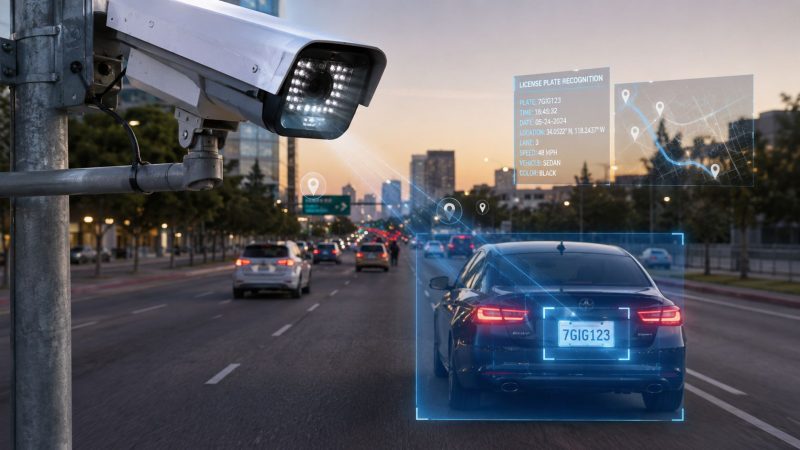
LPR Camera Systems: Your 2026 Guide
You're probably dealing with one of two situations right now. Either your team already has cameras and keeps asking why nobody can pull a usable plate when it matters, or you're being pitched a new LPR package that sounds flawless on paper and expensive in procurement.
Both situations usually come down to the same issue. A true LPR camera system isn't just another surveillance camera, and the glossy spec sheet rarely tells you how it will perform on your road, at your gate, in your lighting, with your traffic pattern. That gap is where money gets wasted.
For public safety agencies, security teams, and operations managers, the value of LPR is simple. It turns passing vehicles into searchable data, supports alerts, and shortens the time between an incident and a lead. But that only happens when the system is matched to the job. A driveway, a staff lot, a freight gate, and a high-speed roadway are not the same deployment.
The Critical Information Hiding in Plain Sight
A patrol unit gets a BOLO for a vehicle tied to a recent incident. Dispatch has a plate. Investigators have a rough direction of travel. What usually happens next is familiar. Officers canvass likely routes, someone starts pulling video from fixed cameras, and staff spend time reviewing footage that may show the car but not the plate.
A working LPR camera system changes that timeline. Instead of treating video as something you review later, the system converts the plate into searchable data in near real time. Industry guidance describes LPR as more than video capture. It's built to convert vehicle plates into searchable records quickly, often within milliseconds after a read, and modern systems can trigger actions such as gate opening or security alerts. The same guide notes that some commercial systems can read multiple plates in a single frame, though results still depend heavily on camera placement, resolution, and processing power. It also notes that some systems can usually discern usable plate data from 50 to 100 feet, and another reports accurate reading at speeds up to about 62 mph (100 km/h) under suitable conditions in this LPR camera overview.
That sounds impressive, and sometimes it is. But the hidden part is this: those capabilities only matter if your field conditions match the design assumptions.
What buyers miss first
A lot of teams buy on the word “camera” and think they're purchasing better video. They're not. They're buying a sensor, optics, illumination, and OCR workflow that must all line up correctly for one narrow task.
Practical rule: If your main goal is “identify every vehicle that matters,” ask for a deployment design first and a camera quote second.
A small police department might need one inbound lane at a municipal lot covered cleanly at night. A corporate campus might need vehicle audit trails at multiple gates. A public works yard might just need whitelist-based entry for staff vehicles. Those are different missions, and they should not all be solved with the same hardware bundle.
Where the savings usually are
The biggest savings rarely come from negotiating unit price. They come from not overbuying for speed, distance, or lane coverage you don't need.
Common examples:
- Slow gate traffic: A fixed-entry setup is often enough. You may not need highway-grade capture hardware.
- General investigation support: You may need strong overview imagery plus reliable plate capture, not every premium analytics add-on.
- One problem lane: You may solve the issue by relocating a camera instead of adding another server, another pole, or another software tier.
The teams that get value from LPR are usually the teams that define the mission tightly before they touch an RFP.
How an LPR System Reads a License Plate
An LPR camera system works because it performs a chain of tasks fast enough that the user sees one simple result: a plate read, a searchable record, or an alert. Under the hood, it's doing much more than recording video.

Capture starts with the right image
Step one is image capture. The system has to get a clean plate image at the moment the vehicle passes through the read zone. That's why professional LPR systems are distinct from CCTV. They typically use infrared illumination and high shutter speeds of 1/1000 second or faster to freeze a plate's image for OCR. Standard systems are effective at about 10–40 feet, while specialized units can read vehicles at much higher speeds, including up to 155 mph (250 km/h) in some deployments, as described in Verkada's LPR camera explanation.
That hardware difference is not a luxury feature. It's the foundation of the entire process.
A standard wide-angle security camera tries to show the whole scene. An LPR camera tries to show one thing well enough for machine reading. If the plate is too small in the frame, washed out by headlights, or blurred by motion, the process starts with a bad input and gets worse from there.
The software pipeline after capture
After the camera gets the frame, the software runs a sequence:
Plate localization
The system identifies where the plate is inside the image.Character segmentation
It separates the individual letters and numbers.OCR
It converts the visual plate image into machine-readable text.Data matching and action
The text can then be stored, searched, compared against lists, or used to trigger a workflow.
This is why plate reading fails upstream. The OCR engine doesn't rescue a plate image that was never captured clearly in the first place.
Good LPR starts with optics, lighting, and geometry. Software matters, but software can't restore detail that the camera never captured.
Why this matters to operations
For a chief or operations manager, the practical takeaway is simple. Don't evaluate LPR like a megapixel contest. Evaluate it like a controlled capture system.
Ask vendors to show:
- Your expected vehicle path: not a demo lane
- Your likely lighting conditions: especially night and headlight wash
- Your expected read distance: not their longest marketed distance
- Your operational workflow: how the read becomes an alert, gate action, or searchable record inside your stack
If your team is building broader automated response workflows, it also helps to understand how LPR data can feed operational tools such as AI-assisted incident workflows, rather than living in a stand-alone console that someone checks only after the fact.
Vendor Hype vs Real-World LPR Accuracy
The easiest way to overspend on an LPR camera system is to buy based on ideal-condition accuracy claims. Most sales material is built around controlled setups, clean plates, favorable lighting, and capture zones designed specifically for the demo.
Operations don't happen in a demo lane.

What field performance actually looks like
The most useful benchmark for buyers is operational accuracy. The U.S. National Institute of Justice notes that while vendors may claim high accuracy, operational deployments commonly achieve only 80–85% accuracy because of real-world conditions such as distance, contrast, and plate occlusions, according to this NIJ-referenced overview.
That gap matters because the missing reads aren't random. They usually happen during the exact moments your team cares about most. Night shifts, poor weather, off-angle approaches, dirty plates, custom frames, trailer hitches, and unusual vehicle movement all make the job harder.
A plate can also be partially visible to a human reviewer and still fail machine recognition. That's where many buyers get surprised. They see a vehicle on screen and assume the system should have read it.
Capture is not the same as recognition
Independent transportation research makes another critical distinction. A camera may capture a vehicle without successfully identifying the plate. In an evaluation on a studied I-95 segment, reported vehicle capture percentages were 26.0% and 33.4%, showing how sharply field performance can differ from ideal expectations on active highways in the Transportation Research Board and AASHTO evaluation report.
That's not a reason to dismiss LPR. It's a reason to match the tool to the mission.
Highway enforcement, arterial traffic monitoring, and open-road mobility analysis are much harder environments than a private entrance or controlled parking lot. If your use case is difficult, paying for premium hardware may be justified. If your use case is controlled, the same premium package may be wasteful.
Where misses usually come from
Missed reads often trace back to a short list of issues:
- Bad angle: The plate is visible, but the perspective distorts characters.
- Too much scene, too little plate: The camera sees the lane, but the plate doesn't occupy enough pixels.
- Lighting mismatch: Headlights, glare, or weak IR create bloom or washout.
- Motion blur: The shutter and target speed don't match.
- Occlusion: Frames, hitches, mud, and bumper accessories interfere with the read.
If a vendor talks mostly about software and barely discusses lane geometry, shutter behavior, and nighttime capture, you're hearing a marketing pitch, not a deployment plan.
A cost-benefit view that saves money
The right buying question isn't “What's the highest claimed accuracy?” It's “What level of accuracy is operationally useful for this lane, and what do I have to spend to get there?”
A practical framework:
| Environment | What usually matters most | Spending mistake to avoid |
|---|---|---|
| Controlled gate | Reliable reads and fast action | Buying speed capability you won't use |
| Parking lot | Searchable records and watchlists | Overinvesting in long-range optics |
| Residential street | Angle control and nighttime stability | Assuming a general CCTV pole is good enough |
| High-speed roadway | Tight geometry and purpose-built capture | Expecting private-site performance on open roads |
The cheapest bad decision is a camera that never reads well. The second most expensive bad decision is a premium system bought for conditions you don't have.
Actionable Use Cases for Security and Public Safety
The strongest LPR deployments are tied to a daily workflow. If the system only creates plate logs that no one checks, it becomes an archive. If it feeds dispatch, access control, investigations, or patrol operations, it becomes useful.
Patrol and investigations
A patrol team may already have city cameras, private partner footage, and body-worn evidence. What they often don't have is a fast way to answer one specific question: where has this vehicle been seen?
With LPR, a read can generate an alert or create a searchable trail. For a detective working a series case, that changes the first few hours of follow-up. Instead of manually scrubbing footage from multiple sites, the investigator can search plate data and narrow the timeline quickly.
This is especially useful when the vehicle isn't the main evidence yet. It may just be a lead vehicle, a possible witness vehicle, or a car seen near a scene.
Gate control and facility security
At a government yard, utility facility, logistics site, or private campus, the most immediate return usually comes from vehicle access automation. Staff vehicles can be allowed in without a guard checking each entry manually. Unauthorized or flagged vehicles can trigger alerts for review.
The operational gain isn't just convenience. It's consistency. Human gate checks vary by shift, weather, and workload. Plate-based entry creates a repeatable log and reduces the chance that a familiar-looking vehicle gets waved through without verification.
A useful reference for teams pairing vehicle identification with door, gate, and credential policy is SES Computers' access control guide. It helps frame where LPR fits and where badge, intercom, or gate hardware still does the heavy lifting.
Parking and compliance workflows
Parking teams often think of LPR as an enforcement tool. It can be that, but the bigger value is usually workflow simplification.
Examples include:
- Permit verification: Registered vehicles can be recognized automatically instead of relying on hangtags or manual lists.
- Search after an incident: Security can pull vehicle history by plate rather than reviewing broad scene video.
- Exception handling: A vehicle on a do-not-admit or enforcement list can trigger a notification before staff have to notice it visually.
Later in the operation, teams also get a cleaner audit trail for disputes. If someone claims they never entered the lot or were incorrectly flagged, the agency has a time-stamped record to review alongside video.
A short explainer helps show how this looks in practice:
Emergency and incident management support
In emergency operations, vehicle movement matters. An LPR point on a key route can help document who entered or exited a restricted area, which contractor vehicles reached a work zone, or determine if an expected support vehicle arrived.
The important point is not to turn LPR into an all-purpose intelligence answer. It works best when the question is specific and operational:
- Did this vehicle arrive?
- Has this flagged plate returned?
- Which of these vehicles entered during the incident window?
- Did a known support or contractor vehicle pass the checkpoint?
That kind of narrow use case is where agencies usually see value fastest.
How to Choose and Procure the Right LPR System
Procurement goes sideways when teams buy a platform before defining the lane conditions, vehicle behavior, and workflow outputs they need. A parking entrance with stop-and-go traffic should not be procured like a roadside enforcement location. The technical requirements, evidence needs, and maintenance burden are different.
Start with the mission, not the brochure
Before you compare vendors, answer these questions internally:
- What is the job? Investigation support, watchlist alerting, gate automation, parking enforcement, or mixed use.
- How do vehicles move? Stopped, slow, rolling, or high speed.
- What evidence do you need? Plate-only data, or plate plus vehicle context.
- Where will staff work from? A security desk, a dispatch center, patrol units, or a shared console.
- What system must it integrate with? VMS, access control, CAD-adjacent workflow, reporting, or exports.
If you don't settle those questions first, vendors will define the problem for you. That usually leads to feature bloat.
Why the dual-camera approach often earns its cost
A common deployment pattern for stronger evidence is a dual-camera architecture. In that setup, a color overview camera captures the broader vehicle and scene context, while a dedicated IR LPR camera captures the plate image for OCR. U.S. justice-sector guidance describes this pattern because it improves evidentiary usefulness and supports near-real-time watchlist checks in the NIJ system guidance document.
For many agencies, this is worth considering even when a lower-cost single-camera option is available. The reason is practical. Plate text alone may identify a vehicle, but the overview image often answers the follow-up questions that matter later: make, model, color, lane position, and surrounding scene.
That said, not every site needs it. A low-risk employee gate may not justify the extra hardware if the main goal is simple entry automation.
Buy the evidence package that fits the consequence of being wrong. Don't pay for courtroom-grade context at every low-risk gate.
Use a checklist that exposes hidden costs
The sticker price is only part of the buy. Software licensing, user tiers, storage, support contracts, and installation corrections can cost more over time than a seemingly cheaper camera package suggests.
Here's a practical evaluation table you can adapt for an RFP:
| Evaluation Criteria | Key Question | Cost Implication |
|---|---|---|
| Use case fit | Is this for gate control, investigations, or roadway capture? | Overbuying speed or analytics raises cost without adding value |
| Camera type | Is a dedicated IR LPR unit required, or is a simpler fixed entry design enough? | Purpose-built hardware costs more, but wrong hardware fails sooner |
| Evidence needs | Do you need a dual-camera setup with overview context? | Better evidence usually means more hardware and storage |
| Processing model | Does processing happen on camera, on server, or in a managed platform? | Server and management overhead can outlast procurement savings |
| Integration | Will it connect cleanly to your existing systems? | Poor integration adds labor and may require extra middleware |
| Alert workflow | Who receives alerts, and where? | If alerts live in a separate console, staff time becomes the hidden cost |
| Maintenance burden | Who handles cleaning, calibration, and software updates? | Deferred upkeep lowers performance and increases support calls |
| Data governance | Can retention and access be managed clearly? | Weak policy controls can create legal and administrative cost |
Fixed, mobile, and mixed deployments
A fixed camera at a known lane is usually the most straightforward procurement. Mobile or vehicle-mounted systems can be effective, but they demand tighter operational discipline and a clear use policy. Mixed deployments can work well, but only if the agency understands what each layer is for.
A practical buying mistake is trying to make one system do every job. A gate solution should solve the gate problem well. A roadway solution should solve the roadway problem well. Combining them into one “universal” spec often increases cost while diluting performance.
Integration should reduce labor
If your team has to check a separate dashboard every day, the system will be underused. Procurement should favor workflows that reduce manual review, not create another screen.
That applies beyond the camera itself. Data handoff, alerts, audit trails, and evidence exports should all be part of the buying decision. If you're pairing LPR with broader site access policy, gate controls, and identity checks, architecture matters as much as optics.
Deployment and Integration Best Practices
A bad installation can make good hardware look useless. Most disappointing LPR projects aren't caused by the OCR engine. They're caused by placement, angle, lighting, and unrealistic expectations about what one camera can cover.

Geometry decides whether the read happens
Practitioner guidance consistently points to installation geometry as the make-or-break issue. General rules often suggest keeping camera angles under about 25–30°, while high-speed capture may require tighter angles closer to 15°. The same guidance notes that small changes in mounting position can determine whether nighttime capture succeeds or fails in this practitioner deployment discussion.
That's the kind of detail that saves money. If a site can't support the necessary angle, adding more analytics won't fix it. You may need a different mounting point, a dedicated pole, or a different lane strategy.
Placement rules that usually hold up
For most deployments, these rules are useful:
- Keep the target lane controlled: The more predictable the vehicle path, the better the read consistency.
- Minimize angle to plate: If the vehicle approaches at too steep an angle, characters distort and reflect poorly.
- Design for night first: Daytime success can hide nighttime failure.
- Limit the read zone: One strong lane is better than several compromised lanes.
- Test with real vehicles: Use the kinds of vehicles your site sees, including trucks, trailers, and dirty plates.
A relocation of a few feet can matter more than a software upgrade. Field-test positions before finalizing conduit and mounts.
Integration flow matters too
The camera read is only the first event. After that, the data has to move into a system people put to use.
A typical operational flow looks like this:
- The LPR camera captures the plate
- OCR produces the machine-readable plate record
- The system compares it against local rules or watchlists
- An event is created, stored, and optionally alerts users
- Staff review the event in the platform they already monitor
That last step is where many projects underperform. If a read generates useful data but doesn't land where dispatchers, security supervisors, or field personnel already work, response slows down.
For mobile teams and field operations, it's often valuable to think through how vehicle events align with location-aware fleet or field tracking tools such as AVL unit workflows. The point isn't to merge every dataset blindly. It's to make sure location and vehicle events support one another operationally.
What doesn't work well
Some deployment choices repeatedly cause trouble:
- Using a PTZ as the primary LPR camera: If it moves, your read zone moves.
- Trying to cover too wide an area: Broad coverage usually means plates don't get enough detail.
- Mounting for convenience instead of geometry: Existing poles are not always good poles.
- Skipping nighttime acceptance testing: That's where weak installs usually show up first.
A successful deployment is usually boring. The lane is controlled, the plate fills the target area correctly, the night image is stable, and the alert goes where staff already work.
Managing Privacy Legal and Maintenance Demands
Owning an LPR camera system is not just a technical decision. It's a policy commitment. The same qualities that make plate data operationally useful also make it sensitive. Agencies and private operators need to decide early who can access the data, what purpose is allowed, how long records are kept, and how access is audited.
Privacy and policy have to be explicit
A weak retention policy creates two problems at once. It increases legal exposure and makes internal use inconsistent. Staff need written guidance that covers permitted use, prohibited use, retention periods, disclosure rules, and supervisory review.
At minimum, the policy should answer:
- Who can search the data
- Why they can search it
- How access is logged
- When records are deleted
- How outside requests are handled
- What training users must complete
For agencies building or revising governance language, it's also smart to review broader data handling and security thinking from adjacent regulated environments. A practical example is managing IT risks in law firms, where access control, client confidentiality, and audit discipline overlap with many of the same governance habits LPR programs need.
Maintenance is part of accuracy
Even a well-installed system drifts if no one owns upkeep. Lenses get dirty. Weather seals age. Watchlists become stale. Firmware and software updates lag. Then the team blames the camera when the actual problem is neglected maintenance.
A simple maintenance checklist usually includes:
- Clean optics regularly: Dirt, water spots, and residue hurt plate contrast quickly.
- Inspect mounts and housings: Vibration and weather can change alignment over time.
- Review night capture samples: Don't rely on daytime checks alone.
- Validate watchlists and rules: Bad list hygiene creates bad alerts.
- Confirm audit logging: Make sure access review works before a complaint or legal request forces the issue.
The legal risk and the performance risk are connected. If you can't show who accessed plate data and can't show the system was maintained, you'll struggle on both fronts.
Access control and audit trails
The best governance model is usually the simplest one staff can follow consistently. Give role-based access only to users who need it. Log every search. Review exceptions. Document who approved the deployment and what mission it serves.
Public-facing transparency also helps. If your organization can explain in plain language what is collected, why it's collected, and how long it is retained, trust is easier to maintain. For teams evaluating platform-level data handling and privacy expectations, it's useful to review Resgrid's privacy information as one example of how operational software providers present governance and data responsibility.
An LPR program lasts longer when policy, maintenance, and operations are treated as one system instead of three separate jobs.
If your agency or organization needs a practical platform for dispatching, messaging, tracking, and operational coordination around incidents and field activity, Resgrid, LLC is worth a look. It gives first responders, dispatch centers, security teams, and businesses a flexible way to manage personnel, events, communications, and reporting without the heavy implementation burden that often slows public safety technology projects.