
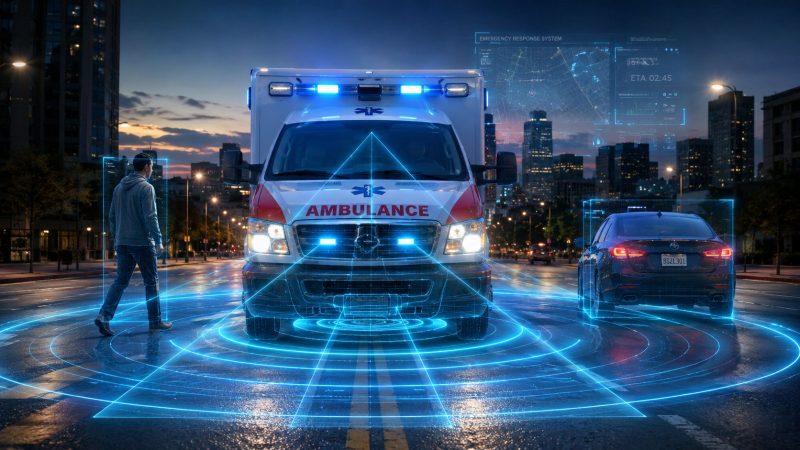
Collision Avoidance System: Fleet Safety Guide
A unit is running hot to a call. The driver clears one green light, approaches the next intersection, and a civilian vehicle edges forward anyway. Nobody intends to crash. But intent doesn't matter when the closing speed is high, sightlines are poor, and the cab is already overloaded with radio traffic, sirens, navigation, and stress.
That's why a collision avoidance system matters in fleet operations. For a fire chief, EMS supervisor, or public safety operations manager, this isn't about buying another driver-assist feature because a brochure says it's modern. It's about preventing the repair bill, the out-of-service apparatus, the overtime shuffle, the insurance fight, and the legal review that follow even a low-speed impact.
The mistake many agencies make is treating collision avoidance as something that lives only inside the vehicle. That leaves money on the table. The bigger win comes when alert data reaches dispatch fast enough for human intervention, route changes, and better after-action coaching.
Why Every Second Counts for Your Fleet
An ambulance doesn't need a major wreck to create a major problem. A clipped bumper at an intersection can still pull the unit from service, force a backup response, delay patient transport, and trigger a paper trail that eats command time for days.

In emergency fleets, the costs stack up fast. You're dealing with vehicle downtime, rushed substitutions, bodywork, calibration after repair, and the possibility that the public sees the incident before your own internal review is complete. A collision avoidance system gives your driver one more layer of protection when the road gets chaotic.
The safety value is measurable. A detailed review of crash data found that forward collision warning combined with automatic emergency braking reduced rear-end striking crashes by 50% according to the U.S. DOT ITS knowledge resource summary. That matters because rear-end impacts are one of the most common ways a busy shift turns into a maintenance and liability event.
What this looks like on a real shift
Think about a ladder truck moving through urban traffic at dusk. Cars are braking late. Pedestrians are stepping off curbs. The driver is scanning mirrors, listening to radio traffic, and managing vehicle position through a narrow corridor. A good system can warn first, then help brake if the hazard closes too quickly.
That doesn't replace training. It does buy time.
Practical rule: If your fleet operates in dense intersections, school zones, hospital approaches, or highway merges, treat collision avoidance as an operational control, not an optional trim package.
Why this is also a workflow issue
Many agencies already understand route planning and dispatch efficiency, but they separate that work from vehicle safety technology. They shouldn't. The same command discipline that improves dispatch performance should shape how you handle risk alerts from the vehicle. If your team is reviewing workflows already, Routelink's guide to delivery processes is a useful outside example of how process design affects field performance, handoffs, and avoidable waste.
A crash avoided is more than a safety win. It protects service continuity. It keeps your best units available. It prevents avoidable maintenance and preserves response capacity for the next call, not just the current one.
How a Collision Avoidance System Works
A collision avoidance system is easiest to understand as a sense, decide, act loop. The vehicle keeps watching the road, calculates whether a threat is developing, and then responds in stages if the driver doesn't.
Sense
The first job is perception. The system uses sensors such as radar, cameras, and sometimes lidar to track nearby vehicles, lane position, obstacles, and motion. In practice, this is your digital co-pilot. It doesn't get fatigued, and it doesn't stop scanning because the radio traffic gets busy.
For fleet leaders, the practical question isn't whether the sensors exist. It's whether they still perform well in the exact environments your drivers face. Night operations, wet pavement, reflections from emergency lighting, and heavy vehicle stopping distances all affect how useful the warning will be.
Decide
Once the vehicle sees the environment, the software estimates risk. It compares your speed, the closing rate, and the position of the object ahead. Then it decides whether the situation is normal, cautionary, or urgent.
Superior systems differentiate themselves from inferior ones. A poor setup nags the driver with unnecessary alerts. A better one stays quiet until the risk is meaningful. If your drivers stop trusting the warnings, the hardware may still be installed, but the safety value is already fading.
A collision alert that goes off too often becomes dashboard wallpaper.
Act
Most automotive systems follow a two-step intervention path. UN ECE Regulation 131 requires detection of a potential forward collision and warning behavior before braking intervention, and UN ECE Regulation 152 allows deceleration up to 5 m/s² for these responses, as summarized in the collision avoidance system regulatory overview.
That means the sequence usually looks like this:
- Monitor the threat: The system tracks the object and your approach speed.
- Warn the driver: Audible, visual, or haptic alerts tell the driver to react.
- Intervene if needed: If there's no adequate response, the system applies emergency braking and, in some designs, supports steering-related avoidance logic.
What works and what doesn't
A system works well when it fits the vehicle mission.
| Fleet situation | What tends to work | What tends to fail |
|---|---|---|
| Urban EMS response | Fast forward hazard detection and clean alerts | Excessive false positives in tight traffic |
| Heavy apparatus on arterial roads | Early warning thresholds and driver familiarity | Overreliance on braking alone |
| Mixed fleet with multiple body types | Standardized policy and alert review | Different systems with no common training plan |
Braking-only intervention is useful, especially at lower speeds. But no chief should assume automation can overcome the physics of a heavy rescue truck loaded with equipment on wet pavement. The system is an aid. It's not a waiver from reality.
Understanding the System's Eyes and Ears
Not all sensor packages are equal. If you're evaluating a collision avoidance system for emergency or commercial fleets, you need to know what each sensor does well, where it struggles, and why the best-performing setups usually combine several technologies.

Radar in bad weather
Radar remains the workhorse for many vehicle safety systems. It's strong at measuring distance and relative speed, and it keeps working when the weather turns ugly. That matters for fleets that don't get to choose their conditions.
From a market perspective, radar's position reflects that practical value. The global collision avoidance system market was valued at USD 61.3 billion in 2023, and radar accounted for about 38% of the share, supported by reliable operation in poor weather and detection ranges up to 250 meters, according to GM Insights' collision avoidance system market analysis.
For a fire chief, that translates into one simple point. If your fleet runs in rain, mist, smoke, or nighttime glare, radar deserves serious weight in the buying decision.
Cameras for context
Cameras add detail that radar alone can't provide. They help the system recognize lane markings, vehicles, traffic signs, and vulnerable road users. They're often the difference between a generic object warning and a more context-aware response.
But cameras have their own failure points:
- Glare exposure: Low sun, headlights, and reflective surfaces can reduce reliability.
- Lens contamination: Dirt, salt, and bug buildup can degrade performance.
- Low-light limits: Some scenes are harder to classify at night.
Fleet maintenance policy matters significantly. A camera-based system is only as good as the windshield area and sensor housing that your crews keep clean.
Lidar and ultrasonic in narrower roles
Lidar can build a precise 3D view of surroundings, which is useful for object detection and spatial accuracy. In fleet terms, it's attractive when you need better shape recognition and richer environmental mapping. The trade-off is that not every fleet can justify the added complexity or cost, especially if the mission is mostly road response rather than advanced autonomy.
Ultrasonic sensors are the close-range specialists. They're helpful for parking, backing, and very tight maneuvering around stations, loading bays, and apparatus aprons. They're not your primary highway collision tool, but they can still prevent the sort of low-speed body damage that drains maintenance budgets.
If a vendor pitches one sensor as the answer to every driving condition, keep asking questions.
Why sensor fusion wins
The best setup isn't radar versus camera versus lidar. It's sensor fusion. One technology covers another's weak spots. Radar reads distance and speed well. Cameras add visual context. Ultrasonic helps in tight spaces. Lidar can sharpen spatial awareness where the use case supports it.
This is the same design logic used in other monitoring environments. If you've looked at integrating smart building solutions, the pattern is familiar. No single sensor tells the whole operational story. Different inputs become useful when they're combined intelligently.
For dispatch-driven fleets, this sensor data becomes more valuable when it's tied to location. A mapping layer helps teams understand where alerts cluster, which intersections keep generating warnings, and which approaches deserve route changes or driver briefings. That's where tools for incident and fleet mapping become operationally important, because location context turns a raw alert into something command staff can act on.
A practical buying lens
Use this quick comparison during procurement:
| Sensor type | Best use in fleet safety | Main limitation |
|---|---|---|
| Radar | Forward detection, speed and distance tracking, poor weather response | Less visual detail |
| Cameras | Lane recognition, object classification, traffic context | Sensitive to glare, dirt, and darkness |
| Lidar | Rich spatial mapping and object definition | More complex and mission-dependent |
| Ultrasonic | Close-range maneuvering and parking alerts | Very short range |
A well-chosen collision avoidance system doesn't chase every specification on the brochure. It matches the sensor mix to your routes, vehicle sizes, weather, and driver workload.
Integrate CAS Data into Your Dispatch Workflow
Most fleets stop too early. They install the hardware, train the driver to respond to alerts, and consider the job done. That's better than doing nothing, but it misses the highest-value move: putting collision avoidance data in front of dispatch while the event is still developing.

Passive safety versus operational control
In-vehicle alerts are passive from the command center's point of view. The unit gets the warning. The driver reacts or doesn't. Dispatch often learns about the near miss later, if at all.
That model is too limited for first responders.
Current collision avoidance coverage often misses the human-in-the-loop protocol that matters in real operations. In practice, a dispatcher's ability to see a time-to-collision style alert and intervene can be more valuable than the vehicle's automatic brake in the final moments before an incident, especially when the hazard involves route congestion, cross traffic, or another responding unit.
What a better workflow looks like
A smarter setup moves alert data out of the vehicle and into the command process. That doesn't mean dispatchers micromanage every hard brake. It means they get actionable visibility when risk spikes.
Consider this operating pattern:
- Vehicle detects an escalating hazard: The onboard system registers a severe forward threat or repeated near-miss behavior.
- Platform receives the event: Telematics passes the alert to a central dashboard.
- Dispatcher sees context, not just noise: Unit ID, location, route, and recent alert history appear together.
- Command takes action: Dispatcher reroutes another unit, warns the driver about a blocked approach, or changes the response path.
- Supervisors use the record later: Training staff review whether the issue was driver behavior, route design, or a signal-control problem.
That's where real savings show up. If you prevent one avoidable impact, you're not just avoiding repair. You're preserving fleet availability, reducing claim exposure, and protecting the shift from cascading disruption.
Field advice: If an alert can't change a decision, it's just a log entry. Build your workflow so alerts trigger a human action, not just a historical report.
Practical examples from fleet operations
A few common scenarios show why dispatch integration matters:
- Blind intersection approach: An ambulance gets a critical hazard alert approaching a congested crossing. Dispatch sees the location and tells a trailing unit to hold back, reducing cross-unit compression into the same choke point.
- Hospital bay congestion: Repeated close-range warnings near a receiving entrance reveal a design problem, not a driver problem. Operations changes the approach pattern instead of blaming crews.
- Recurring route risk: A certain arterial road generates repeated severe alerts during shift change. Dispatch changes standard routing for that time window.
- Driver coaching with evidence: A supervisor reviews near-miss patterns after the shift and coaches a driver using event context rather than vague complaints.
None of this works if the alert stays trapped in the cab.
The minimum data you need
If you want this to work, ask for these feeds from your telematics or vehicle data provider:
- Event severity: Not every warning deserves dispatch interruption.
- Location and heading: Context determines whether the event is meaningful.
- Timestamp accuracy: You need to match the alert to radio traffic, route stage, and other units nearby.
- Vehicle identity: Dispatch must know which unit is involved immediately.
- Driver-accessible acknowledgement: Useful for understanding whether the operator saw and responded to the warning.
A live vehicle view also matters. When a command center can monitor the position and movement of units through automatic vehicle location tools, safety alerts become much more actionable. An isolated warning says, “something happened.” A location-aware workflow says, “this happened at this intersection, during this approach, with these nearby units.”
What usually fails
Three implementation mistakes come up repeatedly.
First, agencies buy a collision avoidance system without data access. They get the dashboard icon in the cab but no usable event stream outside the vehicle.
Second, they dump every alert into dispatch. That creates alarm fatigue at the console, which is just as dangerous as alarm fatigue in the cab.
Third, they never define who acts. If dispatch receives a high-risk alert, does the dispatcher advise the driver, reroute support units, notify command, or log it? If nobody owns the decision, the system won't change outcomes.
The practical standard is simple. Route the right alerts to the right people with a defined playbook. That's how a collision avoidance system stops being a passive accessory and becomes an operational control.
An Implementation Checklist for Your Fleet
Procurement goes wrong when agencies buy based on the feature sheet instead of the mission. A collision avoidance system for a municipal sedan isn't automatically the right fit for a loaded ambulance, a pumper, or a private fleet truck with variable routes and mixed driver experience.

Start with vehicle reality
Before you compare vendors, define where your current risk lives.
Ask questions like:
- Which units face the most dense urban driving
- Which routes produce the most hard braking, backing stress, or intersection exposure
- Which drivers operate the heaviest or tallest vehicles
- Which units can't afford downtime because there's no easy spare
A fire apparatus with long stopping distances has different needs than a supervisor SUV. Don't buy one policy for two different physics problems.
Vendor questions that matter
A strong procurement conversation should sound operational, not marketing-driven. Ask the vendor these directly:
What data can we access outside the vehicle?
If the answer is limited to in-cab alerts, your command center won't get much value.Can the event data feed our dispatch or telematics environment?
You need a path from detection to action.How does the system behave on heavier vehicles?
Warning timing and intervention feel matter more when the vehicle carries weight.What happens after body repair or windshield replacement?
Sensor calibration can become a hidden maintenance burden if nobody plans for it.Can thresholds be configured by vehicle type or mission?
A rescue truck and an urban courier van shouldn't always share the same logic.
Build policy before rollout
Technology without policy creates confusion. Write the operating rules before the first full deployment.
Your policy should answer:
- Driver expectations: Which alerts require immediate driver response?
- Dispatcher authority: When can dispatch advise a route change or speed reduction?
- Supervisor review: Which events trigger coaching, retraining, or maintenance inspection?
- Maintenance accountability: Who checks sensor cleanliness, alignment, and post-repair calibration?
- Documentation: Where are alerts stored, and who can access them during incident review?
A collision avoidance system can reduce risk. It can't defend a weak policy after a crash.
Don't ignore liability
Overconfidence can affect many fleets. UN regulations may mandate automated braking, but they do not remove a commercial fleet manager's duty of care liability. Agencies are still exposed if system latency isn't sufficient for the vehicle's operating conditions or if actionable warnings are ignored.
That means leaders need to think beyond “Do we have the feature?” and ask “Can we prove we implemented, trained, monitored, and responded appropriately?”
A practical liability posture includes:
| Risk area | Better practice |
|---|---|
| Ignored alerts | Define review thresholds and document supervisory follow-up |
| Heavy vehicle limits | Match settings and procurement choices to actual vehicle dynamics |
| Sensor impairment | Add pre-trip and post-wash sensor checks |
| Post-repair drift | Require calibration verification after relevant repairs |
| Dispatcher uncertainty | Write a clear human-in-the-loop response procedure |
Roll out in phases
A phased rollout saves money because it catches bad assumptions early.
Try this sequence:
- Pilot high-risk units first: Start with the vehicles that see the most urban exposure or highest replacement cost.
- Review events weekly: Look for nuisance alerts, route-specific patterns, and maintenance issues.
- Adjust SOPs before expansion: Fix policy gaps before adding more vehicles.
- Train supervisors, not just drivers: Command staff need to interpret data consistently.
- Scale only after data quality improves: More vehicles won't help if your event stream is messy.
Where fleets usually overspend
The expensive mistakes aren't always in the purchase order.
They show up later through poor integration, excess nuisance alerts, retraining after bad rollout, and repair cycles that ignore recalibration. The cheapest path is usually not the lowest initial hardware price. It's the deployment that avoids false confidence and builds a process your crews can use.
For many fleets, the best cost-saving move is simple: buy the system you can operationalize, not the one with the longest feature list.
The Future of Connected Emergency Vehicles
The next step for the collision avoidance system isn't just better braking. It's better coordination.
As vehicles become more connected, the primary advantage will come from combining onboard sensing, live dispatch visibility, and predictive analysis. Instead of waiting for the vehicle to warn at the last moment, agencies will increasingly want systems that identify recurring risk before the same dangerous approach happens again.
From reactive alerts to predictive operations
A mature safety program doesn't just ask, “Did the vehicle intervene?” It asks, “Why do our units keep getting into this situation?”
That's where AI-driven analysis starts to matter. If your system can flag repeated near misses by location, shift window, route type, or unit class, command staff can change traffic approach policies, adjust dispatch patterns, or target coaching where it's needed most. Tools that support AI-assisted operational analysis fit this direction because they help teams find patterns that human review can miss when calls are stacked and reports are delayed.
Connected roads and connected units
Emergency response will also benefit from broader communication between vehicles, infrastructure, and surrounding traffic. In practical terms, that means a future where signals, nearby vehicles, and dispatch systems share more situational data, reducing the chance that a unit enters a conflict blind.
The underlying principle already shows up in other domains. In airborne collision avoidance, ACAS X reduces mid-air collision risk by 59% and unnecessary disruptive alerts by 25% compared with TCAS II, according to MIT Lincoln Laboratory's ACAS X overview. The lesson for ground fleets is straightforward. Better collision avoidance isn't only about sensing more. It's about making better decisions while avoiding alert fatigue.
The future system won't just say “brake.” It will help the whole operation avoid being in the wrong place at the wrong time.
Departments that invest wisely now should think beyond the vehicle purchase. The strongest position is a fleet where safety data supports dispatch, training, maintenance, and command decisions together.
Resgrid, LLC helps first responders, dispatch centers, and public safety teams bring dispatching, tracking, messaging, and operational coordination into one platform. If you want a practical way to connect vehicle activity, team communication, and incident management without adding unnecessary implementation burden, explore Resgrid, LLC.