
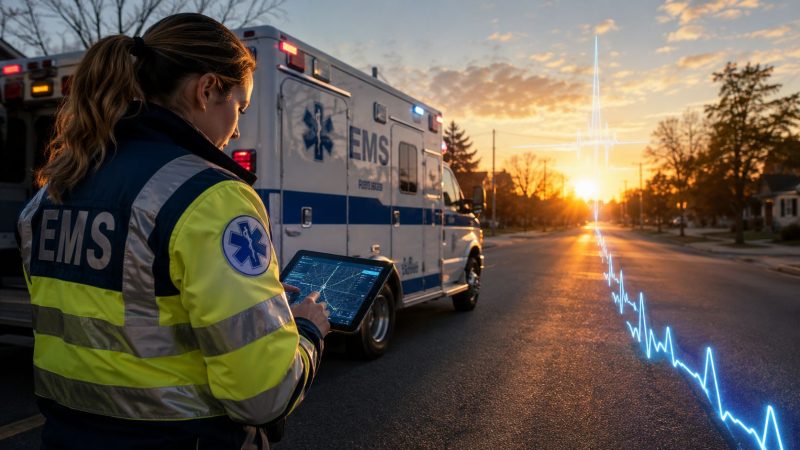
Optimize First Response EMS: Strategies for 2026
Your radio traffic is stacking up, one volunteer crew is still driving in from work, and the closest transport unit is already tied up at the hospital. Then a chest pain call drops on the edge of your district, followed by a rollover on the highway. That's where most department chiefs live now. Not in theory, but in constant trade-offs.
First response EMS only looks simple from the outside. A call comes in, somebody goes, care starts. In practice, it's a chain of decisions about people, time, equipment, training, and money. If any link is weak, the whole response slows down. For departments that depend on volunteers or thin staffing, the difference between a workable system and a failing one usually comes down to whether operations are built for practical conditions instead of the org chart.
The hard truth is that faster care and lower cost often come from the same fixes. Better crew visibility cuts callback delays. Clear role separation prevents over-dispatch. Smarter routing saves fuel, overtime, and response minutes at the same time. If you're trying to stretch a tight budget without letting care standards slip, first response EMS has to be managed as both a clinical function and a resource discipline.
What Is First Response EMS
A 911 call comes in for an unresponsive adult at home. The nearest ambulance is finishing another call. A firefighter with medical training is three minutes away, carrying an AED and basic airway gear. That firefighter is the first response system in action.
First response EMS is the part of emergency care that bridges the gap between the call for help and the arrival of full ambulance-based treatment and transport. In some places, that first unit is fire-based. In others, it's law enforcement, a dedicated medical first response vehicle, or a mixed volunteer crew. The label matters less than the function. Get there fast, identify the immediate threat, and keep the patient alive long enough for the next layer of care to take over.

Why the first few minutes matter
This isn't academic. Every minute without cardiopulmonary resuscitation (CPR) and automated external defibrillation (AED) reduces survival chances after cardiac arrest by about 10 percent. In 2021, survival to hospital discharge after EMS-treated non-traumatic out-of-hospital cardiac arrest in the U.S. was only 9 to 10 percent, based on the data summarized in this cardiac arrest review.
That means the first arriving unit doesn't just “hold the scene” for the ambulance. It changes outcomes through immediate action. Starting CPR, placing an AED, controlling major bleeding, opening an airway, or relaying a sharper patient report to incoming crews can determine whether the rest of the response is recovery or resuscitation.
Practical rule: If your first arriving unit can't reliably deliver the first lifesaving intervention within minutes, you don't have a first response system. You have a notification system.
What first response looks like in the field
On a multi-story apartment call, first responders may reach the patient before the stretcher team can even get through the building. On a rural road, they may be the only hands on scene for a meaningful stretch of time. At a public event, they may sort out minor cases early so transport units stay available for true emergencies.
That's why first response EMS should be designed around speed, stabilization, and coordination. Not every unit needs transport capability. Not every unit needs the same equipment load. But every first-response resource needs a defined mission, a narrow high-value skill set, and a dispatch process that sends it where it creates the most benefit.
Understanding Key Roles and Responsibilities
One of the fastest ways to waste money in EMS is to blur roles. Chiefs see this all the time. A first responder gets dispatched to calls that need transport resources. A paramedic truck gets tied up on low-acuity scenes because nobody defined who should handle what. Or a volunteer fire unit arrives first but doesn't know whether it's expected to start treatment, secure the scene, or update dispatch.
The difference that matters operationally
A first responder is usually a public safety professional who can deliver immediate, limited medical aid before an ambulance clinician arrives. That may include CPR, AED use, hemorrhage control, basic airway support, scene size-up, and relaying patient status.
An EMS clinician is the provider responsible for structured patient assessment, continued medical intervention, and usually transport-level care. Depending on local scope and staffing, that's your EMT or paramedic layer.
The distinction matters because staffing models are not interchangeable. In the United States, there are roughly 260,000 to 270,000 employed EMTs and paramedics, while about 69 percent of U.S. firefighters are volunteers, according to the workforce summary published at WiFiTalents first responder statistics. If your first response system depends heavily on volunteer fire coverage, your scheduling, turnout expectations, and dispatch design have to reflect that reality.
First Responder vs. EMS Clinician at a Glance
| Attribute | First Responder (e.g., Police, Firefighter) | EMS Clinician (e.g., EMT, Paramedic) |
|---|---|---|
| Primary mission | Reach the patient quickly and stabilize immediate threats | Assess, treat, monitor, and manage care through transport or handoff |
| Typical arrival role | Scene size-up, CPR, AED, bleeding control, basic support | Full patient workup, ongoing intervention, transport decisions |
| Staffing pattern | Often mixed career, paid-on-call, or volunteer | More commonly scheduled clinical staffing |
| Deployment value | Fills the gap when transport units are distant or committed | Provides definitive prehospital care within local scope |
| Cost risk if misused | Over-dispatch creates burnout and unnecessary apparatus movement | Sending advanced units to low-value tasks reduces system coverage |
Where chiefs get into trouble
The common mistake is assuming all medically trained personnel should be dispatched the same way. They shouldn't.
A practical staffing model usually works better when you separate decisions like these:
- Who must arrive first: The unit most likely to start time-critical care.
- Who must transport: The crew with the right vehicle, equipment, and clinical authority.
- Who can be held in reserve: The resource that adds less value on low-acuity scenes.
A clean personnel system helps here. If you can see certifications, availability, and assignment status in one place, role-based dispatch gets much easier. That's the operational advantage of tools built around personnel management for response organizations.
If everyone can do everything on paper, dispatchers and supervisors end up guessing. Guessing gets expensive.
A simple working example
Say you have a volunteer engine company, one transporting ambulance, and a neighboring medic unit on automatic aid. For a possible cardiac arrest, dispatch all three because the first intervention matters more than transport timing. For a lift assist with no injury, don't burn the ambulance if the fire crew can safely handle it under policy. For a hazardous scene with uncertain access, let fire secure and assess before committing scarce transport resources.
That's what efficient first response EMS looks like. Not maximum dispatch, but correct dispatch.
The Essential First Response Toolkit
The first response kit isn't a miniature ambulance. It's a time-buying package. Consider a pit crew setup in racing. You don't bring the whole garage to the trackside. You bring the tools that fix the failure most likely to end the race immediately.

What belongs in a first response loadout
A useful first response kit focuses on interventions that change the patient's condition in the first minutes:
- AED access: If your unit gets there first on a collapse, this is the tool that matters most.
- Bleeding control supplies: Tourniquets, pressure dressings, gauze, and trauma shears solve a common life threat quickly.
- Basic airway support: Simple adjuncts, barrier devices, and oxygen delivery tools help stabilize breathing problems before advanced care arrives.
- PPE and scene safety gear: Gloves, eye protection, and high-visibility gear keep the responder from becoming the next patient.
- Reliable communications: A radio that works every time is as important as any medical item in the bag.
If you're standardizing equipment across mixed crews, it also helps to use simple checklists and sealed modules. That reduces restock confusion and cuts the hidden cost of duplicate or expired gear.
How the toolkit gets used on scene
Take a multi-car pileup. The first-arriving non-transport unit shouldn't try to run the whole incident from the jump. It should do four things fast:
- Identify hazards and access. Fuel, traffic, unstable vehicles, weather, and patient count come first.
- Triage immediate threats. Who needs airway support now, who's bleeding badly, who can wait.
- Apply high-impact interventions. Tourniquet, AED, oxygen, positioning, basic airway support.
- Feed dispatch clean updates. Number of patients, access point, resource needs, and whether incoming units should stage or enter.
That sequence saves both lives and money. It prevents overcommitting specialized resources too early while making sure the most urgent needs are addressed before conditions get worse.
Where agencies overspend
Departments often waste money by buying broad kits for every vehicle instead of role-based kits for specific response functions. A command SUV, a police unit, and a first-in engine don't need identical medical inventories.
One practical approach is to define three levels of response cache: everyday first response, trauma-heavy events, and extended rural holdover. For agencies reviewing replacement stock or building volunteer bags, curated emergency preparedness essentials can be a useful benchmark for what should be present before you add specialized items.
The cheapest bag is the one responders can find, open, and use correctly in the dark.
Navigating Dispatch Workflows and Metrics
Most response problems don't start on the road. They start in the workflow before the wheels move.
An emergency call enters the system, details are gathered, the call is prioritized, a unit is assigned, the crew acknowledges, and only then does travel begin. If you want a better first response EMS operation, break that chain apart and measure where time is being lost.

The metrics worth tracking
Chiefs don't need more dashboards. They need a handful of metrics that identify whether the delay is in dispatch, turnout, or travel.
A practical set includes:
- Call receipt to dispatch: How long it takes the center to gather enough information to assign a resource.
- Dispatch to en route: A turnout measure. This shows whether crews are available and moving.
- En route to arrival: Travel time. Road network, routing, traffic, and unit placement all show up here.
- Arrival to patient contact: A hidden delay in apartments, gated sites, industrial campuses, and large events.
- Scene time by call type: Useful for finding handoff and packaging bottlenecks.
Common bottlenecks that chiefs can actually fix
Traffic gets blamed for everything, but many expensive delays are self-inflicted.
Three examples show up repeatedly:
- Poor unit posting: The “assigned zone” model fails when call volume shifts but units stay parked where the map says they belong.
- Bad location data: Incomplete addresses, unclear access notes, and no landmark data force crews to hunt.
- Volunteer turnout uncertainty: Dispatch sends the nominal first-due unit, but another available crew would have moved sooner.
Telematics helps because it turns assumptions into timestamps. Connected vehicle data can capture GPS location, route history, speed patterns, and the exact transitions between dispatch, en route, arrival, and scene time. Integrated with mapping tools, it supports dynamic rerouting when congestion appears. In several urban deployments, pairing telematics with GIS and traffic-flow APIs has reduced average en-route delays by single-digit percentage points, as described in this EMS1 review of connected vehicle technology.
Practical fixes that save money
You don't need a huge rebuild to improve this workflow. Start with targeted changes:
- Tighten address intake: Add local business names, gate codes, apartment access notes, and mile-marker conventions into dispatch scripts.
- Review turnout by unit type: If one station consistently acknowledges slower, adjust who gets hit first on overlapping calls.
- Use route intelligence: If your communications stack is dated, even looking at how small business call centre software handles call flow and queue visibility can help frame what your dispatch side is missing.
- Track the right handoff points: A modern dispatching workflow platform should let you see status changes cleanly enough to compare assigned unit plans against what happened in the field.
Dispatch data should answer one question quickly: where did the minute go?
Training Certification and Cost Management
Training gets cut first in stressed budgets because it looks discretionary on paper. In operations, it's usually the opposite. The right training reduces callback dependency, prevents unnecessary specialty responses, and makes lower-cost units more useful on scene.
Train for the calls you actually hold
A lot of agencies spread training hours too thin across interesting topics instead of building depth in the incidents that repeatedly strain the system. For first response EMS, the practical target is competence in the first interventions that keep a patient stable before transport arrives, plus the scene safety skills that prevent escalation.
That doesn't mean every member needs every certification. It means the agency should deliberately match training spend to recurring operational gaps. If your crews regularly arrive at vehicle crashes before transport. Train harder on hemorrhage control, triage, and scene coordination. If rural hold times are common. Invest in prolonged basic care and communications discipline.
The OSHA example chiefs should use
Here's a concrete case where training directly supports cost control. OSHA requires EMS personnel who may encounter hazardous materials to be trained to at least the first responder operations level, with a minimum of 8 hours of training, under the interpretation summarized by OSHA's first responder operations guidance.
That matters operationally because having internal personnel who meet that standard can reduce the need to call in an external hazmat team for lower-risk incidents. That lowers response cost and overtime exposure while keeping patient contact from being delayed by uncertainty.
Where the savings show up
A chief looking at training through a cost lens should look for savings in three places:
- Fewer specialty callouts: Internal capability covers lower-complexity events without waiting for another agency.
- Better scene sorting: Trained first-arriving personnel identify what needs escalation and what doesn't.
- Less avoidable overtime: Fewer unnecessary callbacks and cleaner scene management reduce extended incident durations.
Training is cheaper than confusion. Confusion burns apparatus time, outside resources, and overtime in the same incident.
One practical move is to bundle specific compliance training across neighboring departments. Shared instruction keeps protocols aligned, cuts duplicate effort, and gives volunteer agencies a more realistic path to maintaining capability.
How Modern Platforms Support EMS Operations
The most expensive EMS inefficiencies are usually small and repeated. A volunteer marks availability by text. A dispatcher doesn't know a crew is already staffed. An ambulance posts in the wrong place because nobody can see demand drift. Another unit gets assigned because the closest one hasn't updated status. None of those failures look dramatic alone, but they stack up all month.

What a unified platform should actually do
For first response EMS, a modern operations platform should solve four practical problems in one environment:
- Availability management: Know who is on, who is coming in, and which certifications are attached to each person.
- Unit visibility: See apparatus, responders, and status changes in real time.
- Messaging and incident coordination: Keep dispatch, field units, and command on the same operating picture.
- Reporting: Turn incidents into usable after-action data instead of disconnected notes.
If the system can't do those things cleanly, chiefs end up paying for the gap with manual workarounds and delayed decisions.
The operational case for predictive deployment
This is where newer analytics start to matter. Machine learning models can predict EMS response times by analyzing variables like weather, call priority, and unit availability. The study summarized at predictive modeling for EMS response times found these models can support dynamic redeployment to demand hotspots, reducing median response times without requiring additional capital resources.
That point matters for budget-strapped departments. Buying another ambulance is a major cost decision. Repositioning the assets you already have, based on likely demand and current unit status, is a management decision.
A practical example from daily operations
Say your afternoon calls keep clustering near a commercial corridor while your nominal first-due ambulance stays posted near headquarters. A platform with live status, mapping, and predictive support can tell supervisors to slide a nearby unit before the queue forms. That improves coverage without adding vehicles, and it lowers the chance that you'll trigger mutual aid for a call your own system could have handled with better placement.
One option in this category is Resgrid, LLC, which provides dispatching, messaging, organization management, tracking, and reporting in one system for response organizations. For agencies exploring predictive tools, its AI-related feature set is relevant in the same way live dispatch visibility is relevant. It supports operational decisions rather than replacing them.
What works and what doesn't
What works:
- A single source of unit status
- Mobile access for volunteers and part-time staff
- Automatic event logging for review
- Role-based permissions so dispatch and field crews see what they need
What doesn't:
- Separate tools that don't sync
- Manual whiteboard staffing
- Status updates passed only by radio
- Post-incident review based on memory
The right platform won't fix poor policy or weak supervision. It will expose both quickly, which is exactly what a chief needs.
Building a More Resilient First Response System
A solid first response EMS system isn't built by chasing one response-time number. It's built by tightening the entire chain. The right people have to arrive with the right equipment, under a dispatch model that matches actual availability, supported by training that reduces both risk and unnecessary spending.
Departments that struggle financially often assume improvement requires more vehicles, more full-time staffing, or a major rebuild. Sometimes it does. Often it doesn't. Better role definition, narrower first-response kits, cleaner dispatch metrics, and targeted training can remove a surprising amount of waste before you spend on expansion.
Resilience also depends on accepting what your system really is. If volunteers carry much of your first-in coverage, build around turnout variability instead of pretending you run a fully staffed urban model. If your district includes rural pockets, design for longer hold times and stronger first-arriving capability. If your transport units stay saturated, use deployment and coordination tools to protect them for calls that critically need them.
The chiefs who get this right treat first response as a resource allocation problem and a patient care problem at the same time. That's the practical path forward. Faster intervention, fewer avoidable specialty callouts, less deadhead movement, stronger documentation, and clearer accountability.
That's how you build a system that's not just busy, but dependable.
If you're reviewing ways to tighten dispatch, improve volunteer coordination, and get better visibility into personnel and unit status without adding unnecessary administrative overhead, Resgrid, LLC is worth evaluating. It brings dispatching, messaging, tracking, scheduling, and reporting into one platform, which can help departments reduce manual work and make cleaner operational decisions in first response EMS.